


 Скачать презентацию Vietnam Ch 17 The Cold War gets HOT
8340ddc1bb05949529f3b107bc47c188.ppt
- Количество слайдов: 27
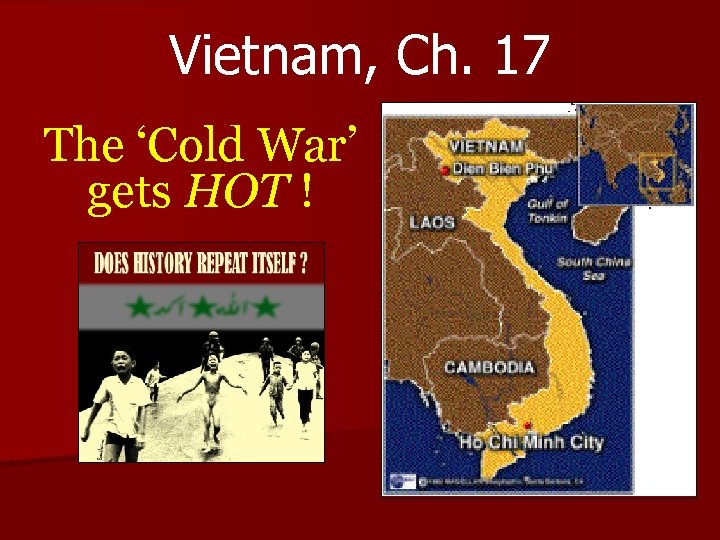 Vietnam, Ch. 17 The ‘Cold War’ gets HOT !
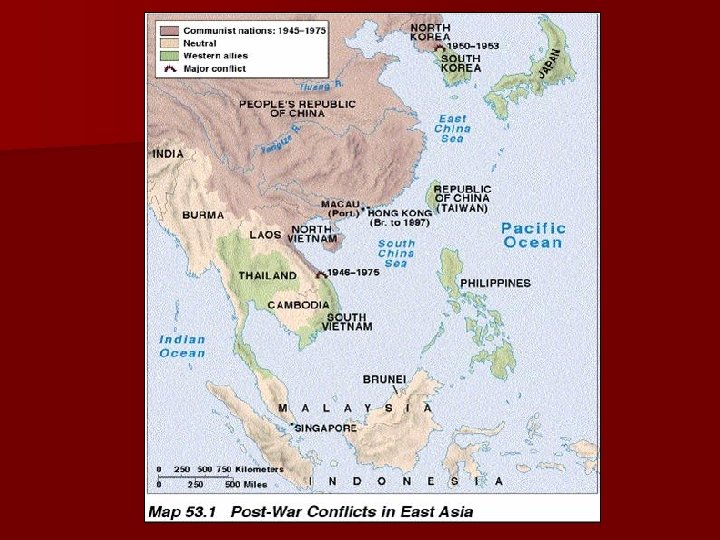
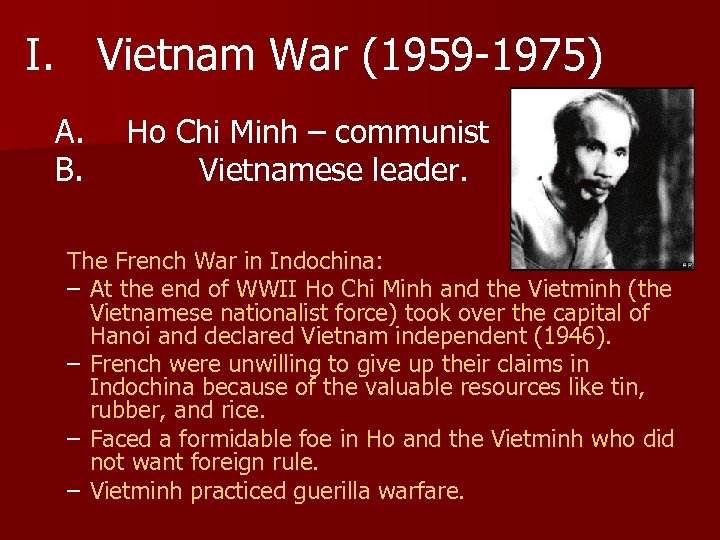 I. Vietnam War (1959 -1975) A. B. Ho Chi Minh – communist Vietnamese leader. The French War in Indochina: – At the end of WWII Ho Chi Minh and the Vietminh (the Vietnamese nationalist force) took over the capital of Hanoi and declared Vietnam independent (1946). – French were unwilling to give up their claims in Indochina because of the valuable resources like tin, rubber, and rice. – Faced a formidable foe in Ho and the Vietminh who did not want foreign rule. – Vietminh practiced guerilla warfare.
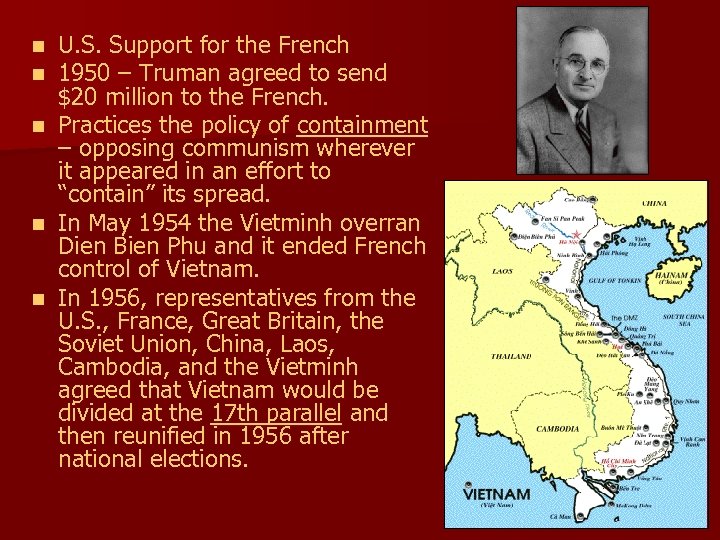 n n n U. S. Support for the French 1950 – Truman agreed to send $20 million to the French. Practices the policy of containment – opposing communism wherever it appeared in an effort to “contain” its spread. In May 1954 the Vietminh overran Dien Bien Phu and it ended French control of Vietnam. In 1956, representatives from the U. S. , France, Great Britain, the Soviet Union, China, Laos, Cambodia, and the Vietminh agreed that Vietnam would be divided at the 17 th parallel and then reunified in 1956 after national elections.
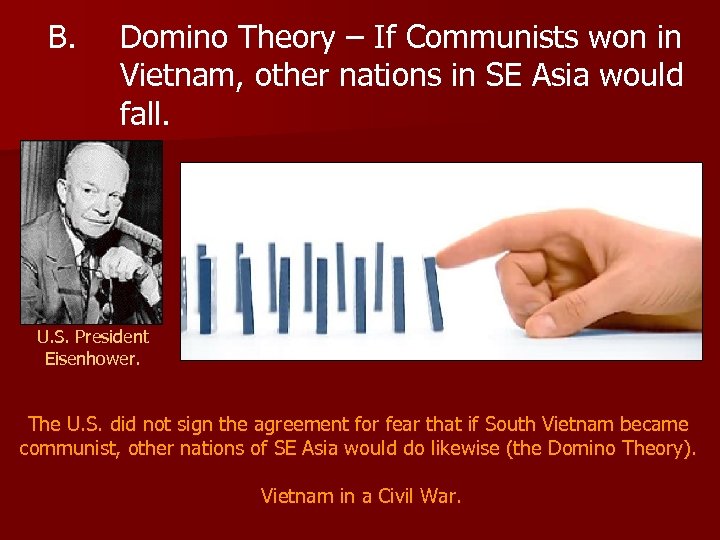 B. Domino Theory – If Communists won in Vietnam, other nations in SE Asia would fall. U. S. President Eisenhower. The U. S. did not sign the agreement for fear that if South Vietnam became communist, other nations of SE Asia would do likewise (the Domino Theory). Vietnam in a Civil War.
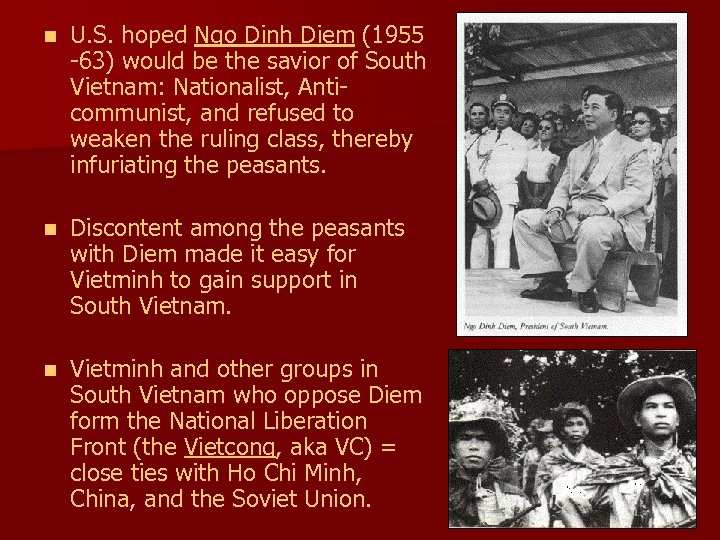 n U. S. hoped Ngo Dinh Diem (1955 -63) would be the savior of South Vietnam: Nationalist, Anticommunist, and refused to weaken the ruling class, thereby infuriating the peasants. n Discontent among the peasants with Diem made it easy for Vietminh to gain support in South Vietnam. n Vietminh and other groups in South Vietnam who oppose Diem form the National Liberation Front (the Vietcong, aka VC) = close ties with Ho Chi Minh, China, and the Soviet Union.
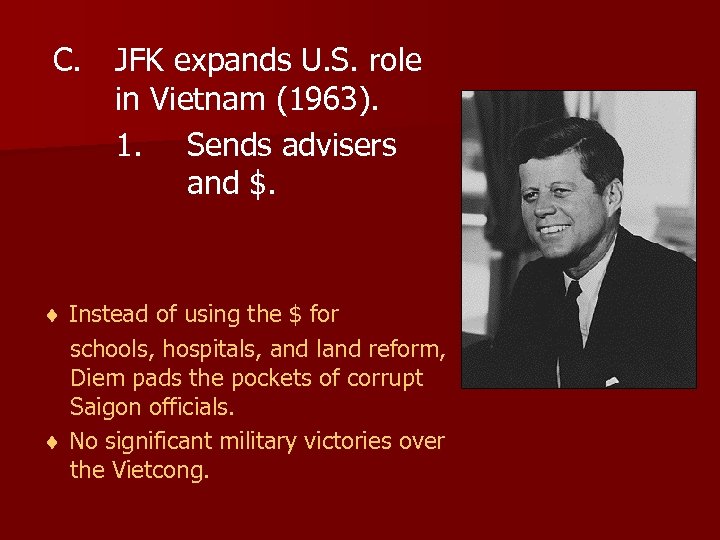 C. JFK expands U. S. role in Vietnam (1963). 1. Sends advisers and $. Instead of using the $ for schools, hospitals, and land reform, Diem pads the pockets of corrupt Saigon officials. No significant military victories over the Vietcong.
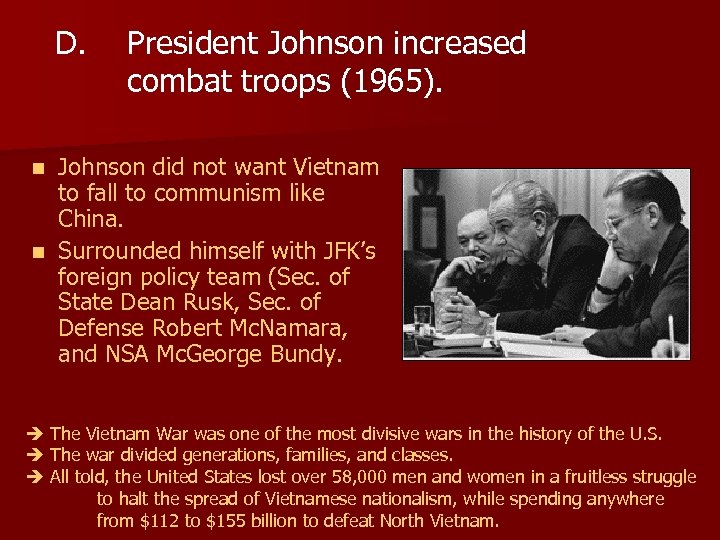 D. President Johnson increased combat troops (1965). Johnson did not want Vietnam to fall to communism like China. n Surrounded himself with JFK’s foreign policy team (Sec. of State Dean Rusk, Sec. of Defense Robert Mc. Namara, and NSA Mc. George Bundy. n The Vietnam War was one of the most divisive wars in the history of the U. S. The war divided generations, families, and classes. All told, the United States lost over 58, 000 men and women in a fruitless struggle to halt the spread of Vietnamese nationalism, while spending anywhere from $112 to $155 billion to defeat North Vietnam.
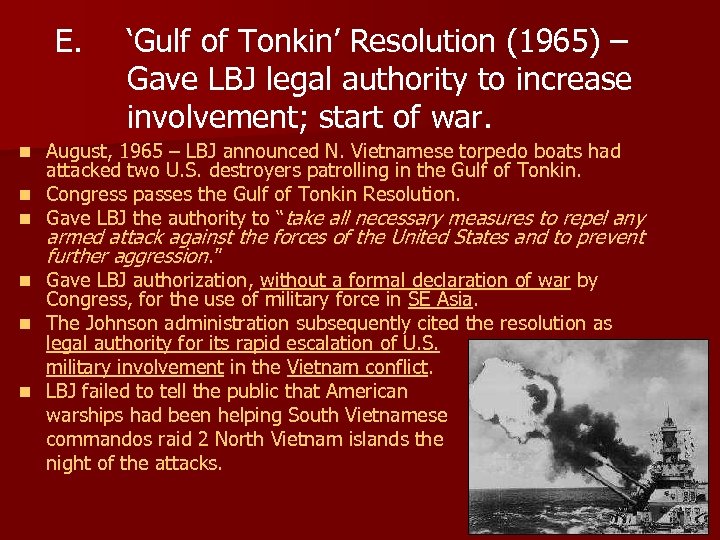 E. ‘Gulf of Tonkin’ Resolution (1965) – Gave LBJ legal authority to increase involvement; start of war. August, 1965 – LBJ announced N. Vietnamese torpedo boats had attacked two U. S. destroyers patrolling in the Gulf of Tonkin. n Congress passes the Gulf of Tonkin Resolution. n Gave LBJ the authority to “take all necessary measures to repel any n armed attack against the forces of the United States and to prevent further aggression. ” Gave LBJ authorization, without a formal declaration of war by Congress, for the use of military force in SE Asia. n The Johnson administration subsequently cited the resolution as legal authority for its rapid escalation of U. S. military involvement in the Vietnam conflict. n LBJ failed to tell the public that American warships had been helping South Vietnamese commandos raid 2 North Vietnam islands the night of the attacks. n
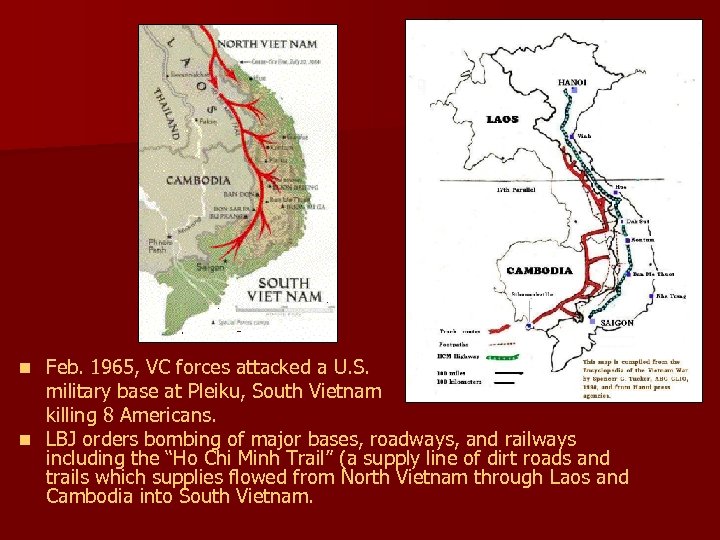 Feb. 1965, VC forces attacked a U. S. military base at Pleiku, South Vietnam killing 8 Americans. n LBJ orders bombing of major bases, roadways, and railways including the “Ho Chi Minh Trail” (a supply line of dirt roads and trails which supplies flowed from North Vietnam through Laos and Cambodia into South Vietnam. n
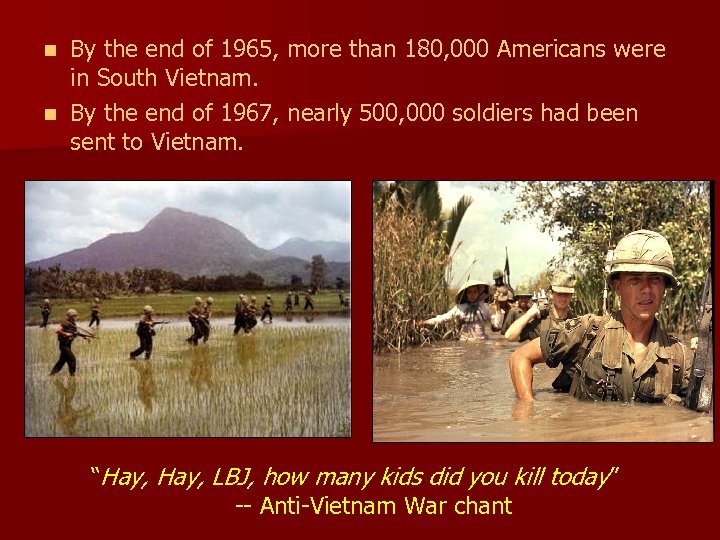 By the end of 1965, more than 180, 000 Americans were in South Vietnam. n By the end of 1967, nearly 500, 000 soldiers had been sent to Vietnam. n “Hay, LBJ, how many kids did you kill today” -- Anti-Vietnam War chant
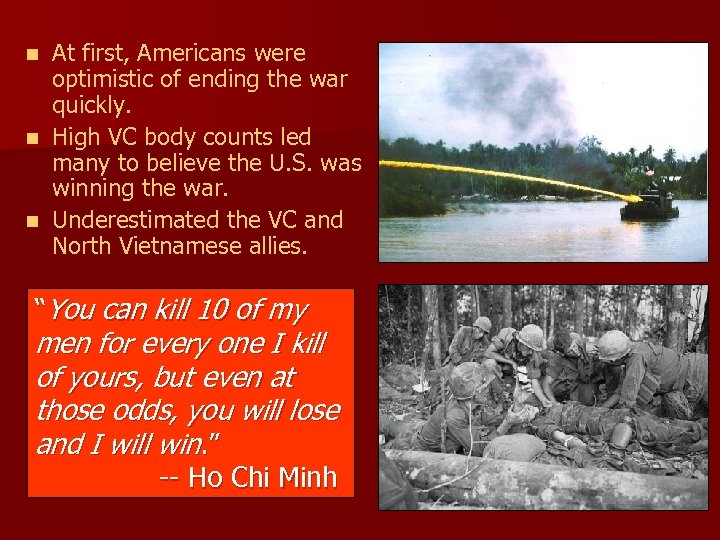 At first, Americans were optimistic of ending the war quickly. n High VC body counts led many to believe the U. S. was winning the war. n Underestimated the VC and North Vietnamese allies. n “You can kill 10 of my men for every one I kill of yours, but even at those odds, you will lose and I will win. ” -- Ho Chi Minh
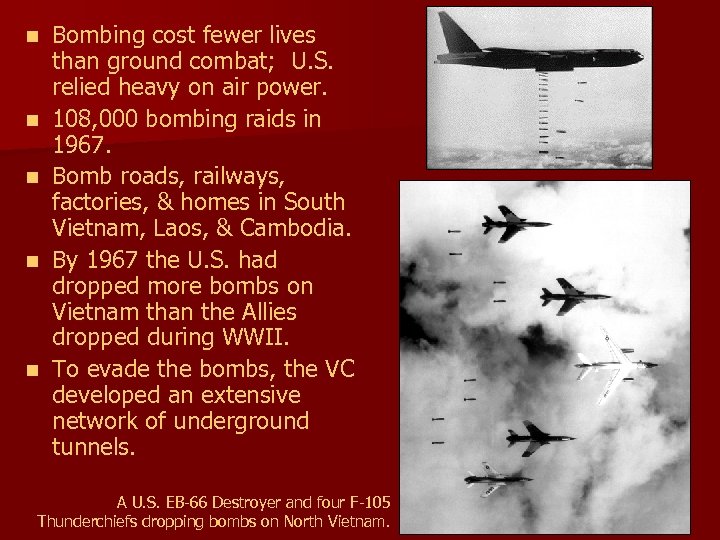 n n n Bombing cost fewer lives than ground combat; U. S. relied heavy on air power. 108, 000 bombing raids in 1967. Bomb roads, railways, factories, & homes in South Vietnam, Laos, & Cambodia. By 1967 the U. S. had dropped more bombs on Vietnam than the Allies dropped during WWII. To evade the bombs, the VC developed an extensive network of underground tunnels. A U. S. EB-66 Destroyer and four F-105 Thunderchiefs dropping bombs on North Vietnam.
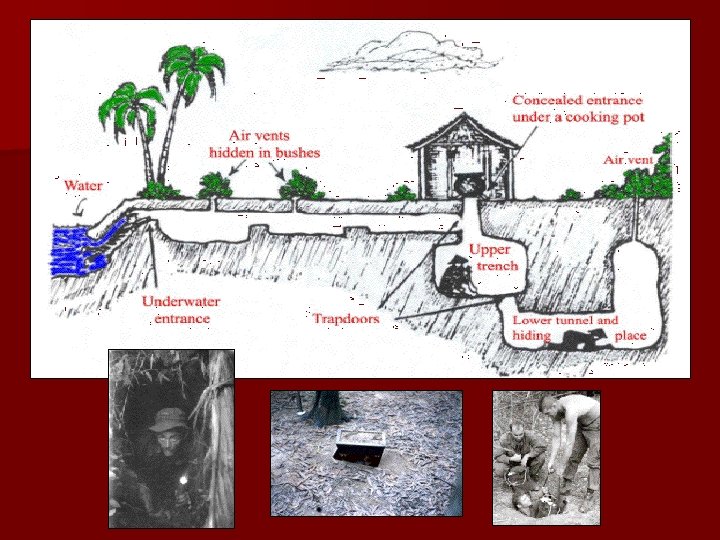
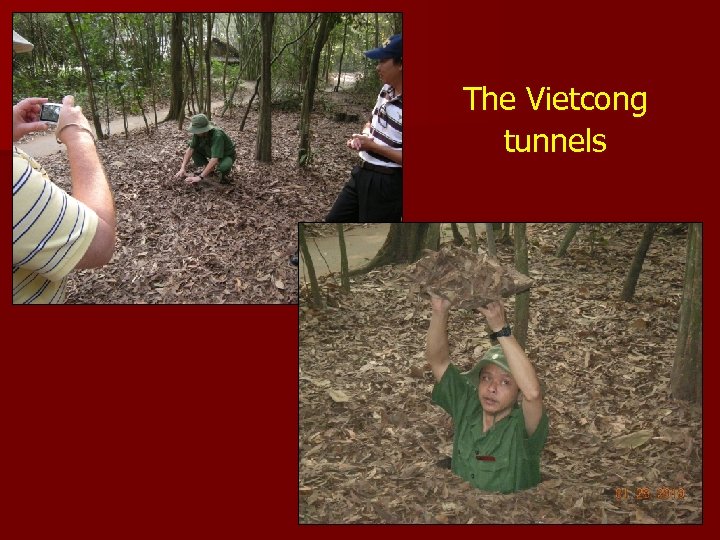 The Vietcong tunnels
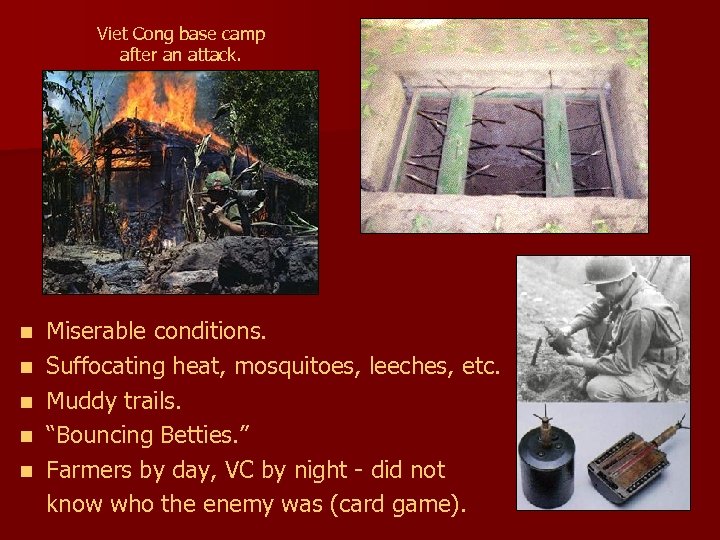 Viet Cong base camp after an attack. n n n Miserable conditions. Suffocating heat, mosquitoes, leeches, etc. Muddy trails. “Bouncing Betties. ” Farmers by day, VC by night - did not know who the enemy was (card game).
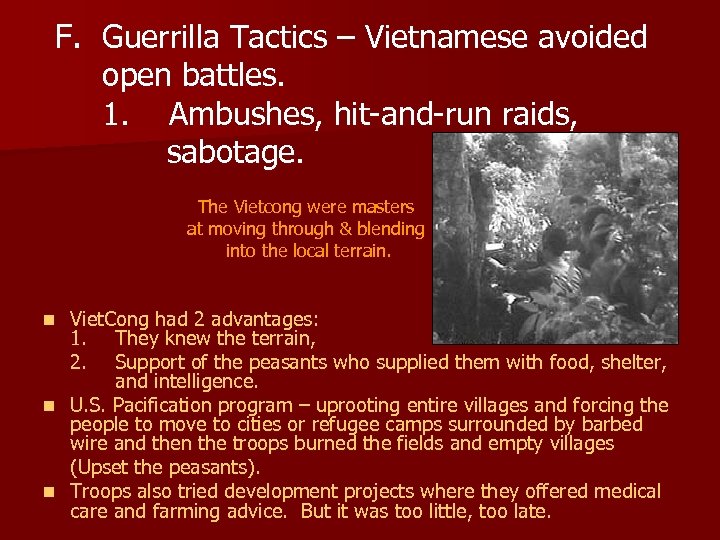 F. Guerrilla Tactics – Vietnamese avoided open battles. 1. Ambushes, hit-and-run raids, sabotage. The Vietcong were masters at moving through & blending into the local terrain. Viet. Cong had 2 advantages: 1. They knew the terrain, 2. Support of the peasants who supplied them with food, shelter, and intelligence. n U. S. Pacification program – uprooting entire villages and forcing the people to move to cities or refugee camps surrounded by barbed wire and then the troops burned the fields and empty villages (Upset the peasants). n Troops also tried development projects where they offered medical care and farming advice. But it was too little, too late. n
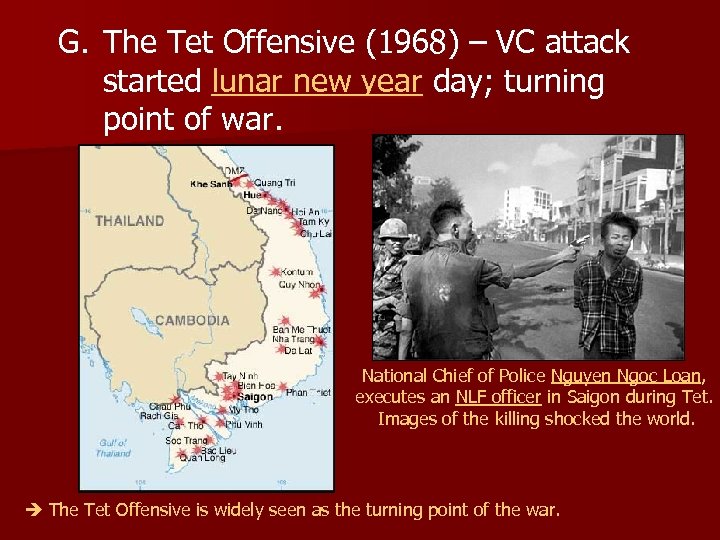 G. The Tet Offensive (1968) – VC attack started lunar new year day; turning point of war. National Chief of Police Nguyen Ngoc Loan, executes an NLF officer in Saigon during Tet. Images of the killing shocked the world. The Tet Offensive is widely seen as the turning point of the war.
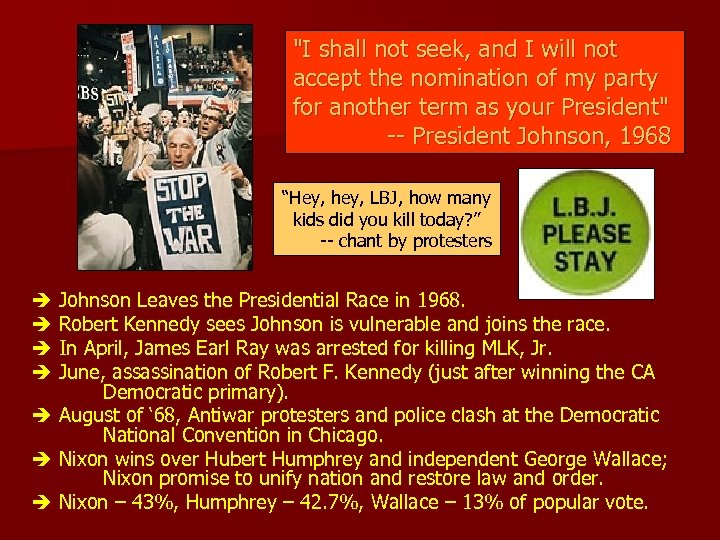 "I shall not seek, and I will not accept the nomination of my party for another term as your President" -- President Johnson, 1968 “Hey, hey, LBJ, how many kids did you kill today? ” -- chant by protesters Johnson Leaves the Presidential Race in 1968. Robert Kennedy sees Johnson is vulnerable and joins the race. In April, James Earl Ray was arrested for killing MLK, Jr. June, assassination of Robert F. Kennedy (just after winning the CA Democratic primary). August of ‘ 68, Antiwar protesters and police clash at the Democratic National Convention in Chicago. Nixon wins over Hubert Humphrey and independent George Wallace; Nixon promise to unify nation and restore law and order. Nixon – 43%, Humphrey – 42. 7%, Wallace – 13% of popular vote.
 ‘Masters of War’ by Bob Dylan (1963) Come you masters of war You that build all the guns You that build the death planes You that build the big bombs You that hide behind walls You that hide behind desks I just want you to know I can see through your masks You that never done nothin' But build to destroy You play with my world Like it's your little toy You put a gun in my hand And you hide from my eyes And you turn and run farther When the fast bullets fly Like Judas of old You lie and deceive A world war can be won You want me to believe But I see through your eyes And I see through your brain Like I see through the water That runs down my drain You fasten the triggers For the others to fire Then you set back and watch When the death count gets higher You hide in your mansion As young people's blood Flows out of their bodies And is buried in the mud You've thrown the worst fear That can ever be hurled Fear to bring children Into the world For threatening my baby Unborn and unnamed You ain't worth the blood That runs in your veins How much do I know To talk out of turn You might say that I'm young You might say I'm unlearned But there's one thing I know Though I'm younger than you Even Jesus would never Forgive what you do Let me ask you one question Is your money that good Will it buy you forgiveness Do you think that it could I think you will find When your death takes its toll All the money you made Will never buy back your soul And I hope that you die And your death'll come soon I will follow your casket In the pale afternoon And I'll watch while you're lowered Down to your deathbed And I'll stand o'er your grave 'Til I'm sure that you're dead
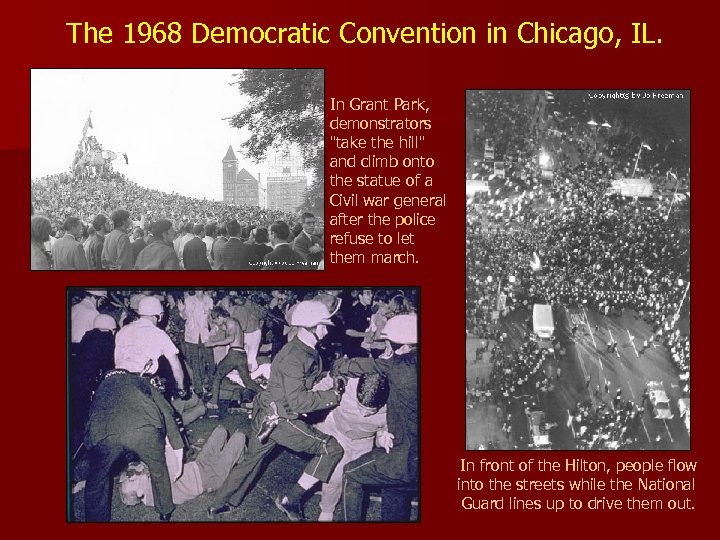 The 1968 Democratic Convention in Chicago, IL. In Grant Park, demonstrators "take the hill" and climb onto the statue of a Civil war general after the police refuse to let them march. In front of the Hilton, people flow into the streets while the National Guard lines up to drive them out.
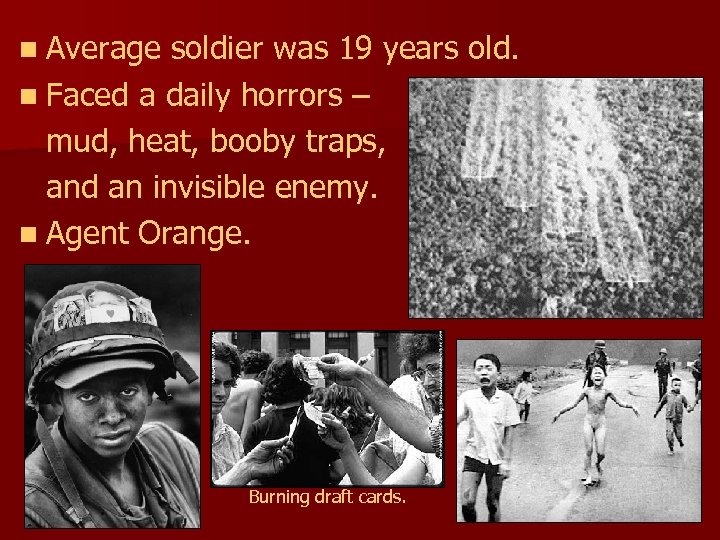 n Average soldier was 19 years old. n Faced a daily horrors – mud, heat, booby traps, and an invisible enemy. n Agent Orange. Burning draft cards.
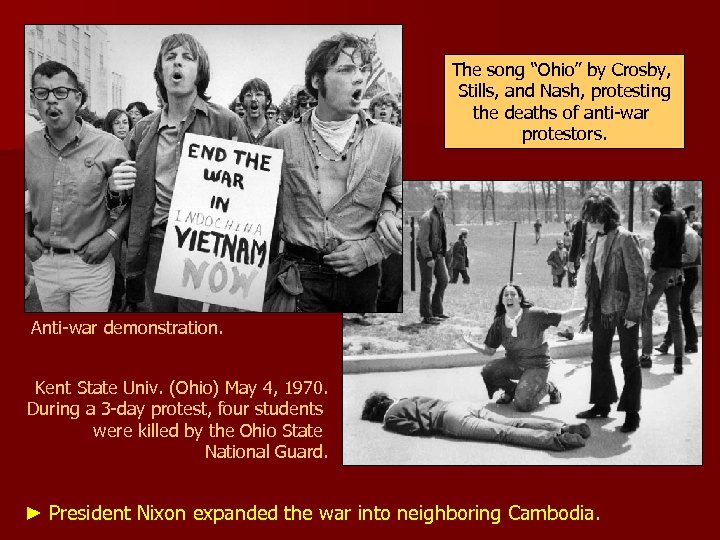 The song “Ohio” by Crosby, Stills, and Nash, protesting the deaths of anti-war protestors. Anti-war demonstration. Kent State Univ. (Ohio) May 4, 1970. During a 3 -day protest, four students were killed by the Ohio State National Guard. ► President Nixon expanded the war into neighboring Cambodia.
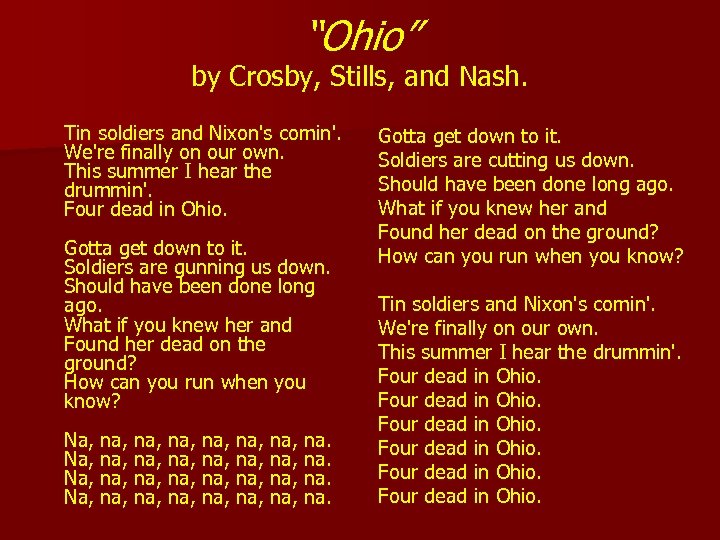 “Ohio” by Crosby, Stills, and Nash. Tin soldiers and Nixon's comin'. We're finally on our own. This summer I hear the drummin'. Four dead in Ohio. Gotta get down to it. Soldiers are gunning us down. Should have been done long ago. What if you knew her and Found her dead on the ground? How can you run when you know? Na, na, na, na, na. Gotta get down to it. Soldiers are cutting us down. Should have been done long ago. What if you knew her and Found her dead on the ground? How can you run when you know? Tin soldiers and Nixon's comin'. We're finally on our own. This summer I hear the drummin'. Four dead in Ohio.
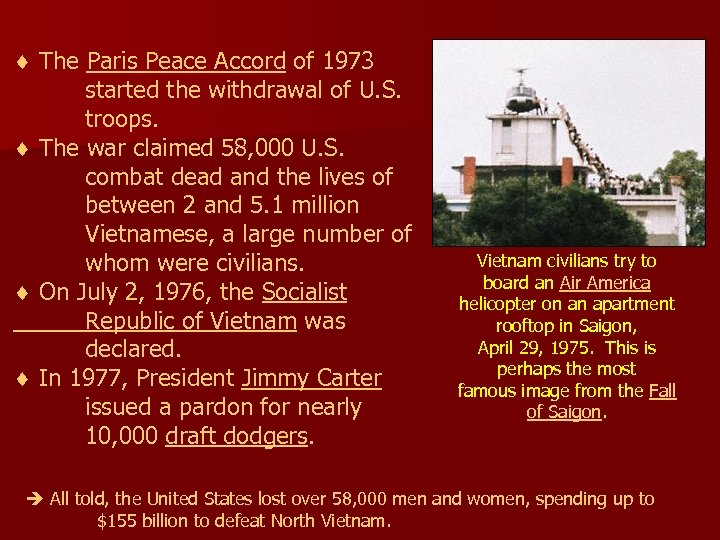 The Paris Peace Accord of 1973 started the withdrawal of U. S. troops. The war claimed 58, 000 U. S. combat dead and the lives of between 2 and 5. 1 million Vietnamese, a large number of whom were civilians. On July 2, 1976, the Socialist Republic of Vietnam was declared. In 1977, President Jimmy Carter issued a pardon for nearly 10, 000 draft dodgers. Vietnam civilians try to board an Air America helicopter on an apartment rooftop in Saigon, April 29, 1975. This is perhaps the most famous image from the Fall of Saigon. All told, the United States lost over 58, 000 men and women, spending up to $155 billion to defeat North Vietnam.
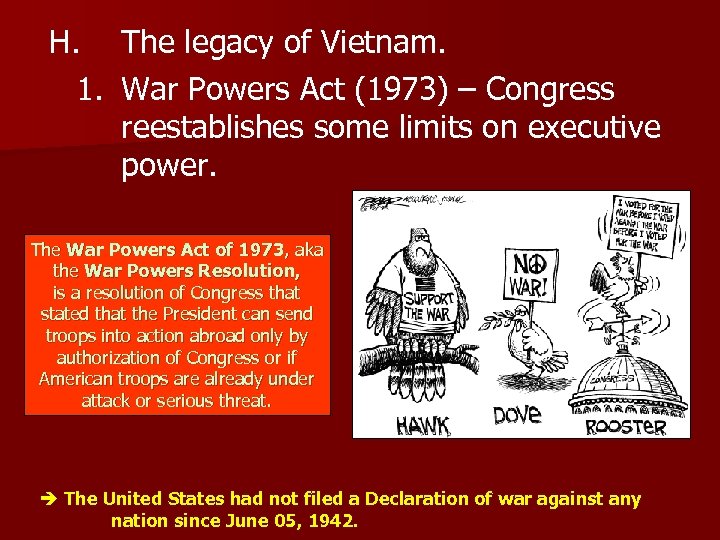 H. The legacy of Vietnam. 1. War Powers Act (1973) – Congress reestablishes some limits on executive power. The War Powers Act of 1973, aka the War Powers Resolution, is a resolution of Congress that stated that the President can send troops into action abroad only by authorization of Congress or if American troops are already under attack or serious threat. The United States had not filed a Declaration of war against any nation since June 05, 1942.
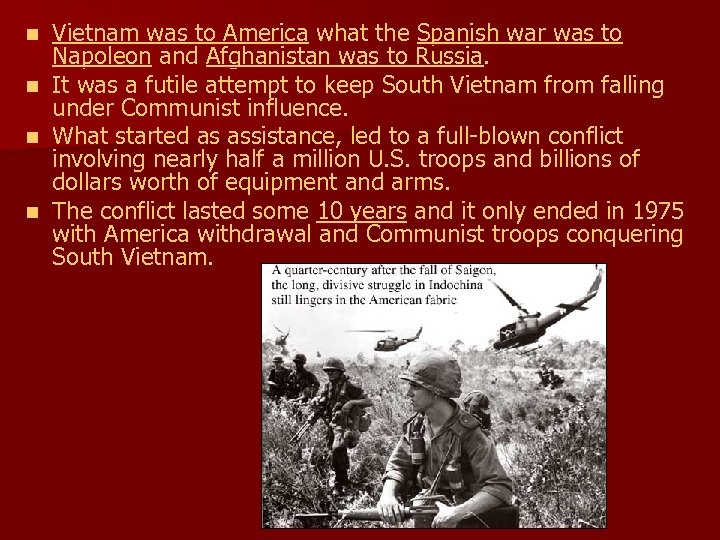 n n Vietnam was to America what the Spanish war was to Napoleon and Afghanistan was to Russia. It was a futile attempt to keep South Vietnam from falling under Communist influence. What started as assistance, led to a full-blown conflict involving nearly half a million U. S. troops and billions of dollars worth of equipment and arms. The conflict lasted some 10 years and it only ended in 1975 with America withdrawal and Communist troops conquering South Vietnam.