 Скачать презентацию Videoconferencing standards update and industry trends Roberto Flaiani
3fc46693bb3e4bd4d0f18505b34e0e1f.ppt
- Количество слайдов: 24



Videoconferencing: standards update and industry trends Roberto Flaiani AETHRA June 3 rd, 2004
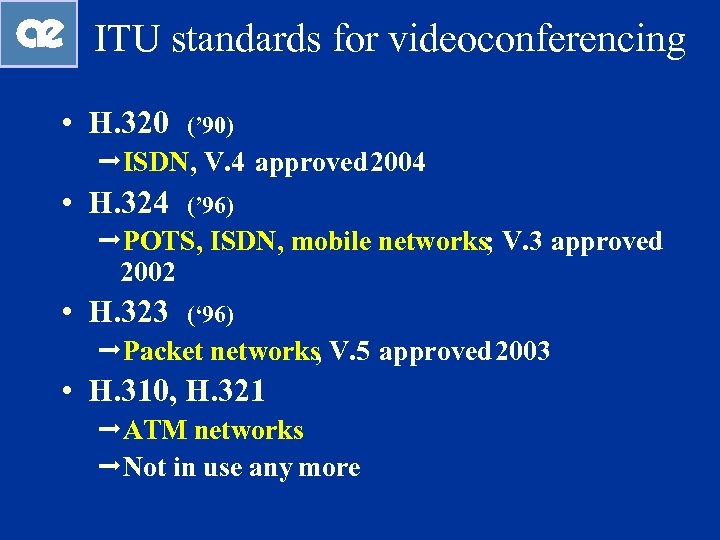
ITU standards for videoconferencing • H. 320 (’ 90) ªISDN, V. 4 approved 2004 • H. 324 (’ 96) ªPOTS, ISDN, mobile networks; V. 3 approved 2002 • H. 323 (‘ 96) ªPacket networks , V. 5 approved 2003 • H. 310, H. 321 ªATM networks ªNot in use any more
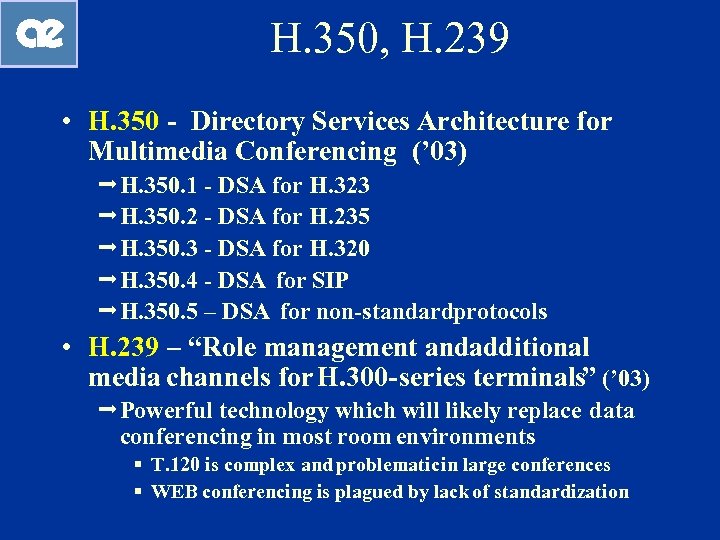
H. 350, H. 239 • H. 350 - Directory Services Architecture for Multimedia Conferencing (’ 03) ªH. 350. 1 - DSA for H. 323 ªH. 350. 2 - DSA for H. 235 ªH. 350. 3 - DSA for H. 320 ªH. 350. 4 - DSA for SIP ªH. 350. 5 – DSA for non-standard rotocols p • H. 239 – “Role management and dditional a media channels for H. 300 -series terminals” (’ 03) ªPowerful technology which will likely replace data conferencing in most room environments § T. 120 is complex and problematic in large conferences § WEB conferencing is plagued by lack of standardization
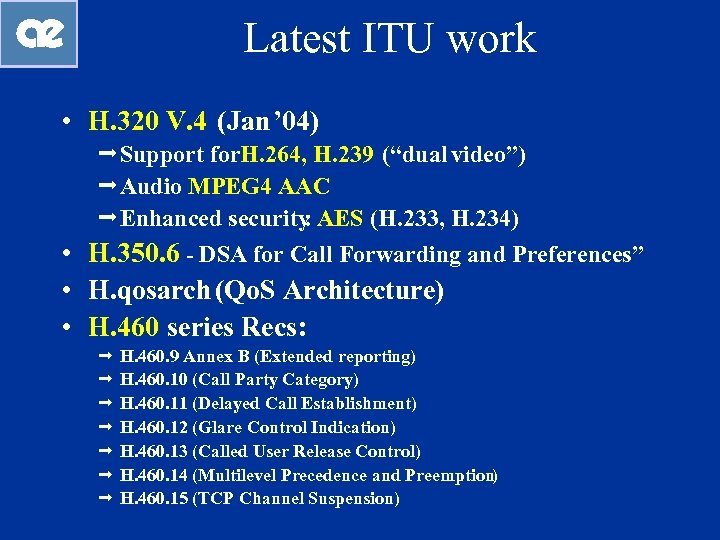
Latest ITU work • H. 320 V. 4 (Jan ’ 04) ªSupport for H. 264, H. 239 (“dual video”) ªAudio MPEG 4 AAC ªEnhanced security : AES (H. 233, H. 234) • H. 350. 6 - DSA for Call Forwarding and Preferences” • H. qosarch (Qo. S Architecture) • H. 460 series Recs: ª ª ª ª H. 460. 9 Annex B (Extended reporting) H. 460. 10 (Call Party Category) H. 460. 11 (Delayed Call Establishment) H. 460. 12 (Glare Control Indication) H. 460. 13 (Called User Release Control) H. 460. 14 (Multilevel Precedence and Preemption) H. 460. 15 (TCP Channel Suspension)
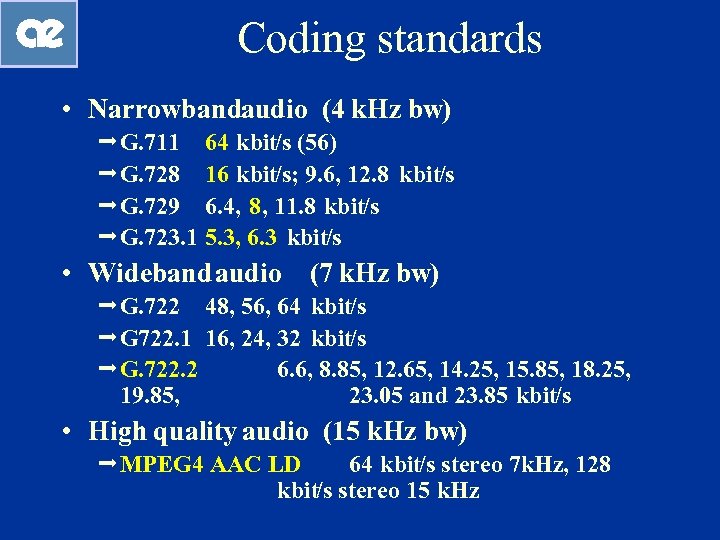
Coding standards • Narrowband udio (4 k. Hz bw) a ªG. 711 64 kbit/s (56) ªG. 728 16 kbit/s; 9. 6, 12. 8 kbit/s ªG. 729 6. 4, 8, 11. 8 kbit/s ªG. 723. 1 5. 3, 6. 3 kbit/s • Wideband audio (7 k. Hz bw) ªG. 722 48, 56, 64 kbit/s ªG 722. 1 16, 24, 32 kbit/s ªG. 722. 2 6. 6, 8. 85, 12. 65, 14. 25, 15. 85, 18. 25, 19. 85, 23. 05 and 23. 85 kbit/s • High quality audio (15 k. Hz bw) ªMPEG 4 AAC LD 64 kbit/s stereo 7 k. Hz, 128 kbit/s stereo 15 k. Hz
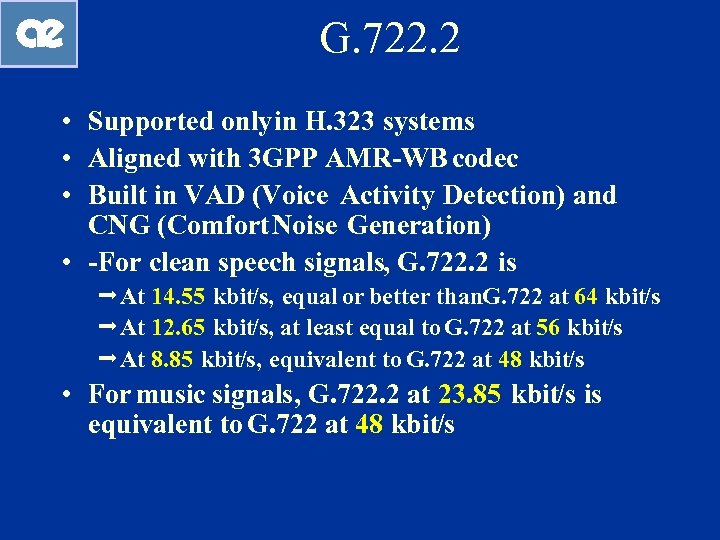
G. 722. 2 • Supported only in H. 323 systems • Aligned with 3 GPP AMR-WB codec • Built in VAD (Voice Activity Detection) and CNG (Comfort Noise Generation) • -For clean speech signals, G. 722. 2 is ªAt 14. 55 kbit/s, equal or better than . 722 at 64 kbit/s G ªAt 12. 65 kbit/s, at least equal to G. 722 at 56 kbit/s ªAt 8. 85 kbit/s, equivalent to G. 722 at 48 kbit/s • For music signals, G. 722. 2 at 23. 85 kbit/s is equivalent to G. 722 at 48 kbit/s
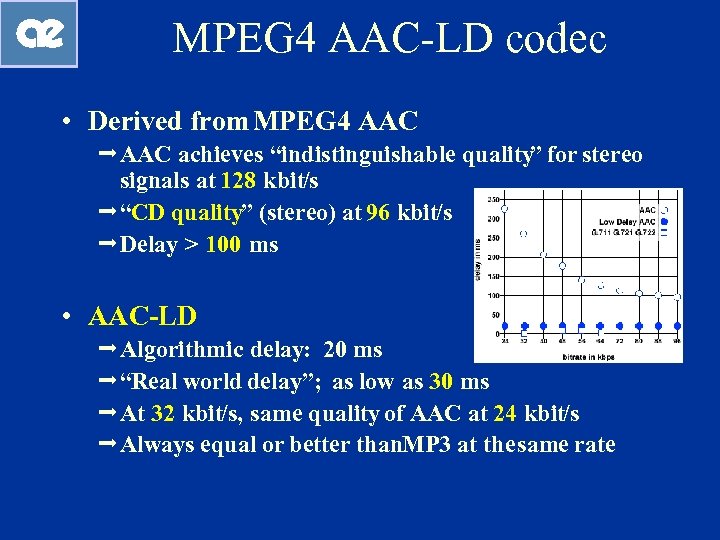
MPEG 4 AAC-LD codec • Derived from MPEG 4 AAC ªAAC achieves “indistinguishable quality” for stereo signals at 128 kbit/s ª“CD quality” (stereo) at 96 kbit/s ªDelay > 100 ms • AAC-LD ªAlgorithmic delay: 20 ms ª“Real world delay”; as low as 30 ms ªAt 32 kbit/s, same quality of AAC at 24 kbit/s ªAlways equal or better than P 3 at the same rate M
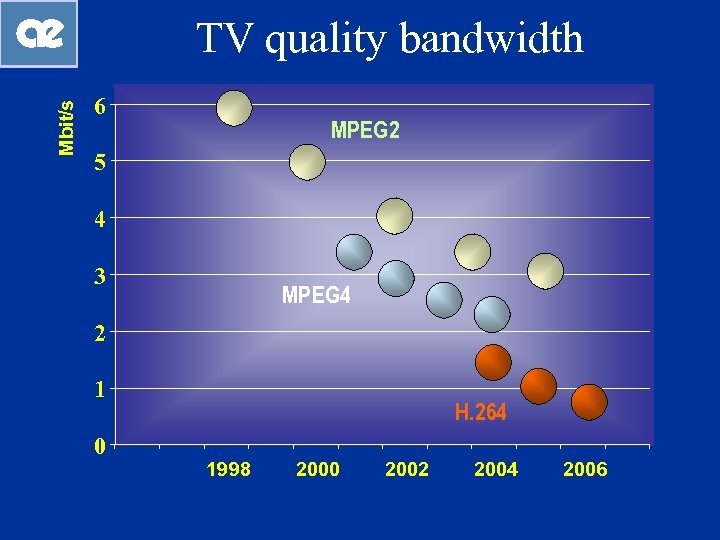
Mbit/s TV quality bandwidth 6 MPEG 2 5 4 3 MPEG 4 2 1 0 H. 264 1998 2000 2002 2004 2006
![Quality Y PSNR [d. B] Codec comparison H. 264 MPEG-2 H. 263 Tempete CIF](https://present5.com/presentation/3fc46693bb3e4bd4d0f18505b34e0e1f/image-9.jpg "Quality Y PSNR [d. B] Codec comparison H. 264 MPEG-2 H. 263 Tempete CIF")
Quality Y PSNR [d. B] Codec comparison H. 264 MPEG-2 H. 263 Tempete CIF 30 Hz 38 37 36 35 34 33 32 31 30 29 28 27 26 25 0 500 1000 1500 2000 2500 Bit-rate (kbit/s) 3000 3500
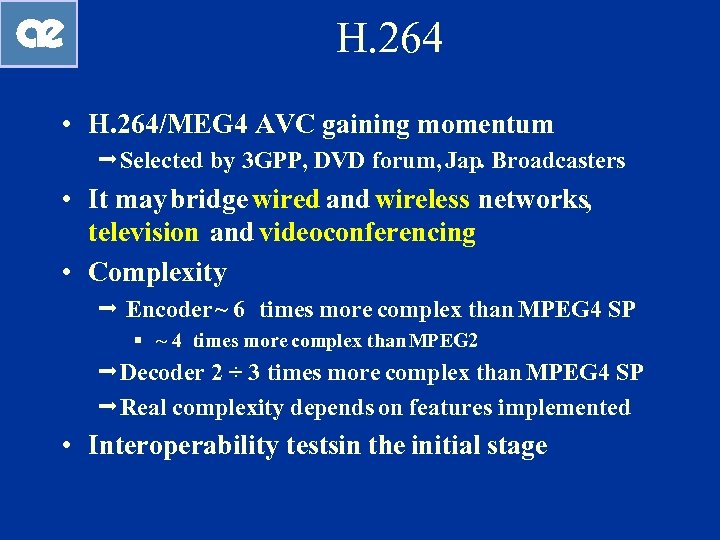
H. 264 • H. 264/MEG 4 AVC gaining momentum ªSelected by 3 GPP, DVD forum, Jap. Broadcasters • It may bridge wired and wireless networks, television and videoconferencing • Complexity ª Encoder ~ 6 times more complex than MPEG 4 SP § ~ 4 times more complex than MPEG 2 ªDecoder 2 ÷ 3 times more complex than MPEG 4 SP ªReal complexity depends on features implemented • Interoperability testsin the initial stage
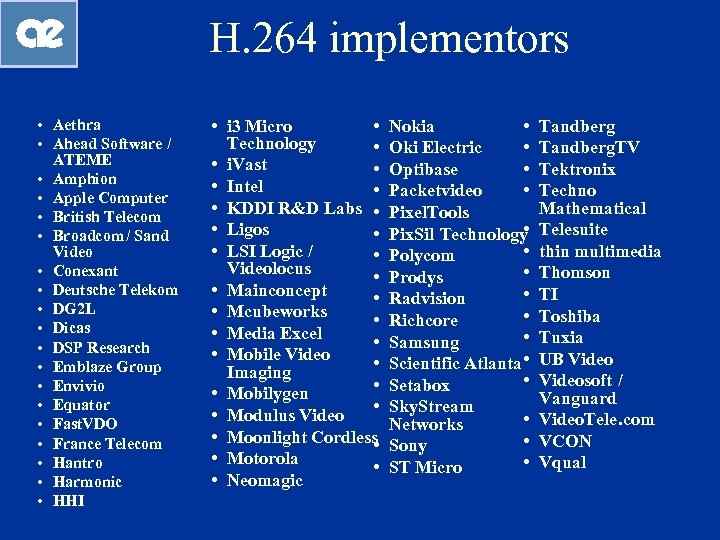
H. 264 implementors • Aethra • Ahead Software / ATEME • Amphion • Apple Computer • British Telecom • Broadcom / Sand Video • Conexant • Deutsche Telekom • DG 2 L • Dicas • DSP Research • Emblaze Group • Envivio • Equator • Fast. VDO • France Telecom • Hantro • Harmonic • HHI • i 3 Micro • Technology • • i. Vast • • Intel • • KDDI R&D Labs • • Ligos • • LSI Logic / • Videolocus • • Mainconcept • • Mcubeworks • • Media Excel • • Mobile Video • Imaging • • Mobilygen • • Modulus Video • Moonlight Cordless • • Motorola • • Neomagic Nokia • Oki Electric • Optibase • Packetvideo • Pixel. Tools • Pix. Sil Technology • Polycom • Prodys • Radvision • Richcore • Samsung Scientific Atlanta • • Setabox Sky. Stream • Networks • Sony • ST Micro Tandberg. TV Tektronix Techno Mathematical Telesuite thin multimedia Thomson TI Toshiba Tuxia UB Videosoft / Vanguard Video. Tele. com VCON Vqual
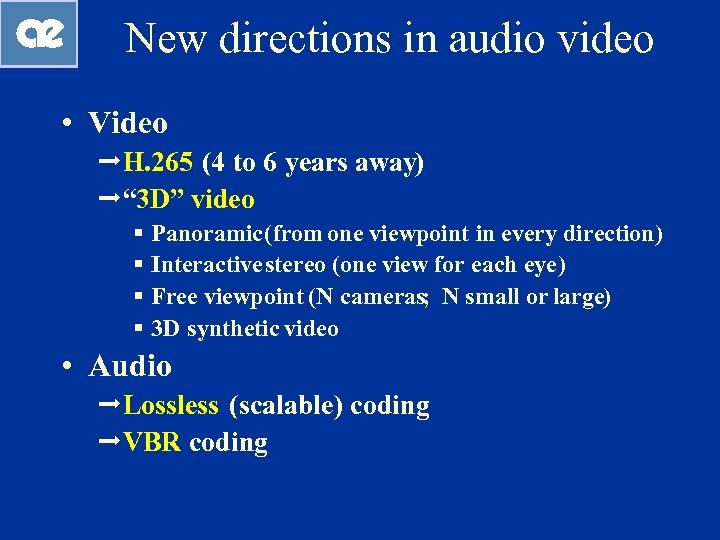
New directions in audio video • Video ªH. 265 (4 to 6 years away) ª“ 3 D” video § Panoramic (from one viewpoint in every direction) § Interactive stereo (one view for each eye) § Free viewpoint (N cameras; N small or large) § 3 D synthetic video • Audio ªLossless (scalable) coding ªVBR coding
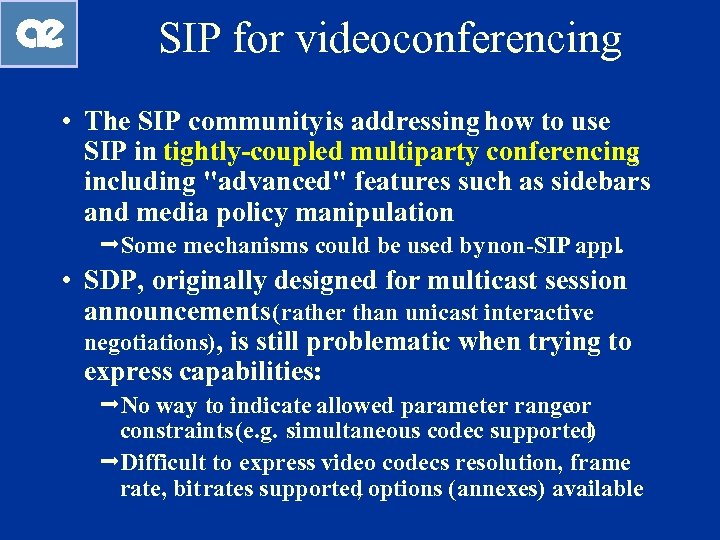
SIP for videoconferencing • The SIP community is addressing how to use SIP in tightly-coupled multiparty conferencing , including "advanced" features such as sidebars and media policy manipulation ªSome mechanisms could be used by non-SIP appl. • SDP, originally designed for multicast session announcements (rather than unicast interactive negotiations), is still problematic when trying to express capabilities: ªNo way to indicate allowed parameter rangeor constraints (e. g. simultaneous codec supported ) ªDifficult to express video codecs resolution, frame rate, bit rates supported , options (annexes) available
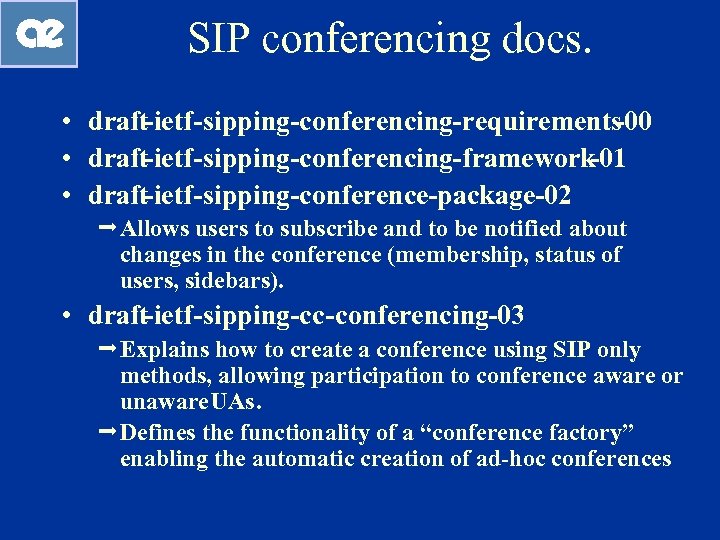
SIP conferencing docs. • draft-ietf-sipping-conferencing-requirements -00 • draft-ietf-sipping-conferencing-framework -01 • draft-ietf-sipping-conference-package-02 ªAllows users to subscribe and to be notified about changes in the conference (membership, status of users, sidebars). • draft-ietf-sipping-cc-conferencing-03 ªExplains how to create a conference using SIP only methods, allowing participation to conference aware or unaware UAs. ªDefines the functionality of a “conference factory” enabling the automatic creation of ad-hoc conferences
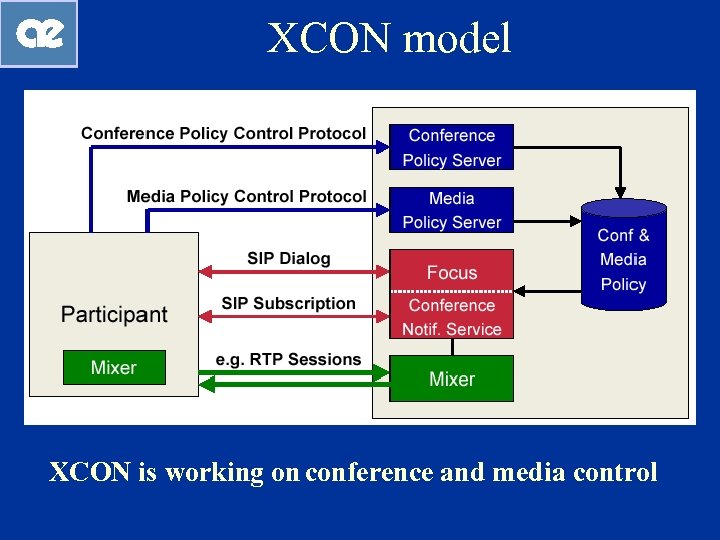
XCON model XCON is working on conference and media control
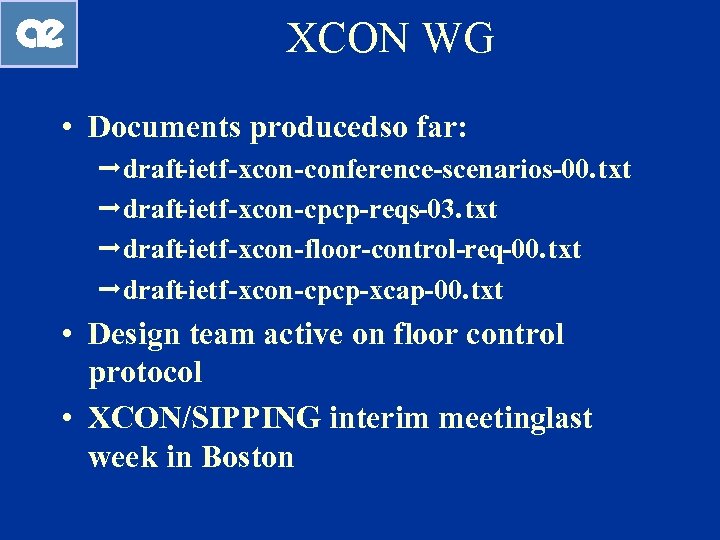
XCON WG • Documents produced so far: ªdraft-ietf-xcon-conference-scenarios-00. txt ªdraft-ietf-xcon-cpcp-reqs-03. txt ªdraft-ietf-xcon-floor-control-req-00. txt ªdraft-ietf-xcon-cpcp-xcap-00. txt • Design team active on floor control protocol • XCON/SIPPING interim meeting ast l week in Boston
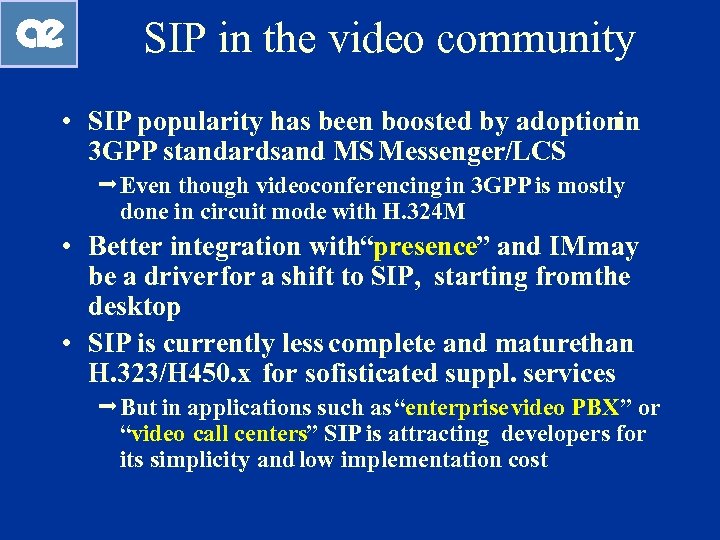
SIP in the video community • SIP popularity has been boosted by adoption in 3 GPP standards nd MS Messenger/LCS a ªEven though videoconferencing in 3 GPP is mostly done in circuit mode with H. 324 M • Better integration with presence” and IM ay “ m be a driver for a shift to SIP, starting from he t desktop • SIP is currently less complete and mature han t H. 323/H 450. x for sofisticated suppl. services ªBut in applications such as “enterprise video PBX” or “video call centers” SIP is attracting developers for its simplicity and low implementation cost
SIP in the video community • SIP has enjoyed limited acceptance so far in the video community, but this is going to change soon • Unfortunately, adoption of SIP in CPE and network equipment is not going to improve interoperability : ªSIP as a protocol is less mature han H. 323 t ªH. 323 is more precisely defined ªSIP-H. 323 gateways will add complexity
NAT – Firewall traversal • It is widely recognized as a big problem • It affects both signalling and media traversal • Various solutions have been proposed , each with its own drawbacks /limitations: ªApplication awareness in middleboxes: ALGs ªRelay servers: proxies, reflectors (STUN, TURN) ªMiddlebox configuration (MIDCOM, UPn. P…) ªMiddlebox traversal by unneling t
NAT – Firewall traversal • The IETF has tried to solve the problem ªMIDCOM failed to fulfill expectations § Only STUN promoted to RFC • Something new is being developed in NSIS (“Next Steps in Signalling”): ªIETF draft: “A NAT/Firewall NSIS Signaling Layer Protocol (NSLP)” ªDifficult to say if it will fly at this stage
Short term study items in ITU • Signalling traversal ªRAS over TCP § The assumption is that once a connection is established through the NAT then messages from the outgoing destination address can flow back § If RAS and H. 225. 0 share the same (persistent) connection, after registration an EP can be reached from outside • Media traversal ªSupport of ICE • ITU has opened a new Question (Q 4/16) to study NAT/firewall traversal related issues
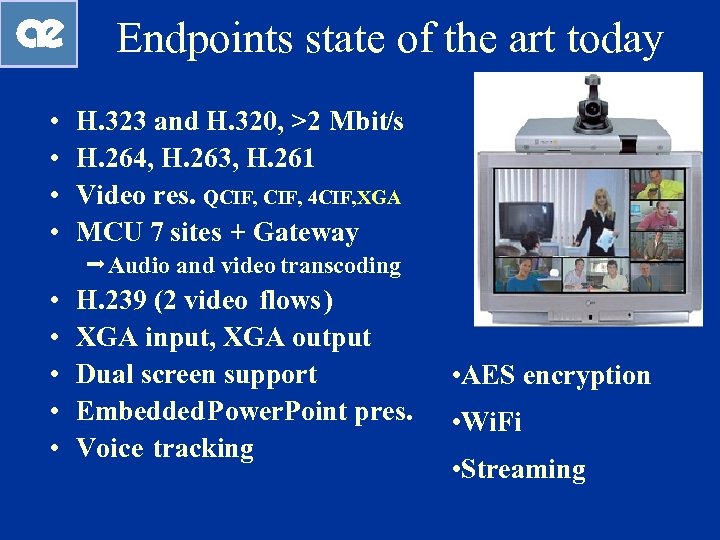
Endpoints state of the art today • • H. 323 and H. 320, >2 Mbit/s H. 264, H. 263, H. 261 Video res. QCIF, 4 CIF, XGA MCU 7 sites + Gateway ªAudio and video transcoding • • • H. 239 (2 video flows ) XGA input, XGA output Dual screen support Embedded Power. Point pres. Voice tracking • AES encryption • Wi. Fi • Streaming
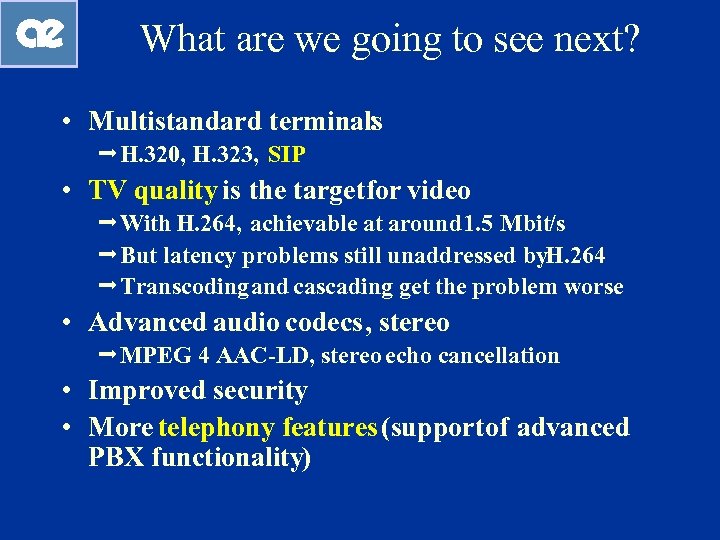
What are we going to see next? • Multistandard terminals : ªH. 320, H. 323, SIP • TV quality is the target or video f ªWith H. 264, achievable at around . 5 Mbit/s 1 ªBut latency problems still unaddressed by H. 264 ªTranscoding and cascading get the problem worse • Advanced audio codecs, stereo ªMPEG 4 AAC-LD, stereo echo cancellation • Improved security • More telephony features (support of advanced PBX functionality)
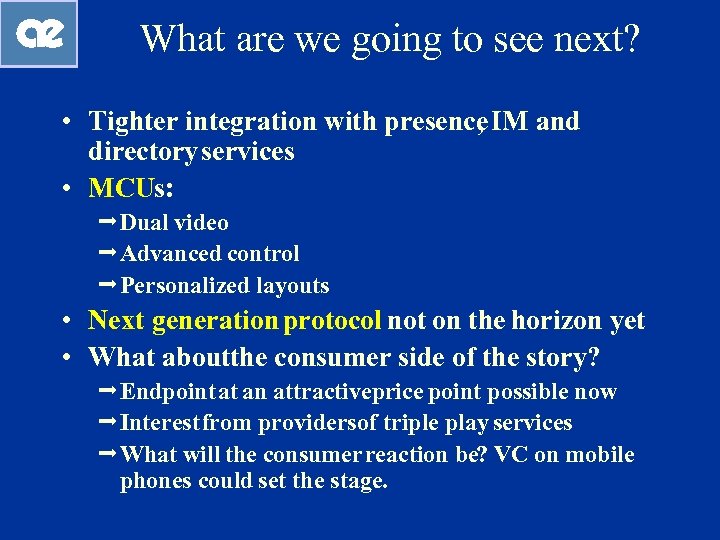
What are we going to see next? • Tighter integration with presence IM and , directory services • MCUs: ªDual video ªAdvanced control ªPersonalized layouts • Next generation protocol not on the horizon yet • What about he consumer side of the story? t ªEndpoint at an attractive rice point possible now p ªInterest from providers f triple play services o ªWhat will the consumer reaction be? VC on mobile phones could set the stage.
Скачать презентацию Videoconferencing standards update and industry trends Roberto Flaiani
3fc46693bb3e4bd4d0f18505b34e0e1f.ppt