Скачать презентацию Video Conferencing Fundamentals and Application Prof J
a65a1c404d6242f4c5363c456bd85821.ppt
- Количество слайдов: 43
 Video Conferencing : Fundamentals and Application Prof. J Mukhopadhyay Dept. of Computer Science and Engineering, IIT Kharagpur
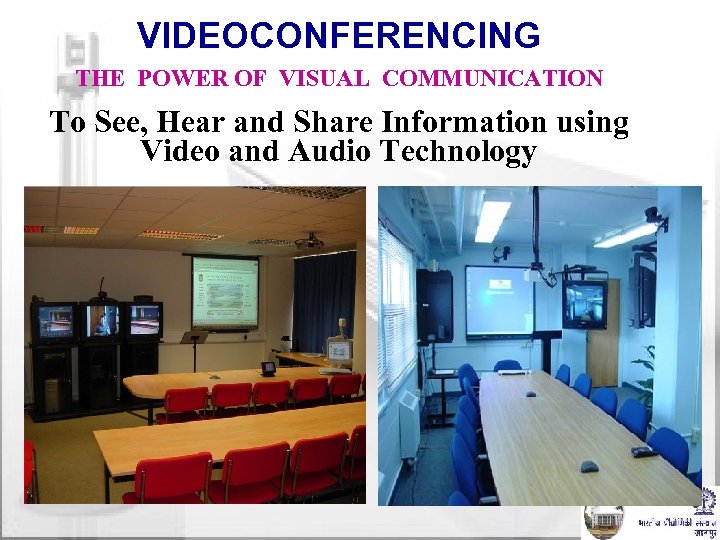 VIDEOCONFERENCING THE POWER OF VISUAL COMMUNICATION To See, Hear and Share Information using Video and Audio Technology
 Modes of Interactions • • • Email. Fax. Telephone. Online Chat. Video Conferencing. Face to face. In many situations, video conferencing is the next best thing to a face to face meeting.
 Why Video Conferencing? • Save money and time. • Build relationships. • Communicate “face to face” where it would otherwise be impossible. • Avoid travels. • Teach. • Collaborate.
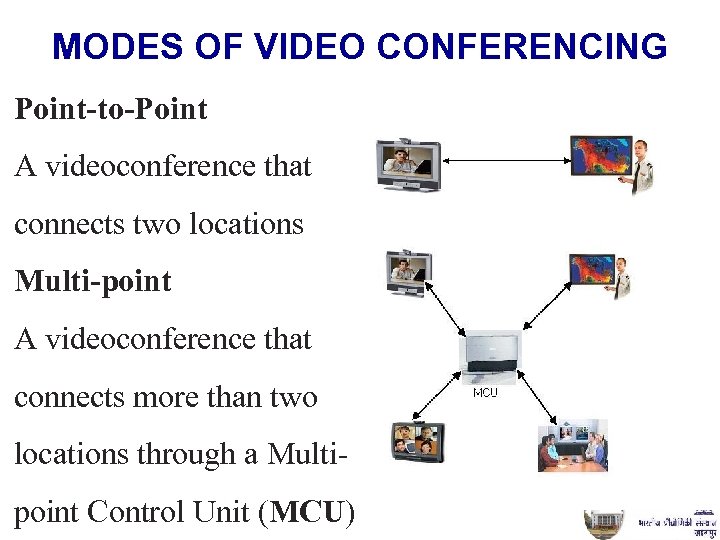 MODES OF VIDEO CONFERENCING Point-to-Point A videoconference that connects two locations Multi-point A videoconference that connects more than two locations through a Multipoint Control Unit (MCU)
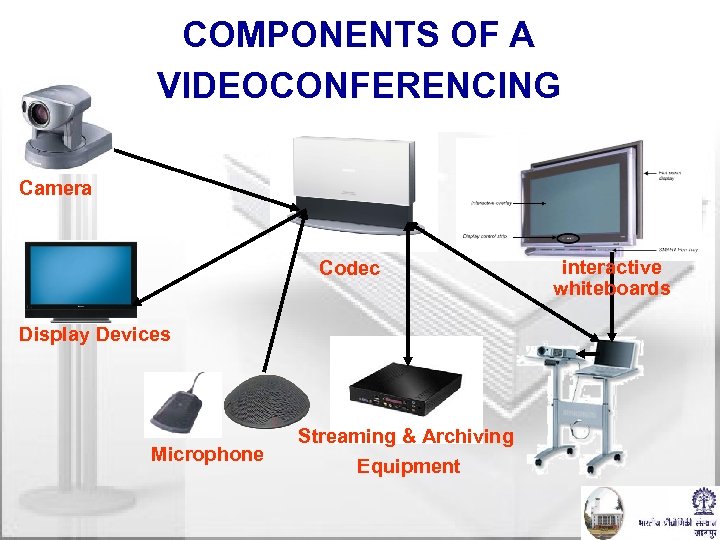 COMPONENTS OF A VIDEOCONFERENCING Camera Codec Display Devices Microphone Streaming & Archiving Equipment interactive whiteboards
 Technologies Involved • Video and Audio signal acquisition. • Data Communication. • Display and reproduction of transmitted signal.
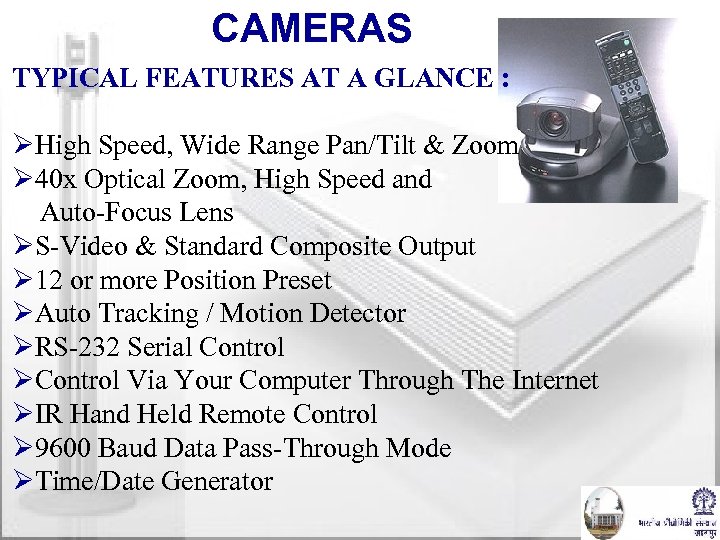 CAMERAS TYPICAL FEATURES AT A GLANCE : ØHigh Speed, Wide Range Pan/Tilt & Zoom Ø 40 x Optical Zoom, High Speed and Auto-Focus Lens ØS-Video & Standard Composite Output Ø 12 or more Position Preset ØAuto Tracking / Motion Detector ØRS-232 Serial Control ØControl Via Your Computer Through The Internet ØIR Hand Held Remote Control Ø 9600 Baud Data Pass-Through Mode ØTime/Date Generator
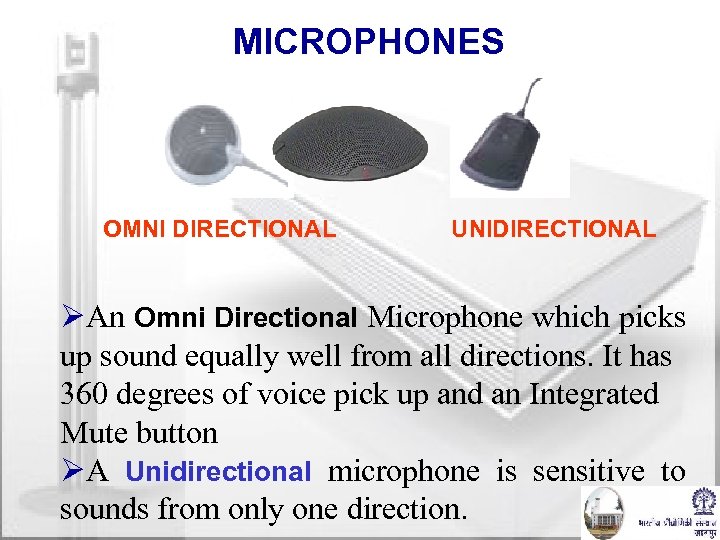 MICROPHONES OMNI DIRECTIONAL UNIDIRECTIONAL ØAn Omni Directional Microphone which picks up sound equally well from all directions. It has 360 degrees of voice pick up and an Integrated Mute button ØA Unidirectional microphone is sensitive to sounds from only one direction.
 Typical features of a LCD TV ØViewing angle : 176º (H) / 176º (V) ØDiagonal screen size (inch) : 42 inch ØDisplay screen type : LCD WXGA Active Matrix TFT ØPanel resolution : 1366 x 768 p ØSound Output power (RMS) : 2 x 12 W + 1 x 24 W ØLoudspeakers Built-in speakers : 5 ØLoudspeaker types : Integrated subwoofer, Dome tweeter ØPicture in Picture : HDMI-Component PIP ØPlayback Formats : MP 3, Slideshow files (. alb), JPEG, Still pictures ØMains power : AC 110 - 240 V +/- 10% ØPower consumption : 263 W
 Bandwidth / Data Rate Requirement • • • Frame Rate. 15 -30 fps. Frame Size. QCIF( 176 x 144) , 4 CIF (480 x 330) etc. Color. Mono / Stereo Audio. Sample per second. 14 KHZ Audio Bit per sample. 8 -12 bit for audio, 24 bit for video
 Data Size: Voice • • Band width: ~ 4 Khz Minimum Sampling Frequency: 8 Khz Bits per sample: 8 bits (for 256 levels) Minmum data rate: 8000 x 8 bits per second = 64 Kbps
 Data Size: Video • • Number of frames per second: 15 fps Resolution of a frame: 480 x 640 pixels Bits per pixel: 24 bits (for colored video) Data Rate: 480 x 640 x 15 x 24 bits per second = 110. 6 Mbps
 Compression Standards • Lossy and Lossless Compression • Audio: G. 711, G. 722. 1, G. 728, MPEG-4 • Still Image: JPEG, JPEG-LS, JPEG-2000 • Video: MPEG-2, MPEG-4, H. 263, H. 264
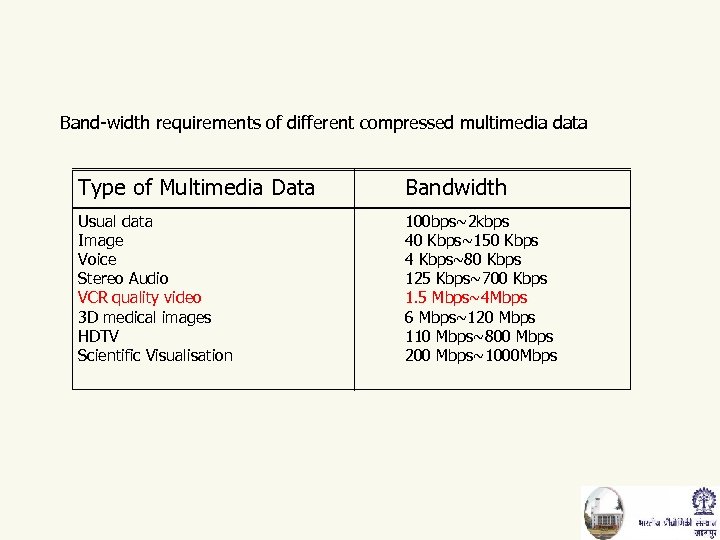 Band-width requirements of different compressed multimedia data Type of Multimedia Data Bandwidth Usual data Image Voice Stereo Audio VCR quality video 3 D medical images HDTV Scientific Visualisation 100 bps~2 kbps 40 Kbps~150 Kbps 4 Kbps~80 Kbps 125 Kbps~700 Kbps 1. 5 Mbps~4 Mbps 6 Mbps~120 Mbps 110 Mbps~800 Mbps 200 Mbps~1000 Mbps
 Protocols for VC • H. 320 ( 1990) – ISDN • H. 323 (1996) – IP • SIP (Session Initiation Protocol) – Used by most Voice Over IP (VOIP) solutions
 H. 323 contains several protocols: • H. 225. 0 : Call Signaling between two H. 323 endpoints • Registration, Admission, and Status (RAS). RAS is used between an endpoint and a Gatekeeper. • H. 245 : control protocol for opening and closing logical channels for audio, video and data, capability exchange, control and indications. • H. 450 : for various supplementary services
 H. 323 (Contd. ) • H. 235 : for security within H. 323, including both signaling and media security • H. 239 : describes dual stream use (usually for live video, the other for presentation. ) • H. 460 : optional extensions that might be implemented by an endpoint or a Gatekeeper. • In addition to those ITU recommendations, H. 323 utilizes various IETF RFCs for media transport and media packetization, including RTP.
 H. 323 (Contd. ) Codecs • Video codecs: H. 261, H. 263, H. 264. • Audio codecs: G. 711, G. 729 a, G. 723. 1, G. 726 • Text codecs: T. 140
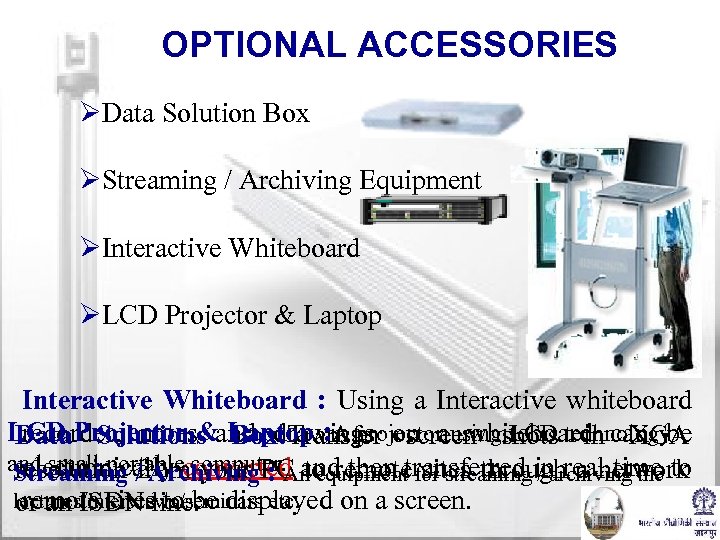 OPTIONAL ACCESSORIES ØData Solution Box ØStreaming / Archiving Equipment ØInteractive Whiteboard ØLCD Projector & Laptop Interactive Whiteboard : Using a Interactive whiteboard LCD Projector &and drawings on a whiteboard can be recorder, notes Box: Transfer screen shots in XGA Data Solutions Laptop : A projector using LCD technology and small portable computer. An equipment for streaming / archiving the electronically converted and then transferred in real time to resolution from your PC to remote sites through a network Streaming / Archiving : lectures/interviews/seminars etc. remote sites to be displayed on a screen. or an ISDN line.
 Challenges in Internet VC • Firewalls – Port Blocking • NAT – Hidden IP Address • Bandwidth – NOT! Dial Up Modem – MAYBE… Cable Modem/DSL – Yes!!! Internet 2
 Network Servers for VC • Gatekeeper – Allows assignment of static numbers – Allows use of MCUs, and Gateways • MCU – Allows more than two participants to be in the call at the same time. • Gateway – Allows calls to and from telephones. • Ridgeway Server – Firewall/NAT solution.
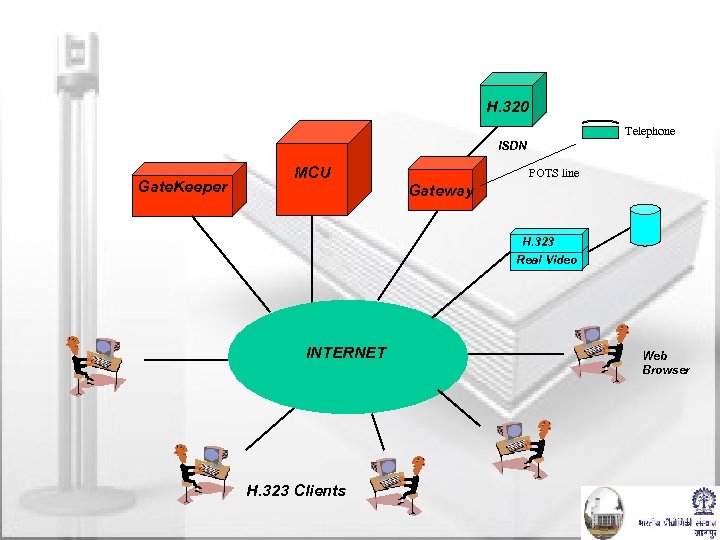 H. 323 Videoconferencing H. 320 Telephone ISDN Gate. Keeper MCU POTS line Gateway H. 323 Real Video INTERNET H. 323 Clients Web Browser
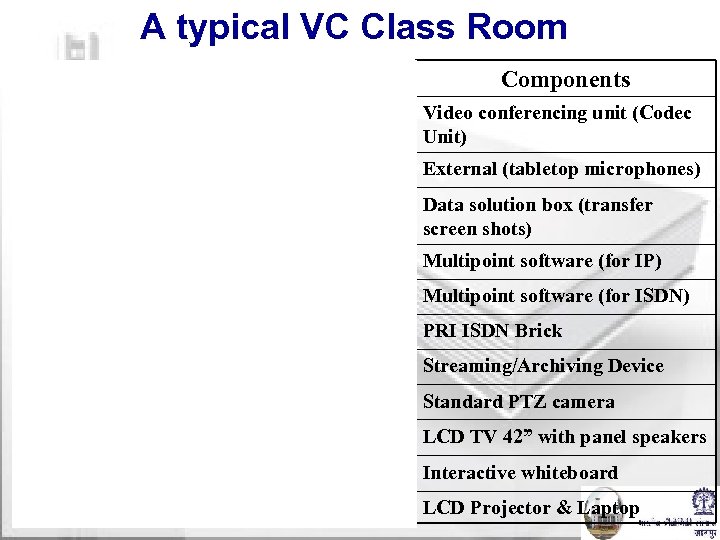 A typical VC Class Room Components Video conferencing unit (Codec Unit) External (tabletop microphones) Data solution box (transfer screen shots) Multipoint software (for IP) Multipoint software (for ISDN) PRI ISDN Brick Streaming/Archiving Device Standard PTZ camera LCD TV 42” with panel speakers Interactive whiteboard LCD Projector & Laptop
 A TYPICAL BOARD ROOM SET-UP Components Video conferencing Unit (Codec Unit) LCD TV 42” with panel speakers External (tabletop microphones)
 EBaithak: Multiparty Desktop Video Conferencing over Internet Developed at Dept. of CSE, IIT, Kharagpur
 Video Servers • Progressive – – Video files are kept at a location on the server. Files can be downloaded at a later stage for viewing in a suitable player The problem is whole files has to be downloaded before actually playing Any Server can host multi-media files. • Streaming – – – Video files are kept at a location on the server. Video file is played as it is being downloaded. Video file need not to be saved at the client Special streaming servers to be used for hosting files RED 5, WOWZA, FMS, DARWIN, MICROSOFT MEDIA SERVER are example.
 • Protocols Used RTMP – Available as an open specification to create products and technology that enable delivery of video, audio, and data in the open AMF, SWF, FLV, and F 4 V formats compatible with Adobe Flash Player • RTMPT – – Basically is a HTTP wrapper around the RTMP protocol Send POST requests from the client to the server. Clients to poll for updates periodically in order to get notified about generated events Four possible request types can be sent to the server • • • Initial connect (command "open") Client updates (command "send") Polling requests (command "idle") Disconnect of a session (command "close") RTMPS – works just like RTMPT, but over a secure HTTPS connection
 e. Baithak – Server Part • e. Baithak uses Red 5 as its Media Server • Red 5 is Open Source Flash Media Server written in Java • Protocols Supported: RTMP/RTMPT/RTMPS – RTMP : Real Time Messaging Protocol is a proprietary protocol of ADOBE Systems. – RTMP based on top of TCP and uses 1935 port – RTMPT is RTMP encapsulated within HTTP requests. – RTPMS is RTMP encapsulated with in secure HTTP
 e. Baithak - Client • Flash Application 1. Flash is a multimedia graphics program specially for use on the Web 2. Flash enables you to create interactive Applications on the Web 3. Flash uses vector graphics, which can be scaled to any size without losing clarity/quality 4. Action. Script v 3. 0 is used for programming complicated Flash Applications
 e. Baithak & Flash • Software Client Side: – Adobe CS 4 for developing GUI • Uses Action Scripting 3. 0 – Adobe Flash Player for displaying GUI • Across-platform browser plug-in that delivers multimedia content. • Embedded inside html pages which can be served through Red 5 Server.
 e. Baithak & Flash • Software Server Side: – Embed Flash Application inside server-side scripting program like JSP/ASP for Client Access: • • This can be saved a HTML file and has to be put on the website alongwith "somefilename. swf" Flash application
 Client Requirements • Installed Webcam, Head-Phones • Any web-browser with flash player installed. • Internet connection for connecting Video Server • User credentials for connecting the server.
 Red 5 Application (Server Side) • In Simple form, it is a server side java program, hosted on the Red 5 Server. • It contains methods such as connect, app. Connect, start, stop etc. • Authentication etc are applied in app. Connect method • If any VOD data is there, it can be hosted in the streams directory.
 Video Quality Parameters • Quality of Video Depends on the following factors: 1. Frame Rate: This parameters define how many frames are displayed in one second. 2. Frame Resolution: Dimensions of each frame. 3. Frame Quality: Compression of each frame. 4. Bitrate: Supported on specific Video Formats • Quality of images in the video depend on Frame Resolution & Quality. • Smoothness of Video depends on Frame Rate.
 Bandwidth & Video Quality Relation • Bandwidth also known as bitrate, is rate of data transfer measured in bits per second. • Higher the Video Quality we prefer, higher bandwidth is required. • Video Quality has to be adjusted to meet the current bandwdith available. • e. Baithak prefers bandwidth of 512 kbps at client
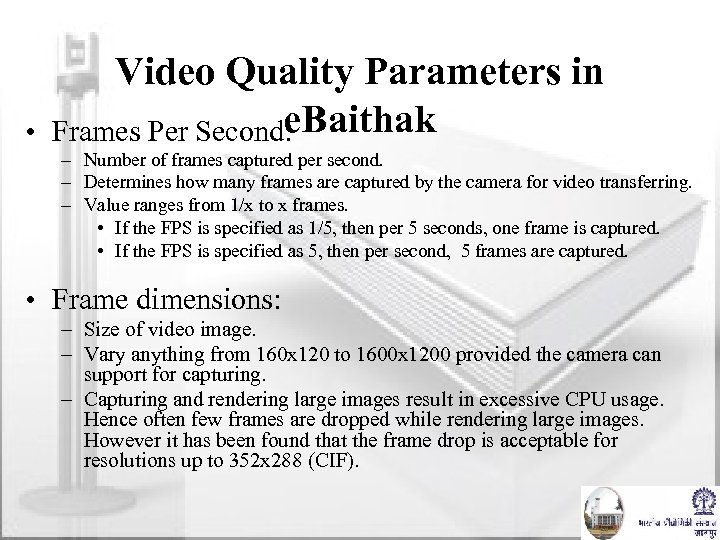 • Video Quality Parameters in e. Baithak Frames Per Second: – Number of frames captured per second. – Determines how many frames are captured by the camera for video transferring. – Value ranges from 1/x to x frames. • If the FPS is specified as 1/5, then per 5 seconds, one frame is captured. • If the FPS is specified as 5, then per second, 5 frames are captured. • Frame dimensions: – Size of video image. – Vary anything from 160 x 120 to 1600 x 1200 provided the camera can support for capturing. – Capturing and rendering large images result in excessive CPU usage. Hence often few frames are dropped while rendering large images. However it has been found that the frame drop is acceptable for resolutions up to 352 x 288 (CIF).
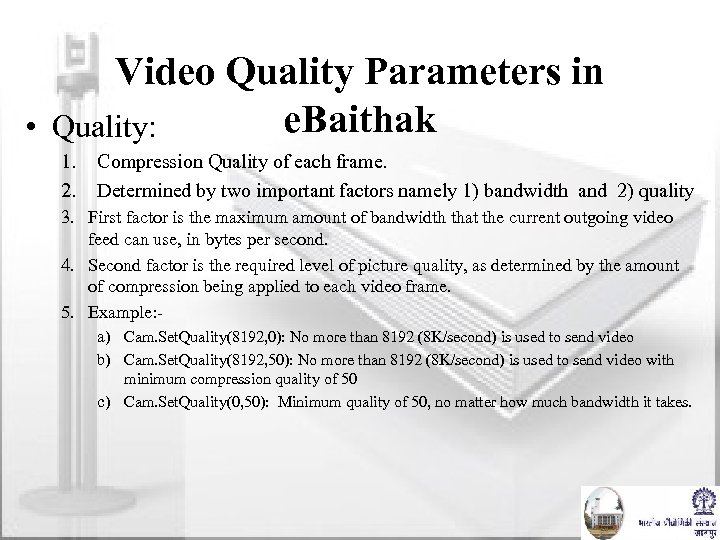 Video Quality Parameters in e. Baithak • Quality: 1. 2. Compression Quality of each frame. Determined by two important factors namely 1) bandwidth and 2) quality 3. First factor is the maximum amount of bandwidth that the current outgoing video feed can use, in bytes per second. 4. Second factor is the required level of picture quality, as determined by the amount of compression being applied to each video frame. 5. Example: a) Cam. Set. Quality(8192, 0): No more than 8192 (8 K/second) is used to send video b) Cam. Set. Quality(8192, 50): No more than 8192 (8 K/second) is used to send video with minimum compression quality of 50 c) Cam. Set. Quality(0, 50): Minimum quality of 50, no matter how much bandwidth it takes.
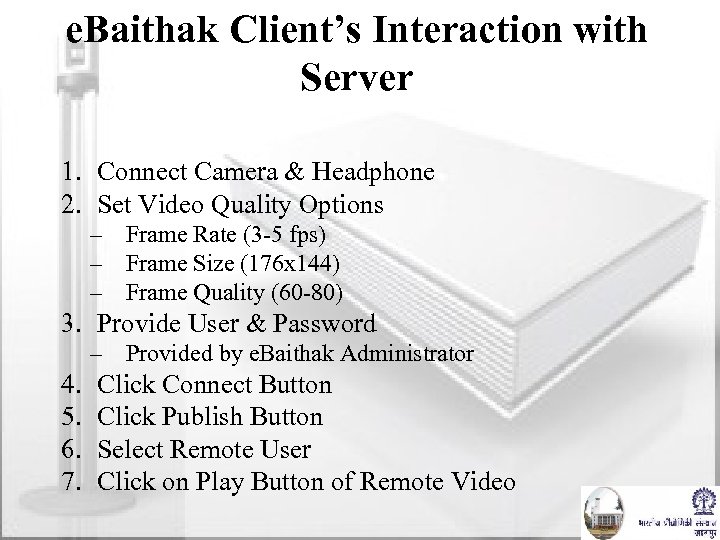 e. Baithak Client’s Interaction with Server 1. Connect Camera & Headphone 2. Set Video Quality Options – Frame Rate (3 -5 fps) – Frame Size (176 x 144) – Frame Quality (60 -80) 3. Provide User & Password – Provided by e. Baithak Administrator 4. 5. 6. 7. Click Connect Button Click Publish Button Select Remote User Click on Play Button of Remote Video
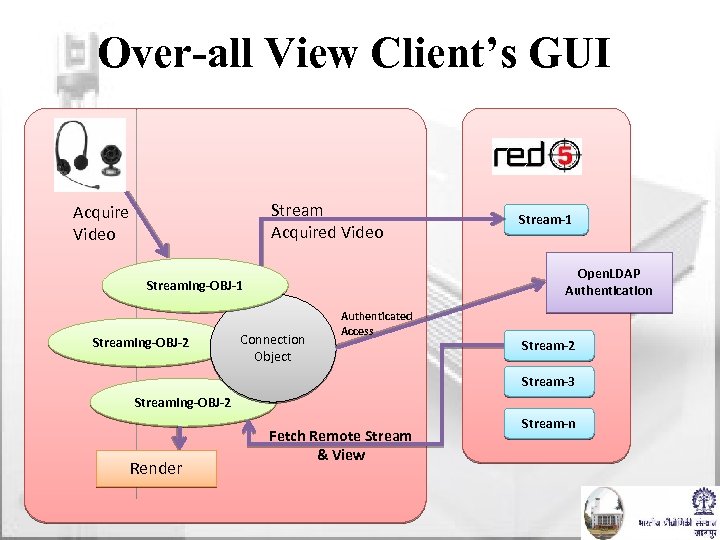 Over-all View Client’s GUI Stream Acquired Video Acquire Video Open. LDAP Authentication Streaming-OBJ-1 Streaming-OBJ-2 Stream-1 Connection Object Authenticated Access Stream-2 Stream-3 Streaming-OBJ-2 Render Fetch Remote Stream & View Stream-n
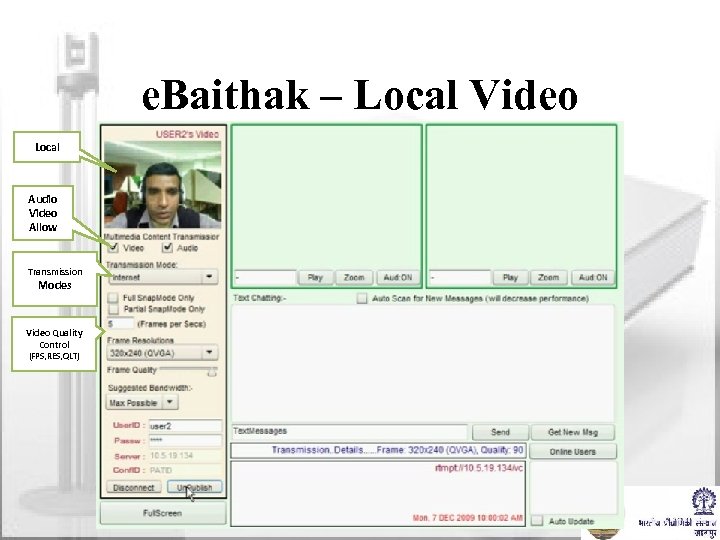 e. Baithak – Local Video Local Audio Video Allow Transmission Modes Video Quality Control (FPS, RES, QLT)
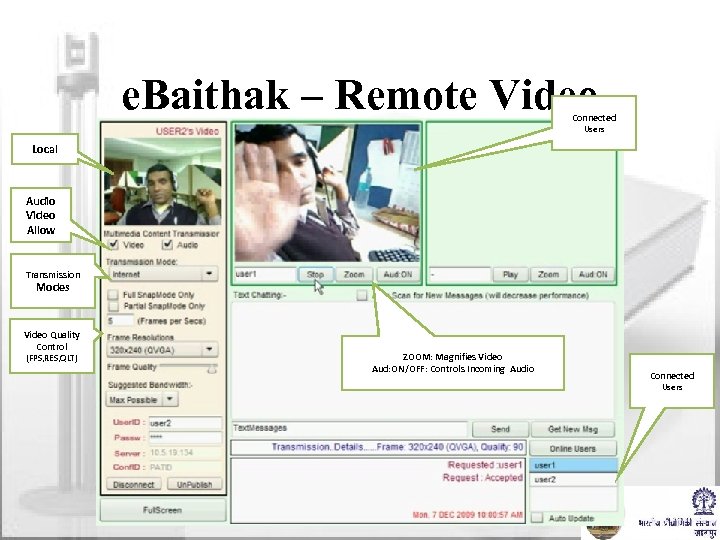 e. Baithak – Remote Video Connected Users Local Audio Video Allow Transmission Modes Video Quality Control (FPS, RES, QLT) ZOOM: Magnifies Video Aud: ON/OFF: Controls Incoming Audio Connected Users