


 Скачать презентацию Victory day Types of Questions Teacher Ekaterina
Victory day.pptx
- Количество слайдов: 15
 Victory day Types of Questions Teacher : Ekaterina Kursanina
 Types of questions question to the subject Ø Ø Ø What has happened? What makes you feel upset? Who told you this? Where are you come from? your examples
 Types of questions general question Ø Does she like singing? Ø Is this apartment? Ø Did you go to the training center yesterday? Ø Are you going to the stadium? Ø Do you do sport every day? Ø Your example
 Types of questions special question Ø Where are you going to move? Ø What would you like to read? Ø When did you leave your apartment? Ø When did you play tennis last time? Ø What do you plan to do in the evening? Ø Your examples
 Types of questions alternative question Ø Did they finish writing the article in the morning or at night? Ø Did they finish writing or reading the article? Ø Your examples
 Types of questions tag-question / disjunctive question Ø My mother prefers meat to fish, does not she? Ø You can cook this dish, can’t you? Ø She doesn’t go to the church, does she? Ø Your examples.
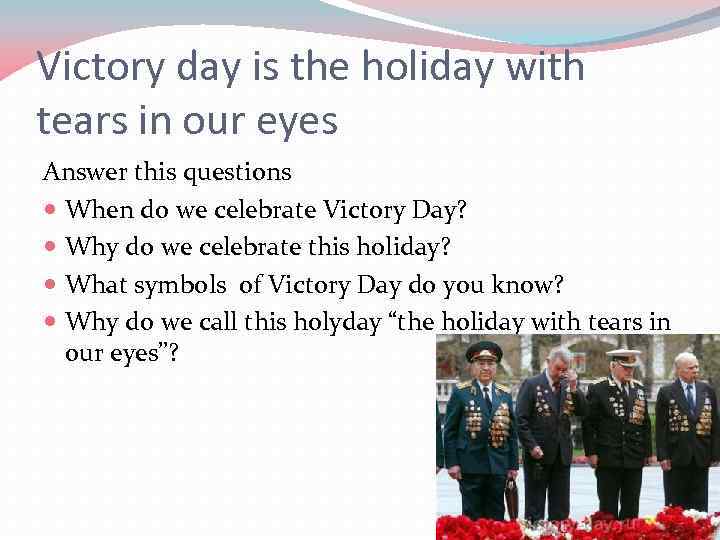 Victory day is the holiday with tears in our eyes Answer this questions When do we celebrate Victory Day? Why do we celebrate this holiday? What symbols of Victory Day do you know? Why do we call this holyday “the holiday with tears in our eyes”?
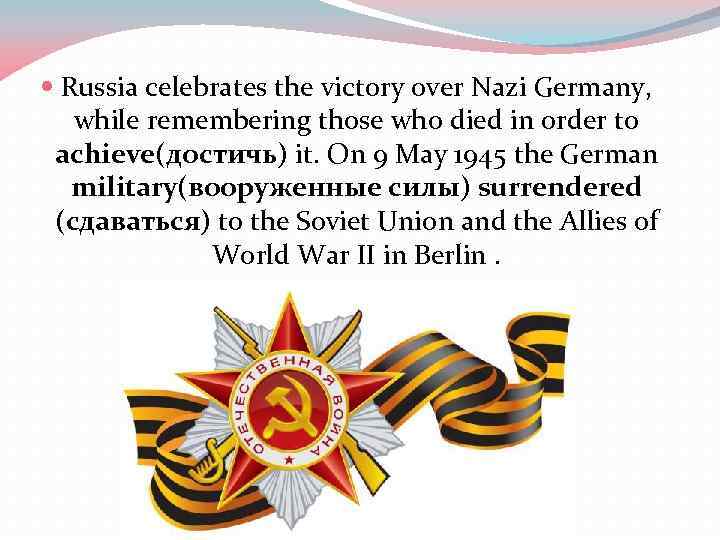 Russia celebrates the victory over Nazi Germany, while remembering those who died in order to achieve(достичь) it. On 9 May 1945 the German military(вооруженные силы) surrendered (сдаваться) to the Soviet Union and the Allies of World War II in Berlin.
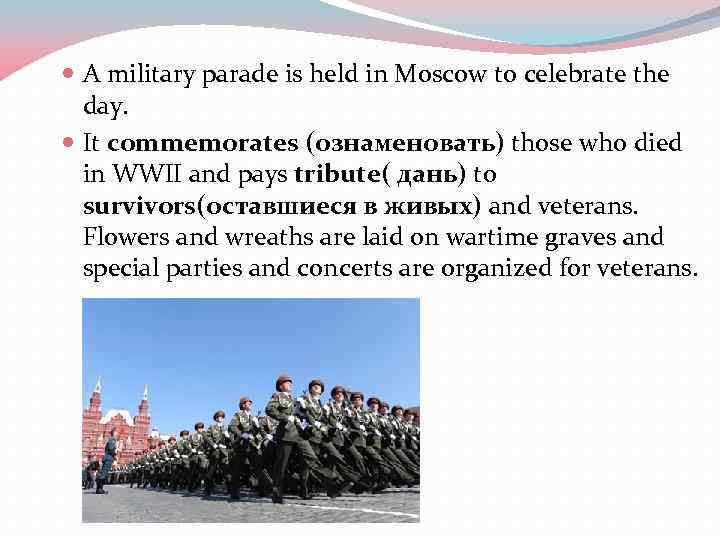 A military parade is held in Moscow to celebrate the day. It commemorates (ознаменовать) those who died in WWII and pays tribute( дань) to survivors(оставшиеся в живых) and veterans. Flowers and wreaths are laid on wartime graves and special parties and concerts are organized for veterans.
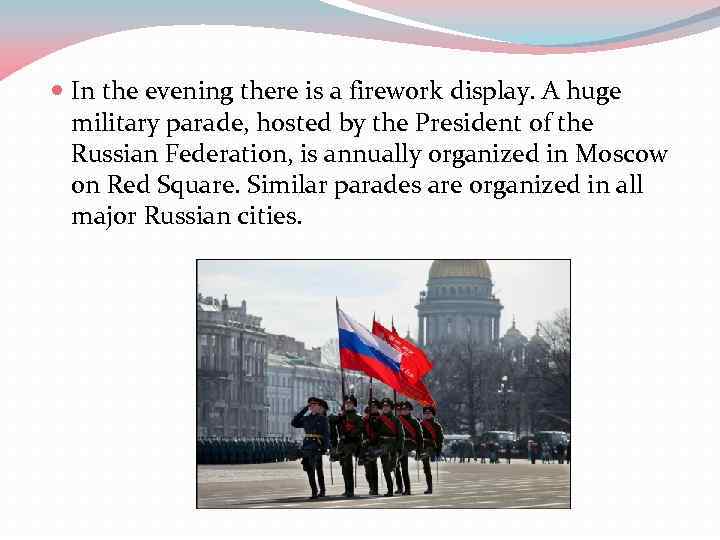 In the evening there is a firework display. A huge military parade, hosted by the President of the Russian Federation, is annually organized in Moscow on Red Square. Similar parades are organized in all major Russian cities.
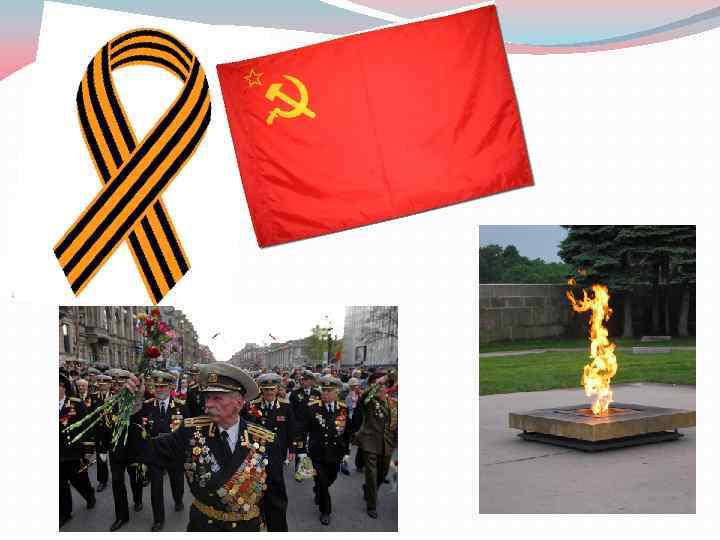
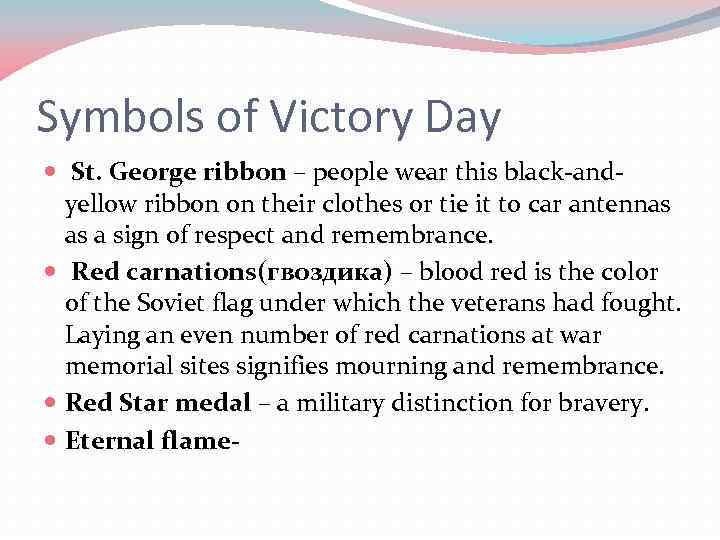 Symbols of Victory Day St. George ribbon – people wear this black-andyellow ribbon on their clothes or tie it to car antennas as a sign of respect and remembrance. Red carnations(гвоздика) – blood red is the color of the Soviet flag under which the veterans had fought. Laying an even number of red carnations at war memorial sites signifies mourning and remembrance. Red Star medal – a military distinction for bravery. Eternal flame-
 Tomb of the Unknown Soldier (Moscow) The Tomb of the Unknown Soldier is a war memorial, dedicated(посвящать) to the Soviet soldiers killed during World War II. It is located at the Kremlin Wall in the Alexander Garden in Moscow. The remains of the unknown soldiers killed in the Battle of Moscow in 1941 were initially (первоначально) buried (захоронены) in a mass grave at the 41 st km of the Leningrad highway at the city of Zelenograd. This was the location of the closest approach of the Nazi armies to Moscow during the war. To commemorate the 25 th anniversary of the battle, in December 1966 these remains were relocated to the Kremlin Wall. The dark red porphyry monument is decorated with a bronze sculpture of a laurel branch and a soldier's helmet(шлем) laid upon a banner.
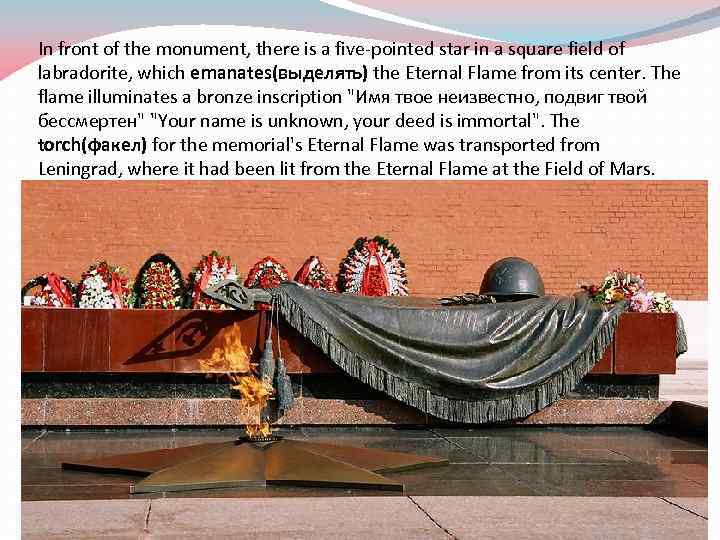 In front of the monument, there is a five-pointed star in a square field of labradorite, which emanates(выделять) the Eternal Flame from its center. The flame illuminates a bronze inscription "Имя твое неизвестно, подвиг твой бессмертен" "Your name is unknown, your deed is immortal". The torch(факел) for the memorial's Eternal Flame was transported from Leningrad, where it had been lit from the Eternal Flame at the Field of Mars.
 Thank you for attention