 Скачать презентацию Viability of International Tourism Symposium on Tourism Services
048c636e28215465e1d48c4a8d9330dc.ppt
- Количество слайдов: 14



Viability of International Tourism Symposium on Tourism Services World Trade Organization, Geneva, February 23, 2001 Iain T. Christie MIGA ichristie@worldbank. org World Bank Group
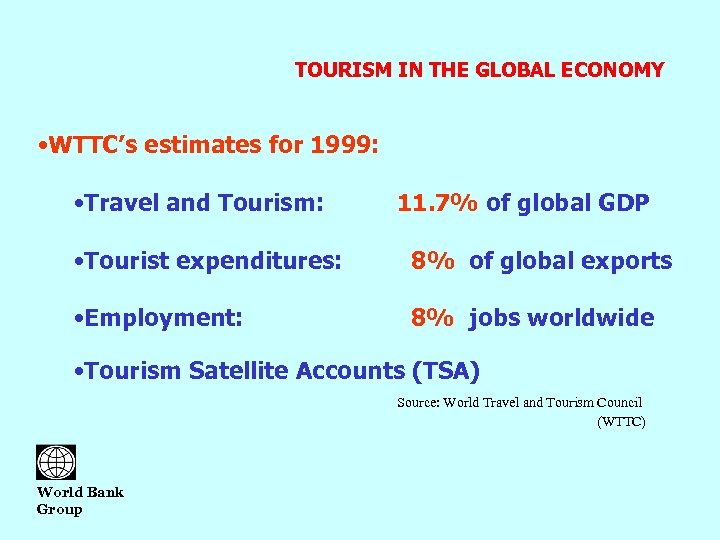
TOURISM IN THE GLOBAL ECONOMY • WTTC’s estimates for 1999: • Travel and Tourism: 11. 7% of global GDP • Tourist expenditures: 8% of global exports • Employment: 8% jobs worldwide • Tourism Satellite Accounts (TSA) Source: World Travel and Tourism Council (WTTC) World Bank Group
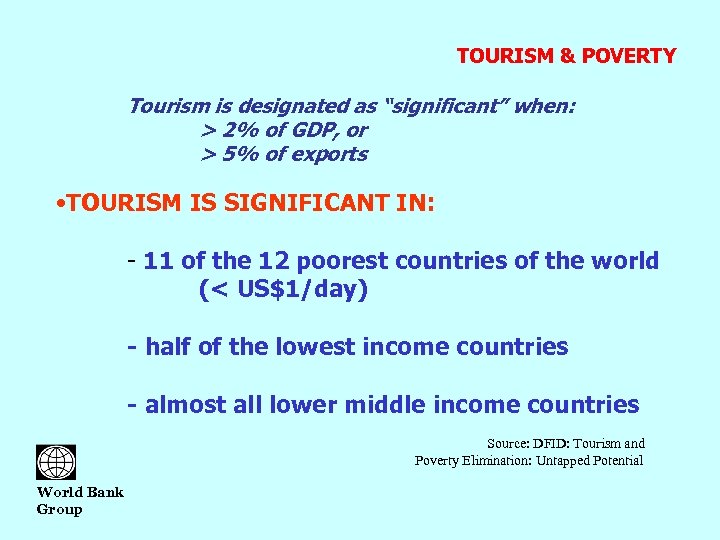
TOURISM & POVERTY Tourism is designated as “significant” when: > 2% of GDP, or > 5% of exports • TOURISM IS SIGNIFICANT IN: - 11 of the 12 poorest countries of the world (< US$1/day) - half of the lowest income countries - almost all lower middle income countries Source: DFID: Tourism and Poverty Elimination: Untapped Potential World Bank Group
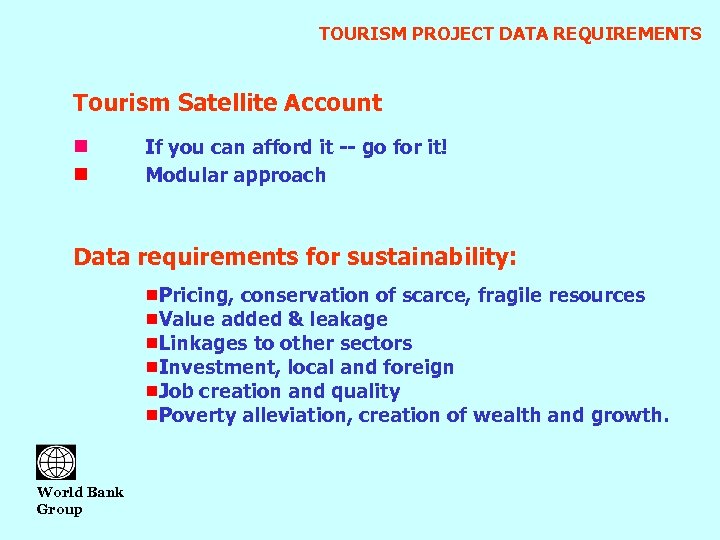
TOURISM PROJECT DATA REQUIREMENTS Tourism Satellite Account g g If you can afford it -- go for it! Modular approach Data requirements for sustainability: g. Pricing, conservation of scarce, fragile resources g. Value added & leakage g. Linkages to other sectors g. Investment, local and foreign g. Job creation and quality g. Poverty alleviation, creation of wealth and growth. World Bank Group
WBG CONTEXT • DEMAND from client countries • IFC finances tourist establishments • MIGA provides guarantees and investment promotion • Bank/IDA Formerly financed tourism, including: Infrastructure & site development Hotel credit Tourism training Cultural heritage Renewed interest, spurred by: Environment & Ecotourism -- GEF Poverty alleviation Community participation & social inclusion Cultural heritage & preservation World Bank Group
THE ACTORS • TOURISM IS A PRIVATE SECTOR ACTIVITY Entrepreneurs finance hotels & other businesses Opportunity to make profits Cross sectoral with wide business linkages • SUCCESS DEPENDS ON A PERFORMING PUBLIC SECTOR Policy & regulatory framework (economic, social & cultural) Infrastructure services, public & private Key services: public health, security & rule of law • PUBLIC/PRIVATE PARTNERSHIP • DONOR COMMUNITY World Bank Group
SUSTAINABILITY • RIO EARTH SUMMIT AGENDA 21, 1992 - one of few economic activities capable of providing economic incentives for preservation of the environment • - potential major source of continuing employment for women and the unskilled COMMISSION FOR SUSTAINABLE DEVELOPMENT 19 “economic benefits of tourism have the potential to alleviate poverty in the developing world, but capacity building is needed at the local level to achieve the goal” World Bank Group
SUSTAINABILITY & DEVELOPMENT • POVERTY ALLEVIATION • INTERDISCIPLINARY NATURE OF TOURISM • FINANCIAL AND ECONOMIC Create the opportunity for owners, investors to make profits Economic catalyst Expenditure outside tourist enterprises Leakages or linkages? Employment Tax revenues Regional development Ownership • SOCIO-CULTURAL Inclusion of local people in benefits Interpretation, protection of cultural heritage • ENVIRONMENTAL Conservation and mitigation Eco-tourism, coastal zone management (CZM), wildlife management • EXTERNALITIES
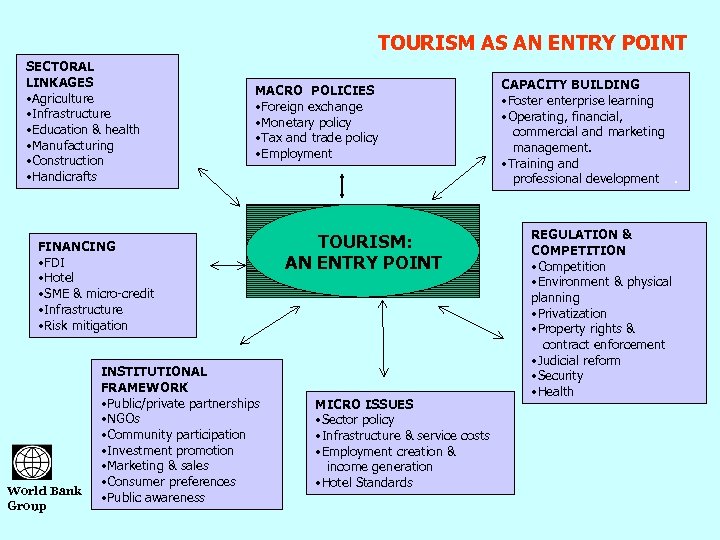
TOURISM AS AN ENTRY POINT SECTORAL LINKAGES • Agriculture • Infrastructure • Education & health • Manufacturing • Construction • Handicrafts MACRO POLICIES • Foreign exchange • Monetary policy • Tax and trade policy • Employment FINANCING • FDI • Hotel • SME & micro-credit • Infrastructure • Risk mitigation World Bank Group INSTITUTIONAL FRAMEWORK • Public/private partnerships • NGOs • Community participation • Investment promotion • Marketing & sales • Consumer preferences • Public awareness TOURISM: AN ENTRY POINT MICRO ISSUES • Sector policy • Infrastructure & service costs • Employment creation & income generation • Hotel Standards CAPACITY BUILDING • Foster enterprise learning • Operating, financial, commercial and marketing management. • Training and professional development. REGULATION & COMPETITION • Competition • Environment & physical planning • Privatization • Property rights & contract enforcement • Judicial reform • Security • Health
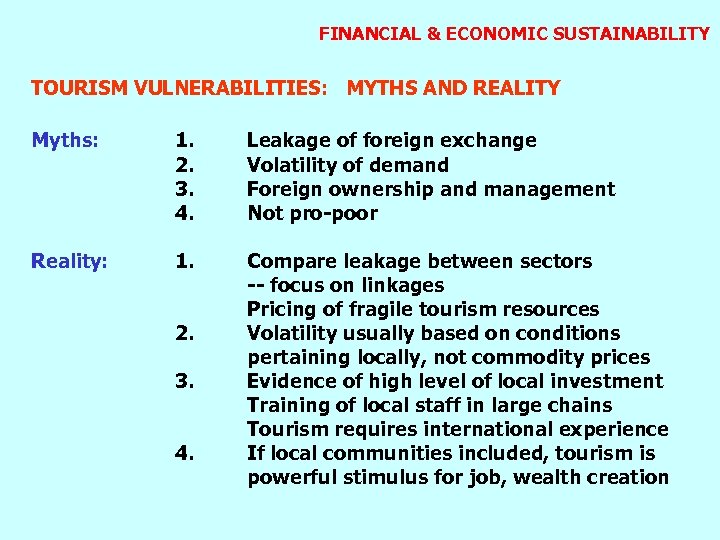
FINANCIAL & ECONOMIC SUSTAINABILITY TOURISM VULNERABILITIES: MYTHS AND REALITY Myths: 1. 2. 3. 4. Leakage of foreign exchange Volatility of demand Foreign ownership and management Not pro-poor Reality: 1. Compare leakage between sectors -- focus on linkages Pricing of fragile tourism resources Volatility usually based on conditions pertaining locally, not commodity prices Evidence of high level of local investment Training of local staff in large chains Tourism requires international experience If local communities included, tourism is powerful stimulus for job, wealth creation 2. 3. 4.
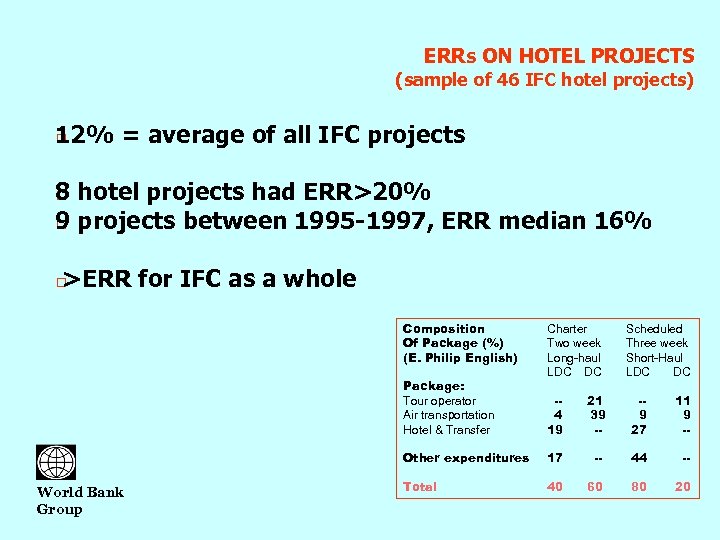
ERRs ON HOTEL PROJECTS (sample of 46 IFC hotel projects) 1 2% = average of all IFC projects 8 hotel projects had ERR>20% 9 projects between 1995 -1997, ERR median 16% >ERR for IFC as a whole Composition Of Package (%) (E. Philip English) Package: Tour operator Air transportation Hotel & Transfer Charter Two week Long-haul LDC DC Scheduled Three week Short-Haul LDC DC 21 39 -- -9 27 11 9 -- Other expenditures World Bank Group -4 19 17 -- 44 -- Total 40 60 80 20
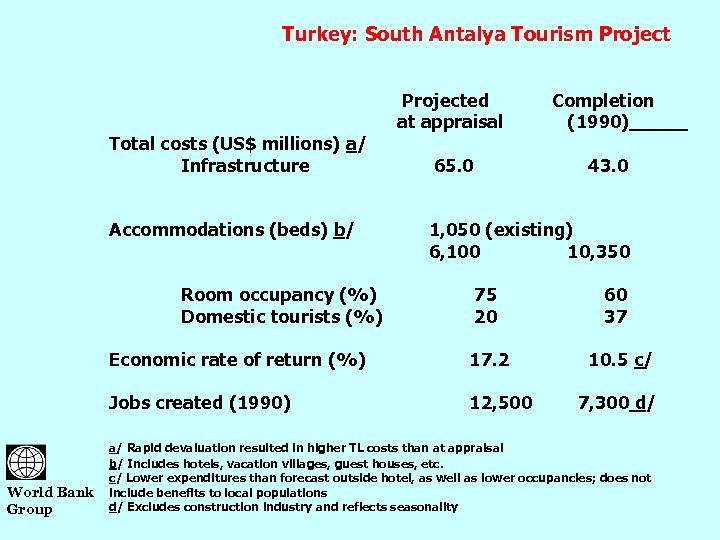
Turkey: South Antalya Tourism Project Total costs (US$ millions) a/ Infrastructure Accommodations (beds) b/ Room occupancy (%) Domestic tourists (%) Projected at appraisal Completion (1990) 65. 0 43. 0 1, 050 (existing) 6, 100 10, 350 75 20 Economic rate of return (%) Jobs created (1990) World Bank Group 17. 2 12, 500 60 37 10. 5 c/ 7, 300 d/ a/ Rapid devaluation resulted in higher TL costs than at appraisal b/ Includes hotels, vacation villages, guest houses, etc. c/ Lower expenditures than forecast outside hotel, as well as lower occupancies; does not include benefits to local populations d/ Excludes construction industry and reflects seasonality
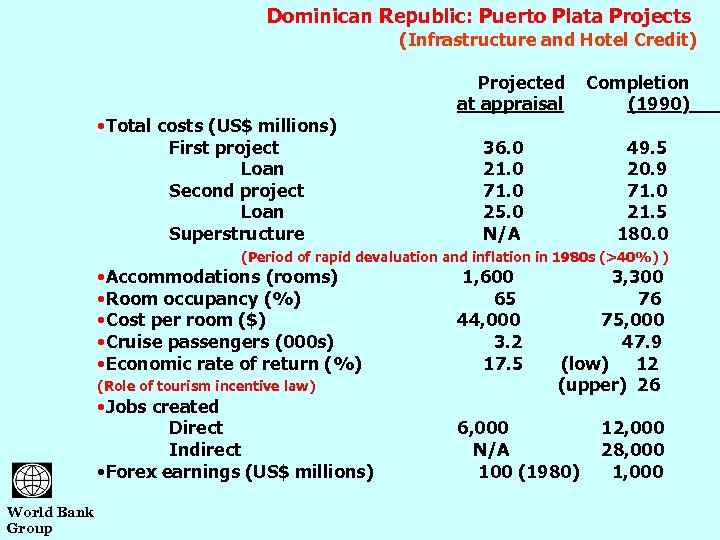
Dominican Republic: Puerto Plata Projects (Infrastructure and Hotel Credit) • Total costs (US$ millions) First project Loan Second project Loan Superstructure Projected at appraisal 36. 0 21. 0 71. 0 25. 0 N/A Completion (1990) 49. 5 20. 9 71. 0 21. 5 180. 0 (Period of rapid devaluation and inflation in 1980 s (>40%) ) • Accommodations (rooms) • Room occupancy (%) • Cost per room ($) • Cruise passengers (000 s) • Economic rate of return (%) (Role of tourism incentive law) • Jobs created Direct Indirect • Forex earnings (US$ millions) World Bank Group 1, 600 65 44, 000 3. 2 17. 5 3, 300 76 75, 000 47. 9 (low) 12 (upper) 26 6, 000 N/A 100 (1980) 12, 000 28, 000 1, 000
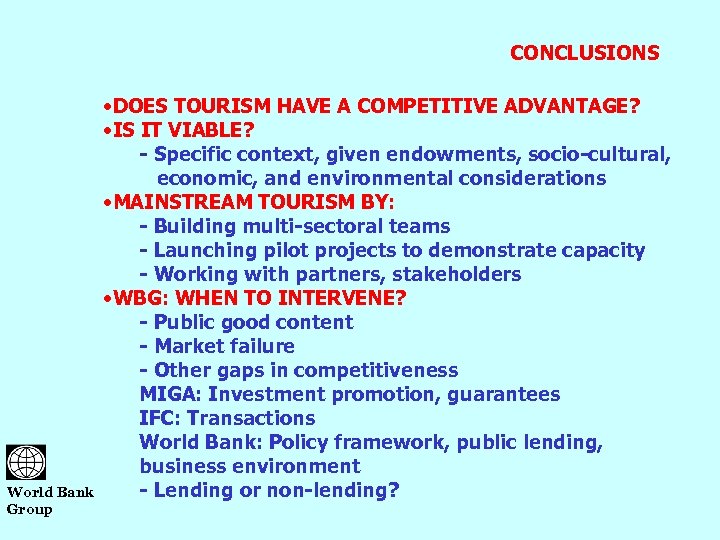
CONCLUSIONS World Bank Group • DOES TOURISM HAVE A COMPETITIVE ADVANTAGE? • IS IT VIABLE? - Specific context, given endowments, socio-cultural, economic, and environmental considerations • MAINSTREAM TOURISM BY: - Building multi-sectoral teams - Launching pilot projects to demonstrate capacity - Working with partners, stakeholders • WBG: WHEN TO INTERVENE? - Public good content - Market failure - Other gaps in competitiveness MIGA: Investment promotion, guarantees IFC: Transactions World Bank: Policy framework, public lending, business environment - Lending or non-lending?
Скачать презентацию Viability of International Tourism Symposium on Tourism Services
048c636e28215465e1d48c4a8d9330dc.ppt