


 Скачать презентацию VI THE MACROECONOMICS OF OPEN ECONOMIES Open-Economy
cbfbc963040ab537d598478444ff1461.ppt
- Количество слайдов: 56
 VI THE MACROECONOMICS OF OPEN ECONOMIES
 Open-Economy Macroeconomics: Basic Concepts 13
 Open and Closed Economies • A closed economy is one that does not interact with other economies in the world. • There are no exports, no imports, and no capital flows (that is, no borrowing from foreigners and no lending to foreigners). • An open economy is one that interacts freely with other economies around the world.
 An Open Economy • An open economy interacts with other countries in two ways. • It buys and sells goods and services in world markets. (This is international trade. ) • It buys and sells financial assets in world markets. That is, it allows its citizens to borrow money from or lend money to foreigners. (This is international finance. )
 The Flow of Goods: Exports, Imports, Net Exports • Exports are goods and services that are produced domestically and sold abroad. • Imports are goods and services that are produced abroad and sold domestically.
 The Flow of Goods: Exports, Imports, Net Exports • Net exports (NX) = exports – imports. • Net exports are also called the trade balance. • Net exports could be positive, negative or zero.
 The Flow of Goods: Exports, Imports, Net Exports • A trade deficit is a situation in which net exports (NX) are negative. • Imports > Exports • A trade surplus is a situation in which net exports (NX) are positive. • Exports > Imports • Balanced trade is a situation in which net exports are zero. • Exports = Imports
 Factors That Affect Net Exports • The tastes of consumers for domestic and foreign goods. • The prices of goods at home and abroad. • The exchange rates at which people can sell domestic currency to buy foreign currencies. • Continued on next slide
 Factors That Affect Net Exports • The incomes of consumers at home and abroad. • The costs of transporting goods from country to country. • The policies of governments toward international trade. That is, the level of barriers (such as tariffs and quotas on imports) imposed against free trade.
 The U. S. is an Open Economy • The United States is a very large and open economy—it imports and exports huge quantities of goods and services. • Over the past four decades, international trade and finance have become increasingly important.
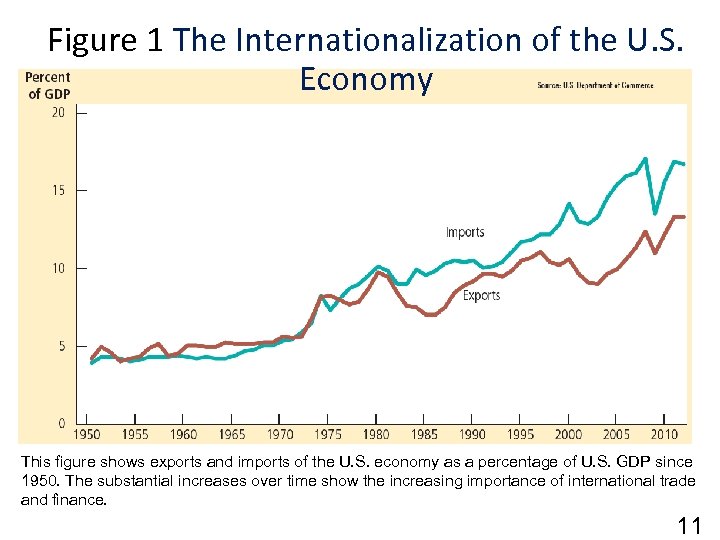 Figure 1 The Internationalization of the U. S. Economy This figure shows exports and imports of the U. S. economy as a percentage of U. S. GDP since 1950. The substantial increases over time show the increasing importance of international trade and finance. 11
 Increasing openness of the U. S. economy: reasons • Improvements in transportation • Advances in telecommunications • Goods produced with modern technology are often light and easy to transport • International agreements have gradually lowered tariffs, import quotas, and other trade barriers
 The Flow of Financial Resources: Net Capital Outflow • Net Capital Outflow (NCO) = purchase of foreign assets by domestic residents – purchase of domestic assets by foreigners = lending to foreigners – borrowing from foreigners. = capital outflow – capital inflow = Net Capital Outflow
 Net Capital Outflow • Net Capital Outflow can be: • Positive, when we lend more than we borrow • Zero, when we lend just as much as we borrow • Negative, when we lend less than we borrow
 The Flow of Financial Resources: Net Capital Outflow • When a U. S. resident buys stock in Telmex, the Mexican phone company, the purchase raises U. S. net capital outflow. • When a Japanese residents buys a bond issued by the U. S. government, the purchase reduces the U. S. net capital outflow.
 Variables that Influence Net Capital Outflow • The real interest rates being paid on foreign assets. • The real interest rates being paid on domestic assets. • The perceived economic and political risks of holding assets abroad. • The government policies that affect foreign ownership of domestic assets.
 The Equality of Net Exports and Net Capital Outflow • Net exports (NX) and net capital outflow (NCO) are closely linked. • For an economy as a whole, NX and NCO must balance each other so that: NCO = NX • This is true because excess purchases of goods and services from foreigners must be paid for with excess sales of assets.
 The Equality of Net Exports and Net Capital Outflow • Suppose • Exports = $120 • Imports = $100 • Net Exports = $20 • Foreigners got $100 by selling us their stuff. Then they spent an additional $20 on our stuff. How did they get the additional $20? • We must have given them a loan of $20. That is our net lending to them must have been $20. • Therefore, Net Capital Outflow = $20
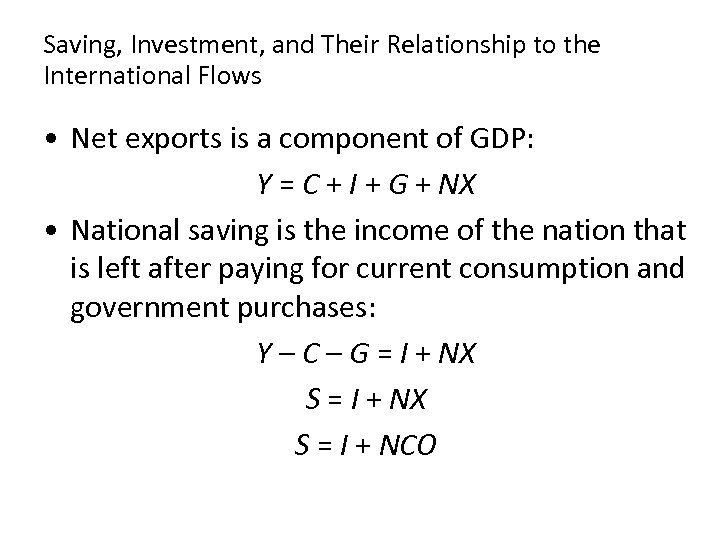 Saving, Investment, and Their Relationship to the International Flows • Net exports is a component of GDP: Y = C + I + G + NX • National saving is the income of the nation that is left after paying for current consumption and government purchases: Y – C – G = I + NX S = I + NCO
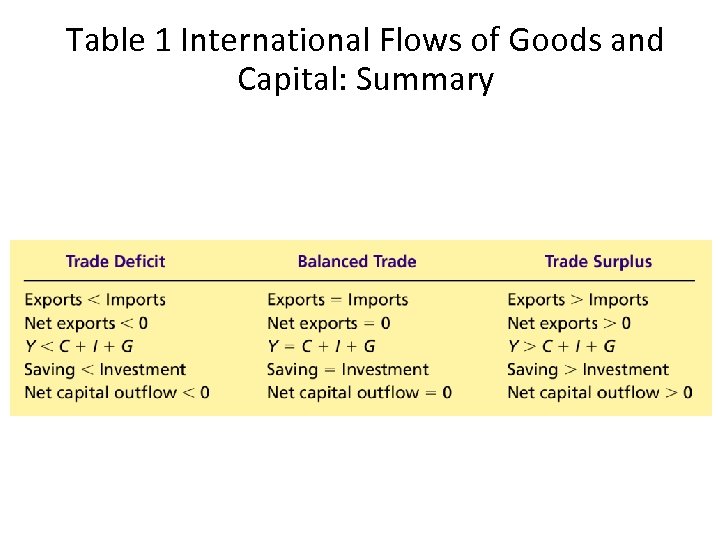 Table 1 International Flows of Goods and Capital: Summary
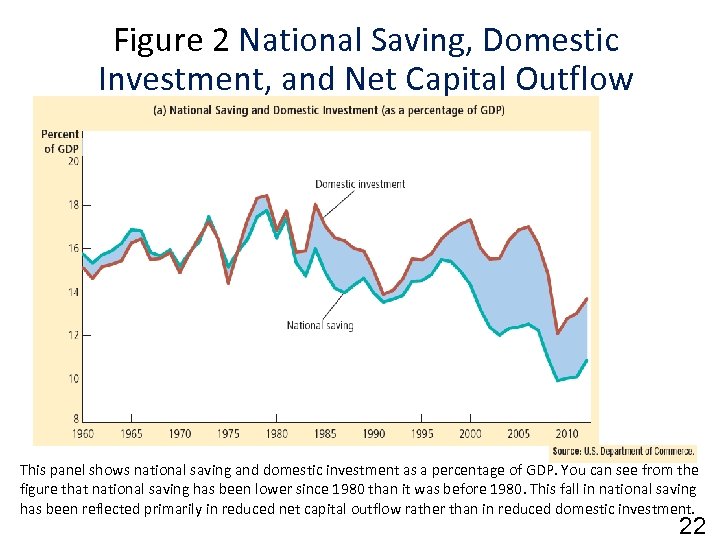 Figure 2 National Saving, Domestic Investment, and Net Capital Outflow This panel shows national saving and domestic investment as a percentage of GDP. You can see from the figure that national saving has been lower since 1980 than it was before 1980. This fall in national saving has been reflected primarily in reduced net capital outflow rather than in reduced domestic investment. 22
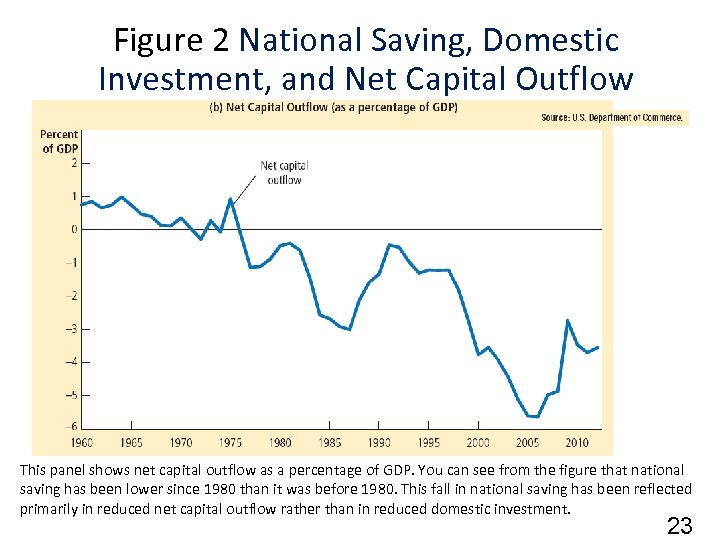 Figure 2 National Saving, Domestic Investment, and Net Capital Outflow This panel shows net capital outflow as a percentage of GDP. You can see from the figure that national saving has been lower since 1980 than it was before 1980. This fall in national saving has been reflected primarily in reduced net capital outflow rather than in reduced domestic investment. 23
 Is the U. S. trade deficit a national problem? • After 1980, national saving fell considerably below investment and, therefore, net capital outflow became a large negative number • The gap was caused by • Falling saving during the 1980 s, and • Rising investment during the 1990 s. Therefore, • Foreign debt stabilized investment in the 1980 s and amplified it in the 1990 s. • Would we be able to get a high enough return on the investments to repay our foreign debts?
 THE PRICES FOR INTERNATIONAL TRANSACTIONS: REAL AND NOMINAL EXCHANGE RATES • International trade is influenced by international prices. • The two most important international prices are • the nominal exchange rate and • the real exchange rate.
 Nominal Exchange Rates • The nominal exchange rate is the rate at which a person can trade the currency of one country for the currency of another.
 Nominal Exchange Rates • The nominal exchange rate is expressed in two ways: • In units of foreign currency per one U. S. dollar. • And in units of U. S. dollars per one unit of the foreign currency.
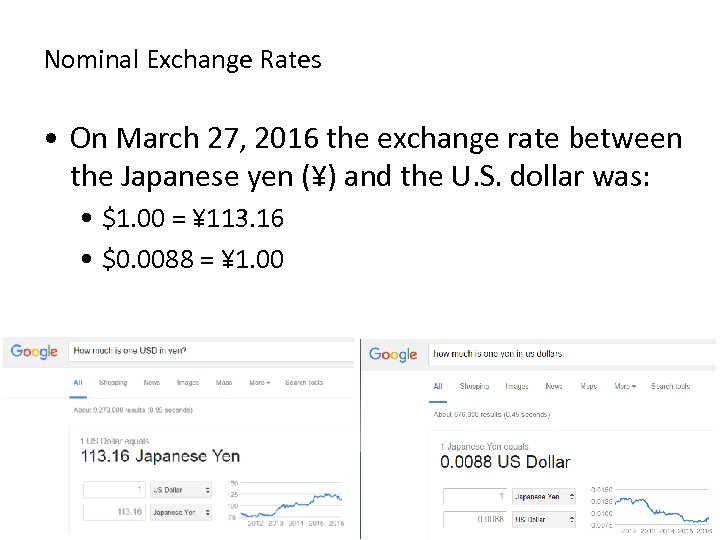 Nominal Exchange Rates • On March 27, 2016 the exchange rate between the Japanese yen (¥) and the U. S. dollar was: • $1. 00 = ¥ 113. 16 • $0. 0088 = ¥ 1. 00
 Nominal Exchange Rates • Appreciation is an increase in the value of a currency (as measured by the amount of foreign currency it can buy). • Depreciation is a decrease in the value of a currency (as measured by the amount of foreign currency it can buy).
 Nominal Exchange Rates • If the price of a dollar increases (say, from ¥ 100 to ¥ 120), it is an appreciation of the dollar. • If the price of a dollar decreases (say, from ¥ 100 to ¥ 80), it is a depreciation of the dollar.
 Real Exchange Rates • Recall that the nominal exchange rate is the rate at which a person can trade the currency of one country for the currency of another. • The real exchange rate is the rate at which a person can trade the goods and services of one country for the goods and services of another.
 Real Exchange Rates • The real exchange rate expresses the prices of domestic goods not in currency units but in units of foreign goods. • If a case of German beer is twice as expensive as American beer, the US real exchange rate is 1/2 case of German beer per case of American beer. • Note that this expresses the price of a case of American beer in units of German beer.
 Real Exchange Rates • Suppose: • Price of U. S. wheat is P = $4. 00 per ton • Price of French wheat is P* = € 2. 00 per ton • Price of a dollar is e = € 3. 00 per dollar • Note that: • Price of a ton of U. S. wheat is $4. 00 or, equivalently, € 12. 00 (because each dollar is worth 3 euros) • Therefore, one ton of U. S. wheat costs the same as six tons of French wheat • Therefore, the real exchange rate = 6.
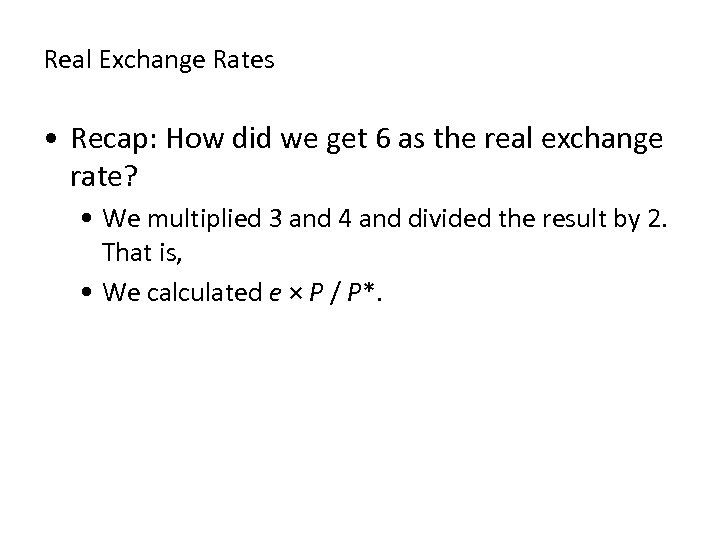 Real Exchange Rates • Recap: How did we get 6 as the real exchange rate? • We multiplied 3 and 4 and divided the result by 2. That is, • We calculated e × P / P*.
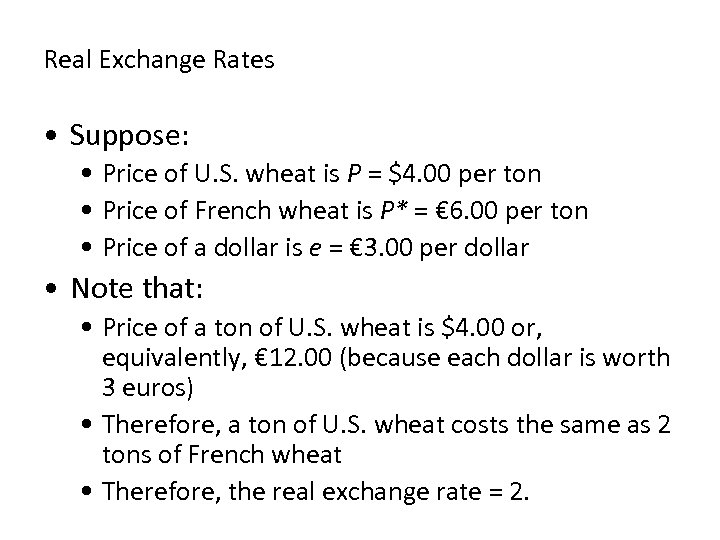 Real Exchange Rates • Suppose: • Price of U. S. wheat is P = $4. 00 per ton • Price of French wheat is P* = € 6. 00 per ton • Price of a dollar is e = € 3. 00 per dollar • Note that: • Price of a ton of U. S. wheat is $4. 00 or, equivalently, € 12. 00 (because each dollar is worth 3 euros) • Therefore, a ton of U. S. wheat costs the same as 2 tons of French wheat • Therefore, the real exchange rate = 2.
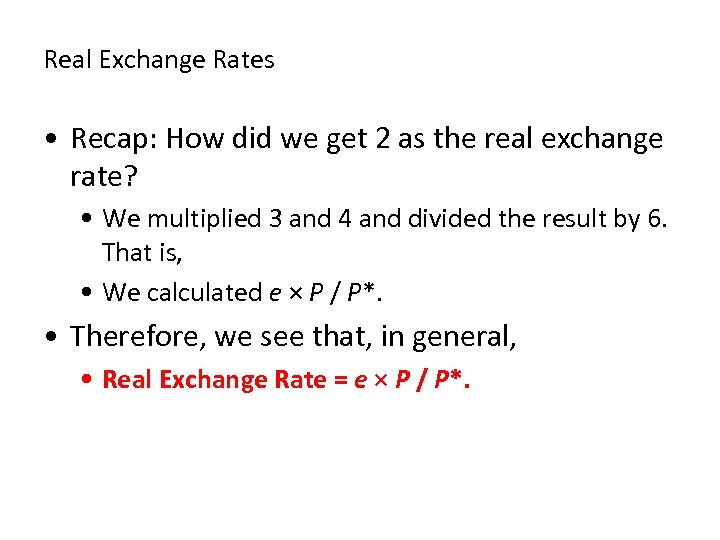 Real Exchange Rates • Recap: How did we get 2 as the real exchange rate? • We multiplied 3 and 4 and divided the result by 6. That is, • We calculated e × P / P*. • Therefore, we see that, in general, • Real Exchange Rate = e × P / P*.
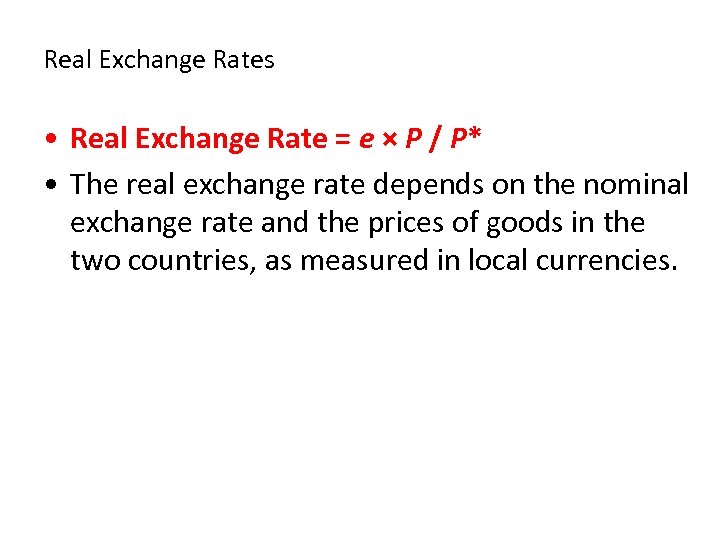 Real Exchange Rates • Real Exchange Rate = e × P / P* • The real exchange rate depends on the nominal exchange rate and the prices of goods in the two countries, as measured in local currencies.
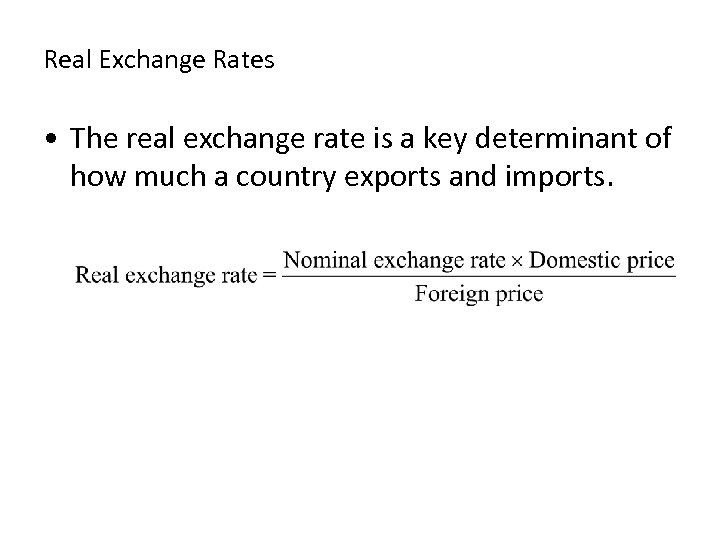 Real Exchange Rates • The real exchange rate is a key determinant of how much a country exports and imports.
 Real Exchange Rates: Effect of Depreciation • A depreciation (fall) in the U. S. real exchange rate means that U. S. goods have become cheaper relative to foreign goods. • This encourages consumers both at home and abroad to buy more U. S. goods and fewer goods from other countries. • As a result, U. S. exports rise, and U. S. imports fall. Therefore, • U. S. net exports increase.
 Real Exchange Rates: Effect of Appreciation • Conversely, an appreciation in the U. S. real exchange rate means that U. S. goods have become more expensive compared to foreign goods, so U. S. net exports fall.
 A FIRST THEORY OF EXCHANGE-RATE DETERMINATION: PURCHASINGPOWER PARITY • The purchasing-power parity theory is the simplest and most widely accepted theory explaining the variation of currency exchange rates in the long run.
 The Basic Logic of Purchasing-Power Parity • According to the purchasing-power parity theory, a unit of any given currency should be able to buy the same quantity of goods in all countries.
 The Basic Logic of Purchasing-Power Parity • The theory of purchasing-power parity is based on a principle called the law of one price. • According to the law of one price, a good must sell for the same price in all locations, once the prices are all expressed in the same currency. • Consequently, a unit of any given currency should be able to buy the same quantity of goods in all countries
 The Basic Logic of Purchasing-Power Parity • If the law of one price were not true, unexploited profit opportunities would exist. • If the same good sold at different prices in different countries, you could make money by simply buying the good where it is cheap and selling it where it is expensive • The process of taking advantage of differences in prices in different markets is called arbitrage.
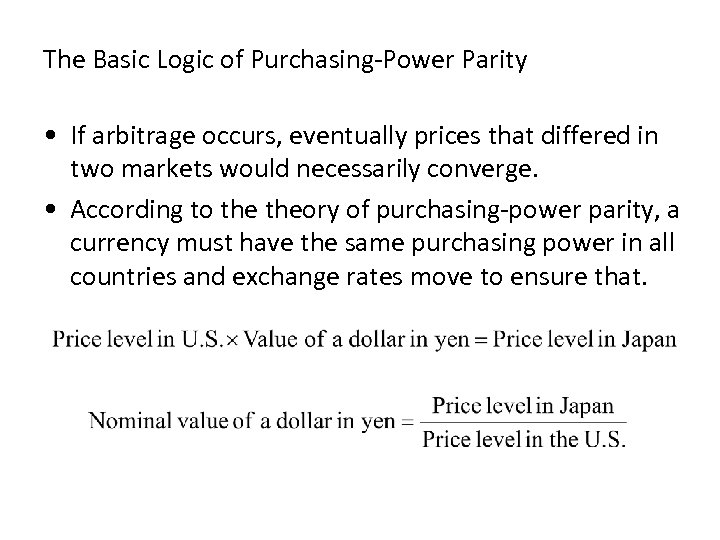 The Basic Logic of Purchasing-Power Parity • If arbitrage occurs, eventually prices that differed in two markets would necessarily converge. • According to theory of purchasing-power parity, a currency must have the same purchasing power in all countries and exchange rates move to ensure that.
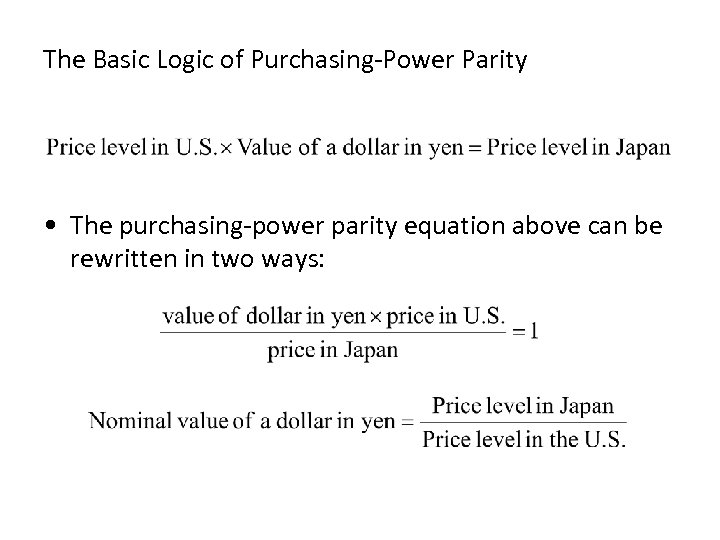 The Basic Logic of Purchasing-Power Parity • The purchasing-power parity equation above can be rewritten in two ways:
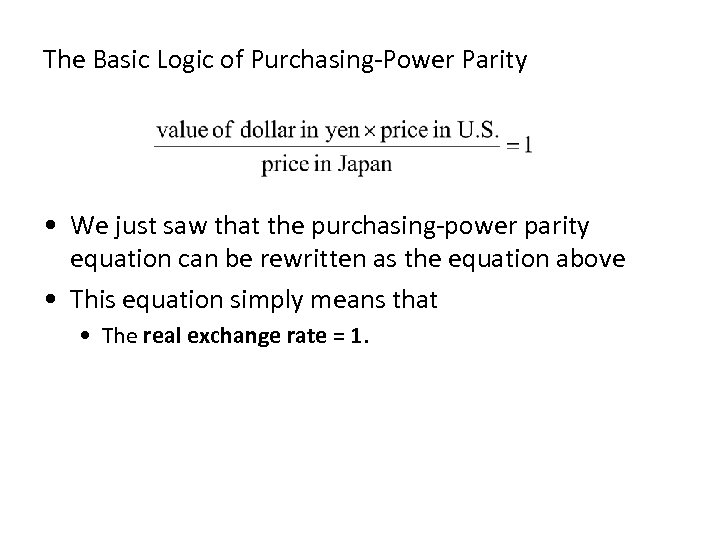 The Basic Logic of Purchasing-Power Parity • We just saw that the purchasing-power parity equation can be rewritten as the equation above • This equation simply means that • The real exchange rate = 1.
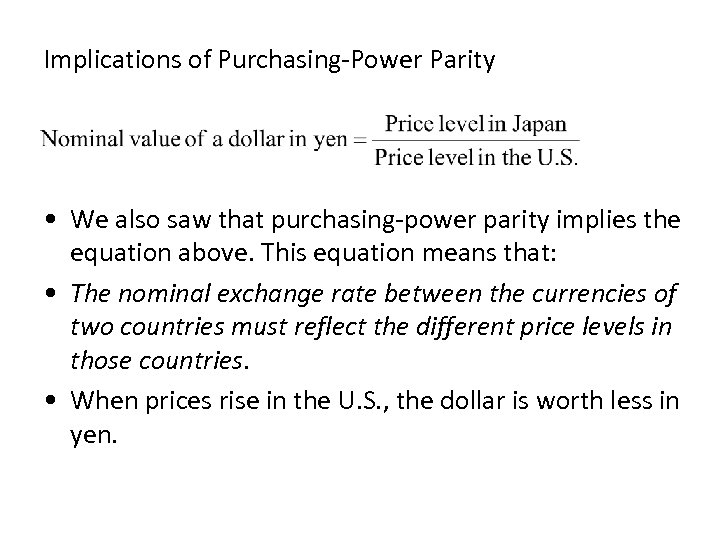 Implications of Purchasing-Power Parity • We also saw that purchasing-power parity implies the equation above. This equation means that: • The nominal exchange rate between the currencies of two countries must reflect the different price levels in those countries. • When prices rise in the U. S. , the dollar is worth less in yen.
 Implications of Purchasing-Power Parity • When the central bank prints large quantities of money, the money loses value in two ways: • It buys fewer goods and services, as we saw in chapter 30, and • It buys smaller amounts of other currencies, as we saw in the previous slide
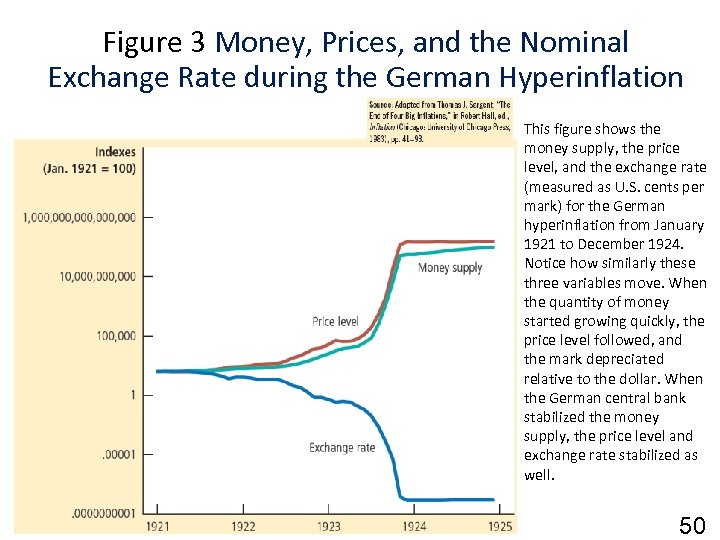 Figure 3 Money, Prices, and the Nominal Exchange Rate during the German Hyperinflation This figure shows the money supply, the price level, and the exchange rate (measured as U. S. cents per mark) for the German hyperinflation from January 1921 to December 1924. Notice how similarly these three variables move. When the quantity of money started growing quickly, the price level followed, and the mark depreciated relative to the dollar. When the German central bank stabilized the money supply, the price level and exchange rate stabilized as well. 50
 Limitations of Purchasing-Power Parity • Many goods are not easily traded or shipped from one country to another. • Tradable goods are not always perfect substitutes when they are produced in different countries.
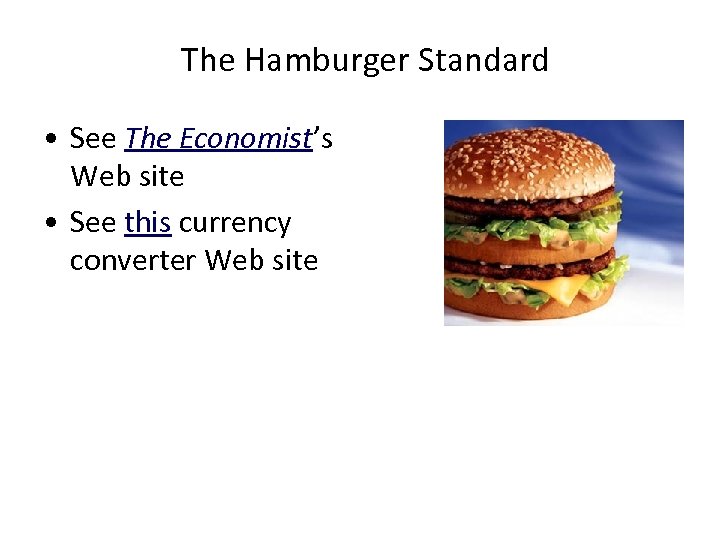 The Hamburger Standard • See The Economist’s Web site • See this currency converter Web site
 Summary • Net exports are the value of domestic goods and services sold abroad minus the value of foreign goods and services sold domestically. • Net capital outflow is the acquisition of foreign assets by domestic residents minus the acquisition of domestic assets by foreigners.
 Summary • An economy’s net capital outflow always equals its net exports. • An economy’s saving can be used to either finance investment at home or to buy assets abroad.
 Summary • The nominal exchange rate is the relative price of the currency of two countries. • The real exchange rate is the relative price of the goods and services of two countries.
 Summary • When the nominal exchange rate changes so that each dollar buys more foreign currency, the dollar is said to appreciate or strengthen. • When the nominal exchange rate changes so that each dollar buys less foreign currency, the dollar is said to depreciate or weaken.
 Summary • According to theory of purchasing-power parity, a unit of currency should buy the same quantity of goods in all countries. • The nominal exchange rate between the currencies of two countries should reflect the countries’ price levels in those countries.