


 Скачать презентацию VHDL Overview A Quick Start Tutorial 1
734d351f597843b38b77ab3d68a4d73e.ppt
- Количество слайдов: 63
 VHDL Overview A Quick Start Tutorial 1
 What does VHDL stand for ? l VHSIC Hardware Description Language l VHSIC: Very High Speed Integrated Circuits 2
 There are many HDLs … l l l VHDL USA Department of Defense IEEE Std 1076 -1993 Verilog IEEE Std 1364 -1995 Super Verilog System. C HW & SW Spec. C … 3
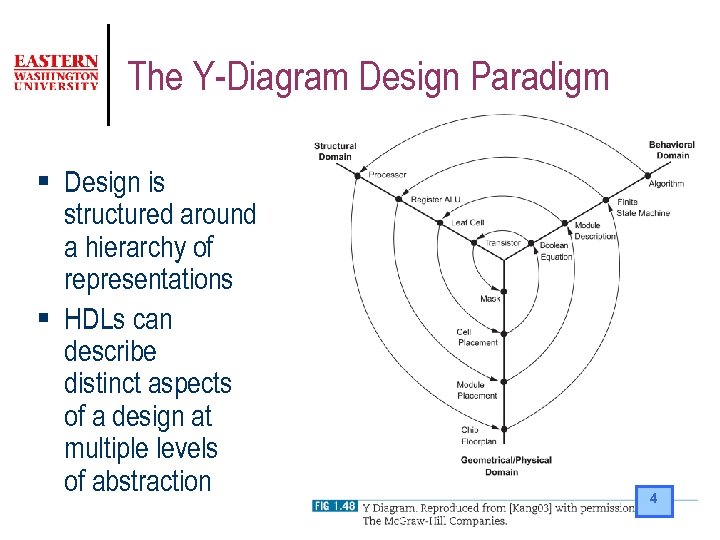 The Y-Diagram Design Paradigm § Design is structured around a hierarchy of representations § HDLs can describe distinct aspects of a design at multiple levels of abstraction 4
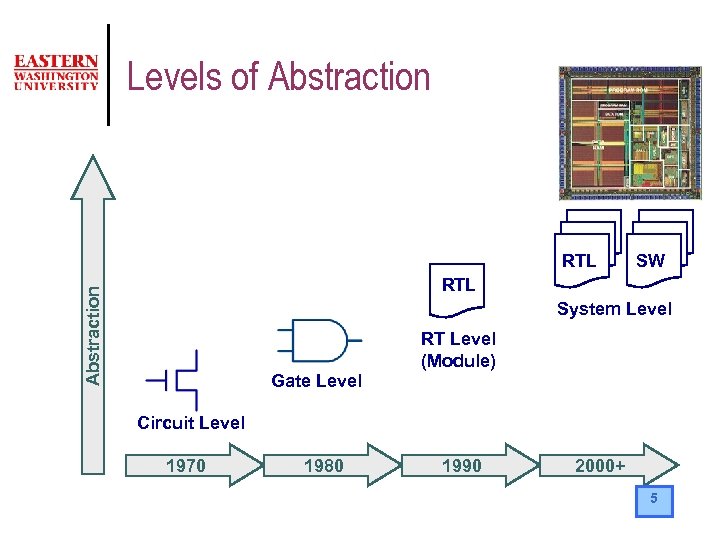 Levels of Abstraction RTL SW Abstraction RTL System Level RT Level (Module) Gate Level Circuit Level 1970 1980 1990 2000+ 5
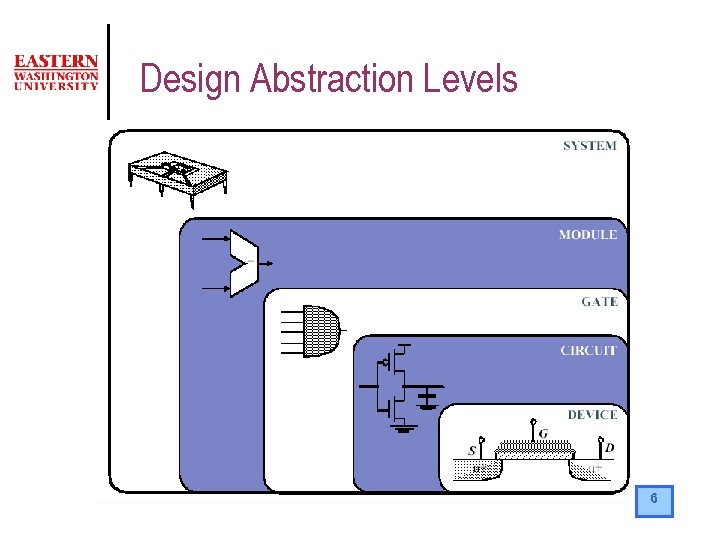 Design Abstraction Levels 6
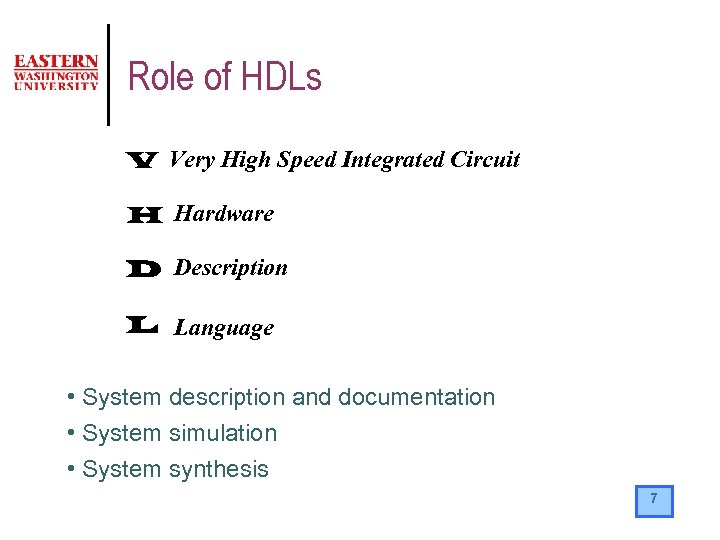 Role of HDLs V Very High Speed Integrated Circuit H Hardware D Description L Language • System description and documentation • System simulation • System synthesis 7
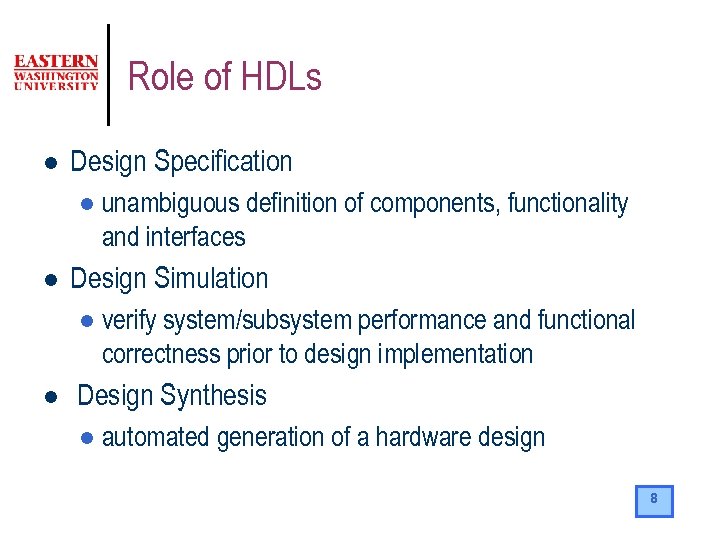 Role of HDLs l Design Specification l l Design Simulation l l unambiguous definition of components, functionality and interfaces verify system/subsystem performance and functional correctness prior to design implementation Design Synthesis l automated generation of a hardware design 8
 HDL Benefits l Technology independence l l portability Reuse l Interoperability between multiple levels of abstractions Cost reduction l Higher Level of Abstraction (hiding details) l l The design task become simpler The design is less error prone Productivity is increased 9
 HDL coding Styles l l l Register Transfer Level Structural Behavioral Be careful NOT everybody gives the same meaning to the term BEHAVIORAL ! 10
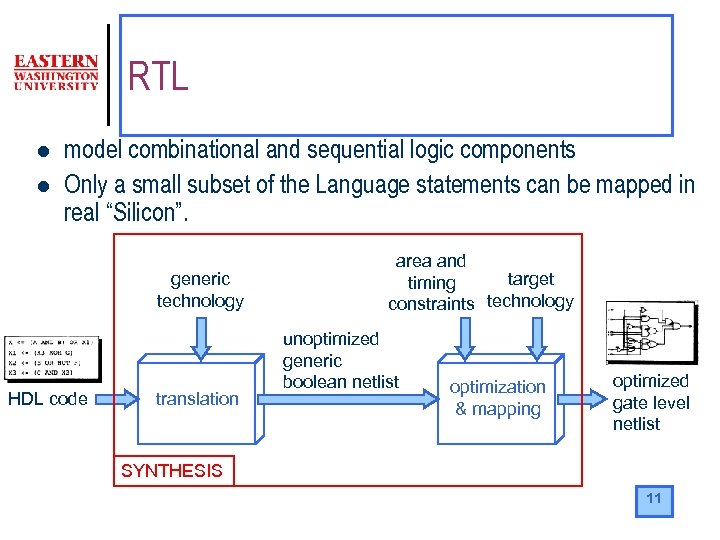 RTL l l model combinational and sequential logic components Only a small subset of the Language statements can be mapped in real “Silicon”. generic technology HDL code translation area and target timing constraints technology unoptimized generic boolean netlist optimization & mapping optimized gate level netlist SYNTHESIS 11
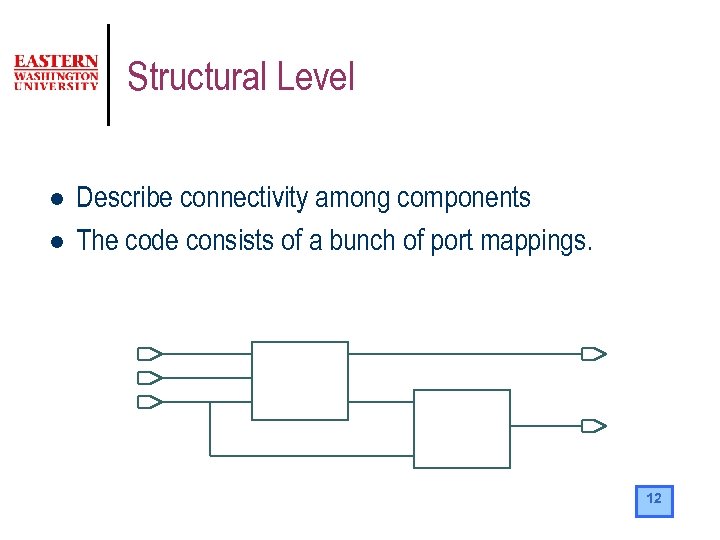 Structural Level l l Describe connectivity among components The code consists of a bunch of port mappings. 12
 Behavioral Level l l Describe behavior (functionality and performances) All language features can be used 13
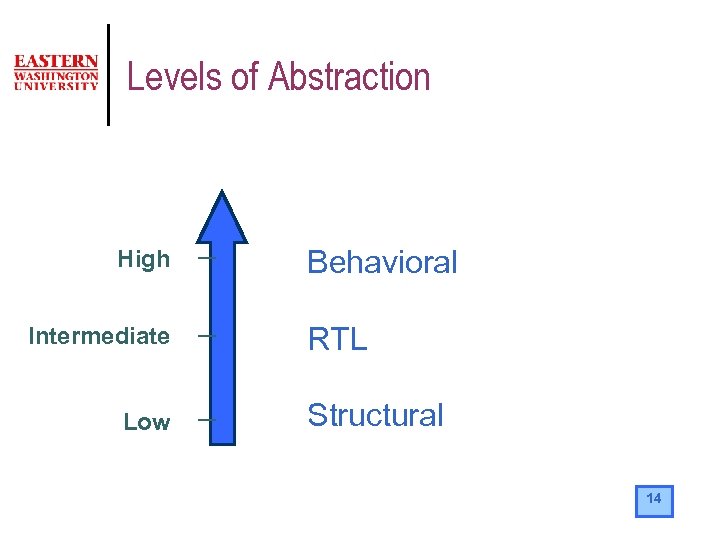 Levels of Abstraction High Intermediate Low Behavioral RTL Structural 14
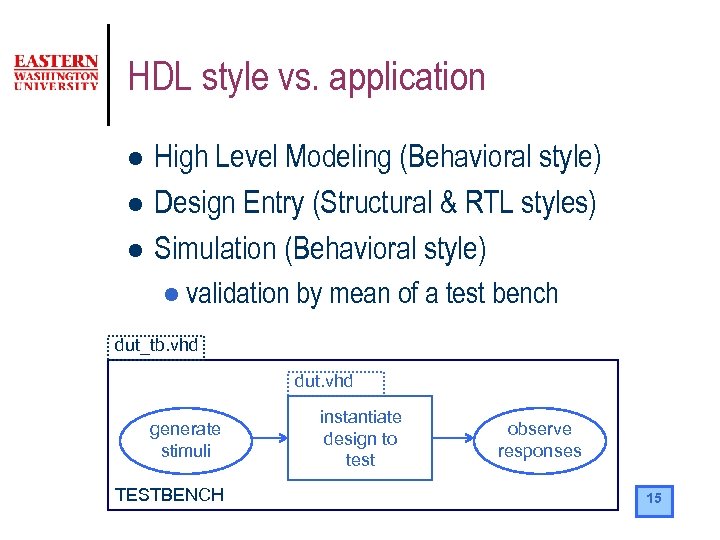 HDL style vs. application l l l High Level Modeling (Behavioral style) Design Entry (Structural & RTL styles) Simulation (Behavioral style) l validation by mean of a test bench dut_tb. vhd dut. vhd generate stimuli TESTBENCH instantiate design to test observe responses 15
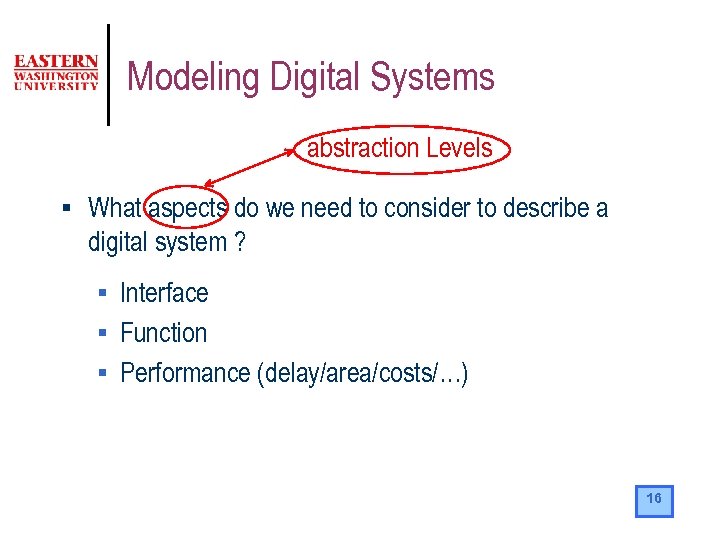 Modeling Digital Systems abstraction Levels § What aspects do we need to consider to describe a digital system ? § Interface § Function § Performance (delay/area/costs/…) 16
 Modeling Digital Systems l What are the attributes necessary to describe a digital systems ? l events, propagation delays, concurrency l waveforms and timing l signal values l shared signals 17
 Modeling Digital Systems l Hardware description languagesmust provide constructs for describing the attributes of a specific design, and … l Simulators use such descriptions for “mimicking” the physical system behavior Synthesis compilersuse such descriptions for synthesizing manufacturable hardware that conform to a given specification l 18
 HDLs vs. Software Languages Concurrent (parallel) Statements vs. Sequential Statements 19
 VHDL Design Organization l l l Entity the “symbol” (input/output ports) Architecture one of the several possible implementation of the design Configuration binding between the symbol and one of the many possible implementation. Can be used to express hierarchy. 20
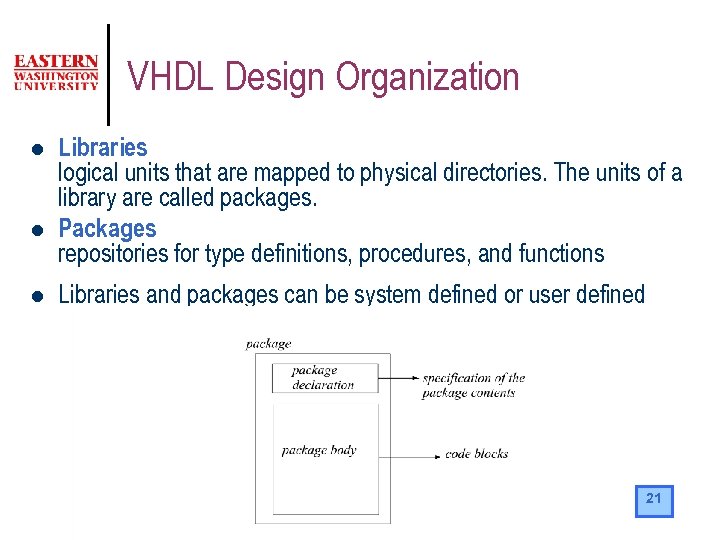 VHDL Design Organization l l l Libraries logical units that are mapped to physical directories. The units of a library are called packages. Packages repositories for type definitions, procedures, and functions Libraries and packages can be system defined or user defined 21
 Design Units l Primary design units(not dependent on other design units) l l Entity Configuration Package Declaration Secondary design units l l Package body Architecture l Design units are arranged in files l Now you know the layout of a VHDL program! 22
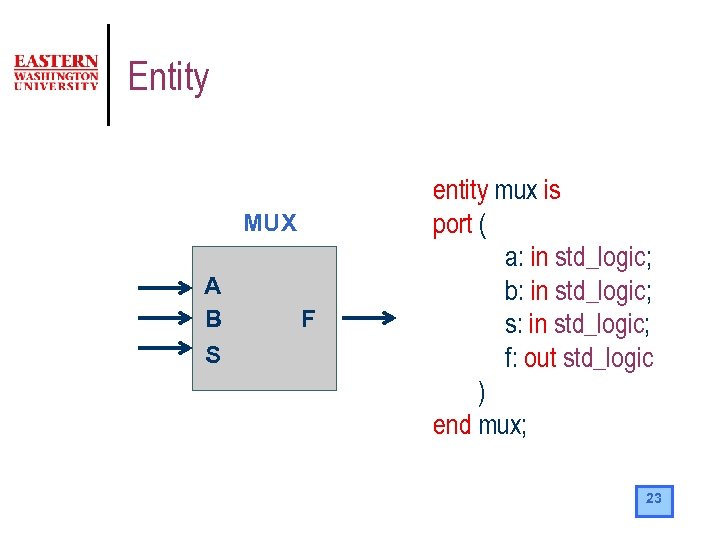 Entity MUX A B S F entity mux is port ( a: in std_logic; b: in std_logic; s: in std_logic; f: out std_logic ) end mux; 23
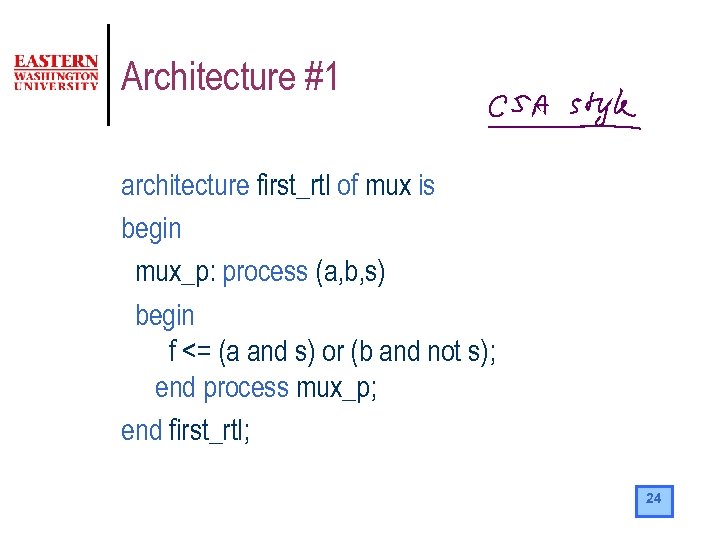 Architecture #1 architecture first_rtl of mux is begin mux_p: process (a, b, s) begin f <= (a and s) or (b and not s); end process mux_p; end first_rtl; 24
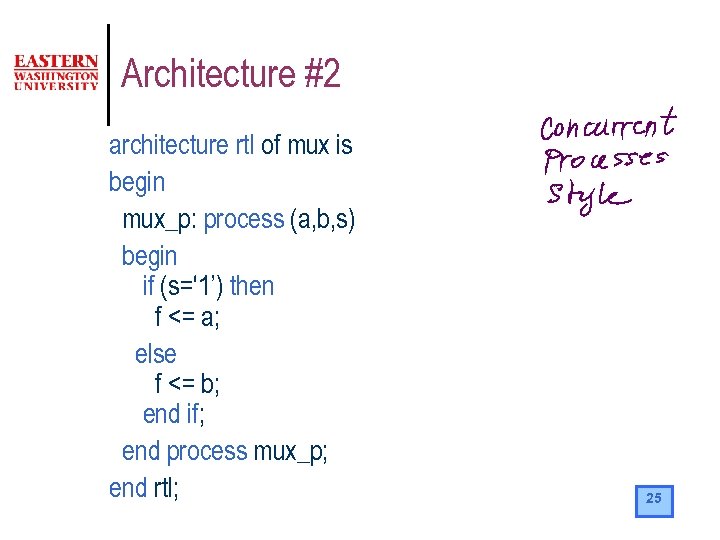 Architecture #2 architecture rtl of mux is begin mux_p: process (a, b, s) begin if (s=‘ 1’) then f <= a; else f <= b; end if; end process mux_p; end rtl; 25
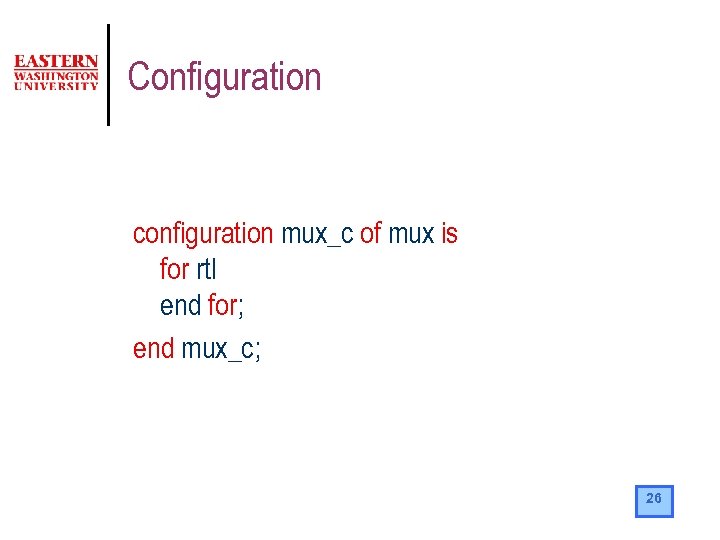 Configuration configuration mux_c of mux is for rtl end for; end mux_c; 26
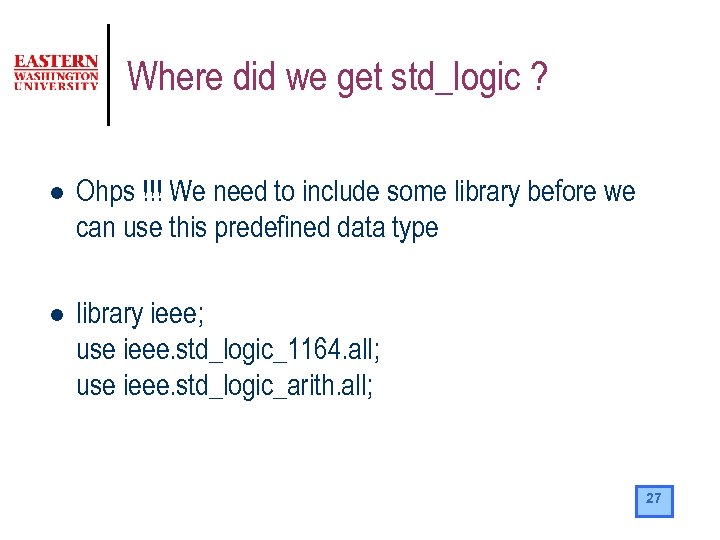 Where did we get std_logic ? l Ohps !!! We need to include some library before we can use this predefined data type l library ieee; use ieee. std_logic_1164. all; use ieee. std_logic_arith. all; 27
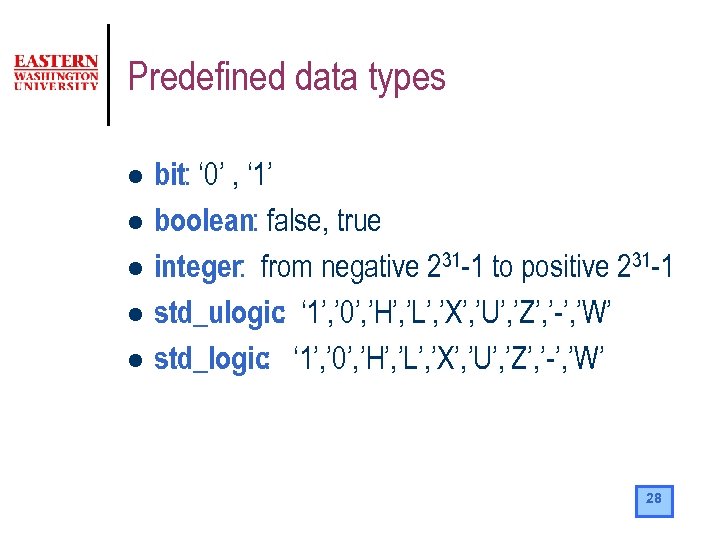 Predefined data types l l l bit: ‘ 0’ , ‘ 1’ boolean: false, true integer: from negative 231 -1 to positive 231 -1 std_ulogic ‘ 1’, ’ 0’, ’H’, ’L’, ’X’, ’U’, ’Z’, ’-’, ’W’ : std_logic: ‘ 1’, ’ 0’, ’H’, ’L’, ’X’, ’U’, ’Z’, ’-’, ’W’ 28
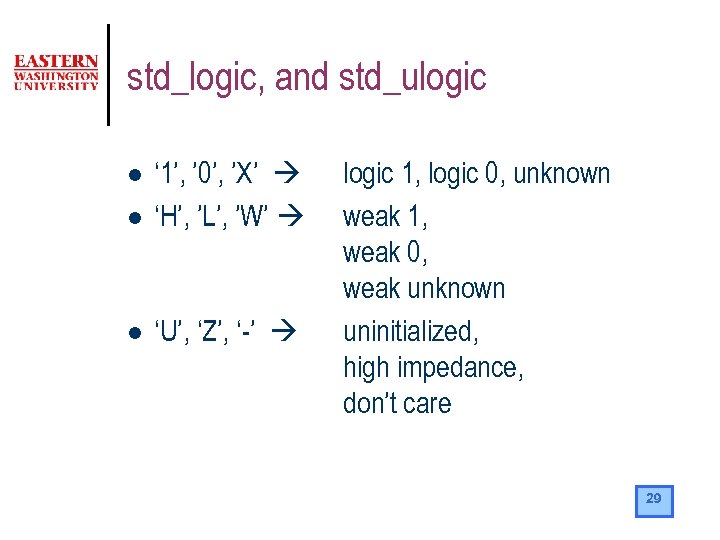 std_logic, and std_ulogic l ‘ 1’, ’ 0’, ’X’ ‘H’, ’L’, ’W’ l ‘U’, ‘Z’, ‘-’ l logic 1, logic 0, unknown weak 1, weak 0, weak unknown uninitialized, high impedance, don’t care 29
 resolved or unresolved ? l l l VHDL Driver – it is one contributor to the final value of a signal Drivers are created by concurrent signal assignments Recommendation: use std_logic, but always check that you do not have any multiple drivers (you don’t want any wired OR inside an ASIC !!!) 30
 What is a process ? l l A process statement is a concurrent statement, but all statements contained in it are sequential statement (statements that executes serially, one after the other). The use of processes makes your code more modular, more readable, and allows you to separate combinational logic from sequential logic. 31
 The sensitivity list l List of all signals that the process is sensitive to. Sensitive means that a change in the value of these signals will cause the process to be invoked. 32
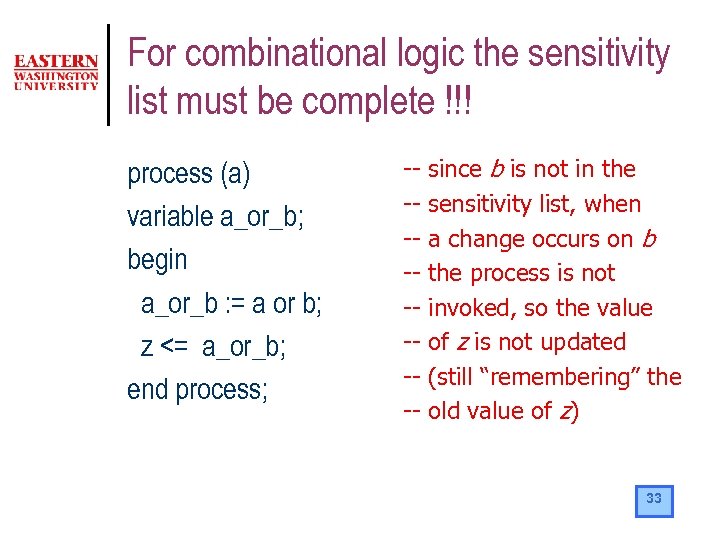 For combinational logic the sensitivity list must be complete !!! process (a) variable a_or_b; begin a_or_b : = a or b; z <= a_or_b; end process; ----- since b is not in the sensitivity list, when a change occurs on b the process is not invoked, so the value of z is not updated (still “remembering” the old value of z) 33
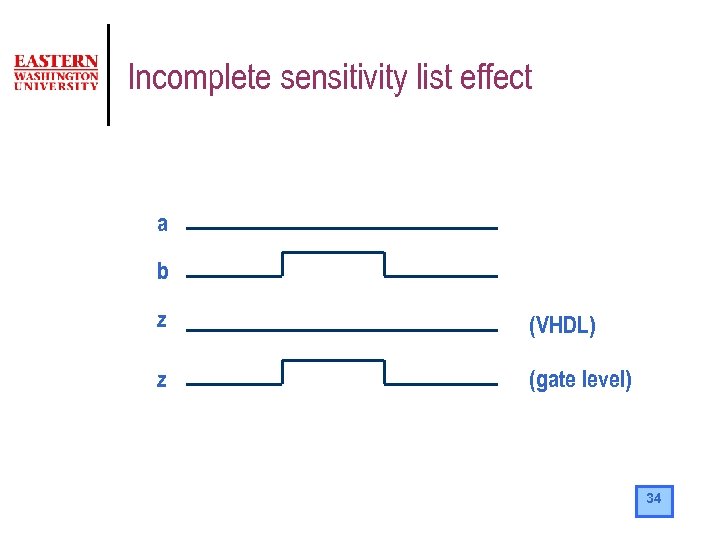 Incomplete sensitivity list effect a b z (VHDL) z (gate level) 34
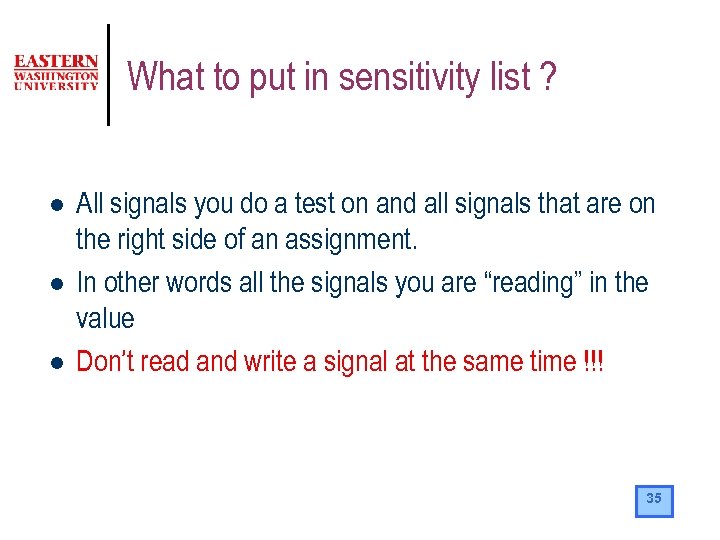 What to put in sensitivity list ? l l l All signals you do a test on and all signals that are on the right side of an assignment. In other words all the signals you are “reading” in the value Don’t read and write a signal at the same time !!! 35
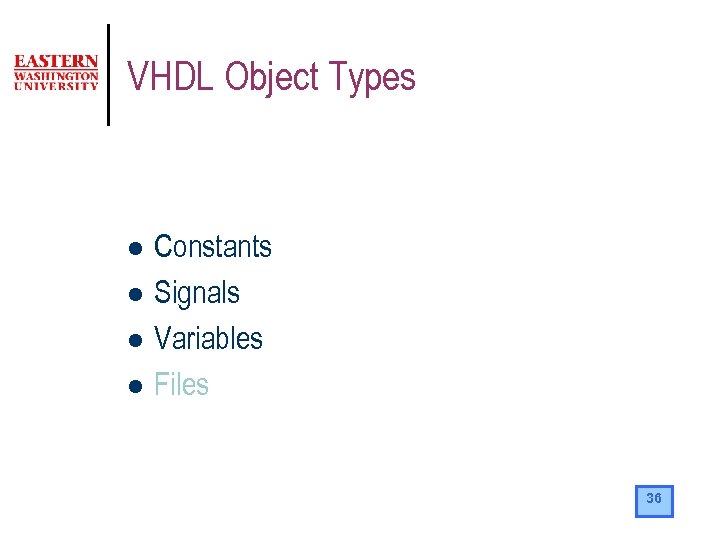 VHDL Object Types l l Constants Signals Variables Files 36
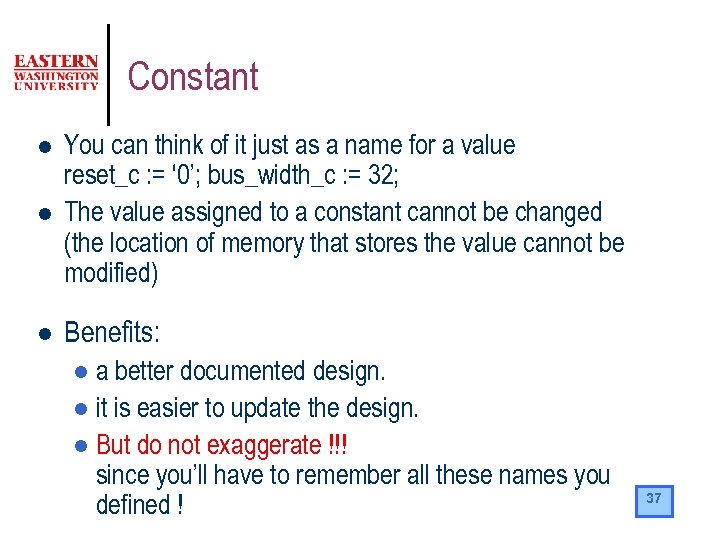 Constant l You can think of it just as a name for a value reset_c : = ‘ 0’; bus_width_c : = 32; The value assigned to a constant cannot be changed (the location of memory that stores the value cannot be modified) l Benefits: l a better documented design. l it is easier to update the design. l But do not exaggerate !!! since you’ll have to remember all these names you defined ! l 37
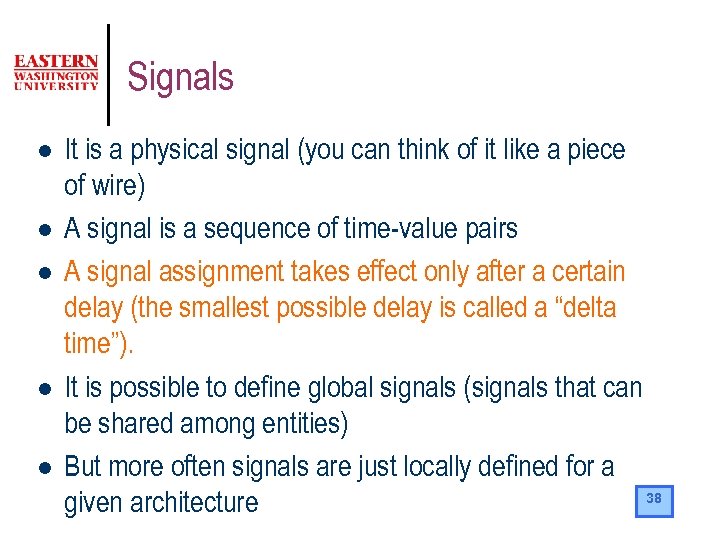 Signals l l l It is a physical signal (you can think of it like a piece of wire) A signal is a sequence of time-value pairs A signal assignment takes effect only after a certain delay (the smallest possible delay is called a “delta time”). It is possible to define global signals (signals that can be shared among entities) But more often signals are just locally defined for a 38 given architecture
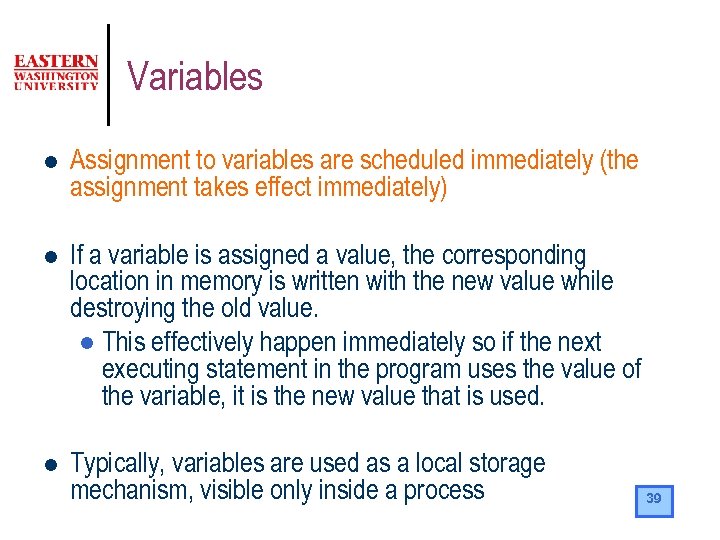 Variables l Assignment to variables are scheduled immediately (the assignment takes effect immediately) l If a variable is assigned a value, the corresponding location in memory is written with the new value while destroying the old value. l This effectively happen immediately so if the next executing statement in the program uses the value of the variable, it is the new value that is used. l Typically, variables are used as a local storage mechanism, visible only inside a process 39
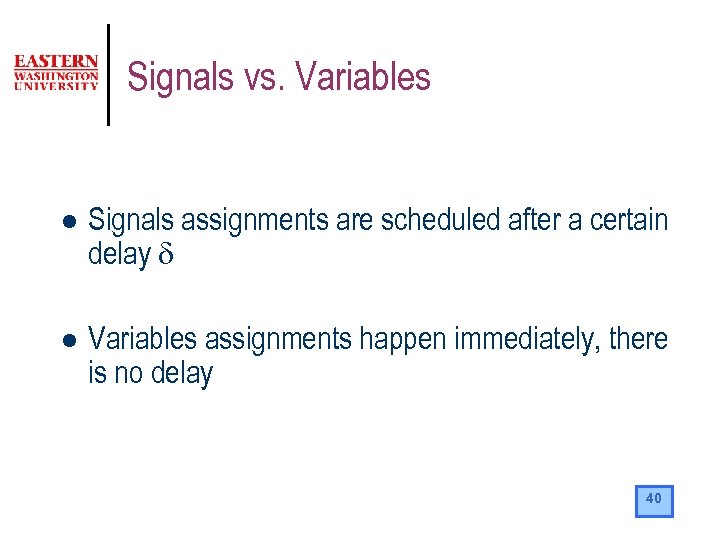 Signals vs. Variables l Signals assignments are scheduled after a certain delay d l Variables assignments happen immediately, there is no delay 40
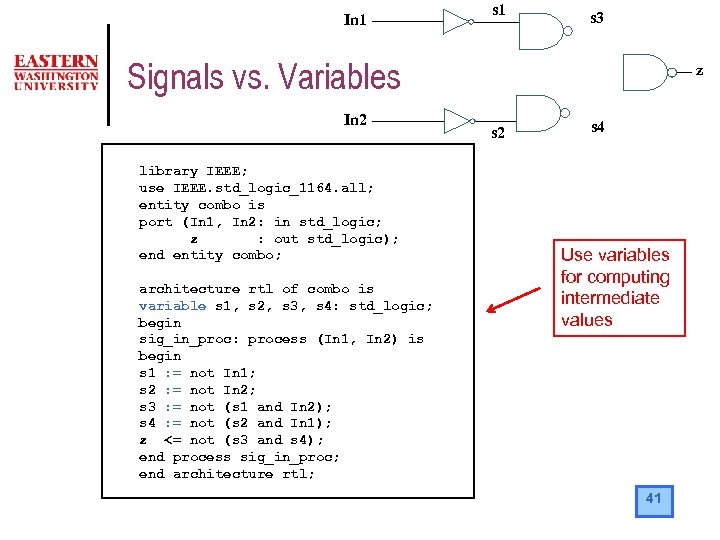 In 1 s 3 Signals vs. Variables In 2 library IEEE; use IEEE. std_logic_1164. all; entity combo is port (In 1, In 2: in std_logic; z : out std_logic); end entity combo; architecture rtl of combo is variable s 1, s 2, s 3, s 4: std_logic; begin sig_in_proc: process (In 1, In 2) is begin s 1 : = not In 1; s 2 : = not In 2; s 3 : = not (s 1 and In 2); s 4 : = not (s 2 and In 1); z <= not (s 3 and s 4); end process sig_in_proc; end architecture rtl; z s 2 s 4 Use variables for computing intermediate values 41
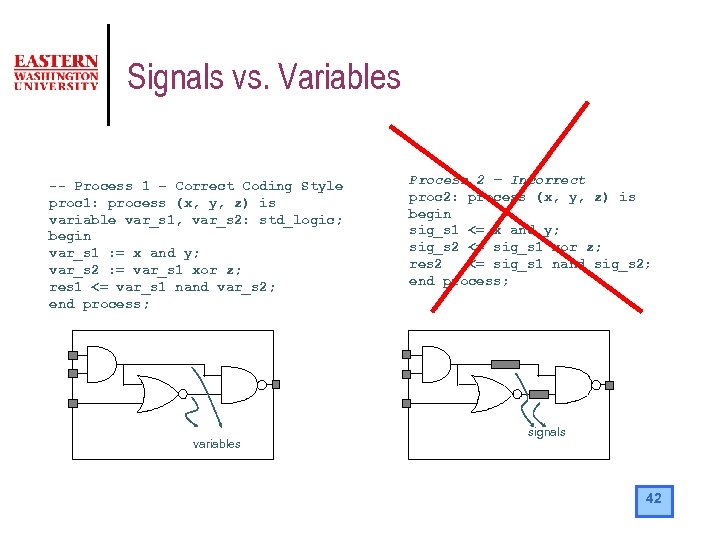 Signals vs. Variables -- Process 1 – Correct Coding Style proc 1: process (x, y, z) is variable var_s 1, var_s 2: std_logic; begin var_s 1 : = x and y; var_s 2 : = var_s 1 xor z; res 1 <= var_s 1 nand var_s 2; end process; variables Process 2 – Incorrect proc 2: process (x, y, z) is begin sig_s 1 <= x and y; sig_s 2 <= sig_s 1 xor z; res 2 <= sig_s 1 nand sig_s 2; end process; signals 42
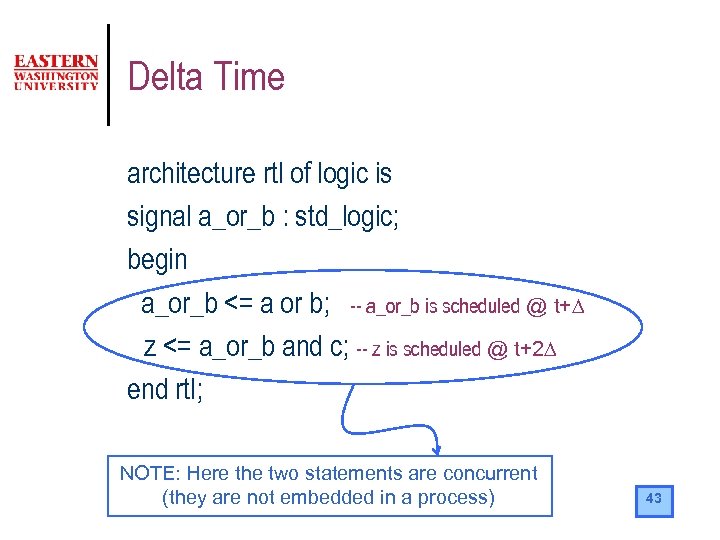 Delta Time architecture rtl of logic is signal a_or_b : std_logic; begin a_or_b <= a or b; -- a_or_b is scheduled @ t+D z <= a_or_b and c; -- z is scheduled @ t+2 D end rtl; NOTE: Here the two statements are concurrent (they are not embedded in a process) 43
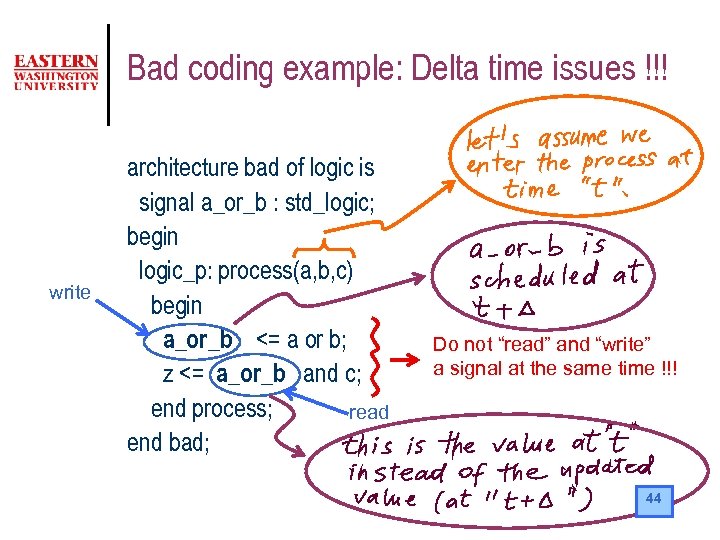 Bad coding example: Delta time issues !!! write architecture bad of logic is signal a_or_b : std_logic; begin logic_p: process(a, b, c) begin a_or_b <= a or b; z <= a_or_b and c; end process; read end bad; Do not “read” and “write” a signal at the same time !!! 44
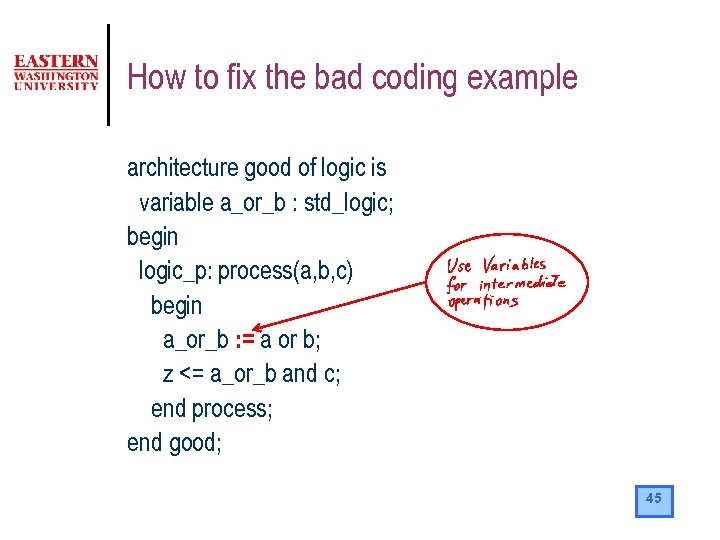 How to fix the bad coding example architecture good of logic is variable a_or_b : std_logic; begin logic_p: process(a, b, c) begin a_or_b : = a or b; z <= a_or_b and c; end process; end good; 45
 Packages l Packages offers a mechanism to globally define and share values, types, components, functions and procedures that are commonly used. l package declaration and package body 46
 Subprograms l Procedures can return more than one value (they can have both input and output parameters) l Functions return always just one value (can have only input parameters) Example: conversion functions, resolution functions, … 47
 Attributes l l Info attached to VHDL objects Some predefined attributes: ‘left ‘right ‘high ‘low ‘length ‘event ‘range the leftmost value of a type the greatest value of a type the number of elements in an array a change on a signal or variable the range of the elements of an array object 48
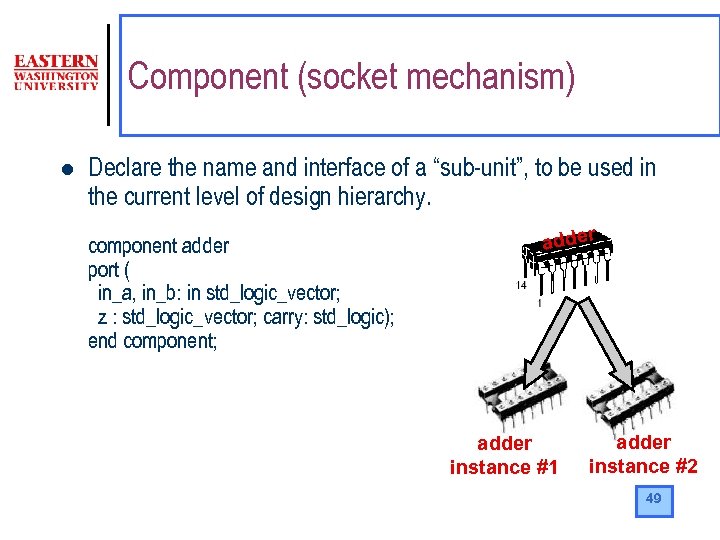 Component (socket mechanism) l Declare the name and interface of a “sub-unit”, to be used in the current level of design hierarchy. component adder port ( in_a, in_b: in std_logic_vector; z : std_logic_vector; carry: std_logic); end component; adder instance #1 adder instance #2 49
 Elements of structural models l Structural models describe a digital system as an interconnection of components l An entity/architecture for each component must be independently available 50
 Structural models l Structural models are always “built” as follows: Define the components used in the design l Describe the interconnection of these components l l Structural models can be easily generated (automatically) from schematics l Structural descriptions can be nested 51
 Hierarchy and Abstraction l Structural modeling expresses the hierarchical nature of designs and provides a mechanism for the instantiation and reuse of cores 52
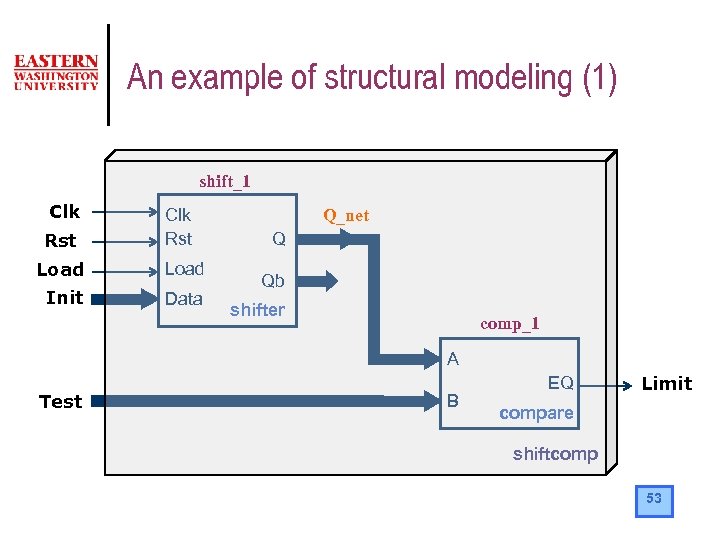 An example of structural modeling (1) shift_1 Clk Rst Load Init Data Q_net Q Qb shifter comp_1 A Test B EQ Limit compare shiftcomp 53
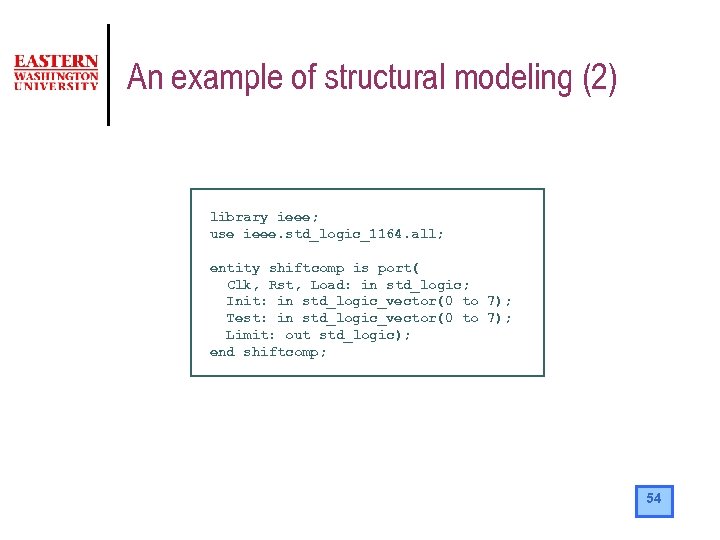 An example of structural modeling (2) library ieee; use ieee. std_logic_1164. all; entity shiftcomp is port( Clk, Rst, Load: in std_logic; Init: in std_logic_vector(0 to 7); Test: in std_logic_vector(0 to 7); Limit: out std_logic); end shiftcomp; 54
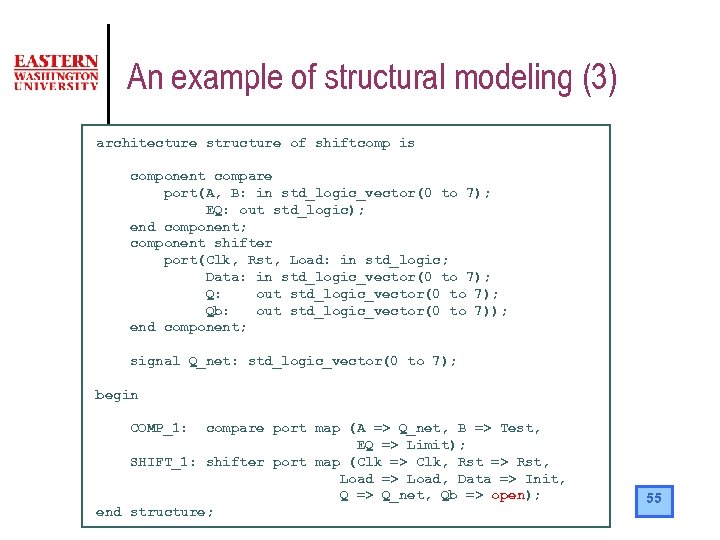 An example of structural modeling (3) architecture structure of shiftcomp is component compare port(A, B: in std_logic_vector(0 to 7); EQ: out std_logic); end component; component shifter port(Clk, Rst, Load: in std_logic; Data: in std_logic_vector(0 to 7); Q: out std_logic_vector(0 to 7); Qb: out std_logic_vector(0 to 7)); end component; signal Q_net: std_logic_vector(0 to 7); begin COMP_1: compare port map (A => Q_net, B => Test, EQ => Limit); SHIFT_1: shifter port map (Clk => Clk, Rst => Rst, Load => Load, Data => Init, Q => Q_net, Qb => open); 55 end structure;
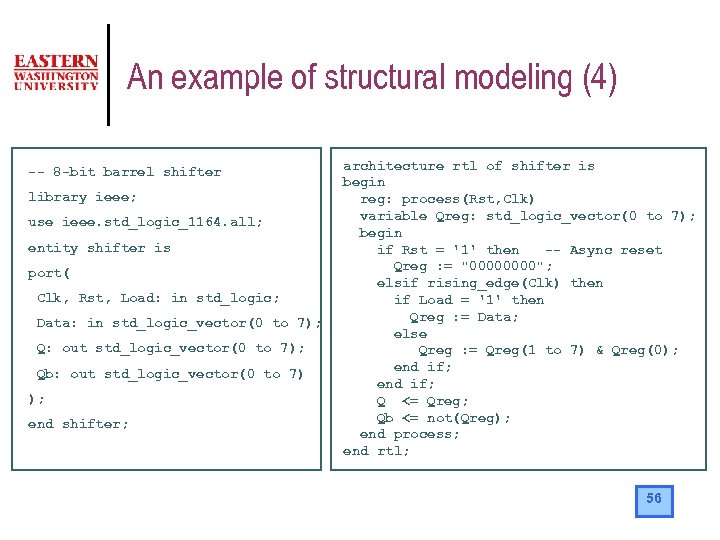 An example of structural modeling (4) -- 8 -bit barrel shifter library ieee; use ieee. std_logic_1164. all; entity shifter is port( Clk, Rst, Load: in std_logic; Data: in std_logic_vector(0 to 7); Q: out std_logic_vector(0 to 7); Qb: out std_logic_vector(0 to 7) ); end shifter; architecture rtl of shifter is begin reg: process(Rst, Clk) variable Qreg: std_logic_vector(0 to 7); begin if Rst = '1' then -- Async reset Qreg : = "0000"; elsif rising_edge(Clk) then if Load = '1' then Qreg : = Data; else Qreg : = Qreg(1 to 7) & Qreg(0); end if; Q <= Qreg; Qb <= not(Qreg); end process; end rtl; 56
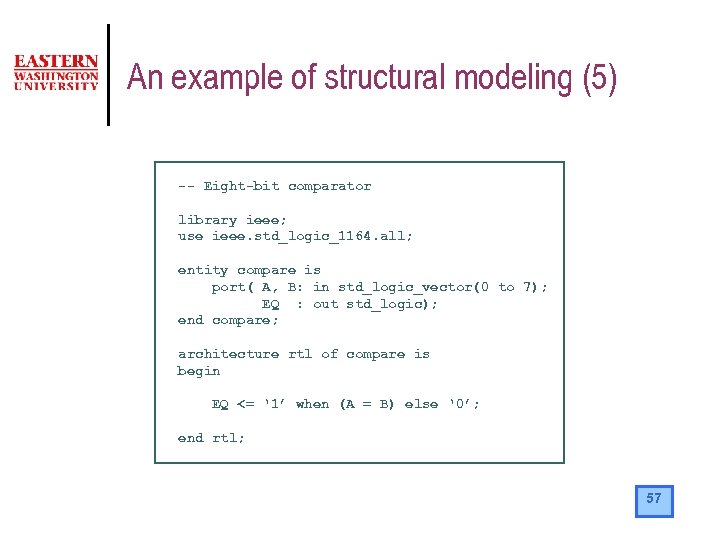 An example of structural modeling (5) -- Eight-bit comparator library ieee; use ieee. std_logic_1164. all; entity compare is port( A, B: in std_logic_vector(0 to 7); EQ : out std_logic); end compare; architecture rtl of compare is begin EQ <= ‘ 1’ when (A = B) else ‘ 0’; end rtl; 57
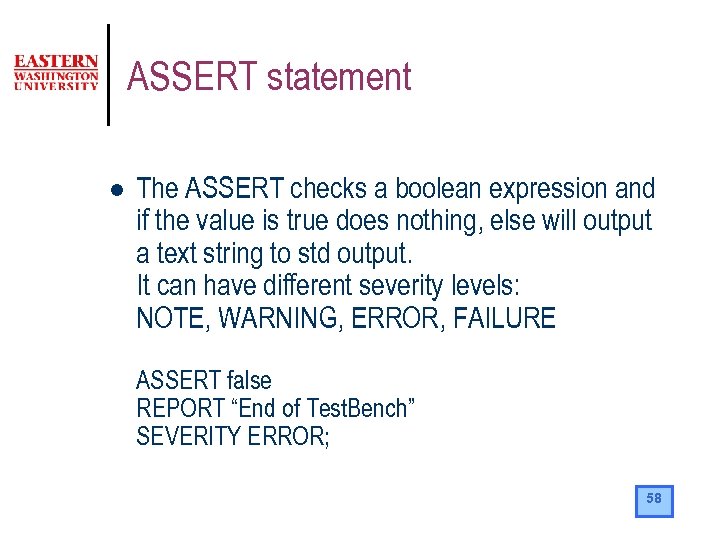 ASSERT statement l The ASSERT checks a boolean expression and if the value is true does nothing, else will output a text string to std output. It can have different severity levels: NOTE, WARNING, ERROR, FAILURE ASSERT false REPORT “End of Test. Bench” SEVERITY ERROR; 58
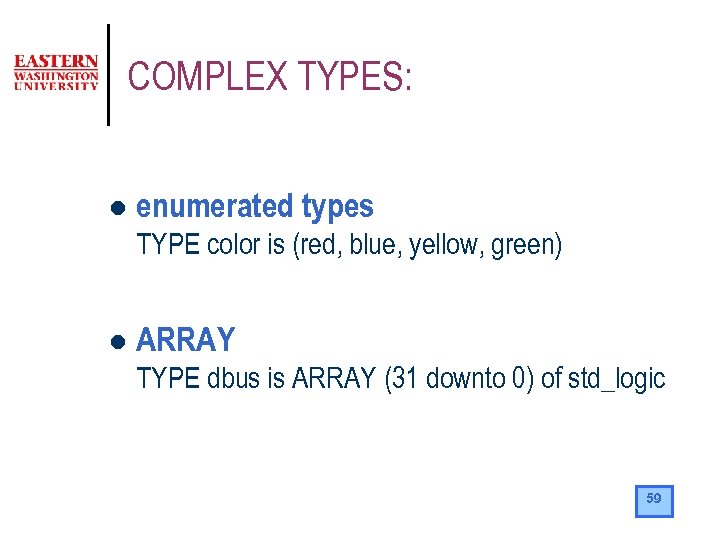 COMPLEX TYPES: l enumerated types TYPE color is (red, blue, yellow, green) l ARRAY TYPE dbus is ARRAY (31 downto 0) of std_logic 59
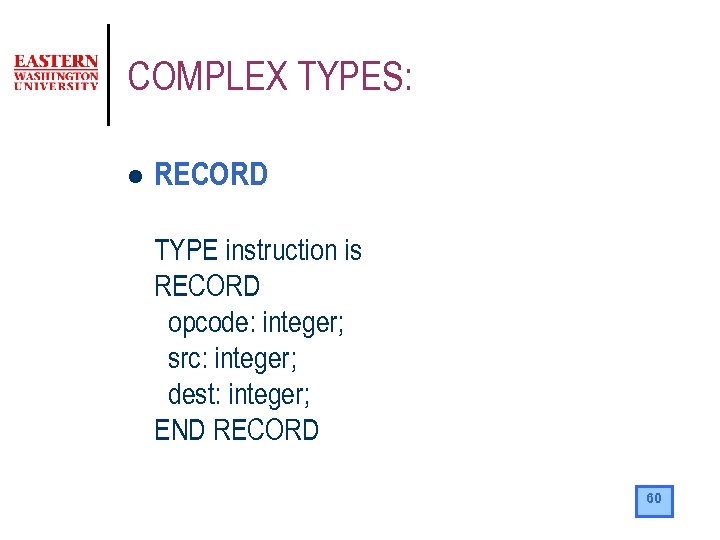 COMPLEX TYPES: l RECORD TYPE instruction is RECORD opcode: integer; src: integer; dest: integer; END RECORD 60
 COMPLEX TYPES: l FILE TYPE ram_data_file_t IS FILE OF INTEGER; FILE ram_data_file : ram_data_file_t IS IN “/claudio/vhdl/tb/ram. txt” 61
 More on FILEs l l use std. textio. all; READ, WRITE, READLINE, WRITELINE, ENDFILE, … 62
 Advanced Topics l VHDL supports overloading 63