 Скачать презентацию VEX units of work UNIT 1 TUMBLER UNIT
a1d7b0a26a7af164d9c143ee95478374.ppt
- Количество слайдов: 17



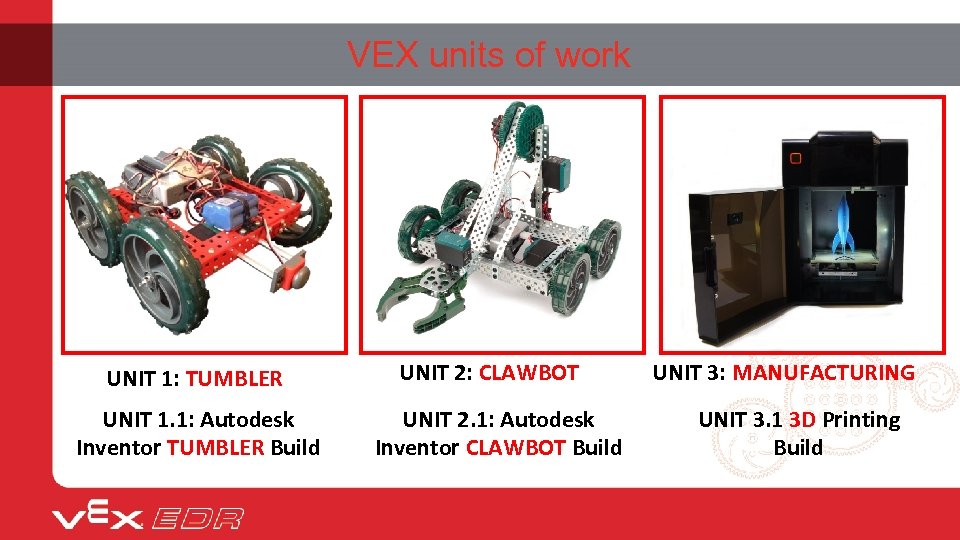
VEX units of work UNIT 1: TUMBLER UNIT 1. 1: Autodesk Inventor TUMBLER Build UNIT 2: CLAWBOT UNIT 2. 1: Autodesk Inventor CLAWBOT Build UNIT 3: MANUFACTURING UNIT 3. 1 3 D Printing Build
Project Overview § § § An introduction to 3 D printing Designing 3 D printing parts Redesigning the Clawbot 3 D printing new Claw components Assembling & Testing 3 D printed components Open 3 D printing design challenge
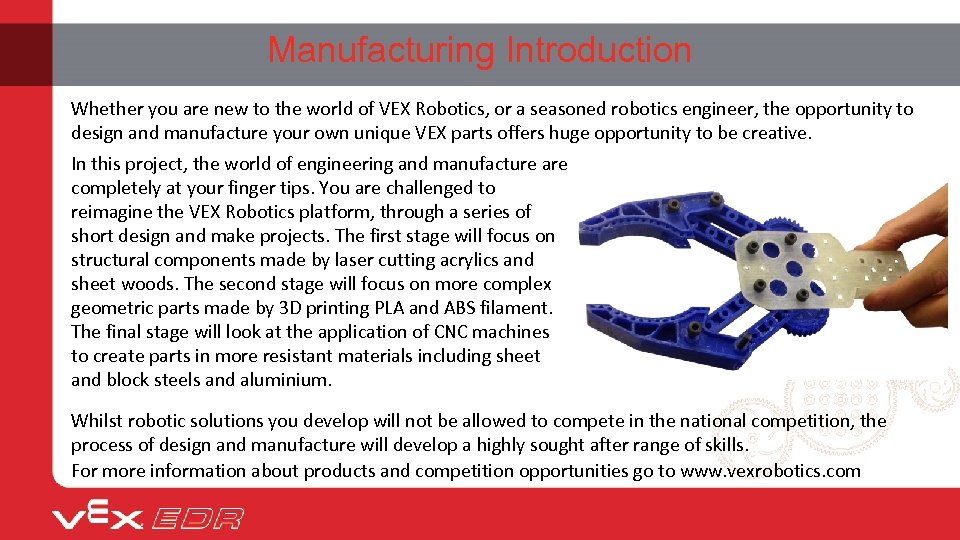
Manufacturing Introduction Whether you are new to the world of VEX Robotics, or a seasoned robotics engineer, the opportunity to design and manufacture your own unique VEX parts offers huge opportunity to be creative. In this project, the world of engineering and manufacture are completely at your finger tips. You are challenged to reimagine the VEX Robotics platform, through a series of short design and make projects. The first stage will focus on structural components made by laser cutting acrylics and sheet woods. The second stage will focus on more complex geometric parts made by 3 D printing PLA and ABS filament. The final stage will look at the application of CNC machines to create parts in more resistant materials including sheet and block steels and aluminium. Whilst robotic solutions you develop will not be allowed to compete in the national competition, the process of design and manufacture will develop a highly sought after range of skills. For more information about products and competition opportunities go to www. vexrobotics. com
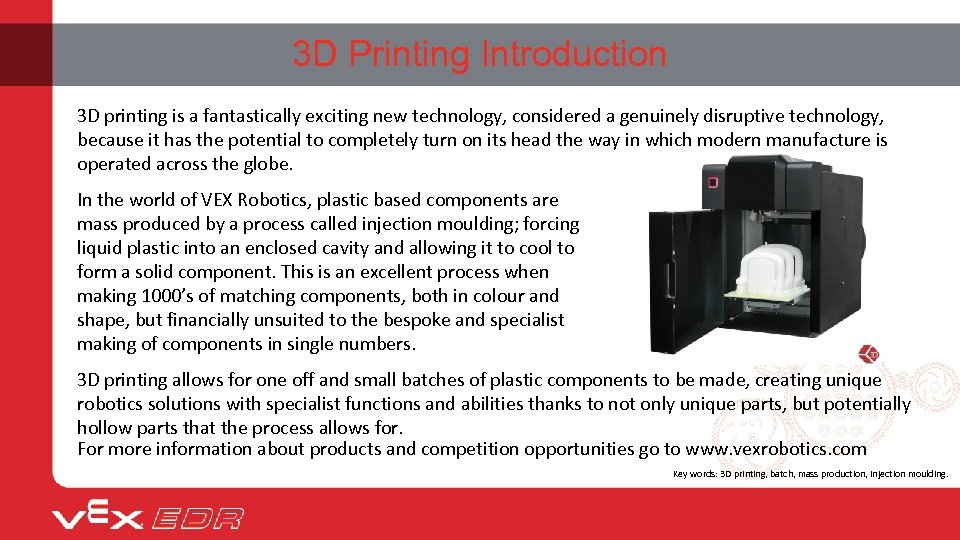
3 D Printing Introduction 3 D printing is a fantastically exciting new technology, considered a genuinely disruptive technology, because it has the potential to completely turn on its head the way in which modern manufacture is operated across the globe. In the world of VEX Robotics, plastic based components are mass produced by a process called injection moulding; forcing liquid plastic into an enclosed cavity and allowing it to cool to form a solid component. This is an excellent process when making 1000’s of matching components, both in colour and shape, but financially unsuited to the bespoke and specialist making of components in single numbers. 3 D printing allows for one off and small batches of plastic components to be made, creating unique robotics solutions with specialist functions and abilities thanks to not only unique parts, but potentially hollow parts that the process allows for. For more information about products and competition opportunities go to www. vexrobotics. com Key words: 3 D printing, batch, mass production, injection moulding.
LESSON 01
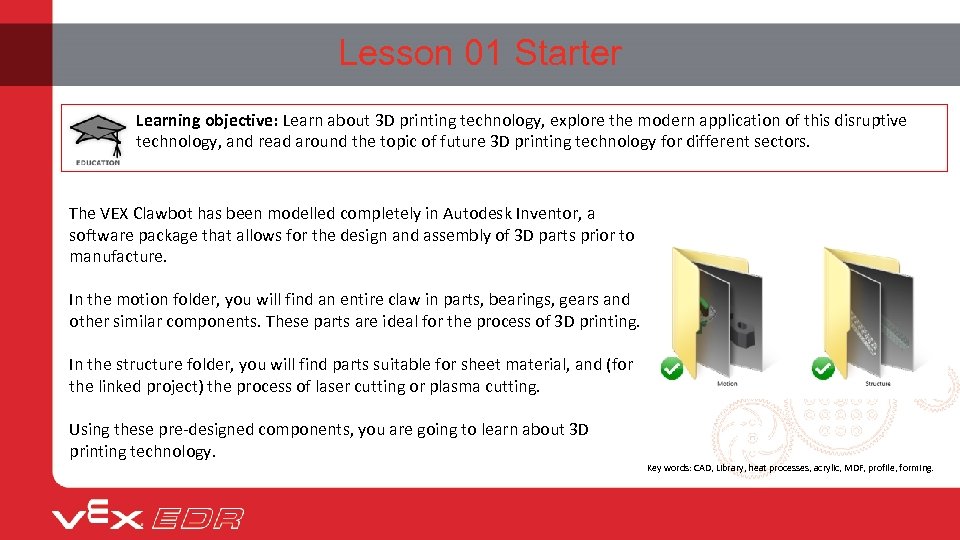
Lesson 01 Starter Learning objective: Learn about 3 D printing technology, explore the modern application of this disruptive technology, and read around the topic of future 3 D printing technology for different sectors. The VEX Clawbot has been modelled completely in Autodesk Inventor, a software package that allows for the design and assembly of 3 D parts prior to manufacture. In the motion folder, you will find an entire claw in parts, bearings, gears and other similar components. These parts are ideal for the process of 3 D printing. In the structure folder, you will find parts suitable for sheet material, and (for the linked project) the process of laser cutting or plasma cutting. Using these pre-designed components, you are going to learn about 3 D printing technology. Key words: CAD, Library, heat processes, acrylic, MDF, profile, forming.
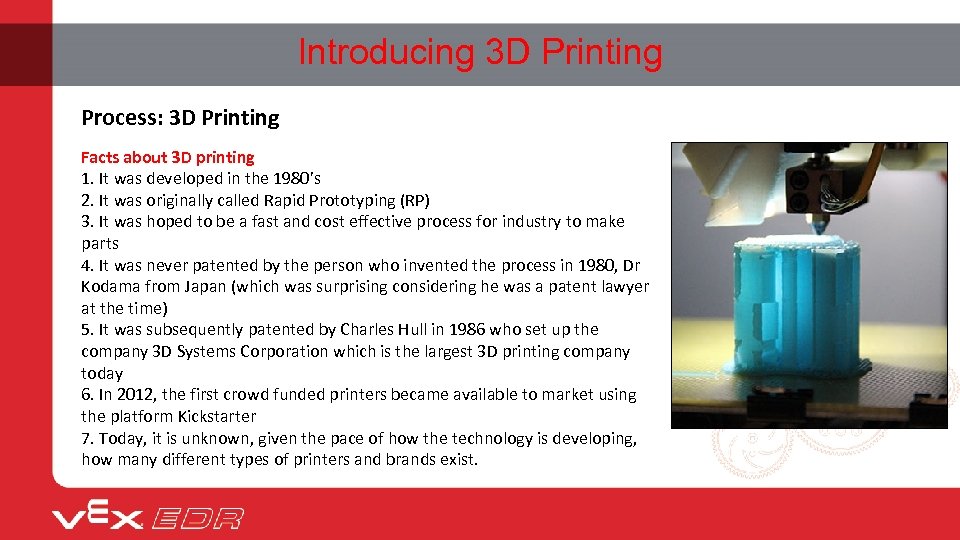
Introducing 3 D Printing Process: 3 D Printing Facts about 3 D printing 1. It was developed in the 1980’s 2. It was originally called Rapid Prototyping (RP) 3. It was hoped to be a fast and cost effective process for industry to make parts 4. It was never patented by the person who invented the process in 1980, Dr Kodama from Japan (which was surprising considering he was a patent lawyer at the time) 5. It was subsequently patented by Charles Hull in 1986 who set up the company 3 D Systems Corporation which is the largest 3 D printing company today 6. In 2012, the first crowd funded printers became available to market using the platform Kickstarter 7. Today, it is unknown, given the pace of how the technology is developing, how many different types of printers and brands exist.
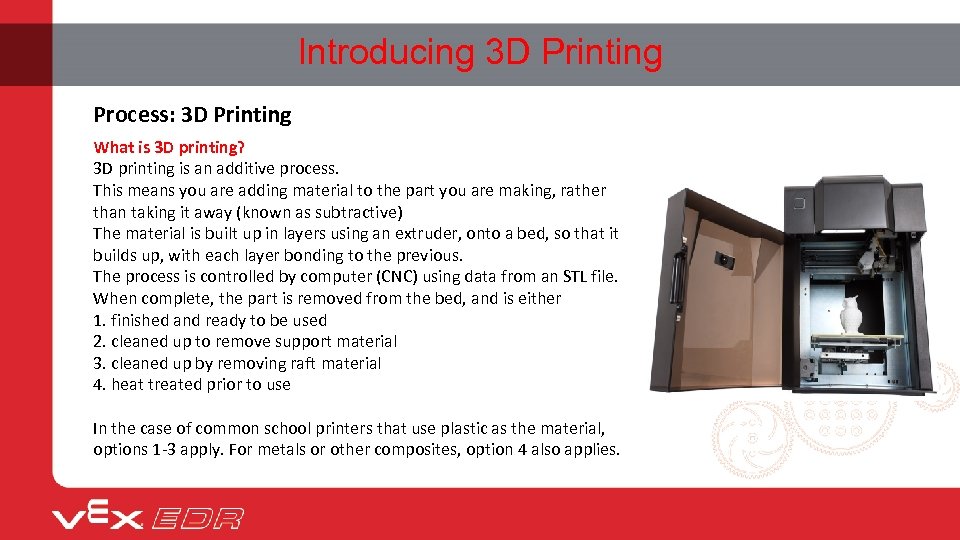
Introducing 3 D Printing Process: 3 D Printing What is 3 D printing? 3 D printing is an additive process. This means you are adding material to the part you are making, rather than taking it away (known as subtractive) The material is built up in layers using an extruder, onto a bed, so that it builds up, with each layer bonding to the previous. The process is controlled by computer (CNC) using data from an STL file. When complete, the part is removed from the bed, and is either 1. finished and ready to be used 2. cleaned up to remove support material 3. cleaned up by removing raft material 4. heat treated prior to use In the case of common school printers that use plastic as the material, options 1 -3 apply. For metals or other composites, option 4 also applies.
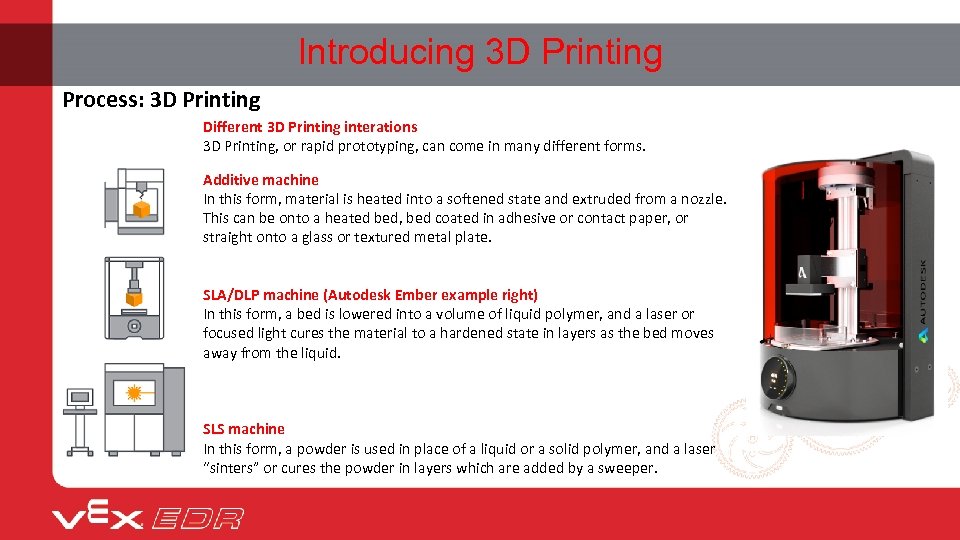
Introducing 3 D Printing Process: 3 D Printing Different 3 D Printing interations 3 D Printing, or rapid prototyping, can come in many different forms. Additive machine In this form, material is heated into a softened state and extruded from a nozzle. This can be onto a heated bed, bed coated in adhesive or contact paper, or straight onto a glass or textured metal plate. SLA/DLP machine (Autodesk Ember example right) In this form, a bed is lowered into a volume of liquid polymer, and a laser or focused light cures the material to a hardened state in layers as the bed moves away from the liquid. SLS machine In this form, a powder is used in place of a liquid or a solid polymer, and a laser “sinters” or cures the powder in layers which are added by a sweeper.
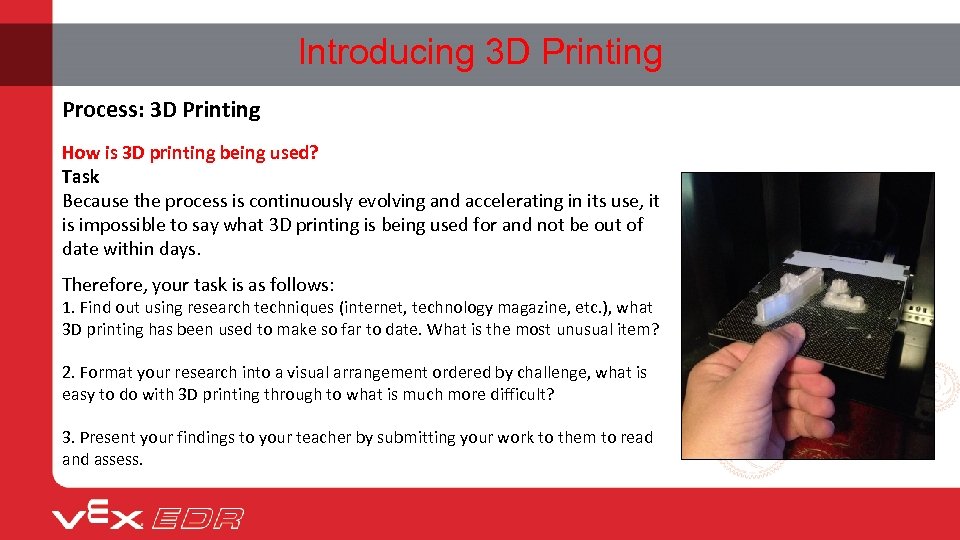
Introducing 3 D Printing Process: 3 D Printing How is 3 D printing being used? Task Because the process is continuously evolving and accelerating in its use, it is impossible to say what 3 D printing is being used for and not be out of date within days. Therefore, your task is as follows: 1. Find out using research techniques (internet, technology magazine, etc. ), what 3 D printing has been used to make so far to date. What is the most unusual item? 2. Format your research into a visual arrangement ordered by challenge, what is easy to do with 3 D printing through to what is much more difficult? 3. Present your findings to your teacher by submitting your work to them to read and assess.
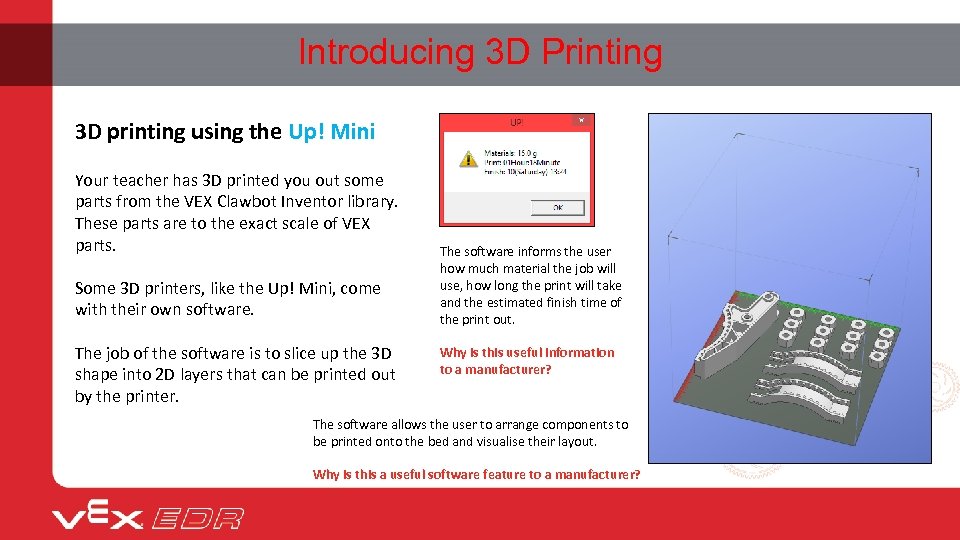
Introducing 3 D Printing 3 D printing using the Up! Mini Your teacher has 3 D printed you out some parts from the VEX Clawbot Inventor library. These parts are to the exact scale of VEX parts. Some 3 D printers, like the Up! Mini, come with their own software. The job of the software is to slice up the 3 D shape into 2 D layers that can be printed out by the printer. The software informs the user how much material the job will use, how long the print will take and the estimated finish time of the print out. Why is this useful information to a manufacturer? The software allows the user to arrange components to be printed onto the bed and visualise their layout. Why is this a useful software feature to a manufacturer?
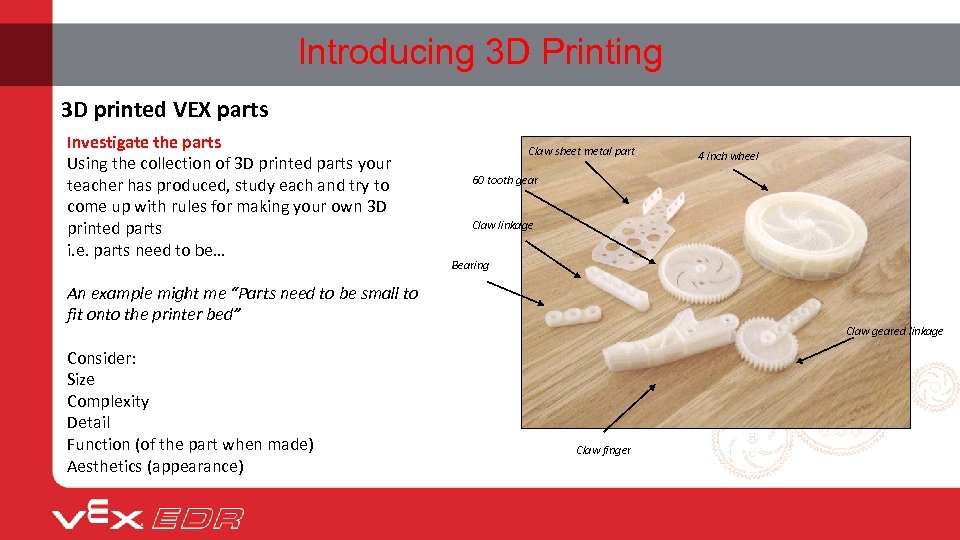
Introducing 3 D Printing 3 D printed VEX parts Investigate the parts Using the collection of 3 D printed parts your teacher has produced, study each and try to come up with rules for making your own 3 D printed parts i. e. parts need to be… Claw sheet metal part 60 tooth gear Claw linkage Bearing An example might me “Parts need to be small to fit onto the printer bed” Consider: Size Complexity Detail Function (of the part when made) Aesthetics (appearance) 4 inch wheel Claw geared linkage Claw finger
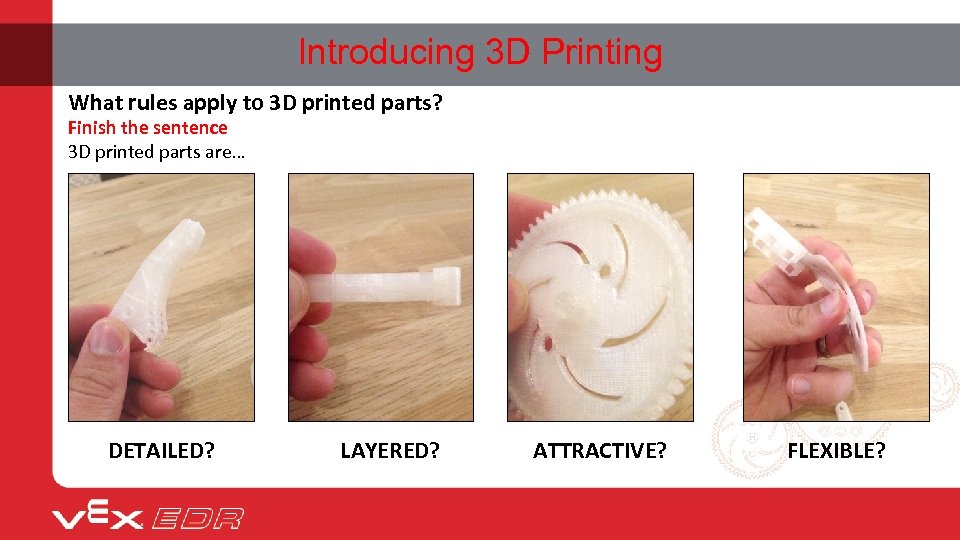
Introducing 3 D Printing What rules apply to 3 D printed parts? Finish the sentence 3 D printed parts are… DETAILED? LAYERED? ATTRACTIVE? FLEXIBLE?
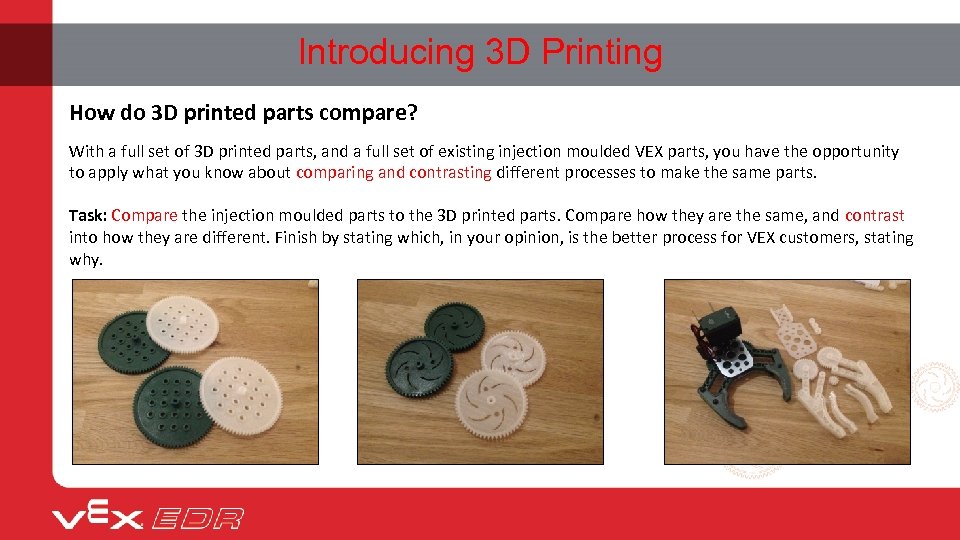
Introducing 3 D Printing How do 3 D printed parts compare? With a full set of 3 D printed parts, and a full set of existing injection moulded VEX parts, you have the opportunity to apply what you know about comparing and contrasting different processes to make the same parts. Task: Compare the injection moulded parts to the 3 D printed parts. Compare how they are the same, and contrast into how they are different. Finish by stating which, in your opinion, is the better process for VEX customers, stating why.
Lesson 01 – Plenary As a class, let us consider the following questions? A. How is 3 D printing so different from subtractive technology? B. How could 3 D printing make a positive impact on the environment? C. Who should be allowed to print out detailed product parts, the customer or the manufacture? D. Do you think there will be a 3 D printer in every home in the future?
Summary Learning objective: Learn about 3 D printing technology, explore the modern application of this disruptive technology, and read around the topic of future 3 D printing technology for different sectors. Today you have: § Learnt about 3 D printing technology focused around the Up! Mini 3 D printer. § Explored and studied the disruptive potential of 3 D printing technology. § Discovered the potential future opportunities for 3 D printing beyond design and engineering.
Скачать презентацию VEX units of work UNIT 1 TUMBLER UNIT
a1d7b0a26a7af164d9c143ee95478374.ppt