 Скачать презентацию Veterans Disability Benefits Compensation and Pension Robert Chisholm
5d93ba133394d5cab56fe45efce1b40b.ppt
- Количество слайдов: 111




Veterans’ Disability Benefits: Compensation and Pension Robert Chisholm & Kilpatrick Providence, R. I. 1
Who is a Veteran? • A veteran is a person who served in the active military, naval or air services, and who was discharged or released under conditions other than dishonorable. 38 U. S. C. § 101(2). – This also includes a person who served in the Coast Guard. 2
Veterans Statistics • As of September 2015, there approximately 21. 7 million veterans – Approximately 9% are women • About two thirds of this number are Vietnam Era veterans and Gulf War Era veterans – Source: Department of Veterans Affairs, as of September 2015 3
Veterans Statistics • Veterans enrolled in VA Health Care System: 8. 97 million • Veterans receiving Disability Compensation: 4. 26 million • Veterans Receiving VA Pension: 0. 29 million – Source: Department of Veterans Affairs, as of March 2016 4
Department of Veterans Affairs • Cabinet-level Agency of the U. S. government which provides healthcare, benefits, and compensation to veterans and their dependents • Secretary is David J. Shulkin, M. D. • Two major functions of the VA: 1. Veterans Health Administration (VHA) 2. Veterans Benefits Administration (VBA) 5

Main Types of VA Benefits • • • VA Compensation Benefits VA Pension Benefits VA Vocational Benefits Section 1151 Benefits Readjustment Benefits 6
VA Claim Levels of Jurisdiction 1. VA Regional Office – 56 VA ROs, which includes one in San Juan, Puerto Rico and one in Manila, Philippines 2. 3. 4. 5. Board of Veterans Appeals Court of Appeals for Veterans Claims Court of Appeals for the Federal Circuit United States Supreme Court 7
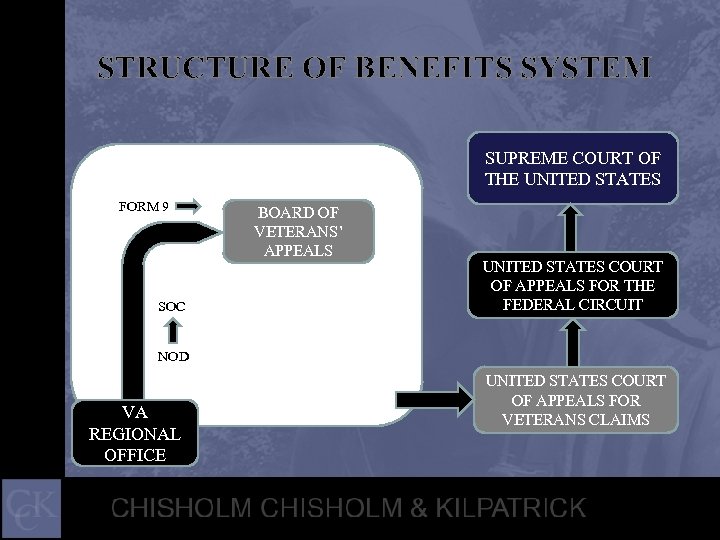
STRUCTURE OF BENEFITS SYSTEM SUPREME COURT OF THE UNITED STATES FORM 9 SOC BOARD OF VETERANS’ APPEALS UNITED STATES COURT OF APPEALS FOR THE FEDERAL CIRCUIT NOD VA REGIONAL OFFICE UNITED STATES COURT OF APPEALS FOR VETERANS CLAIMS 8
UNIQUE FEATURES OF THE ADMINISTRATIVE PROCESS q The veterans’ benefits system is a hybrid: administrative and judicial. q Judicial system is largely “normal” in that it is adversarial. q Administrative System is “non-adversarial” and pro-claimant. § Duty to Notify (38 U. S. C. § 5103) § Duty to Assist (38 U. S. C. § 5103 A) § Benefit of Doubt Rule (38 U. S. C. § 5107) § May introduce new evidence at any point. 9

Service Connection and Non-Service Connected Pension
Service Connection • The term "service-connected" means, with respect to disability or death, that such disability was incurred or aggravated, or that the death resulted from a disability incurred or aggravated, in line of duty in the active military, naval, or air service. – This excludes an injury or disease that is the result of a veteran’s own willful misconduct or abuse of alcohol or drugs. 11
Methods of Service Connection 1. 2. 3. 4. Direct service connection Presumptive service connection Secondary service connection Service connection by aggravation – Aggravation by military service – Aggravation by service-connected disability 12
Methods of Service Connection 5. Service connection based on paired organs and extremities 6. Service connection under 38 U. S. C. § 1151 – Due to disability or death from VA-provided hospitalization, medical or surgical care – Due to participation in a program of VAprovided vocational rehabilitation 13
Direct Service Connection • In general – an injury, disease, or disability that was incurred in service. • Establishing this requires: – (1) medical evidence of a current disability; – (2) lay or medical evidence of in-service incurrence of a disease, injury, or event; and – (3) medical evidence that links the current disability to the precipitating disease, injury, or event in service. 14
Direct Service Connection • In-service incurrence or event – What to look for? • Injury or hospitalization; • Event that occurred in service, such as an accident, attack, mistreatment, etc. ; • Behavioral issues, especially for psychiatric cases; • For PTSD claims: Stressor, and credible supporting evidence that the stressor occurred. • Medical Nexus – Need a link between service and current disability; – VA standard is “at least as likely as not” (50/50). 15
Presumptive Service Connection • Here, no medical nexus is necessary because the VA law and policy allows for certain conditions to be service connected. • • Chronic Conditions; Diseases specific to former POWs; Radiation Exposure; Tropical Conditions; Herbicide or Agent Orange Exposure; Persian Gulf War; Exposure to contaminated water at Marine Corps Base Camp Lejeune. 16
Secondary Service Connection • Service connection is available for almost any disability that is the result of another service-connected condition. • A disability which is proximately due to or the result of a service-connected disease or injury shall be service connected. – Common example are various residuals of diabetes mellitus type II. 17
Service Connection based on Aggravation • A condition can be compensated for if it is aggravated beyond its natural progression. – By military service: if a condition is noted on entry into service, evidence is needed to demonstrate that the pre-existing condition was aggravated by service. – By a service-connected condition: where a service connected disability aggravates (worsens) a nonservice connected condition. 18
Service Connection of Paired Organs • Compensation is payable for the combinations of service connected and non-serviceconnected disabilities, as if both disabilities were service-connected, provided the nonservice-connected disability is not the result of the veteran's own willful misconduct. • Conditions listed in the regulation: impairment of vision; loss or loss of use of one kidney; hearing impairment; loss of use of one hand or one foot; or one lung. 19
Service Connection based on Treatment or Voc Rehab • 38 U. S. C. § 1151 provides for service connected compensation due to disability or death from hospitalization, medical or surgical care – Carelessness, negligence, lack of proper skill, error in judgement, or similar instance of fault (medical malpractice); – Event not reasonably foreseeable. • Also, service connection is available for disability or death due to participation in a program of vocational rehabilitation 20
Service Connection for Cause of Death • An eligible surviving dependent may receive monthly VA compensation where a veteran’s service connected condition was: – Principal cause of death, or – Contributory cause of death • This can mean that the service connected condition made the veteran less capable of resisting the cause of death, or even had accelerated that cause of death 21

Non-Service Connected Pension • VA offers pension to low-income veterans who meet minimum service requirements and are: – Age 65 or older, or – Totally and permanently disabled, or – A patient in a nursing home receiving skilled nursing care, or – Receiving Social Security Disability Insurance, or – Receiving Supplemental Security Income 22

Non-Service Connected Pension • Low-income means that the veteran’s annual earned income does not meet a threshold that is set by Congress every year • This includes Social Security benefits, and any income earned by family members the veteran lives with • VA then pays the difference in equal monthly amounts 23

Non-Service Connected Pension • While a veteran may qualify for both Service Connected Compensation and Non-Service Connected Pension, a veteran may only receive one benefit • VA will pay the greater of the two 24

Compensation Ratings
Compensation Ratings • Once VA has determined a disability is service-connected, a determination of severity will be made, and the disability will be rated • A rating between 0% and 100%, in increments of 10, will be assigned to each service connected condition 26
VA Ratings • Essentials of Evaluative Rating – “The percentage ratings represent as far as can practically be determined the average impairment in earning capacity resulting from such disease and injuries and their residual conditions in civil occupations. ” 38 C. F. R. § 4. 1 • Functional Impairment – “The basis of disability evaluations is the ability of the body as a whole, or of the psyche… to function under the ordinary conditions of daily life including employment. ” 38 C. F. R. § 4. 10 27
VA Rating Schedule • VA uses a rating schedule to rate almost every medical condition that VA can grant service connection for, based on common symptomology and severity – 38 C. F. R. Part 4 Subpart B covers this – Each of these conditions has a “Diagnostic Code” – VA law does allow for medical conditions that don’t have a specific code 28
Examples of VA Rating Schedules • 4. 71 a – Musculoskeletal System – E. g. , arthritis, joint replacements, flatfoot • 4. 124 a – Neurological Disorders – E. g. , traumatic brain injury, migraines, multiple sclerosis • 4. 130 –Mental Disorders – E. g. , PTSD, depression, anxiety disorder 29
Combined Ratings • When two or more service connected conditions exist, the monthly amount of compensation paid to the veteran is based on the combined rating • Because VA uses percentages in evaluating disabilities, numbers aren’t simply added up – e. g. , 50% + 50% ≠ 100%. • 50% + 50% = 75%, rounds up to 80% combined rating • VA uses a Combined Ratings Table to easily calculate combined ratings 30
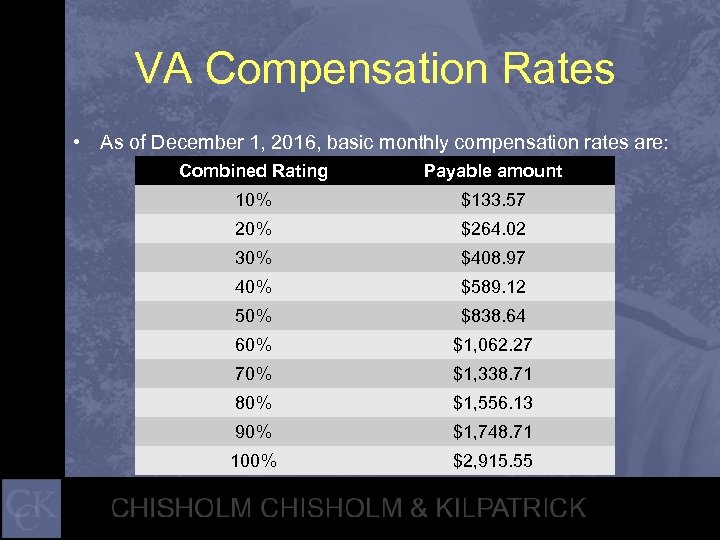
VA Compensation Rates • As of December 1, 2016, basic monthly compensation rates are: Combined Rating Payable amount 10% $133. 57 20% $264. 02 30% $408. 97 40% $589. 12 50% $838. 64 60% $1, 062. 27 70% $1, 338. 71 80% $1, 556. 13 90% $1, 748. 71 100% $2, 915. 55 31
Total Disability based on Individual Unemployability • “Total disability ratings for compensation may be assigned where the schedular rating is less than total, when the disabled person is… unable to secure or follow a substantially gainful occupation as a result of service-connected disabilities” 38 C. F. R. § 4. 16(a) • Two paths: schedular and extraschedular • If the veteran does not meet the schedular criteria, the case is referred to the VA Director of Compensation Services for an extraschedular opinion • Although it sounds difficult, getting a schedular total rating is often harder due to the use of percentages 32

Compensation Effective Dates
Effective Dates • “Except as otherwise provided, the effective date of an evaluation and award… will be the date of receipt of the claim or the date entitlement arose, whichever is the later. ” 38 C. F. R. § 3. 400 • Generally, the effective date of a benefit is the day VA received a Veteran’s claim 34
Effective Dates • If a benefit is not granted on the first decision, and that decision is not timely appealed, the decision becomes final • A veteran may file the claim again. There are no limits to the number of times a veteran may file a claim • To reopen a previously denied claim, however, the veteran must submit new and material evidence 35
New and Material Evidence 1. New – “existing evidence not previously submitted to agency decisionmakers. ” 2. Material – “existing evidence that, by itself or when considered with previous evidence of record, relates to an unestablished fact necessary to substantiate the claim. ” • 38 C. F. R. § 3. 156(a) 36

New and Material Evidence • Generally, if a claim is granted on the second (or third, etc. ) attempt at filing, the effective date is the date of that second (or third, etc. ) claim, not the initial claim • But of course, there are exceptions: 37
Exception 1: Pending Claim • Submitting new and material evidence within an appeal period (as opposed to filing an appeal of the decision) reopens a claim, forcing VA to readjudicate it, and to also consider it as part of the beginning of the appeal period. 38 C. F. R. § 3. 156(b) • This can greatly influence the effective date of a grant of benefits to a Veteran. 38
![Exception 2: Service Records • “[A]t any time after VA issues a decision on](https://present5.com/presentation/5d93ba133394d5cab56fe45efce1b40b/image-39.jpg "Exception 2: Service Records • “[A]t any time after VA issues a decision on")
Exception 2: Service Records • “[A]t any time after VA issues a decision on a claim, if VA receives… relevant official service department records that existed and had not been associated with the claims file when VA first decided the claim, VA will reconsider the claim” 38 C. F. R. § 3. 156(c) • The service records can be received by VA at any time following a decision, not just within the appeal period, and force VA to reconsider the original claim. 39

VA Claim Stream
Filing a VA Claim • A veteran begins by filing a claim with their local Regional Office (RO) – May be submitted to VA’s Evidence Intake Center (EIC), located in Wisconsin • VA Form 21 -526, or 21 -526 EZ • An “Intent to File” may be submit up to 1 year prior to the 21 -526 to preserve a veteran’s desired effective date 41
Filing a VA Claim • A veteran must specify the condition(s) they seek compensation for • VA has a Duty to Assist the veteran in obtaining records, such as service records or medical treatment records, to substantiate a veteran’s claim • A Compensation & Pension Examination may be administered by the VA to provide a medical nexus opinion, as required by most theories of service connection 42
Rating Decision • Issued by the RO • May grant or deny benefits • VA must explain reasons for the decision that is made – At this stage, explanation may be very brief and is often vague • Veteran has one year from date of notification letter to appeal 43
Notice of Disagreement • Veteran may appeal the Rating Decision and seek benefits that were not granted • VA Form 21 -0958 • It must be specified which issue(s) the veteran disagrees with – VA will not accept an appeal that only says, e. g. , “everything”, “all issues”, etc. • Is sent to VA RO (or EIC) 44
Appeal Review • At this stage, the veteran may select one of two types of review of their claim 1. Decision Review Officer (DRO) – – – De novo review by experienced VA adjudicators Hearing or conference with the DRO is possible May take longer to see a new decision 2. Traditional Review – Someone new will review the decision, but is not reviewing the appeal anew 45
Decision Review Officer Decision • Issued by the RO • Potential outcome of DRO review of a claim appealed by a Notice of Disagreement • Functionally the same as a Rating Decision, with the same one year window to appeal 46
Statement of the Case • Issued by the RO • Typically is a restatement of a denial, but can also include a grant or a partial grant • Includes citations to statutes and regulations used in making the decision • Appeal deadline is 60 days following the date of the notification letter 47
VA Form 9 Substantive Appeal • • Sent to the RO (or EIC) VA Form 9 Perfects an appeal to the Board Veteran can request a hearing with a Veterans Law Judge at the Board • Has an option to appeal all issues in the Statement of the Case, or only specified issues 48
Supplemental Statement of the Case • Issued by the RO • Should VA receive any additional evidence prior to certifying the veteran’s file to the Board, this is issued – Examples include statements sent by the veteran, or medical opinions obtained by VA • If more evidence is submitted/obtained, multiple SSOCs can potentially be issued, catching a veteran in a “hamster wheel” of continued denials before the file is finally certified to the Board • No response is required, but the deadline to do so is 30 days following the date of the notification letter 49
Board Hearings • Is optional; can be requested in the VA Form 9 Appeal • Three types, which pertain to location: 1. Live videoconference – The veteran can go to their local RO, and a Veterans Law Judge at the Board will be videoconference called in 2. In Washington, D. C. – The veteran travels to Washington, D. C. to appear before a Veterans Law Judge 3. At a local VA office – A Veterans Law Judge will visit the local office for the hearing 50
Board of Veterans Appeals Decision • Issued by the Board • Can do a combination of four things: 1. 2. 3. 4. Grant an issue Deny an issue Remand an issue Refer an issue 51
Board Grant • Board grants are implemented by the RO – Essentially, “the Board says the thing, the RO then does it” • Rating Decision is issued by the RO • If the Board grant is not specific to rating and/or effective date, the veteran can file a Notice of Disagreement to appeal for an increased rating and/or earlier effective date 52
Board Denial • Can be appealed within 120 days of the date of the Board decision to the Court of Appeals for Veterans Claims • Partial grants, where the Board will grant a benefit “but no higher” (a rating) or “but no earlier” (an effective date) can also be appealed to the CAVC 53
Board Remand • Is not a final decision - if the Board cannot decide one way or the other, the case is sent back to the RO for development • Development can include obtaining service records, medical records, and/or new medical opinions or clarifications to existing opinions • If the benefit can then be granted, the RO will issue a Rating Decision doing so • If the benefit remains denied, a Supplemental Statement of the Case is completed, and the issue is sent right back to the Board for a new decision 54
Board Referral • When the Board notices a claim that was raised but has not had a Rating Decision issued, that claim is referred back to the Agency of Original Jurisdiction (the RO) for the claim to be adjudicated • Can happen following Board hearings, if other issues not on appeal are brought up and discussed 55
Court of Appeals for Veterans Claims • A federal court, separate from the VA • While the VA claims process by law is “nonadversarial”, appealing at the CAVC can be argumentative, and may be shocking to some! • CAVC does not grant benefits, but can affirm a Board decision (a loss) or vacate it and remand the case back to Board (a “win”) • Occasionally, CAVC will reverse findings of fact the Board had made, and even less frequently, VA may offer to settle with the appellant • Unfavorable decisions may be appealed to CAFC 56

Attorney Fees
Fees: A History • Dark Ages: 1862 – 1988 – For over a century, VA decision making goes unchallenged because there is no right to judicial review and the maximum fee was $10. 00. 58
Fees: A History • Middle Ages: 1988 – June 19, 2007 • Veterans Judicial Review Act of 1988: The Most Important Piece of Veteran’s Legislation until 2006 1. Created the Court of Veterans Appeals (now called the Court of Appeals for Veterans Claims) and for the first time a Veteran could appeal to a Court albeit an Article I Court not an Article III Court. Thus arbitrary decision-making by the VA was subject to judicial scrutiny. 59
Fees: A History • Middle Ages: 1988 – June 19, 2007 2. Veterans were able to hire and compensate counsel for the first time in certain limited circumstances. A Veteran could hire counsel: a. b. After the first final BVA decision. If retained within one year of that BVA decision. For any work in court. 60
Fees: A History • Renaissance: 2007 – ? ? ? • In the waning days of the 109 th Congress, the House and Senate ended a standoff and decided to pass an Omnibus Veterans Bill that included an amendment that permitted veterans to hire counsel earlier in the Agency process at a point in time when attorneys can have a chance to make a difference. S-3421 was the bill. • Fees now permitted for claims in which the Notice of Disagreement was filed on or after June 20, 2007 (180 days after date of enactment which was December 22, 2006). 61
Who Can Charge A Fee? • An Attorney or an Agent – 38 U. S. C. § 5904(c)(1). – Attorneys must be admitted to at least one state, Court or Federal Agency • All attorneys and agents must be accredited by VA to both charge and receive fees – Attorneys: Complete the application – Non-Attorney Practitioners: Complete the application and take VA’s Accreditation exam • Currently 28 questions and require 21+ correct to pass 62

When Can You Charge A Fee? • The first rule is you cannot simply charge a fee to any Veteran who walks in the door. 63
When Can You Charge A Fee? • There are two separate triggers for fees: 1. For all cases in which a Notice of Disagreement (NOD) was filed before June 20, 2007, the trigger is the first final decision of the BVA or Court representation. 2. For all cases in which the Notice of Disagreement was filed after June 20, 2007, the filing of the NOD is the trigger for fees 64
Charging a Fee – Prior to June 20, 2007 • After the Board of Veterans’ Appeals first makes a final decision in the case. – 5904(c)(1) “a fee may not be charged, allowed, or paid for services of agents and attorneys with respect to services provided before the date of which the Board of Veterans’ Appeals first makes a final decision in the case. ” 65
Charging a Fee – Prior to June 20, 2007 • What is a final decision for the purpose of 5904(c)? a. It is a denial of a claim. b. If the Board reopens a claim finding the Veteran submitted new and material evidence, that decision triggers entitlement to a fee under 5904. – See Stanley v. Principi, 283 F. 3 d 1350 (Fed. Cir. 2002) 66
Charging a Fee – Prior to June 20, 2007 • Stanley is so important because many of the cases decided by the Board and that I review are reopened claims that the Board remands after finding new and material evidence. • You can charge a fee on these remanded cases. • Remember – new and material evidence is a jurisdictional issue for the Board. 67
Charging a Fee – After June 20, 2007 • If a Notice of Disagreement is filed after June 20, 2007, the NOD is the trigger for fees. • What this means is that if the Regional Office denies a claim and the notice of disagreement is filed after June 19, 2007, you can charge a fee. 68
When Can You Charge A Fee? • It is critical to assess a new file to see what fee rule you are operating on. Do not rely on the Veteran to tell you. You need to always assess what rule you are operating under as soon as you obtain the claims folder. • Ten years after the effective date of the amendment to 5904 there are still many cases where there is no NOD after June 20, 2007. • EXAMINE THE VA CLAIMS FILE YOURSELF!!!! 69

What Kind of Fee Can You Charge? • At the Agency level: 38 C. F. R. § 14. 363 – Contingency fees – Flat fees – Hourly fees – Combination of the above 70
Reasonable • Whatever kind of fee you charge, it must be reasonable. 38 C. F. R. § 14. 636(e). • Factors that the Secretary will weigh in determining reasonableness: – (1) The extent and type of services the representative performed; – (2) The complexity of the case; 71

– (3) The level of skill and competence required of the representative in giving the services; – (4) The amount of time the representative spent on the case; – (5) The results the representative achieved, including the amount of any benefits recovered; 72
– (6) The level of review to which the claim was taken and the level of the review at which the representative was retained; – (7) Rates charged by other representatives for similar services; and – (8) Whether, and to what extent, the payment of fees is contingent upon the results achieved. 73
What Kind of Fee Can You Charge? • Under 38 C. F. R. § 14. 636(f): – 20% fee agreement is presumptively reasonable. – Any fee in excess of 33% is presumptively unreasonable. 74
Who Can You Charge A Fee? 1. The Veteran, Widow, Dependent Child 2. What about the payee for an incompetent veteran? A disinterested third party. 38 C. F. R. 14. 636(d)(2). 75
Fee Agreements: The Basics 1. All fee agreements must be in writing – (Cannot be verbal). 2. 3. 4. 5. It must be signed by the claimant and the attorney. It must include the name of the veteran. It must include the C-File number. The specific terms under which the amount to be paid for the services of the attorney-at-law or agent will be determined. 6. A copy of the agreement must be filed with the Office of General Counsel. – You can email it to: feeagreements. ogc@va. gov 76
Fee Agreements: The Basics 7. Post June 19, 2007: The regulations require the fee agreement to clearly state whether you want the VA to withhold and pay your fee or not. 77
Wait. Withhold My Fee? • VA can act as a “bank” to withhold your fee from a retroactive award to the veteran and pay you directly – Only applies to 20% contingency agreement – VA will deduct an assessment fee for this: • 5% of the attorney fee, up to a maximum charge of $100. 00 • This cannot be charged back to the client. 78

What Does VA Do With The Fee Agreement? 1. They are supposed to associate it with the claims folder. 2. Flag the file so if any award of past-due benefits is made, they will withhold 20% if the fee agreement calls for it. You can see a notation in VBMS on the Veteran Profile Screen Flashes. 79
What Kind of Fee Agreement Should I Have? • The first question you have to ask yourself is: who do you want to pay you? – Department of Veterans Affairs – Client • This assessment should be made on a case-bycase basis. • Important: This assessment may need to be made more than once. If you have a non-withholding fee agreement with a client, you should keep an eye out for any red flags that may indicate a need to switch the fee agreement. 80

Non-Exhaustive List of Potential Red Flags • • Client has periods of incarceration. Client threatens to fire you. Client refuses to reimburse you for case expenses. Client asks to file for extreme financial hardship, informs you he is filing for bankruptcy, etc. Client is uncooperative or unsatisfied with attorney representation. You are unable to get in contact with the client for a long period of time. You think the client may be proposed incompetent. This is not a complete list – and not all of the above indicates that a client should have a withholding fee agreement. 81
Withholding Fee Agreements • To have the VA withhold your fee it must meet all the conditions previously discussed and: 1. The total fee payable (excluding expenses) does not exceed 20 percent of the total amount of the past-due benefits awarded; 2. The amount of the fee is contingent (needs to be 100% contingent) on whether or not the claim is resolved in a manner favorable to the claimant or appellant, see Hazan V. Gober, 10 Vet. App. 511 (1997); 82
Withholding Fee Agreements 3. The award of past-due benefits results in a cash payment to a claimant from which the fee may be deducted. 4. The attorney-at-law must notify the agency of original jurisdiction, within 30 days of the date of execution of the agreement, of the existence of an agreement providing for the direct payment of fees out of any benefits subsequently determined to be past due and provide that agency with a copy of the fee agreement. 38 C. F. R. § 14. 636(h). 83
How Do I Get Paid A Fee? • Non-withholding fee agreements: Client pays you. • You need to learn as soon as possible when your client was paid so you can collect your fee before the money is spent. • Access to VBMS and SHARE is critical so you can see what the client was paid and when. • Alternatively, you will need to call the RO to determine what was paid to your client and when. • It is good practice to review the award print in VBMS to insure the RO did not withhold in error. – Yes, this can and does happen. 84
How Do I Get Paid A Fee? • Withholding fee agreement: you should tell the attorney fee coordinator that they need to withhold 20% of the past due benefits and issue an Attorney Fee Decision on your entitlement to the fee. • Call the attorney fee coordinator, introduce yourself, and inform them that you have a 20% fee agreement. • An AFD is not an automatic indication that your fee was successfully withheld. 85
Attorney Fee Decisions • Issued upon completion of an award when there is a withholding fee agreement on file. • VA determines entitlement to the attorney fee. • If you (or your client!) disagree with the AFD, it follows the simultaneously contested claims appeal deadlines as in 38 C. F. R. § 20. 501. – i. e. , 60 days to file NOD, 30 days to file VA 9 86

How Do I Get Paid A Fee? • Once the 60 days for due process of an AFD has run, do I still just sit back and wait or is there more to do? • Still more to do. You need to stay in touch with the Attorney Fee Coordinator to be sure you know that the fee has been processed and the payment voucher sent to Treasury. • Sometimes the RO sends a copy of the payment voucher. Usually the payment will arrive in 7 -10 days after a payment voucher is processed. 87
Helpful Fee Release Tips • You should first become vendorized by the VA and then track your fees from the RO. – https: //www. vis. fsc. va. gov • Be relentless! Anything less and there will be no change in your bank account! • Do not be intimidated. Keep calling, but always be nice about it. 88
Things to Worry About • Offsets – CRDP payments, CRSC payments, incarceration, NSC pension, bankruptcy proceedings, etc. • Fiduciaries – Receiving payment of a non-withholding fee – Receiving payment of costs – VA holding up release of your withheld fee due to the appointment of a fiduciary • Note there is an M 21 provision instructing fee coordinators not to let this hold up issuing an AFD 89
Things to Worry About • Clients filing appeal on an AFD and the fee is held up for readjudication • Clients with non-withholding fee agreements refusing to pay • VA mistakenly paid all of a client’s award but the fee agreement is withholding – Collect directly from the client? – Make VA pay you the fee? This would establish an overpayment on the client so that VA could recoup the amount erroneously released to them. 90
Court Fees - EAJA 28 U. S. C. § 2412(d) • Equal Access to Justice Act (EAJA) • Separate fee agreement • 4 Elements Necessary to Warrant an EAJA Award: 1. Showing Appellant is a prevailing party; 2. Showing Appellant is eligible to receive an award; 3. Allegation that the government’s position is not substantially justified; and 4. Itemized statement of fees sought. 91
Court Fees - EAJA • Deadline to file for EAJA fees is 30 days after the Court enters mandate or 60 days after judgment, whichever comes first. 92
Court Fees - EAJA 1. Prevailing Party – In order to qualify as a prevailing party, the applicant must receive some relief on the merits and that relief must materially alter the legal relationship of the parties. – The applicant must show that it obtained an enforceable judgment on the merits or a court ordered consent decree that materially altered the legal relationship between the parties or the equivalent of either of those. 93
Court Fees - EAJA • Examples of securing some relief on the merits or a “win” include: – Joint Motion for Remand agreed to between the parties – Memorandum Decision from the Court vacating, remanding, and / or reversing the relevant Board decision or a portion thereof – Settlement agreement between the parties to dismiss the appeal 94
Court Fees - EAJA • Each of these “win” examples will indicate the Board’s error • Relevant Case Law - Prevailing Party: – Buckhannon Bd. and Case Home, Inc. v. West Virginia Dept. of Health and Human Resources, 532 U. S. 598, 121 S. Ct. 1835 (2001) 95
Court Fees - EAJA • Relevant Case Law continued: – Brickwood Contractors, Inc. v. United States, 288 F. 3 d 1371 (Fed. Cir. 2002) – Rice Services , LTD. v. United States, 405 F. 3 d 1017 (Fed. Cir. 2005) – Zuberi v. Nicholson, 19 Vet. App. 541 (2006) – Kelly v. Nicholson, 463 F. 3 d 1349 (Fed. Cir. 2006) 96
Court Fees - EAJA 2. Eligibility to Receive an Award – EAJA Applicant’s net worth at the time the appeal was filed must not exceed $2 million. – In the fee agreement, there is a specific statement stating that Appellant’s net worth is less than $2 million. 97
Court Fees - EAJA 3. Substantial Justification – The record must supply the evidence of the Government’s substantial justification. – There is nothing substantially justified in the Board’s error. 98
Court Fees - EAJA • Relevant Case Law – Substantial Justification: – White v. Nicholson, 412 F. 3 d 1314 (Fed. Cir. 2004) 99
Court Fees - EAJA 4. Itemized Statement of Services Rendered and Fees and Expenses Sought – Appellant may seek payment for services rendered for representation services before the Court. – The EAJA Application must lay out who specifically worked on the case, including hourly rates for each, the total number of hours worked and the total fees accumulated as well as the specific task performed. 100
Court Fees – EAJA • Hourly rates are calculated through a formula, which includes the statutory EAJA rate and the cost of living as determined by the Consumer Price Index, depending on where in the country the attorney is based. 101
Court Fees - EAJA • Expenses may also be recouped – Such as: Court filing fee, postage, any travel expenses 102
Court Fees - EAJA • Examples of Appropriate Billing: – Reviewing specific documents in the file to familiarize with the issues in the case or to prepare to draft a pleading – Drafting a Court pleading – Updating the client – Conversations with the government regarding the specific issues in the case 103
Court Fees - EAJA • Examples of Inappropriate Billing: – Receiving a document without review of same – Updating or checking on the file without a specific purpose – Block billing tasks or billing in a block of more than 3 hours – Duplicate billing 104
Court Fees – EAJA • Relevant Case Law – Billing – Apodackis v. Nicholson, 19 Vet. App. 91 (2005). – Elcyzyn v. Brown, 7 Vet. App. 170 (1994) – Mannino v. West, 12 Vet. App. 242 (1999) – Baldridge v. Nicholson, 19 Vet. App. 227 (2005) 105
Court Fees - EAJA • How long from the time the Application is Submitted until Fees are Paid? – The government has 30 days from the day the Application is submitted to respond. – If there is no objection, and the Court finds the fees reasonable, the Court will issue EAJA mandate within 14 days from the government’s response. – The government then has 30 days from the EAJA mandate to issue payment. 106
A Couple Of Words About the Future • Growth of claims generally. • Pending legislation: The Separation of Powers Restoration Act. – Eliminating deference to administrative agencies under both Chevron and Auer. • Presidential Executive Order limiting promulgation of new regulations. – For each new regulation, two existing regulations will need to be removed. 107

A Couple Of Words About the Future • Appeals Reform 108

A Great Resource • The “bible” in this area is THE VETERANS BENEFITS MANUAL by NVLSP, et al (published by Lexis. Nexis). • There is also an accompanying statutory/regulatory supplement. • Join NOVA www. vetadvocates. com 109

Questions?

Contact Information Robert V. Chisholm, Esq. Chisholm & Kilpatrick LLP One Turks Head Place, Suite 1100 Providence, RI 02903 Phone: (401) 331 -6300 E-mail: RChisholm@CCK-Law. com www. cck-law. com 111
Скачать презентацию Veterans Disability Benefits Compensation and Pension Robert Chisholm
5d93ba133394d5cab56fe45efce1b40b.ppt