 Скачать презентацию VERTIGO 2 Critical Design Presentation December 1 2004
d8f82ca42e7db3507b2a207f6b02dee9.ppt
- Количество слайдов: 18



VERTIGO 2 Critical Design Presentation December 1, 2004
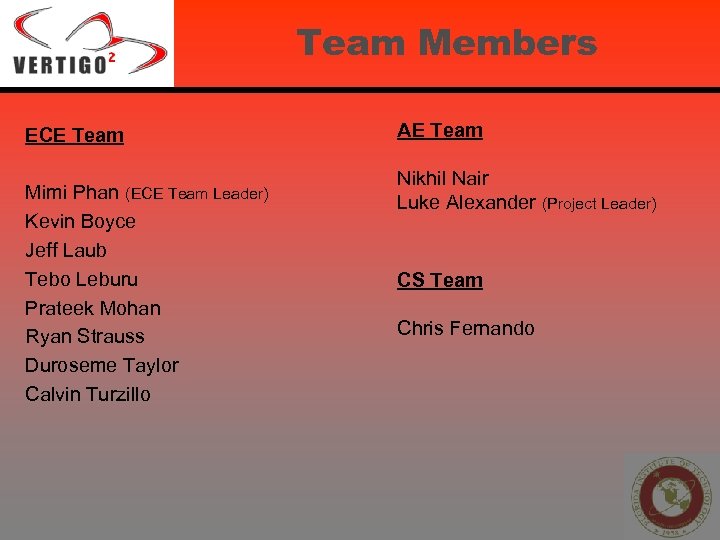
Team Members ECE Team Mimi Phan (ECE Team Leader) Kevin Boyce Jeff Laub Tebo Leburu Prateek Mohan Ryan Strauss Duroseme Taylor Calvin Turzillo AE Team Nikhil Nair Luke Alexander (Project Leader) CS Team Chris Fernando
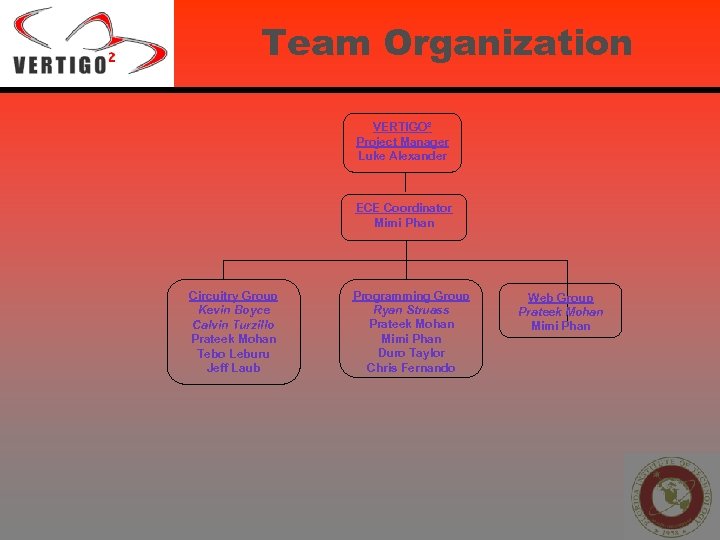
Team Organization VERTIGO² Project Manager Luke Alexander ECE Coordinator Mimi Phan Circuitry Group Kevin Boyce Calvin Turzillo Prateek Mohan Tebo Leburu Jeff Laub Programming Group Ryan Struass Prateek Mohan Mimi Phan Duro Taylor Chris Fernando Web Group Prateek Mohan Mimi Phan

Introduction VERTIGO—Versatile Exploratory Robotic Tilt-rotor for Information Gathering Operations—is a small dual mode aircraft designed as a VTOL aircraft with the ability to transition to normal horizontal flight. Many different projects have been undertaken to challenge the idea of a dual mode aircraft. The advantages of utilizing both flight modes in one aircraft can be realized with a simple understanding of helicopter aerodynamics—namely the ratio of stability to altitude.
Objectives Primary Objectives • • • Design and integrate a proper electrical system to ensure functionality Design a simple, sufficient tilting mechanism for the rotor assemblies Perform laboratory testing to verify aerodynamics and functionality Achieve vertical flight and vertical maneuverability Land Secondary Objectives • • • Transition to horizontal flight via tilting mechanism Return to vertical flight Land without catastrophe
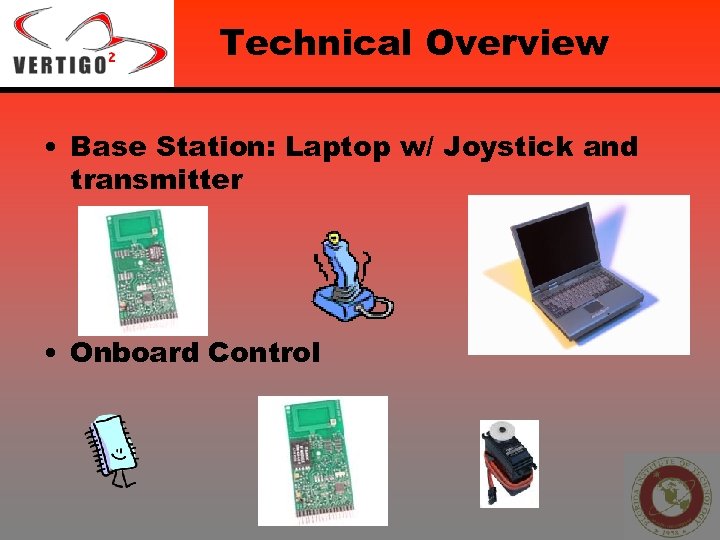
Technical Overview • Base Station: Laptop w/ Joystick and transmitter • Onboard Control
System Overview Base Station • Laptop: receives serial input from joystick, and send command out serial port to transmitter • Joystick: user input • Transmitter: serial communication to onboard system Onboard System • Receiver: serial communication from base station • Microcontroller: interprets signals from receiver and outputs to proper device • Servos: control position for airfoils and blade position • Motors: spin the propellers • Gyro: used for stabilizing aircraft • Wireless Camera: not integrated into system-just live video
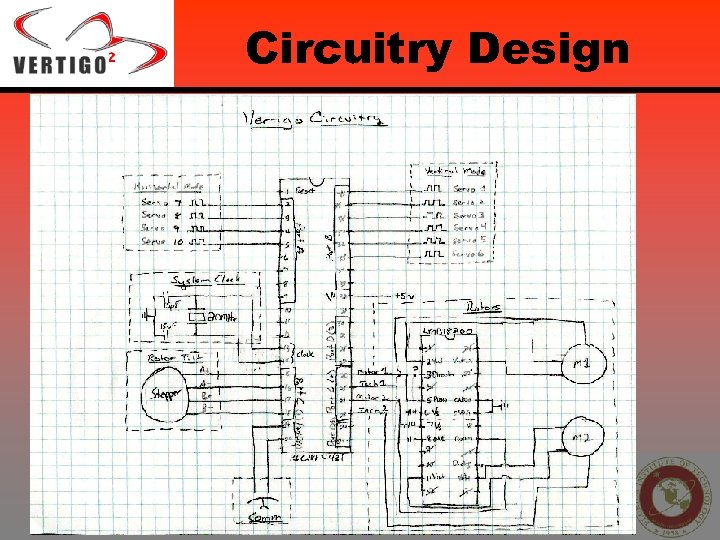
Circuitry Design
Software Overview PIC Software • Written in PIC Basic Pro • Continuous loops monitor for changes in servo position and motor speed Base Station Software • Written in C++ • Takes user input from joystick and converts to a serial signal that PIC can interpret

Reliability, Testability, & Manufacturability • How reliable is our product? What is its expected lifetime? • How will we test the product? • What about manufacturability?
Reliability Microchip’s PIC 18 F 4431 Microcontroller • • • Excessive Temperatures Random Voltage Spurts Limited Life for Onboard Flash Memory Card (5 to 10 years) Saitek X 45 Digital Joystick and Throttle • • Breakage of Mechanical Parts Limited Life due to Wear and Tear 11. 1 V 2200 m. AH Lithium Ion Batteries • • Chemical Imbalance Deterioration over Time (Batteries can lose charge over time. )
Reliability 433 MHz Dual-Mode RF Transmitter/Receiver Module • • • Excessive Temperatures Random Frequency Transferences Limited Life (5 to 10 years) Possible Problems Limiting Overall Product Life • • • Short Circuits Soldering Errors Dead on Arrival (DOA)
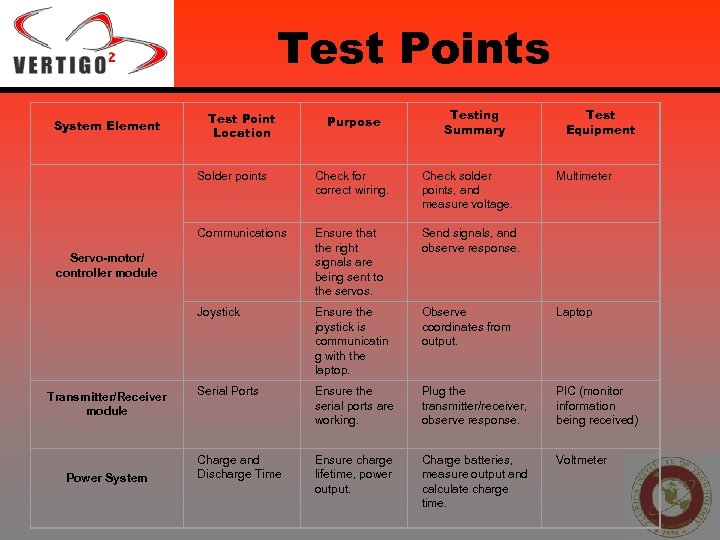
Test Points System Element Test Point Location Purpose Testing Summary Test Equipment Solder points Check for correct wiring. Check solder points, and measure voltage. Multimeter Communications Ensure that the right signals are being sent to the servos. Send signals, and observe response. Joystick Ensure the joystick is communicatin g with the laptop. Observe coordinates from output. Laptop Serial Ports Ensure the serial ports are working. Plug the transmitter/receiver, observe response. PIC (monitor information being received) Charge and Discharge Time Ensure charge lifetime, power output. Charge batteries, measure output and calculate charge time. Voltmeter Servo-motor/ controller module Transmitter/Receiver module Power System
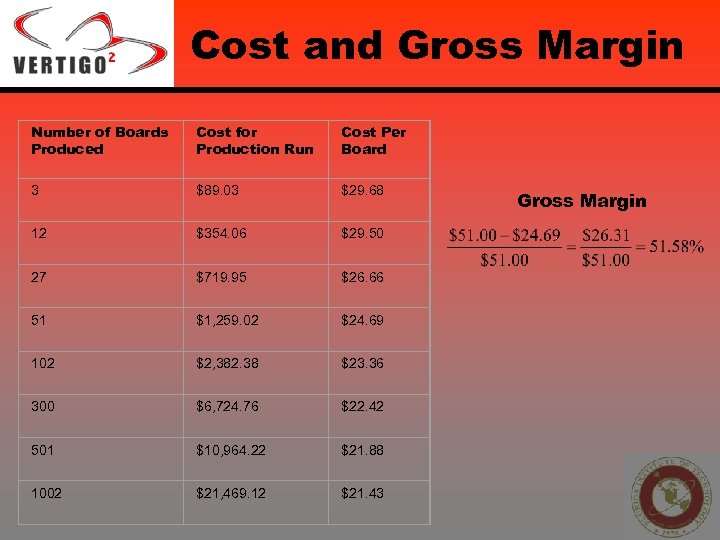
Cost and Gross Margin Number of Boards Produced Cost for Production Run Cost Per Board 3 $89. 03 $29. 68 12 $354. 06 $29. 50 27 $719. 95 $26. 66 51 $1, 259. 02 $24. 69 102 $2, 382. 38 $23. 36 300 $6, 724. 76 $22. 42 501 $10, 964. 22 $21. 88 1002 $21, 469. 12 $21. 43 Gross Margin
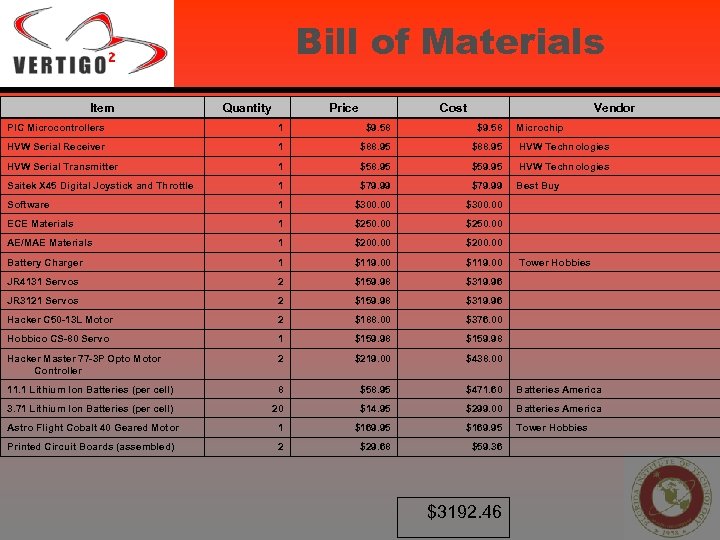
Bill of Materials Item Quantity Price Cost Vendor PIC Microcontrollers 1 $9. 58 HVW Serial Receiver 1 $88. 95 HVW Technologies HVW Serial Transmitter 1 $58. 95 $59. 95 HVW Technologies Saitek X 45 Digital Joystick and Throttle 1 $79. 99 Best Buy Software 1 $300. 00 ECE Materials 1 $250. 00 AE/MAE Materials 1 $200. 00 Battery Charger 1 $119. 00 JR 4131 Servos 2 $159. 98 $319. 96 JR 3121 Servos 2 $159. 98 $319. 96 Hacker C 50 -13 L Motor 2 $188. 00 $376. 00 Hobbico CS-80 Servo 1 $159. 98 Hacker Master 77 -3 P Opto Motor Controller 2 $219. 00 $438. 00 11. 1 Lithium Ion Batteries (per cell) 8 $58. 95 $471. 60 Batteries America 3. 71 Lithium Ion Batteries (per cell) 20 $14. 95 $299. 00 Batteries America Astro Flight Cobalt 40 Geared Motor 1 $169. 95 Tower Hobbies Printed Circuit Boards (assembled) 2 $29. 68 $59. 36 $3192. 46 Microchip Tower Hobbies
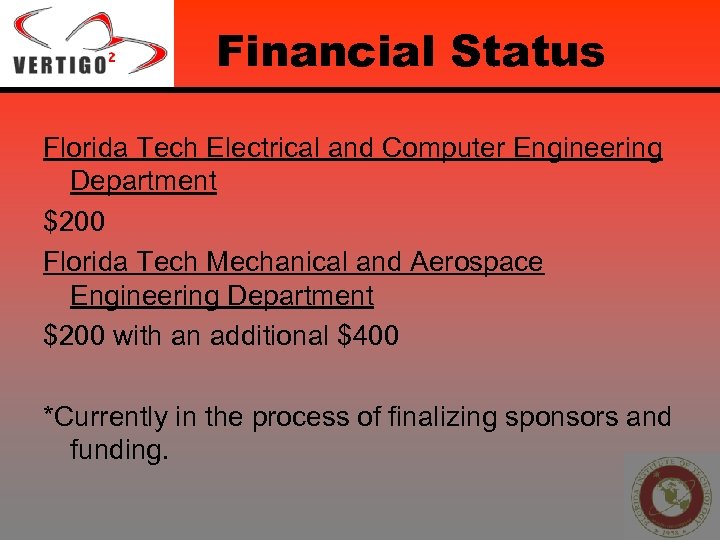
Financial Status Florida Tech Electrical and Computer Engineering Department $200 Florida Tech Mechanical and Aerospace Engineering Department $200 with an additional $400 *Currently in the process of finalizing sponsors and funding.
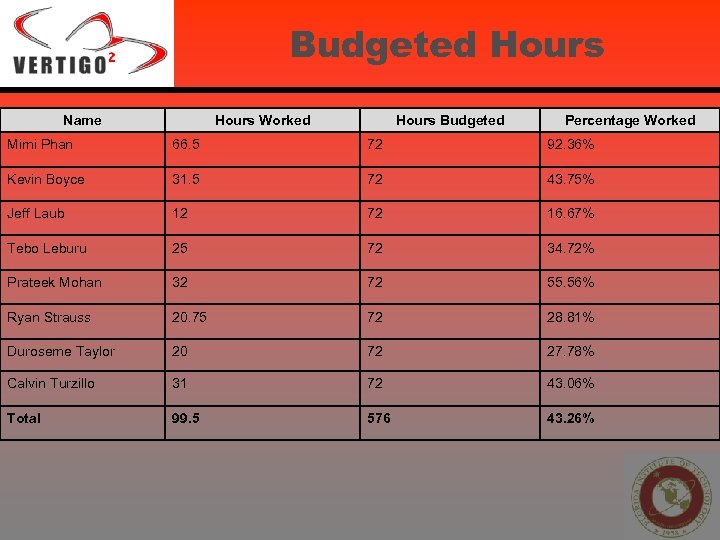
Budgeted Hours Name Hours Worked Hours Budgeted Percentage Worked Mimi Phan 66. 5 72 92. 36% Kevin Boyce 31. 5 72 43. 75% Jeff Laub 12 72 16. 67% Tebo Leburu 25 72 34. 72% Prateek Mohan 32 72 55. 56% Ryan Strauss 20. 75 72 28. 81% Duroseme Taylor 20 72 27. 78% Calvin Turzillo 31 72 43. 06% Total 99. 5 576 43. 26%

Questions?
Скачать презентацию VERTIGO 2 Critical Design Presentation December 1 2004
d8f82ca42e7db3507b2a207f6b02dee9.ppt