


 Скачать презентацию Verifying Properties of Well-Founded Linked Lists Shuvendu K
5a4d88d1b24855f1667f03eb77a786fe.ppt
- Количество слайдов: 44
 Verifying Properties of Well-Founded Linked Lists Shuvendu K. Lahiri Shaz Qadeer Software Reliability Research Microsoft Research
 Motivation for analyzing linked lists Verify control, memory, and API safety of lowlevel systems code n Integers n Arrays n Singly linked lists n Doubly linked lists (acyclic and cyclic) – 2–
 Motivation for analyzing linked lists Verify control, memory, and API safety of lowlevel systems code n Integers n Arrays n Singly linked lists n Doubly linked lists (acyclic and cyclic) Establish properties about linking structure and content n Absence of null dereference, memory leaks n All elements of a list have data value 0 n List 1 and List 2 are disjoint – 3–
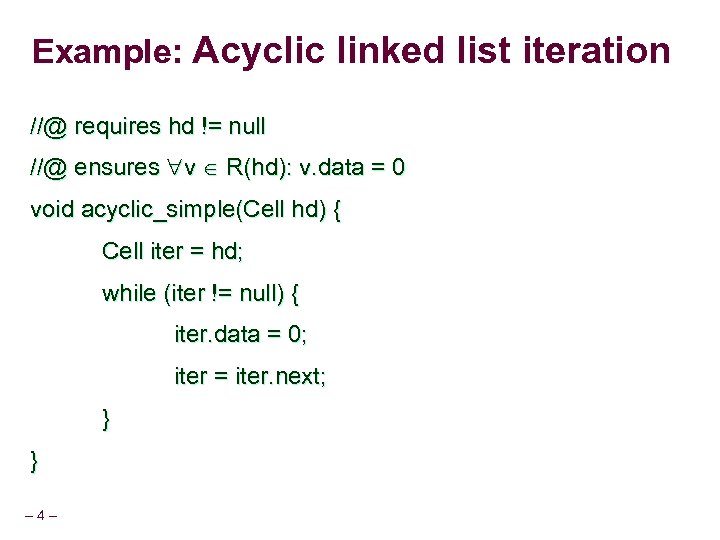 Example: Acyclic linked list iteration //@ requires hd != null //@ ensures v R(hd): v. data = 0 void acyclic_simple(Cell hd) { Cell iter = hd; while (iter != null) { iter. data = 0; iter = iter. next; } } – 4–
 Problem Existing program analyses either lack scalability or precision for such programs/properties – 5–
 Reasoning in first-order logic Can support many theories important for program verification n Uninterpreted functions, linear arithmetic, arrays, quantifiers n Reason about programs with a mix of scalar variables, arithmetic, arrays Powerful analysis engines n Pioneering n Recent – 6– work by Nelson-Oppen[’ 79] advances in SAT-based theorem provers
 Program verification and first-order logic Automated software verification tools n SLAM, BLAST, MAGIC, … n ESC/JAVA, Boogie, . . Perform symbolic reasoning for first-order logic n Theorem provers to discharge verification conditions n Operations for abstract interpretation (predicate abstraction, join, . . ) n Automatic – 7– abstraction-refinement
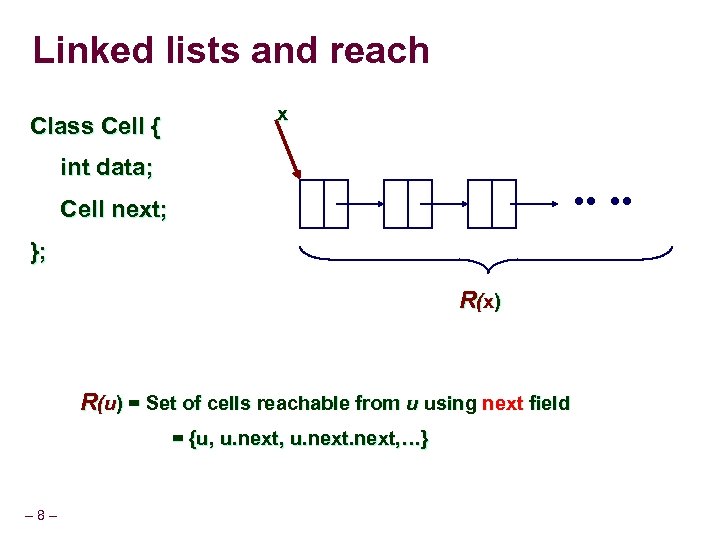 Linked lists and reach Class Cell { x int data; Cell next; }; R (x ) R(u) = Set of cells reachable from u using next field = {u, u. next, …} – 8–
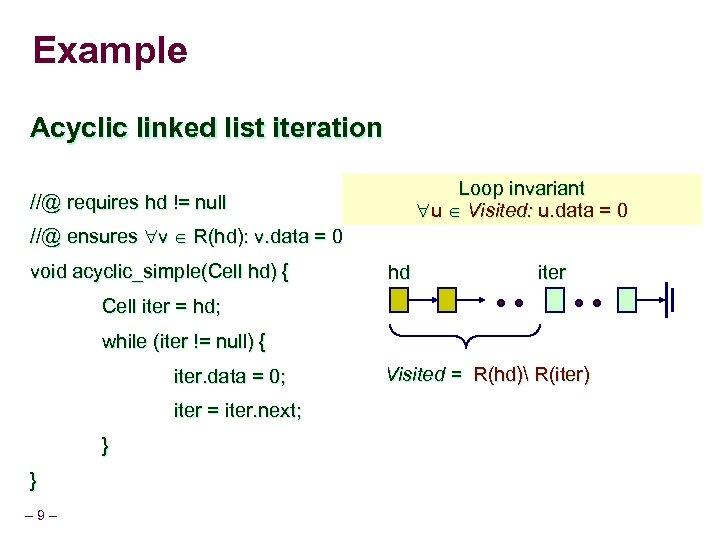 Example Acyclic linked list iteration Loop invariant u Visited: u. data = 0 //@ requires hd != null //@ ensures v R(hd): v. data = 0 void acyclic_simple(Cell hd) { hd iter Cell iter = hd; while (iter != null) { iter. data = 0; iter = iter. next; } } – 9– Visited = R(hd) R(iter)
 Reachability predicate Need to reason about reachability predicate n e. g. u R(x): u. data = 0 Need axioms to relate the field next and R However, reachability can’t be modeled in firstorder logic n Finite first-order axiomatization of reachability impossible – 10 –
 Motivation for this work n Simple axioms may suffice for many examples Provide a first-order axiomatization of Reach n Necessarily n First incomplete investigated by Nelson [POPL’ 83] Enable list manipulating programs (also containing integers, arrays etc. ) to be analyzed uniformly n Can leverage first-order reasoning n Predicate abstraction, … n Abstraction – 11 – refinement
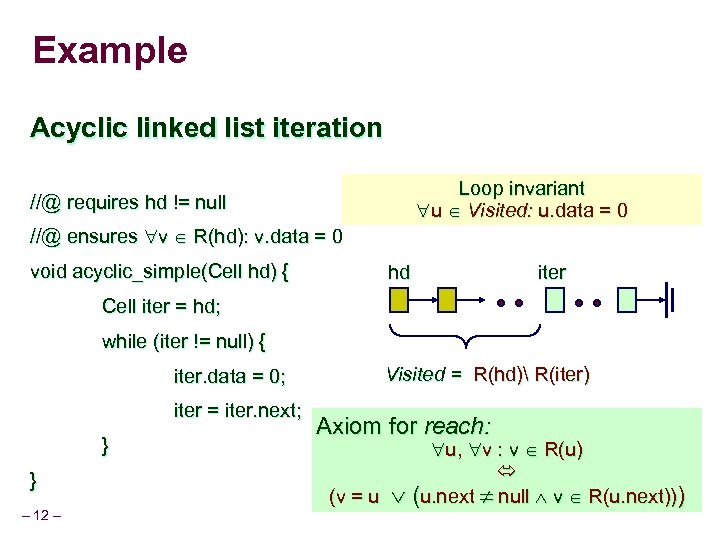 Example Acyclic linked list iteration Loop invariant u Visited: u. data = 0 //@ requires hd != null //@ ensures v R(hd): v. data = 0 void acyclic_simple(Cell hd) { hd iter Cell iter = hd; while (iter != null) { iter. data = 0; iter = iter. next; } } – 12 – Visited = R(hd) R(iter) Axiom for reach: u, v : v R(u) (v = u (u. next null v R(u. next)))
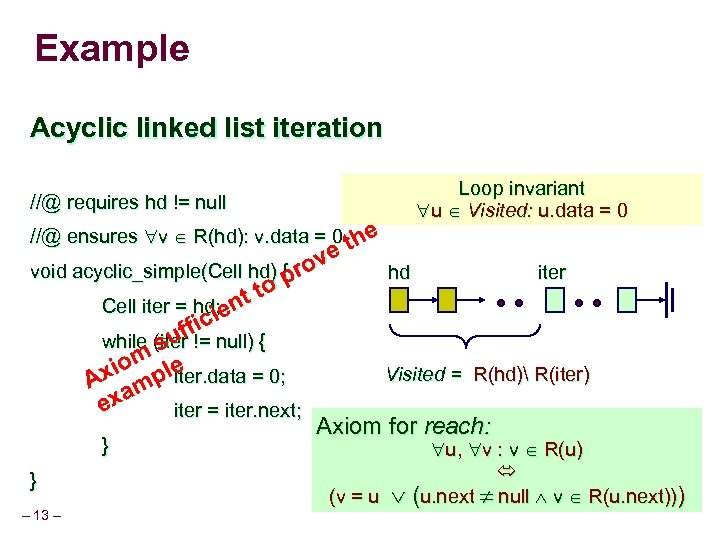 Example Acyclic linked list iteration //@ requires hd != null //@ ensures v R(hd): v. data = 0 the Loop invariant u Visited: u. data = 0 e ov void acyclic_simple(Cell hd) { r hd iter p t to Cell iter = hd; en i fic while (suf != null) { iter iom ple Visited = R(hd) R(iter) Ax am iter. data = 0; ex iter = iter. next; Axiom for reach: } } – 13 – u, v : v R(u) (v = u (u. next null v R(u. next)))
 Rest of the talk How to n Handle cyclic lists n Handle destructive updates n Generate first-order axioms for Reach Well-founded linked lists n How it makes the above tasks amenable Results Deciding ground fragment with Reach predicate – 14 –
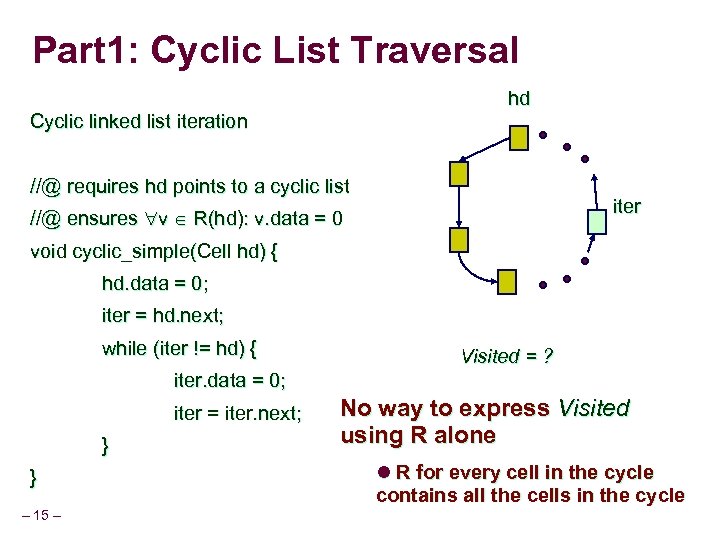 Part 1: Cyclic List Traversal hd Cyclic linked list iteration //@ requires hd points to a cyclic list iter //@ ensures v R(hd): v. data = 0 void cyclic_simple(Cell hd) { hd. data = 0; iter = hd. next; while (iter != hd) { Visited = ? iter. data = 0; iter = iter. next; } } – 15 – No way to express Visited using R alone l R for every cell in the cycle contains all the cells in the cycle
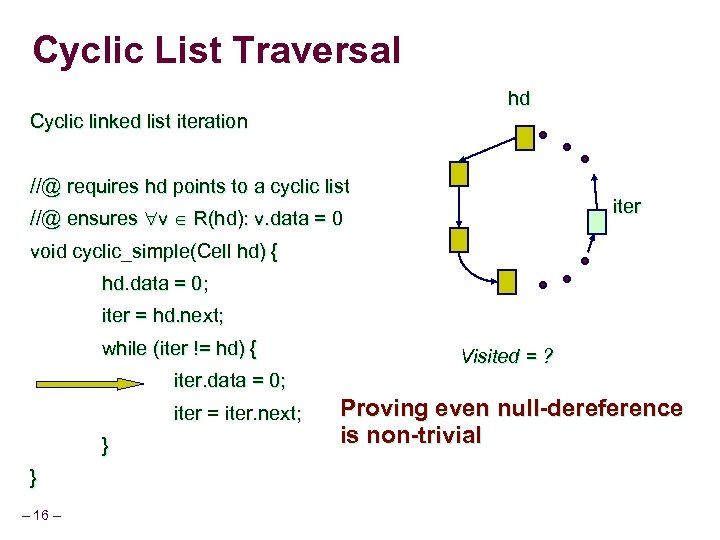 Cyclic List Traversal hd Cyclic linked list iteration //@ requires hd points to a cyclic list iter //@ ensures v R(hd): v. data = 0 void cyclic_simple(Cell hd) { hd. data = 0; iter = hd. next; while (iter != hd) { Visited = ? iter. data = 0; iter = iter. next; } } – 16 – Proving even null-dereference is non-trivial
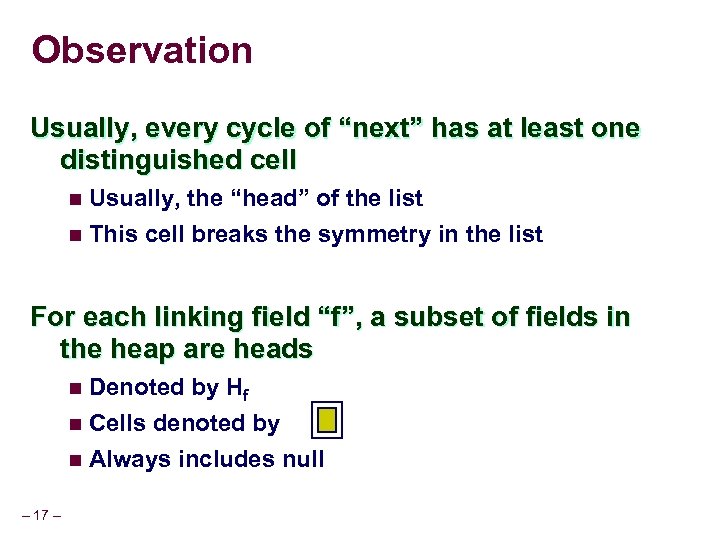 Observation Usually, every cycle of “next” has at least one distinguished cell n Usually, the “head” of the list n This cell breaks the symmetry in the list For each linking field “f”, a subset of fields in the heap are heads n Denoted n Cells denoted by n Always – 17 – by Hf includes null
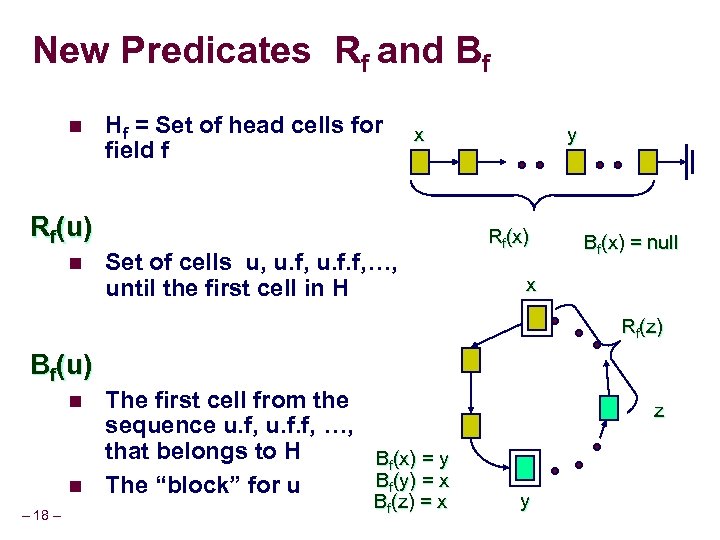 New Predicates Rf and Bf n Hf = Set of head cells for field f x Rf(u) n Set of cells u, u. f. f, …, until the first cell in H y Rf(x) Bf(x) = null x Rf(z) Bf(u) n n – 18 – The first cell from the sequence u. f, u. f. f, …, that belongs to H Bf(x) = y Bf(y) = x The “block” for u Bf(z) = x z y
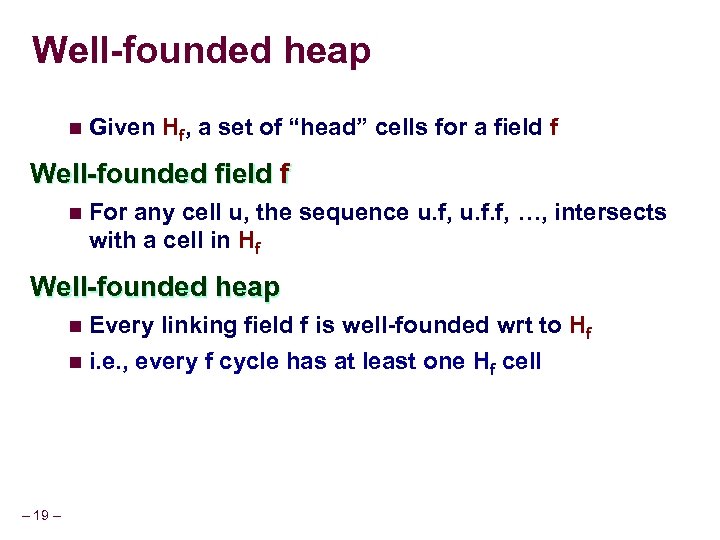 Well-founded heap n Given Hf, a set of “head” cells for a field f Well-founded field f n For any cell u, the sequence u. f, u. f. f, …, intersects with a cell in Hf Well-founded heap n Every n i. e. , – 19 – linking field f is well-founded wrt to Hf every f cycle has at least one Hf cell
 Programming methodology l Programmer must supply Hf l Every mutation of the linking field f is required to preserve well-foundedness l Restricted to programs maninpulating well founded heaps only n Almost – 20 – all list programs obey this restriction
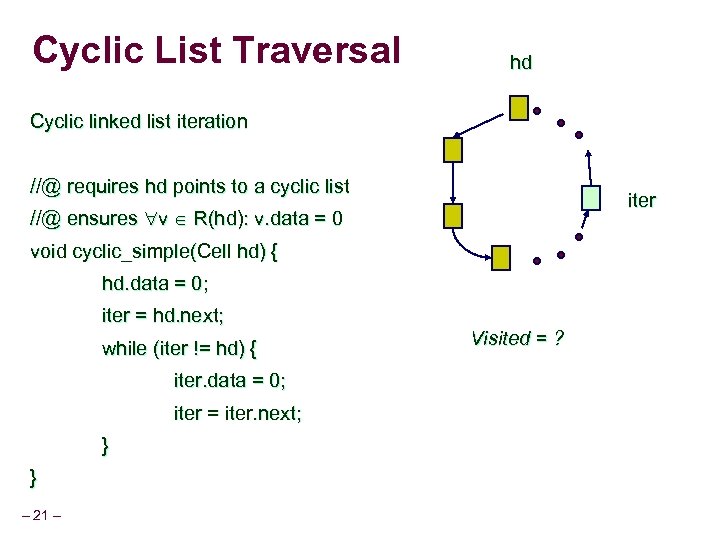 Cyclic List Traversal hd Cyclic linked list iteration //@ requires hd points to a cyclic list iter //@ ensures v R(hd): v. data = 0 void cyclic_simple(Cell hd) { hd. data = 0; iter = hd. next; while (iter != hd) { iter. data = 0; iter = iter. next; } } – 21 – Visited = ?
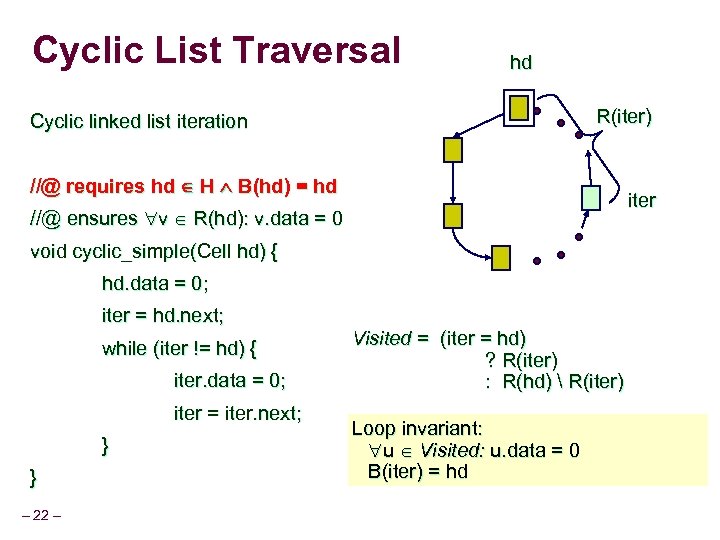 Cyclic List Traversal hd R(iter) Cyclic linked list iteration //@ requires hd H B(hd) = hd iter //@ ensures v R(hd): v. data = 0 void cyclic_simple(Cell hd) { hd. data = 0; iter = hd. next; while (iter != hd) { iter. data = 0; iter = iter. next; } } – 22 – Visited = (iter = hd) ? R(iter) : R(hd) R(iter) Loop invariant: u Visited: u. data = 0 B(iter) = hd
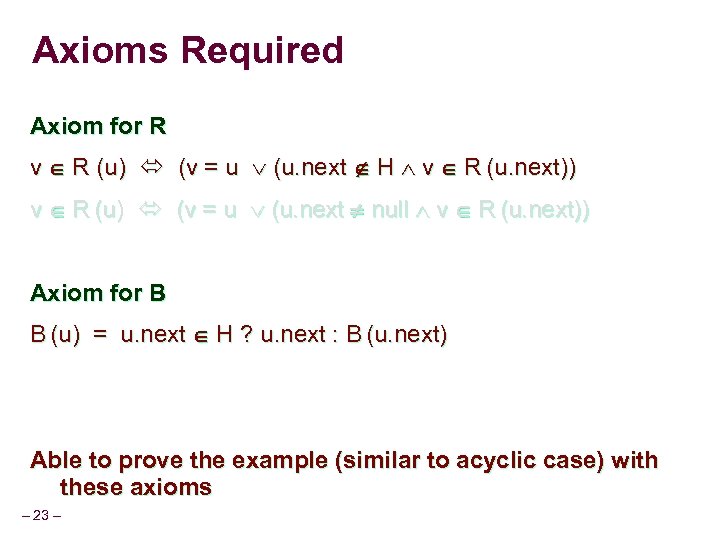 Axioms Required Axiom for R v R (u) (v = u (u. next H v R (u. next)) v R (u) (v = u (u. next null v R (u. next)) Axiom for B B (u) = u. next H ? u. next : B (u. next) Able to prove the example (similar to acyclic case) with these axioms – 23 –
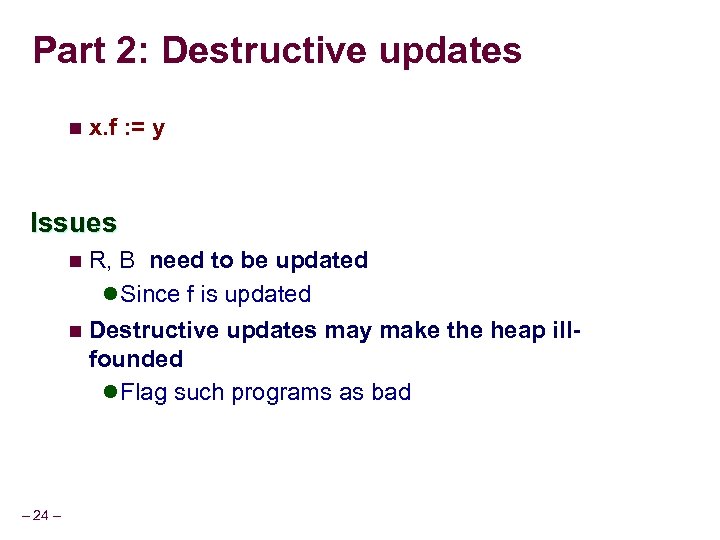 Part 2: Destructive updates n x. f : = y Issues n R, B need to be updated l Since f is updated n Destructive updates may make the heap ill- founded l Flag such programs as bad – 24 –
 Updates to R, B (some cases) n x. f : = y u u x x y R (u) = R (u) R (x) {x} R (y) B (u) = B (y) – 25 – y R (u) = R (u) R (x) {x} B (u) = y
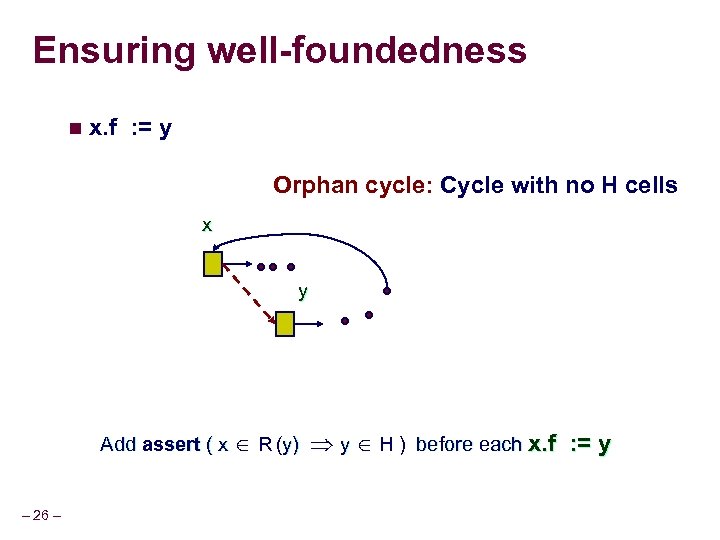 Ensuring well-foundedness n x. f : = y Orphan cycle: Cycle with no H cells x y Add assert ( x R (y) – 26 – y H ) before each x. f : = y
 Updating cells in Hf is a program variable now Hf. Add(x) n Adds the cell pointed to by x to Hf n Useful when creating a cycle for the first time Hf. Remove(x) n Removes the cell pointed to by x to Hf n Remove one head when two cycles with a head each are fused Updates to Rf, Bf still remain quantifier-free – 27 –
 Summary: Instrumentation Quantifier-free updates to auxiliary variables R, B n n Similar to acyclic case [Dong & Su ‘ 95] Very difficult to update R for cyclic lists in general Instrumentation captures “well-foundedness” precisely n – 28 – The instrumented program goes wrong (violates an assertion) iff the source program 1. goes wrong (violates some assertions), or 2. heap of the source program becomes not wellfounded
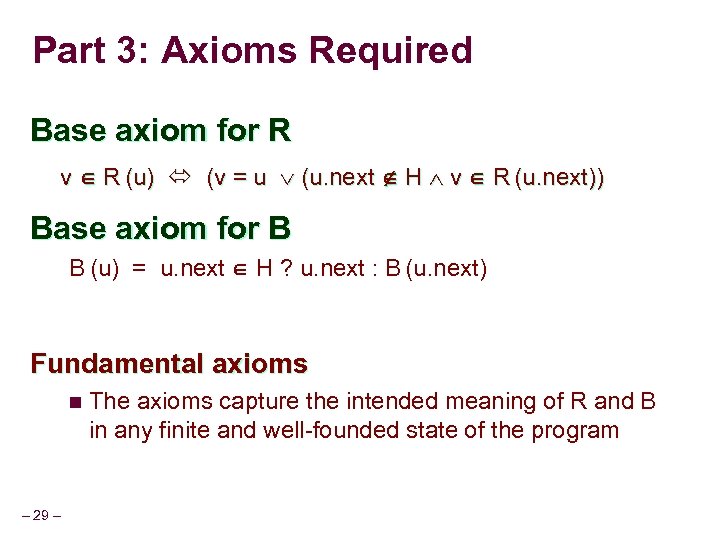 Part 3: Axioms Required Base axiom for R v R (u) (v = u (u. next H v R (u. next)) Base axiom for B B (u) = u. next H ? u. next : B (u. next) Fundamental axioms n The axioms capture the intended meaning of R and B in any finite and well-founded state of the program – 29 –
 Generating new axioms n Not possible to express finiteness and wellfoundedness in first-order logic Derive new axioms from the base axioms n Using induction For well-founded heaps n We provide an induction principle to generate derived axioms from base axioms – 30 –
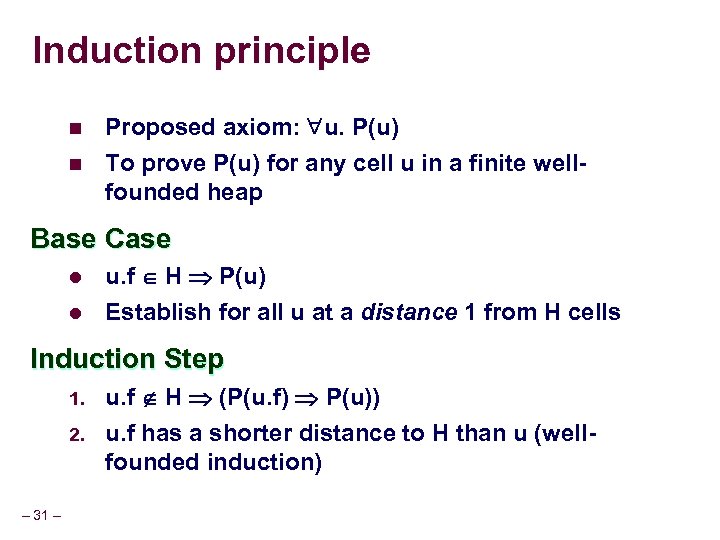 Induction principle n n Proposed axiom: u. P(u) To prove P(u) for any cell u in a finite wellfounded heap Base Case l l u. f H P(u) Establish for all u at a distance 1 from H cells Induction Step 1. 2. – 31 – u. f H (P(u. f) P(u)) u. f has a shorter distance to H than u (wellfounded induction)
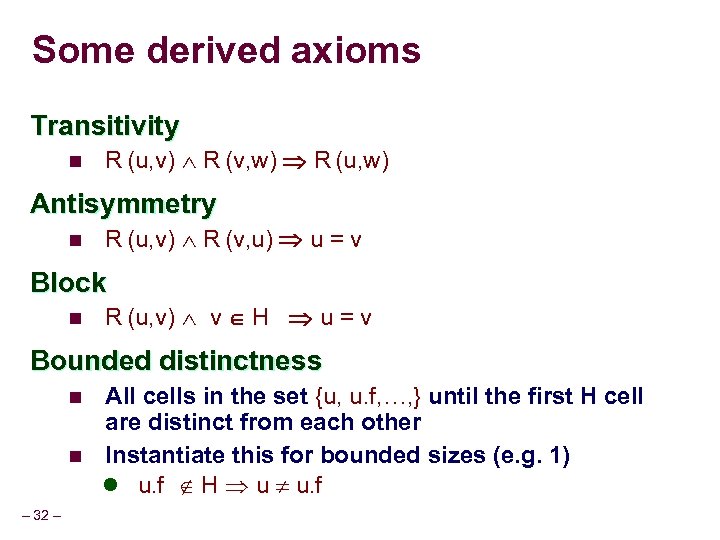 Some derived axioms Transitivity n R (u, v) R (v, w) R (u, w) Antisymmetry n R (u, v) R (v, u) u = v Block n R (u, v) v H u = v Bounded distinctness n n – 32 – All cells in the set {u, u. f, …, } until the first H cell are distinct from each other Instantiate this for bounded sizes (e. g. 1) l u. f H u u. f
 Derived Axioms Set of axioms are fairly fundamental properties and fairly intuitive n Can be easily proved from the base axioms using the induction principle Suffice for a large set of examples n Otherwise derive new axioms using the base axioms and induction – 33 –
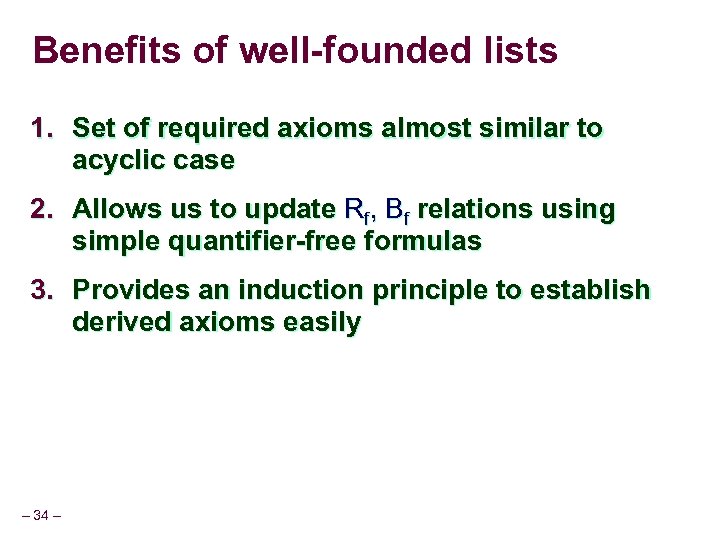 Benefits of well-founded lists 1. Set of required axioms almost similar to acyclic case 2. Allows us to update Rf, Bf relations using simple quantifier-free formulas 3. Provides an induction principle to establish derived axioms easily – 34 –
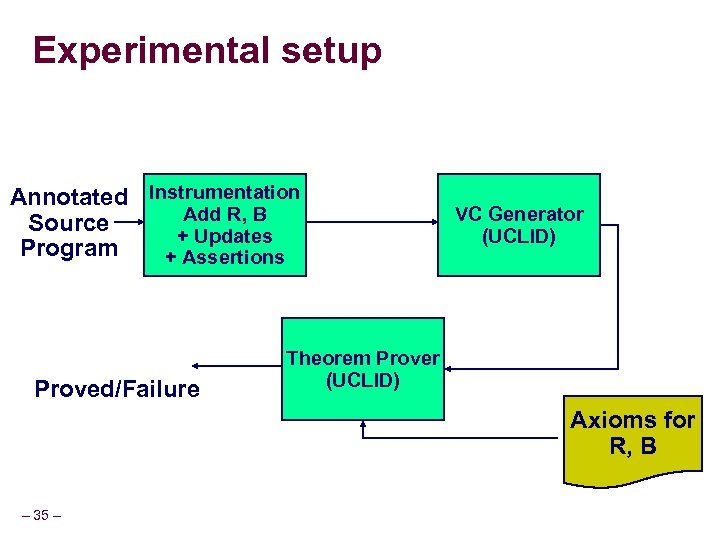 Experimental setup Annotated Instrumentation Add R, B Source + Updates Program + Assertions Proved/Failure VC Generator (UCLID) Theorem Prover (UCLID) Axioms for R, B – 35 –
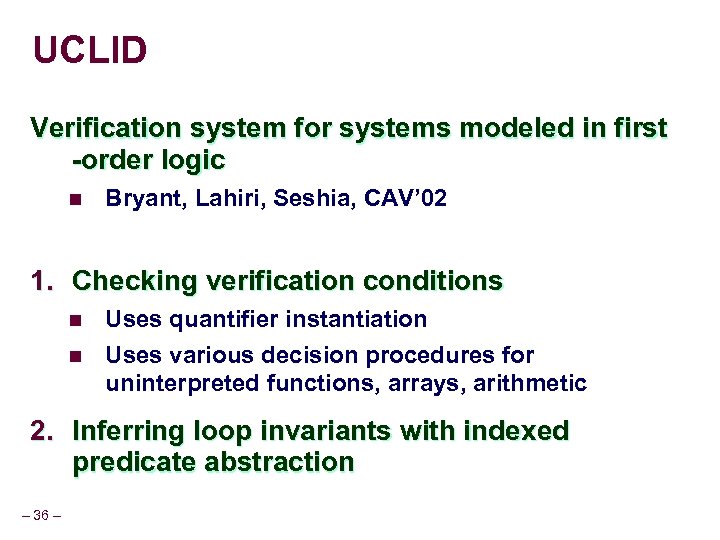 UCLID Verification system for systems modeled in first -order logic n Bryant, Lahiri, Seshia, CAV’ 02 1. Checking verification conditions n n Uses quantifier instantiation Uses various decision procedures for uninterpreted functions, arrays, arithmetic 2. Inferring loop invariants with indexed predicate abstraction – 36 –
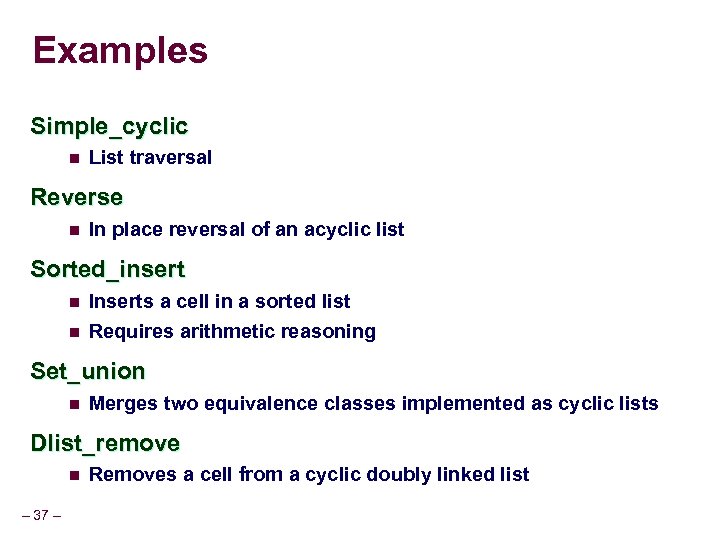 Examples Simple_cyclic n List traversal Reverse n In place reversal of an acyclic list Sorted_insert n n Inserts a cell in a sorted list Requires arithmetic reasoning Set_union n Merges two equivalence classes implemented as cyclic lists Dlist_remove n – 37 – Removes a cell from a cyclic doubly linked list
 Experiments Proving Verification Conditions (VCs) n Most examples take < 1 s Loop Invariant synthesis using indexed predicate abstraction – 38 –
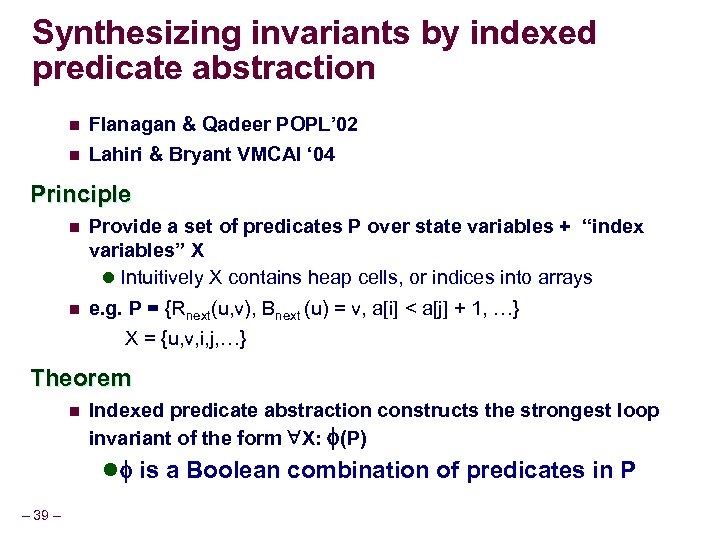 Synthesizing invariants by indexed predicate abstraction n n Flanagan & Qadeer POPL’ 02 Lahiri & Bryant VMCAI ‘ 04 Principle n Provide a set of predicates P over state variables + “index variables” X l Intuitively X contains heap cells, or indices into arrays n e. g. P = {Rnext(u, v), Bnext (u) = v, a[i] < a[j] + 1, …} X = {u, v, i, j, …} Theorem n Indexed predicate abstraction constructs the strongest loop invariant of the form X: (P) l is a Boolean combination of predicates in P – 39 –
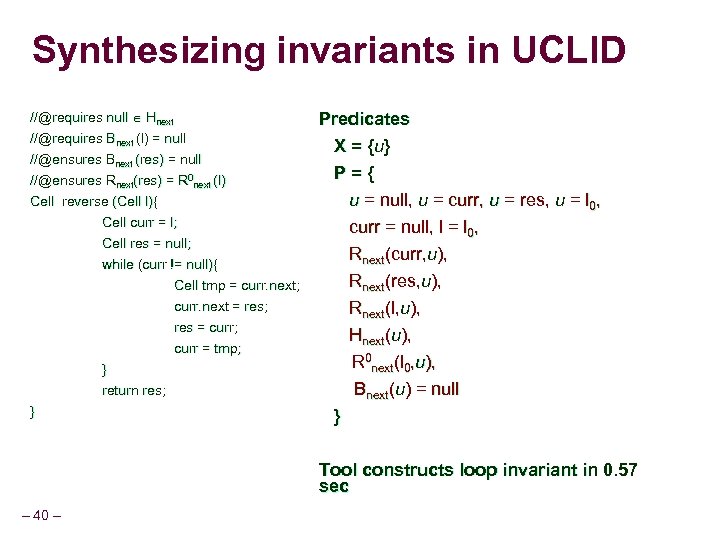 Synthesizing invariants in UCLID //@requires null Hnext //@requires Bnext (l) = null //@ensures Bnext (res) = null //@ensures Rnext(res) = R 0 next (l) Cell reverse (Cell l){ Cell curr = l; Cell res = null; while (curr != null){ Cell tmp = curr. next; curr. next = res; res = curr; curr = tmp; } return res; } Predicates X = { u} P={ u = null, u = curr, u = res, u = l 0, curr = null, l = l 0, Rnext(curr, u), Rnext(res, u), Rnext(l, u), Hnext(u), R 0 next(l 0, u), Bnext(u) = null } Tool constructs loop invariant in 0. 57 sec – 40 –
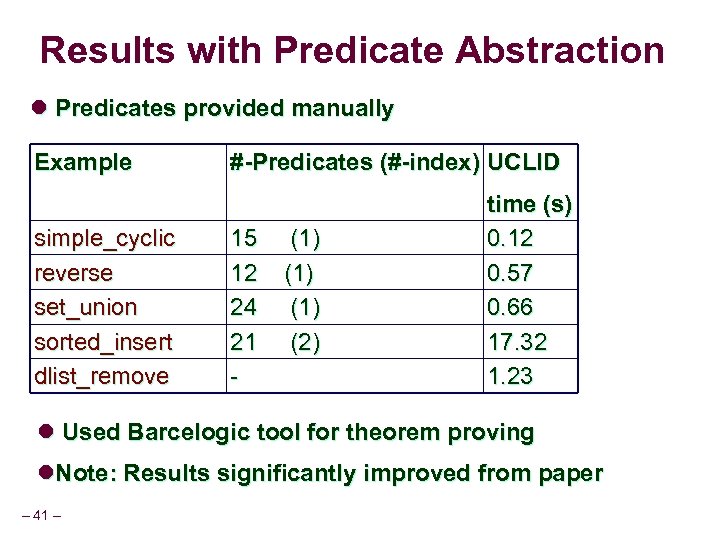 Results with Predicate Abstraction l Predicates provided manually Example simple_cyclic reverse set_union sorted_insert dlist_remove #-Predicates (#-index) UCLID 15 12 24 21 - (1) (1) (2) time (s) 0. 12 0. 57 0. 66 17. 32 1. 23 l Used Barcelogic tool for theorem proving l. Note: Results significantly improved from paper – 41 –
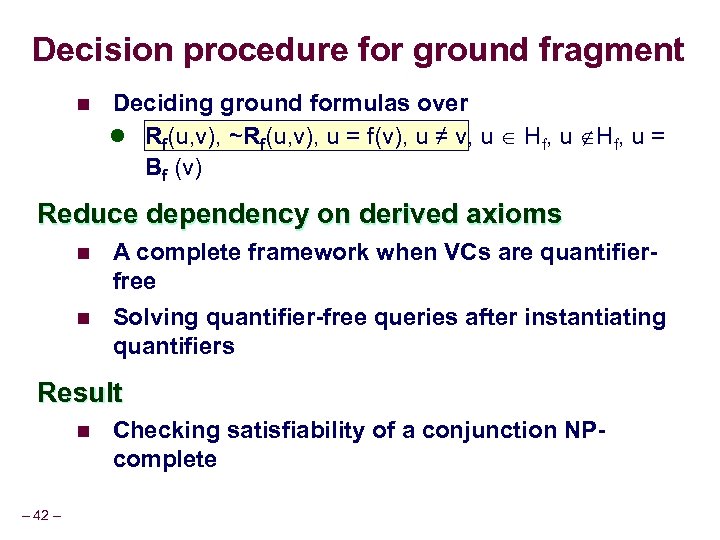 Decision procedure for ground fragment n Deciding ground formulas over l Rf(u, v), ~Rf(u, v), u = f(v), u ≠ v, u Hf, u = Bf (v) Reduce dependency on derived axioms n n A complete framework when VCs are quantifierfree Solving quantifier-free queries after instantiating quantifiers Result n – 42 – Checking satisfiability of a conjunction NPcomplete
 Related work First-order axiomatization of reachability n Nelson ’ 83, Lev-Ami et al. ’ 05 First-order reasoning without reachability n Necula & Mc. Peak ’ 05 Shape analysis with 3 -valued logic n n Sagiv et al. ’ 99, … TVLA Predicate abstraction for lists n Dams et al. ’ 03, Balaban et al. ’ 05, Manevich et al. ’ 05, Bingham ’ 06 Separation logic n – 43 – O’Hearn et al. ’ 01, Reynolds ’ 02,
 Conclusions Two new predicates R, B for well-founded heaps Instrumentation of source program with auxiliary variables for the predicates First-order axiomatization n New induction principle n Simpler derived axioms Implementation n Leverage first-order theorem provers n Indexed predicate abstraction provides a uniform scheme for synthesizing invariants – 44 –