 Скачать презентацию Verification of Embedded Software in Industrial Microprocessors Eli
04e070ebc6d400aa745d505973ef3f4d.ppt
- Количество слайдов: 41



Verification of Embedded Software in Industrial Microprocessors Eli Singerman Design and Technology Solutions Intel Corp. FMCAD’ 2007, Austin
Acknowledgements • Our Intel team: – Michael Mishaeli, Elad Elster, Ronen Kofman, Tamarah Arons, Andreas Tiemeyer, Shlomit Ozer, Jonathan Shalev, Pavel Mikhlin, Terry Murphi, Sela Mador. Haim (past) • Academic partners: – Lenore Zuck, Amir Pnueli, Moshe Vardi E. Singerman FMCAD Talk November 2007 2
Outline • Motivation • Embedded Software Intro – Characteristics – Verification Landscape • Application of Formal Methods – Modeling – Reasoning – Verification Flows • The way ahead… • Related work E. Singerman FMCAD Talk November 2007 3
Motivation • In modern Intel processors, several advanced new technologies are provided through embedded software – E. g. , virtualization, security… – We expect this to grow as CPUs gradually move to So. C design paradigm E. Singerman FMCAD Talk November 2007 4
Motivation cont. • Verification is on the critical path – Limits the introduction of new features – Dominant in Time-To-Market • Embedded software (mostly microcode) is “responsible” for a significant portion of bugs – Implementation is challenging (and error prone) • Verification methodologies/tools/technologies are challenged • In this talk, I will overview some of the directions we have pursued in addressing this growing gap (extending what we reported at CAV’ 05) E. Singerman FMCAD Talk November 2007 5
Outline • Motivation • Embedded Software Intro – Characteristics – Verification Landscape • Application of Formal Methods – Modeling – Reasoning – Verification Flows (it is not all FV…) • The way ahead… • Related work E. Singerman FMCAD Talk November 2007 6
Characteristics: Basics • Programs are low level (sub-assembly) – let us call them microprograms • The basic data types are bits and bitvectors – Denoting state variables such as registers, memory, microarchitectural control and configuration bits E. Singerman FMCAD Talk November 2007 7
• Control flow is facilitated by jump-to-label instructions – Where the labels appear in the program or indicate a call to an external procedure – Sometimes, label + offset is used – It is possible to have indirect jumps (target is known only at run time) – Have loops (non-recursive, almost all with fixed bound) E. Singerman FMCAD Talk November 2007 8
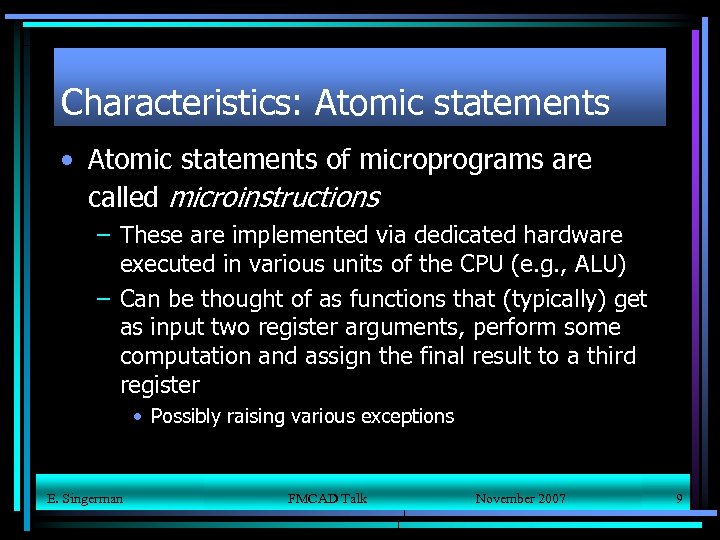
Characteristics: Atomic statements • Atomic statements of microprograms are called microinstructions – These are implemented via dedicated hardware executed in various units of the CPU (e. g. , ALU) – Can be thought of as functions that (typically) get as input two register arguments, perform some computation and assign the final result to a third register • Possibly raising various exceptions E. Singerman FMCAD Talk November 2007 9
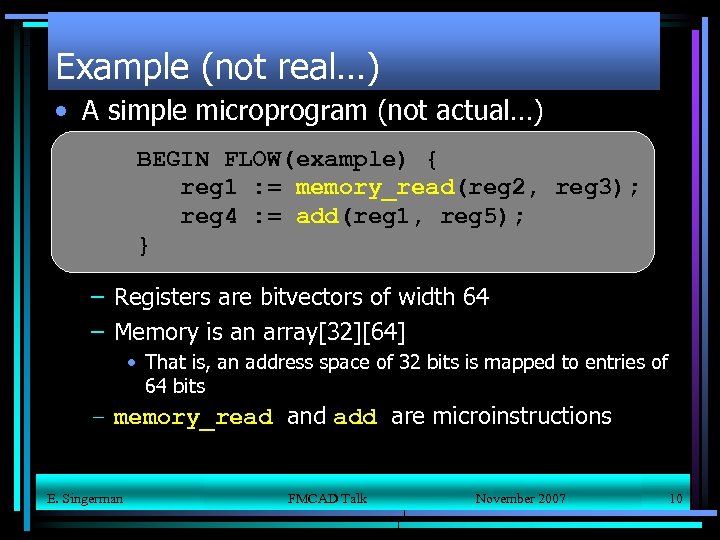
Example (not real…) • A simple microprogram (not actual…) BEGIN FLOW(example) { reg 1 : = memory_read(reg 2, reg 3); reg 4 : = add(reg 1, reg 5); } – Registers are bitvectors of width 64 – Memory is an array[32][64] • That is, an address space of 32 bits is mapped to entries of 64 bits – memory_read and add are microinstructions E. Singerman FMCAD Talk November 2007 10
Characteristics: Hardware Interaction • In addition to invoking microinstructions, we have implicit interaction by reading/setting various shared machine-state variables – E. g. , memory (both persistent and volatile), special control bits for signaling microarchitectural events, etc. • The latter is used for governing the microarchitectural state and is mostly modeled as side-effects (not visible in the source code) E. Singerman FMCAD Talk November 2007 11
Characteristics: Termination • All microprograms execution paths are finite (hopefully…) – Except for spin-loops waiting for HW event to occur in order to resume execution • Two types of exits – Normal: Nothing bad happened – Exception: Some fault occurred, e. g. , arithmetic (underflow…), memory (page not found…) E. Singerman FMCAD Talk November 2007 12
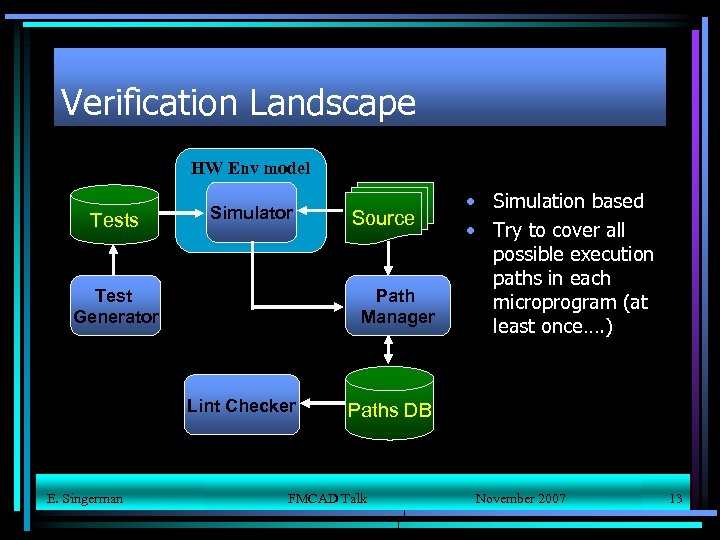
Verification Landscape HW Env model Tests Simulator Test Generator Path Manager Lint Checker E. Singerman Source • Simulation based • Try to cover all possible execution paths in each microprogram (at least once…. ) Paths DB FMCAD Talk November 2007 13
Major Limitations • Path extraction is manual -- annotation based – Very difficult to write and get correct – Missing real paths – Generating un-real paths that can never be covered – Significant maintenance burden • Test Simulate Cover loop is too long • Verification is control oriented – In critical microprograms data should be taken into account E. Singerman FMCAD Talk November 2007 14
Outline • Motivation • Embedded Software Intro – Characteristics – Verification Landscape • Application of Formal Methods – Modeling – Reasoning – Verification Flows (it is not all FV…) • The way ahead… • Related work E. Singerman FMCAD Talk November 2007 15
Modeling… E. Singerman FMCAD Talk November 2007 16
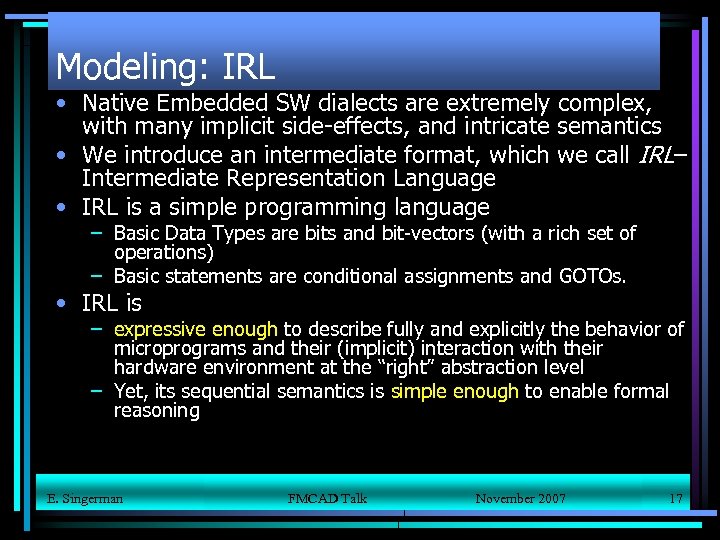
Modeling: IRL • Native Embedded SW dialects are extremely complex, with many implicit side-effects, and intricate semantics • We introduce an intermediate format, which we call IRL– Intermediate Representation Language • IRL is a simple programming language – Basic Data Types are bits and bit-vectors (with a rich set of operations) – Basic statements are conditional assignments and GOTOs. • IRL is – expressive enough to describe fully and explicitly the behavior of microprograms and their (implicit) interaction with their hardware environment at the “right” abstraction level – Yet, its sequential semantics is simple enough to enable formal reasoning E. Singerman FMCAD Talk November 2007 17
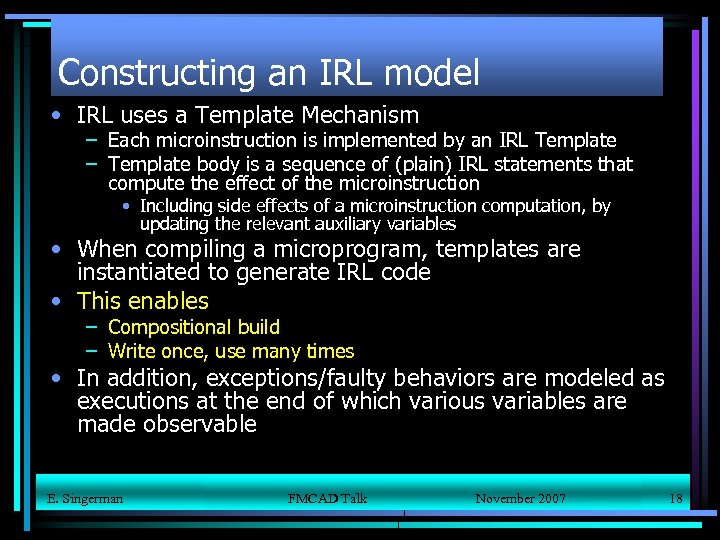
Constructing an IRL model • IRL uses a Template Mechanism – Each microinstruction is implemented by an IRL Template – Template body is a sequence of (plain) IRL statements that compute the effect of the microinstruction • Including side effects of a microinstruction computation, by updating the relevant auxiliary variables • When compiling a microprogram, templates are instantiated to generate IRL code • This enables – Compositional build – Write once, use many times • In addition, exceptions/faulty behaviors are modeled as executions at the end of which various variables are made observable E. Singerman FMCAD Talk November 2007 18
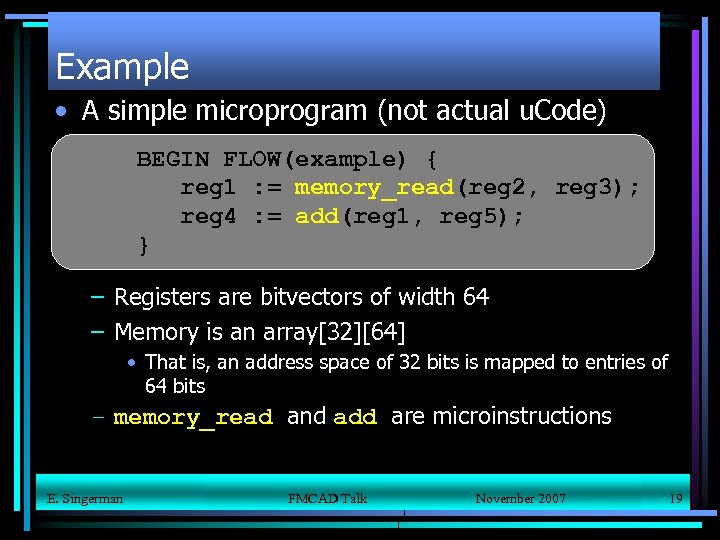
Example • A simple microprogram (not actual u. Code) BEGIN FLOW(example) { reg 1 : = memory_read(reg 2, reg 3); reg 4 : = add(reg 1, reg 5); } – Registers are bitvectors of width 64 – Memory is an array[32][64] • That is, an address space of 32 bits is mapped to entries of 64 bits – memory_read and add are microinstructions E. Singerman FMCAD Talk November 2007 19
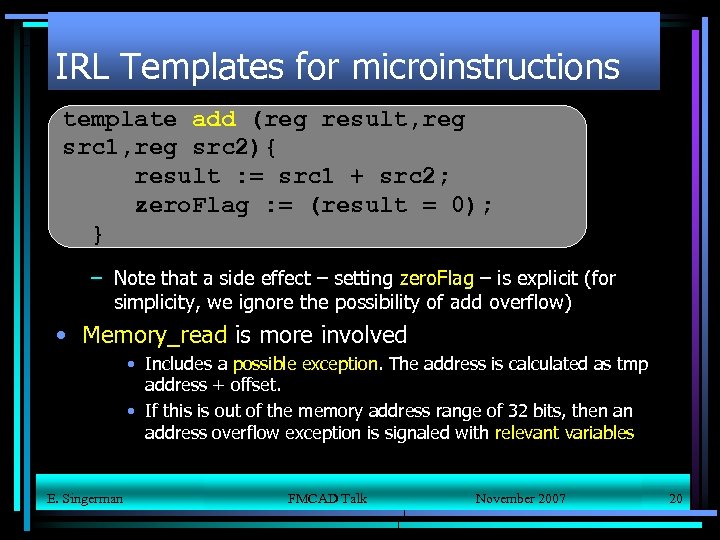
IRL Templates for microinstructions template add (reg result, reg src 1, reg src 2){ result : = src 1 + src 2; zero. Flag : = (result = 0); } – Note that a side effect – setting zero. Flag – is explicit (for simplicity, we ignore the possibility of add overflow) • Memory_read is more involved • Includes a possible exception. The address is calculated as tmp address + offset. • If this is out of the memory address range of 32 bits, then an address overflow exception is signaled with relevant variables E. Singerman FMCAD Talk November 2007 20
![IRL Templates cont. exception address_overflow(bit[32] address); template memory_read(reg result, reg tmp_address, reg offset) {](https://present5.com/presentation/04e070ebc6d400aa745d505973ef3f4d/image-21.jpg "IRL Templates cont. exception address_overflow(bit[32] address); template memory_read(reg result, reg tmp_address, reg offset) {")
IRL Templates cont. exception address_overflow(bit[32] address); template memory_read(reg result, reg tmp_address, reg offset) { TMP 0 : = tmp_address + offset; observable if (TMP 0 side 0 x. FFFF) > effect exit address_overflow (TMP 0[63: 32]); result : = memory[TMP 0[31: 0]]; zero. Flag : = (result = 0); Found_valid_address : = 1; } E. Singerman FMCAD Talk November 2007 21
Formal model • Symbolic transition system (Manna et al. ) – States defined by means of state variables – Transitions defined by means of logical constraints between pre and post values • Multiple exits (“doors”) – Each exit has its own observable expressions E. Singerman FMCAD Talk November 2007 22

Reasoning… E. Singerman FMCAD Talk November 2007 23
Overview • Reasoning is done through an IRL symbolic simulator • All inputs are assigned with initial symbolic values – Memory interaction is modeled via un-interpreted functions using a stack mechanism • Constraints computed by the simulator are propositional formulas involving bit-vector expressions over initial values – We compute necessary and sufficient conditions to traverse any path the program can execute – For each path, compute the final state mapped to selected observables • For evaluation, the conditions are submitted to propositional SAT solver – We are very encouraged by initial results using academic bitvector solvers, more on this later… E. Singerman FMCAD Talk November 2007 24
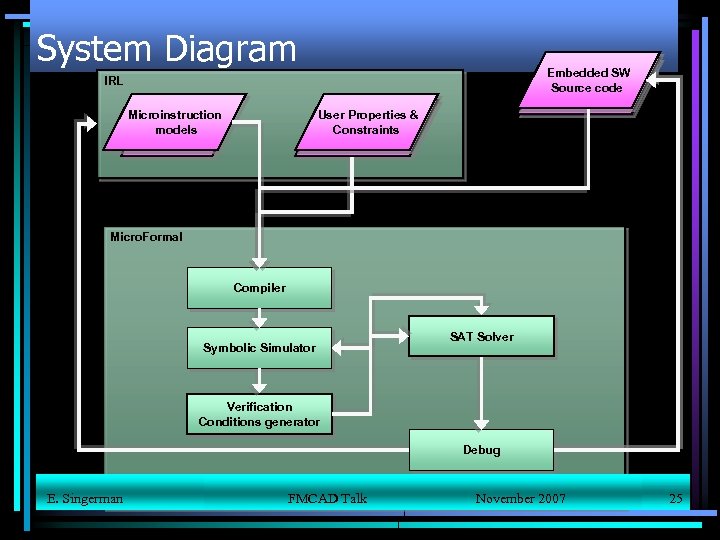
System Diagram Embedded SW u. Code Source code IRL User Properties & Properties Constraints Microinstruction UOP modeling models Micro. Formal Compiler Symbolic Simulator SAT Solver Verification Conditions generator Debug E. Singerman FMCAD Talk November 2007 25
Symbolic Simulation: Some obstacles… • Simulating industrial strength embedded SW requires resolving some difficulties – First, expressions get REALLY BIG, e. g. , a microprogram can consist of thousands of execution paths, several of which have a sequential length of ~10^4 – In addition, have to handle indirect jump statements – Lastly, have to account for loops… – Have to handle these on-the-fly due to first issue E. Singerman FMCAD Talk November 2007 26
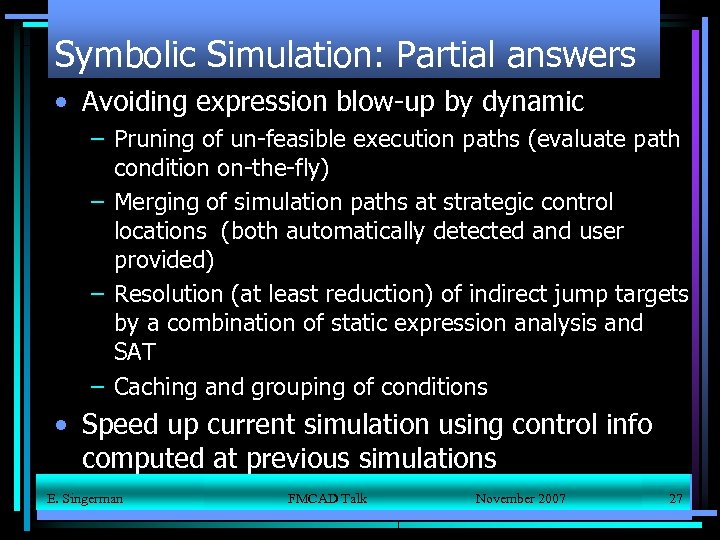
Symbolic Simulation: Partial answers • Avoiding expression blow-up by dynamic – Pruning of un-feasible execution paths (evaluate path condition on-the-fly) – Merging of simulation paths at strategic control locations (both automatically detected and user provided) – Resolution (at least reduction) of indirect jump targets by a combination of static expression analysis and SAT – Caching and grouping of conditions • Speed up current simulation using control info computed at previous simulations More details available in our coming DATE’ 08 paper E. Singerman FMCAD Talk November 2007 27
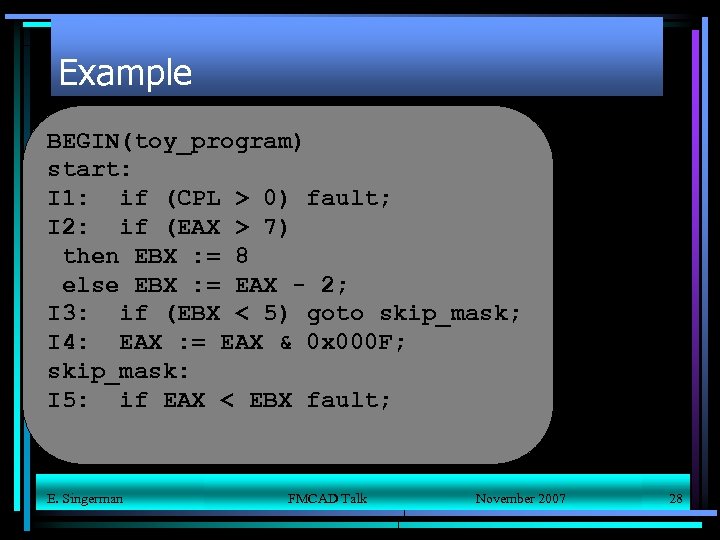
Example BEGIN(toy_program) start: I 1: if (CPL > 0) fault; I 2: if (EAX > 7) then EBX : = 8 else EBX : = EAX - 2; I 3: if (EBX < 5) goto skip_mask; I 4: EAX : = EAX & 0 x 000 F; skip_mask: I 5: if EAX < EBX fault; E. Singerman FMCAD Talk November 2007 28
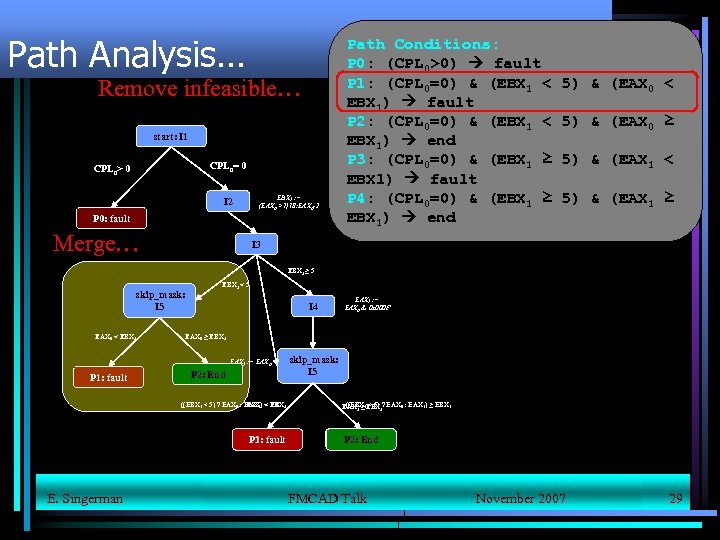
Path Analysis… Remove infeasible… start: I 1 CPL 0= 0 CPL 0> 0 EBX 1 : = (EAX 0 >7)? 8: EAX 0 -2 I 2 P 0: fault Merge… Path Conditions: P 0: (CPL 0>0) fault P 1: (CPL 0=0) & (EBX 1 < EBX 1) fault P 2: (CPL 0=0) & (EBX 1 < EBX 1) end P 3: (CPL 0=0) & (EBX 1 ≥ EBX 1) fault P 4: (CPL 0=0) & (EBX 1 ≥ EBX 1) end 5) & (EAX 0 < 5) & (EAX 0 ≥ 5) & (EAX 1 < 5) & (EAX 1 ≥ I 3 EBX 1 ≥ 5 skip_mask: I 5 EAX 0 < EBX 1 < 5 I 4 EAX 0 ≥ EBX 1 EAX 1 : = EAX 0 P 1: fault P 2: End ((EBX 1 < 5) ? EAX 0 : EAX 11 < EBX 1 EAX) P 1: P 3: fault E. Singerman EAX 1 : = EAX 0 & 0 x 000 F skip_mask: I 5 ((EBX < 5) EAX 1 ≥ 1 EBX 1? EAX 0 : EAX 1) ≥ EBX 1 P 4: End P 2: FMCAD Talk November 2007 29
Verification flows… E. Singerman FMCAD Talk November 2007 30
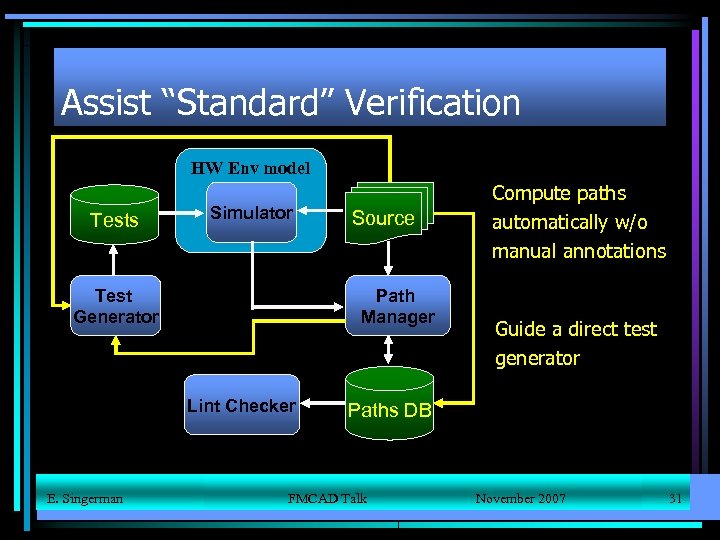
Assist “Standard” Verification HW Env model Tests Simulator Test Generator Source Path Manager Lint Checker Compute paths automatically w/o manual annotations Guide a direct test generator Paths DB Note: These have far more impact than formal verification flows… E. Singerman FMCAD Talk November 2007 31
Test Generation • Using the path conditions, tests can be created to exercise paths in simulation • State mapped between microarchitectural representation and architectural means of setting it • The program simulated is only a small piece of the whole environment simulated – Other structures are needed to bootstrap test, handle faulting conditions, and reach the program under test – For this reason, it is not possible to simply “jam” the values (example: memory layout) E. Singerman FMCAD Talk November 2007 32
Formal Property Verification • Goal: verify intended (partial) behavior of microprograms • Specifying properties – Essentially, state predicates expressing u. Arch/Arch properties – User can specify “what” and “where” to check – These are natural – based on control flow of the program, relating to significant program locations – Examples: § “If EAX[3]=true at start then XYZ = true at end” § “if ECX contains an initial value of given set, then a General Protection Ffault will occur” § … § Basic directives – Assume a predicate at a specific loaction – Assert (verify) a predicate at a specific location (or at a set of locations) – Constrain program simulation paths during execution E. Singerman FMCAD Talk November 2007 33
Formal Equivalence Verification • Goals: • • Given two microprograms “new”, “legacy” A set of (global) constraints • “new” is backward compatible with “legacy” if both exhibit the same observable behavior (under constraints): – Ensure “backward compatibility” w/IA 32 – Verify that optimizations do not break functionality – Mapping predicates -- relating the two different CPU micro-architectures – Predicates specifying “new” features are disabled – – – • For every initial state, both exit in the same manner Both produce the same values on relevant observables Both write the same values into the same locations of external memory, in the same order • Either both reach normal exit or both have the same “fault” Compatible means: equivalent under constraints E. Singerman FMCAD Talk November 2007 34
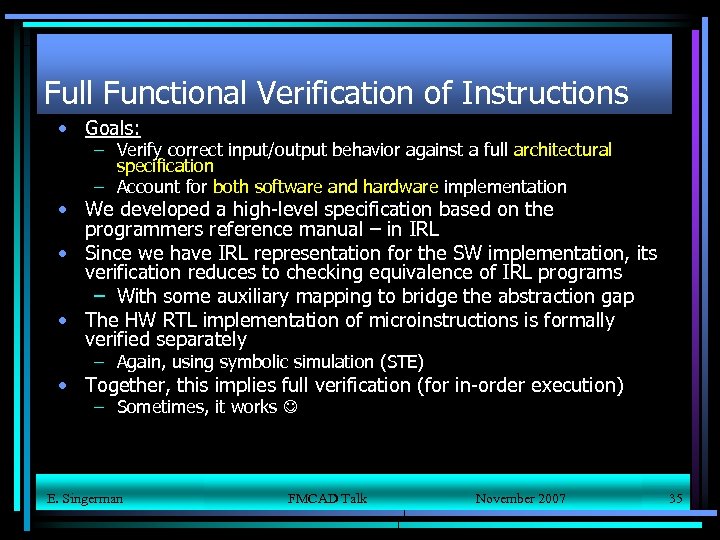
Full Functional Verification of Instructions • Goals: – Verify correct input/output behavior against a full architectural specification – Account for both software and hardware implementation • We developed a high-level specification based on the programmers reference manual – in IRL • Since we have IRL representation for the SW implementation, its verification reduces to checking equivalence of IRL programs – With some auxiliary mapping to bridge the abstraction gap • The HW RTL implementation of microinstructions is formally verified separately – Again, using symbolic simulation (STE) • Together, this implies full verification (for in-order execution) – Sometimes, it works E. Singerman FMCAD Talk November 2007 35
Outline • Motivation • Embedded Software Intro – Characteristics – Verification Landscape • Application of Formal Methods – Modeling – Reasoning – Verification Flows (it is not all FV…) • The way ahead… • Related work E. Singerman FMCAD Talk November 2007 36
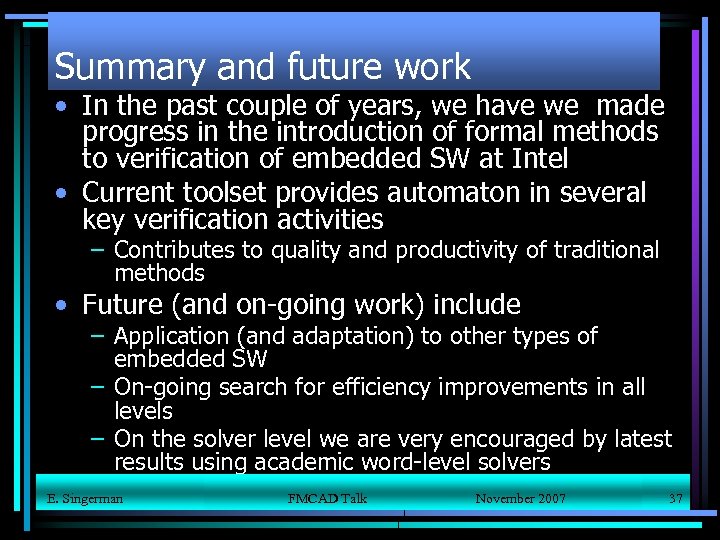
Summary and future work • In the past couple of years, we have we made progress in the introduction of formal methods to verification of embedded SW at Intel • Current toolset provides automaton in several key verification activities – Contributes to quality and productivity of traditional methods • Future (and on-going work) include – Application (and adaptation) to other types of embedded SW – On-going search for efficiency improvements in all levels – On the solver level we are very encouraged by latest results using academic word-level solvers E. Singerman FMCAD Talk November 2007 37

Thanks! E. Singerman FMCAD Talk November 2007 38
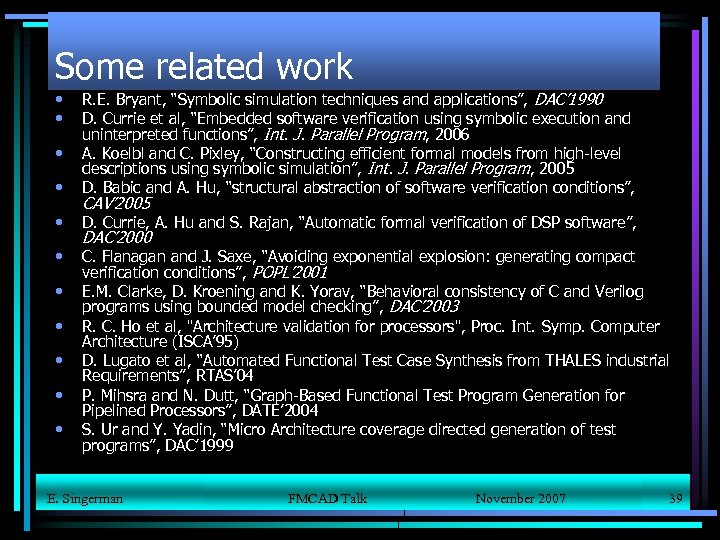
Some related work • R. E. Bryant, “Symbolic simulation techniques and applications”, DAC’ 1990 D. Currie et al, “Embedded software verification using symbolic execution and uninterpreted functions”, Int. J. Parallel Program, 2006 A. Koelbl and C. Pixley, “Constructing efficient formal models from high-level descriptions using symbolic simulation”, Int. J. Parallel Program, 2005 D. Babic and A. Hu, “structural abstraction of software verification conditions”, • D. Currie, A. Hu and S. Rajan, “Automatic formal verification of DSP software”, • • • CAV’ 2005 DAC’ 2000 C. Flanagan and J. Saxe, “Avoiding exponential explosion: generating compact verification conditions”, POPL’ 2001 E. M. Clarke, D. Kroening and K. Yorav, “Behavioral consistency of C and Verilog programs using bounded model checking”, DAC’ 2003 R. C. Ho et al, "Architecture validation for processors", Proc. Int. Symp. Computer Architecture (ISCA’ 95) D. Lugato et al, “Automated Functional Test Case Synthesis from THALES industrial Requirements”, RTAS’ 04 P. Mihsra and N. Dutt, “Graph-Based Functional Test Program Generation for Pipelined Processors”, DATE’ 2004 S. Ur and Y. Yadin, “Micro Architecture coverage directed generation of test programs”, DAC’ 1999 E. Singerman FMCAD Talk November 2007 39
More related work • • • D. Cyrluk, “Microprocessor Verification in PVS: A Methodology and Simple Example”, Technical Report SRI-CSL-93 -12, 1993 S. Y. Huang and K. T. Cheng, “Formal Equivalence Checking and Design Debugging ”, Kluwer, 1998. D. Harel and A. Pnueli, “On the development of reactive systems”, In Logics and Models of Concurrent Systems, 1985. A. Pnueli, M. Siegel, and E. Singerman, “Translation validation”, In TACAS’ 1998 J. Sawada and W. A. Hunt, “Verification of FM 9801: An out-of-order microprocessor model with speculative execution, exceptions, and program-modifying capability”, J. on Formal Methods in System Design, 2002. M. Srivas and S. Miller, “Applying formal verification to the AAMP 5 microprocessor: A case study in the industrial use of formal methods”, J. on Formal Methods in System, 1996. A. Aharon et al, “Test Program Generation for Functional Verification of Power. PC Processors in IBM”, DAC’ 1995 R. S. Boyer, B. Elspas and K. N. Levitt, “SELECT - a formal system for testing and debugging programs by symbolic execution”, 1975. T. Ball and S. K. Rajamani, “Automatically Validating Temporal Safety Properties of Interfaces”, SPIN 2001. E. Singerman FMCAD Talk November 2007 40
Yet, some more… • • • S. Fine and A. Ziv. Coverage Directed Test Generation for Functional Verification using Bayesian Networks, DAC’ 2003 D. Geist et al, “Coverage directed test generation using symbolic techniques”, FMCAD‘ 1996 A. Gupta et al, “Property-Specific Testbench Generation for Guided Simulation”, VLSID’ 2002. T. Arons et al, “Formal verification of backward compatibility of microcode”, CAV’ 2005 T. Arons et al, “Embedded Software Validation: Applying formal techniques for coverage and test Generation, MTV’ 2006 T. Arons et al, “Efficient symbolic simulation of low-level software”, to appear in DATE’ 2008 E. Singerman FMCAD Talk November 2007 41
Скачать презентацию Verification of Embedded Software in Industrial Microprocessors Eli
04e070ebc6d400aa745d505973ef3f4d.ppt