


 Скачать презентацию Verification of dynamically downscaled results around Japan Islands
dd18e5da3fbe391accac2111a5d9873a.ppt
- Количество слайдов: 21
 Verification of dynamically downscaled results around Japan Islands Izuru Takayabu Meteorological Research Institute JAPAN 2009/02/10 RT 3 -meeting Toulouse
 Contents • On problems of (1) verification (2) applying dynamical downscaling method around Japan area. (Around 30 – 45 degrees north along the eastern coast of the Eurasian continent) Here we introduce the results of on going 4 projects in Japan. (20 km, 5 km, 4 km, 2 km and 1 km RCMs are used)
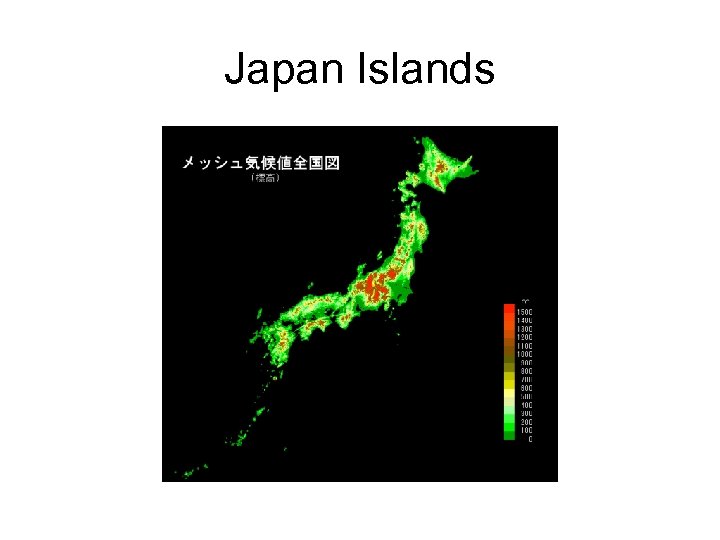 Japan Islands
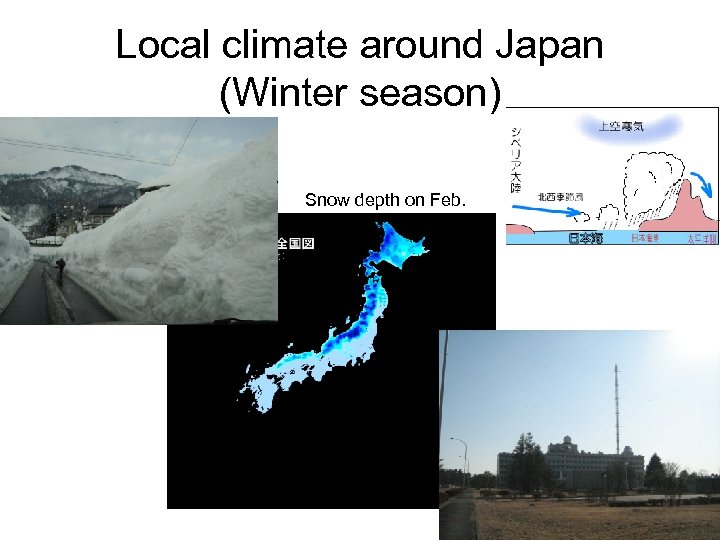 Local climate around Japan (Winter season) Snow depth on Feb.
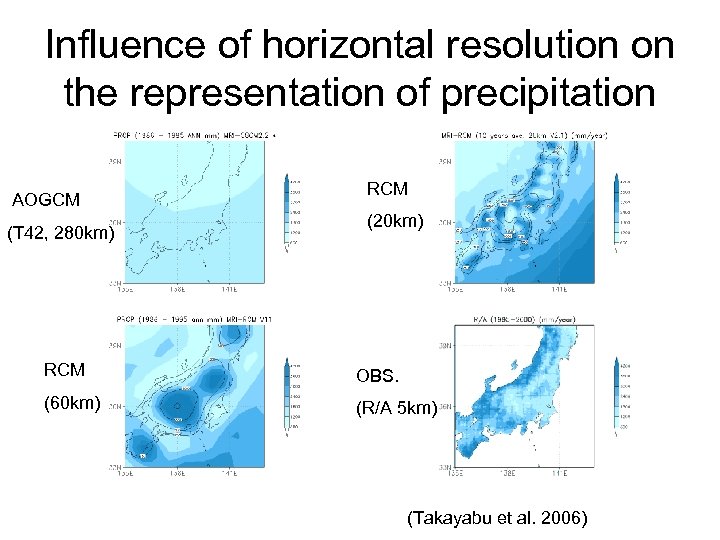 Influence of horizontal resolution on the representation of precipitation AOGCM (T 42, 280 km) RCM (20 km) RCM OBS. (60 km) (R/A 5 km) (Takayabu et al. 2006)
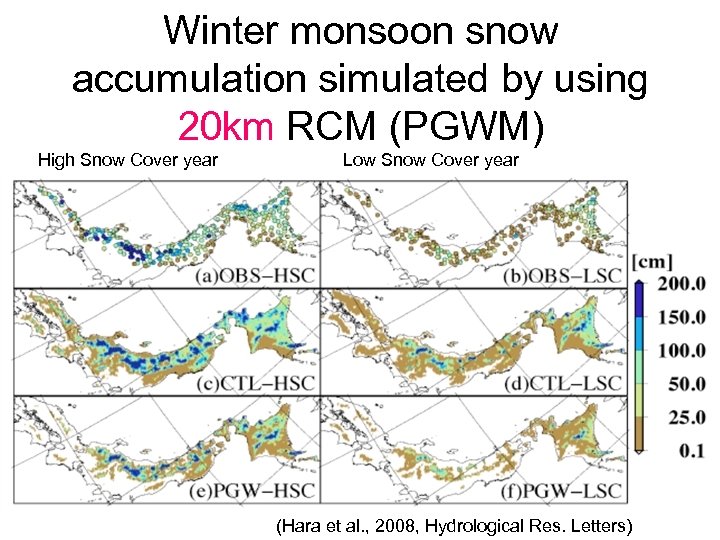 Winter monsoon snow accumulation simulated by using 20 km RCM (PGWM) High Snow Cover year Low Snow Cover year (Hara et al. , 2008, Hydrological Res. Letters)
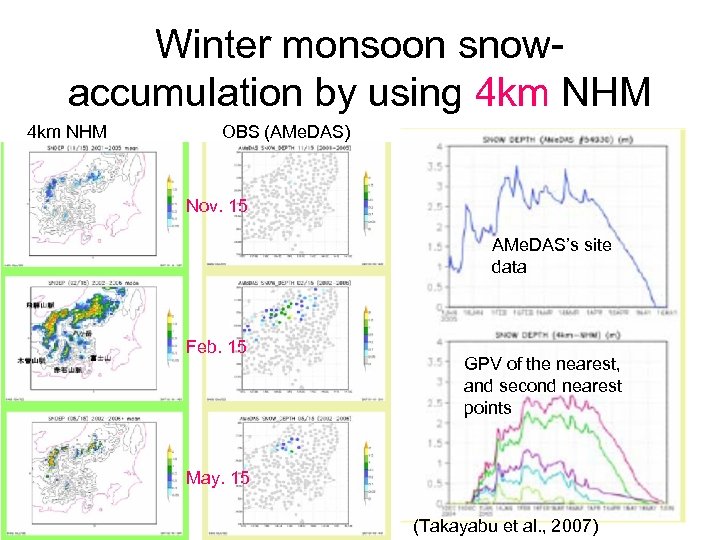 Winter monsoon snowaccumulation by using 4 km NHM OBS (AMe. DAS) Nov. 15 AMe. DAS’s site data Feb. 15 GPV of the nearest, and second nearest points May. 15 (Takayabu et al. , 2007)
 On problems on verification We need to think of the observation site’s condition, and their representative In our area, for verify the results of our regional climate model, we are using Automated Data Acquisition System, which are operationally used in JMA.
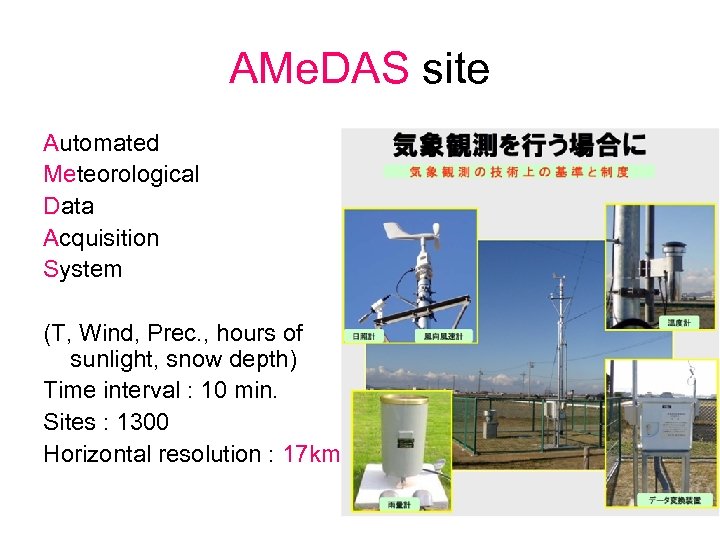 AMe. DAS site Automated Meteorological Data Acquisition System (T, Wind, Prec. , hours of sunlight, snow depth) Time interval : 10 min. Sites : 1300 Horizontal resolution : 17 km
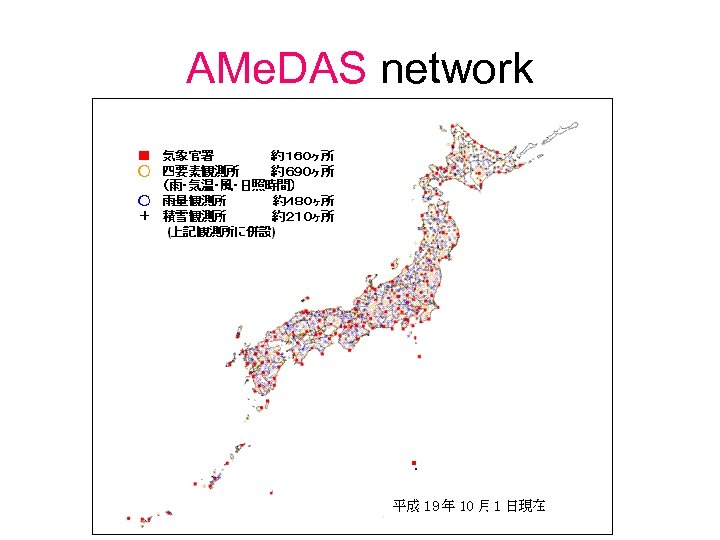 AMe. DAS network
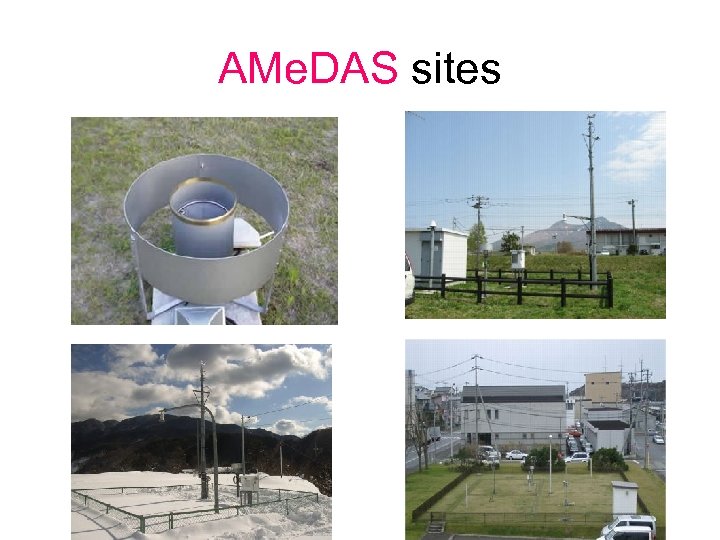 AMe. DAS sites
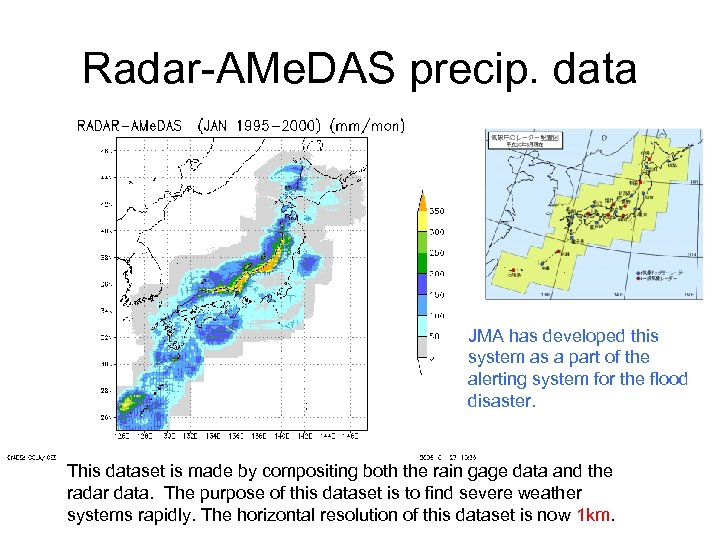 Radar-AMe. DAS precip. data JMA has developed this system as a part of the alerting system for the flood disaster. This dataset is made by compositing both the rain gage data and the radar data. The purpose of this dataset is to find severe weather systems rapidly. The horizontal resolution of this dataset is now 1 km.
 Problems we are facing now is. . • We need to use high resolution data for verifying the model’s results • However, the operational data is fit for the alerting system, or so. • Thus we need to be careful when we try to use such kind of data for verifying from the standpoint of climate. For example, the hydrologists are …
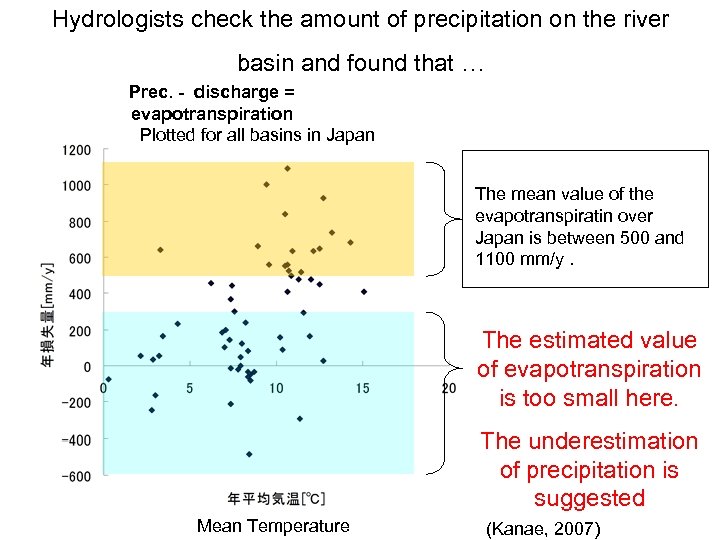 Hydrologists check the amount of precipitation on the river basin and found that … Prec. - discharge = evapotranspiration Plotted for all basins in Japan The mean value of the evapotranspiratin over Japan is between 500 and 1100 mm/y. The estimated value of evapotranspiration is too small here. The underestimation of precipitation is suggested Mean Temperature (Kanae, 2007)
![Estimated discharge [mm/y] Non-UC UC Non-PER OBS. discharge[mm/y] UC: Undercatch correction PER: altitude correction](https://present5.com/presentation/dd18e5da3fbe391accac2111a5d9873a/image-15.jpg "Estimated discharge [mm/y] Non-UC UC Non-PER OBS. discharge[mm/y] UC: Undercatch correction PER: altitude correction") Estimated discharge [mm/y] Non-UC UC Non-PER OBS. discharge[mm/y] UC: Undercatch correction PER: altitude correction Improve the consistency with the amount of river dischage. (Kanae, 2007) UC PER
Estimated discharge [mm/y] Non-UC UC Non-PER OBS. discharge[mm/y] UC: Undercatch correction PER: altitude correction Improve the consistency with the amount of river dischage. (Kanae, 2007) UC PER
 Summery • Around Japan Islands, we have a dense network to verify the RCM’s data. • However, we should pay attention when we try to use this dataset for climatology, because it was made for the disaster alarming system, and is sometimes too sensitive for discussing the climatic value. • Thus, we are now making efforts to avoid these weaknesses.
 Other important problems around Japan ① SST impact on winter climate. ② Representative of Floods (Convection scheme and horizontal resolution)
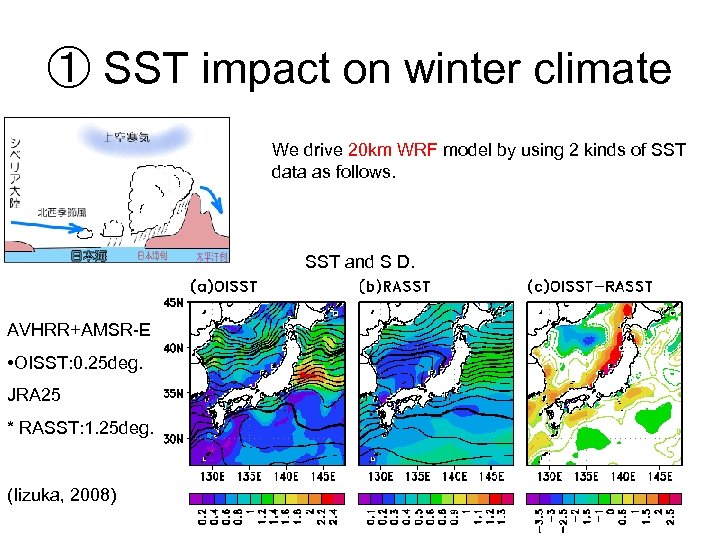 ① SST impact on winter climate We drive 20 km WRF model by using 2 kinds of SST data as follows. SST and S D. AVHRR+AMSR-E • OISST: 0. 25 deg. JRA 25 * RASST: 1. 25 deg. (Iizuka, 2008)
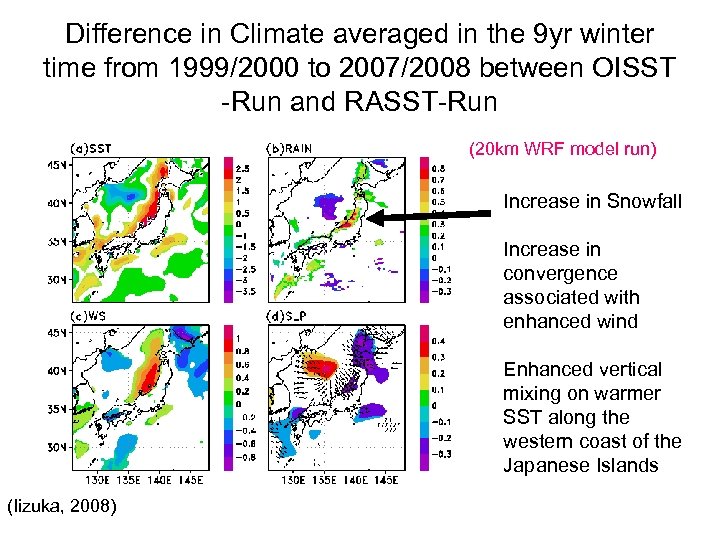 Difference in Climate averaged in the 9 yr winter time from 1999/2000 to 2007/2008 between OISST -Run and RASST-Run (20 km WRF model run) Increase in Snowfall Increase in convergence associated with enhanced wind Enhanced vertical mixing on warmer SST along the western coast of the Japanese Islands (Iizuka, 2008)
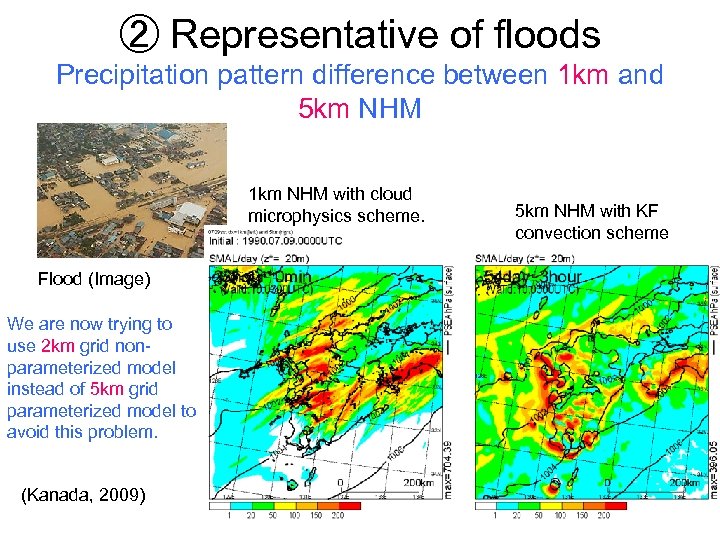 ② Representative of floods Precipitation pattern difference between 1 km and 5 km NHM 1 km NHM with cloud microphysics scheme. Flood (Image) We are now trying to use 2 km grid nonparameterized model instead of 5 km grid parameterized model to avoid this problem. (Kanada, 2009) 5 km NHM with KF convection scheme
 Conclusion • Over the Japan Islands, we have a dense network for getting meteorolgical data. -It is useful to verify very high resolution RCM, however, we still have some problems. There exists also some difficulties in simulating the climate like around Japan Isls. -This is because the Islands are located around the boundary between the tropical , and high-latitude airmasses. - And also these Islands are all surrounded by water surface.