


 Скачать презентацию Verification of a timed multitask system with Uppaal
2a9f59a9b6fa44140797e667b879aacf.ppt
- Количество слайдов: 15
 Verification of a timed multitask system with Uppaal case study ETFA 2005 Beatrice Berard, Houda Bel mokadem, Vincent Gourcuff, Jean-Marc Roussel, Olivier De Smet LURPA - EA 1385 - ENS de Cachan LSV - CNRS UMR 8643 - ENS de Cachan LAMSADE - CNRS UMR 7024 & Université Paris-Dauphine LSV
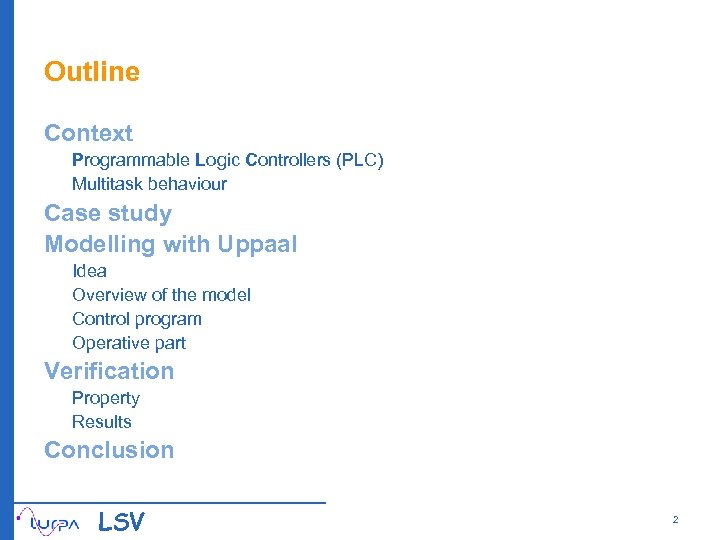 Outline Context Programmable Logic Controllers (PLC) Multitask behaviour Case study Modelling with Uppaal Idea Overview of the model Control program Operative part Verification Property Results Conclusion LSV 2
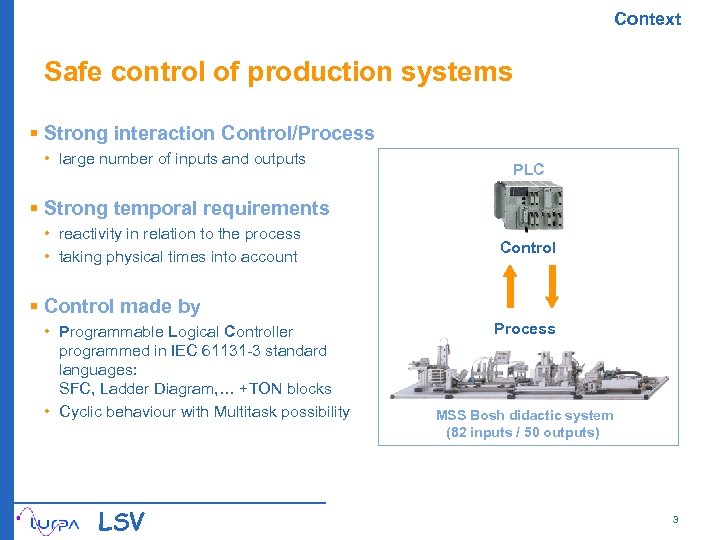 Context Safe control of production systems § Strong interaction Control/Process • large number of inputs and outputs PLC § Strong temporal requirements • reactivity in relation to the process • taking physical times into account Control § Control made by • Programmable Logical Controller programmed in IEC 61131 -3 standard languages: SFC, Ladder Diagram, … +TON blocks • Cyclic behaviour with Multitask possibility LSV Process MSS Bosh didactic system (82 inputs / 50 outputs) 3
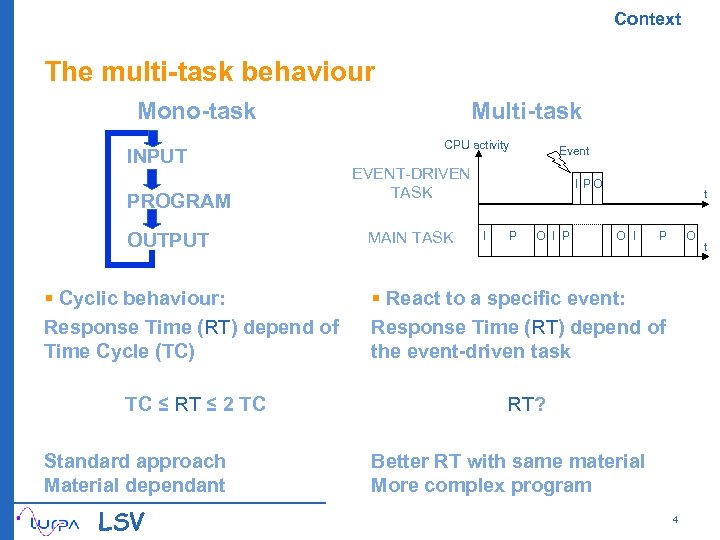 Context The multi-task behaviour Mono-task INPUT PROGRAM OUTPUT § Cyclic behaviour: Response Time (RT) depend of Time Cycle (TC) TC ≤ RT ≤ 2 TC Standard approach Material dependant LSV Multi-task CPU activity Event EVENT-DRIVEN TASK MAIN TASK I PO I P t O I P O § React to a specific event: Response Time (RT) depend of the event-driven task RT? Better RT with same material More complex program 4 t
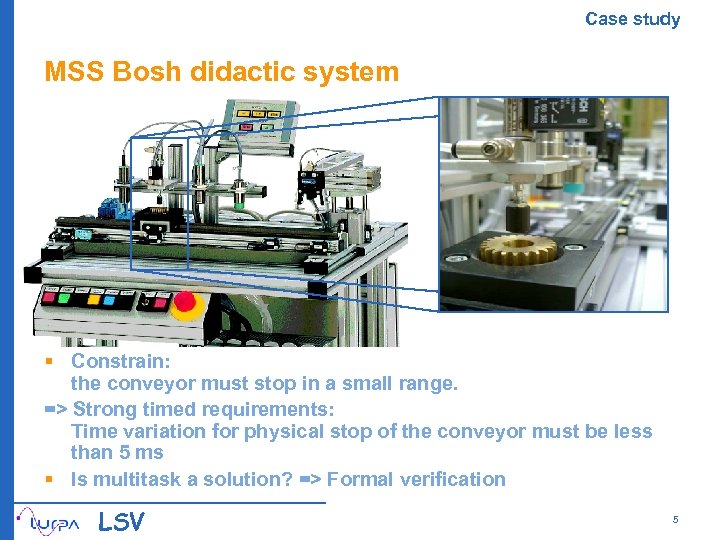 Case study MSS Bosh didactic system § Constrain: the conveyor must stop in a small range. => Strong timed requirements: Time variation for physical stop of the conveyor must be less than 5 ms § Is multitask a solution? => Formal verification LSV 5
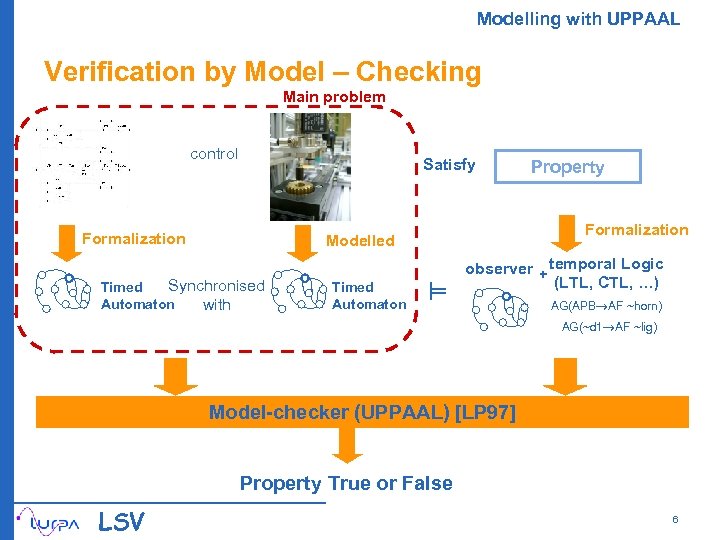 Modelling with UPPAAL Verification by Model – Checking Main problem control Satisfy Formalization Modelled Synchronised Timed Automaton with Timed Automaton Property ⊨ observer + temporal Logic (LTL, CTL, …) AG(APB AF ~horn) AG(~d 1 AF ~lig) Model-checker (UPPAAL) [LP 97] Property True or False LSV 6
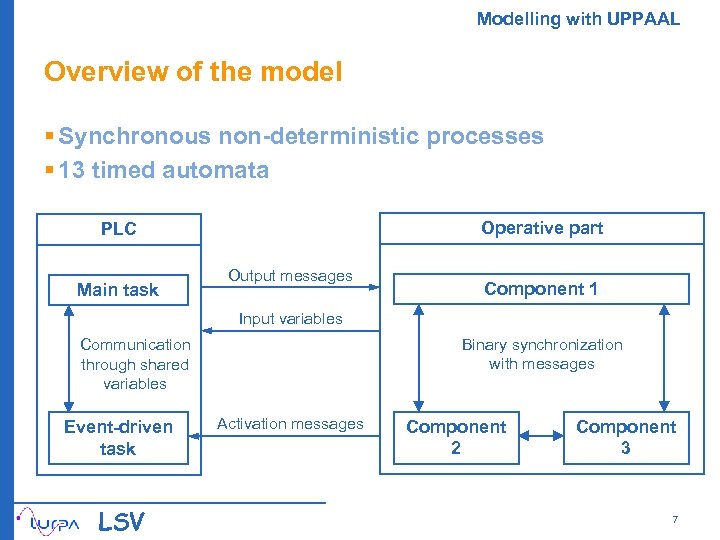 Modelling with UPPAAL Overview of the model § Synchronous non-deterministic processes § 13 timed automata Operative part PLC Main task Output messages Component 1 Input variables Binary synchronization with messages Communication through shared variables Event-driven task LSV Activation messages Component 2 Component 3 7
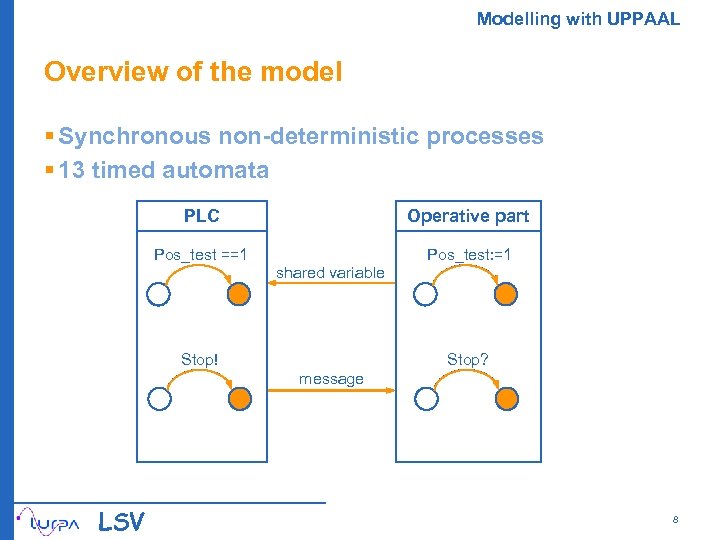 Modelling with UPPAAL Overview of the model § Synchronous non-deterministic processes § 13 timed automata PLC Operative part Pos_test ==1 Pos_test: =1 shared variable Stop! Stop? message LSV 8
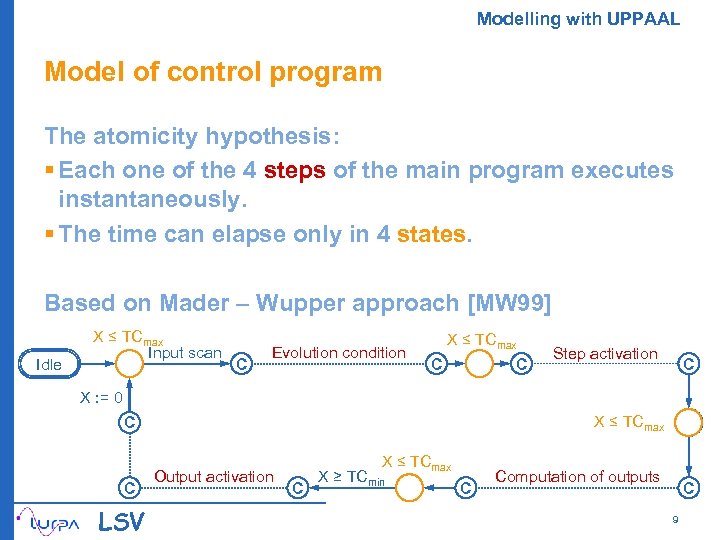 Modelling with UPPAAL Model of control program The atomicity hypothesis: § Each one of the 4 steps of the main program executes instantaneously. § The time can elapse only in 4 states. Based on Mader – Wupper approach [MW 99] Idle X ≤ TCmax Input scan C Evolution condition X ≤ TCmax C C Step activation C X : = 0 X ≤ TCmax C C LSV Output activation X ≤ TCmax C X ≥ TCmin C Computation of outputs C 9
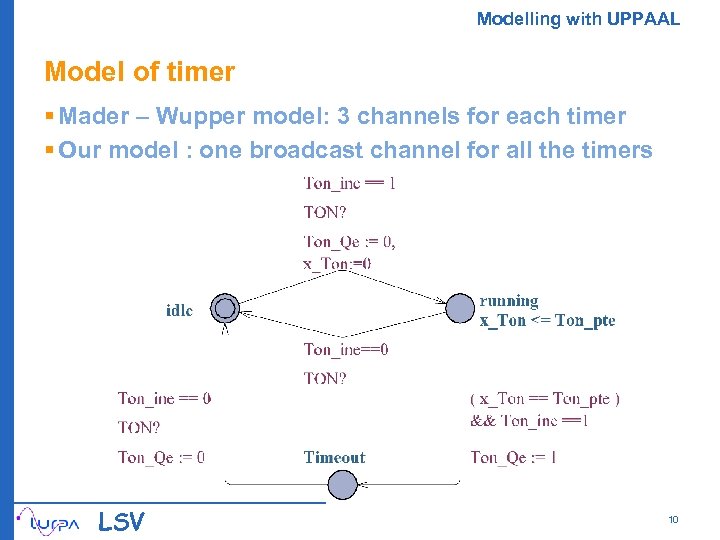 Modelling with UPPAAL Model of timer § Mader – Wupper model: 3 channels for each timer § Our model : one broadcast channel for all the timers LSV 10
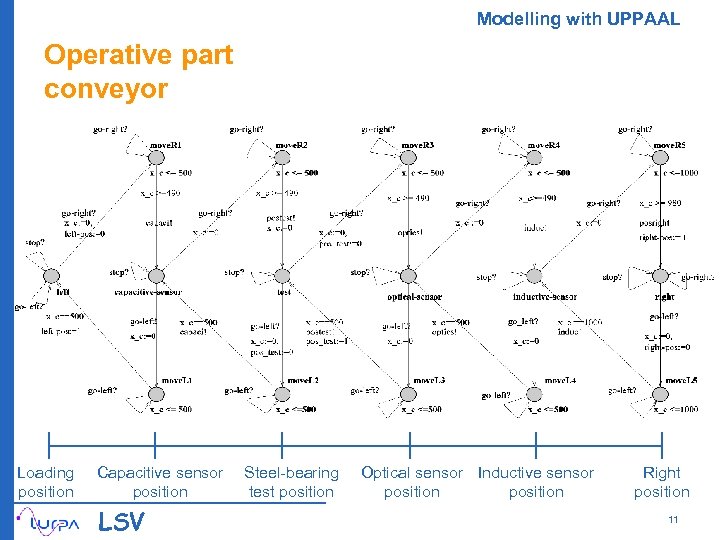 Modelling with UPPAAL Operative part conveyor Loading position Capacitive sensor Steel-bearing position test position LSV Optical sensor Inductive sensor position Right position 11
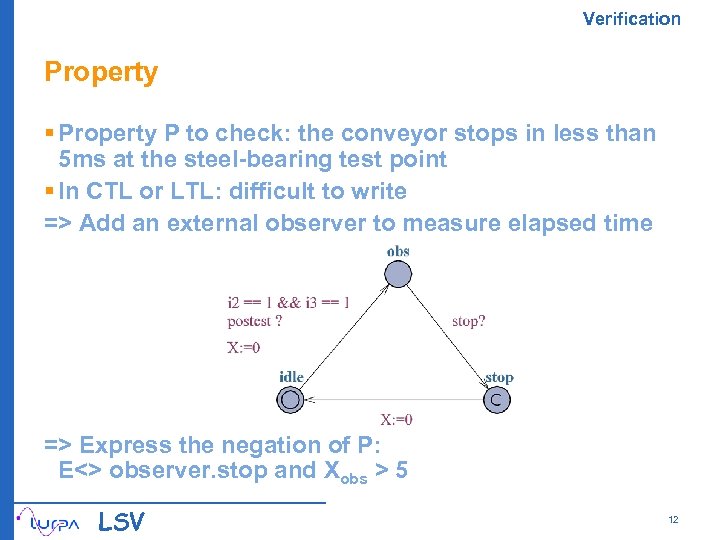 Verification Property § Property P to check: the conveyor stops in less than 5 ms at the steel-bearing test point § In CTL or LTL: difficult to write => Add an external observer to measure elapsed time => Express the negation of P: E<> observer. stop and Xobs > 5 LSV 12
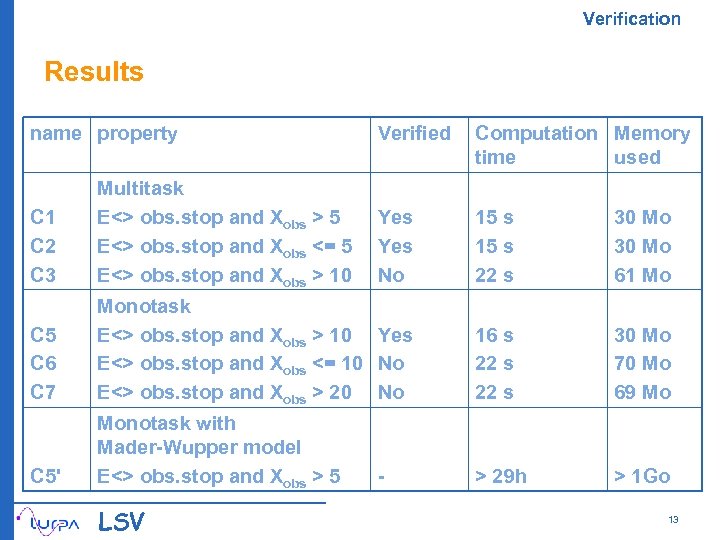 Verification Results name property Verified Computation Memory time used C 1 C 2 C 3 Multitask E<> obs. stop and Xobs > 5 E<> obs. stop and Xobs <= 5 E<> obs. stop and Xobs > 10 Yes No 15 s 22 s 30 Mo 61 Mo C 5 C 6 C 7 Monotask E<> obs. stop and Xobs > 10 Yes E<> obs. stop and Xobs <= 10 No E<> obs. stop and Xobs > 20 No 16 s 22 s 30 Mo 70 Mo 69 Mo C 5' Monotask with Mader-Wupper model E<> obs. stop and Xobs > 5 > 29 h > 1 Go LSV - 13
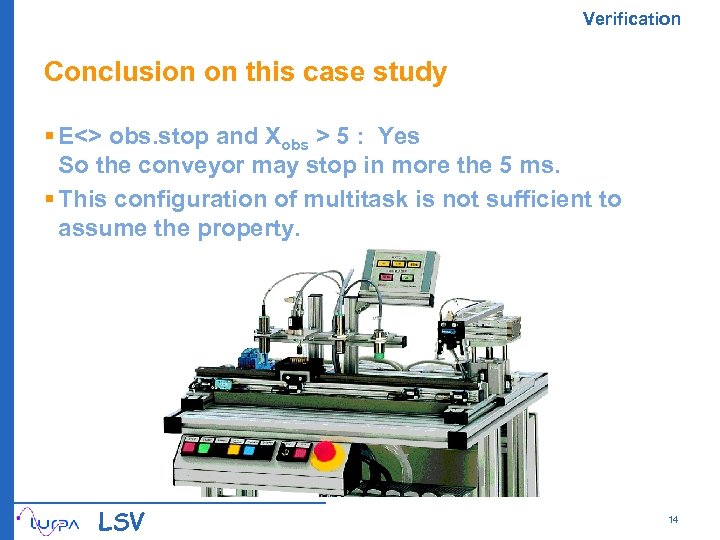 Verification Conclusion on this case study § E<> obs. stop and Xobs > 5 : Yes So the conveyor may stop in more the 5 ms. § This configuration of multitask is not sufficient to assume the property. LSV 14
 Conclusion and perspectives § Achievements • Method to represent time dependant system : control + process • Improvement in modelling control program - Easier modelling of TON - Less time and memory cost in verification • Real case application in Ladder Diagram § Future works • • • Automated modelling of control program Timed property library Function bloc Other IEC 61131 -3 languages … LSV 15