


 Скачать презентацию Verification and Validation Ian Sommerville 2004 Software Engineering
7964685e5411dc2ffe62adab4974f2f2.ppt
- Количество слайдов: 33
 Verification and Validation ©Ian Sommerville 2004 Software Engineering, 7 th edition. Chapter 22 Slide 1
 Objectives l l To introduce software verification and validation and to discuss the distinction between them To describe the program inspection process and its role in V & V To explain static analysis as a verification technique To describe the Cleanroom software development process ©Ian Sommerville 2004 Software Engineering, 7 th edition. Chapter 22 Slide 2
 Topics covered l l Verification and validation planning Software inspections Automated static analysis Cleanroom software development ©Ian Sommerville 2004 Software Engineering, 7 th edition. Chapter 22 Slide 3
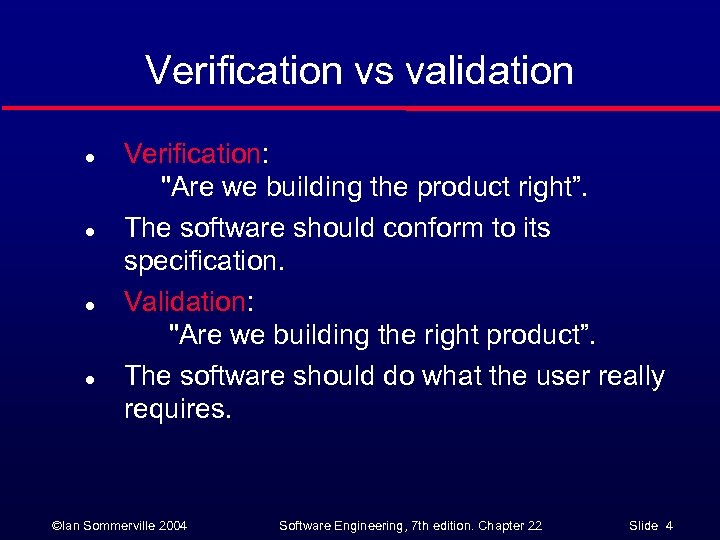 Verification vs validation l l Verification: "Are we building the product right”. The software should conform to its specification. Validation: "Are we building the right product”. The software should do what the user really requires. ©Ian Sommerville 2004 Software Engineering, 7 th edition. Chapter 22 Slide 4
 The V & V process l l Is a whole life-cycle process - V & V must be applied at each stage in the software process. Has two principal objectives • • The discovery of defects in a system; The assessment of whether or not the system is useful and useable in an operational situation. ©Ian Sommerville 2004 Software Engineering, 7 th edition. Chapter 22 Slide 5
 V& V goals l l l Verification and validation should establish confidence that the software is fit for purpose. This does NOT mean completely free of defects. Rather, it must be good enough for its intended use and the type of use will determine the degree of confidence that is needed. ©Ian Sommerville 2004 Software Engineering, 7 th edition. Chapter 22 Slide 6
 V & V confidence l Depends on system’s purpose, user expectations and marketing environment • Software function • The level of confidence depends on how critical the software is to an organisation. • User expectations • Users may have low expectations of certain kinds of software. • Marketing environment • Getting a product to market early may be more important than finding defects in the program. ©Ian Sommerville 2004 Software Engineering, 7 th edition. Chapter 22 Slide 7
 Static and dynamic verification l Software inspections. Concerned with analysis of the static system representation to discover problems (static verification) • l May be supplement by tool-based document and code analysis Software testing. Concerned with exercising and observing product behaviour (dynamic verification) • The system is executed with test data and its operational behaviour is observed ©Ian Sommerville 2004 Software Engineering, 7 th edition. Chapter 22 Slide 8
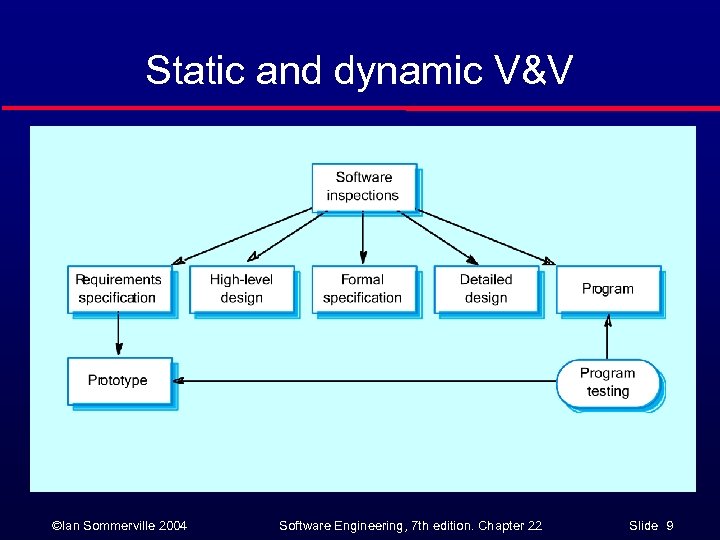 Static and dynamic V&V ©Ian Sommerville 2004 Software Engineering, 7 th edition. Chapter 22 Slide 9
 Program testing l l l Can reveal the presence of errors NOT their absence. The only validation technique for nonfunctional requirements as the software has to be executed to see how it behaves. Should be used in conjunction with static verification to provide full V&V coverage. ©Ian Sommerville 2004 Software Engineering, 7 th edition. Chapter 22 Slide 10
 Types of testing l Defect testing • • • l Tests designed to discover system defects. A successful defect test is one which reveals the presence of defects in a system. Covered in Chapter 23 Validation testing • • Intended to show that the software meets its requirements. A successful test is one that shows that a requirements has been properly implemented. ©Ian Sommerville 2004 Software Engineering, 7 th edition. Chapter 22 Slide 11
 Testing and debugging l l Defect testing and debugging are distinct processes. Verification and validation is concerned with establishing the existence of defects in a program. Debugging is concerned with locating and repairing these errors. Debugging involves formulating a hypothesis about program behaviour then testing these hypotheses to find the system error. ©Ian Sommerville 2004 Software Engineering, 7 th edition. Chapter 22 Slide 12
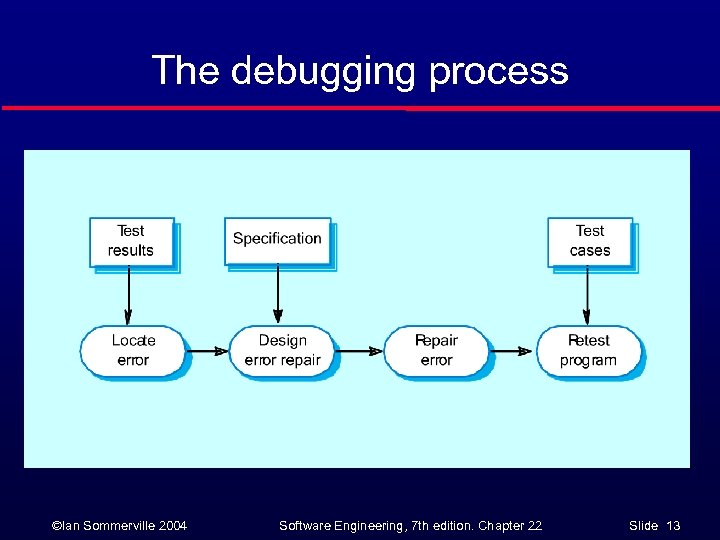 The debugging process ©Ian Sommerville 2004 Software Engineering, 7 th edition. Chapter 22 Slide 13
 V & V planning l l Careful planning is required to get the most out of testing and inspection processes. Planning should start early in the development process. The plan should identify the balance between static verification and testing. Test planning is about defining standards for the testing process rather than describing product tests. ©Ian Sommerville 2004 Software Engineering, 7 th edition. Chapter 22 Slide 14
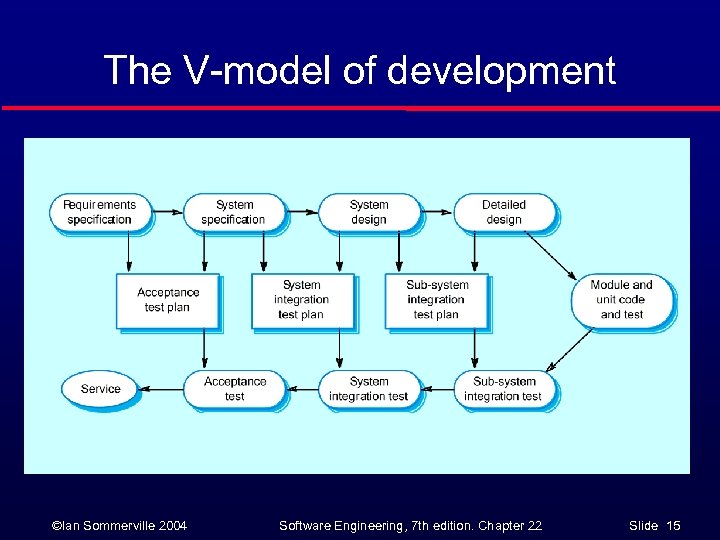 The V-model of development ©Ian Sommerville 2004 Software Engineering, 7 th edition. Chapter 22 Slide 15
 The structure of a software test plan l l l l The testing process. Requirements traceability. Tested items. Testing schedule. Test recording procedures. Hardware and software requirements. Constraints. ©Ian Sommerville 2004 Software Engineering, 7 th edition. Chapter 22 Slide 16
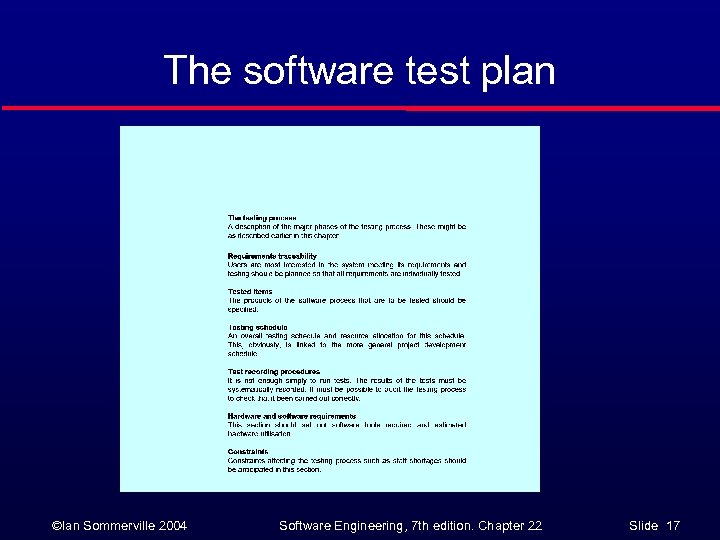 The software test plan ©Ian Sommerville 2004 Software Engineering, 7 th edition. Chapter 22 Slide 17
 Software inspections l l These involve people examining the source representation with the aim of discovering anomalies and defects. Inspections not require execution of a system so may be used before implementation. They may be applied to any representation of the system (requirements, design, configuration data, test data, etc. ). They have been shown to be an effective technique for discovering program errors. ©Ian Sommerville 2004 Software Engineering, 7 th edition. Chapter 22 Slide 18
 Inspection success l l Many different defects may be discovered in a single inspection. In testing, one defect , may mask another so several executions are required. The reuse domain and programming knowledge so reviewers are likely to have seen the types of error that commonly arise. ©Ian Sommerville 2004 Software Engineering, 7 th edition. Chapter 22 Slide 19
 Inspections and testing l l Inspections and testing are complementary and not opposing verification techniques. Both should be used during the V & V process. Inspections can check conformance with a specification but not conformance with the customer’s real requirements. Inspections cannot check non-functional characteristics such as performance, usability, etc. ©Ian Sommerville 2004 Software Engineering, 7 th edition. Chapter 22 Slide 20
 Program inspections l l l Formalised approach to document reviews Intended explicitly for defect detection (not correction). Defects may be logical errors, anomalies in the code that might indicate an erroneous condition (e. g. an uninitialised variable) or non-compliance with standards. ©Ian Sommerville 2004 Software Engineering, 7 th edition. Chapter 22 Slide 21
 Inspection pre-conditions l l l A precise specification must be available. Team members must be familiar with the organisation standards. Syntactically correct code or other system representations must be available. An error checklist should be prepared. Management must accept that inspection will increase costs early in the software process. Management should not use inspections for staff appraisal ie finding out who makes mistakes. ©Ian Sommerville 2004 Software Engineering, 7 th edition. Chapter 22 Slide 22
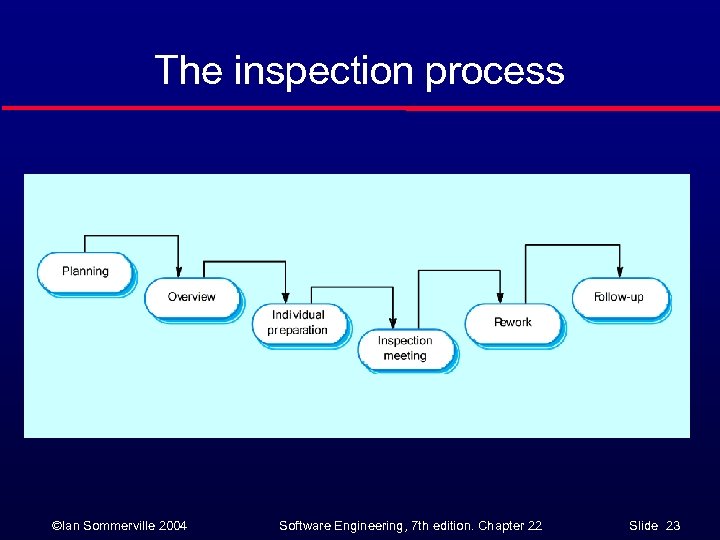 The inspection process ©Ian Sommerville 2004 Software Engineering, 7 th edition. Chapter 22 Slide 23
 Inspection procedure l l l System overview presented to inspection team. Code and associated documents are distributed to inspection team in advance. Inspection takes place and discovered errors are noted. Modifications are made to repair discovered errors. Re-inspection may or may not be required. ©Ian Sommerville 2004 Software Engineering, 7 th edition. Chapter 22 Slide 24
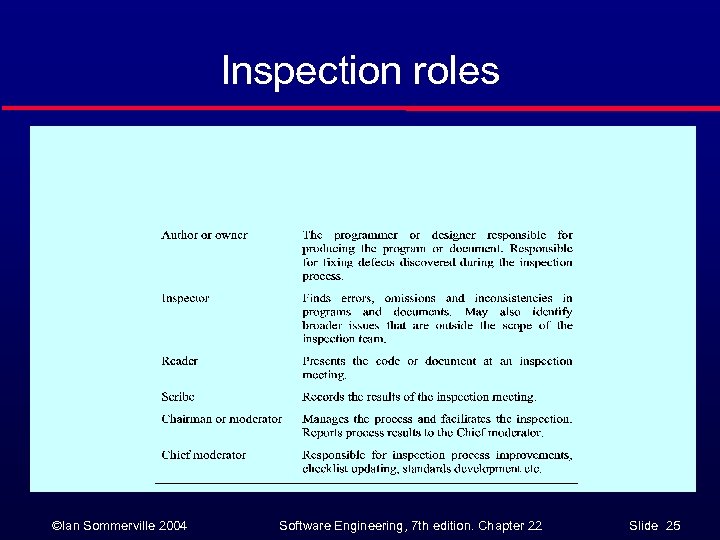 Inspection roles ©Ian Sommerville 2004 Software Engineering, 7 th edition. Chapter 22 Slide 25
 Inspection checklists l l Checklist of common errors should be used to drive the inspection. Error checklists are programming language dependent and reflect the characteristic errors that are likely to arise in the language. In general, the 'weaker' the type checking, the larger the checklist. Examples: Initialisation, Constant naming, loop termination, array bounds, etc. ©Ian Sommerville 2004 Software Engineering, 7 th edition. Chapter 22 Slide 26
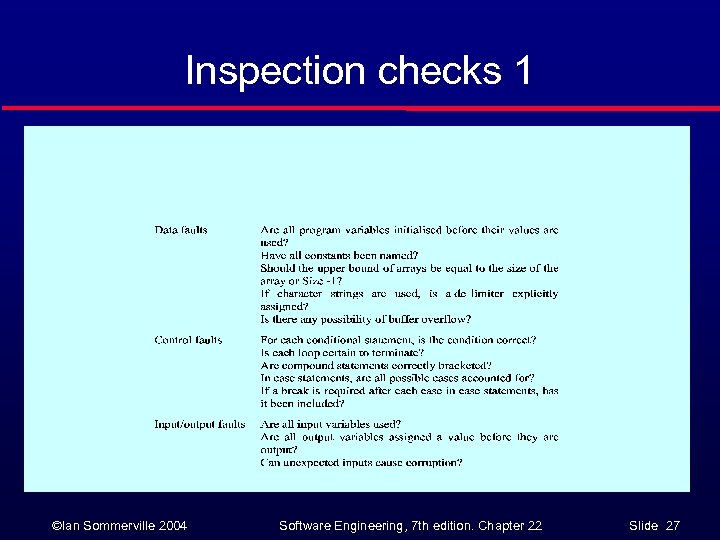 Inspection checks 1 ©Ian Sommerville 2004 Software Engineering, 7 th edition. Chapter 22 Slide 27
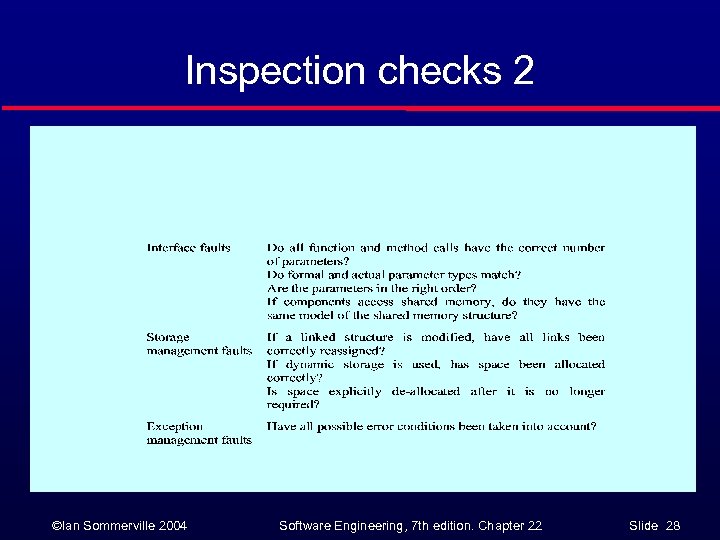 Inspection checks 2 ©Ian Sommerville 2004 Software Engineering, 7 th edition. Chapter 22 Slide 28
 Inspection rate l l l 500 statements/hour during overview. 125 source statement/hour during individual preparation. 90 -125 statements/hour can be inspected. Inspection is therefore an expensive process. Inspecting 500 lines costs about 40 man/hours effort - about £ 2800 at UK rates. ©Ian Sommerville 2004 Software Engineering, 7 th edition. Chapter 22 Slide 29
 Automated static analysis l l l Static analysers are software tools for source text processing. They parse the program text and try to discover potentially erroneous conditions and bring these to the attention of the V & V team. They are very effective as an aid to inspections - they are a supplement to but not a replacement for inspections. ©Ian Sommerville 2004 Software Engineering, 7 th edition. Chapter 22 Slide 30
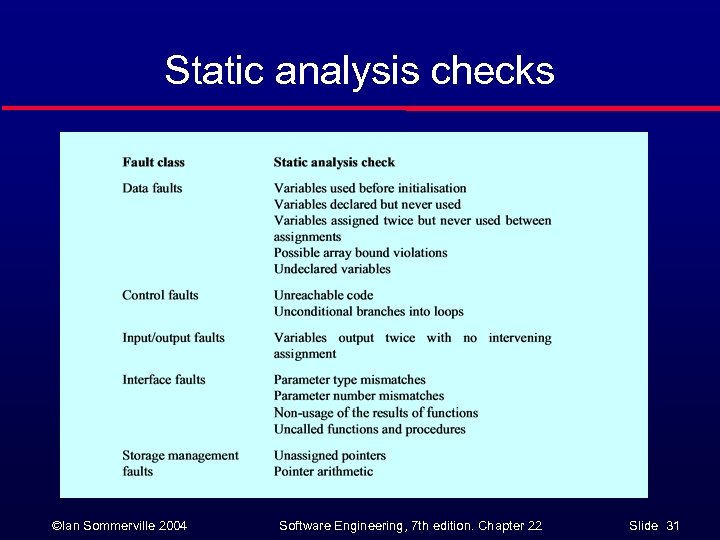 Static analysis checks ©Ian Sommerville 2004 Software Engineering, 7 th edition. Chapter 22 Slide 31
 Stages of static analysis l l l Control flow analysis. Checks for loops with multiple exit or entry points, finds unreachable code, etc. Data use analysis. Detects uninitialised variables, variables written twice without an intervening assignment, variables which are declared but never used, etc. Interface analysis. Checks the consistency of routine and procedure declarations and their use ©Ian Sommerville 2004 Software Engineering, 7 th edition. Chapter 22 Slide 32
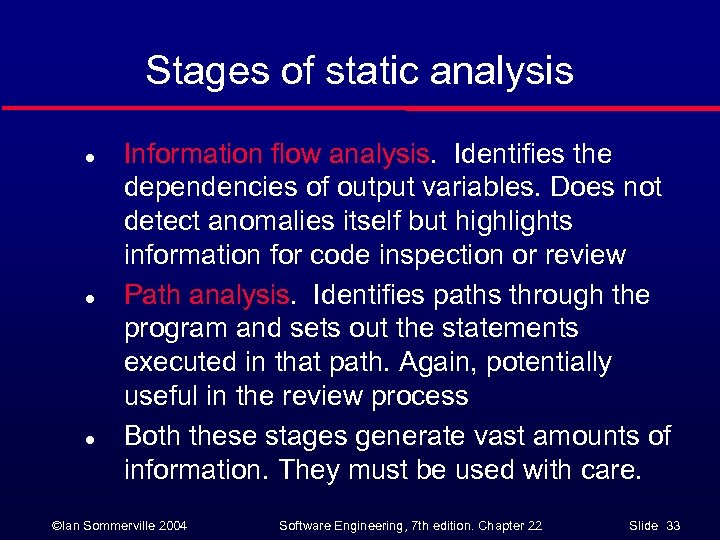 Stages of static analysis l l l Information flow analysis. Identifies the dependencies of output variables. Does not detect anomalies itself but highlights information for code inspection or review Path analysis. Identifies paths through the program and sets out the statements executed in that path. Again, potentially useful in the review process Both these stages generate vast amounts of information. They must be used with care. ©Ian Sommerville 2004 Software Engineering, 7 th edition. Chapter 22 Slide 33