 Скачать презентацию Verb Terms you must know n
9509f06185e3854c24435ade71677e19.ppt
- Количество слайдов: 66




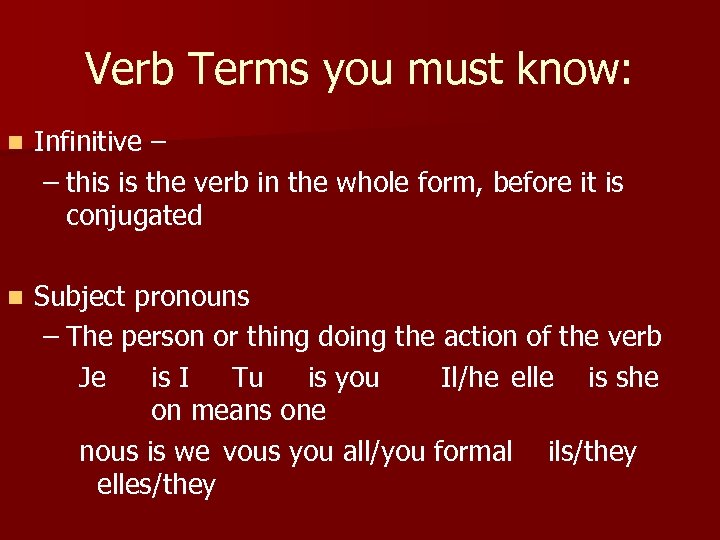
Verb Terms you must know: n Infinitive – – this is the verb in the whole form, before it is conjugated n Subject pronouns – The person or thing doing the action of the verb Je is I Tu is you Il/he elle is she on means one nous is we vous you all/you formal ils/they elles/they
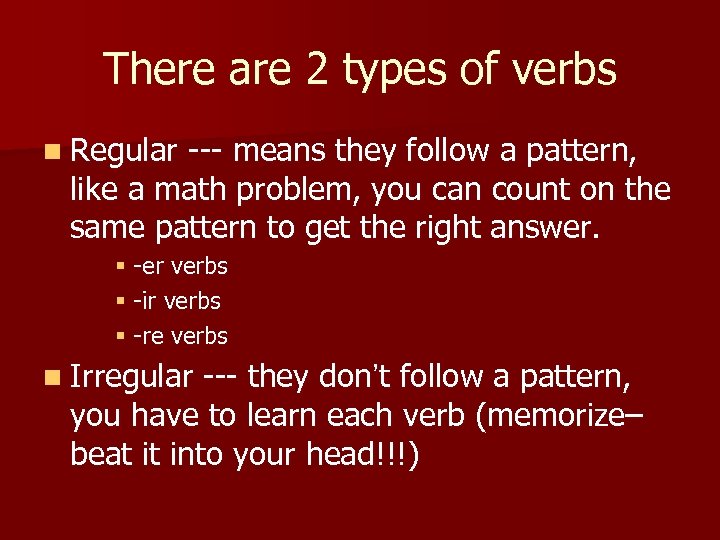
There are 2 types of verbs n Regular --- means they follow a pattern, like a math problem, you can count on the same pattern to get the right answer. § -er verbs § -ir verbs § -re verbs n Irregular --- they don’t follow a pattern, you have to learn each verb (memorize– beat it into your head!!!)
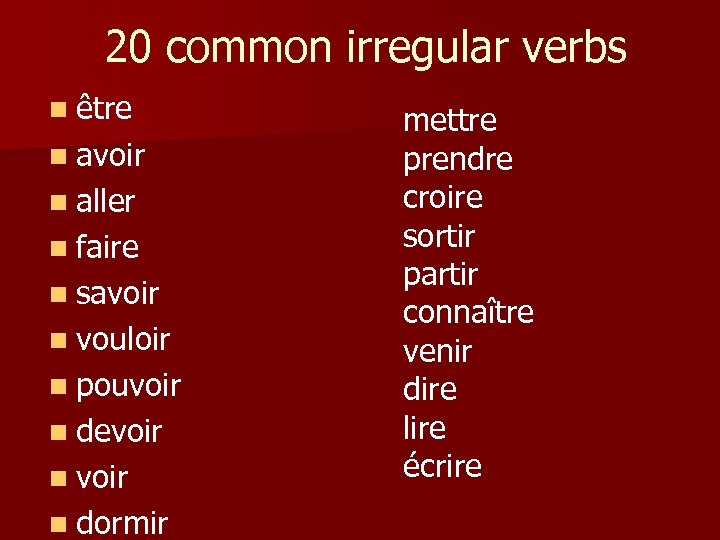
20 common irregular verbs n être n avoir n aller n faire n savoir n vouloir n pouvoir n devoir n dormir mettre prendre croire sortir partir connaître venir dire lire écrire
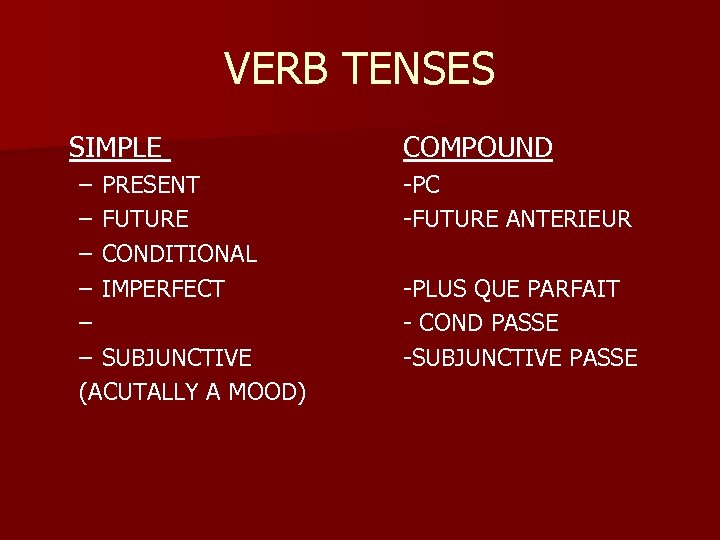
VERB TENSES SIMPLE – PRESENT – FUTURE – CONDITIONAL – IMPERFECT – – SUBJUNCTIVE (ACUTALLY A MOOD) COMPOUND -PC -FUTURE ANTERIEUR -PLUS QUE PARFAIT - COND PASSE -SUBJUNCTIVE PASSE
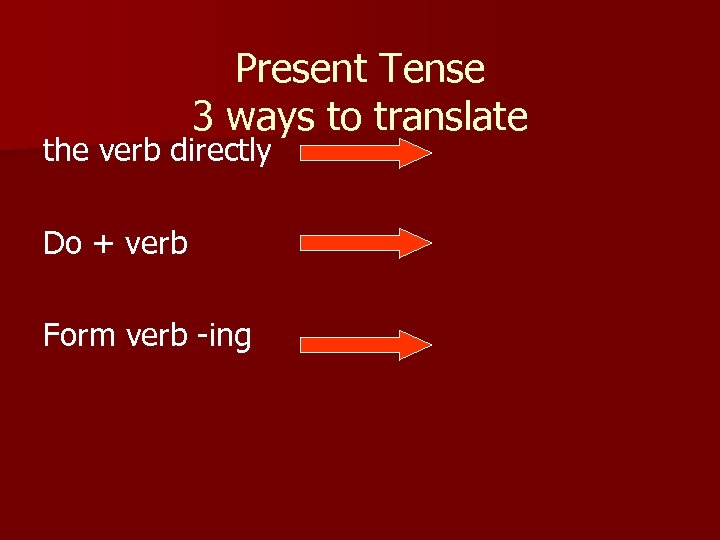
Present Tense 3 ways to translate the verb directly Do + verb Form verb -ing
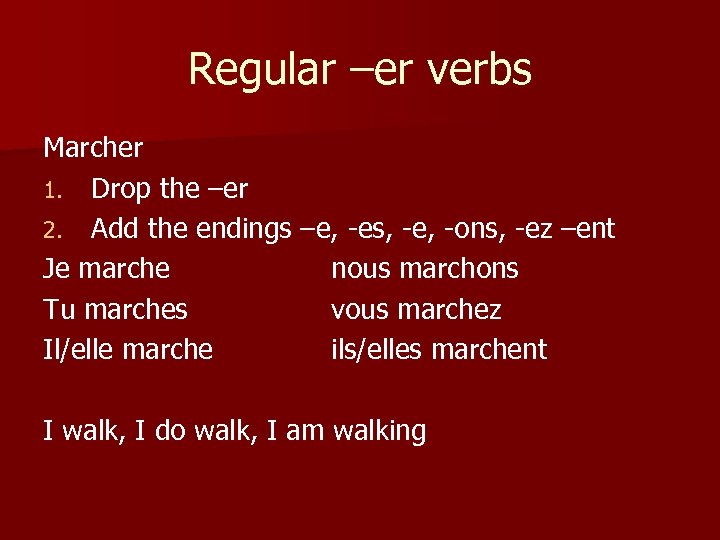
Regular –er verbs Marcher 1. Drop the –er 2. Add the endings –e, -es, -e, -ons, -ez –ent Je marche nous marchons Tu marches vous marchez Il/elle marche ils/elles marchent I walk, I do walk, I am walking
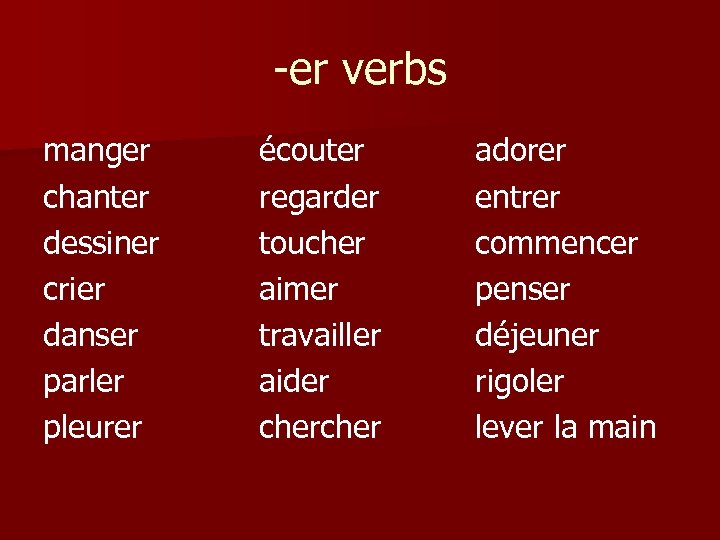
-er verbs manger chanter dessiner crier danser parler pleurer écouter regarder toucher aimer travailler aider cher adorer entrer commencer penser déjeuner rigoler lever la main
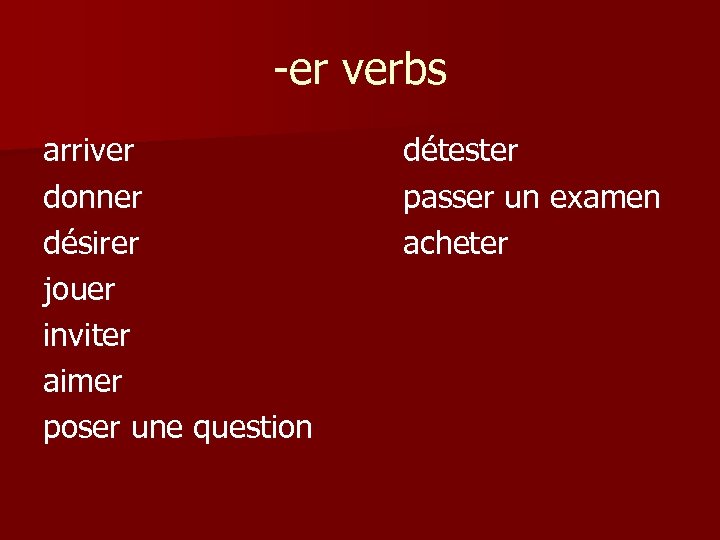
-er verbs arriver donner désirer jouer inviter aimer poser une question détester passer un examen acheter
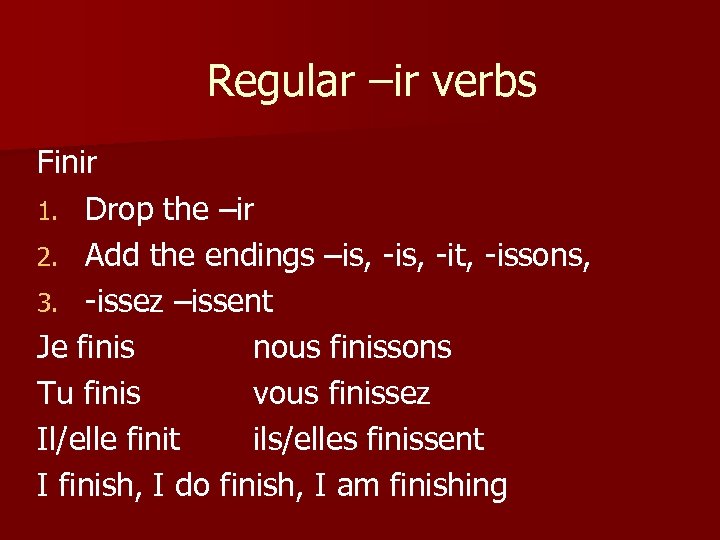
Regular –ir verbs Finir 1. Drop the –ir 2. Add the endings –is, -it, -issons, 3. -issez –issent Je finis nous finissons Tu finis vous finissez Il/elle finit ils/elles finissent I finish, I do finish, I am finishing
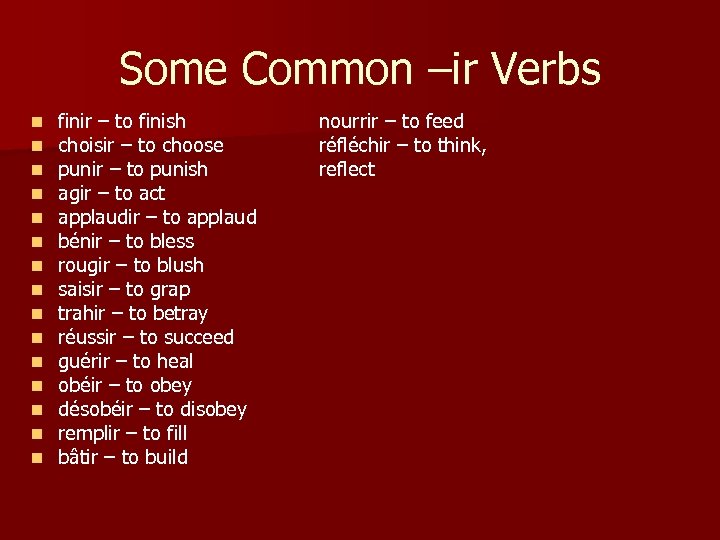
Some Common –ir Verbs n n n n finir – to finish choisir – to choose punir – to punish agir – to act applaudir – to applaud bénir – to bless rougir – to blush saisir – to grap trahir – to betray réussir – to succeed guérir – to heal obéir – to obey désobéir – to disobey remplir – to fill bâtir – to build nourrir – to feed réfléchir – to think, reflect
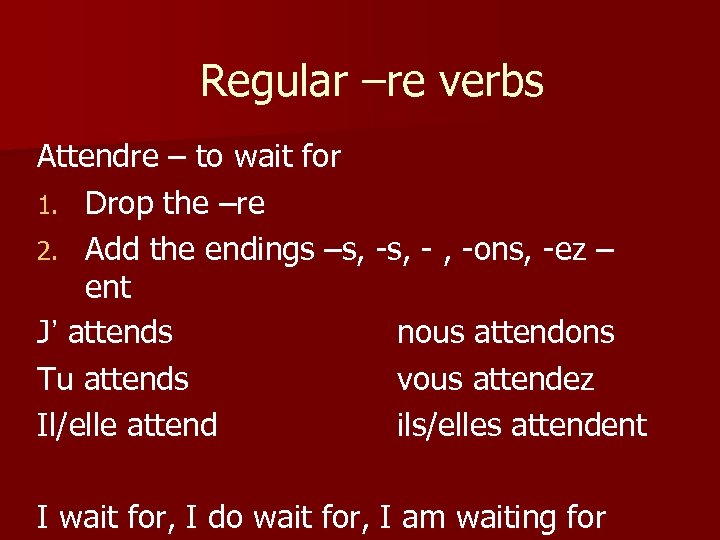
Regular –re verbs Attendre – to wait for 1. Drop the –re 2. Add the endings –s, - , -ons, -ez – ent J’ attends nous attendons Tu attends vous attendez Il/elle attend ils/elles attendent I wait for, I do wait for, I am waiting for
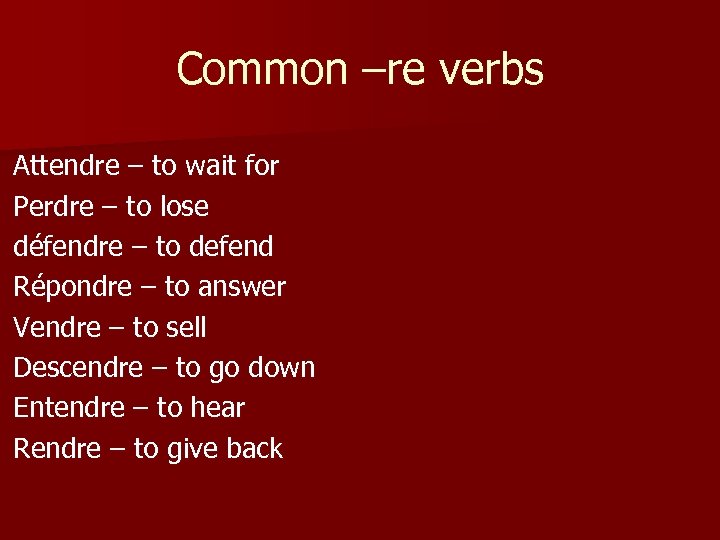
Common –re verbs Attendre – to wait for Perdre – to lose défendre – to defend Répondre – to answer Vendre – to sell Descendre – to go down Entendre – to hear Rendre – to give back
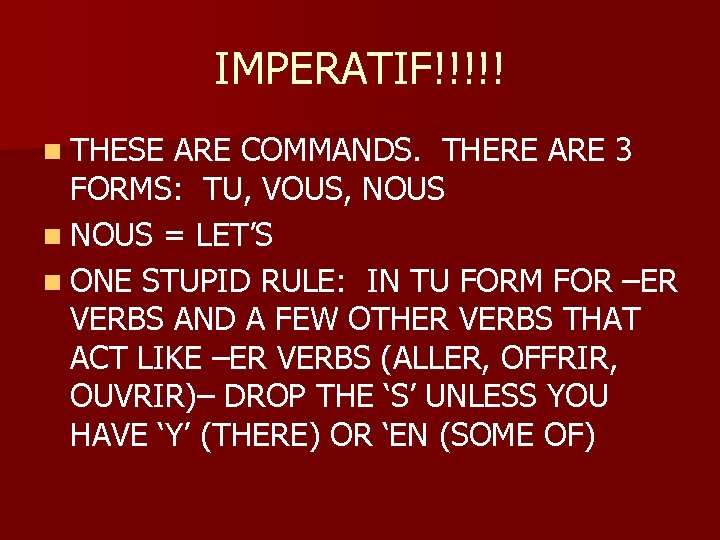
IMPERATIF!!!!! n THESE ARE COMMANDS. THERE ARE 3 FORMS: TU, VOUS, NOUS n NOUS = LET’S n ONE STUPID RULE: IN TU FORM FOR –ER VERBS AND A FEW OTHER VERBS THAT ACT LIKE –ER VERBS (ALLER, OFFRIR, OUVRIR)– DROP THE ‘S’ UNLESS YOU HAVE ‘Y’ (THERE) OR ‘EN (SOME OF)
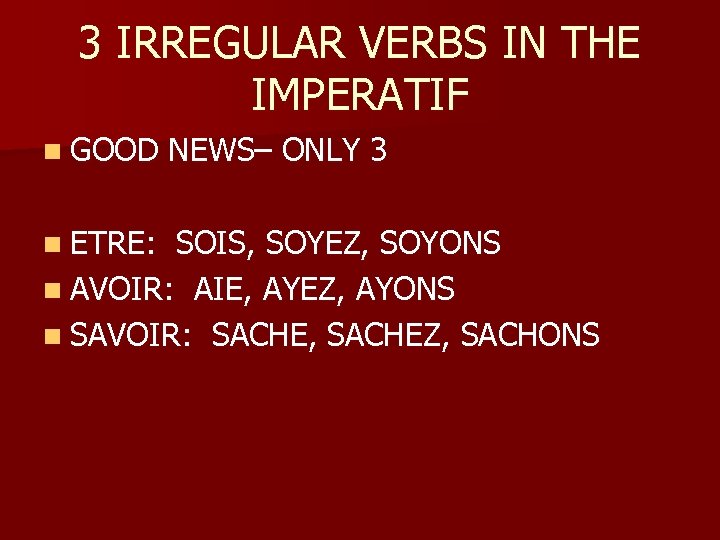
3 IRREGULAR VERBS IN THE IMPERATIF n GOOD NEWS– ONLY 3 n ETRE: SOIS, SOYEZ, SOYONS n AVOIR: AIE, AYEZ, AYONS n SAVOIR: SACHE, SACHEZ, SACHONS
IMPERATIF AU NEGATIF n FACILE: n JUST ADD NE PAS AROUND THE VERB!!
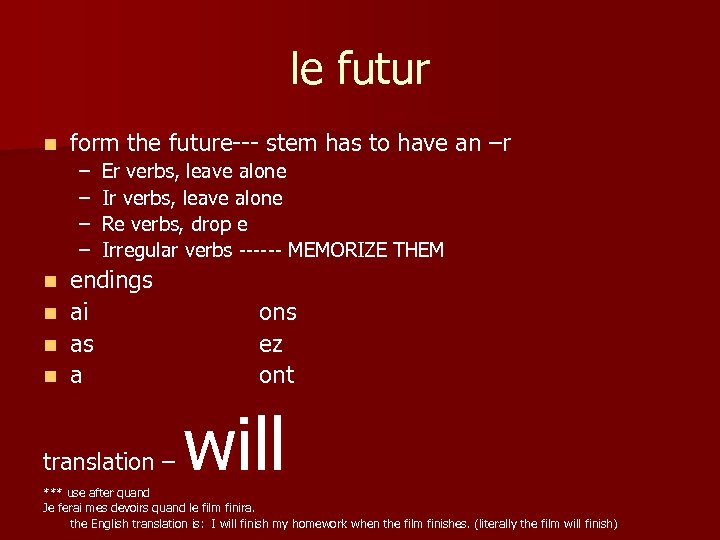
le futur n form the future--- stem has to have an –r – – n n Er verbs, leave alone Ir verbs, leave alone Re verbs, drop e Irregular verbs ------ MEMORIZE THEM endings ai as a ons ez ont will translation – *** use after quand Je ferai mes devoirs quand le film finira. the English translation is: I will finish my homework when the film finishes. (literally the film will finish)
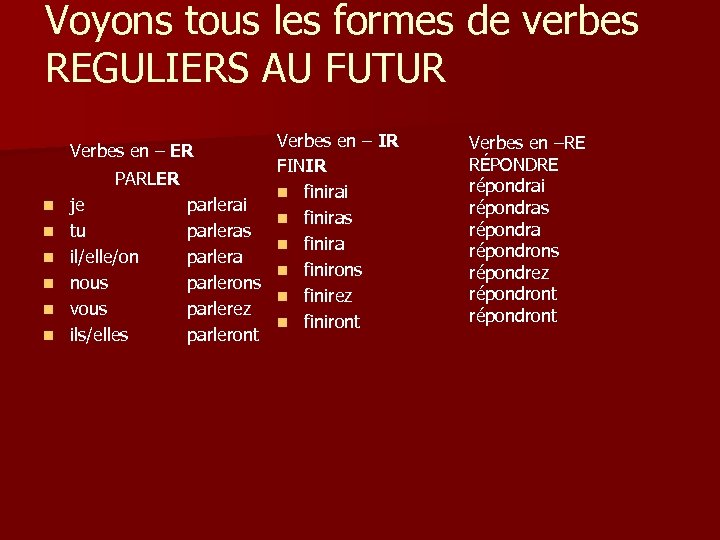
Voyons tous les formes de verbes REGULIERS AU FUTUR Verbes en – IR FINIR PARLER n finirai n je parlerai n finiras n tu parleras n finira n il/elle/on parlera n finirons n nous parlerons n finirez n vous parlerez n finiront n ils/elles parleront Verbes en – ER Verbes en –RE RÉPONDRE répondrai répondras répondra répondrons répondrez répondront
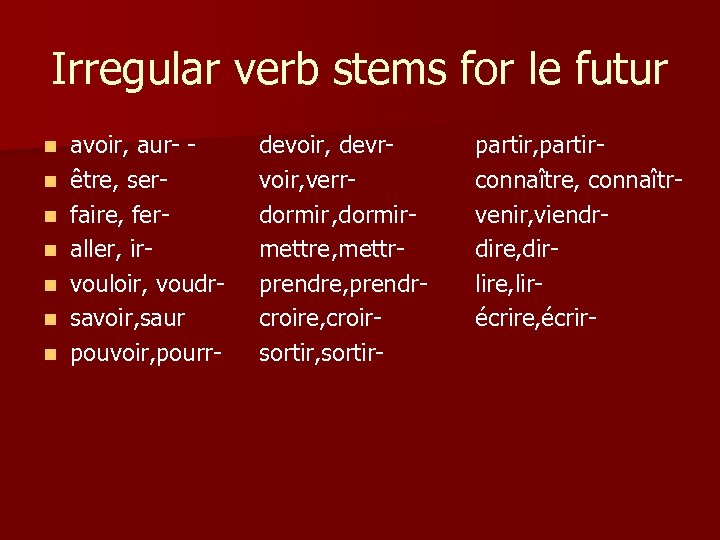
Irregular verb stems for le futur n n n n avoir, aur- - être, ser- faire, feraller, irvouloir, voudrsavoir, saur pouvoir, pourr- devoir, devrvoir, verrdormir , dormirmettre , mettrprendre, prendrcroire, croirsortir, sortir- partir, partirconnaître, connaîtr- venir, viendrdire, dirlire, lirécrire, écrir-
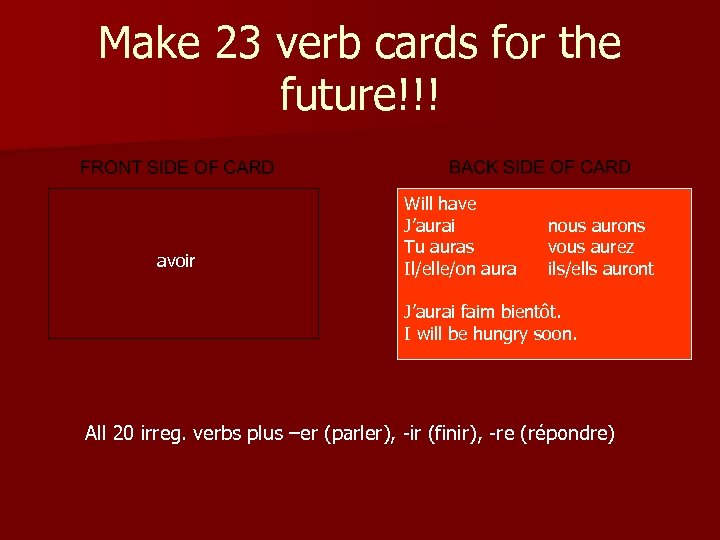
Make 23 verb cards for the future!!! avoir Will have J’aurai Tu auras Il/elle/on aura nous aurons vous aurez ils/ells auront J’aurai faim bientôt. I will be hungry soon. All 20 irreg. verbs plus –er (parler), -ir (finir), -re (répondre)
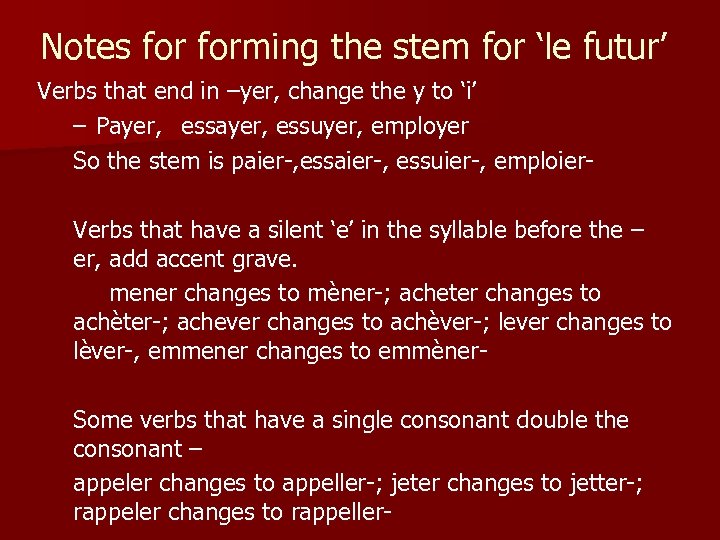
Notes forming the stem for ‘le futur’ Verbs that end in –yer, change the y to ‘i’ – Payer, essuyer, employer So the stem is paier-, essuier-, emploier. Verbs that have a silent ‘e’ in the syllable before the – er, add accent grave. mener changes to mèner-; acheter changes to achèter-; achever changes to achèver-; lever changes to lèver-, emmener changes to emmèner. Some verbs that have a single consonant double the consonant – appeler changes to appeller-; jeter changes to jetter-; rappeler changes to rappeller-
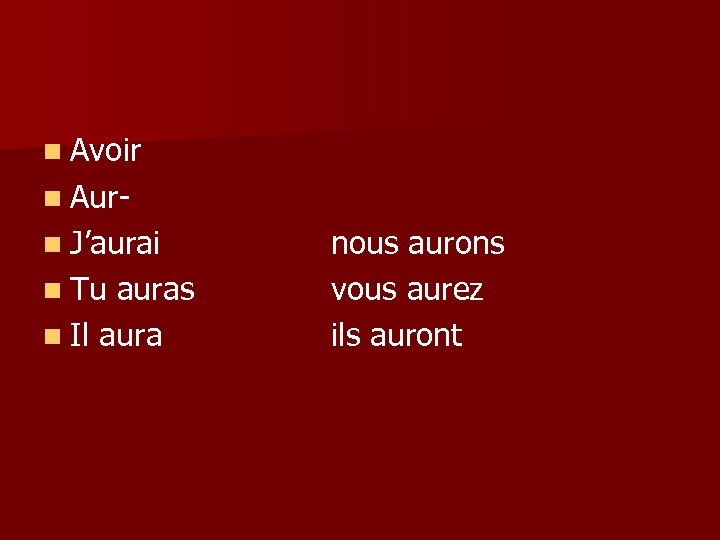
n Avoir n Aurn J’aurai n Tu auras n Il aura nous aurons vous aurez ils auront
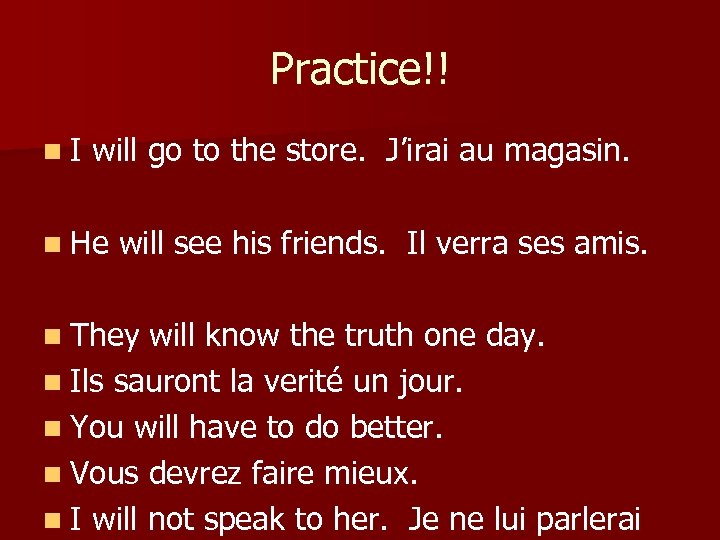
Practice!! n I will go to the store. J’irai au magasin. n He will see his friends. Il verra ses amis. n They will know the truth one day. n Ils sauront la verité un jour. n You will have to do better. n Vous devrez faire mieux. n I will not speak to her. Je ne lui parlerai
LES TEMPS PASSÉS IMPARFAIT et PASSÉ COMPOSÉ Comment les utiliser?
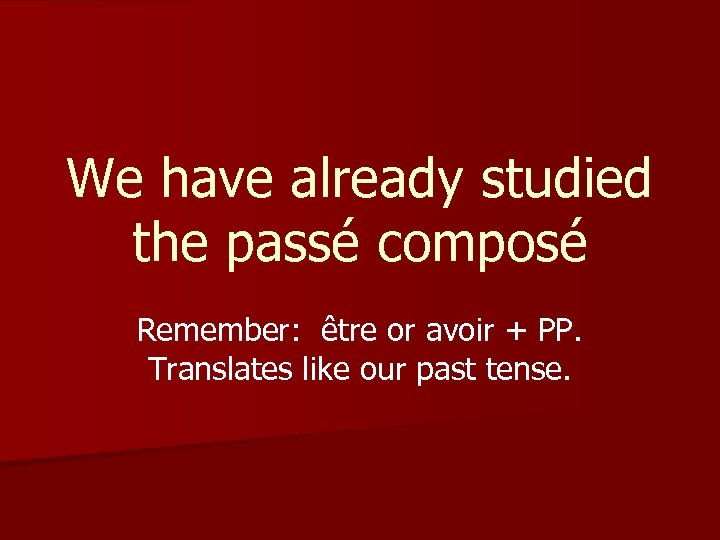
We have already studied the passé composé Remember: être or avoir + PP. Translates like our past tense.
Well there is another way to express the pass. . . n It is called the imparfait. n We are going to look at how to form it then how it is used. . .
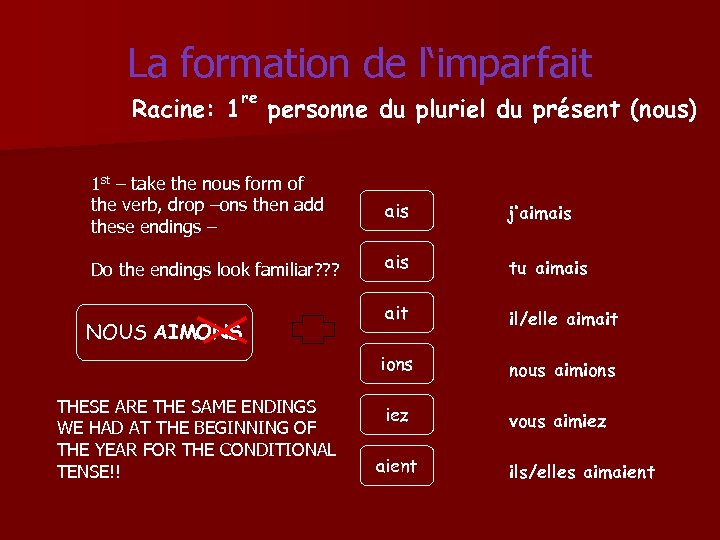
La formation de l‘imparfait Racine: 1 re personne du pluriel du présent (nous) 1 st – take the nous form of the verb, drop –ons then add these endings – ais j‘aimais Do the endings look familiar? ? ? ais tu aimais ait il/elle aimait ions nous aimions iez vous aimiez NOUS AIMONS THESE ARE THE SAME ENDINGS WE HAD AT THE BEGINNING OF THE YEAR FOR THE CONDITIONAL TENSE!! aient ils/elles aimaient
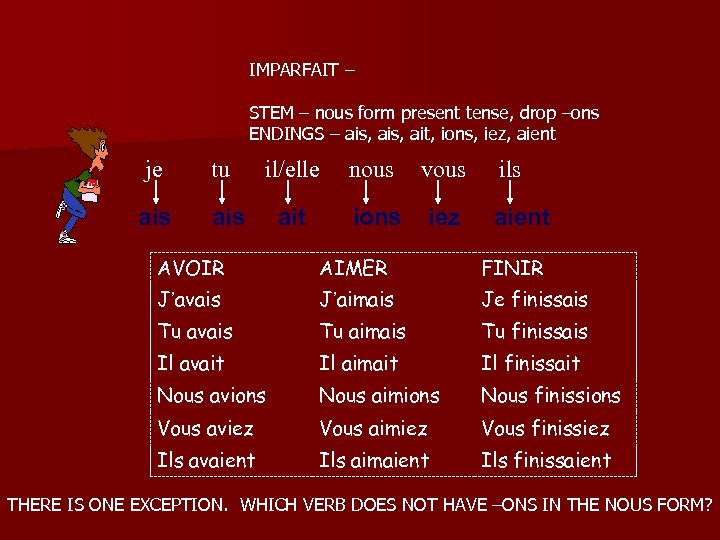
IMPARFAIT – STEM – nous form present tense, drop –ons ENDINGS – ais, ait, ions, iez, aient je tu ais il/elle nous vous ait ions iez ils aient AVOIR AIMER FINIR J’avais J’aimais Je finissais Tu avais Tu aimais Tu finissais Il avait Il aimait Il finissait Nous avions Nous aimions Nous finissions Vous aviez Vous aimiez Vous finissiez Ils avaient Ils aimaient Ils finissaient THERE IS ONE EXCEPTION. WHICH VERB DOES NOT HAVE –ONS IN THE NOUS FORM?
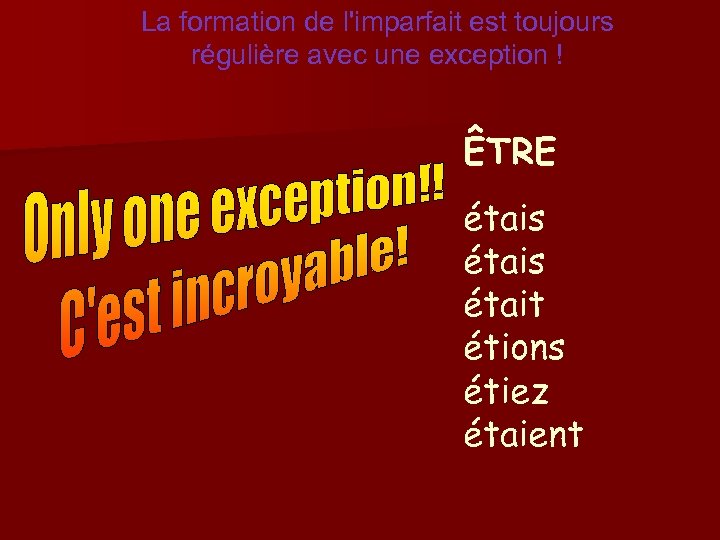
La formation de l'imparfait est toujours régulière avec une exception ! ÊTRE étais était étions étiez étaient
L‘imparfait exprime When do we use imparfait? ? n 1. Une description – Il était midi et le soleil brillait. n 2. Une durée (sans précision sur ses limites) – Quand ma mère était petite la télévision n‘existait pas. n 3. Une habitude – Tous les dimanches nous allions chez nos grandsparents.
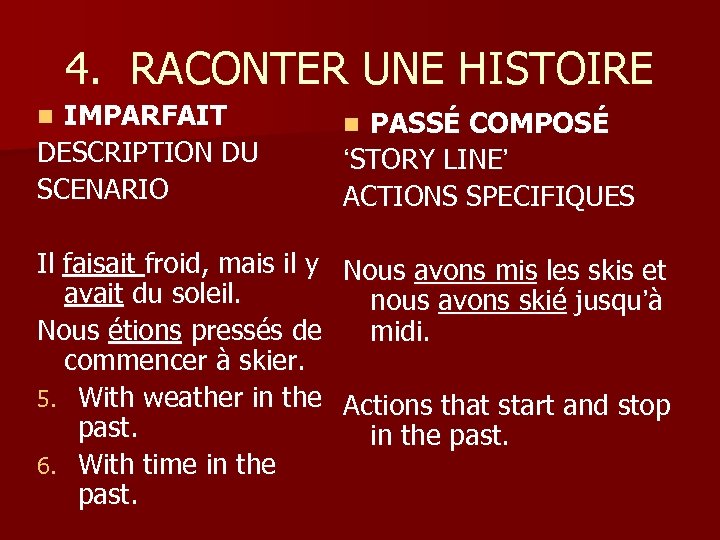
4. RACONTER UNE HISTOIRE IMPARFAIT DESCRIPTION DU SCENARIO n PASSÉ COMPOSÉ ‘STORY LINE’ ACTIONS SPECIFIQUES n Il faisait froid, mais il y Nous avons mis les skis et avait du soleil. nous avons skié jusqu’à Nous étions pressés de midi. commencer à skier. 5. With weather in the Actions that start and stop past. in the past. 6. With time in the past.
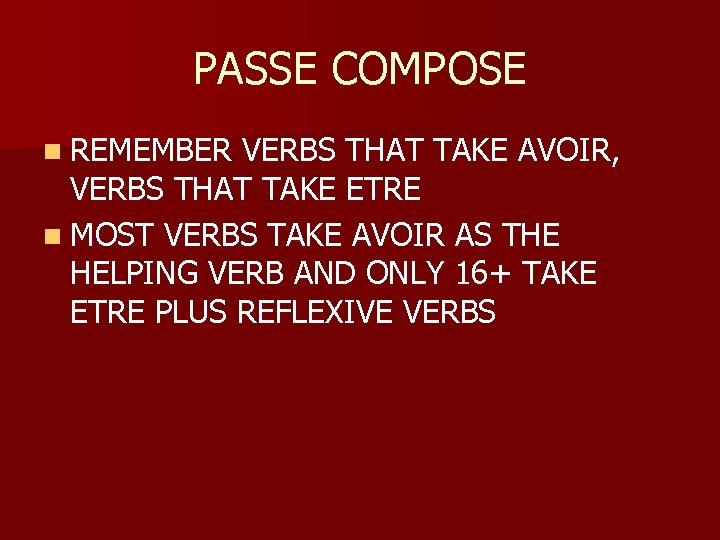
PASSE COMPOSE n REMEMBER VERBS THAT TAKE AVOIR, VERBS THAT TAKE ETRE n MOST VERBS TAKE AVOIR AS THE HELPING VERB AND ONLY 16+ TAKE ETRE PLUS REFLEXIVE VERBS
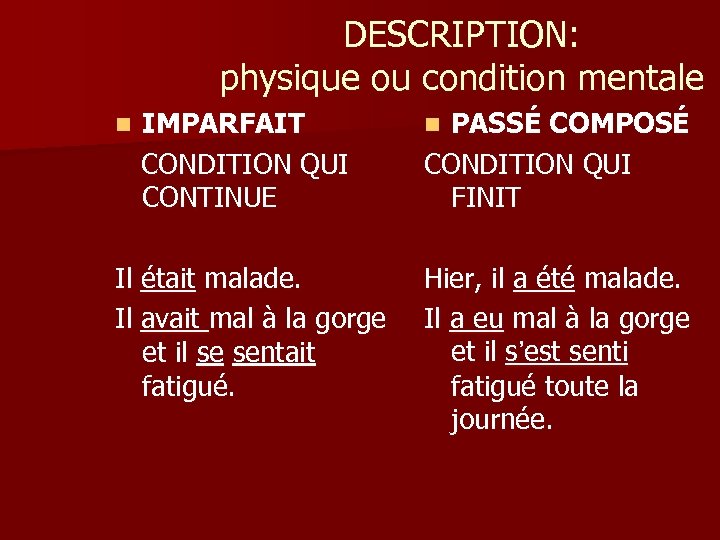
DESCRIPTION: physique ou condition mentale IMPARFAIT CONDITION QUI CONTINUE Il était malade. Il avait mal à la gorge et il se sentait fatigué. n PASSÉ COMPOSÉ CONDITION QUI FINIT n Hier, il a été malade. Il a eu mal à la gorge et il s’est senti fatigué toute la journée.
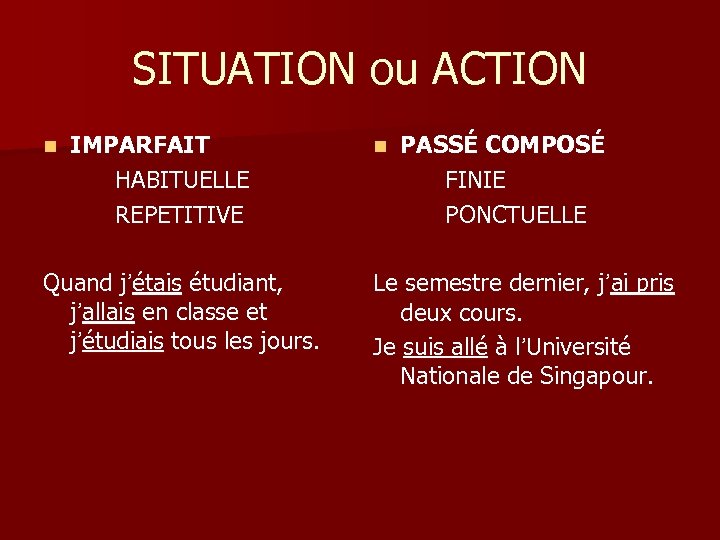
SITUATION ou ACTION n IMPARFAIT HABITUELLE REPETITIVE Quand j’étais étudiant, j’allais en classe et j’étudiais tous les jours. n PASSÉ COMPOSÉ FINIE PONCTUELLE Le semestre dernier, j’ai pris deux cours. Je suis allé à l’Université Nationale de Singapour.
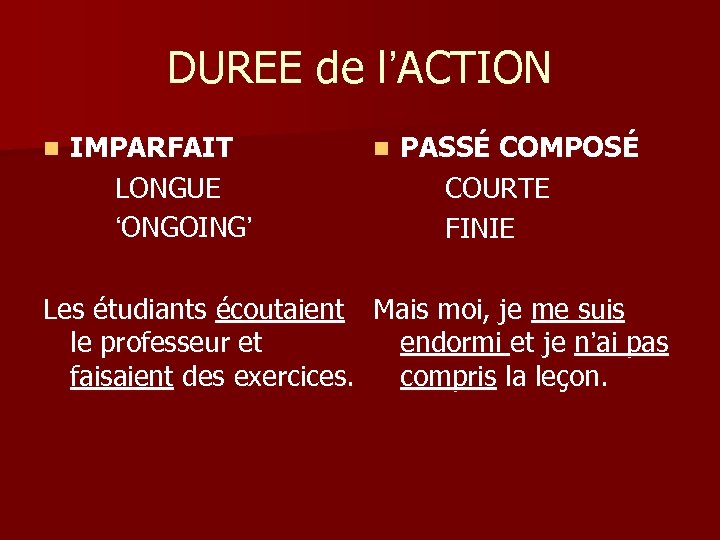
DUREE de l’ACTION n IMPARFAIT LONGUE ‘ONGOING’ n PASSÉ COMPOSÉ COURTE FINIE Les étudiants écoutaient Mais moi, je me suis endormi et je n’ai pas le professeur et faisaient des exercices. compris la leçon.
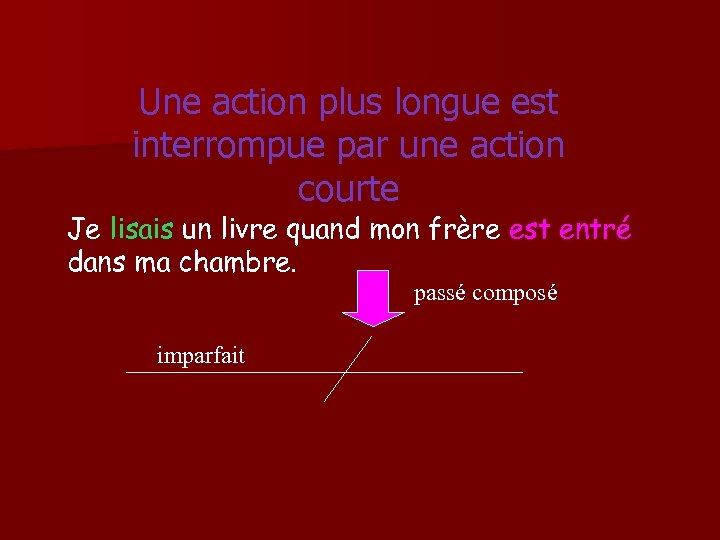
Une action plus longue est interrompue par une action courte Je lisais un livre quand mon frère est entré dans ma chambre. passé composé imparfait
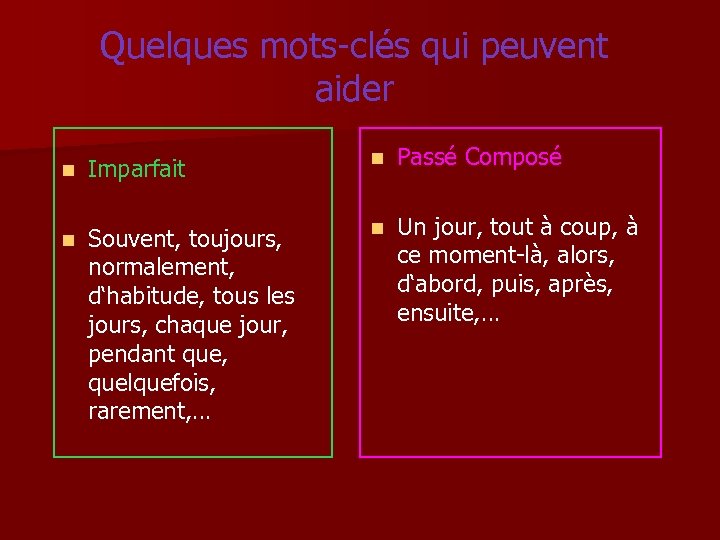
Quelques mots-clés qui peuvent aider n Imparfait n Passé Composé n Souvent, toujours, normalement, d‘habitude, tous les jours, chaque jour, pendant que, quelquefois, rarement, … n Un jour, tout à coup, à ce moment-là, alors, d‘abord, puis, après, ensuite, …
Le Conditionnel Expressing what would or could happen
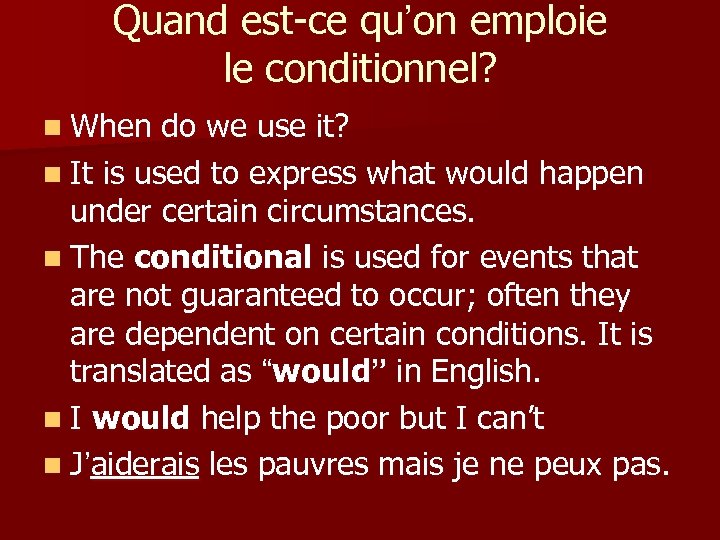
Quand est-ce qu’on emploie le conditionnel? n When do we use it? n It is used to express what would happen under certain circumstances. n The conditional is used for events that are not guaranteed to occur; often they are dependent on certain conditions. It is translated as “would” in English. n I would help the poor but I can’t n J’aiderais les pauvres mais je ne peux pas.
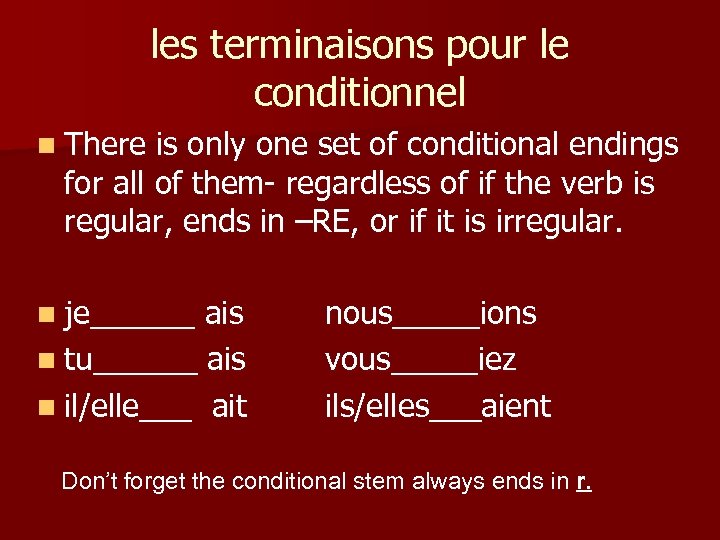
les terminaisons pour le conditionnel n There is only one set of conditional endings for all of them- regardless of if the verb is regular, ends in –RE, or if it is irregular. n je______ ais n tu______ ais n il/elle___ ait nous_____ions vous_____iez ils/elles___aient Don’t forget the conditional stem always ends in r.
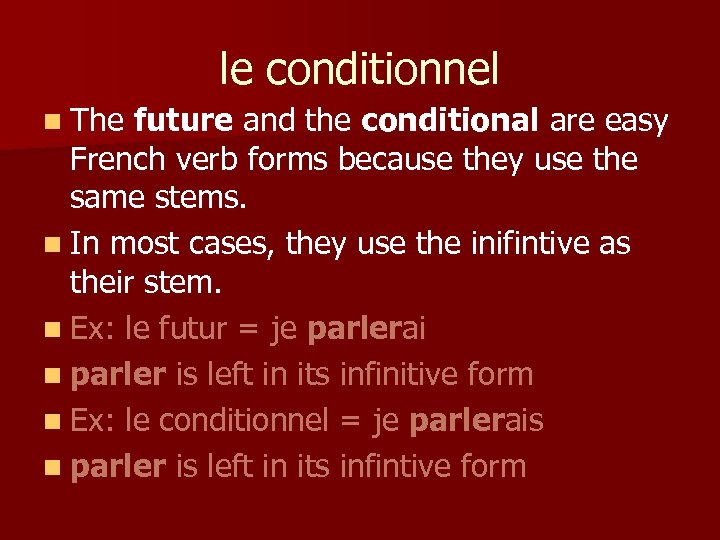
le conditionnel n The future and the conditional are easy French verb forms because they use the same stems. n In most cases, they use the inifintive as their stem. n Ex: le futur = je parlerai n parler is left in its infinitive form n Ex: le conditionnel = je parlerais n parler is left in its infintive form
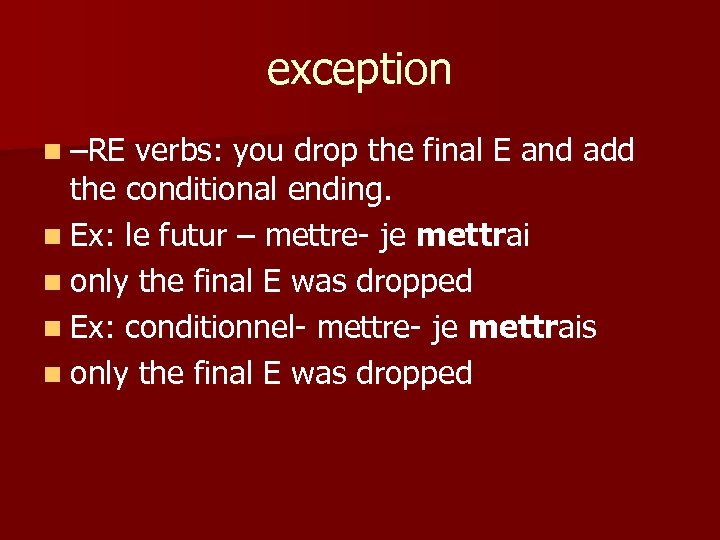
exception n –RE verbs: you drop the final E and add the conditional ending. n Ex: le futur – mettre- je mettrai n only the final E was dropped n Ex: conditionnel- mettre- je mettrais n only the final E was dropped
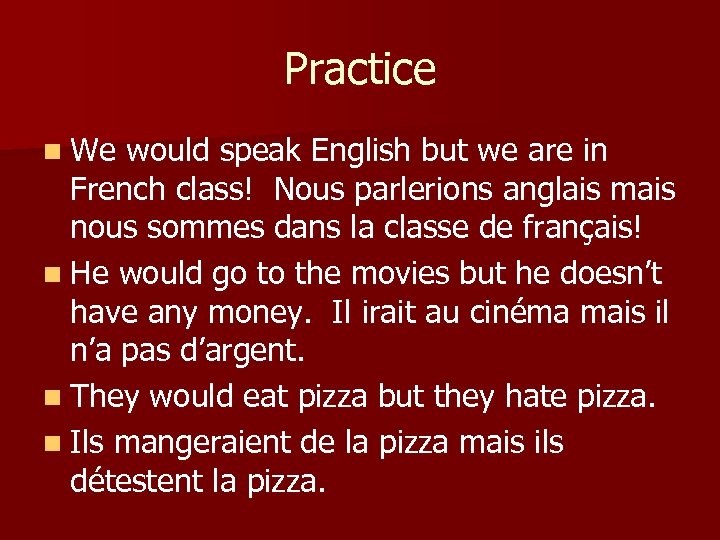
Practice n We would speak English but we are in French class! Nous parlerions anglais mais nous sommes dans la classe de français! n He would go to the movies but he doesn’t have any money. Il irait au cinéma mais il n’a pas d’argent. n They would eat pizza but they hate pizza. n Ils mangeraient de la pizza mais ils détestent la pizza.
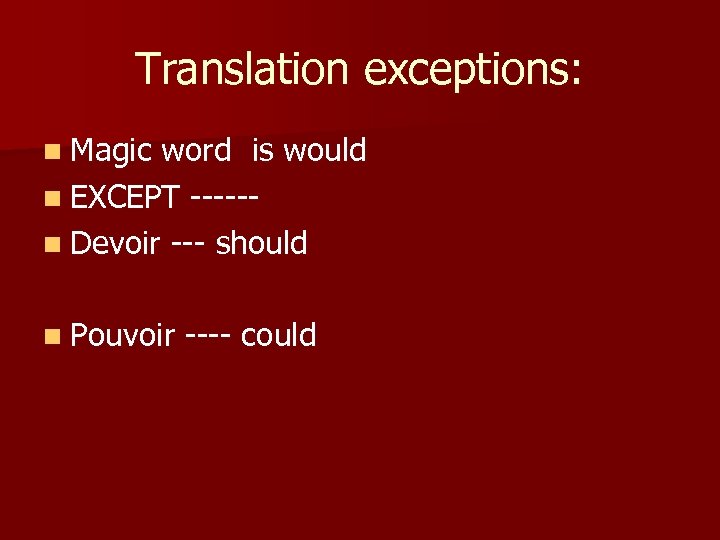
Translation exceptions: n Magic word is would n EXCEPT -----n Devoir --- should n Pouvoir ---- could
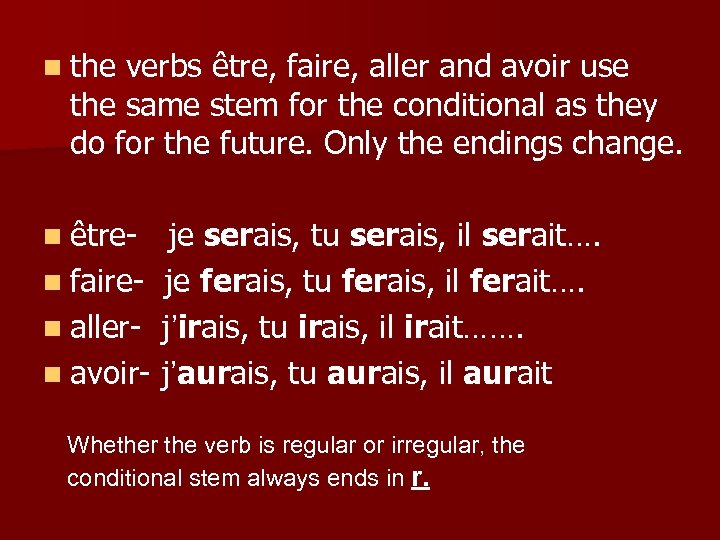
n the verbs être, faire, aller and avoir use the same stem for the conditional as they do for the future. Only the endings change. n être- je serais, tu serais, il serait…. n faire- je ferais, tu ferais, il ferait…. n aller- j’irais, tu irais, il irait……. n avoir- j’aurais, tu aurais, il aurait Whether the verb is regular or irregular, the conditional stem always ends in r.
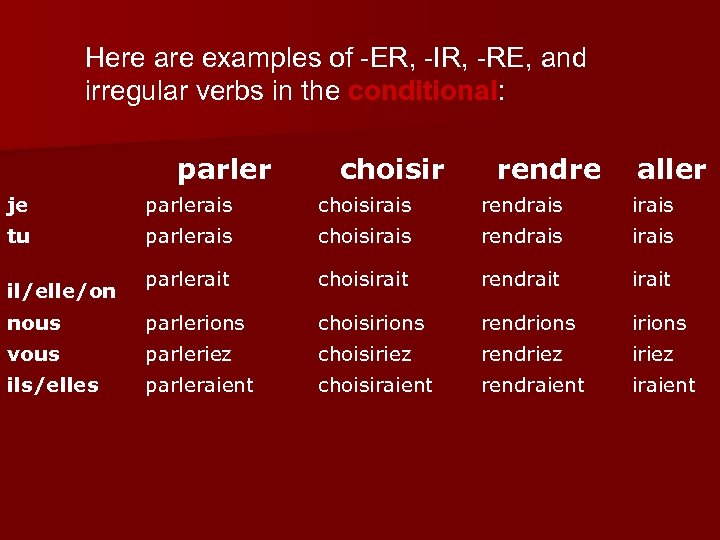
Here are examples of -ER, -IR, -RE, and irregular verbs in the conditional: parler choisir rendre aller je parlerais choisirais rendrais irais tu parlerais choisirais rendrais irais parlerait choisirait rendrait irait nous parlerions choisirions rendrions irions vous parleriez choisiriez rendriez ils/elles parleraient choisiraient rendraient iraient il/elle/on
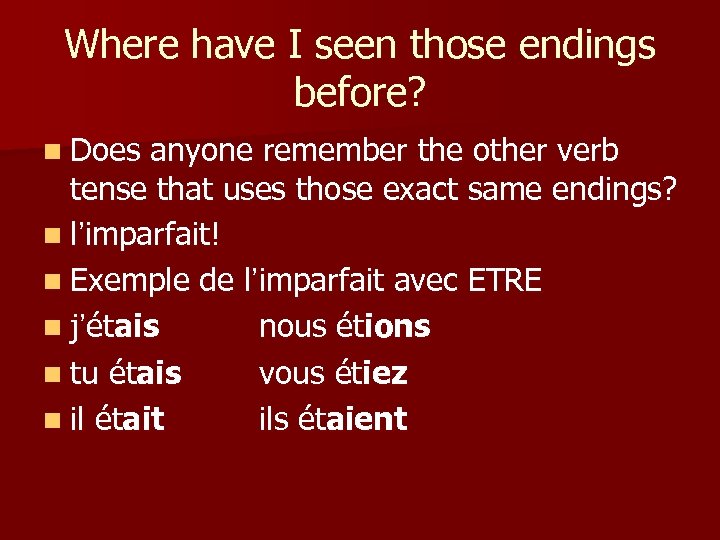
Where have I seen those endings before? n Does anyone remember the other verb tense that uses those exact same endings? n l’imparfait! n Exemple de l’imparfait avec ETRE n j’étais nous étions n tu étais vous étiez n il était ils étaient
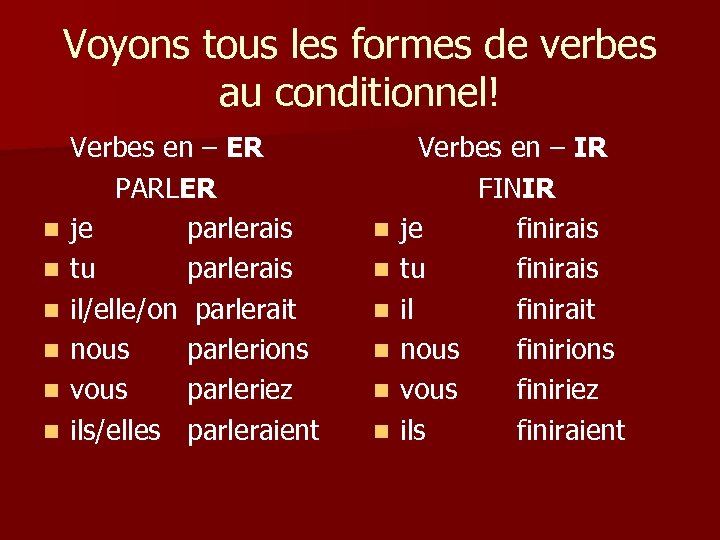
Voyons tous les formes de verbes au conditionnel! n n n Verbes en – ER PARLER je parlerais tu parlerais il/elle/on parlerait nous parlerions vous parleriez ils/elles parleraient n n n Verbes en – IR FINIR je finirais tu finirais il finirait nous finirions vous finiriez ils finiraient
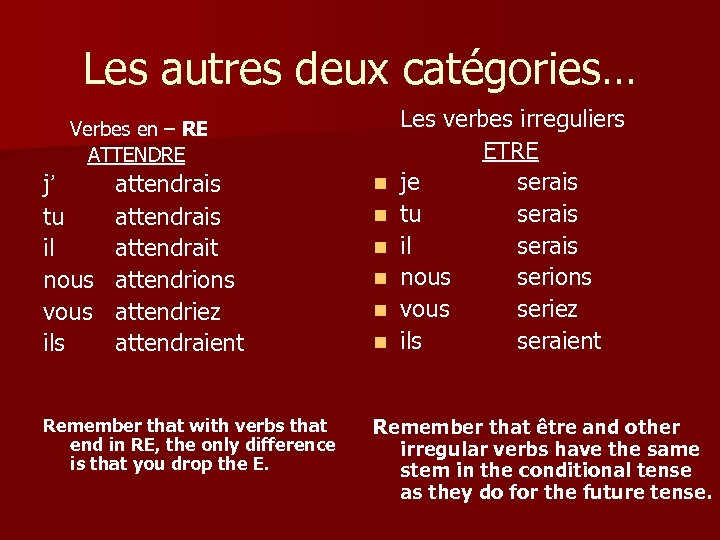
Les autres deux catégories… Verbes en – RE ATTENDRE j ’ tu il nous vous ils attendrais attendrait attendrions attendriez attendraient Remember that with verbs that end in RE, the only difference is that you drop the E. n n n Les verbes irreguliers ETRE je serais tu serais il serais nous serions vous seriez ils seraient Remember that être and other irregular verbs have the same stem in the conditional tense as they do for the future tense.
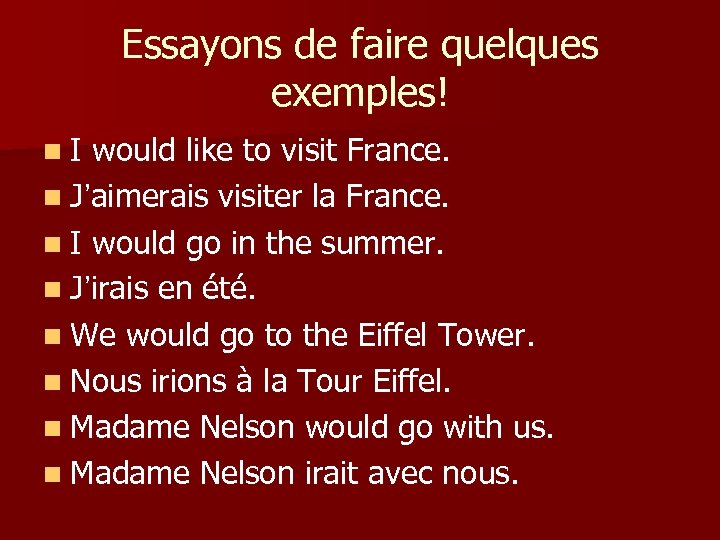
Essayons de faire quelques exemples! n I would like to visit France. n J’aimerais visiter la France. n I would go in the summer. n J’irais en été. n We would go to the Eiffel Tower. n Nous irions à la Tour Eiffel. n Madame Nelson would go with us. n Madame Nelson irait avec nous.
Expressing possibilities Using “Si…. ” clauses with the conditional and the future
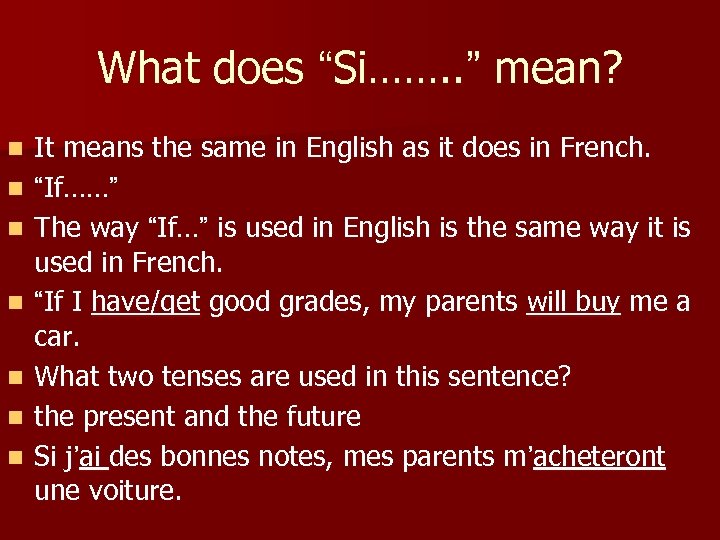
What does “Si……. . ” mean? n n n n It means the same in English as it does in French. “If……” The way “If…” is used in English is the same way it is used in French. “If I have/get good grades, my parents will buy me a car. What two tenses are used in this sentence? the present and the future Si j’ai des bonnes notes, mes parents m’acheteront une voiture.
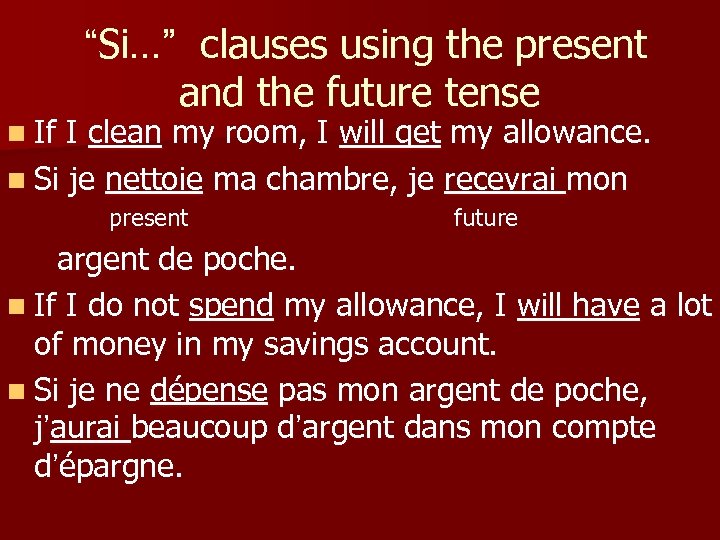
“Si…” clauses using the present and the future tense n If I clean my room, I will get my allowance. n Si je nettoie ma chambre, je recevrai mon present future argent de poche. n If I do not spend my allowance, I will have a lot of money in my savings account. n Si je ne dépense pas mon argent de poche, j’aurai beaucoup d’argent dans mon compte d’épargne.
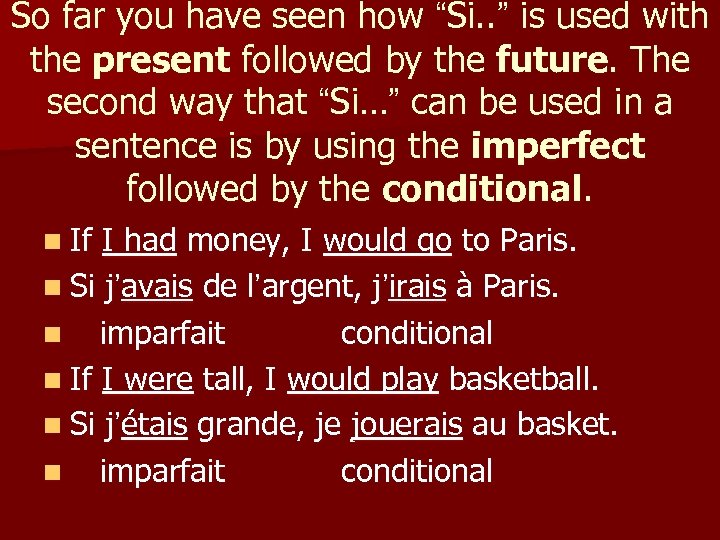
So far you have seen how “Si. . ” is used with the present followed by the future. The second way that “Si…” can be used in a sentence is by using the imperfect followed by the conditional. n If I had money, I would go to Paris. n Si j’avais de l’argent, j’irais à Paris. n imparfait conditional n If I were tall, I would play basketball. n Si j’étais grande, je jouerais au basket. n imparfait conditional
“Si …” clauses with the imperfect and the conditional
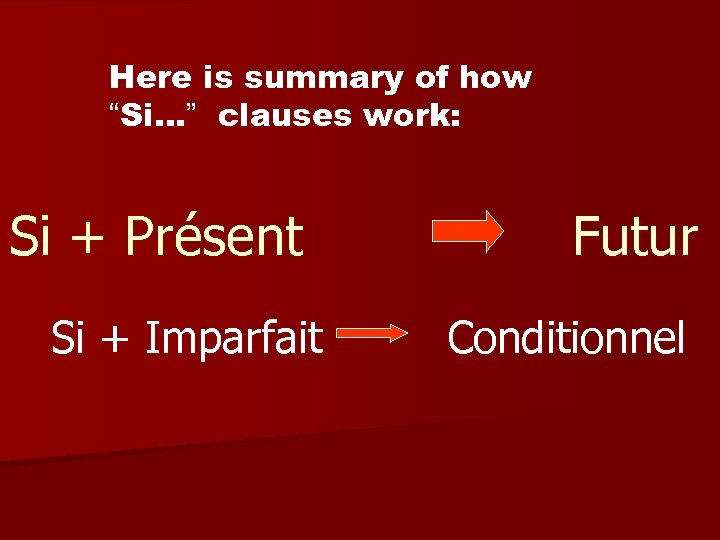
Here is summary of how “Si…” clauses work: Si + Présent Futur Si + Imparfait Conditionnel
Si j’avais une voiture…… If I had a car……….

Si je n’avais pas de voiture… Si je n’avais pas de voiture, ma vie serait très différente. Je serais très ennuyée parce que je serais toujours à la maison. Je passerais beaucoup de temps devant la télé parce qu’il n’y aurait pas d’autre chose à faire. Je grossirais beaucoup parce que sans ma voiture, je ne ne pourrais pas aller au gym. J’espère que mes amies qui ont une voiture viendraient me prendre pour aller quelque part. Mais comme je suis une personne positive, j’ inventerais des choses à faire. Au lieu d’aller au gym, je ferais du jogging dans mon quartier. En plus, je profiterais d’être plus à la maison et je lirais un livre. Et bien sur, j’aurais plus d’argent--- car maintenir une voiture c’est cher!
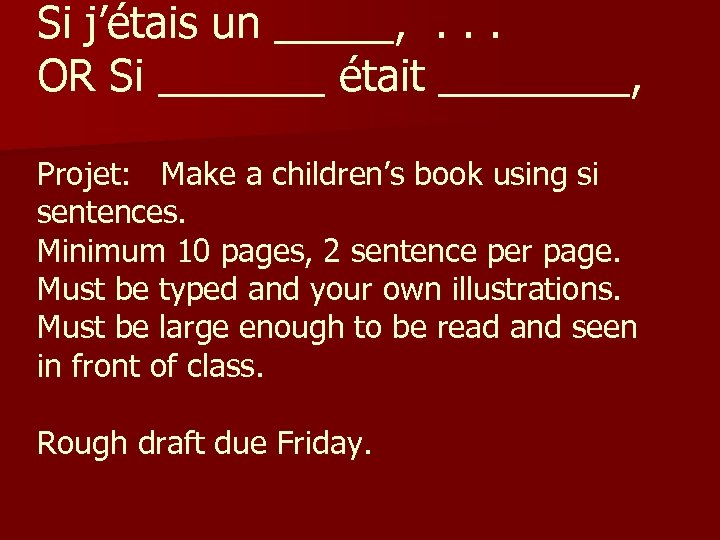
Si j’étais un _____, . . . OR Si _______ était ____, Projet: Make a children’s book using si sentences. Minimum 10 pages, 2 sentence per page. Must be typed and your own illustrations. Must be large enough to be read and seen in front of class. Rough draft due Friday.
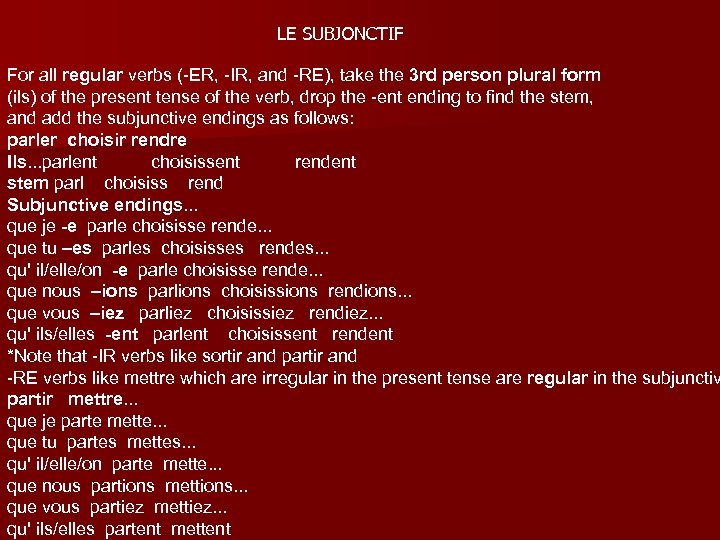
LE SUBJONCTIF For all regular verbs (-ER, -IR, and -RE), take the 3 rd person plural form (ils) of the present tense of the verb, drop the -ent ending to find the stem, and add the subjunctive endings as follows: parler choisir rendre Ils. . . parlent choisissent rendent stem parl choisiss rend Subjunctive endings. . . que je -e parle choisisse rende. . . que tu –es parles choisisses rendes. . . qu' il/elle/on -e parle choisisse rende. . . que nous –ions parlions choisissions rendions. . . que vous –iez parliez choisissiez rendiez. . . qu' ils/elles -ent parlent choisissent rendent *Note that -IR verbs like sortir and partir and -RE verbs like mettre which are irregular in the present tense are regular in the subjunctiv partir mettre. . . que je parte mette. . . que tu partes mettes. . . qu' il/elle/on parte mette. . . que nous partions mettions. . . que vous partiez mettiez. . . qu' ils/elles partent mettent
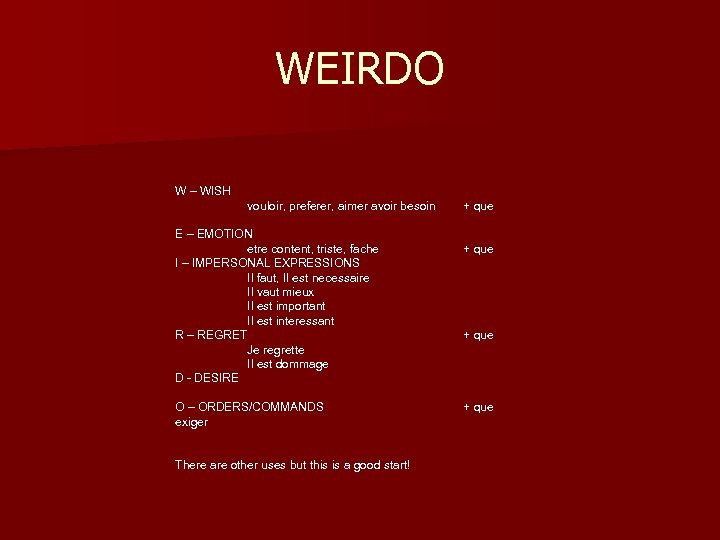
WEIRDO W – WISH vouloir, preferer, aimer avoir besoin E – EMOTION etre content, triste, fache I – IMPERSONAL EXPRESSIONS Il faut, Il est necessaire Il vaut mieux Il est important Il est interessant R – REGRET Je regrette Il est dommage D - DESIRE O – ORDERS/COMMANDS exiger There are other uses but this is a good start! + que
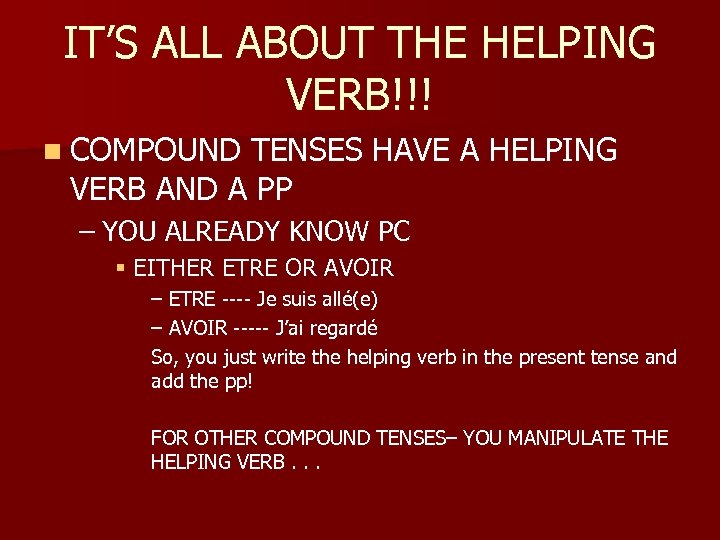
IT’S ALL ABOUT THE HELPING VERB!!! n COMPOUND TENSES HAVE A HELPING VERB AND A PP – YOU ALREADY KNOW PC § EITHER ETRE OR AVOIR – ETRE ---- Je suis allé(e) – AVOIR ----- J’ai regardé So, you just write the helping verb in the present tense and add the pp! FOR OTHER COMPOUND TENSES– YOU MANIPULATE THE HELPING VERB. . .
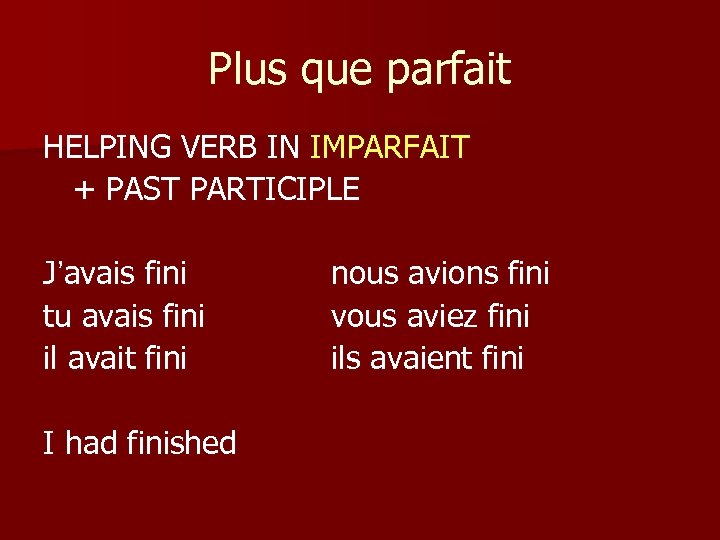
Plus que parfait HELPING VERB IN IMPARFAIT + PAST PARTICIPLE J’avais fini tu avais fini il avait fini I had finished nous avions fini vous aviez fini ils avaient fini
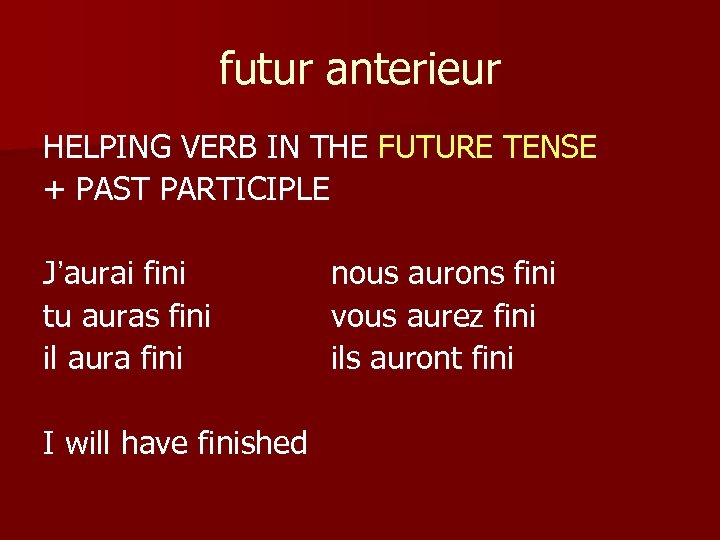
futur anterieur HELPING VERB IN THE FUTURE TENSE + PAST PARTICIPLE J’aurai fini tu auras fini il aura fini I will have finished nous aurons fini vous aurez fini ils auront fini
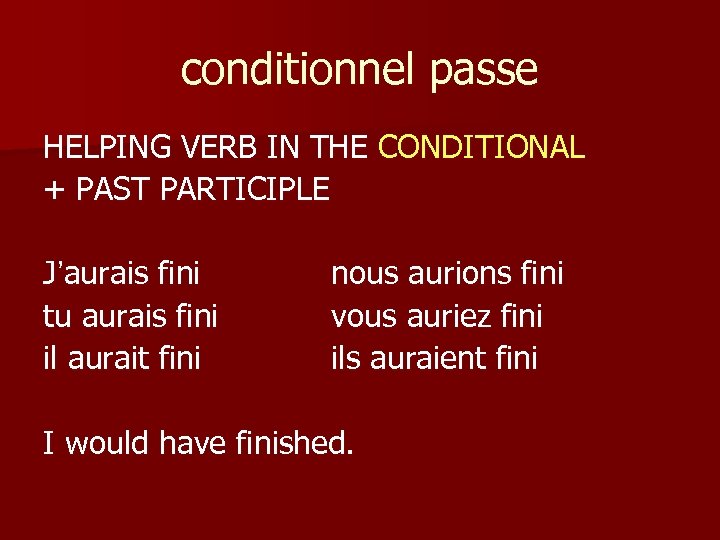
conditionnel passe HELPING VERB IN THE CONDITIONAL + PAST PARTICIPLE J’aurais fini tu aurais fini il aurait fini nous aurions fini vous auriez fini ils auraient fini I would have finished.
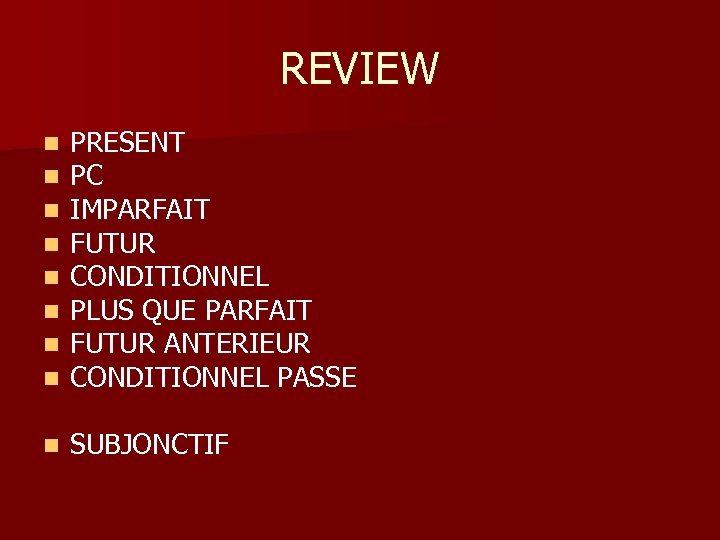
REVIEW n n n n PRESENT PC IMPARFAIT FUTUR CONDITIONNEL PLUS QUE PARFAIT FUTUR ANTERIEUR CONDITIONNEL PASSE n SUBJONCTIF
Скачать презентацию Verb Terms you must know n
9509f06185e3854c24435ade71677e19.ppt