 Скачать презентацию Verb agreement in Turkish-Dutch bilingual children with SLI
18aa7e63480373b72db242b5cb795299.ppt
- Количество слайдов: 30



Verb agreement in Turkish-Dutch bilingual children with SLI Jan de Jong, Antje Orgassa, Nazife Çavuş, Anne Baker, Fred Weerman 1
Research issue n n n Verb morphology is vulnerable in SLI. Explanations: locus of the problem either in representation or processing Explanations are based on crosslinguistic differences or commonalities in symptoms Are crosslinguistic differences found when the subjects are the same (bilingual) children? Which theory explains the symptoms best? 2
Outline of the talk n n n n Two theories of SLI Characteristics of Dutch and Turkish Predictions for SLI in two languages: Dutch and Turkish The Dutch study The Turkish study Comparing the results from both studies Conclusions 3
SLI in Turkish and Dutch: two theories on SLI will be tested n SLI is a representational deficit n n Agreement Deficit hypothesis (Clahsen) SLI is a processing deficit n Sparse morphology hypothesis (Leonard) 4
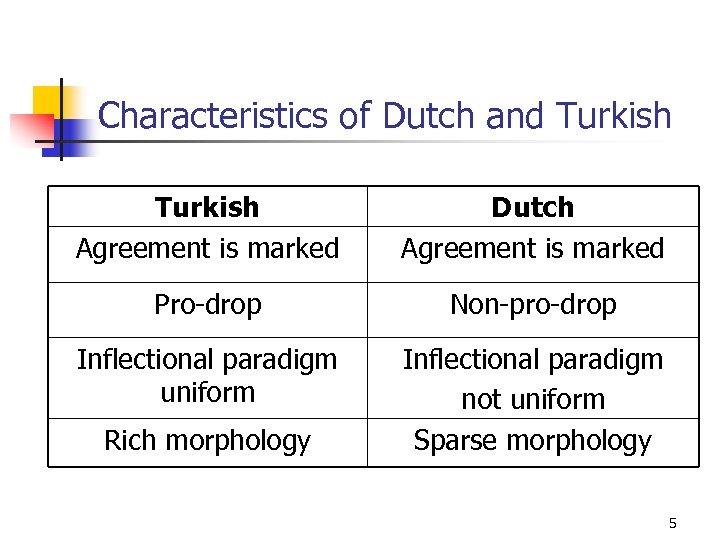
Characteristics of Dutch and Turkish Agreement is marked Dutch Agreement is marked Pro-drop Non-pro-drop Inflectional paradigm uniform Inflectional paradigm not uniform Sparse morphology Rich morphology 5
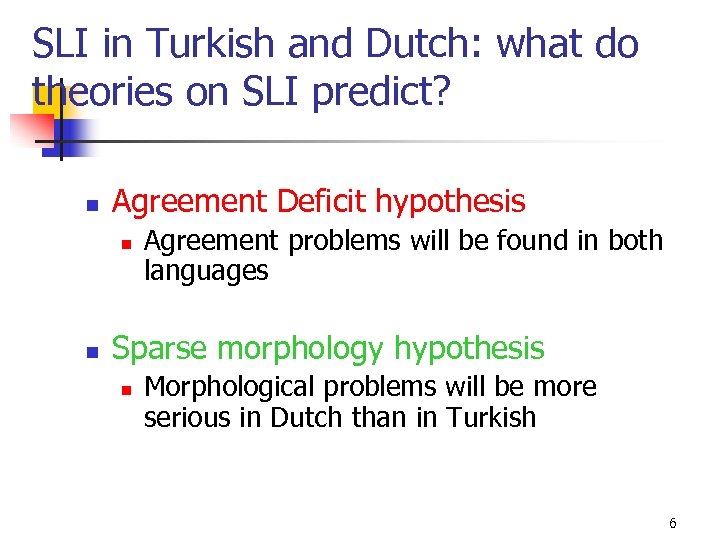
SLI in Turkish and Dutch: what do theories on SLI predict? n Agreement Deficit hypothesis n n Agreement problems will be found in both languages Sparse morphology hypothesis n Morphological problems will be more serious in Dutch than in Turkish 6
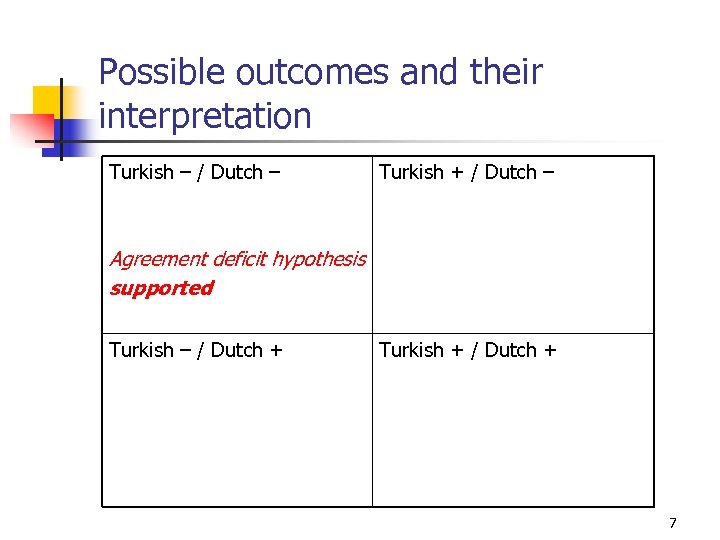
Possible outcomes and their interpretation Turkish – / Dutch – Turkish + / Dutch – Agreement deficit hypothesis supported Turkish – / Dutch + Turkish + / Dutch + 7
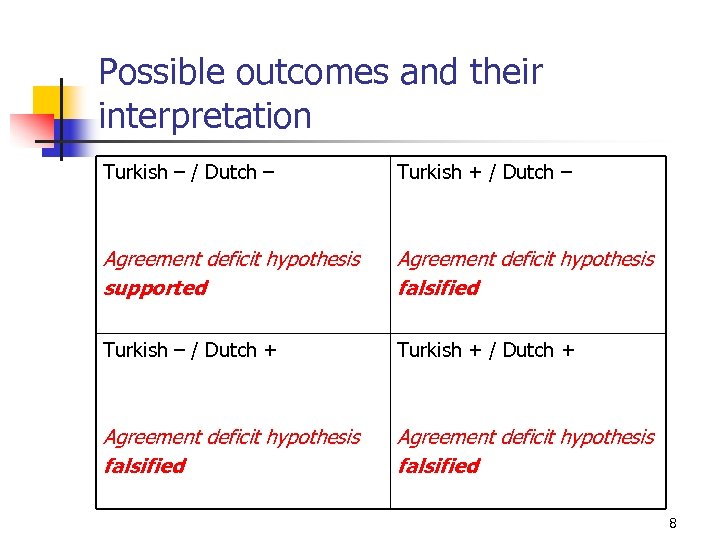
Possible outcomes and their interpretation Turkish – / Dutch – Turkish + / Dutch – Agreement deficit hypothesis supported Agreement deficit hypothesis falsified Turkish – / Dutch + Turkish + / Dutch + Agreement deficit hypothesis falsified 8
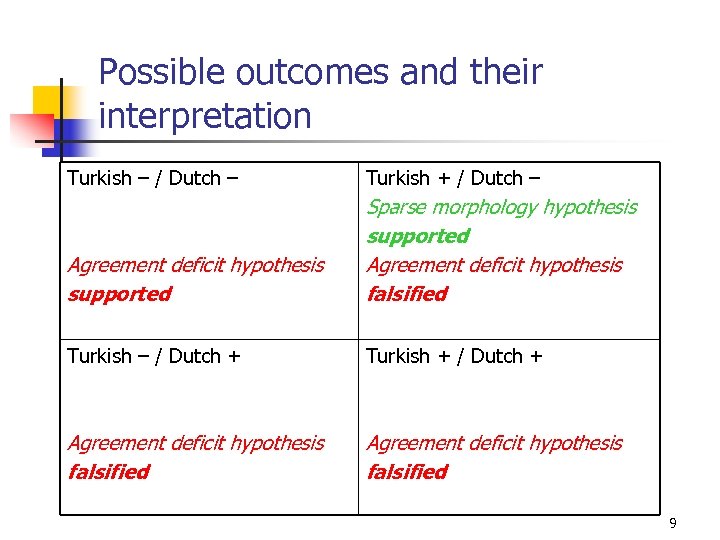
Possible outcomes and their interpretation Turkish – / Dutch – Turkish + / Dutch – Agreement deficit hypothesis supported Sparse morphology hypothesis supported Agreement deficit hypothesis falsified Turkish – / Dutch + Turkish + / Dutch + Agreement deficit hypothesis falsified 9
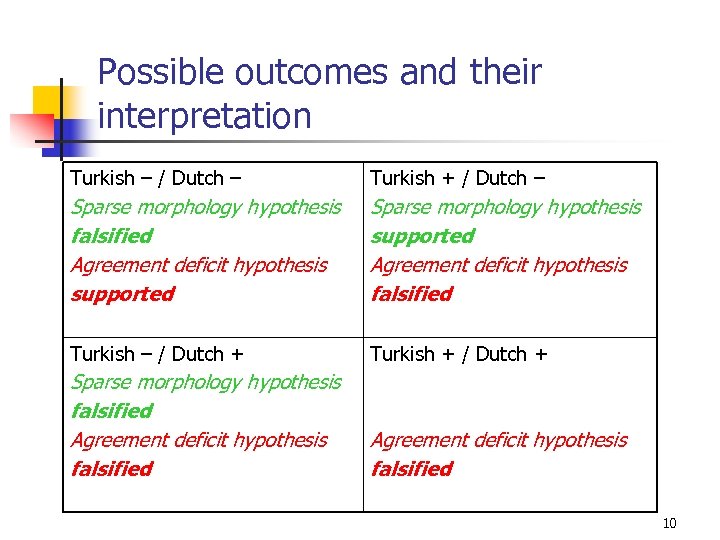
Possible outcomes and their interpretation Turkish – / Dutch – Turkish + / Dutch – Sparse morphology hypothesis falsified Agreement deficit hypothesis supported Sparse morphology hypothesis supported Agreement deficit hypothesis falsified Turkish – / Dutch + Turkish + / Dutch + Sparse morphology hypothesis falsified Agreement deficit hypothesis falsified 10
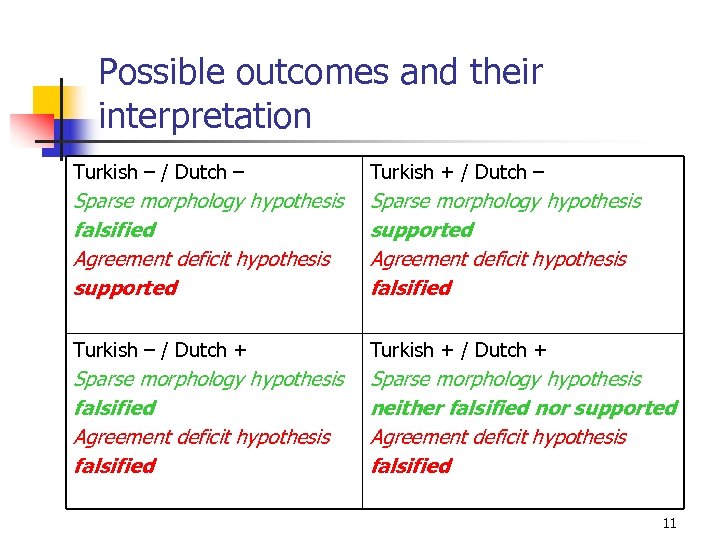
Possible outcomes and their interpretation Turkish – / Dutch – Turkish + / Dutch – Sparse morphology hypothesis falsified Agreement deficit hypothesis supported Sparse morphology hypothesis supported Agreement deficit hypothesis falsified Turkish – / Dutch + Turkish + / Dutch + Sparse morphology hypothesis falsified Agreement deficit hypothesis falsified Sparse morphology hypothesis neither falsified nor supported Agreement deficit hypothesis falsified 11
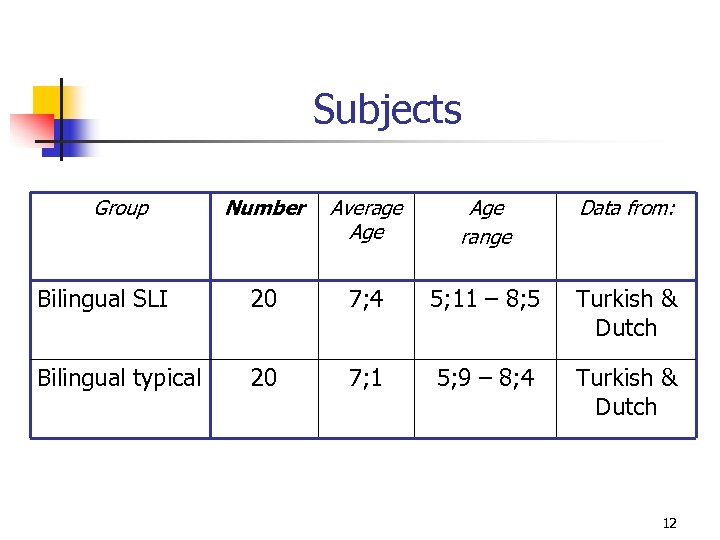
Subjects Group Number Average Age range Data from: Bilingual SLI 20 7; 4 5; 11 – 8; 5 Turkish & Dutch Bilingual typical 20 7; 1 5; 9 – 8; 4 Turkish & Dutch 12
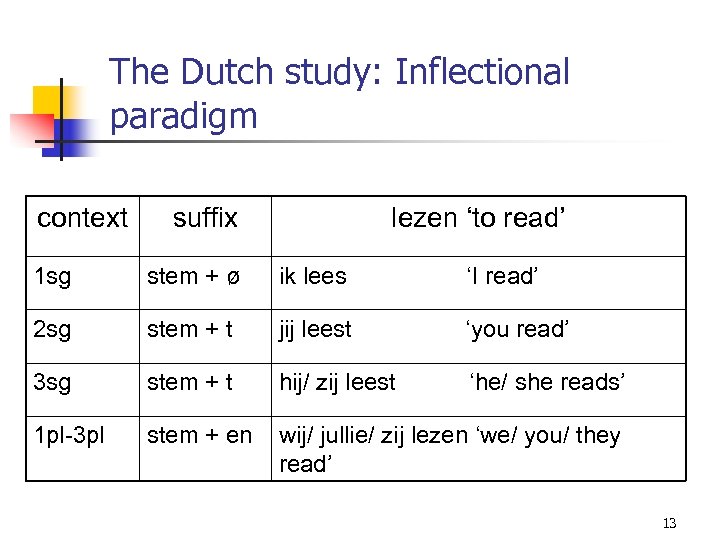
The Dutch study: Inflectional paradigm context suffix lezen ‘to read’ 1 sg stem + ø ik lees ‘I read’ 2 sg stem + t jij leest ‘you read’ 3 sg stem + t hij/ zij leest ‘he/ she reads’ 1 pl-3 pl stem + en wij/ jullie/ zij lezen ‘we/ you/ they read’ 13
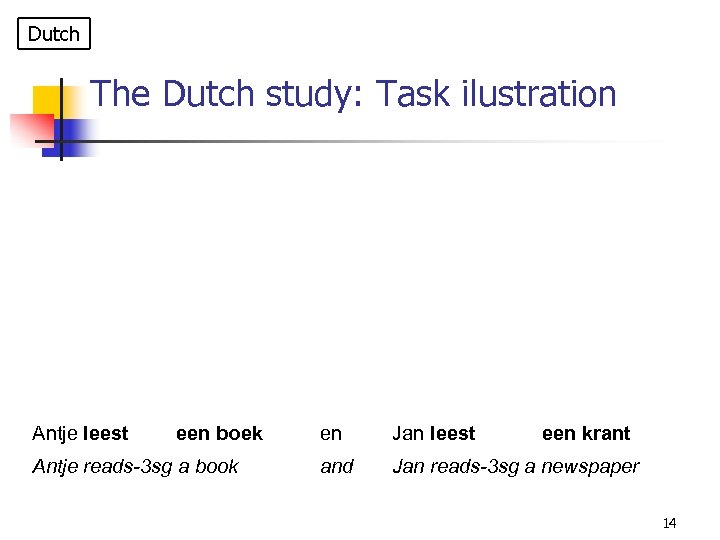
Dutch The Dutch study: Task ilustration Antje leest een boek Antje reads-3 sg a book en Jan leest een krant and Jan reads-3 sg a newspaper 14
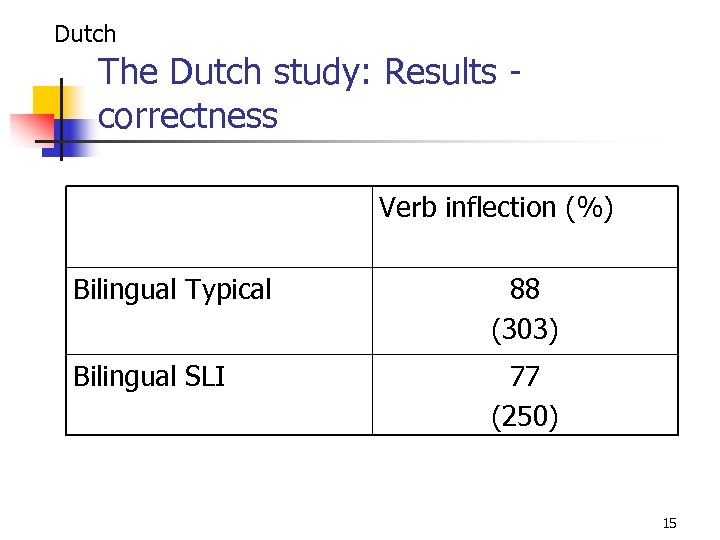
Dutch The Dutch study: Results correctness Verb inflection (%) Bilingual Typical 88 (303) Bilingual SLI 77 (250) 15
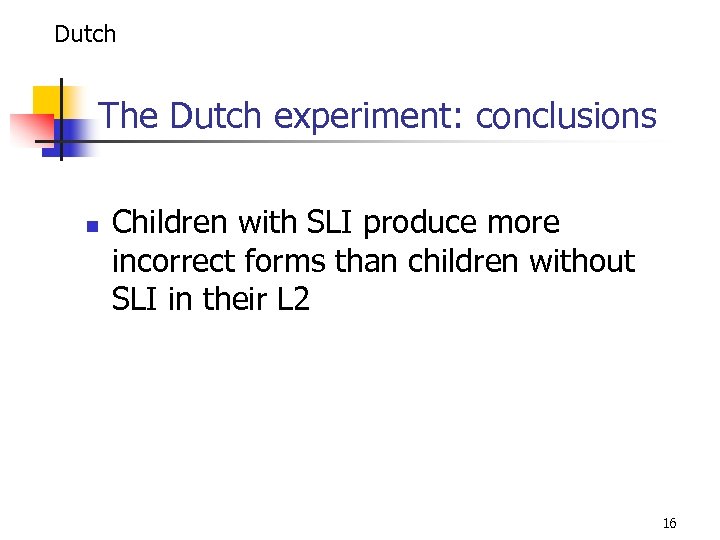
Dutch The Dutch experiment: conclusions n Children with SLI produce more incorrect forms than children without SLI in their L 2 16
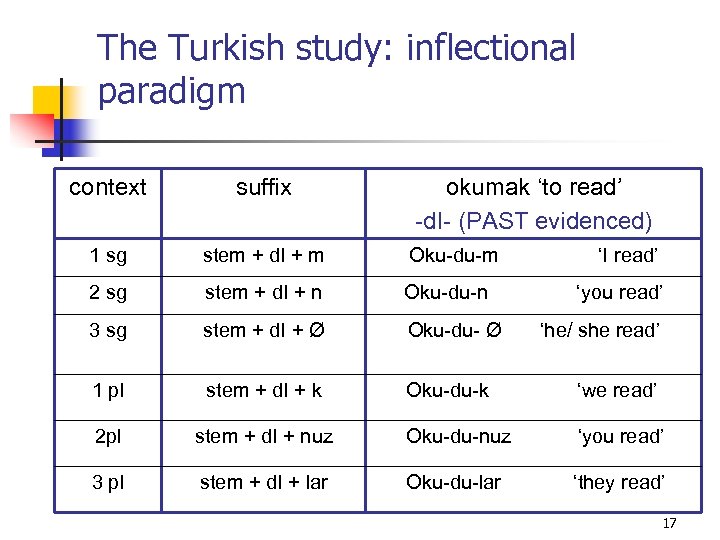
The Turkish study: inflectional paradigm context suffix okumak ‘to read’ -d. I- (PAST evidenced) 1 sg stem + d. I + m Oku-du-m 2 sg stem + d. I + n Oku-du-n 3 sg stem + d. I + Ø Oku-du- Ø 1 pl stem + d. I + k Oku-du-k ‘we read’ 2 pl stem + d. I + nuz Oku-du-nuz ‘you read’ 3 pl stem + d. I + lar Oku-du-lar ‘they read’ ‘I read’ ‘you read’ ‘he/ she read’ 17
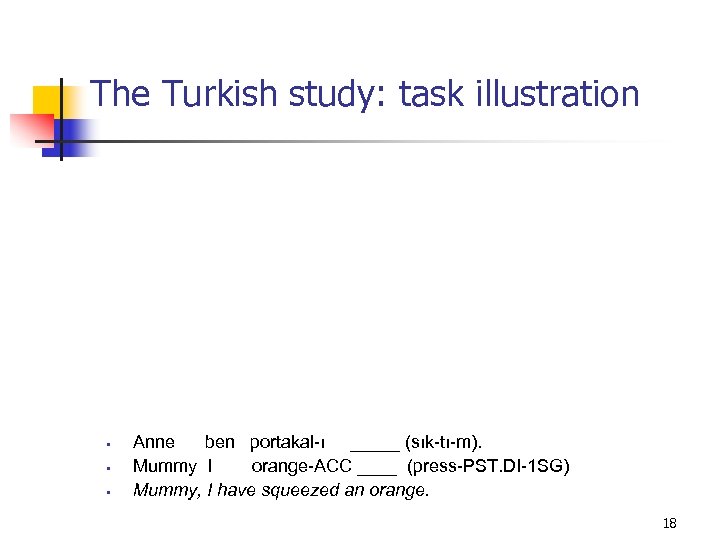
The Turkish study: task illustration § § § Anne ben portakal-ı _____ (sık-tı-m). Mummy I orange-ACC ____ (press-PST. DI-1 SG) Mummy, I have squeezed an orange. 18
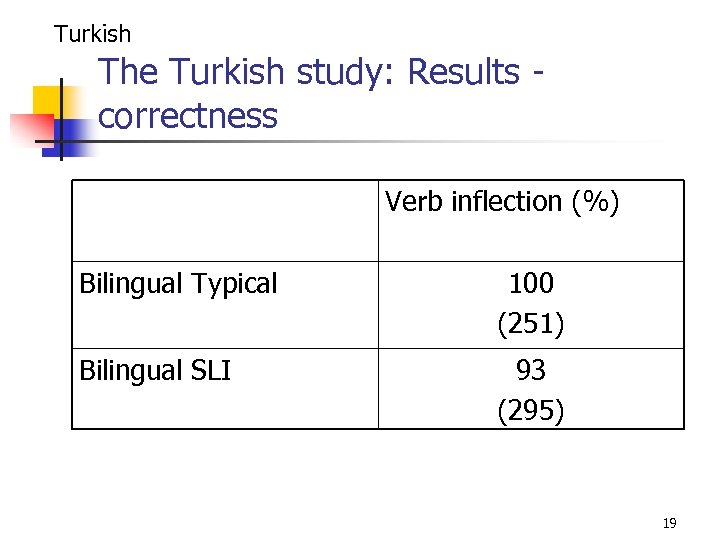
Turkish The Turkish study: Results correctness Verb inflection (%) Bilingual Typical 100 (251) Bilingual SLI 93 (295) 19
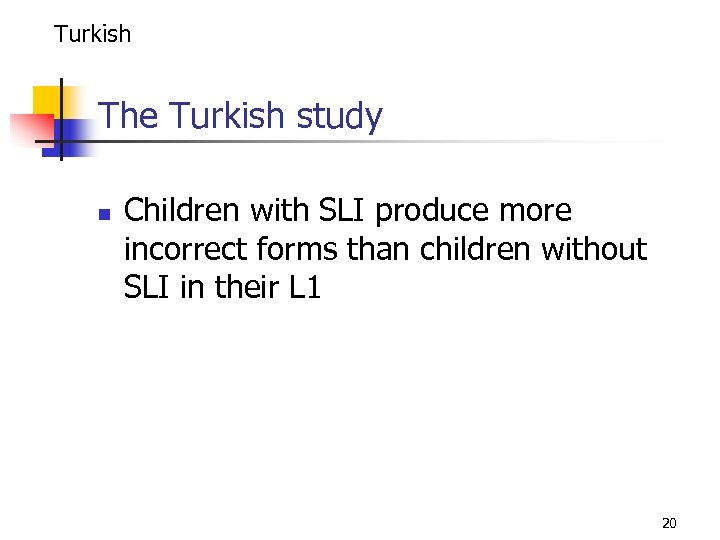
Turkish The Turkish study n Children with SLI produce more incorrect forms than children without SLI in their L 1 20
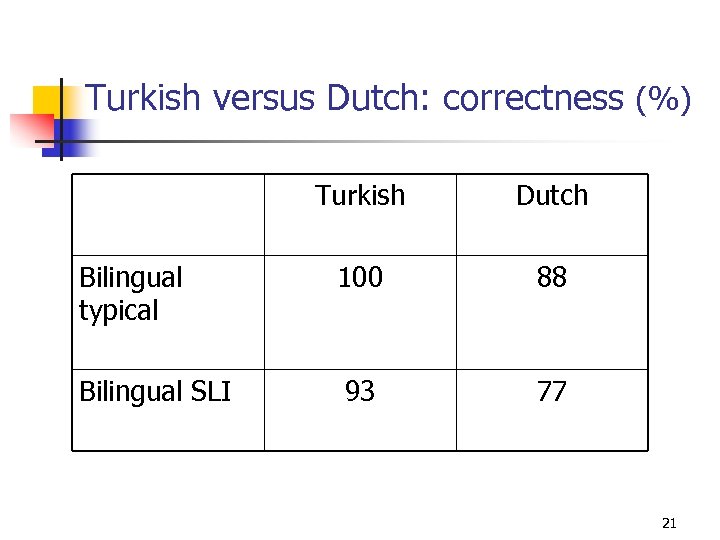
Turkish versus Dutch: correctness (%) Turkish Dutch Bilingual typical 100 88 Bilingual SLI 93 77 21
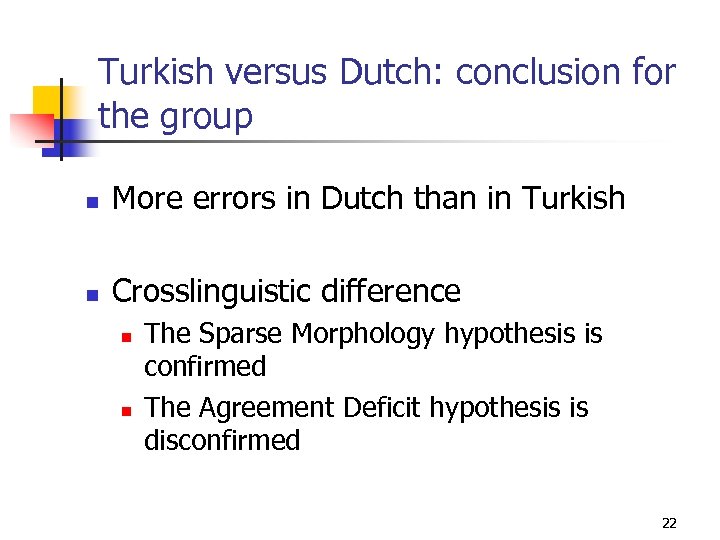
Turkish versus Dutch: conclusion for the group n More errors in Dutch than in Turkish n Crosslinguistic difference n n The Sparse Morphology hypothesis is confirmed The Agreement Deficit hypothesis is disconfirmed 22
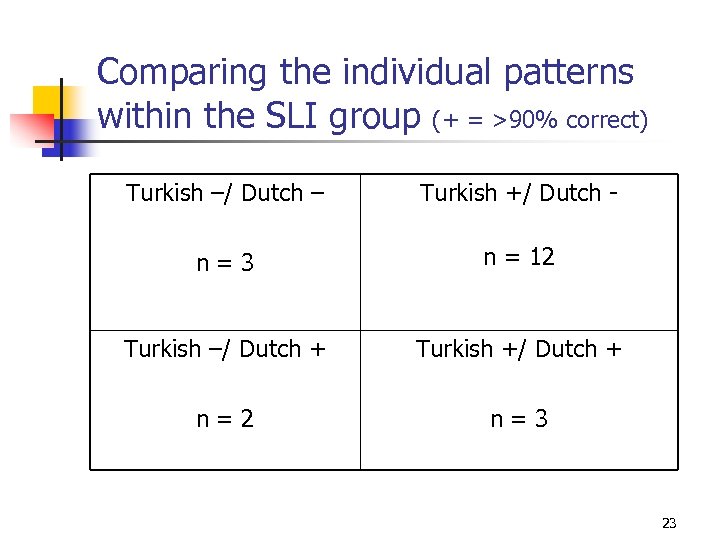
Comparing the individual patterns within the SLI group (+ = >90% correct) Turkish –/ Dutch – Turkish +/ Dutch - n=3 n = 12 Turkish –/ Dutch + Turkish +/ Dutch + n=2 n=3 23
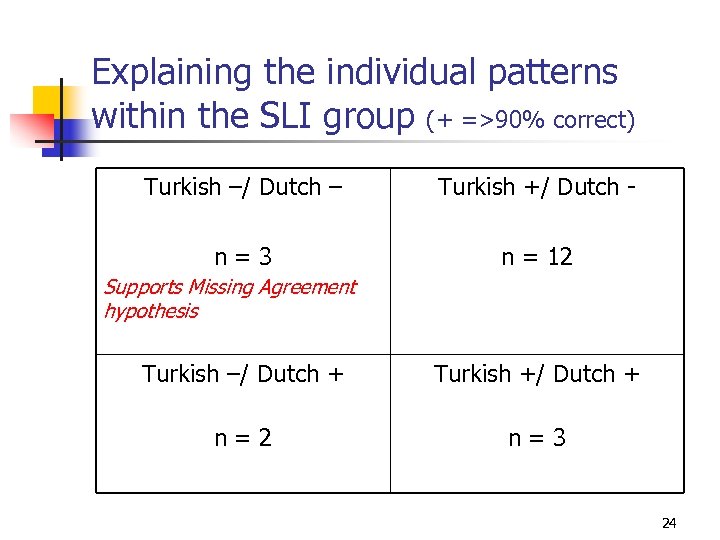
Explaining the individual patterns within the SLI group (+ =>90% correct) Turkish –/ Dutch – Turkish +/ Dutch - n=3 n = 12 Supports Missing Agreement hypothesis Turkish –/ Dutch + Turkish +/ Dutch + n=2 n=3 24
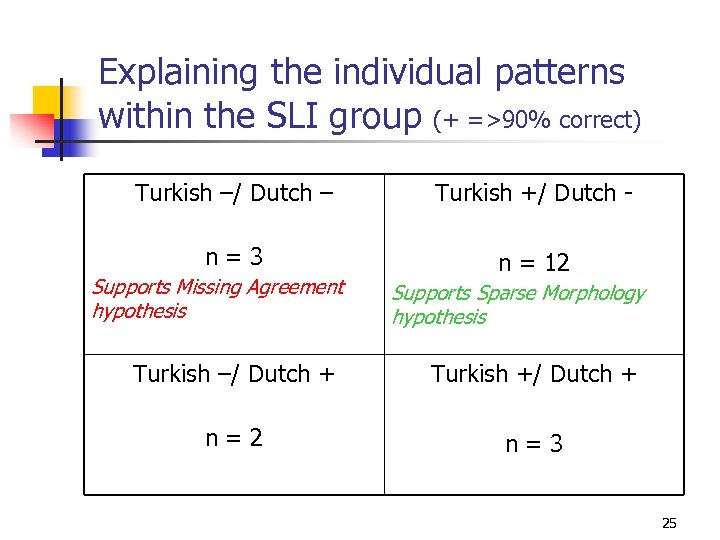
Explaining the individual patterns within the SLI group (+ =>90% correct) Turkish –/ Dutch – Turkish +/ Dutch - n=3 n = 12 Supports Missing Agreement hypothesis Supports Sparse Morphology hypothesis Turkish –/ Dutch + Turkish +/ Dutch + n=2 n=3 25
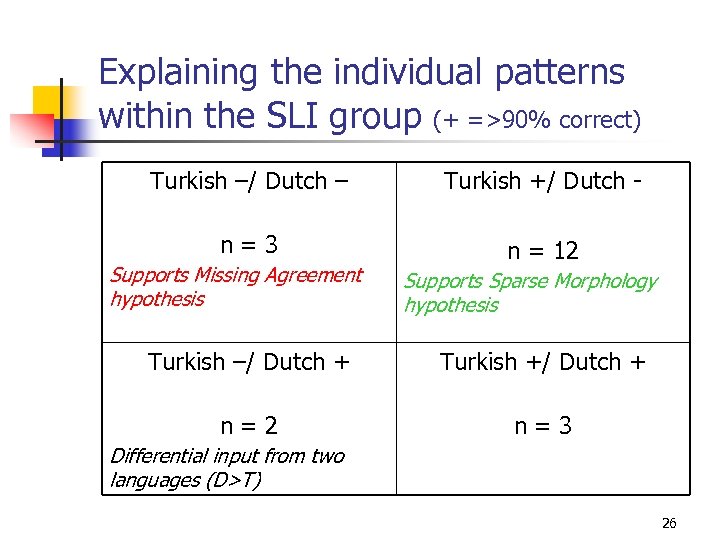
Explaining the individual patterns within the SLI group (+ =>90% correct) Turkish –/ Dutch – Turkish +/ Dutch - n=3 n = 12 Supports Missing Agreement hypothesis Supports Sparse Morphology hypothesis Turkish –/ Dutch + Turkish +/ Dutch + n=2 n=3 Differential input from two languages (D>T) 26
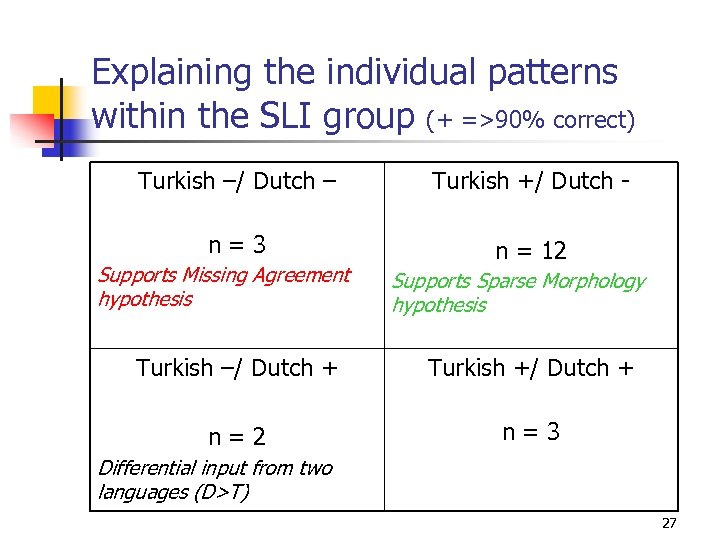
Explaining the individual patterns within the SLI group (+ =>90% correct) Turkish –/ Dutch – Turkish +/ Dutch - n=3 n = 12 Supports Missing Agreement hypothesis Supports Sparse Morphology hypothesis Turkish –/ Dutch + Turkish +/ Dutch + n=2 n=3 Differential input from two languages (D>T) 27
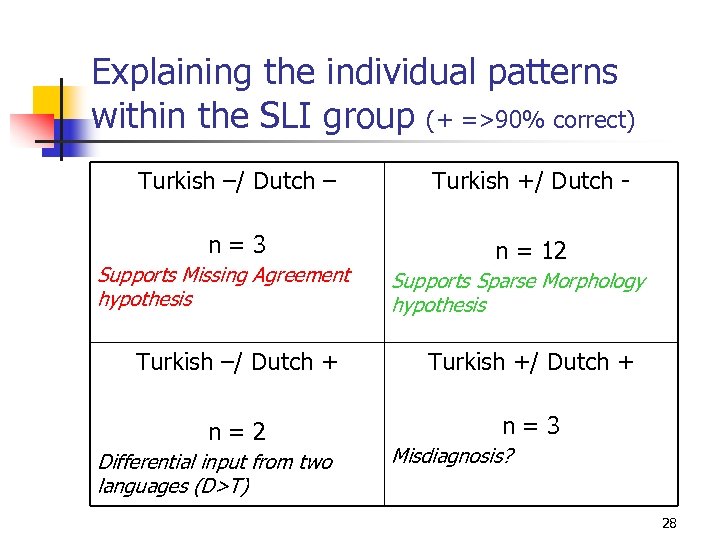
Explaining the individual patterns within the SLI group (+ =>90% correct) Turkish –/ Dutch – Turkish +/ Dutch - n=3 n = 12 Supports Missing Agreement hypothesis Supports Sparse Morphology hypothesis Turkish –/ Dutch + Turkish +/ Dutch + n=2 n=3 Differential input from two languages (D>T) Misdiagnosis? 28
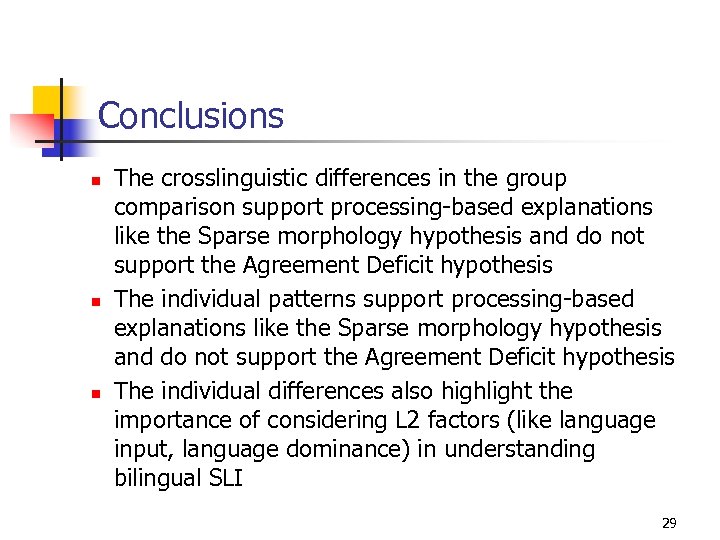
Conclusions n n n The crosslinguistic differences in the group comparison support processing-based explanations like the Sparse morphology hypothesis and do not support the Agreement Deficit hypothesis The individual patterns support processing-based explanations like the Sparse morphology hypothesis and do not support the Agreement Deficit hypothesis The individual differences also highlight the importance of considering L 2 factors (like language input, language dominance) in understanding bilingual SLI 29
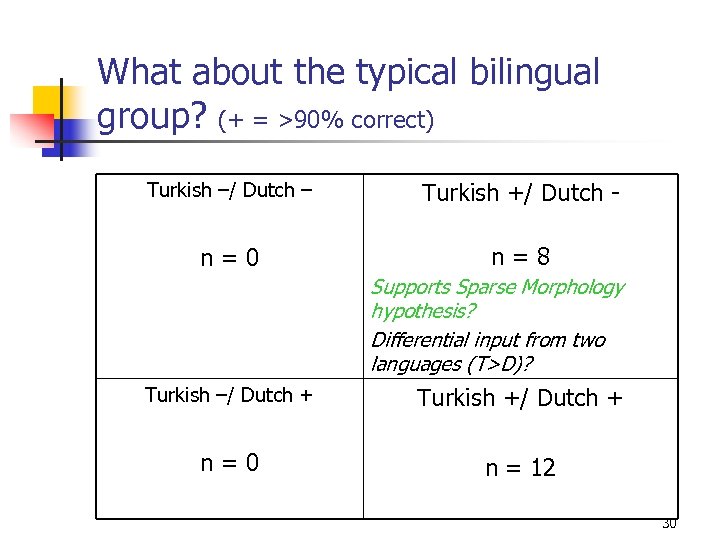
What about the typical bilingual group? (+ = >90% correct) Turkish –/ Dutch – Turkish +/ Dutch - n=0 n=8 Supports Sparse Morphology hypothesis? Differential input from two languages (T>D)? Turkish –/ Dutch + Turkish +/ Dutch + n=0 n = 12 30
Скачать презентацию Verb agreement in Turkish-Dutch bilingual children with SLI
18aa7e63480373b72db242b5cb795299.ppt