


 Скачать презентацию Vera I Podlesskaya Russian State U for the
10ae3c3a928a6647868b6f84f34e2f71.ppt
- Количество слайдов: 58
 Vera I. Podlesskaya Russian State U for the Humanities, Moscow Lexicalmarkers of speechdisfluency Russianand in cross-linguistically

 PLOT
PLOT
 Data: http: //spokencorpora. ru
 Chapter one: Lexical vs. non-lexical signals of production difficulties
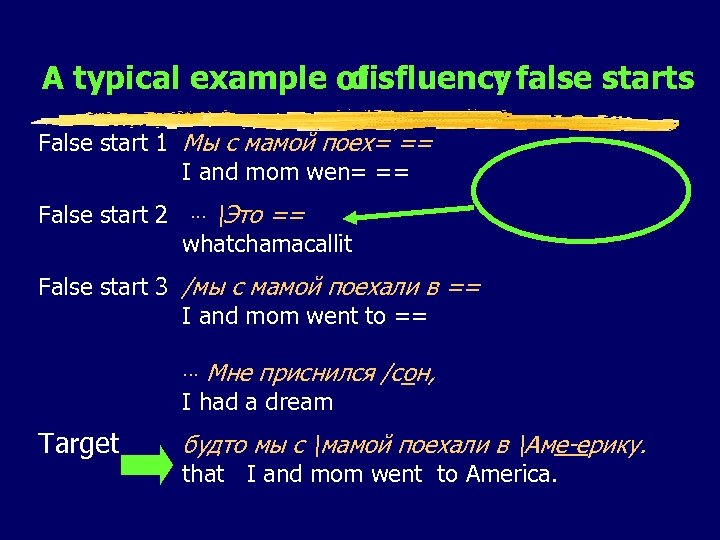 A typical example of disfluency false starts : False start 1 Мы с мамой поех= == I and mom wen= == False start 2 ∙∙∙ Это == whatchamacallit False start 3 /мы с мамой поехали в == I and mom went to == ∙∙∙ Мне приснился /сон, I had a dream Target будто мы с мамой поехали в Аме-ерику. that I and mom went to America.
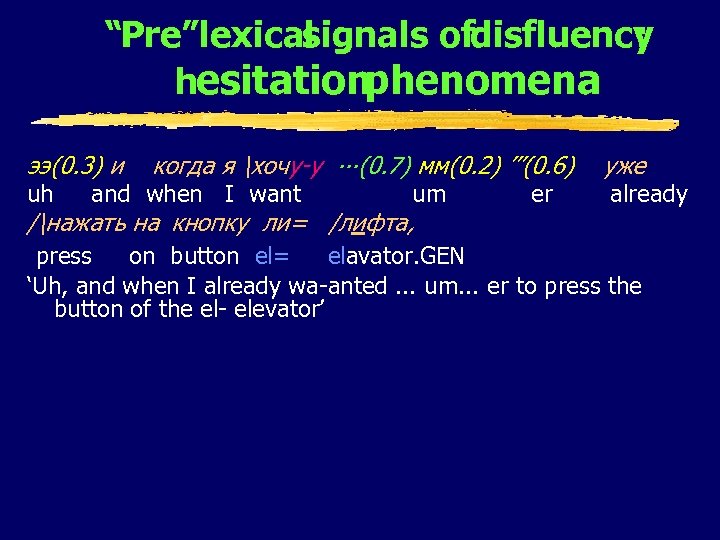 “Pre”lexical signals ofdisfluency : hesitationphenomena ээ(0. 3) и когда я хочу-у ∙∙∙(0. 7) мм(0. 2) ’’’(0. 6) uh and when I want um /нажать на кнопку ли= /лифта, press on button el= elavator. GEN er уже already ‘Uh, and when I already wa-anted. . . um. . . er to press the button of the el- elevator’
![“Post”lexical signals: structural isomorphism in on-line self-repairs ∙∙∙ назвали его Ив= named him Iv[an]](https://present5.com/presentation/10ae3c3a928a6647868b6f84f34e2f71/image-8.jpg "“Post”lexical signals: structural isomorphism in on-line self-repairs ∙∙∙ назвали его Ив= named him Iv[an]") “Post”lexical signals: structural isomorphism in on-line self-repairs ∙∙∙ назвали его Ив= named him Iv[an] ‘[They] named him Iv=…Vanja…’ || ’’’ /Ва-аня, , , Va-anja
“Post”lexical signals: structural isomorphism in on-line self-repairs ∙∙∙ назвали его Ив= named him Iv[an] ‘[They] named him Iv=…Vanja…’ || ’’’ /Ва-аня, , , Va-anja
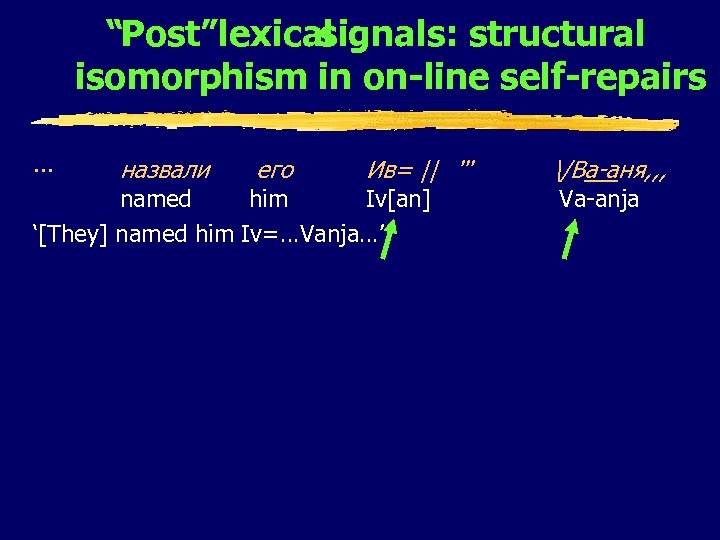 “Post”lexical signals: structural isomorphism in on-line self-repairs ∙∙∙ назвали его Ив= || ’’’ named him Iv[an] ‘[They] named him Iv=…Vanja…’ /Ва-аня, , , Va-anja
 Lexical markers are not mandatory in repairs wit different types of isomorphism – with different features triggered (corrected)
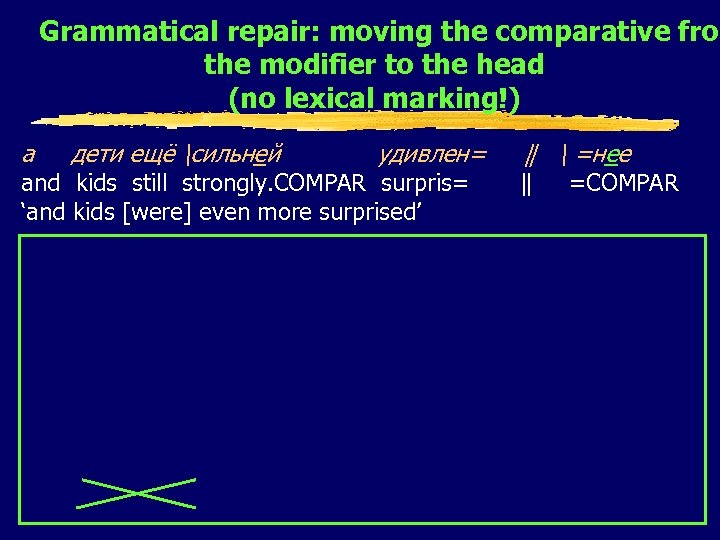 Grammatical repair: moving the comparative from the modifier to the head (no lexical marking!) а дети ещё сильней удивлен= ‖ =нее and kids still strongly. COMPAR surpris= ‖ =COMPAR ‘and kids [were] even more surprised’
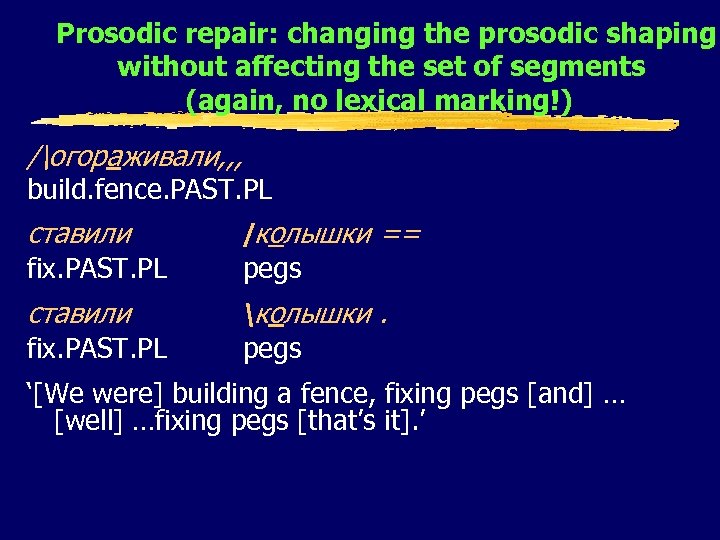 Prosodic repair: changing the prosodic shaping without affecting the set of segments (again, no lexical marking!) /огораживали, , , build. fence. PAST. PL ставили fix. PAST. PL /колышки == pegs колышки. pegs ‘[We were] building a fence, fixing pegs [and] … [well] …fixing pegs [that’s it]. ’
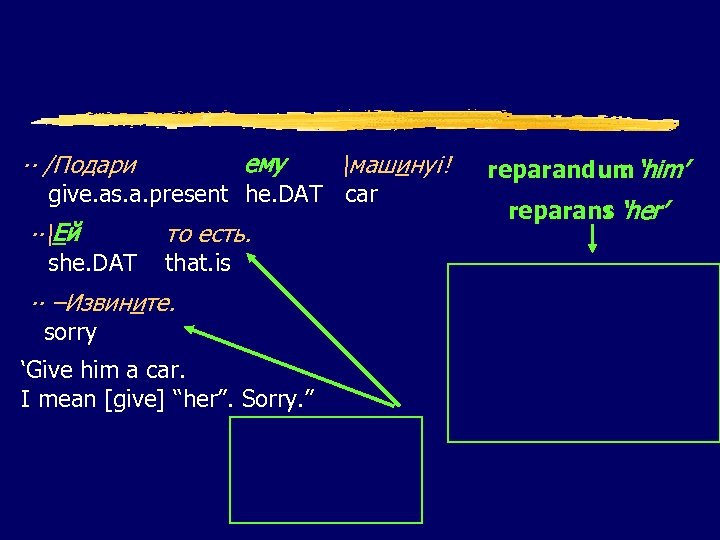 ∙∙ /Подари ему машину¡! give. as. a. present he. DAT car ∙∙Ей то есть. she. DAT that. is ∙∙ –Извините. sorry ‘Give him a car. I mean [give] “her”. Sorry. ” reparandum ‘him’ : reparans ‘her’ :
 In off-line repairs, when the transparent structure “reparandum+interruption point+reparansis absent, ” the explicit lexical notification of the trouble remains the last reso
 Chapter two: Lexical signals of production difficulties: main types

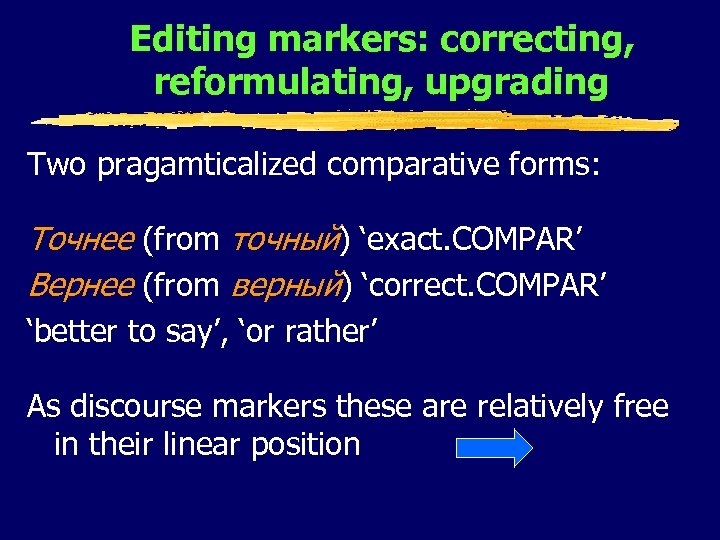 Editing markers: correcting, reformulating, upgrading Two pragamticalized comparative forms: Точнее (from точный) ‘exact. COMPAR’ Вернее (from верный) ‘correct. COMPAR’ ‘better to say’, ‘or rather’ As discourse markers these are relatively free in their linear position
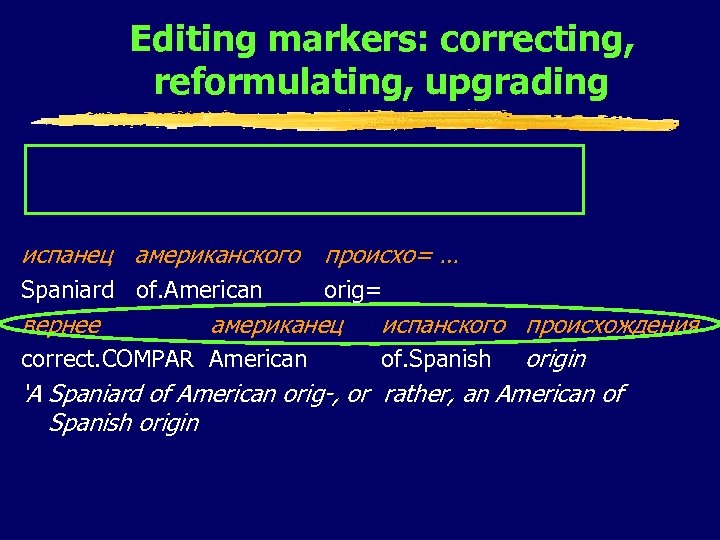 Editing markers: correcting, reformulating, upgrading испанец американского Spaniard of. American вернее происхо= … orig= американец испанского происхождения correct. COMPAR American of. Spanish origin ‘A Spaniard of American orig-, or rather, an American of Spanish origin
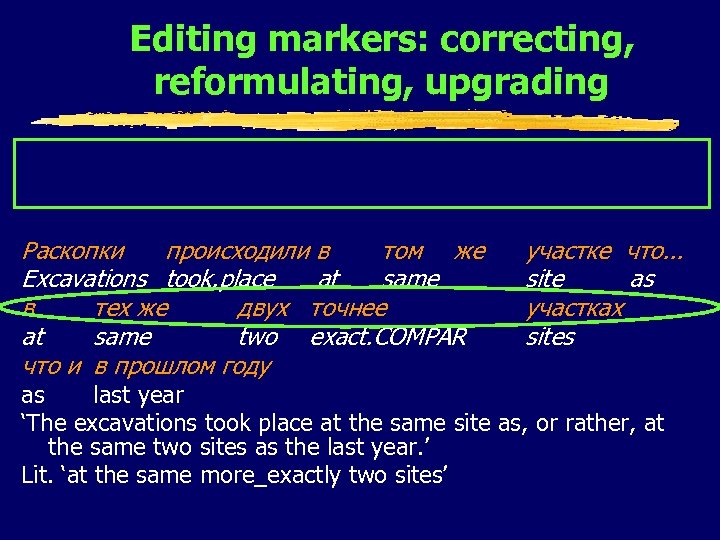 Editing markers: correcting, reformulating, upgrading Раскопки происходили в том же Excavations took. place at same в тех же двух точнее at same two exact. COMPAR что и в прошлом году участке что. . . site as участках sites as last year ‘The excavations took place at the same site as, or rather, at the same two sites as the last year. ’ Lit. ‘at the same more_exactly two sites’
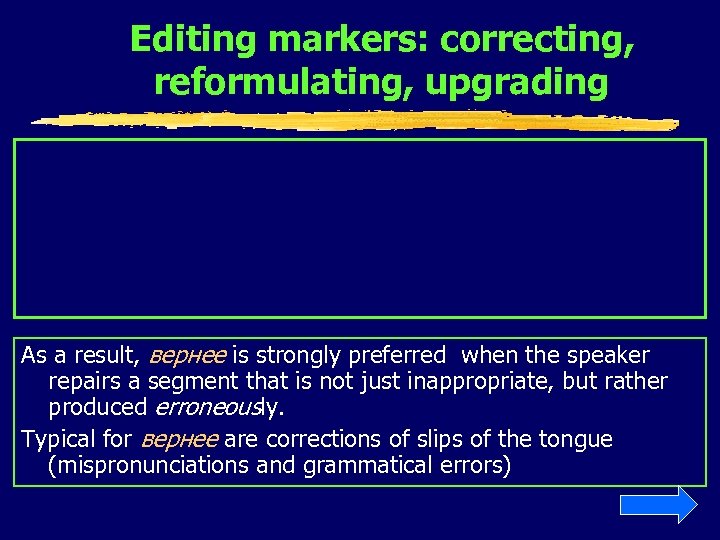 Editing markers: correcting, reformulating, upgrading As a result, вернее is strongly preferred when the speaker repairs a segment that is not just inappropriate, but rather produced erroneously. Typical for вернее are corrections of slips of the tongue (mispronunciations and grammatical errors)
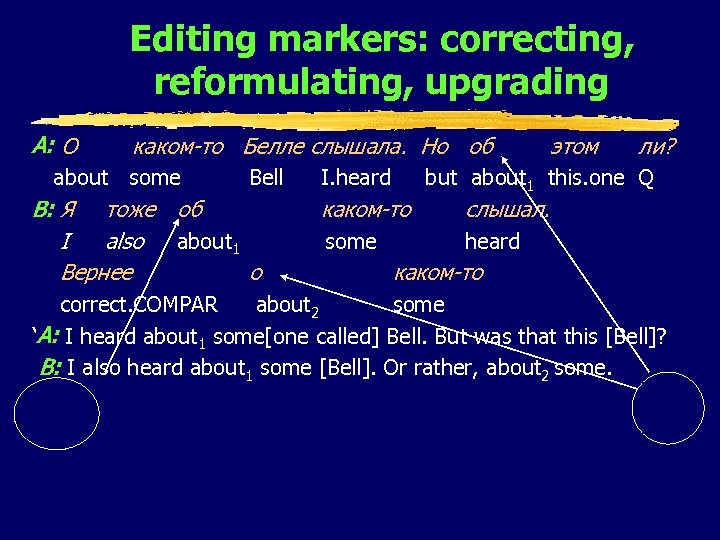 Editing markers: correcting, reformulating, upgrading A: О каком-то Белле слышала. Но об about some Bell B: Я тоже об I also about 1 Вернее о этом ли? I. heard but about 1 this. one Q каком-то слышал. some heard каком-то correct. COMPAR about 2 some ‘A: I heard about 1 some[one called] Bell. But was that this [Bell]? B: I also heard about 1 some [Bell]. Or rather, about 2 some.
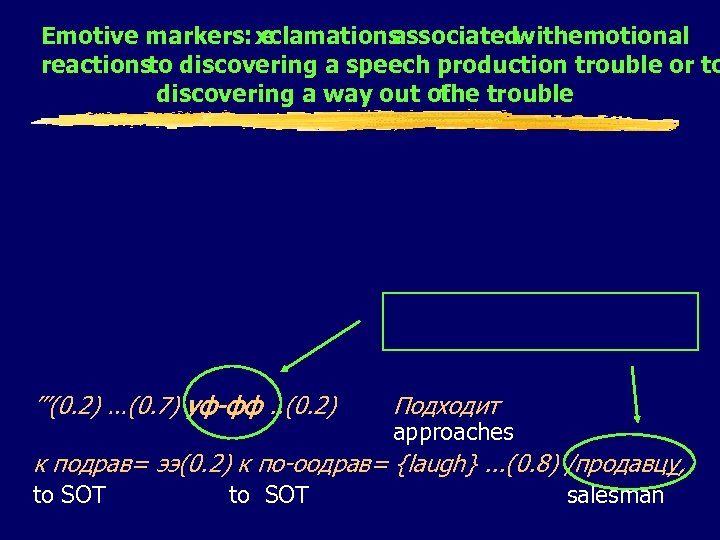 Emotive markers: xclamations e associated withemotional reactionsto discovering a speech production trouble or to discovering a way out of trouble the ’’’(0. 2) …(0. 7) уф-фф. . (0. 2) Подходит approaches к подрав= ээ(0. 2) к по-оодрав= {laugh}. . . (0. 8) /продавцу, to SOT salesman
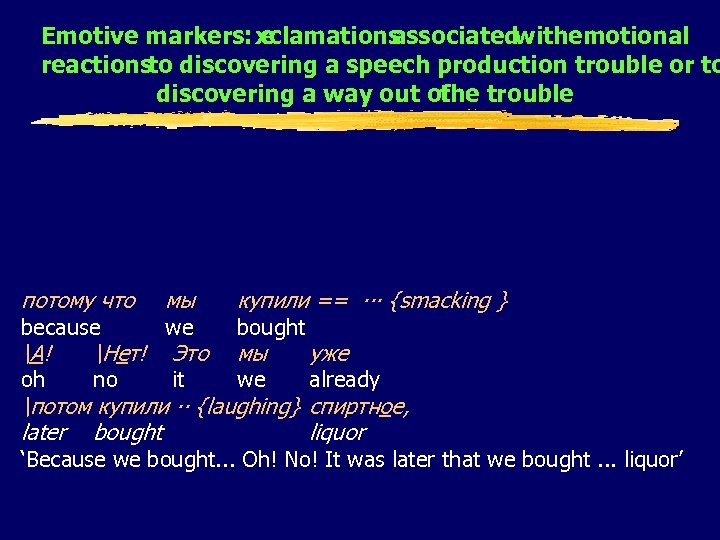 Emotive markers: xclamations e associated withemotional reactionsto discovering a speech production trouble or to discovering a way out of trouble the потому что мы купили == ∙∙∙ {smacking } А! Это мы because oh Нет! no we it bought we уже already потом купили ∙∙ {laughing} спиртное, later bought liquor ‘Because we bought. . . Oh! No! It was later that we bought. . . liquor’
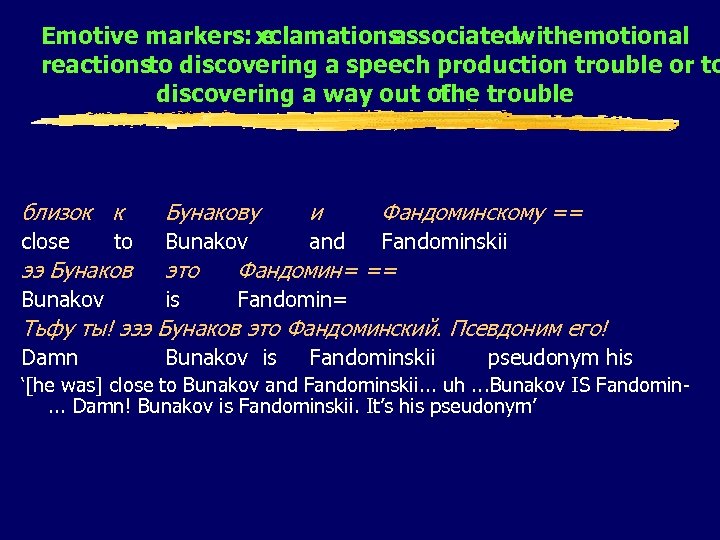 Emotive markers: xclamations e associated withemotional reactionsto discovering a speech production trouble or to discovering a way out of trouble the близок к Бунакову и Фандоминскому == close to Bunakov and Fandominskii ээ Бунаков это Фандомин= == Bunakov is Fandomin= Тьфу ты! эээ Бунаков это Фандоминский. Псевдоним его! Damn Bunakov is Fandominskii pseudonym his ‘[he was] close to Bunakov and Fandominskii. . . uh. . . Bunakov IS Fandomin- . . . Damn! Bunakov is Fandominskii. It’s his pseudonym’
 Chapter three: Placeholders and approximators
 Placeholders PH (“lexical fillers”): special hesitation markers mainly of pronominal origin that signal production difficulties and serve as a preparatory substitute for a delayed constituent in spontaneous informal spoken discourse. PH (Podlesskaya 2010) i. is a referential expression that is used as a substitute for a specific lexical item that has momentarily eluded the speaker (and which is often specified subsequently as a result of a word search), and … ii. occupies a syntactic slot that would have been occupied by the target word, and thus constitutes a part of the syntactic structure under construction.
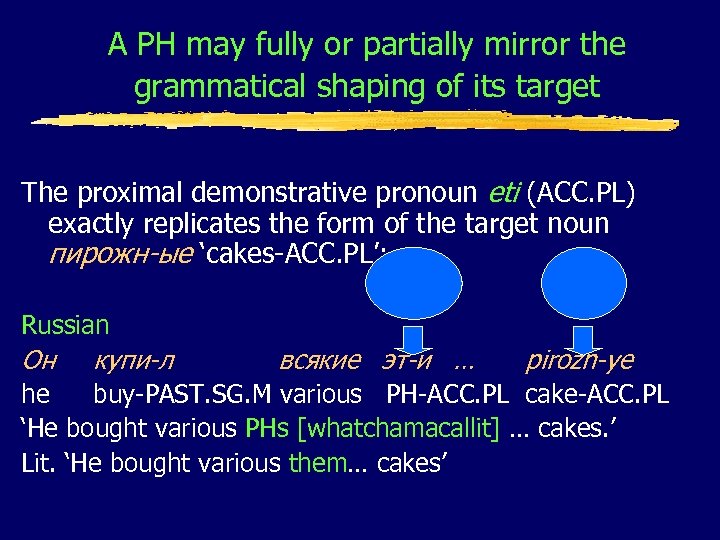 A PH may fully or partially mirror the grammatical shaping of its target The proximal demonstrative pronoun eti (ACC. PL) exactly replicates the form of the target noun пирожн-ыe ‘cakes-ACC. PL’: Russian Он купи-л всякие эт-и … pirožn-ye he buy-PAST. SG. M various PH-ACC. PL cake-ACC. PL ‘He bought various PHs [whatchamacallit] … cakes. ’ Lit. ‘He bought various them… cakes’
 A set of parameters for typological variation of placeholders across languages:
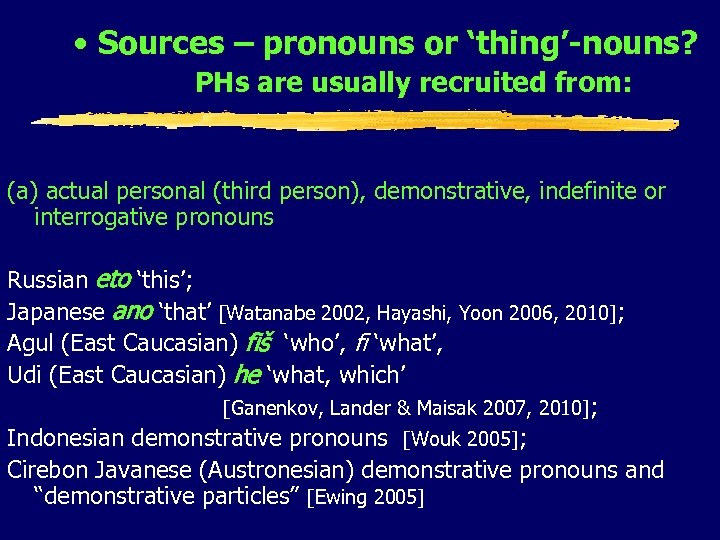 • Sources – pronouns or ‘thing’-nouns? PHs are usually recruited from: (a) actual personal (third person), demonstrative, indefinite or interrogative pronouns Russian eto ‘this’; Japanese ano ‘that’ [Watanabe 2002, Hayashi, Yoon 2006, 2010]; Agul (East Caucasian) fiš ‘who’, fi ‘what’, Udi (East Caucasian) he ‘what, which’ [Ganenkov, Lander & Maisak 2007, 2010]; Indonesian demonstrative pronouns [Wouk 2005]; Cirebon Javanese (Austronesian) demonstrative pronouns and “demonstrative particles” [Ewing 2005]
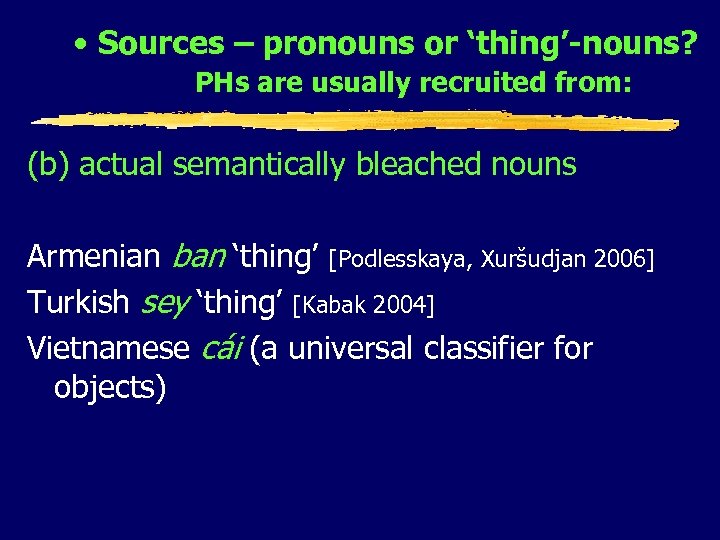 • Sources – pronouns or ‘thing’-nouns? PHs are usually recruited from: (b) actual semantically bleached nouns Armenian ban ‘thing’ [Podlesskaya, Xuršudjan 2006] Turkish sey ‘thing’ [Kabak 2004] Vietnamese cái (a universal classifier for objects)
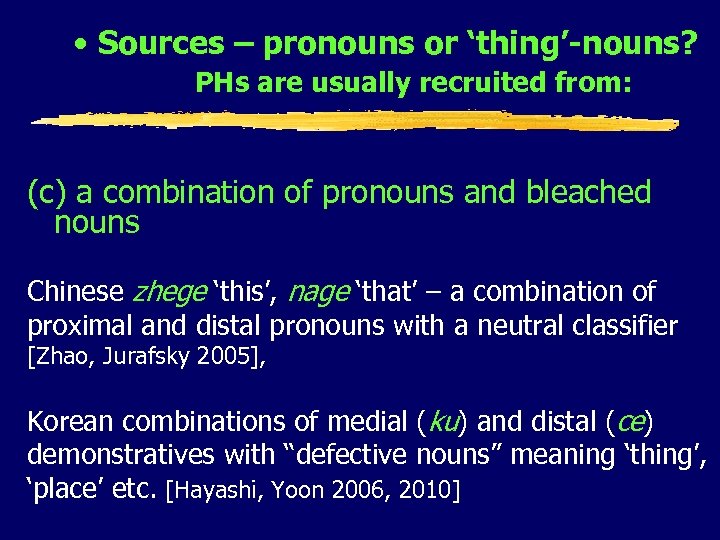 • Sources – pronouns or ‘thing’-nouns? PHs are usually recruited from: (c) a combination of pronouns and bleached nouns Chinese zhege ‘this’, nage ‘that’ – a combination of proximal and distal pronouns with a neutral classifier [Zhao, Jurafsky 2005], Korean combinations of medial (ku) and distal (ce) demonstratives with “defective nouns” meaning ‘thing’, ‘place’ etc. [Hayashi, Yoon 2006, 2010]
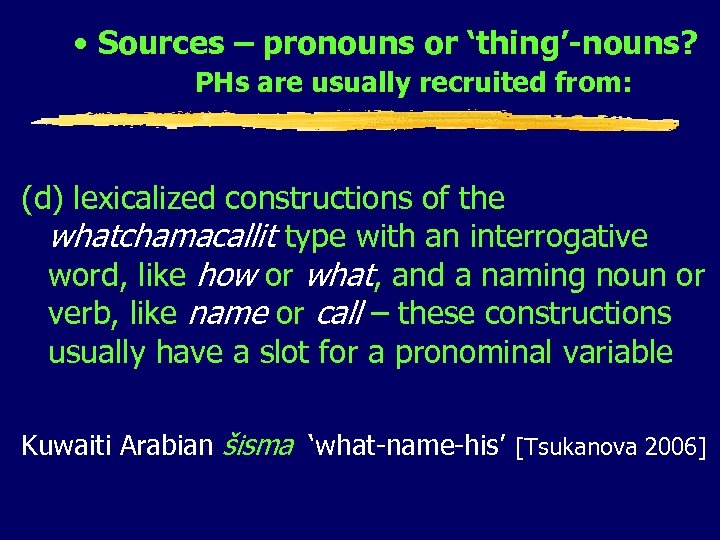 • Sources – pronouns or ‘thing’-nouns? PHs are usually recruited from: (d) lexicalized constructions of the whatchamacallit type with an interrogative word, like how or what, and a naming noun or verb, like name or call – these constructions usually have a slot for a pronominal variable Kuwaiti Arabian šisma ‘what-name-his’ [Tsukanova 2006]
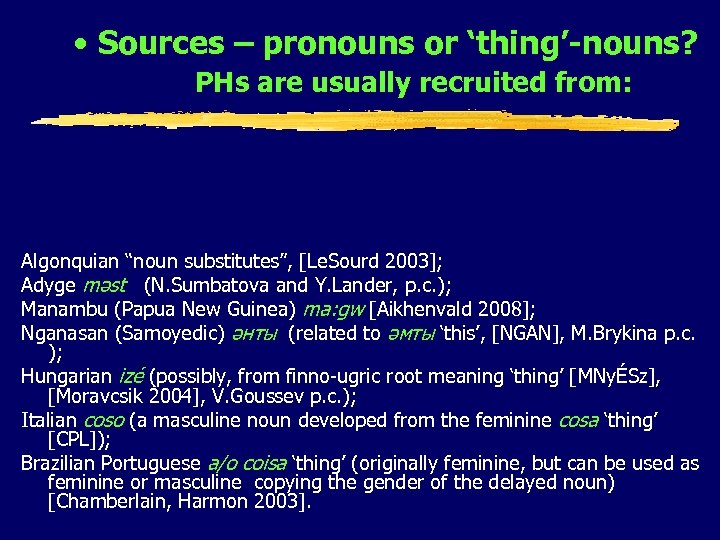 • Sources – pronouns or ‘thing’-nouns? PHs are usually recruited from: Algonquian “noun substitutes”, [Le. Sourd 2003]; Adyge məst (N. Sumbatova and Y. Lander, p. c. ); Manambu (Papua New Guinea) ma: gw [Aikhenvald 2008]; Nganasan (Samoyedic) əнты (related to əмты ‘this’, [NGAN], M. Brykina p. c. ); Hungarian izé (possibly, from finno-ugric root meaning ‘thing’ [MNyÉSz], [Moravcsik 2004], V. Goussev p. c. ); Italian coso (a masculine noun developed from the feminine cosa ‘thing’ [CPL]); Brazilian Portuguese a/o coisa ‘thing’ (originally feminine, but can be used as feminine or masculine copying the gender of the delayed noun) [Chamberlain, Harmon 2003].
 • PHs may appear with the same morphological marking as the upcoming target constituent. Morphology – only nominal or not only nominal? It is more common for PHs to substitute nominal constituents (cf. Russian), but they may have wider distribution and replicate also verbal, adjectival and adverbial morphology. Our data allows to hypothesize that: if a language has PHs that can replicate morphology other than nominal, it also has PHs that replicate nominal morphology, but not vice versa.
 • Morphology of verbal PHs – verbal affixes can be attached: (a) directly to a pronominal stem (b) to a derived stem (c) to a verbal root compounded with a pronominal stem (d) to an auxiliary combined with a nominal PH
 • Morphology of verbal PHs – verbal affixes can be attached: (a) directly to a pronominal stem – typical to languages that show little or no N vs. V contrast (Adyge), but observed also in languages of other types, e. g. in Samoyedic and Tungusic In this case, one and the same placeholder carries nominal morphology when substituting nominal constituents, but carries verbal morphology when substituting verbal constituents
 • Morphology of verbal PHs – verbal affixes can be attached:
 • Morphology of verbal PHs – verbal affixes can be attached:
 • Morphology of verbal PHs – verbal affixes can be attached:
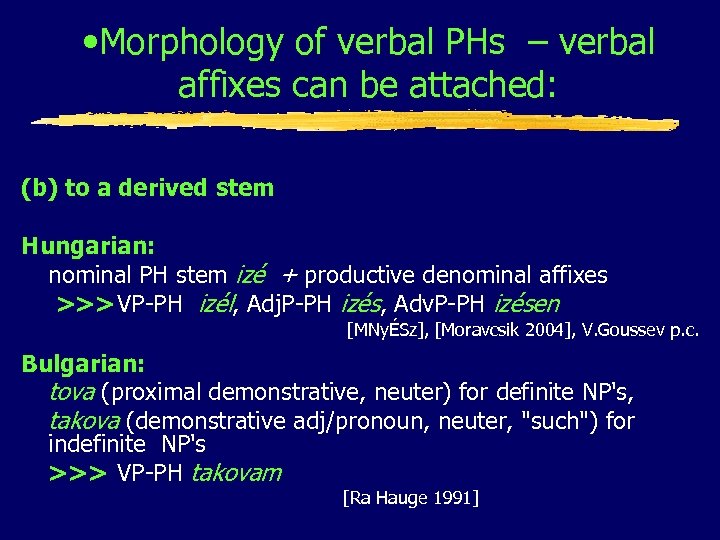 • Morphology of verbal PHs – verbal affixes can be attached: (b) to a derived stem Hungarian: nominal PH stem izé + productive denominal affixes >>> VP-PH izél, Adj. P-PH izés, Adv. P-PH izésen [MNyÉSz], [Moravcsik 2004], V. Goussev p. c. Bulgarian: tova (proximal demonstrative, neuter) for definite NP's, takova (demonstrative adj/pronoun, neuter, "such") for indefinite NP's >>> VP-PH takovam [Ra Hauge 1991]
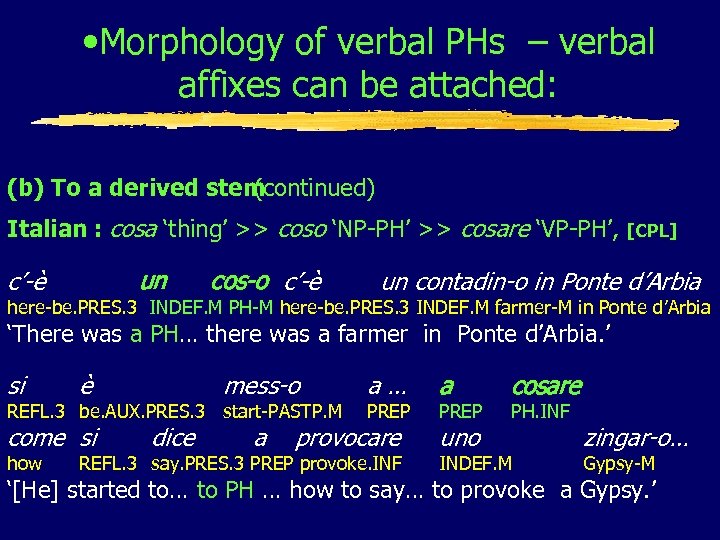 • Morphology of verbal PHs – verbal affixes can be attached: (b) To a derived stem (continued) Italian : cosa ‘thing’ >> coso ‘NP-PH’ >> cosare ‘VP-PH’, [CPL] c’-è un cos-o c’-è un contadin-o in Ponte d’Arbia here-be. PRES. 3 INDEF. M PH-M here-be. PRES. 3 INDEF. M farmer-M in Ponte d’Arbia ‘There was a PH… there was a farmer in Ponte d’Arbia. ’ si è mess-o a… REFL. 3 be. AUX. PRES. 3 start-PASTP. M PREP come si how dice a provocare REFL. 3 say. PRES. 3 PREP provoke. INF a PREP uno cosare PH. INF INDEF. M zingar-o… Gypsy-M ‘[He] started to… to PH … how to say… to provoke a Gypsy. ’
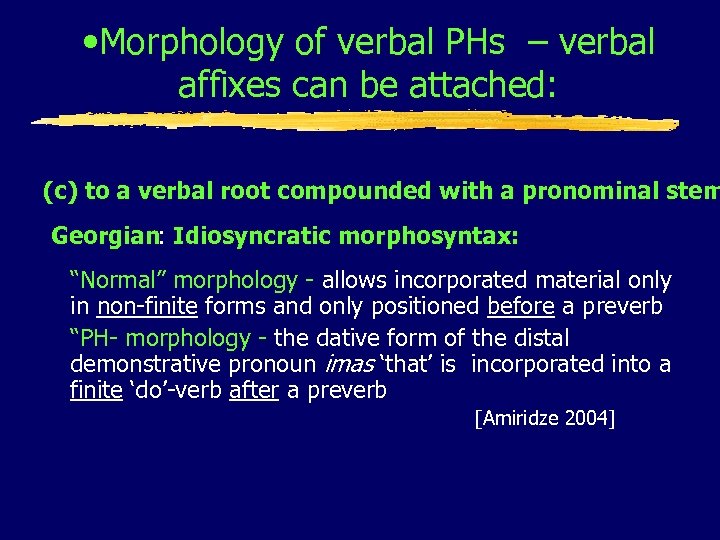 • Morphology of verbal PHs – verbal affixes can be attached: (c) to a verbal root compounded with a pronominal stem Georgian : Idiosyncratic morphosyntax: “Normal” morphology - allows incorporated material only in non-finite forms and only positioned before a preverb “PH- morphology - the dative form of the distal demonstrative pronoun imas ‘that’ is incorporated into a finite ‘do’-verb after a preverb [Amiridze 2004]
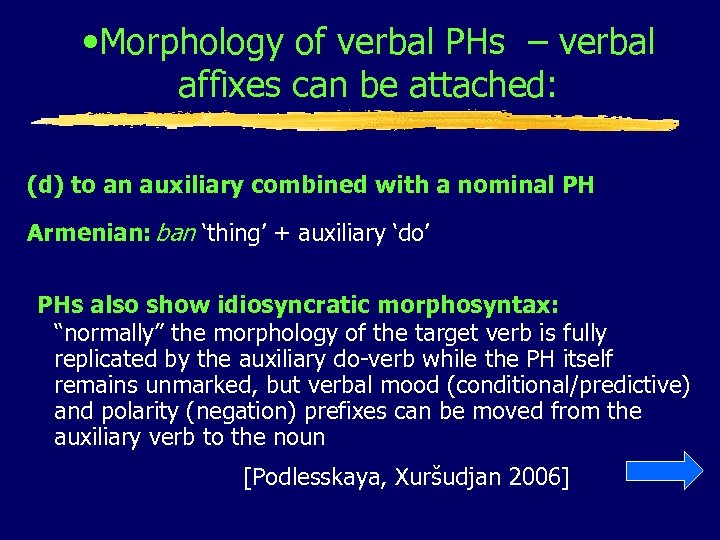 • Morphology of verbal PHs – verbal affixes can be attached: (d) to an auxiliary combined with a nominal PH Armenian: ban ‘thing’ + auxiliary ‘do’ PHs also show idiosyncratic morphosyntax: “normally” the morphology of the target verb is fully replicated by the auxiliary do-verb while the PH itself remains unmarked, but verbal mood (conditional/predictive) and polarity (negation) prefixes can be moved from the auxiliary verb to the noun [Podlesskaya, Хuršudjan 2006]
 • Morphology of verbal PHs – verbal affixes can be attached:
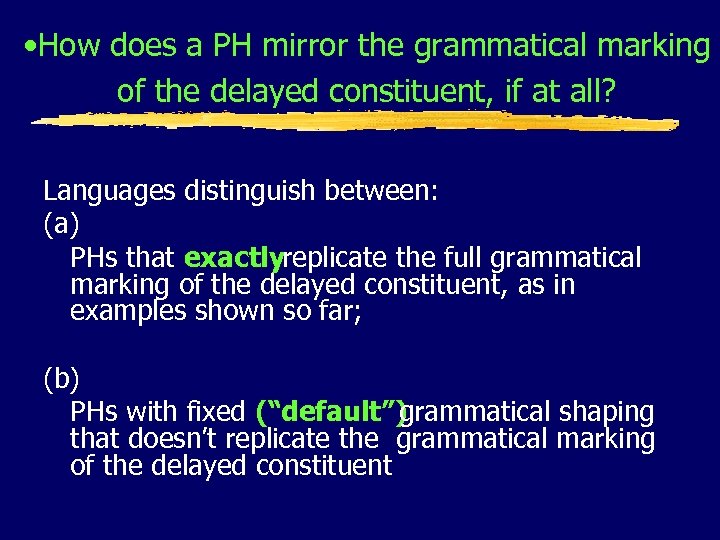 • How does a PH mirror the grammatical marking of the delayed constituent, if at all? Languages distinguish between: (a) PHs that exactly replicate the full grammatical marking of the delayed constituent, as in examples shown so far; (b) PHs with fixed (“default”) grammatical shaping that doesn’t replicate the grammatical marking of the delayed constituent
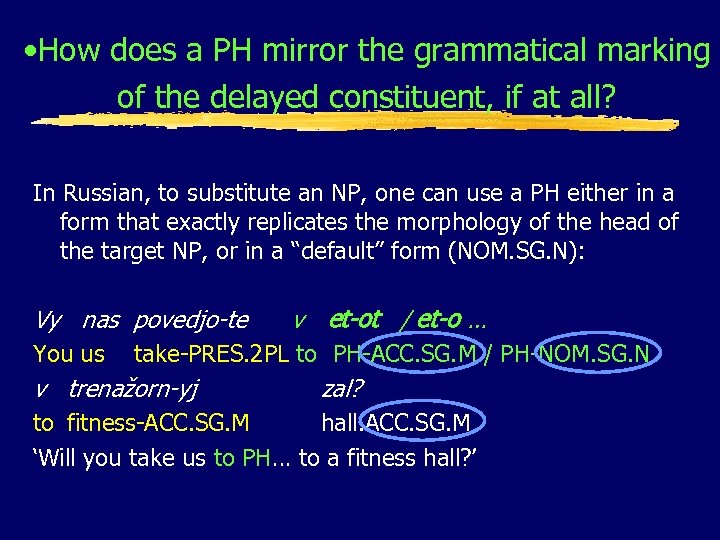 • How does a PH mirror the grammatical marking of the delayed constituent, if at all? In Russian, to substitute an NP, one can use a PH either in a form that exactly replicates the morphology of the head of the target NP, or in a “default” form (NOM. SG. N): Vy nas povedjo-te v et-ot / et-o … You us take-PRES. 2 PL to PH-ACC. SG. M / PH-NOM. SG. N v trenažorn-yj zal? to fitness-ACC. SG. M hall. ACC. SG. M ‘Will you take us to PH… to a fitness hall? ’
 • How does a PH mirror the grammatical marking of the delayed constituent, if at all? PHs with “default” grammatical shaping that don’t replicate the grammatical marking of the delayed constituent often tend to develop into interjective hesitation markers undergoing ‘pragmaticization’
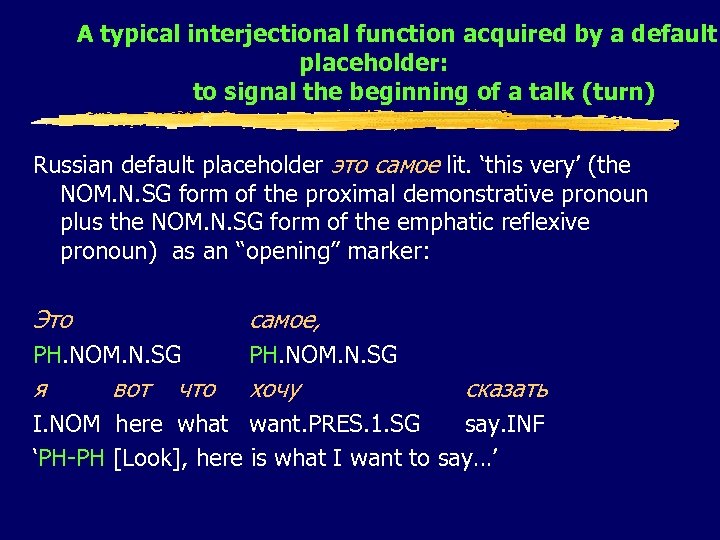 A typical interjectional function acquired by a default placeholder: to signal the beginning of a talk (turn) Russian default placeholder это самое lit. ‘this very’ (the NOM. N. SG form of the proximal demonstrative pronoun plus the NOM. N. SG form of the emphatic reflexive pronoun) as an “opening” marker: Это самое, PH. NOM. N. SG я хочу вот что сказать I. NOM here what want. PRES. 1. SG say. INF ‘PH-PH [Look], here is what I want to say…’
 • Other possible transitions of PHs: hesitation markers, approximators or generic words? The use of placeholders falls under the broader category of what is called “loose uses” of language [Jucker et al. 2003, Sperber, Wilson, 1991: 546], “vague reference” or “vague categorization” [Chanell 1994], “recognitional deixis” [Enfield 2003]. These are lexical and grammatical resources that allow the speaker to refer to objects and events for which the speaker fails to retrieve the exact name, or simply finds the exact name to be unnecessary or inappropriate. The same words that are used in a language as placeholders per se, that is to temporary substitute a delayed constituent, may also be used as “vague” or “imprecise” expressions that do not imply any later substitution, but rather suggest an approximate nomination sufficient at the current moment of communication.
 Two syntactic options for the approximate naming: insteadof its supposed exact correlate, togetherwith it its supposed exact correlate. The instead option: a PH is used as a generic expression, i. e. as a cover bleached nomination. (thing, thingy, thingummy) The togetheroption: a PH is used to signal that the speaker doesn’t take the full responsibility for the given actual nomination the PH is added to, since it is in some sense incomplete or not fully appropriate. (like, and stuff, or whatever)
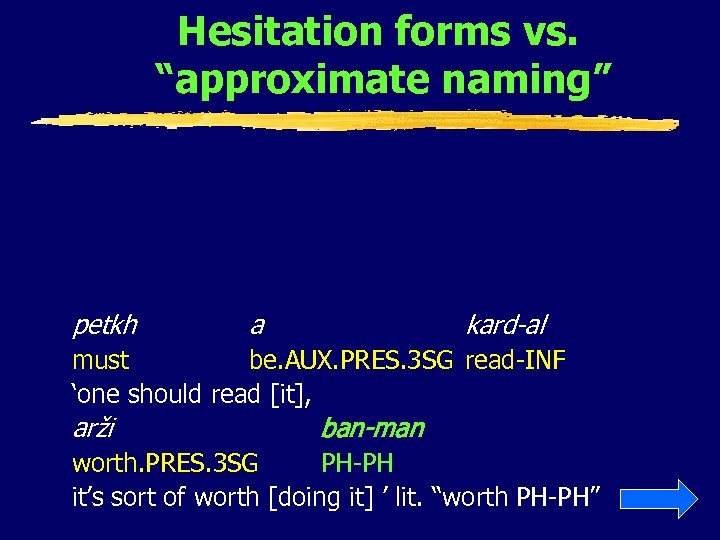 Hesitation forms vs. “approximate naming” petkh a kard-al must be. AUX. PRES. 3 SG read-INF ‘one should read [it], arži ban-man worth. PRES. 3 SG PH-PH it’s sort of worth [doing it] ’ lit. “worth PH-PH”
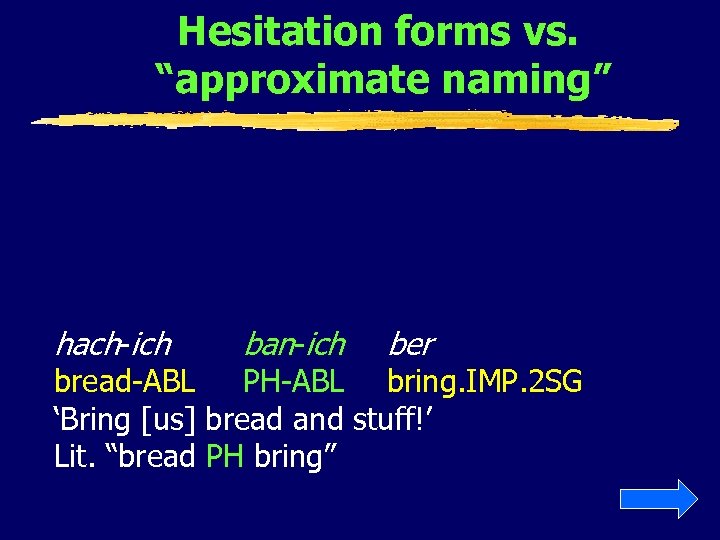 Hesitation forms vs. “approximate naming” hach-ich ban-ich ber bread-ABL PH-ABL bring. IMP. 2 SG ‘Bring [us] bread and stuff!’ Lit. “bread PH bring”
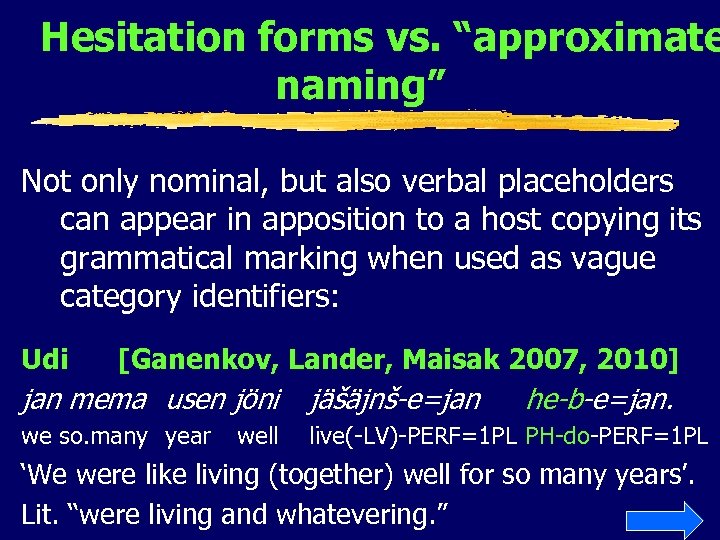 Hesitation forms vs. “approximate naming” Not only nominal, but also verbal placeholders can appear in apposition to a host copying its grammatical marking when used as vague category identifiers: Udi [Ganenkov, Lander, Maisak 2007, 2010] jan mema usen jöni jäšäjnš-e=jan he-b-e=jan. we so. many year well live(-LV)-PERF=1 PL PH-do-PERF=1 PL ‘We were like living (together) well for so many years’. Lit. “were living and whatevering. ”
 Hesitation forms vs. “approximate naming” The use of PHs as hesitation forms and their use for the “approximate naming” can be both viewed as derived from their more general interactional function – to signal the lack of the appropriate expression, no matter whether it has momentarily eluded a speaker or simply doesn’t exist. In both cases, PHs help the speaker to avoid the necessity of being specific and, according to [Le. Sourd 2003: 161], “to call upon the listener to generalize from the specific meaning … to a larger contextually relevant class”
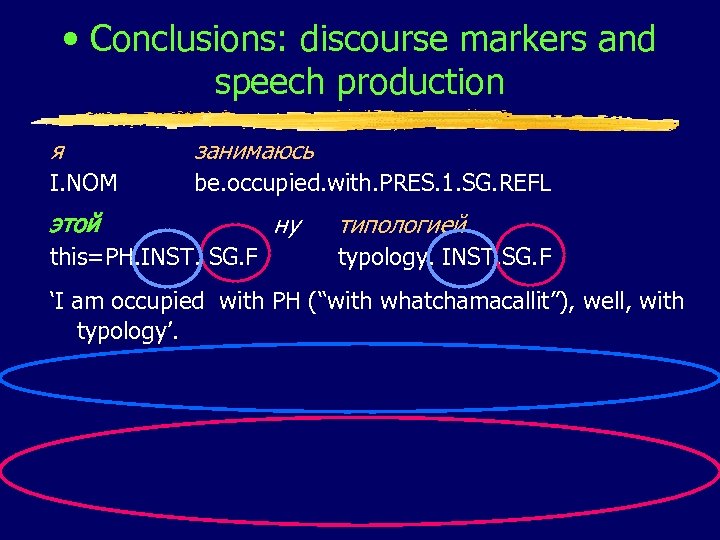 • Conclusions: discourse markers and speech production я занимаюсь I. NOM be. occupied. with. PRES. 1. SG. REFL этой this=PH. INST. SG. F ну типологией typology. INST. SG. F ‘I am occupied with PH (“with whatchamacallit”), well, with typology’.
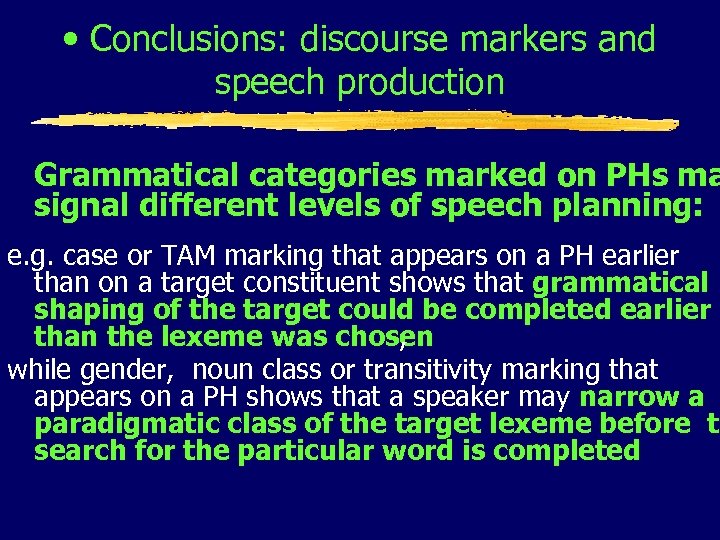 • Conclusions: discourse markers and speech production Grammatical categories marked on PHs ma signal different levels of speech planning: e. g. case or TAM marking that appears on a PH earlier than on a target constituent shows that grammatical shaping of the target could be completed earlier than the lexeme was chosen , while gender, noun class or transitivity marking that appears on a PH shows that a speaker may narrow a paradigmatic class of the target lexeme before th search for the particular word is completed
 • Conclusions: discourse markers and speech production This paradoxical behavior of PHs is yet another evidence that studying discourse markers in natural discourse provide a window on speech production processes
 This is. . . whatchamacallit. . . the end