 Скачать презентацию Ventilator Discontinuation The evidence base and best practice
Russia - Vent discontinuation process.ppt
- Количество слайдов: 29



Ventilator Discontinuation: The evidence base and “best practice” Neil Mac. Intyre MD Duke University Durham NC USA
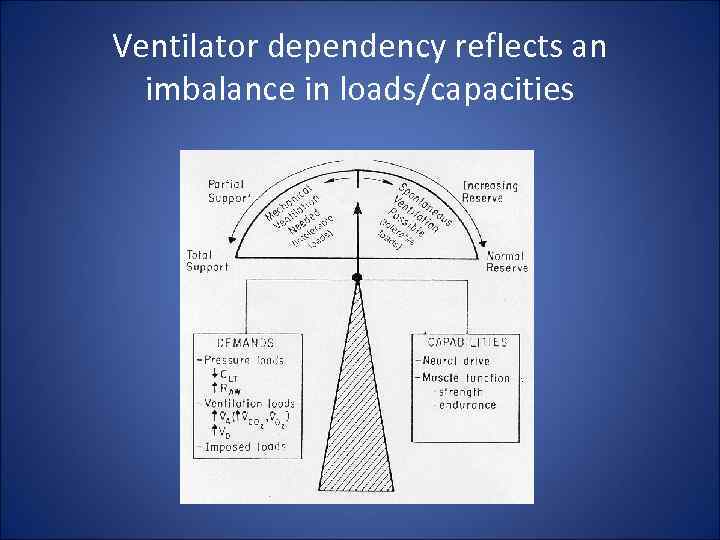
Ventilator dependency reflects an imbalance in loads/capacities
Ventilator dependency can also be iatrogenic • Failure to recognize discontinuation potential • Imposed loading: – insufficient support – insensitive/unresponsive triggers – flow dys-synchrony – cycle dys-synchrony • Inefficient weaning “rules” • Unnecessary sedation: – Kollef et al (1999) demonstrated sedation protocols reduce ventilator time
The Ventilator Discontinuation Process - EBM Projects • AHCPR - Mc. Master comprehensive evidence based review – 5000 papers screened – Over 150 quality trials systematically analyzed – Published Nov 1999
The Ventilator Discontinuation Process - EBM Projects • ACCP/SCCM/AARC Task Force – Organized May 1999 – Used Mc. Master report + own research + consensus to “fill in the gaps” – Developed 12 evidence based guidelines published in Chest Supplement December 2001
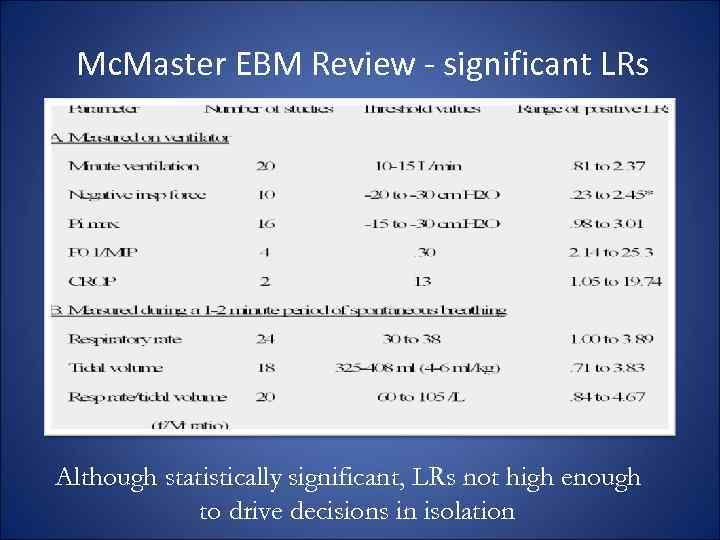
Mc. Master EBM Review - significant LRs Although statistically significant, LRs not high enough to drive decisions in isolation
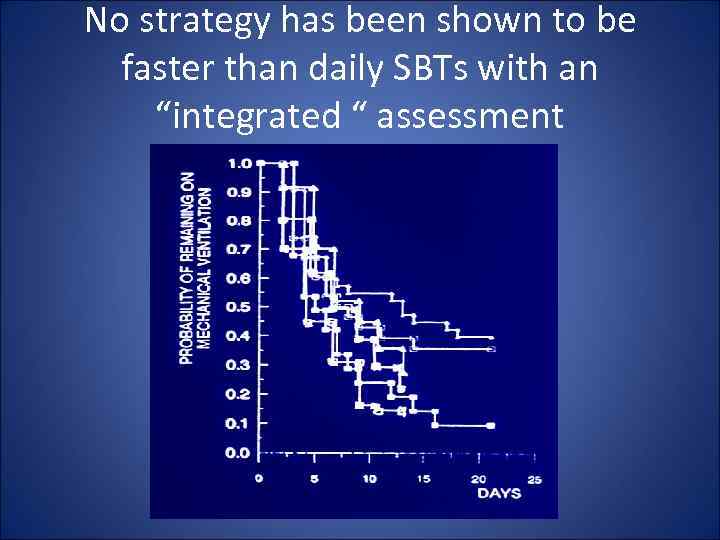
No strategy has been shown to be faster than daily SBTs with an “integrated “ assessment
ACCP/SCCM/AARC EBM Guidelines • Criteria for considering vent discontinuation: – stability/reversal of respiratory failure – P/F > 150 -200, PEEP < 5 -8, Fi. O 2 < 0. 4 -0. 5, p. H > 7. 25 – hemodynamic stability (no pressors/inotropes) – capable of reliable insp efforts
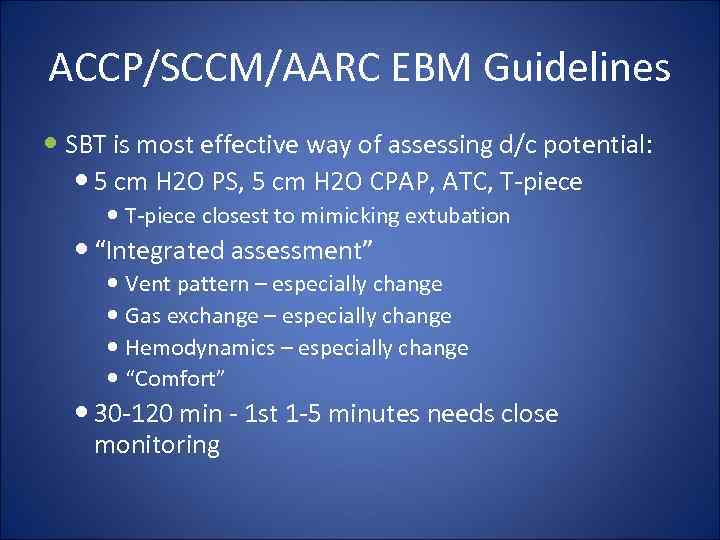
ACCP/SCCM/AARC EBM Guidelines SBT is most effective way of assessing d/c potential: 5 cm H 2 O PS, 5 cm H 2 O CPAP, ATC, T-piece closest to mimicking extubation “Integrated assessment” Vent pattern – especially change Gas exchange – especially change Hemodynamics – especially change “Comfort” 30 -120 min - 1 st 1 -5 minutes needs close monitoring
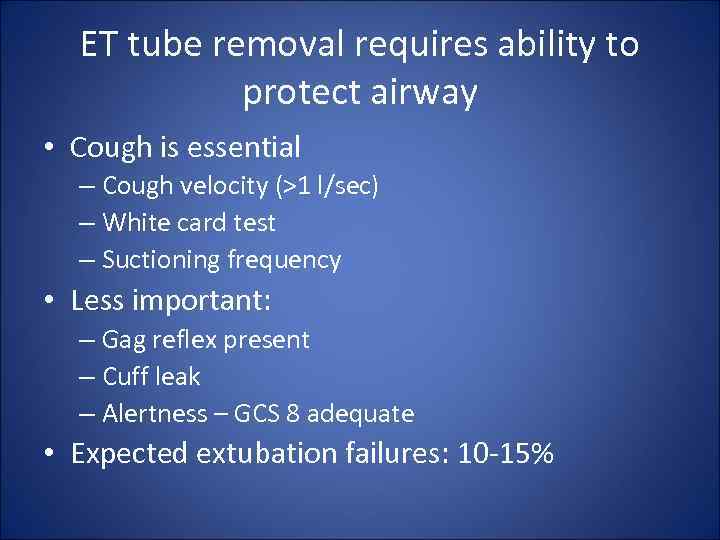
ET tube removal requires ability to protect airway • Cough is essential – Cough velocity (>1 l/sec) – White card test – Suctioning frequency • Less important: – Gag reflex present – Cuff leak – Alertness – GCS 8 adequate • Expected extubation failures: 10 -15%
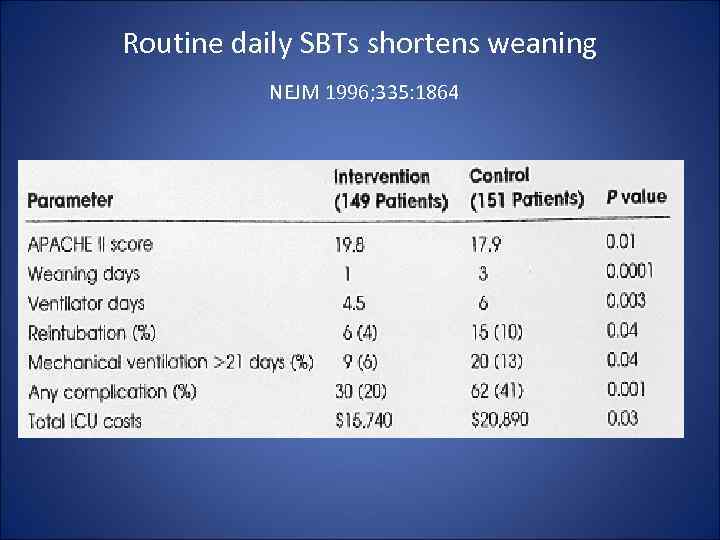
Routine daily SBTs shortens weaning NEJM 1996; 335: 1864
ACCP/SCCM/AARC EBM Guidelines • For patients who fail the SBT: – Search for reversible causes
In between the daily SBT: • Address the reversible aspects of load/capabilities imbalance: – Loads: • improve mechanics (edema, airways) • metabolic demands – Capabilities • • nutrients/electrolytes provide adequate DO 2 to vent muscles (CO*, Hb) adrenal function SEDATION STRATEGIES – SAT vs targeted protocols? *removal of intrathoracic pressure may precipitate heart failure
ACCP/SCCM/AARC EBM Guidelines • For patients who fail the SBT: – Search for reversible causes – Repeat SBTs q 24 hrs in those maintaining clinical stability • In between, provide stable and comfortable assisted ventilation • Little data demonstrating gradual support reduction reduces VLOS – likely wastes resources and risks fatigue
In between daily SBTs • Properly load the muscles: – “Normalize” amount of load • avoid atrophy, avoid fatigue – “Optimize” comfort with synchronous flow delivery throughout the breath • sensitive/responsive triggering • responsive (variable) flow with EVERY breath • proper breath termination (cycling) • Maintain this level without change until next SBT • “Weaning” this level has never been shown to improve outcomes
Practical aspects of “normalized”, comfortable loading • Triggering - max sensitivity, “balance” PEEPi with applied PEEP • Pressure/flow targets – Variable flow easier to synchronize with effort therefore pressure targeted modes (PS, PA) best – Operational pressure range 10 -25 cm H 2 O - start at 15 and titrate to breathing pattern, comfort • Cycling - PS uses flow, PA uses time - adjust to comfortable I: E
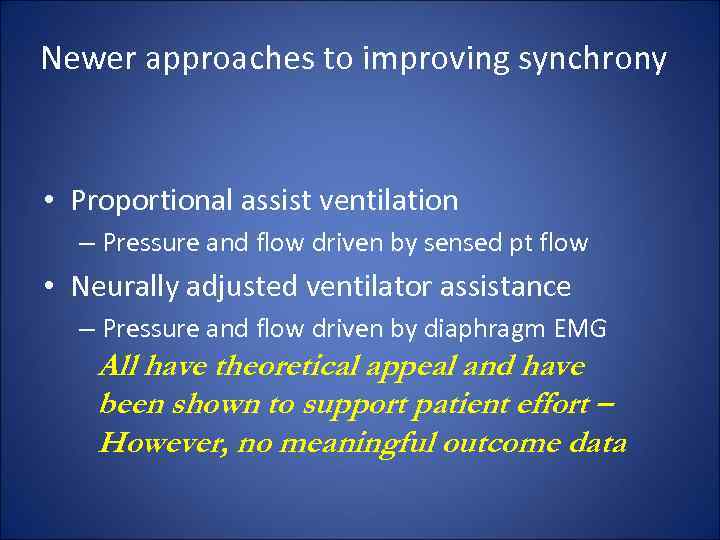
Newer approaches to improving synchrony • Proportional assist ventilation – Pressure and flow driven by sensed pt flow • Neurally adjusted ventilator assistance – Pressure and flow driven by diaphragm EMG All have theoretical appeal and have been shown to support patient effort – However, no meaningful outcome data
ACCP/SCCM/AARC EBM Guidelines • For patients who fail the SBT: – Search for reversible causes – Repeat SBTs q 24 hrs in those maintaining clinical stability • Stable comfortable support – no need to “wean”
ACCP/SCCM/AARC EBM Guidelines • For patients who fail the SBT: – Search for reversible causes – Repeat SBTs q 24 hrs in those maintaining clinical stability • Stable comfortable support – no need to “wean” Is this what is happening?
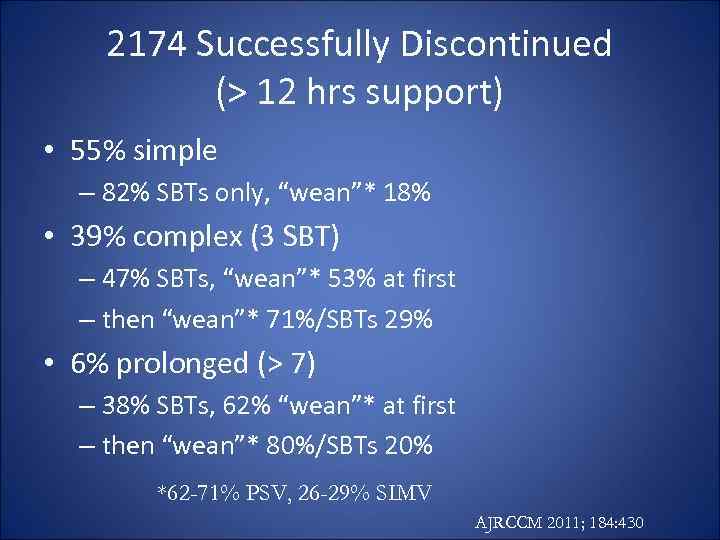
2174 Successfully Discontinued (> 12 hrs support) • 55% simple – 82% SBTs only, “wean”* 18% • 39% complex (3 SBT) – 47% SBTs, “wean”* 53% at first – then “wean”* 71%/SBTs 29% • 6% prolonged (> 7) – 38% SBTs, 62% “wean”* at first – then “wean”* 80%/SBTs 20% *62 -71% PSV, 26 -29% SIMV AJRCCM 2011; 184: 430
Can weaning be automated? • Assumes that gradual support reductions help – evidence supporting this is weak Pressure support reductions based on various feedback algorithms – VS – target VT – Smart Care – target VT, MV, ETCO 2
Volume Support (VS, ASV) • Adjusts pressure to targeted tidal volume • In theory: – As patient recovers, bigger VT, VS drops PS • In practice: – Too high a VT selected – no PS reductions – Too low a VT selected – patient overloaded – Transient increased efforts from pain/anxiety leads to inappropriate PS reduction • NO outcome data
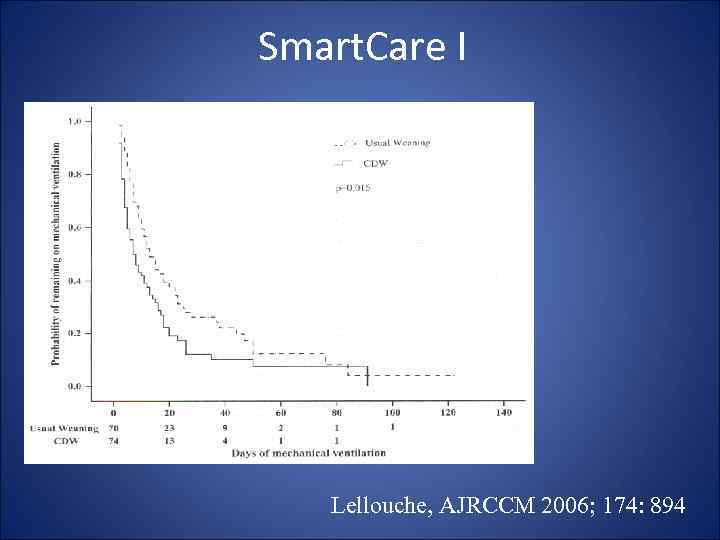
Smart. Care I Lellouche, AJRCCM 2006; 174: 894
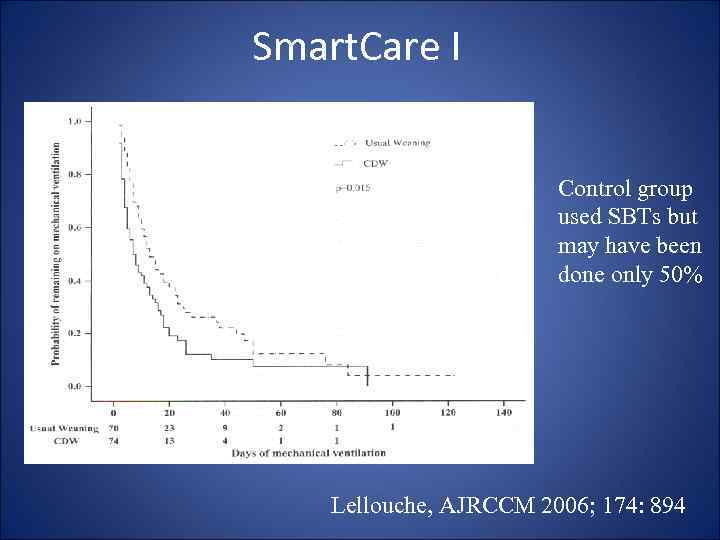
Smart. Care I Control group used SBTs but may have been done only 50% Lellouche, AJRCCM 2006; 174: 894
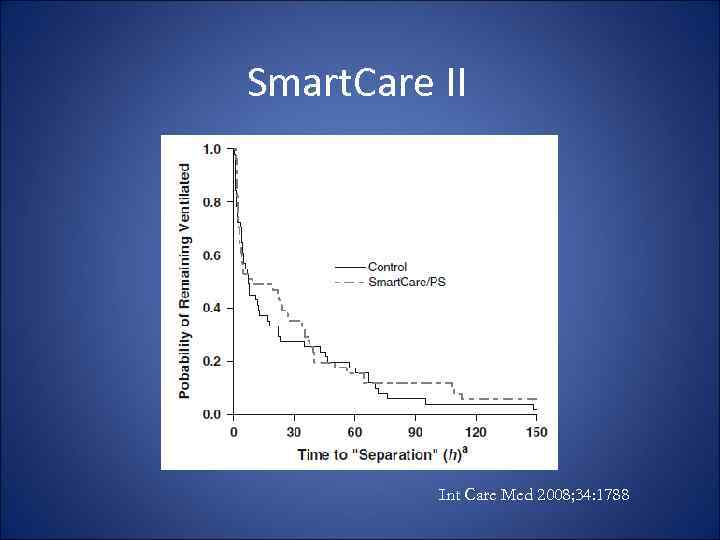
Smart. Care II Int Care Med 2008; 34: 1788
So is there a role for automatic PS reductions? • No evidence that says this facilitates muscle recovery • Patient tolerance to decreasing PS could signal clinicians to initiate SBTs (weaning and weaning success diagnostic, not therapeutic): – Rapidly recovering patient (overdose, post op) – Slowly recovering after many failed SBTs (PMV population)
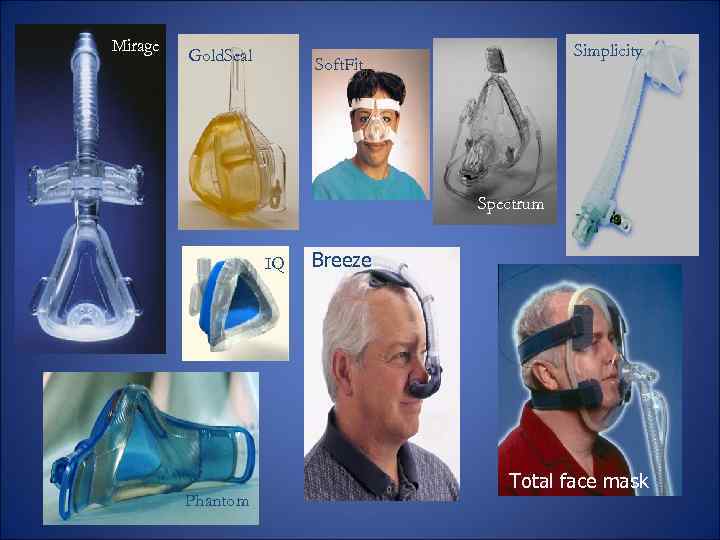
Mirage Gold. Seal Simplicity Soft. Fit Spectrum IQ Phantom Breeze Total face mask
NIV and Vent Discontinuation: Two Scenarios • The failed/borderline SBT but good airway protection – Supportive evidence, especially in COPD • The failed extubation: – Supportive evidence in COPD – May delay life saving intubation in other forms of ARF
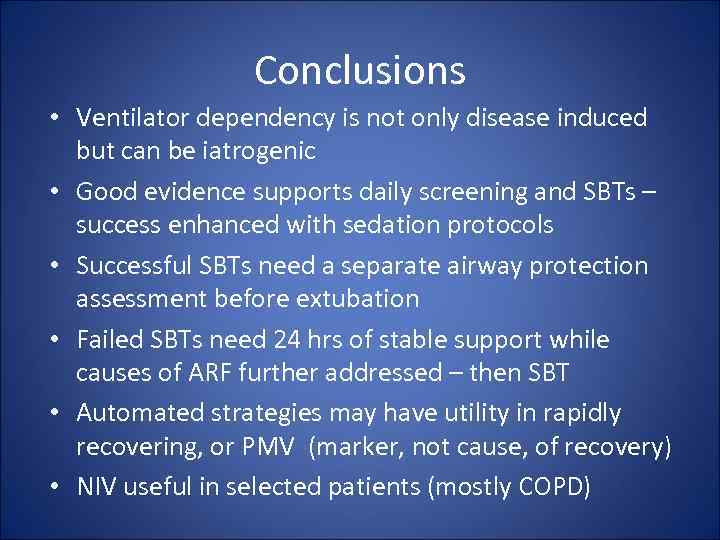
Conclusions • Ventilator dependency is not only disease induced but can be iatrogenic • Good evidence supports daily screening and SBTs – success enhanced with sedation protocols • Successful SBTs need a separate airway protection assessment before extubation • Failed SBTs need 24 hrs of stable support while causes of ARF further addressed – then SBT • Automated strategies may have utility in rapidly recovering, or PMV (marker, not cause, of recovery) • NIV useful in selected patients (mostly COPD)
Скачать презентацию Ventilator Discontinuation The evidence base and best practice
Russia - Vent discontinuation process.ppt