


 Скачать презентацию VELO Software Overview Shutdown Planning Organisation
4c15d69aa55d6679d828a9ab3ba3b7eb.ppt
- Количество слайдов: 27
 VELO Software Overview & Shutdown Planning • Organisation • Milestones • 3 Critical Areas Chris Parkes for VELO software Group
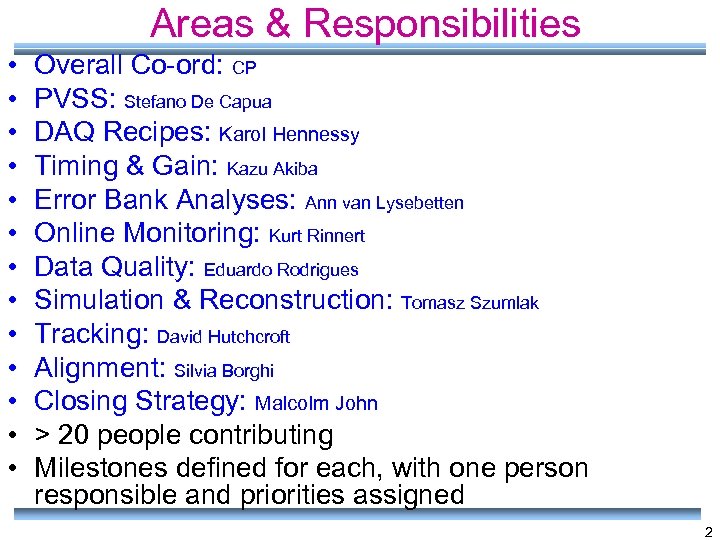 Areas & Responsibilities • • • • Overall Co-ord: CP PVSS: Stefano De Capua DAQ Recipes: Karol Hennessy Timing & Gain: Kazu Akiba Error Bank Analyses: Ann van Lysebetten Online Monitoring: Kurt Rinnert Data Quality: Eduardo Rodrigues Simulation & Reconstruction: Tomasz Szumlak Tracking: David Hutchcroft Alignment: Silvia Borghi Closing Strategy: Malcolm John > 20 people contributing Milestones defined for each, with one person responsible and priorities assigned 2
 Organisation • Weekly Monday commissioning meeting – Report on previous week milestones – News from all, forum for discussing issues – Work plans for the week • Integration Days: Thursdays – Integrate weekly releases (if any) at pit – Release: PVSS, recipes, Vetra • Brief report bi-weekly Friday meeting – Report progress to whole group, no details – Specific presentations on items of general interest • Shutdown progress logged on milestone Twiki page https: //lbtwiki/bin/view/VELO/Software. Milestones 3
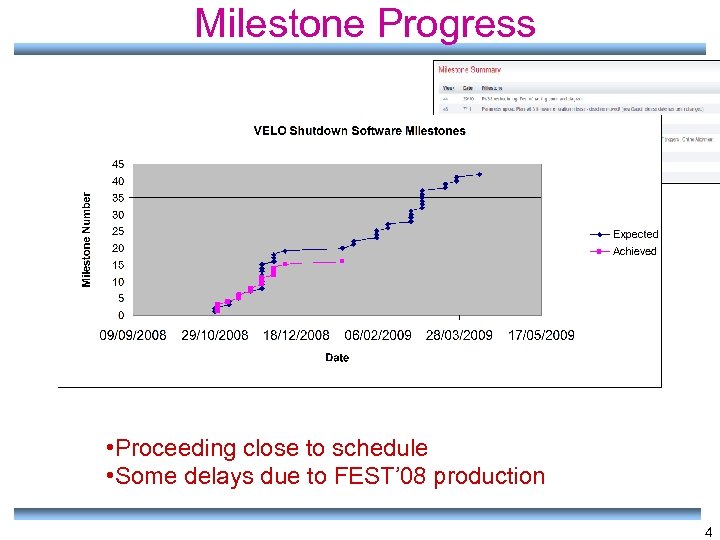 Milestone Progress • Proceeding close to schedule • Some delays due to FEST’ 08 production 4
 Critical Path • In September identified three key areas where progress is needed before we start running this year – Timing – TELL 1 Parameter Uploading – Monitoring 5
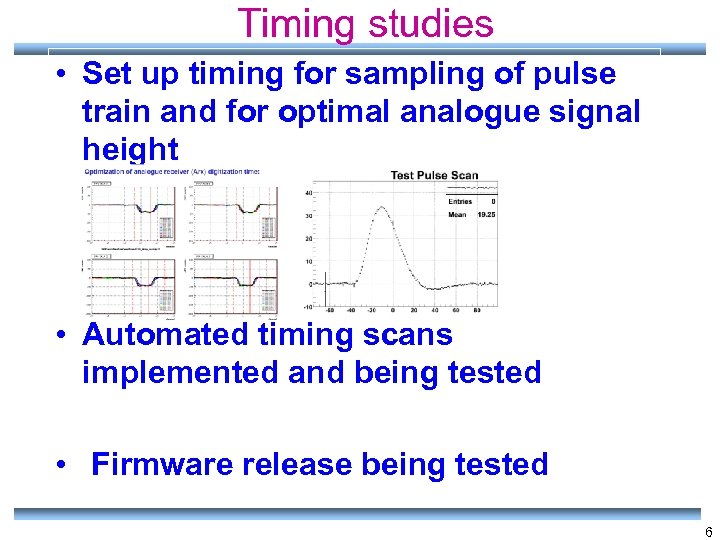 Timing studies • Set up timing for sampling of pulse train and for optimal analogue signal height • Automated timing scans implemented and being tested • Firmware release being tested 6
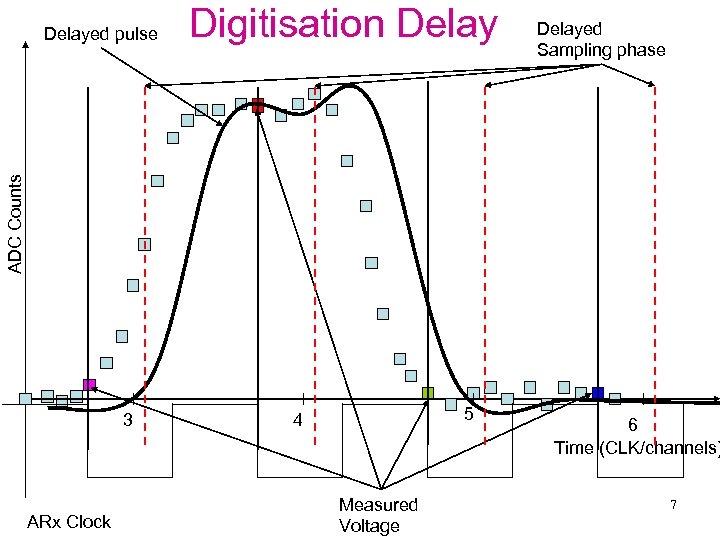 Digitisation Delayed Sampling phase ADC Counts Delayed pulse 3 ARx Clock 5 4 Measured Voltage 6 Time (CLK/channels) 7
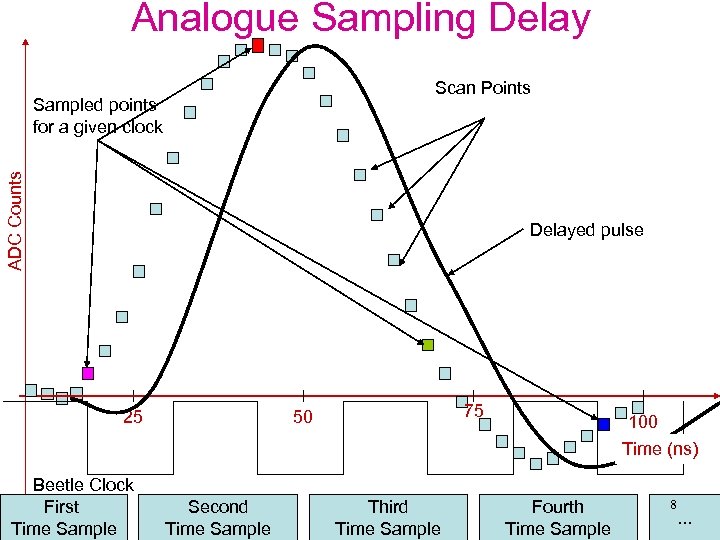 Analogue Sampling Delay Scan Points ADC Counts Sampled points for a given clock Delayed pulse 25 Beetle Clock First Time Sample 75 50 Second Time Sample Third Time Sample 100 Time (ns) Fourth Time Sample 8 . . .
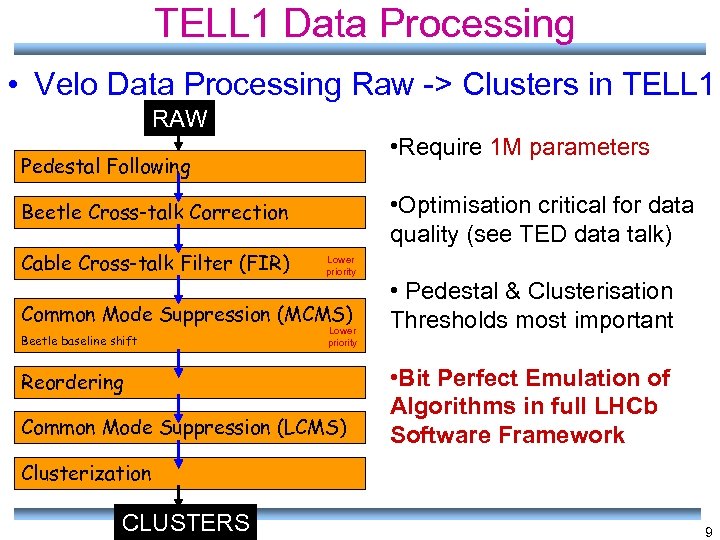 TELL 1 Data Processing • Velo Data Processing Raw -> Clusters in TELL 1 RAW • Require 1 M parameters Pedestal Following • Optimisation critical for data quality (see TED data talk) Beetle Cross-talk Correction Cable Cross-talk Filter (FIR) Lower priority Common Mode Suppression (MCMS) Beetle baseline shift Lower priority Reordering Common Mode Suppression (LCMS) • Pedestal & Clusterisation Thresholds most important • Bit Perfect Emulation of Algorithms in full LHCb Software Framework Clusterization CLUSTERS 9
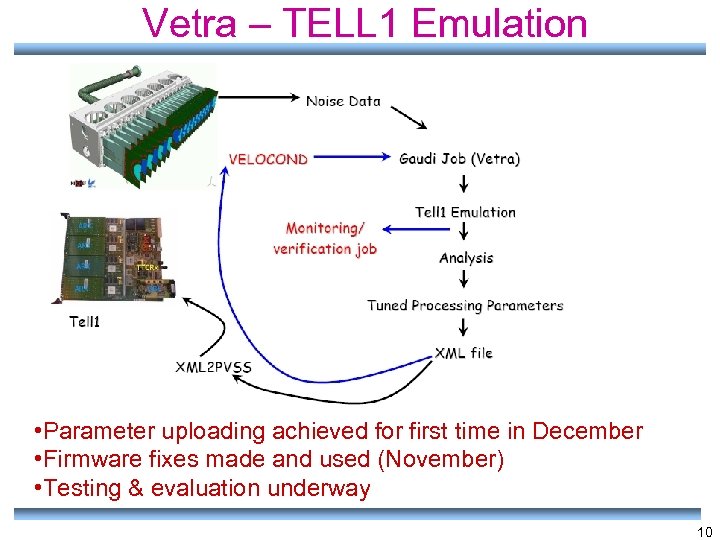 Vetra – TELL 1 Emulation • Parameter uploading achieved for first time in December • Firmware fixes made and used (November) • Testing & evaluation underway 10
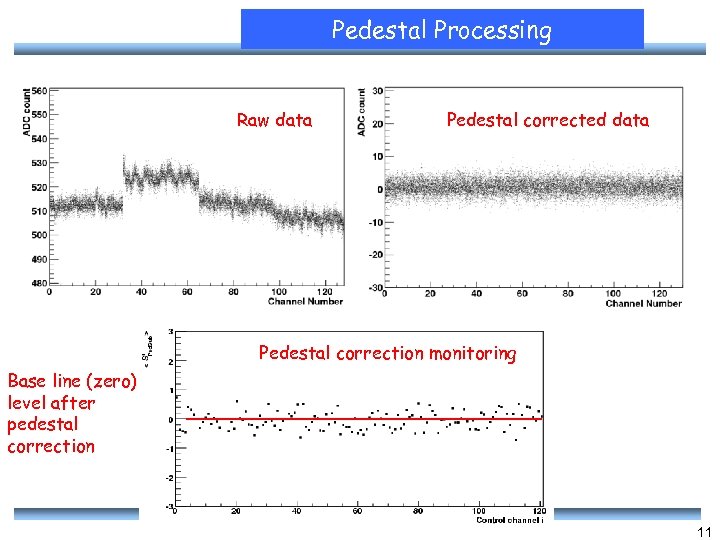 Pedestal Processing Raw data Pedestal corrected data Pedestal correction monitoring Base line (zero) level after pedestal correction 11
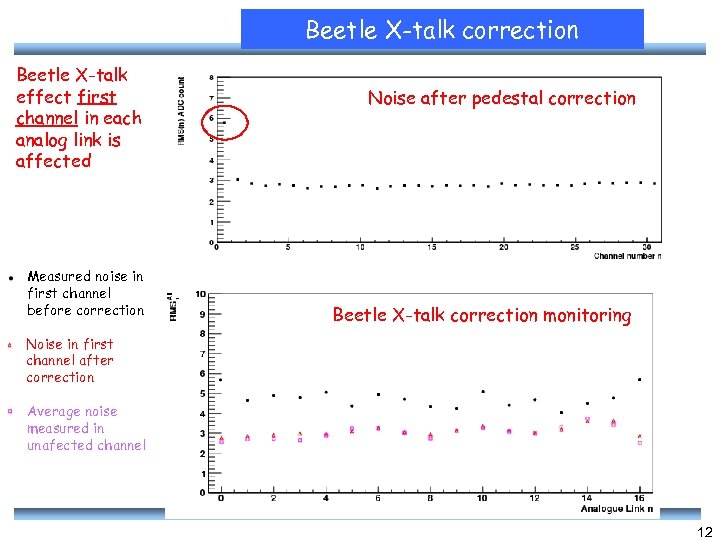 Beetle X-talk correction Beetle X-talk effect first channel in each analog link is affected Measured noise in first channel before correction Noise after pedestal correction Beetle X-talk correction monitoring Noise in first channel after correction Average noise measured in unafected channel 12
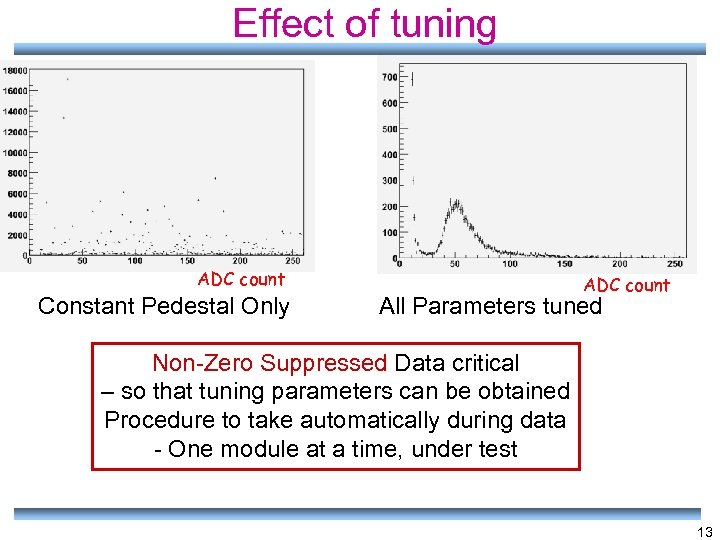 Effect of tuning ADC count Constant Pedestal Only ADC count All Parameters tuned Non-Zero Suppressed Data critical – so that tuning parameters can be obtained Procedure to take automatically during data - One module at a time, under test 13
 Monitoring • Monitoring package – Package for “high-level” (= ZS) data • Monitoring based on clusters and tracks – Package for NZS data • Noise calculation, time alignment study, beetle pulse shape, … • Scripts and macros are being developed to analyse data • Wiki pages with documentation and How. To’s Review of Monitoring status in February 14
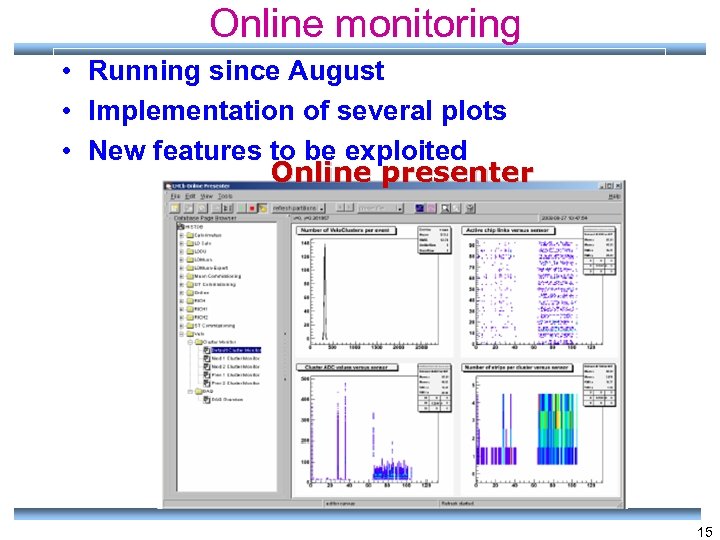 Online monitoring • Running since August • Implementation of several plots • New features to be exploited Online presenter 15
 Cluster Monitoring • Cluster information: – Cluster ADC value – Active chip links – Number of strip in a cluster – Cluster ADC value versus sampling – Number of cluster per events – More… Some of these distributions versus sensor number and/or sensor strip 16
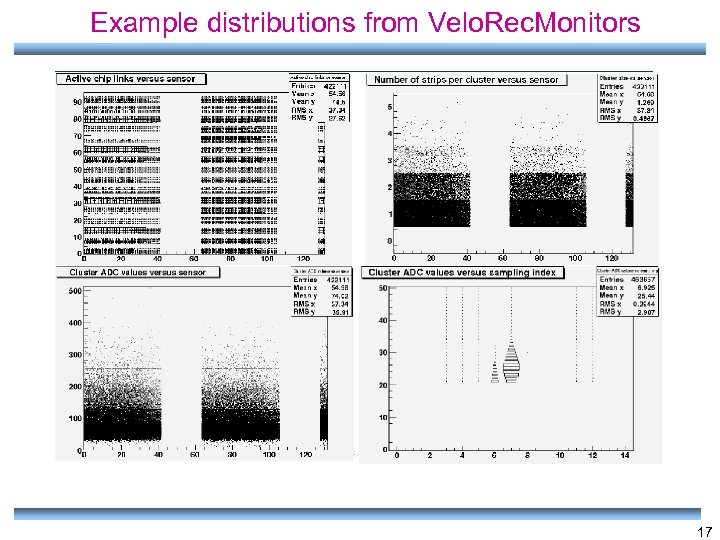 Example distributions from Velo. Rec. Monitors 17
 Track Monitoring • Tracks – Number tracks – Pseudo-rapidity – Azimuthal Angle – Pseudo-efficiency – Biased and unbiased Residuals versus sensor number – Total number of R cluster per track – Vertex information – Hits distribution in xy and xz – Mean sigma of residuals versus of sensors – More… 18
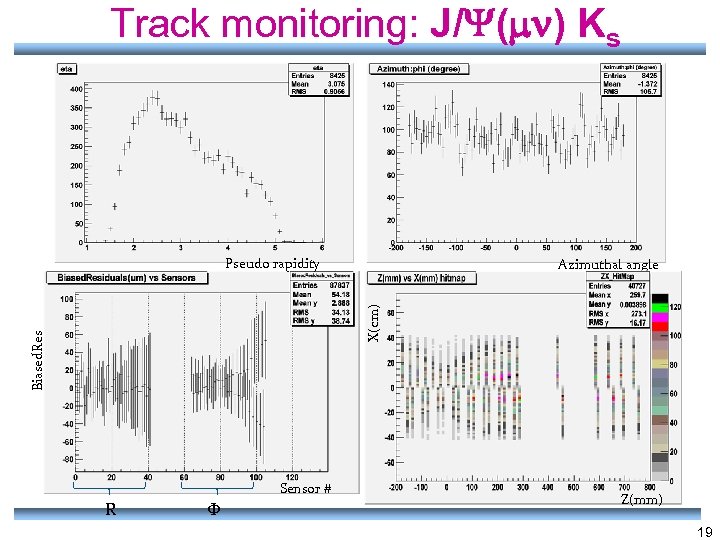 Track monitoring: J/ ( ) Ks Pseudo rapidity Biased. Res X(cm) Azimuthal angle Sensor # R Z(mm) 19
 Script and Macros • Analysis of the data for the evaluation for: – – – Time alignment study, Noise calculation, High voltage scan, beetle pulse shape, More… 20
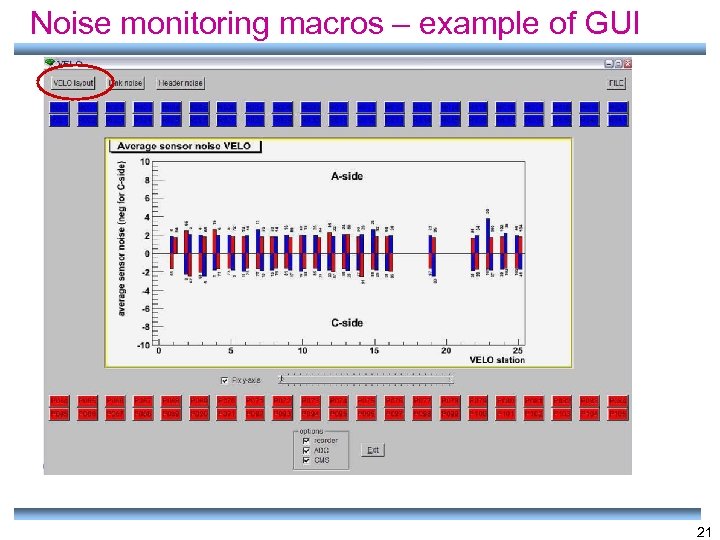 Noise monitoring macros – example of GUI 21
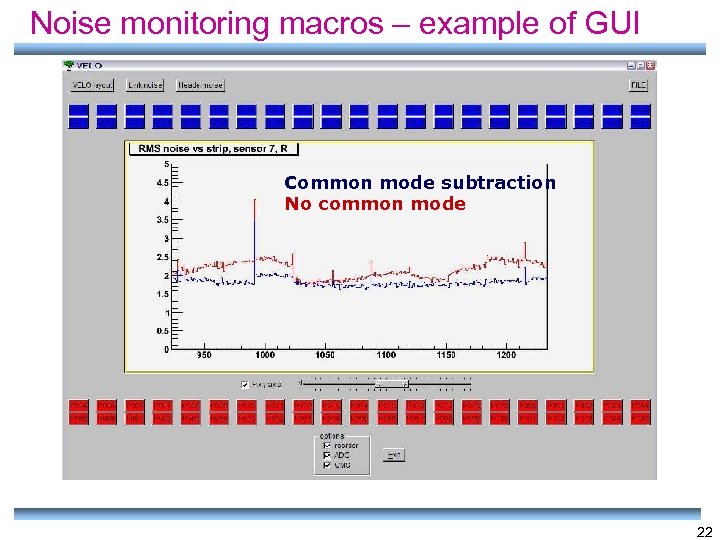 Noise monitoring macros – example of GUI Common mode subtraction No common mode 22
 Noise performance • Common mode pickup from beam requires data • At pit and in previous testbeams parameters highly stable HP 1 HP 2 HP 3 HP 4 23
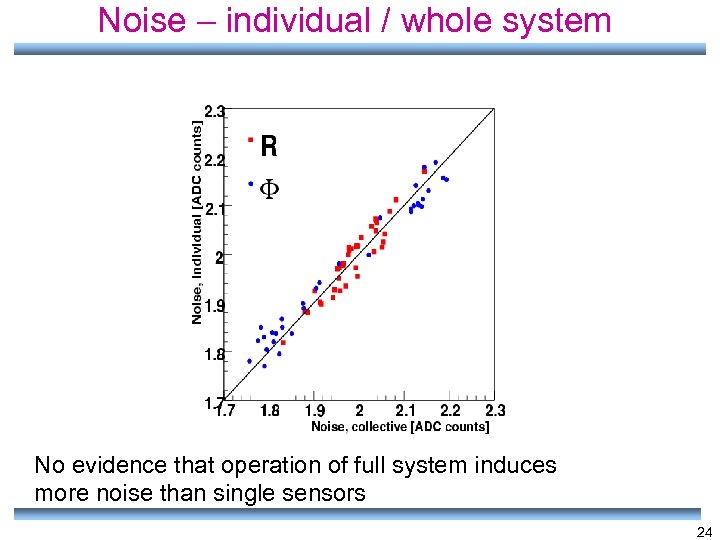 Noise – individual / whole system No evidence that operation of full system induces more noise than single sensors 24
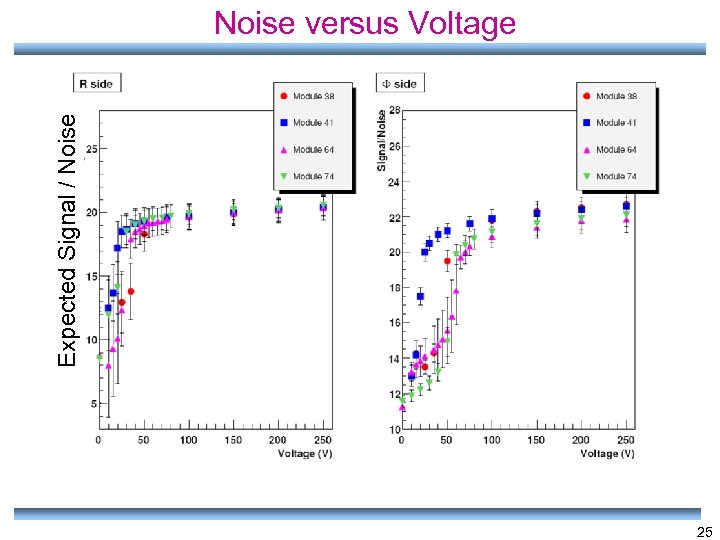 Expected Signal / Noise versus Voltage 25
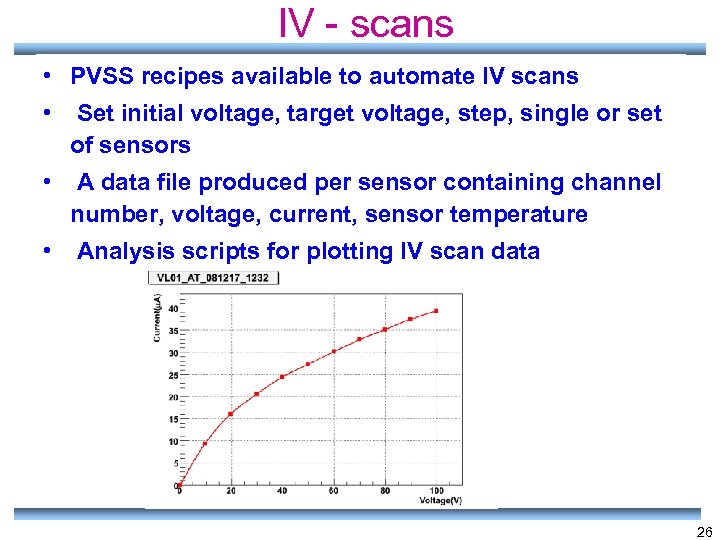 IV - scans • PVSS recipes available to automate IV scans • Set initial voltage, target voltage, step, single or set of sensors • A data file produced per sensor containing channel number, voltage, current, sensor temperature • Analysis scripts for plotting IV scan data 26
 Software Commissioning Summary • All baseline algorithms – Completed for summer ’ 08 • Commissioning software – Milestones for data readiness in April 2009 – 3 critical areas all proceeding according to plan • TED data are the VELO ‘cosmics’ Tremendous success of first tracks This sample has been very useful for comissioning TED data this summer will allow us to: Optimise timing Test and tune FPGA algorithms Increase alignment accuracy 27