


 Скачать презентацию Vehicular Grid Communications the role of the Internet
ad8587f8569f6d351bd91e149639589d.ppt
- Количество слайдов: 29
 Vehicular Grid Communications: the role of the Internet Infrastructure Wicon 2006 Boston, August 3, 2006 Presented by Mario Gerla UCLA CSD gerla@cs. ucla. edu www. cs. ucla. edu/NRL
 Outline § § Emerging urban vehicle applications Routing in a highly mobile urban environment § A case for geo-routing Extending Geo routing to the infrastructure § To use or not to use the infrastructure? § Load balancing Conclusions
 Urban Vehicle Grid Applications – Safe navigation – Content distribution (video, ads) – Vehicle as mobile sensor platform
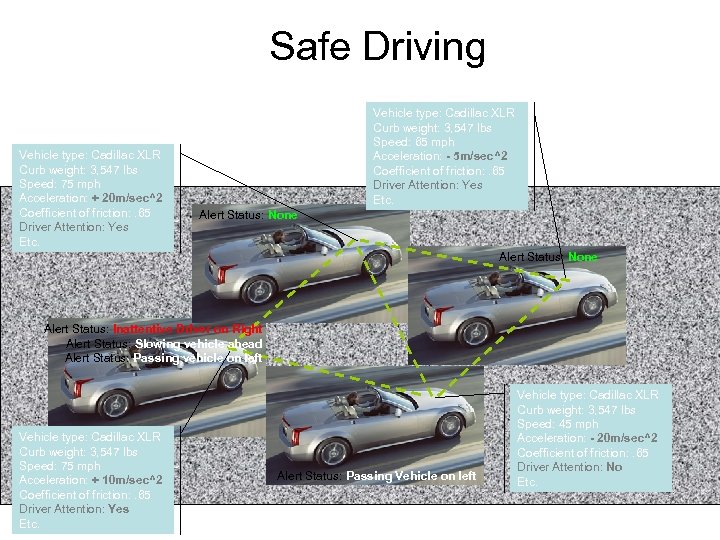 Safe Driving Vehicle type: Cadillac XLR Curb weight: 3, 547 lbs Speed: 75 mph Acceleration: + 20 m/sec^2 Coefficient of friction: . 65 Driver Attention: Yes Etc. Vehicle type: Cadillac XLR Curb weight: 3, 547 lbs Speed: 65 mph Acceleration: - 5 m/sec^2 Coefficient of friction: . 65 Driver Attention: Yes Etc. Alert Status: None Alert Status: Inattentive Driver on Right Alert Status: Slowing vehicle ahead Alert Status: Passing vehicle on left Vehicle type: Cadillac XLR Curb weight: 3, 547 lbs Speed: 75 mph Acceleration: + 10 m/sec^2 Coefficient of friction: . 65 Driver Attention: Yes Etc. Alert Status: Passing Vehicle on left Vehicle type: Cadillac XLR Curb weight: 3, 547 lbs Speed: 45 mph Acceleration: - 20 m/sec^2 Coefficient of friction: . 65 Driver Attention: No Etc.
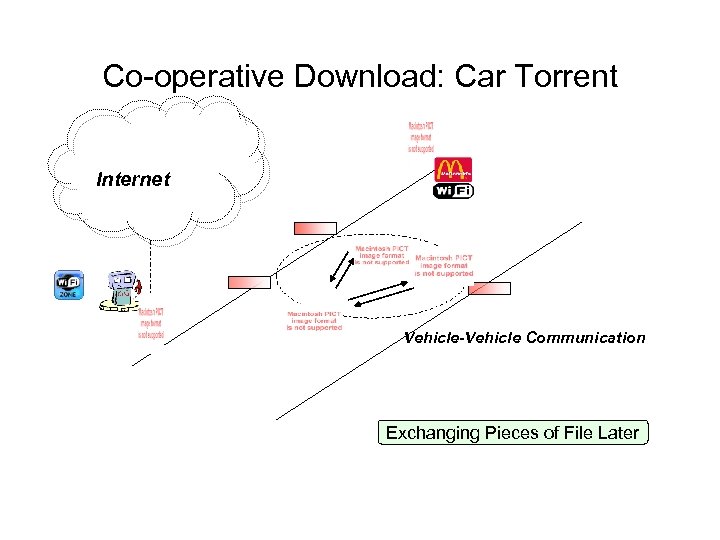 Co-operative Download: Car Torrent Internet Vehicle-Vehicle Communication Exchanging Pieces of File Later
 Digital Billboard: Ad Torrent • Every Access Point (AP) disseminates Ads that are relevant to the locality • Passing cars pick up the Ads • An Ad can be: – simple text message – trailer of nearby movies, – virtual tour of hotels etc • Business owners in the vicinity subscribe to this digital billboard service for a fee.
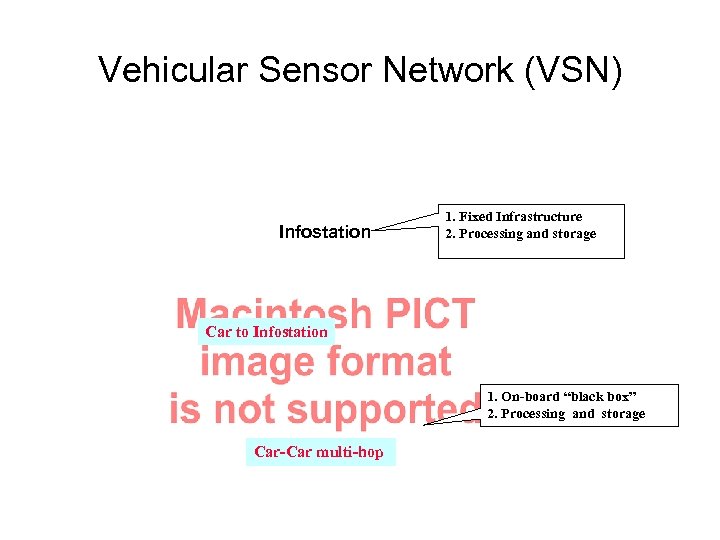 Vehicular Sensor Network (VSN) (UCLA) Infostation 1. Fixed Infrastructure 2. Processing and storage Car to Infostation 1. On-board “black box” 2. Processing and storage Car-Car multi-hop
 Vehicular Sensor Applications • Environment – Traffic congestion monitoring – Urban pollution monitoring • Civic and Homeland security – Forensic accident or crime site investigations – Terrorist tracking after strike
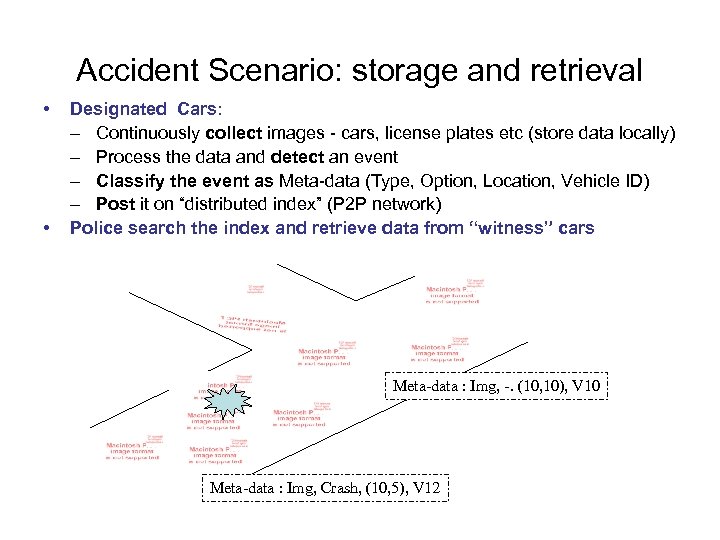 Accident Scenario: storage and retrieval • • Designated Cars: – Continuously collect images - cars, license plates etc (store data locally) – Process the data and detect an event – Classify the event as Meta-data (Type, Option, Location, Vehicle ID) – Post it on “distributed index” (P 2 P network) Police search the index and retrieve data from “witness” cars Crash! Meta-data : Img, -. (10, 10), V 10 Meta-data : Img, Crash, (10, 5), V 12
 How to set up the index and retrieve the data? • “Epidemic diffusion” : – Mobile nodes periodically broadcast meta-data of events to their neighbors • A mobile agent (the police) queries nodes and harvests {event + witness ID} • Data dropped when stale and/or geographically irrelevant
 Epidemic Diffusion + Harvesting
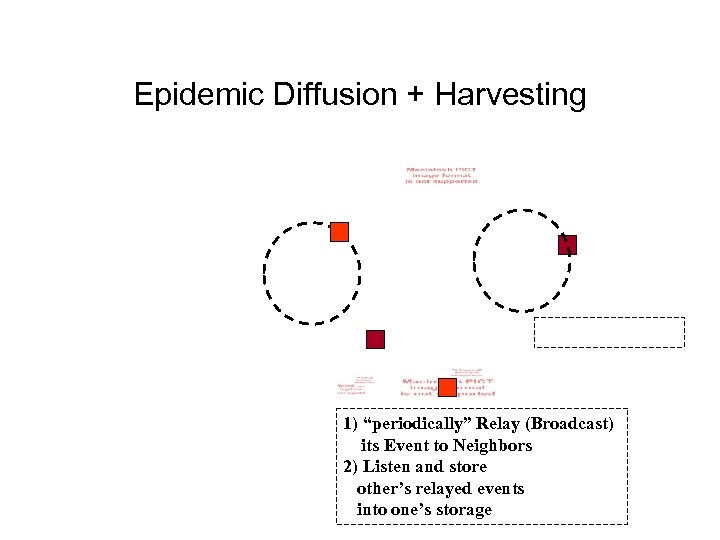 Epidemic Diffusion + Harvesting 1) “periodically” Relay (Broadcast) its Event to Neighbors 2) Listen and store other’s relayed events into one’s storage
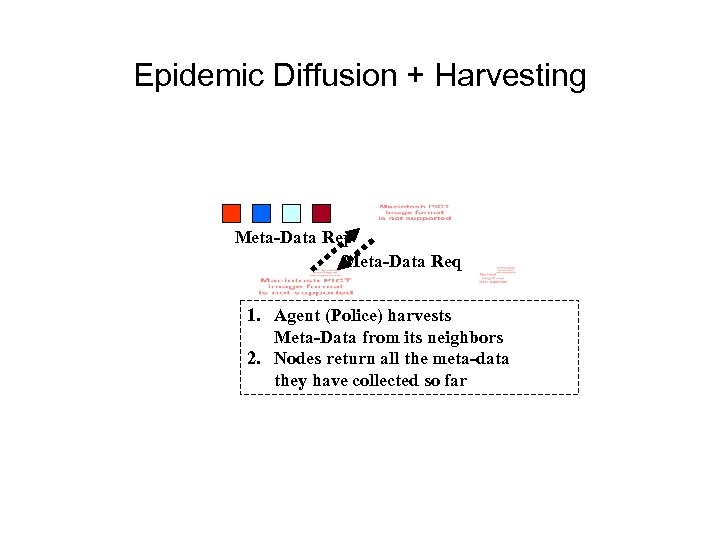 Epidemic Diffusion + Harvesting Meta-Data Rep Meta-Data Req 1. Agent (Police) harvests Meta-Data from its neighbors 2. Nodes return all the meta-data they have collected so far
 Routing in the Vehicle Grid • Mostly “proximity routing”; some long range routing also present • Proactive routing (eg OLSR) – Does not scale to hundreds of 1, 000’s • On Demand routing (eg AODV) – AODV type flood search too costly • Enter geo-routing – Most scalable (no state needed in routers) – GPS available; local coordinates used in blind areas (tunnels, parking lots, urban canyons) – Geo Location Service: distributed implementation
 GLS (Geo Location Service) • Equivalent to DNS to find geo addresses • Maps vehicle ID (driver, VIN, license plate, etc) to the (more or less) current location • Distributed implementation • For resilience, dual implementation: – In the urban Internet infrastructure – In the wireless Vehicle Grid (to survive Infrastructure collapse)
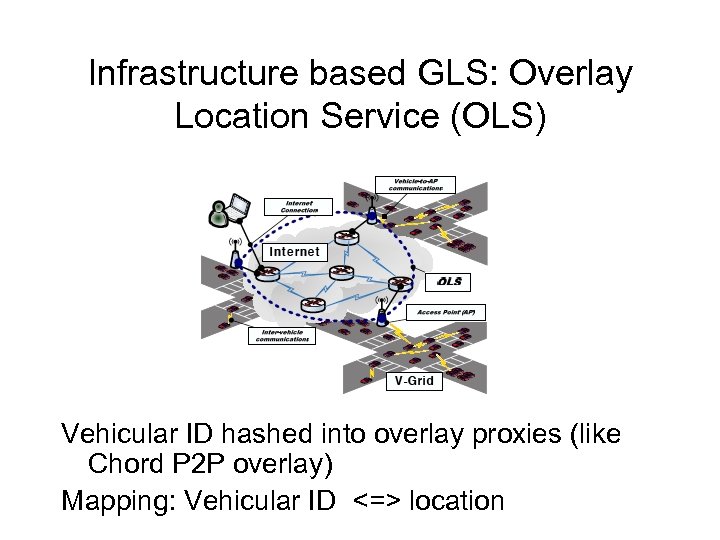 Infrastructure based GLS: Overlay Location Service (OLS) Vehicular ID hashed into overlay proxies (like Chord P 2 P overlay) Mapping: Vehicular ID <=> location
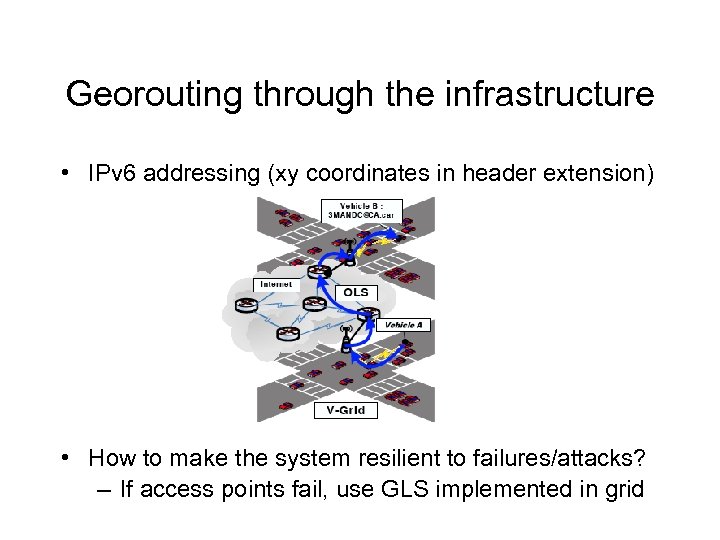 Georouting through the infrastructure • IPv 6 addressing (xy coordinates in header extension) • How to make the system resilient to failures/attacks? – If access points fail, use GLS implemented in grid
 Grid vs Infrastructure routing • The trade offs: grid short paths vs fast wires • Baseline: Shortest path routing – Short connections should go grid – Packets to remote destinations on infrastructure • Next step: Access Points and Overlay assist in the decision – Propagation of congestion info from Overlay to wireless using 3 hop beaconing (say) every second
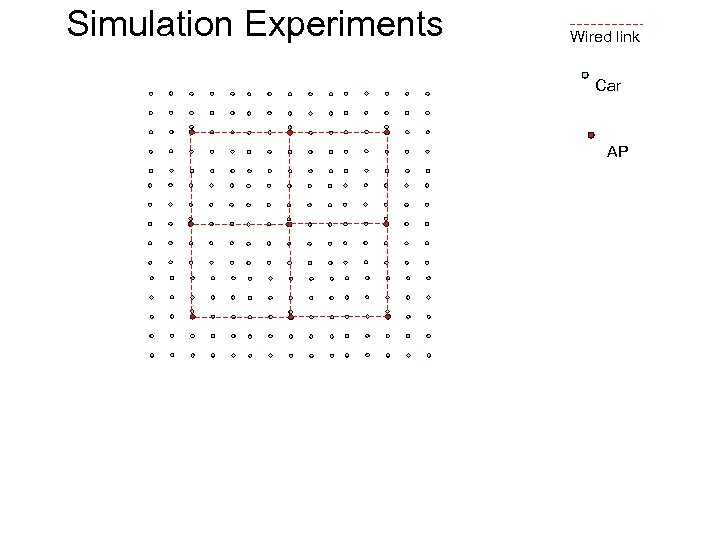 Simulation Experiments Wired link Car AP
 Traffic pattern • Car to access point: – APT fraction of traffic ( APT = 25%, 50%, 75%) • Car to Car: – 1 - APT Traffic fraction • Source/destination pair distance – Say, 40% of pairs < 300 m away – 30% < 1 km – 30% < 10 km • Total # of sessions: • 200 UDP sessions with variable offered rate
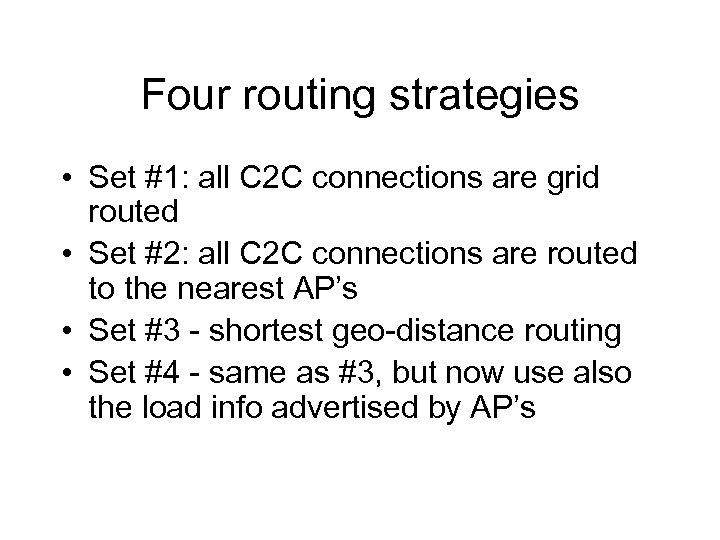 Four routing strategies • Set #1: all C 2 C connections are grid routed • Set #2: all C 2 C connections are routed to the nearest AP’s • Set #3 - shortest geo-distance routing • Set #4 - same as #3, but now use also the load info advertised by AP’s

 Wireless grid vs infrastructure load split as a function of path length
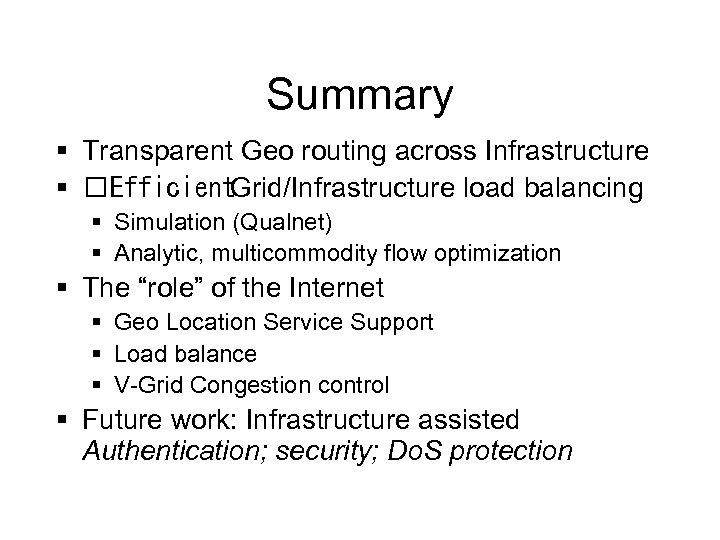 Summary § Transparent Geo routing across Infrastructure § Efficient Grid/Infrastructure load balancing § Simulation (Qualnet) § Analytic, multicommodity flow optimization § The “role” of the Internet § Geo Location Service Support § Load balance § V-Grid Congestion control § Future work: Infrastructure assisted Authentication; security; Do. S protection
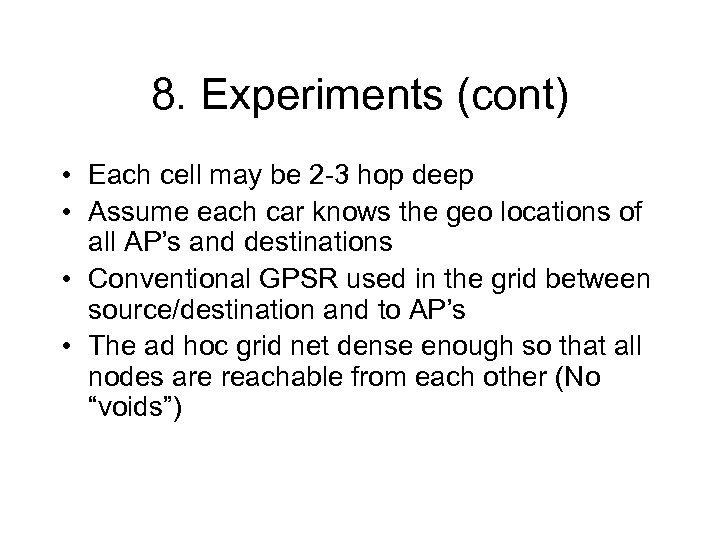 8. Experiments (cont) • Each cell may be 2 -3 hop deep • Assume each car knows the geo locations of all AP’s and destinations • Conventional GPSR used in the grid between source/destination and to AP’s • The ad hoc grid net dense enough so that all nodes are reachable from each other (No “voids”)


 8. Result evaluation • Should find that it is better to discriminate based on shortest path (kind of obvious) • If load info available, shortest path + load combination will give near optimal solutions • Review delays on grid only and on Infrastructure (possibly, real time UPD traffic should go only on AP’s)
 8. Result evaluation (cont) 1. Future: review TCP performance; comment on capture effects, improvements needed etc (if TCP performance is really bad, we may just skip and do only UDP) 2. Discuss congestion control hooks on UDP provided by the info received from the Overlay 1. This is quite open handed, so we will decide if we can do it only after all else is done