Скачать презентацию Vehicle Area Network Zhang Ju 2014 — 5
66e66e00c271bc6419aae27f3924552a.ppt
- Количество слайдов: 33
 Vehicle Area Network Zhang Ju 2014 - 5 -2
 Outline Ø Ø Ø Introduction to Vehicle Area Network Protocol stack of VAN Performance analysis Applications The Future 2
 3
3
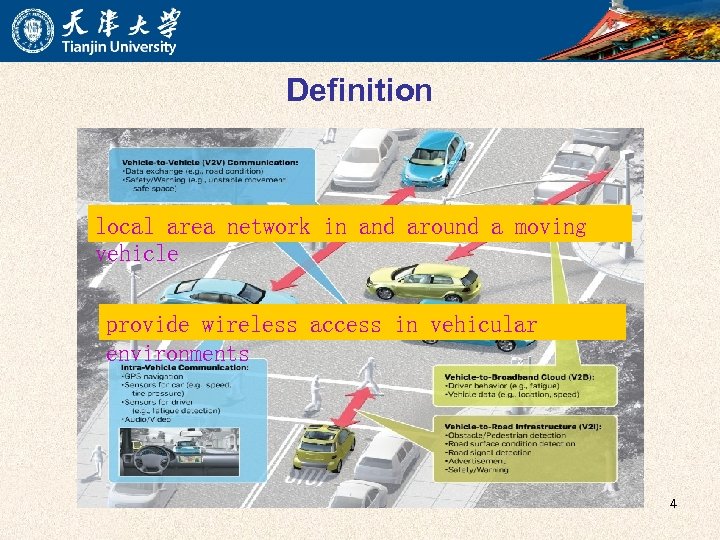 Definition local area network in and around a moving vehicle provide wireless access in vehicular environments 4
![Definition l l Classification —Inter VAN , Intra (In-Vehicle) VAN [1] Technology —Bluetooth, WIFI,](https://present5.com/presentation/66e66e00c271bc6419aae27f3924552a/image-5.jpg "Definition l l Classification —Inter VAN , Intra (In-Vehicle) VAN [1] Technology —Bluetooth, WIFI,") Definition l l Classification —Inter VAN , Intra (In-Vehicle) VAN [1] Technology —Bluetooth, WIFI, 3 G, Vehicle Ad-hoc Network , RFID Standardised in ISO 11519 -3 Spectrum Allocation — 5. 850 -5. 925 GHZ, 7 channels(USA) vehicle-to-vehicle safety high-power, longer-distance communication 5
Definition l l Classification —Inter VAN , Intra (In-Vehicle) VAN [1] Technology —Bluetooth, WIFI, 3 G, Vehicle Ad-hoc Network , RFID Standardised in ISO 11519 -3 Spectrum Allocation — 5. 850 -5. 925 GHZ, 7 channels(USA) vehicle-to-vehicle safety high-power, longer-distance communication 5
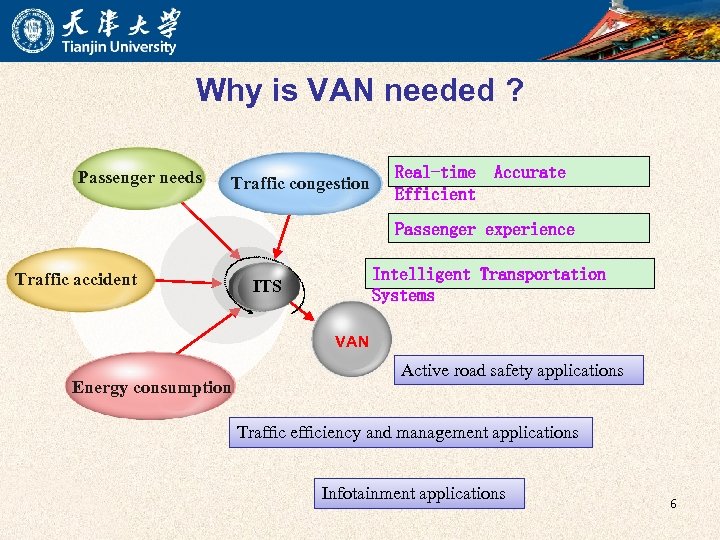 Why is VAN needed ? Passenger needs Traffic congestion Real-time Efficient Accurate Passenger experience Traffic accident Intelligent Transportation Systems ITS VAN Energy consumption Active road safety applications Traffic efficiency and management applications Infotainment applications 6
 Intra (In-Vehicle) VAN l l l Data communication network of onboard equipment (OBE) In-Vehicle Data Collection/Analysis Systems In -Vehicle Communication Network [1] Assess a driver’s behavior or a vehicle’s performance Assist drivers to respond correctly Infotainment 7
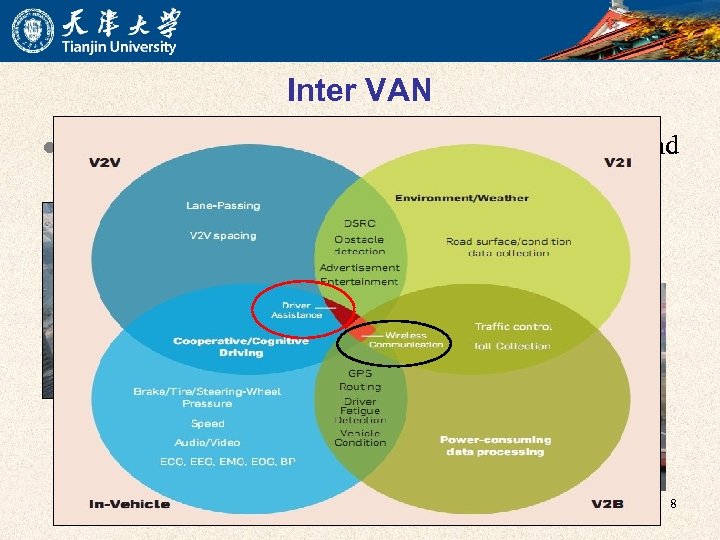 Inter VAN l l Network of vehicles that interact with one another and with infrastructure to transmit and receive data [2] Include q q q l vehicle-to-vehicle (V 2 V) vehicle-to-broadband cloud (V 2 B ) vehicle-to-roadside-infrastructure (V 2 I ) Provide q q obstacle detection navigation data weather conditions and accident locations Global Internet services 8
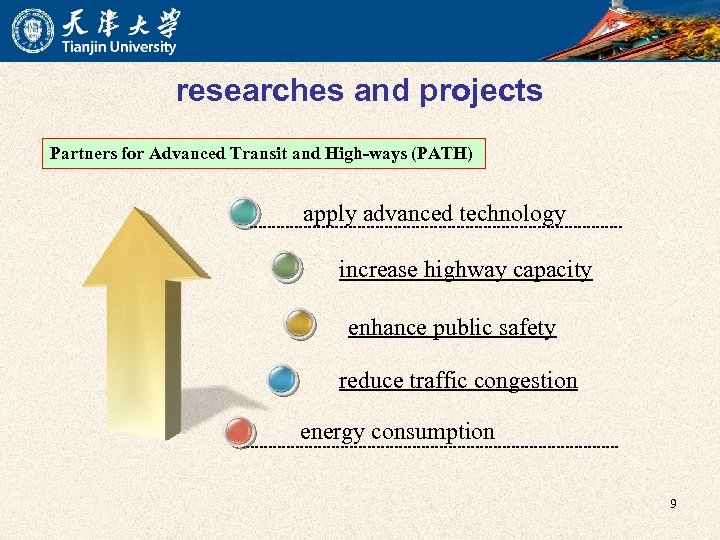 researches and projects Partners for Advanced Transit and High-ways (PATH) apply advanced technology increase highway capacity enhance public safety reduce traffic congestion energy consumption 9
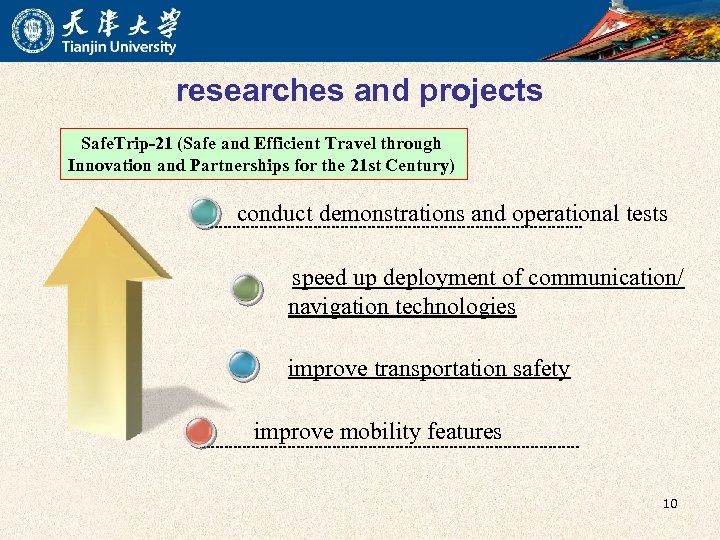 researches and projects Safe. Trip-21 (Safe and Efficient Travel through Innovation and Partnerships for the 21 st Century) conduct demonstrations and operational tests speed up deployment of communication/ navigation technologies improve transportation safety improve mobility features 10
 researches and projects l Tokyo Smartway project (Japan) q q l develop intelligent roads for the 21 st century enable automated driving using ITS technologies Electronic Road Pricing project (Singapore ) q construct a comprehensive road network 11
 12
12
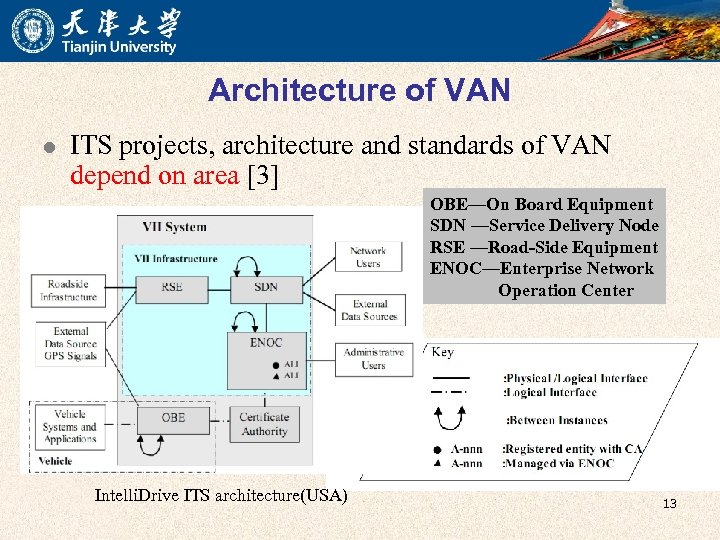 Architecture of VAN l ITS projects, architecture and standards of VAN depend on area [3] OBE—On Board Equipment SDN —Service Delivery Node RSE —Road-Side Equipment ENOC—Enterprise Network Operation Center Intelli. Drive ITS architecture(USA) 13
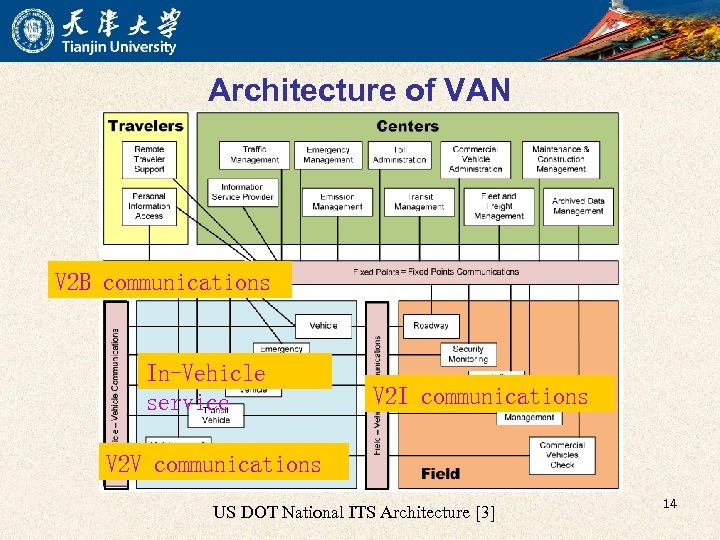 Architecture of VAN V 2 B communications In-Vehicle service V 2 I communications V 2 V communications US DOT National ITS Architecture [3] 14
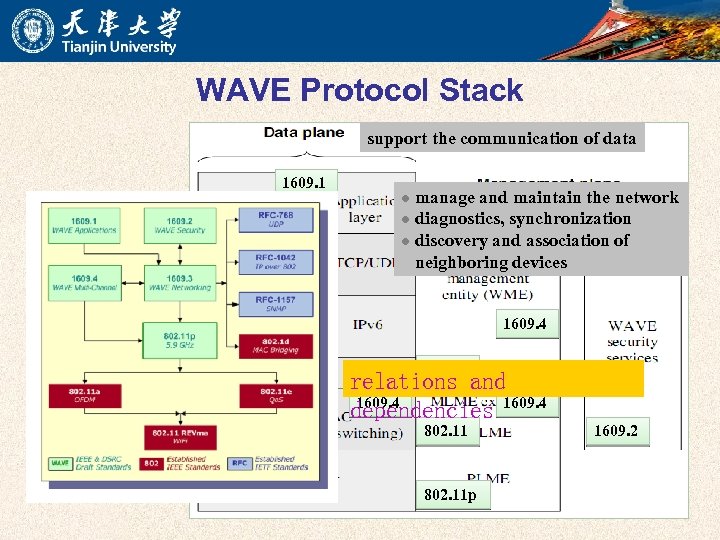 WAVE Protocol Stack support the communication of data 1609. 1 manage and maintain the network l diagnostics, synchronization l discovery and association of neighboring devices l 1609. 3 1609. 4 802. 2 802. 11 1609. 3 relations and 1609. 4 dependencies 1609. 4 802. 11 1609. 2 802. 11 p 15
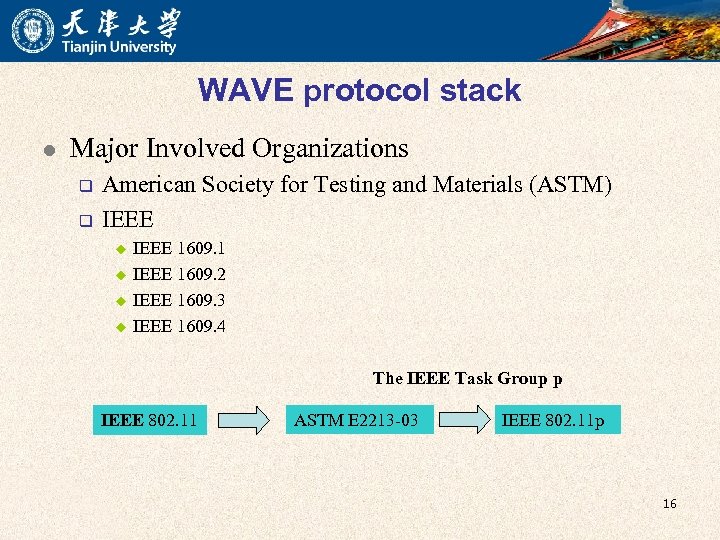 WAVE protocol stack l Major Involved Organizations q q American Society for Testing and Materials (ASTM) IEEE u u IEEE 1609. 1 IEEE 1609. 2 IEEE 1609. 3 IEEE 1609. 4 The IEEE Task Group p IEEE 802. 11 ASTM E 2213 -03 IEEE 802. 11 p 16
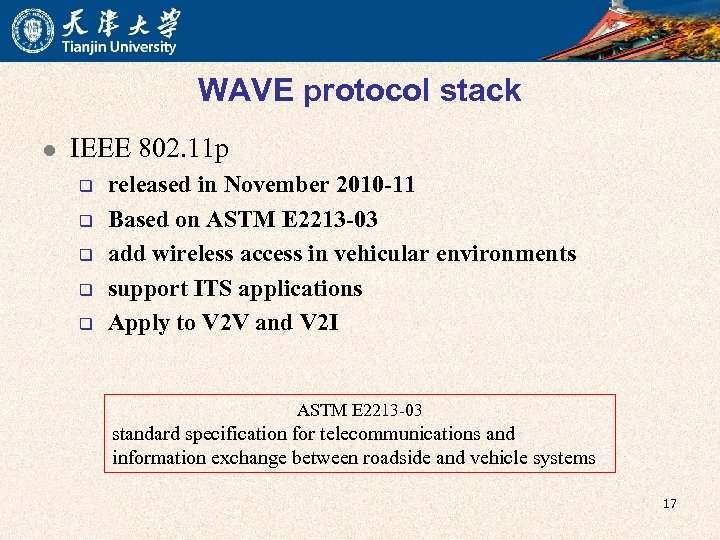 WAVE protocol stack l IEEE 802. 11 p q q q released in November 2010 -11 Based on ASTM E 2213 -03 add wireless access in vehicular environments support ITS applications Apply to V 2 V and V 2 I ASTM E 2213 -03 standard specification for telecommunications and information exchange between roadside and vehicle systems 17
![WAVE protocol stack l IEEE 802. 11 p —physical layer [3] VAN Doppler spread](https://present5.com/presentation/66e66e00c271bc6419aae27f3924552a/image-18.jpg "WAVE protocol stack l IEEE 802. 11 p —physical layer [3] VAN Doppler spread") WAVE protocol stack l IEEE 802. 11 p —physical layer [3] VAN Doppler spread up to 2 k. Hz RMS delay spread of up to 0. 8 µs guard interval 1. 6 µs Doppler spread 156. 25 k. Hz low bit error rates highly reliable communication l IEEE 802. 11 p —MAC layer prioritization of important safety time-critical messages enhanced distributed channel access quality of service (Qo. S) support 18
WAVE protocol stack l IEEE 802. 11 p —physical layer [3] VAN Doppler spread up to 2 k. Hz RMS delay spread of up to 0. 8 µs guard interval 1. 6 µs Doppler spread 156. 25 k. Hz low bit error rates highly reliable communication l IEEE 802. 11 p —MAC layer prioritization of important safety time-critical messages enhanced distributed channel access quality of service (Qo. S) support 18
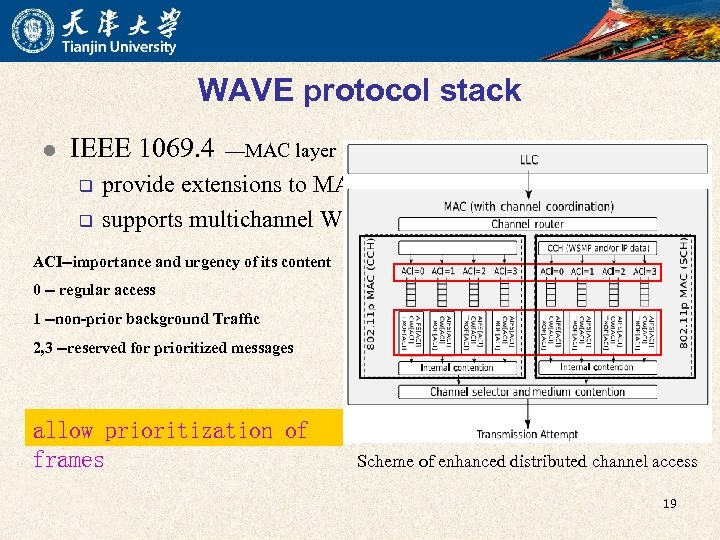 WAVE protocol stack l IEEE 1069. 4 q q —MAC layer provide extensions to MAC supports multichannel WAVE operations ACI--importance and urgency of its content 0 -- regular access 1 --non-prior background Traffic 2, 3 --reserved for prioritized messages allow prioritization of frames Scheme of enhanced distributed channel access 19
![WAVE protocol stack l IEEE 1609 [4] q q q l a family of](https://present5.com/presentation/66e66e00c271bc6419aae27f3924552a/image-20.jpg "WAVE protocol stack l IEEE 1609 [4] q q q l a family of") WAVE protocol stack l IEEE 1609 [4] q q q l a family of standards for WAVE architecture, organization management structure communication model security mechanisms and physical access IEEE 1069. 1 q q q resource manager define the communication formats (command message and data storage formats ) mobile platforms supported 20
WAVE protocol stack l IEEE 1609 [4] q q q l a family of standards for WAVE architecture, organization management structure communication model security mechanisms and physical access IEEE 1069. 1 q q q resource manager define the communication formats (command message and data storage formats ) mobile platforms supported 20
 WAVE protocol stack l IEEE 1069. 2 q l security issues in WAVE IEEE 1609. 3 q q supports secure message data exchange Define Management Information Base(MIB) for the WAVE protocol stack 21
 22
22
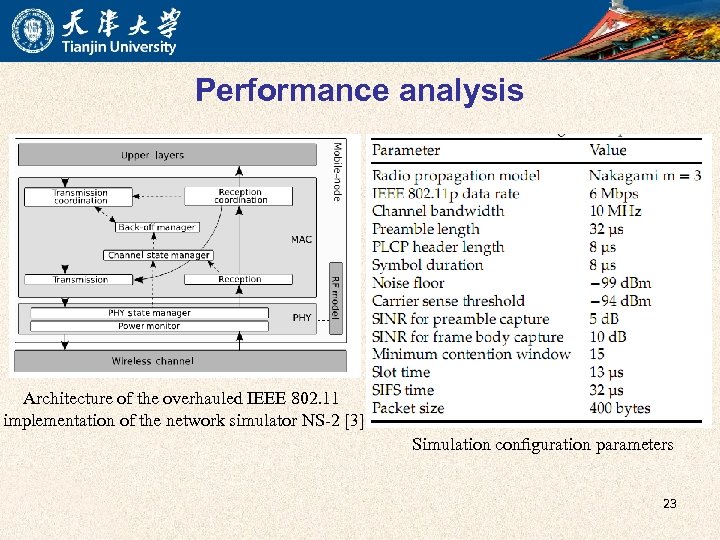 Performance analysis Architecture of the overhauled IEEE 802. 11 implementation of the network simulator NS-2 [3] Simulation configuration parameters 23
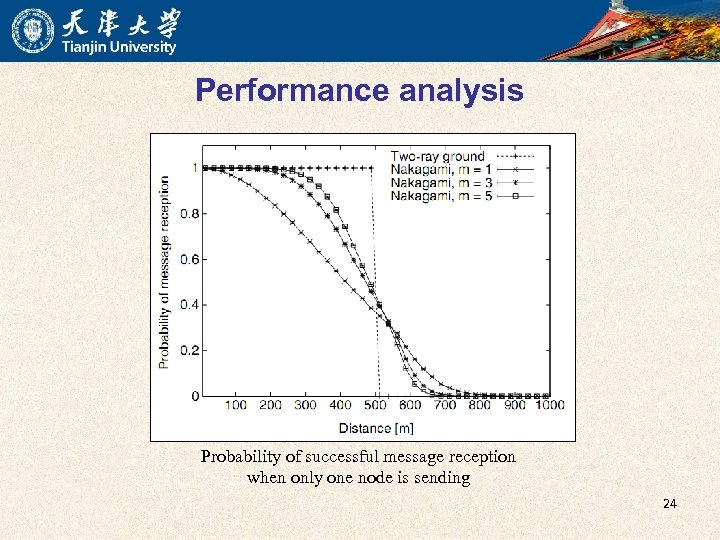 Performance analysis Probability of successful message reception when only one node is sending 24
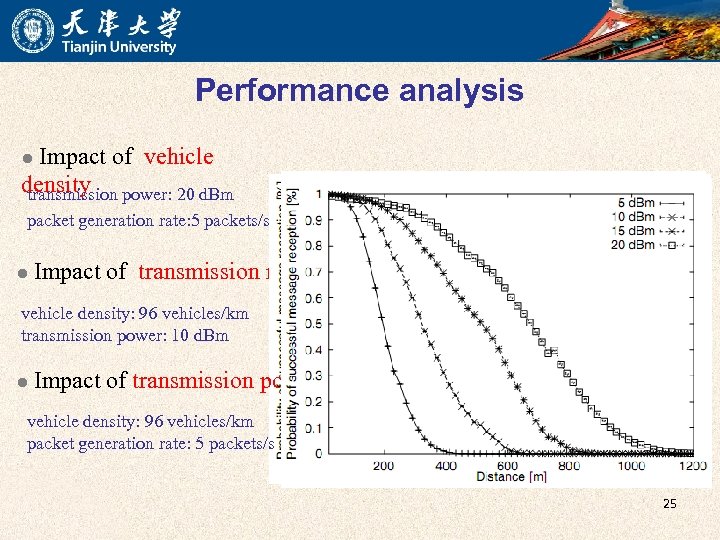 Performance analysis Impact of vehicle density power: 20 d. Bm transmission l packet generation rate: 5 packets/s l Impact of transmission rate vehicle density: 96 vehicles/km transmission power: 10 d. Bm l Impact of transmission power vehicle density: 96 vehicles/km packet generation rate: 5 packets/s 25
 26
26
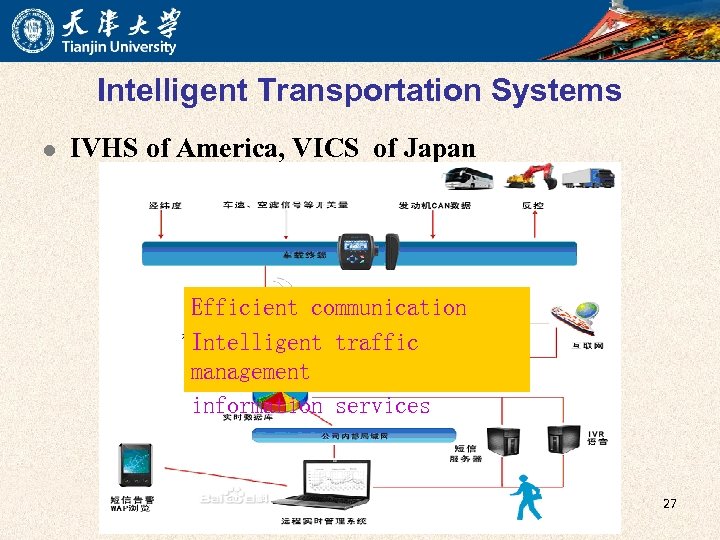 Intelligent Transportation Systems l IVHS of America, VICS of Japan Efficient communication Intelligent traffic management information services 27
![Anti-collision system l Camera + monitor or phone software [5] Anti-collision systems using camera](https://present5.com/presentation/66e66e00c271bc6419aae27f3924552a/image-28.jpg "Anti-collision system l Camera + monitor or phone software [5] Anti-collision systems using camera") Anti-collision system l Camera + monitor or phone software [5] Anti-collision systems using camera 28
Anti-collision system l Camera + monitor or phone software [5] Anti-collision systems using camera 28
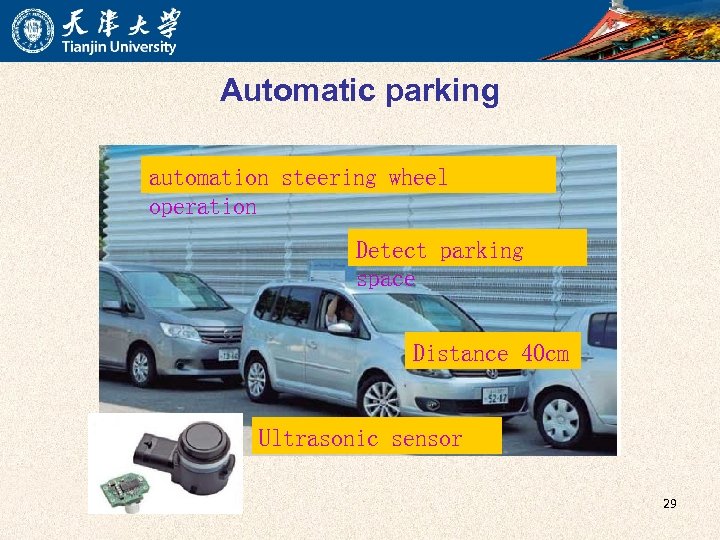 Automatic parking automation steering wheel operation Detect parking space Distance 40 cm Ultrasonic sensor 29
 30
30
 The Future l l l combine wireless local and wide area network technologies IP-centric devices, sensors, signal processing, and driver behavior analysis techniques collect driver/car/ road data quickly analyze and share the information reliable and informative communication 31
![Reference [1] Miad Faezipour, Mehrdad Nourani, Adnan Saeed, Sateesh Addepalli. Progress and Challenges in](https://present5.com/presentation/66e66e00c271bc6419aae27f3924552a/image-32.jpg "Reference [1] Miad Faezipour, Mehrdad Nourani, Adnan Saeed, Sateesh Addepalli. Progress and Challenges in") Reference [1] Miad Faezipour, Mehrdad Nourani, Adnan Saeed, Sateesh Addepalli. Progress and Challenges in Intelligent Vehicle Area Networks [J]. Communications of The ACM, 2012, 55(2): 46 -56. [2] Georgios Karagiannis, Onur Altintas, Eylem Ekici, et al. Vehicular Networking: A Survey and Tutorial on Requirements, Architectures, Challenges, Standards and Solutions [J]. IEEE COMMUNICATIONS SURVEYS AND TUTORIALS , 2011, 13(4): 65 -97. [3] Y. L. Morgan. Notes on DSRC & WAVE Standards Suite: Its Architecture, Design, and Characteristics[J]. IEEE COMMUNICATIONS SURVEYS AND TUTORIALS , 2010, 12(4): 78 -82. [4] Hannes Hartenstein, Kenneth P Laberteaux. VANET: Vehicular Applications and Inter-Networking Technologies [M]. John Wiley & Sons, 2010. 15 -46. [5] http: //www. iova. com. 32
Reference [1] Miad Faezipour, Mehrdad Nourani, Adnan Saeed, Sateesh Addepalli. Progress and Challenges in Intelligent Vehicle Area Networks [J]. Communications of The ACM, 2012, 55(2): 46 -56. [2] Georgios Karagiannis, Onur Altintas, Eylem Ekici, et al. Vehicular Networking: A Survey and Tutorial on Requirements, Architectures, Challenges, Standards and Solutions [J]. IEEE COMMUNICATIONS SURVEYS AND TUTORIALS , 2011, 13(4): 65 -97. [3] Y. L. Morgan. Notes on DSRC & WAVE Standards Suite: Its Architecture, Design, and Characteristics[J]. IEEE COMMUNICATIONS SURVEYS AND TUTORIALS , 2010, 12(4): 78 -82. [4] Hannes Hartenstein, Kenneth P Laberteaux. VANET: Vehicular Applications and Inter-Networking Technologies [M]. John Wiley & Sons, 2010. 15 -46. [5] http: //www. iova. com. 32