


 Скачать презентацию Vector Control Updates and Issues in the WPR
afb7254337b687305af342cac43e17b0.ppt
- Количество слайдов: 19
 Vector Control Updates and Issues in the WPR region Session 2: APMEN Vector Control Working Group meeting APMEN III, 8 May 2011 Dr Jeffrey Hii WHO PHL and WHO Regional Office for the Western Pacific, Manila, Philippines 1 Western Pacific Regio
 Overview – Updates & Issues 1. 2. 3. 4. 5. Moving from control to elimination LLIN/ITNs and universal coverage IRS and elimination Insecticide resistance monitoring network Sound management of pesticides of public health importance 6. Integrated vector management 7. Durability of LLIN monitoring guideline 8. Interim recommendations on LLIN packaging 2 Western Pacific Regio
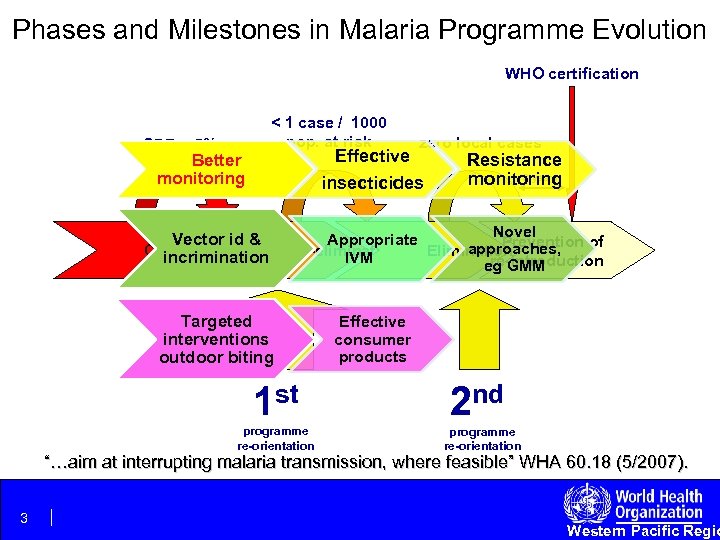 Phases and Milestones in Malaria Programme Evolution WHO certification SPR < 5% < 1 case / 1000 pop. at risk zero local cases Effective insecticides Better monitoring Resistance 3 years monitoring Novel Vector id & Appropriate Prevention of approaches, Control Pre-elimination Elimination IVM incrimination re-introduction eg GMM Targeted interventions outdoor biting 1 st programme re-orientation Effective consumer products 2 nd programme re-orientation “…aim at interrupting malaria transmission, where feasible” WHA 60. 18 (5/2007). 3 Western Pacific Regio
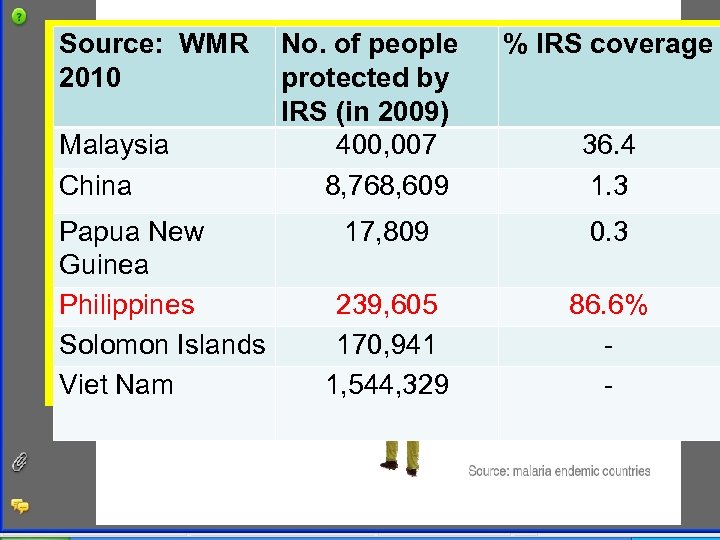 Source: WMRpolicies for IRS programmes, of people % IRS coverage Adoption of No. Issues 2010 IRS & LNs protected by Report 2010 • Both Member States, highly dependent on pyrethroids, World Malaria • widespread use of. IRS (in 2009) a single insecticide class increases Policy risk that mosquitoes will develop resistance Malaysia 400, 007 Number of endemic 36. 4 countries • Changes in species distribution 1. 3 China 8, 768, 609 IRS is recommended by NMCP changes 6 • Behavioral Papua New prevention 17, 809 • for IRS is used Documenting for evidence-based 7 0. 3 and Guinea control of epidemics • Spray quality • Spray coverage Philippines 239, 605 IRS and ITNs used together for 6 86. 6% • malaria control in at least 170, 941 some Solomon Islands. Building IRS capacity areas Viet Nam 1, 544, 329 DDT is used for IRS 0 Insecticide resistance 6 monitoring is undertaken 4 Western Pacific Regio
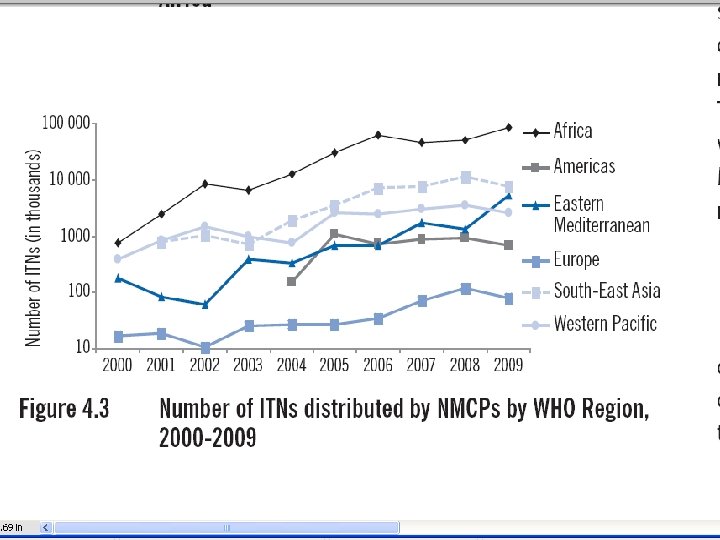 Adoption of policies for ITN programme, 10 Member States, World Malaria Report 2010 Policy No. of endemic countries (5 E) ITNs distributed free of charge ITNs/LLINs sold at subsidized prices 2 ITNs/LLINs distributed to all age groups 9 ITNs/LLINs distributed through mass campaigns to all age groups 7 ITNs/LLINs distributed through mass campaigns to <5 only ITNs/LLINs distributed through antenatal clinics 0 ITNs/LLINs distributed through EPI clinics 5 9 2 3 Western Pacific Regio
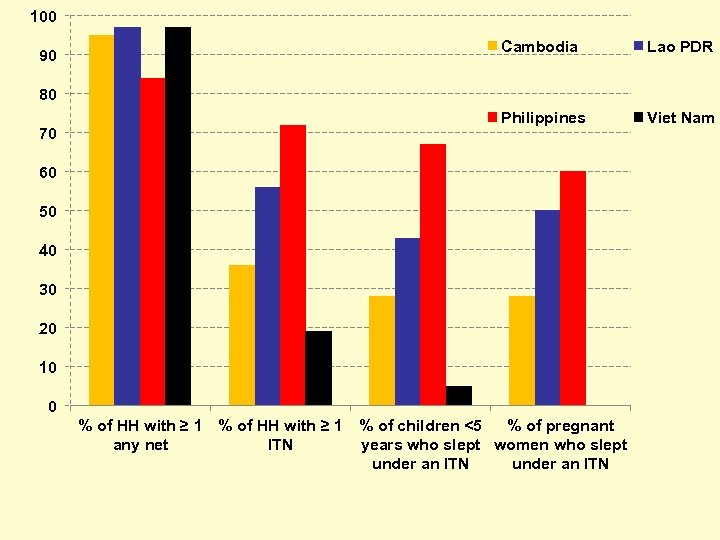 100 Cambodia Lao PDR Philippines 90 Viet Nam 80 70 60 50 40 30 20 10 0 % of HH with ≥ 1 any net ITN 6 % of children <5 % of pregnant years who slept women who slept under an ITN Western Pacific Regio
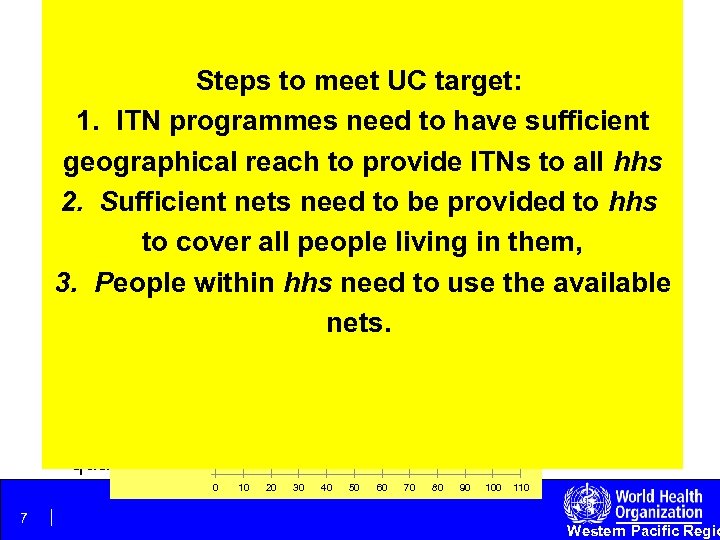 Lao PDR Universal Coverage (UC) and Continuous Cambodia Steps to meet UC target: Distributions Systems for ITNs Measles Vaccine coverage %, 2009 1. ITN programmes need to have sufficient Solomon Is • UC targets whole communities, not only vulnerable subgeographical reach to provide ITNs to all hhs groups with these communities Malaysia • 2. Sufficient nets need to“community effect” Aim – equitable protection & be provided to hhs PNG • Mass campaigns bestpeople ANC Coverage %, them, to cover all to rapidly scale up LLIN coverage, living in but not. Vanuatu enough to sustain UC good Latest Year (source: ADB 2010; • 3. People within hhs need to use the available WHO higher priority to routine services such as ANC WHO) China & EPI as a means to sustain UC nets. • In WPR, ANC & EPI coverage is variable; not enough Viet. Nam to sustain full UC. Philippines • Additional flexible systems for continuous LLIN delivery • Innovative solutions are needed where access and Brunei quality of these services are low 0 7 10 20 30 40 50 60 70 80 90 100 110 Western Pacific Regio
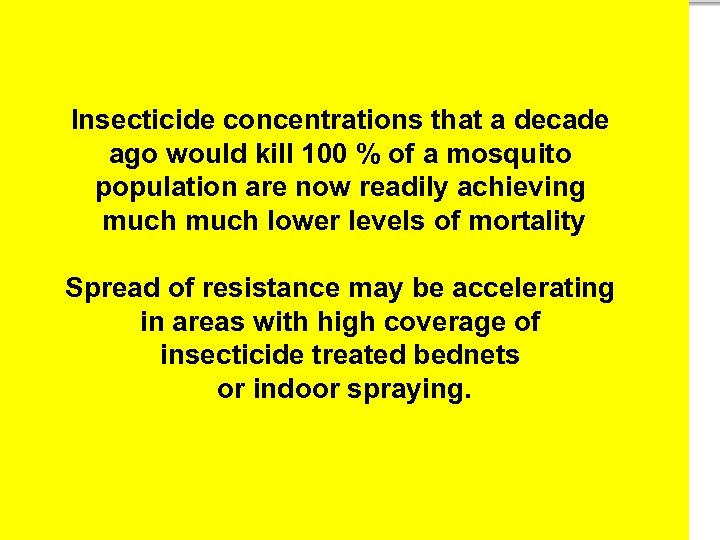 Background of IR Network • • • 8 Need for region-wide comparable resistance data to Insecticide concentrations that a decade encourage the correct use of insecticides in VC. Aug 2008 VCM kill 100 Siem Reap – patchy ago would meeting % of a mosquito information on R status. Requested for capacity population are now readily achieving building & strengthening entomological services. much lower a cross-country IR monitoring ITM Antwerp establishedlevels of mortality network in 4 Mekong countries. MALVECASIA: regional may be accelerating Spread of resistance network for IR monitoring: – To define the insecticide status of the major malaria in areas with high coverage of vectors in indifferent physio-geographical regions in Southeast Asia insecticide treated bednets Extension ofor indoor spraying. of the ACTMalaria this network to the rest countries to gain better insight into the problem of IR Western Pacific Regio
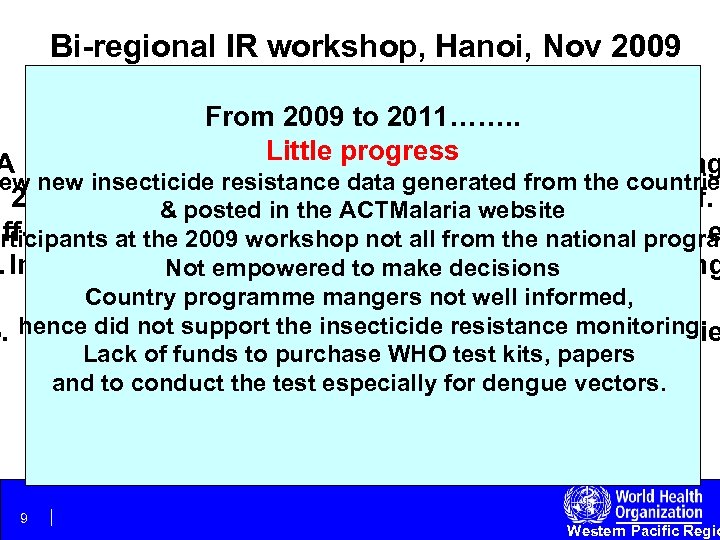 Bi-regional IR workshop, Hanoi, Nov 2009 From 2009 to 2011……. . General Workshop knowledge on insecticide – to improve recommendations resistance status Little progress vector of of adult mosquitoes, A network to monitor IR in vectors of malaria and deng diseases, and changing trends by increasing the ew newcapacity for appropriate IR monitoring. insecticide resistance data generated from the countrie 2. Strengthenposted in the ACTMalaria website & entomology skills among country staff. • Specific objectives ff-up workshops on M&E of LLIN, IRS, vector control e articipants at the 2009 workshop not all from the national program 1. To set up a network for the monitoring of insecticide. Introduce IVM ofempowered to make decisions Not vector mosquito species capacity building resistance strategy (emphasis inin the ACTMalaria countries at regionalmangers not levels Republic (Bangladesh, Cambodia, PR China, Country programme & country well informed, of Indonesia, Lao the insecticide. Myanmar, Philippines, hence did not support PDR, Malaysia, participating countrie 5. WHO test kits to beand East Timor)resistance monitoring Thailand , Vietnam sent to the Lack of funds to purchase WHO test kits, papers 6. Provide technical support to countries 2. To train staff of NMCP in bioassays, data entry and to conduct the test especially for dengue vectors. management • 7. Review progress on insecticide resistance 3. To set up a web based data base for data management and analyses of the bioassay data 9 Western Pacific Regio
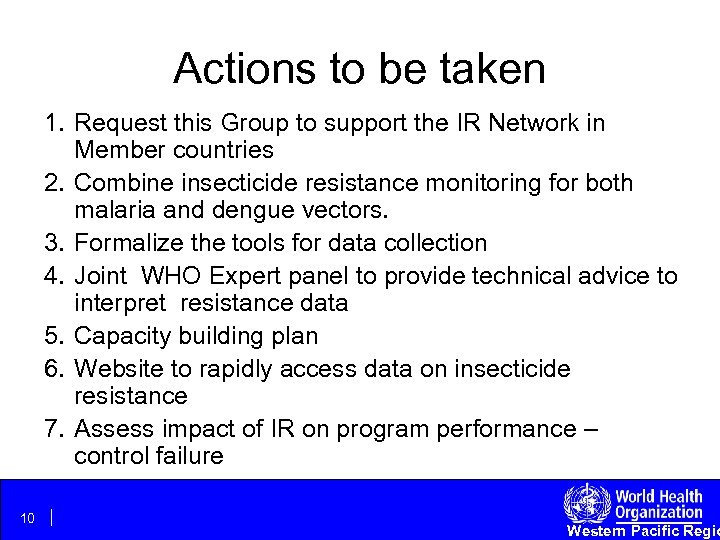 Actions to be taken 1. Request this Group to support the IR Network in Member countries 2. Combine insecticide resistance monitoring for both malaria and dengue vectors. 3. Formalize the tools for data collection 4. Joint WHO Expert panel to provide technical advice to interpret resistance data 5. Capacity building plan 6. Website to rapidly access data on insecticide resistance 7. Assess impact of IR on program performance – control failure 10 Western Pacific Regio
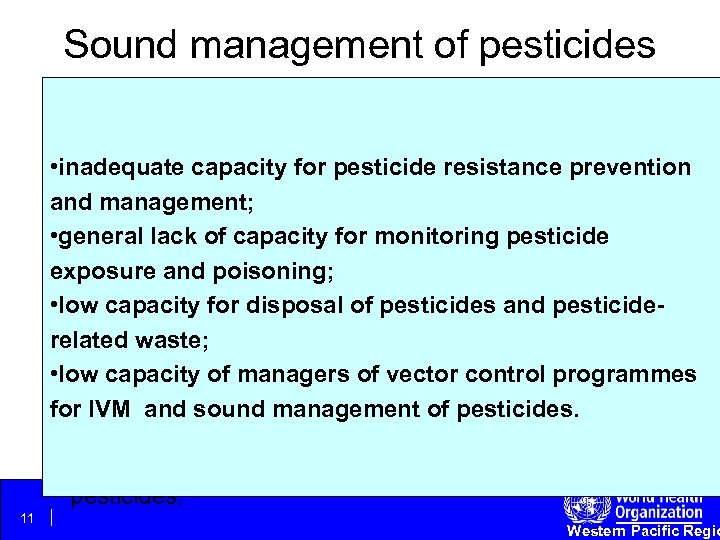 Sound management of pesticides of public health importance • refers to the regulatory control, proper handling, • inadequate capacity for pesticide resistance disposal import, supply, transport, storage, use and prevention of pesticide waste and management; to minimize adverse environmental effects and human exposure. • general lack of capacity for monitoring pesticide • WHO Resolutions 2010 related to the strategic exposure and poisoning; chemicals management approach to international including the management of pesticides • low capacity for disposal of pesticides and pesticide • related waste; survey Report of 2010 • • low capacity of managers of vector control programmes weak legislation & regulation; • for IVM and sound management of pesticides. inadequate mechanisms and capacity for procurement and QC • challenges in implementation of IVM and application of pesticides; 11 Western Pacific Regio
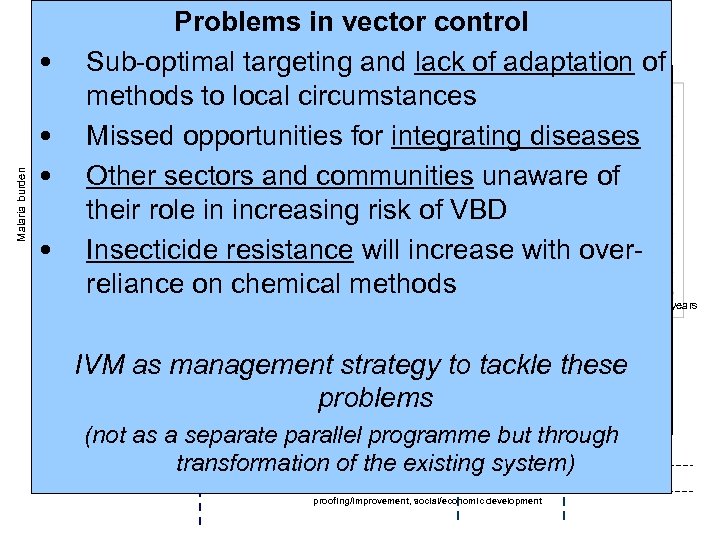 Malaria burden Problems in vector control Role of IVM in elimination • Sub-optimal targeting and lack of adaptation of Need tools to to localdeficiencies in elimination and for methods resolve circumstances sustaining the achievements made in malaria • Malaria & LFopportunities for integrating diseases Missed elimination programs (particularly for Anoph. IVM • Other sectors and communities unaware of transmitted LF) their role in increasing risk of VBD Three WHO products will be released: • 1. Guidanceresistance Developmentwith IVM Insecticide on Policy will increase for overreliance on chemical 2. Handbook on IVM methods Attack Consolidation Elimination Maintenance Certification Indicative time line years 3. Core structure for training curriculum on Full coverage IRS IVM as management strategy to tackle these Residual foci LLINs or IRS (or both) Low receptivity LLINs or IRS problems (not as a separate parallel programme but through Preparation Implementation transformation of the existing system) ITMs - Larvicides Environmental management, larvivorous fish, house proofing/improvement, social/economic development 12 Western Pacific Regio
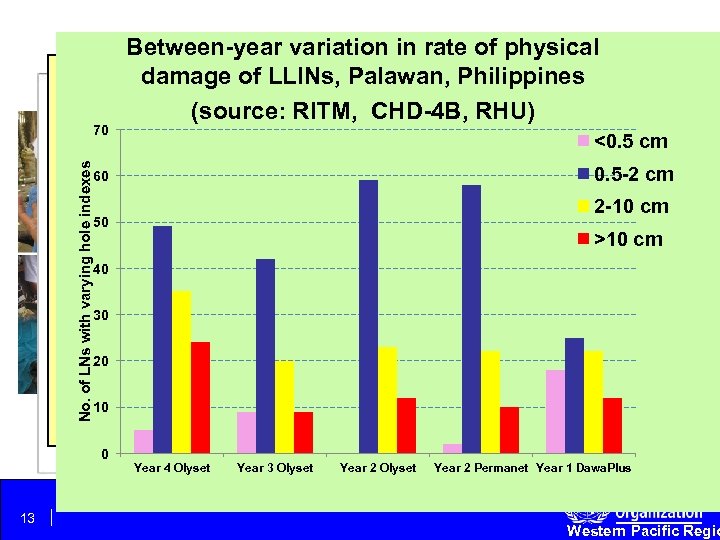 Between-year variation in and physical 150 denier polyethylenerate of 100 denier Multi-country studies show unexpectedly large damage polyester of LLINs, Palawan, Philippines nets, in a durability study No. of LNs with varying hole indexes variation in effective life between locations – (source: RITM, CHD-4 B, RHU) 70 even more variation between. How long do LNs locations than cm <0. 5 really last? cm between brands 0. 5 -2 60 1) survivorship/ 2 -10 cm ·Evidence that the relative lifespan of different 50 attrition (includes brands. Ais not constant. Bbut varies in different >10 cm retention) 40 contexts 2) Physical integrity ·So a global “top five” ranking is not realistic 30 (holes) (and would not be good for market) 3) bio-efficacy – 20 C D interaction between Figure 3. 10 Damage and repairs made on retrieved LLINs: (A) knotted insecticide & holes / tied failed seams on Dawa. Plus, (B) rips and burns on Permanet 2. 0, (C) burned holes on Permanet 2. 0, and (D) repair on long rip on Olyset. 0 Year 4 Olyset 13 Year 3 Olyset Year 2 Permanet Year 1 Dawa. Plus Western Pacific Regio
 Draft standard durability monitoring guidelines now being finalised (J Lines, GMP) • Retrospective monitoring limited by: – Unreliable recall / records to estimate net-age – Attrition cannot be reliably estimated – significant fractions of the population moved in/out of the area – Fade out of labels of nets – Remaining nets may represent a biased sample • However, can provide immediate info about previously distribution as long as the net rosters & time of distribution are kept. 14 Western Pacific Regio
 Monitoring LLIN Durability (J Lines GMP) • Method Involves • A Mixture of Brands / Products used together – (why this is new and important) • Exactly equal and recorded numbers of each brand – (why this is new and important) • Emphasis on attrition and holes – insecticide optional • A Hole Index - quantification of physical wear – (not just % with holes) (but need to calibrate this) • Procedures can be openly & critically scrutinised – – so demonstrably free of external influence / bias • 15 User preference data that is guaranteed from manufacturers’ influence Western Pacific Regio
 Monitoring LLIN Durability (J Lines GMP) • Need constant flow of location-specific data, not some large set-piece trials from WHO. This monitoring will be recommended as "good practice" in all large-scale procurements/deployments, for all implementation agencies, and all donors, especially GFATM. • Estimated Cost: depends on scale and outcomes measured. Typical ballpark might be (excluding nets): $100 k - $300 k • So – how often? – ? should normally be part of every procurement over $2 m ? – ? Where each procurement is smaller, then after every cumulative $2 m. – So then cost of monitoring would be an extra 1%. – Expected to save >>10% ! 16 Western Pacific Regio
 WHO Toolkit on Sustainable management of LLINs (work in progress, GMP) • Objective – to identify and assess the feasibility of environmentally sound and cost-effective options for end-of-life management of nets used for malaria control. • Community surveys • What factors influenced the selection of a geographical area believed to contain an adequate quantity of nets? How accurate were these predictions? • Were collections organized around a distribution programme or independent of a distribution? 17 Western Pacific Regio
 Do: . . . . WHO INTERIM RECOMMENDATIONS ON LLIN 1. recycling LLINs packaging only possible recyclers If Recycle or incineration is not through and if the manufacturers provide necessity of recycling nonthat understand the directions on methods for PACKAGING safe disposal, follow these. biodegradable pesticide-tainted residues only into non-consumer products and that work in an • Do Not: industrial environment insecticide treated If DO NOT any potentiallythat poses little risk to not, bury burn LLIN bags in open air; • workers or the environment. plastics in soils with low permeability, away from • any residences, preferably downspecified high any 2. DO NOT incinerate ONLY if gradient from Incinerate LLIN bags unless the proper incineration conditions leastbe temperature incineration conditions for 100 known domestic water sources but at can pesticidetainted plastic can be guaranteed water intakes guaranteed and other domestic and FAO/WHO meters from wells or maintained for the whole or and Basel Convention incineration depth not high water marks ofbagsguidelines can be strictly duration of the lakes-wetlands, to a and followed; tostrictly one meter above the highest annual water exceed FAO/WHO and Basel Convention table. LLIN packaging only if future safe 3. guidelines; Store incineration or recycling is expected: plastic to a Compacted soil should cover the buried the storage • depth NOT re-use or more. DO of one meterdry andbags for any purpose facility must be LLIN secure; 18 Western Pacific Regio
 Thank you 19 Western Pacific Regio