


 Скачать презентацию Vector Applications TS Develop a capacity for working
3fc5c37417323b4dfd5d2854e5f882b4.ppt
- Количество слайдов: 6
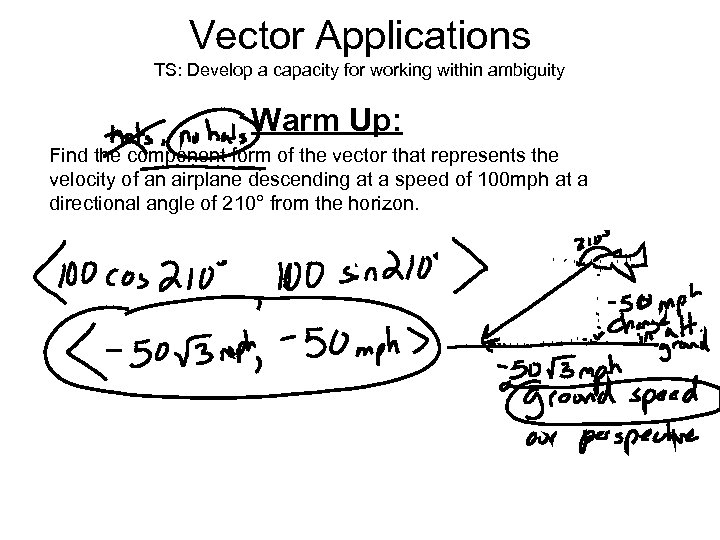 Vector Applications TS: Develop a capacity for working within ambiguity Warm Up: Find the component form of the vector that represents the velocity of an airplane descending at a speed of 100 mph at a directional angle of 210° from the horizon.
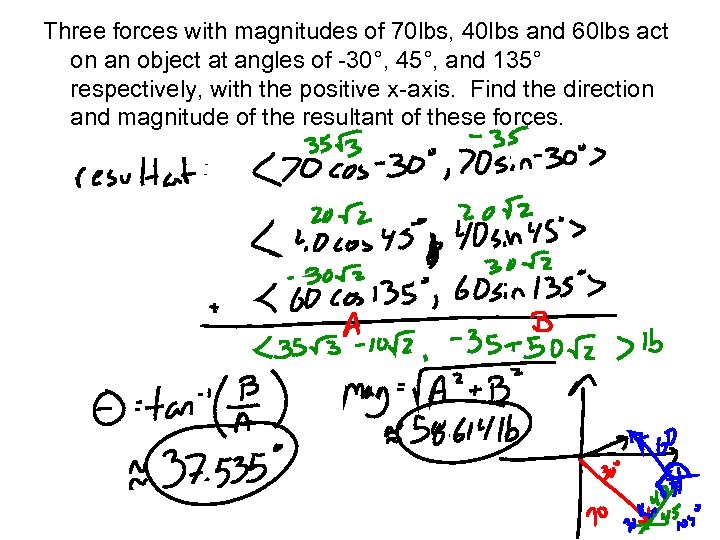 Three forces with magnitudes of 70 lbs, 40 lbs and 60 lbs act on an object at angles of -30°, 45°, and 135° respectively, with the positive x-axis. Find the direction and magnitude of the resultant of these forces.
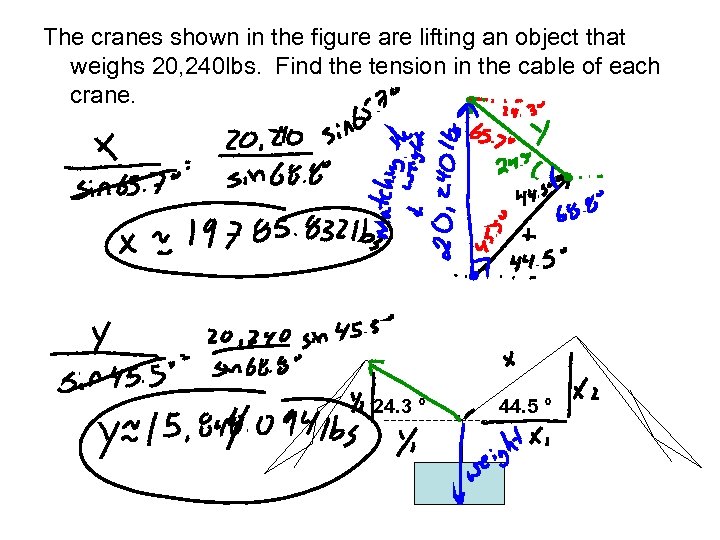 The cranes shown in the figure are lifting an object that weighs 20, 240 lbs. Find the tension in the cable of each crane. 24. 3 ° 44. 5 °
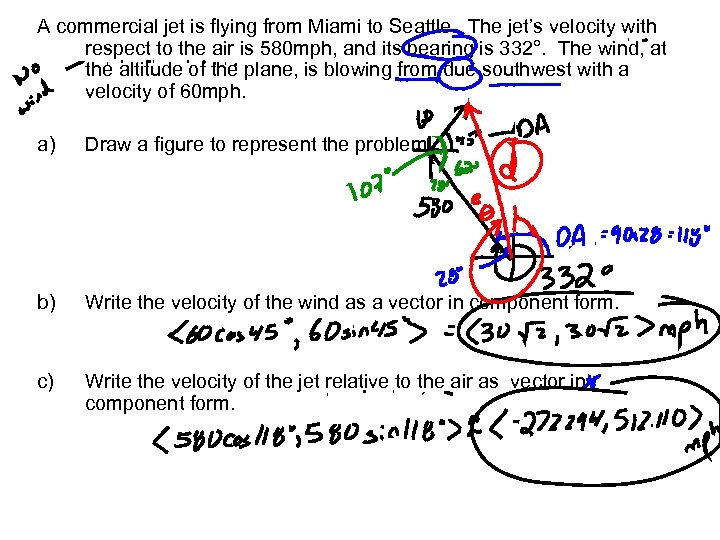 A commercial jet is flying from Miami to Seattle. The jet’s velocity with respect to the air is 580 mph, and its bearing is 332°. The wind, at the altitude of the plane, is blowing from due southwest with a velocity of 60 mph. a) Draw a figure to represent the problem. b) Write the velocity of the wind as a vector in component form. c) Write the velocity of the jet relative to the air as vector in component form.
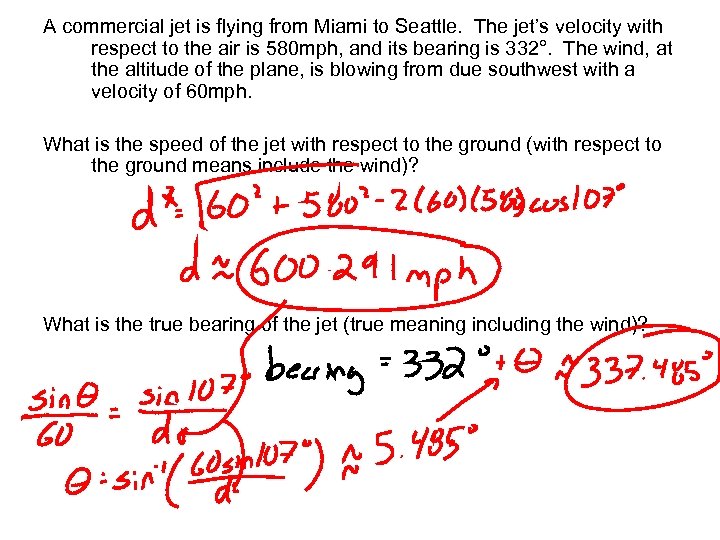 A commercial jet is flying from Miami to Seattle. The jet’s velocity with respect to the air is 580 mph, and its bearing is 332°. The wind, at the altitude of the plane, is blowing from due southwest with a velocity of 60 mph. What is the speed of the jet with respect to the ground (with respect to the ground means include the wind)? What is the true bearing of the jet (true meaning including the wind)?
 YOU TRY: Three forces with magnitudes of 75 lbs, 100 lbs, and 125 lbs act on an object at angles of 30°, 45°, and 120° respectively, with the positive x-axis. Find the direction angle and magnitude of the resultant of these forces. Ans: magnitude is 288. 494 lbs direction angle is 71. 325°