


 Скачать презентацию Vasily Vladimirovich Petrov CHILDHOOD Vasily Petrov —
Vasily Vladimirovich Petrov.pptx
- Количество слайдов: 5
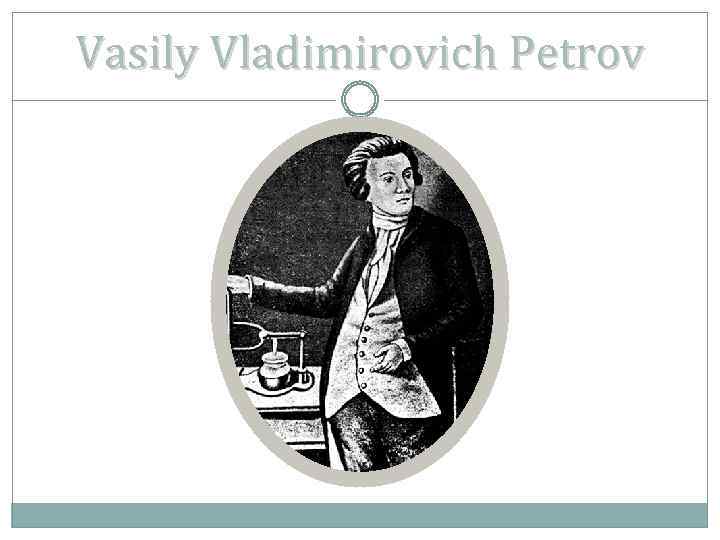 Vasily Vladimirovich Petrov
 CHILDHOOD Vasily Petrov - was a Russian experimental physicist. He was born 8 July, 1761 in the town of Oboyan (currently Kursk Oblast of Russia) in the family of a priest.
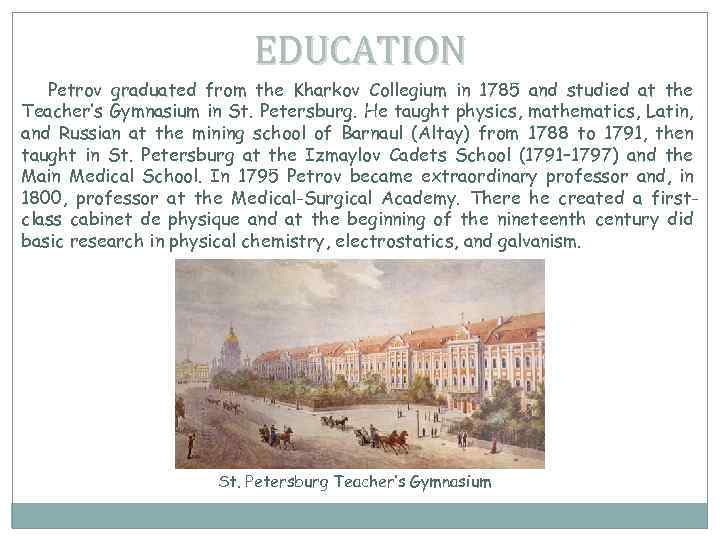 EDUCATION Petrov graduated from the Kharkov Collegium in 1785 and studied at the Teacher’s Gymnasium in St. Petersburg. He taught physics, mathematics, Latin, and Russian at the mining school of Barnaul (Altay) from 1788 to 1791, then taught in St. Petersburg at the Izmaylov Cadets School (1791– 1797) and the Main Medical School. In 1795 Petrov became extraordinary professor and, in 1800, professor at the Medical-Surgical Academy. There he created a firstclass cabinet de physique and at the beginning of the nineteenth century did basic research in physical chemistry, electrostatics, and galvanism. St. Petersburg Teacher’s Gymnasium
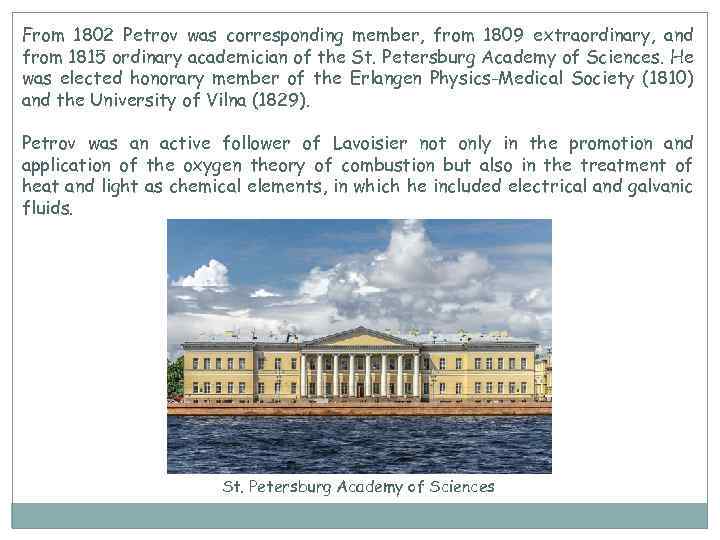 From 1802 Petrov was corresponding member, from 1809 extraordinary, and from 1815 ordinary academician of the St. Petersburg Academy of Sciences. He was elected honorary member of the Erlangen Physics-Medical Society (1810) and the University of Vilna (1829). Petrov was an active follower of Lavoisier not only in the promotion and application of the oxygen theory of combustion but also in the treatment of heat and light as chemical elements, in which he included electrical and galvanic fluids. St. Petersburg Academy of Sciences
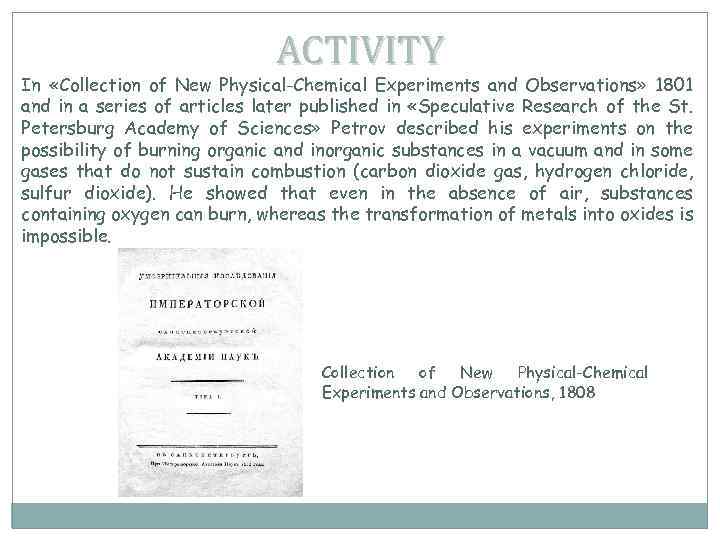 ACTIVITY In «Collection of New Physical-Chemical Experiments and Observations» 1801 and in a series of articles later published in «Speculative Research of the St. Petersburg Academy of Sciences» Petrov described his experiments on the possibility of burning organic and inorganic substances in a vacuum and in some gases that do not sustain combustion (carbon dioxide gas, hydrogen chloride, sulfur dioxide). He showed that even in the absence of air, substances containing oxygen can burn, whereas the transformation of metals into oxides is impossible. Collection of New Physical-Chemical Experiments and Observations, 1808