


 Скачать презентацию VASARA Finnish national source register International Workshop
5b81af7aeef9ab69d3efb9a5df4043c5.ppt
- Количество слайдов: 9
 VASARA – Finnish national source register International Workshop on National Sources Registry IAEA, Vienna March 20 -23, 2017 Eija Venelampi Radiation and Nuclear Safety Authority – STUK, Finland SÄTEILYTURVAKESKUS • STRÅLSÄKERHETSCENTRALEN RADIATION AND NUCLEAR SAFETY AUTHORITY
 General • STUK has maintained information on radioactive sealed sources in electric form since the beginning of 1980’s • The first applications were simple self-made databases planned for maintaining basic information on licenses and related individual sources • Since then, several development phases have taken place leading to establishment of the current Regulatory Authority Information System called VASARA in 2009 • VASARA is used for management of all regulatory processes and related data for the regulatory control of the use of radiation sources in Finland SÄTEILYTURVAKESKUS • STRÅLSÄKERHETSCENTRALEN RADIATION AND NUCLEAR SAFETY AUTHORITY Eija Venelampi 2
 VASARA in general • House designed; technically created and maintained by an IT-company • Integration to other STUK’s IT-systems (e. g. electronic document management and archiving) • Includes information of safety licences, for example : o Data about the licensee and the radiation practice: places of the use of radiation, radiation safety officer, radiation appliances and sources etc. o Inspections: planning, observations, orders given, deadlines, links to the documents o Management of applications and information of decisions, links to the documents o Invoicing • Reports • Personal to-do lists: applications, deadlines… • The national dose register is also included in VASARA SÄTEILYTURVAKESKUS • STRÅLSÄKERHETSCENTRALEN RADIATION AND NUCLEAR SAFETY AUTHORITY Eija Venelampi 3
 VASARA as the national source register • The devices containing radiation sources are included in the safety licenses on the basis of the licencees’ applications • Data on devices and sources are registered in VASARA • VASARA includes data on all sealed sources exceeding the exemption level • Extra data on high-activity sealed sources (HASS sources) is registered • The aim is to gather data from cradle to grave SÄTEILYTURVAKESKUS • STRÅLSÄKERHETSCENTRALEN RADIATION AND NUCLEAR SAFETY AUTHORITY Eija Venelampi 4
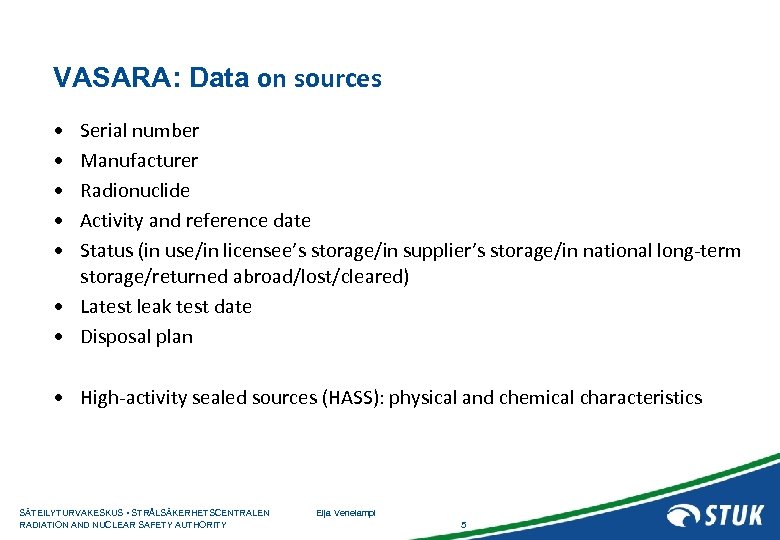 VASARA: Data on sources • • • Serial number Manufacturer Radionuclide Activity and reference date Status (in use/in licensee’s storage/in supplier’s storage/in national long-term storage/returned abroad/lost/cleared) • Latest leak test date • Disposal plan • High-activity sealed sources (HASS): physical and chemical characteristics SÄTEILYTURVAKESKUS • STRÅLSÄKERHETSCENTRALEN RADIATION AND NUCLEAR SAFETY AUTHORITY Eija Venelampi 5
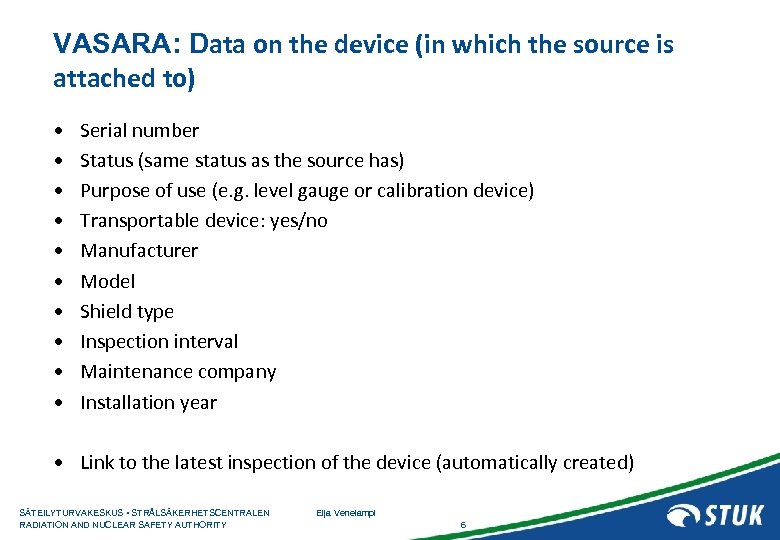 VASARA: Data on the device (in which the source is attached to) • • • Serial number Status (same status as the source has) Purpose of use (e. g. level gauge or calibration device) Transportable device: yes/no Manufacturer Model Shield type Inspection interval Maintenance company Installation year • Link to the latest inspection of the device (automatically created) SÄTEILYTURVAKESKUS • STRÅLSÄKERHETSCENTRALEN RADIATION AND NUCLEAR SAFETY AUTHORITY Eija Venelampi 6
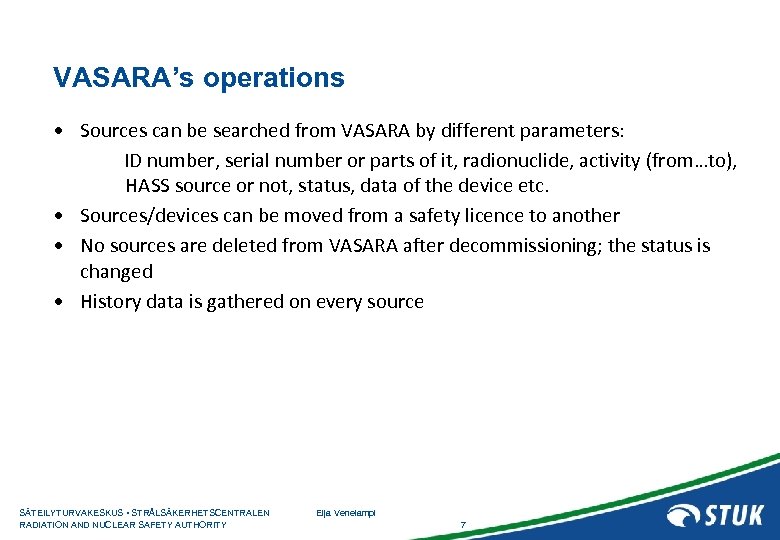 VASARA’s operations • Sources can be searched from VASARA by different parameters: ID number, serial number or parts of it, radionuclide, activity (from…to), HASS source or not, status, data of the device etc. • Sources/devices can be moved from a safety licence to another • No sources are deleted from VASARA after decommissioning; the status is changed • History data is gathered on every source SÄTEILYTURVAKESKUS • STRÅLSÄKERHETSCENTRALEN RADIATION AND NUCLEAR SAFETY AUTHORITY Eija Venelampi 7
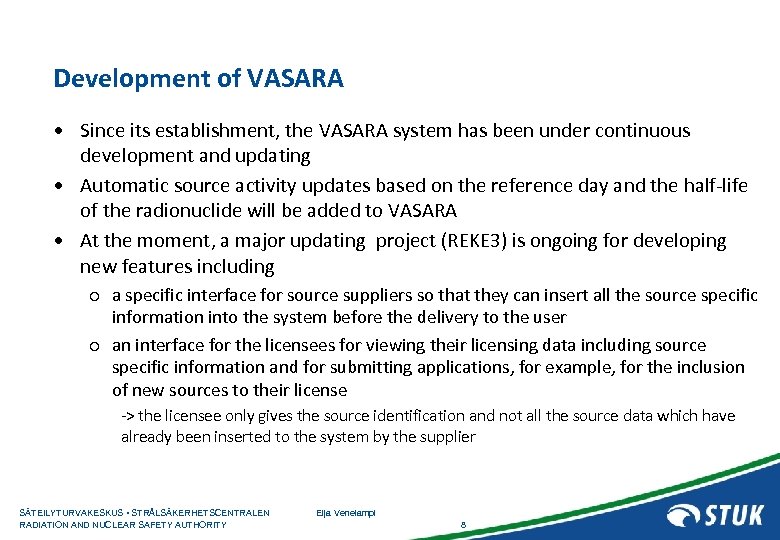 Development of VASARA • Since its establishment, the VASARA system has been under continuous development and updating • Automatic source activity updates based on the reference day and the half-life of the radionuclide will be added to VASARA • At the moment, a major updating project (REKE 3) is ongoing for developing new features including o a specific interface for source suppliers so that they can insert all the source specific information into the system before the delivery to the user o an interface for the licensees for viewing their licensing data including source specific information and for submitting applications, for example, for the inclusion of new sources to their license -> the licensee only gives the source identification and not all the source data which have already been inserted to the system by the supplier SÄTEILYTURVAKESKUS • STRÅLSÄKERHETSCENTRALEN RADIATION AND NUCLEAR SAFETY AUTHORITY Eija Venelampi 8
 Conclusions • Experiences in Finland have shown that maintaining an up to date national register of sealed radioactive sources is essential in maintaining control over them for their whole lifetime • However, any register is only as good as the validity of inserted data • Different mechanisms for continuous verification of the validity of the data needs to be in place • In addition to applications and other notifications from the users, these should include o regular on-site inspections o the cross-checking of supplier delivery notification data with the user application data o as appropriate, different types of licensee-targeted source inventory campaigns (e. g. a request to verify the validity of a source register extract). SÄTEILYTURVAKESKUS • STRÅLSÄKERHETSCENTRALEN RADIATION AND NUCLEAR SAFETY AUTHORITY Eija Venelampi 9