 Скачать презентацию Various concepts of guided transport systems for periurban
ad206494823d899237a1514792c653c2.ppt
- Количество слайдов: 28



Various concepts of guided transport systems for periurban applications Claude Soulas, GRETTIA 29 09 2011
THREE IMPORTANT TERMS • GUIDED TRANSPORTATION SYSTEMS : mainly railway systems, but include theoretically magnetic levitation systems and guided systems on pneumatic tyres • CONCEPTS : try to identify common general characteristics independently from particular applications in different agglomerations or regions • Systems for PERIURBAN AREAS : long lines of urban systems, or specific periurban (or suburban) systems, or regional systems.
SYSTEMS FOR PERIURBAN AREAS • ROAD SYSTEMS : BUS GUIDED SYSTEMS : • RAILBUS (THE PAST) • LIGHT RAILCARS (NOW) • GUIDED SYSTEMS ON PNEUMATIC TYRES ? (difficult for periurban areas) • « CLASSICAL » RAILWAY SYSTEMS • INNOVATIVE SYSTEMS C. SOULAS
TWO DIFFERENT DEUFRAKO PROJECTS (French German cooperation) TWO DIFFERENT PERIODS, TWO DIFFERENT APPROACHES • In 1987 STARLIM = development of an innovative suburban system with magnetic levitation, linear motor, automatic drive (150 km/h or more : long distance between stops). • In 2001 BAHN. VILLE = Rail oriented development and intermodality in German and French urban regions. (Bahn. Ville 1 : 2001 - 2005, Bahn. Ville 2 : 2007 - 2010)
TWO TENDENCIES FOR TRANSPORTATION SYSTEMS • TECHNICAL INNOVATION, WITH MORE OR LESS AMBITIOUS OBJECTIVES. NOWADAYS MORE DEVELOPMENTS FOR PRIVATE CARS THAN FOR PUBLIC TRANSPORT : ELECTROMOBILITY, « INTELLIGENT TRANSPORTS » , …. . • PRAGMATIC EVOLUTION, ADAPTED TO THE CONTEXT, EXAMPLE OF THE INTERCONNEXION TRAMWAY IN KARLSRUHE
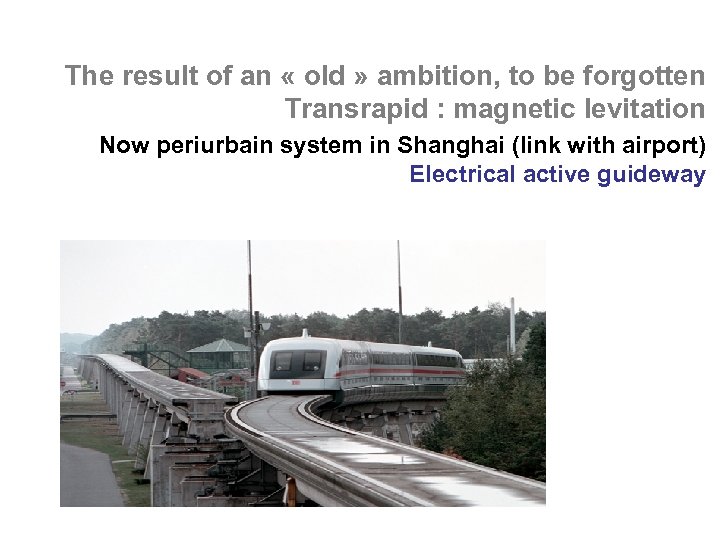
The result of an « old » ambition, to be forgotten Transrapid : magnetic levitation Now periurbain system in Shanghai (link with airport) Electrical active guideway
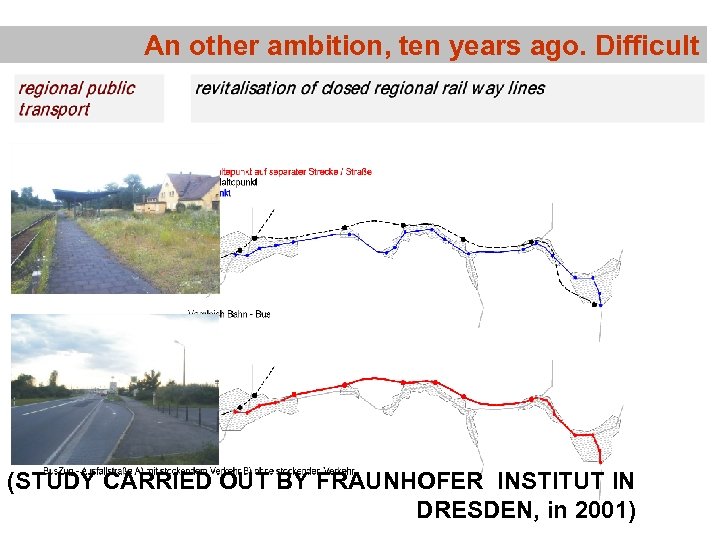
An other ambition, ten years ago. Difficult (STUDY CARRIED OUT BY FRAUNHOFER INSTITUT IN DRESDEN, in 2001)
URBAN/PERIURBAN/ REGIONAL SYSTEMS • TRAMWAY, (55 netwoks in Germany, less in France but some recent relatively long lines) • LIGHT RAIL, « Stadtbahn » or « Métro léger » , (16 netwoks in Germany, no in France according a strict definition but Rouen is a similar concept) • LIGHT METRO, eg automatic systems, VAL, … • CLASSICAL METRO • REGIONAL METRO, « S-Bahn » or « RER » , (at least 14 netwoks in Germany, at least one huge network in France) • VARIOUS RAILWAY SYSTEMS : several concepts Frontiers between systems not always clear. Some overlapping of application fields C. SOULAS
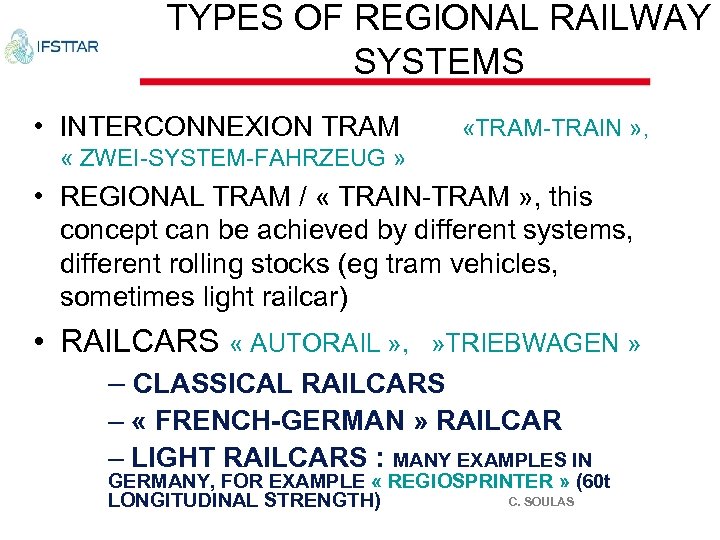
TYPES OF REGIONAL RAILWAY SYSTEMS • INTERCONNEXION TRAM «TRAM-TRAIN » , « ZWEI-SYSTEM-FAHRZEUG » • REGIONAL TRAM / « TRAIN-TRAM » , this concept can be achieved by different systems, different rolling stocks (eg tram vehicles, sometimes light railcar) • RAILCARS « AUTORAIL » , » TRIEBWAGEN » – CLASSICAL RAILCARS – « FRENCH-GERMAN » RAILCAR – LIGHT RAILCARS : MANY EXAMPLES IN GERMANY, FOR EXAMPLE « REGIOSPRINTER » (60 t C. SOULAS LONGITUDINAL STRENGTH)
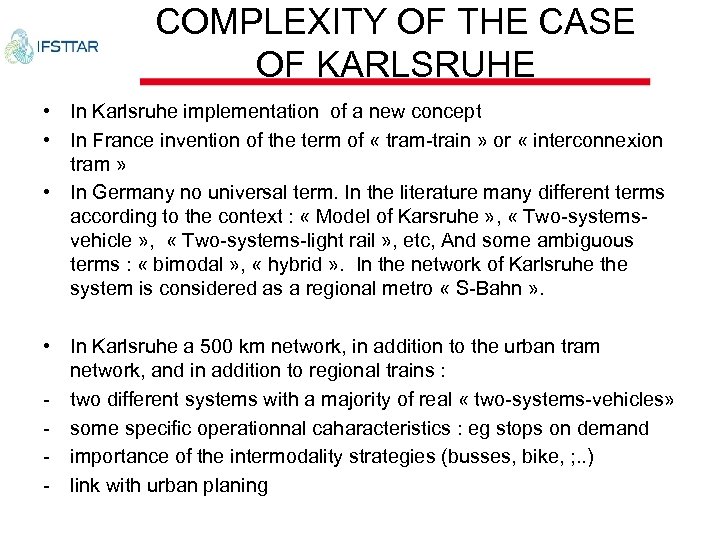
COMPLEXITY OF THE CASE OF KARLSRUHE • In Karlsruhe implementation of a new concept • In France invention of the term of « tram-train » or « interconnexion tram » • In Germany no universal term. In the literature many different terms according to the context : « Model of Karsruhe » , « Two-systemsvehicle » , « Two-systems-light rail » , etc, And some ambiguous terms : « bimodal » , « hybrid » . In the network of Karlsruhe the system is considered as a regional metro « S-Bahn » . • In Karlsruhe a 500 km network, in addition to the urban tram network, and in addition to regional trains : - two different systems with a majority of real « two-systems-vehicles» - some specific operationnal caharacteristics : eg stops on demand - importance of the intermodality strategies (busses, bike, ; . . ) - link with urban planing
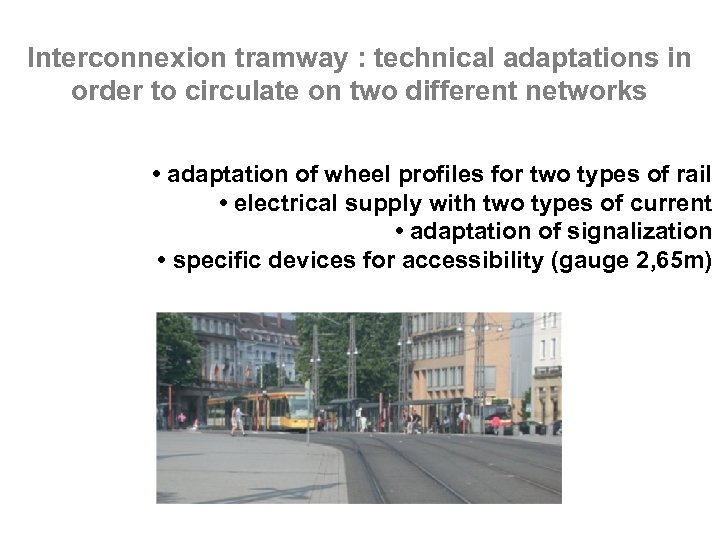
Interconnexion tramway : technical adaptations in order to circulate on two different networks • adaptation of wheel profiles for two types of rail • electrical supply with two types of current • adaptation of signalization • specific devices for accessibility (gauge 2, 65 m)
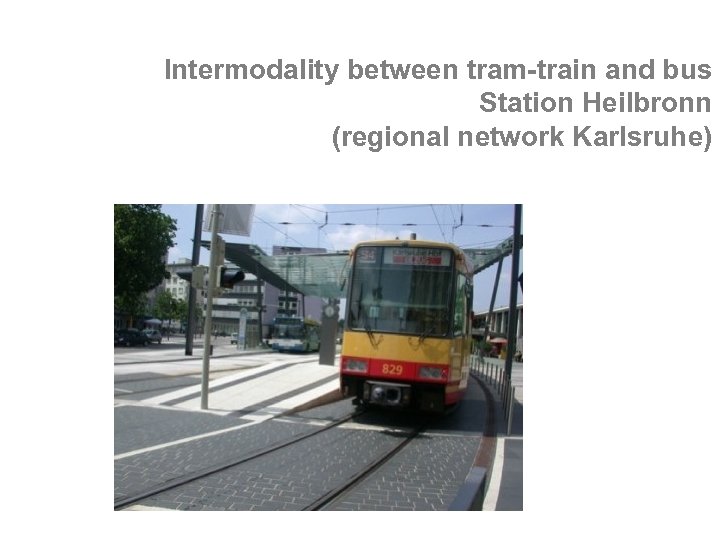
Intermodality between tram-train and bus Station Heilbronn (regional network Karlsruhe)
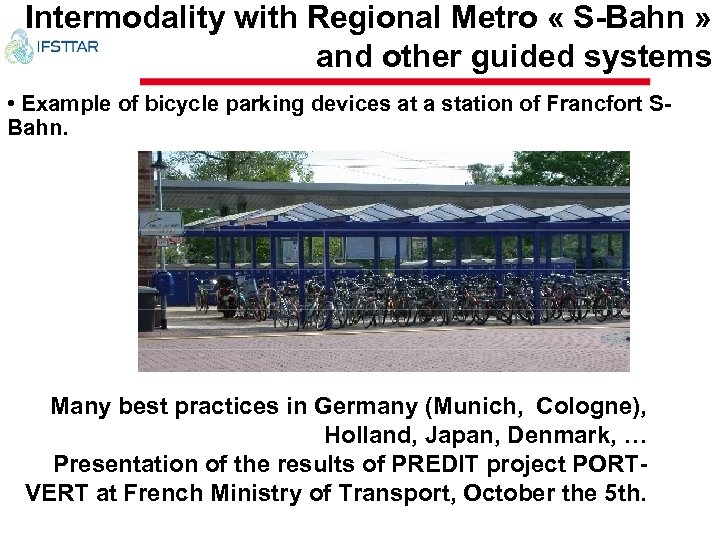
Intermodality with Regional Metro « S-Bahn » and other guided systems • Example of bicycle parking devices at a station of Francfort SBahn. Many best practices in Germany (Munich, Cologne), Holland, Japan, Denmark, … Presentation of the results of PREDIT project PORTVERT at French Ministry of Transport, October the 5 th.
LINKS BETWEEN SYSTEM CHARACTERISTICS AND REGIONAL/URBAN PLANING • ADEQUATION BETWEEN SYSTEM AND TERRITORY (e. g. distance between stopping points) • INSERTION CHARACTERISTICS • TYPE OF LEVEL CROSSINGS • ACCESSIBILITY FOR VARIOUS USER CATEGORIES • SPECIFIC ASPECTS OF SAFETY C. SOULAS
SYSTEM CHARACTERISTICS • TECHNICAL PERFORMANCE SPEED, ACCELERATION, DECELERATION (TRACTION, MASS, LONGITUDINAL STRENGTH) • AESTHETIC PARAMETERS GAUGE, HEIGHT, DESIGN, CATENARY INTEGRATION • IMPACT ON ENVIRONMENT EXHAUST EMISSIONS, NOISE C. SOULAS
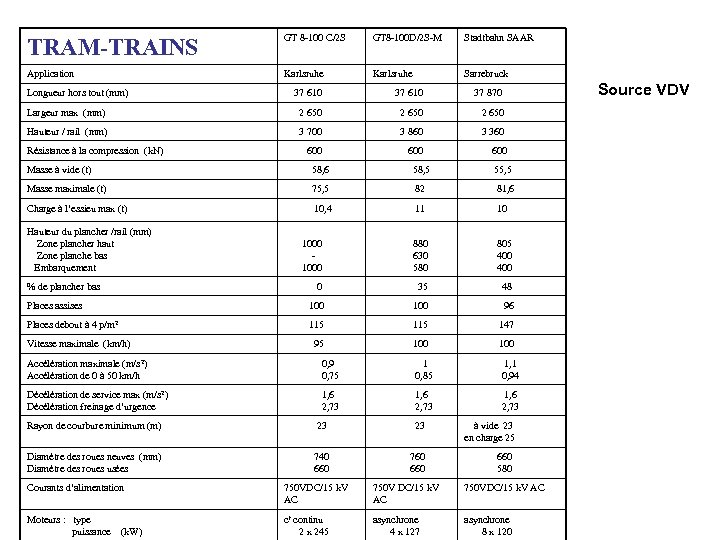
TRAM-TRAINS GT 8 -100 C/2 S GT 8 -100 D/2 S-M Stadtbahn SAAR Application Karlsruhe Sarrebruck Longueur hors tout (mm) 37 610 37 870 Largeur max (mm) 2 650 Hauteur / rail (mm) 3 700 3 860 3 360 Résistance à la compression (k. N) 600 Masse à vide (t) 58, 6 58, 5 55, 5 Masse maximale (t) 75, 5 82 81, 6 Charge à l’essieu max (t) 10, 4 11 10 Hauteur du plancher /rail (mm) Zone plancher haut Zone planche bas Embarquement 1000 880 630 580 805 400 % de plancher bas 0 35 48 Places assises 100 96 Places debout à 4 p/m 2 115 147 Vitesse maximale (km/h) 95 100 Accélération maximale (m/s 2) Accélération de 0 à 50 km/h 0, 9 0, 75 1, 1 0, 85 0, 94 Décélération de service max (m/s 2) Décélération freinage d’urgence 1, 6 2, 73 1, 6 2, 73 1, 6 2, 73 Rayon de courbure minimum (m) 23 à vide 23 en charge 25 Diamètre des roues neuves (mm) Diamètre des roues usées 740 660 760 660 580 Courants d’alimentation 750 VDC/15 k. V AC 750 VDC/15 k. V AC Moteurs : type puissance (k. W) ct continu 2 x 245 asynchrone 4 x 127 asynchrone 8 x 120 Source VDV
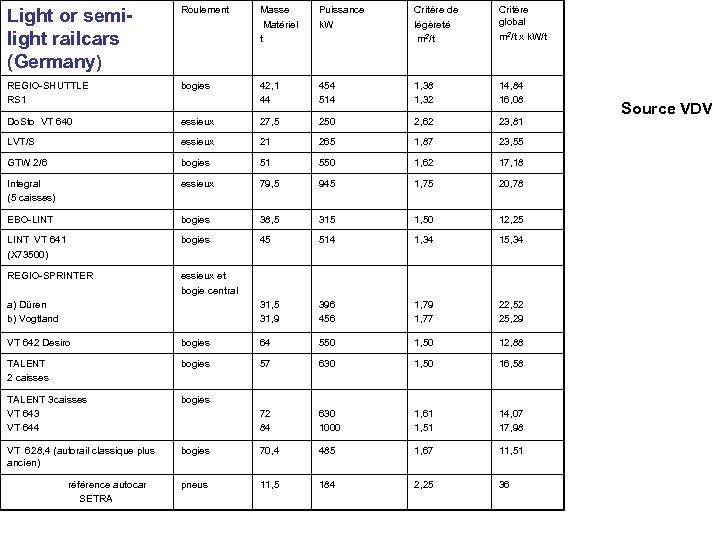
Light or semilight railcars (Germany) Roulement Masse Matériel t Puissance k. W Critère de légèreté m 2/t Critère global m 2/t x k. W/t REGIO-SHUTTLE RS 1 bogies 42, 1 44 454 514 1, 38 1, 32 14, 84 16, 08 Do. Sto VT 640 essieux 27, 5 250 2, 62 23, 81 LVT/S essieux 21 265 1, 87 23, 55 GTW 2/6 bogies 51 550 1, 62 17, 18 Integral (5 caisses) essieux 79, 5 945 1, 75 20, 78 EBO-LINT bogies 38, 5 315 1, 50 12, 25 LINT VT 641 (X 73500) bogies 45 514 1, 34 15, 34 REGIO-SPRINTER essieux et bogie central 31, 5 396 31, 9 456 1, 79 1, 77 22, 52 25, 29 a) Düren b) Vogtland VT 642 Desiro bogies 64 550 1, 50 12, 88 TALENT 2 caisses bogies 57 630 1, 50 16, 58 TALENT 3 caisses VT 643 VT 644 bogies 72 84 630 1000 1, 61 1, 51 14, 07 17, 98 VT 628, 4 (autorail classique plus ancien) bogies 70, 4 485 1, 67 11, 51 référence autocar SETRA pneus 11, 5 184 2, 25 36 Source VDV
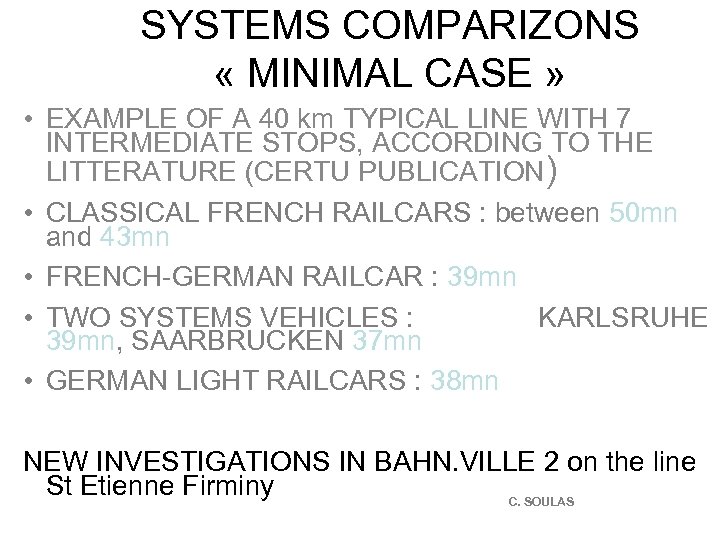
SYSTEMS COMPARIZONS « MINIMAL CASE » • EXAMPLE OF A 40 km TYPICAL LINE WITH 7 INTERMEDIATE STOPS, ACCORDING TO THE LITTERATURE (CERTU PUBLICATION) • CLASSICAL FRENCH RAILCARS : between 50 mn and 43 mn • FRENCH-GERMAN RAILCAR : 39 mn • TWO SYSTEMS VEHICLES : KARLSRUHE 39 mn, SAARBRUCKEN 37 mn • GERMAN LIGHT RAILCARS : 38 mn NEW INVESTIGATIONS IN BAHN. VILLE 2 on the line St Etienne Firminy C. SOULAS
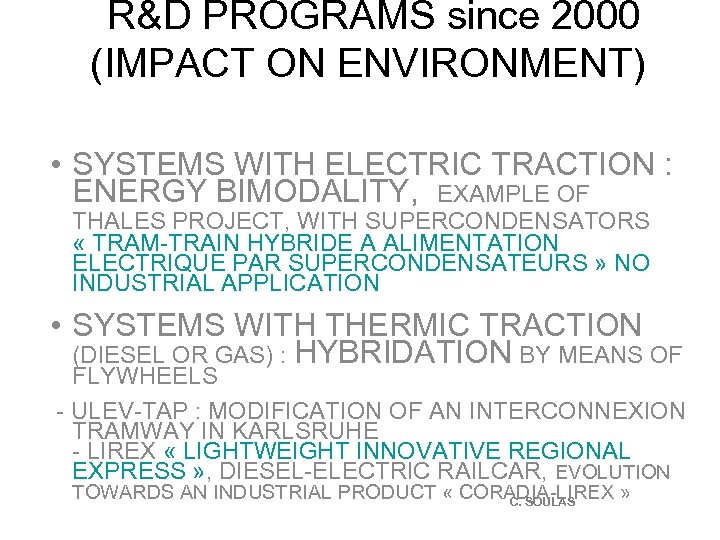
R&D PROGRAMS since 2000 (IMPACT ON ENVIRONMENT) • SYSTEMS WITH ELECTRIC TRACTION : ENERGY BIMODALITY, EXAMPLE OF THALES PROJECT, WITH SUPERCONDENSATORS « TRAM-TRAIN HYBRIDE A ALIMENTATION ELECTRIQUE PAR SUPERCONDENSATEURS » NO INDUSTRIAL APPLICATION • SYSTEMS WITH THERMIC TRACTION (DIESEL OR GAS) : HYBRIDATION BY MEANS OF FLYWHEELS - ULEV-TAP : MODIFICATION OF AN INTERCONNEXION TRAMWAY IN KARLSRUHE - LIREX « LIGHTWEIGHT INNOVATIVE REGIONAL EXPRESS » , DIESEL-ELECTRIC RAILCAR, EVOLUTION TOWARDS AN INDUSTRIAL PRODUCT « CORADIA-LIREX » C. SOULAS
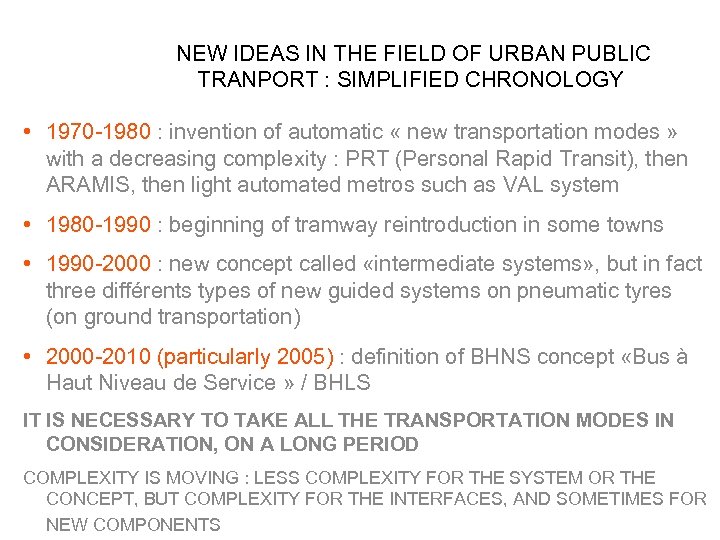
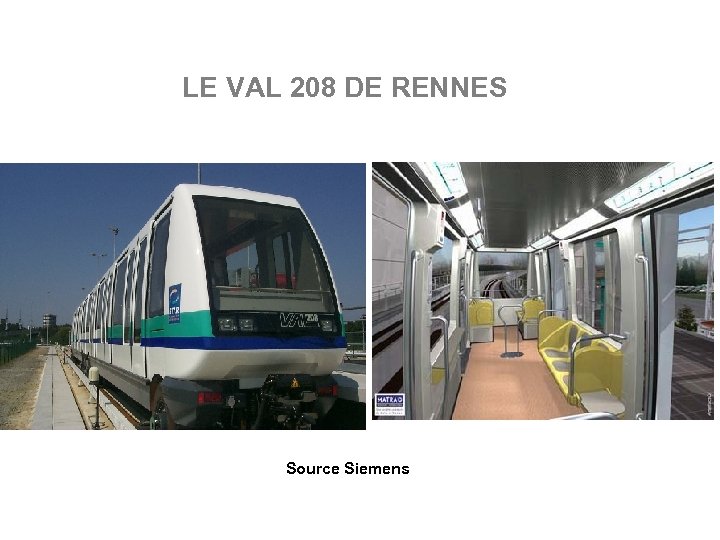
NEW IDEAS IN THE FIELD OF URBAN PUBLIC TRANPORT : SIMPLIFIED CHRONOLOGY • 1970 -1980 : invention of automatic « new transportation modes » with a decreasing complexity : PRT (Personal Rapid Transit), then ARAMIS, then light automated metros such as VAL system • 1980 -1990 : beginning of tramway reintroduction in some towns • 1990 -2000 : new concept called «intermediate systems» , but in fact three différents types of new guided systems on pneumatic tyres (on ground transportation) • 2000 -2010 (particularly 2005) : definition of BHNS concept «Bus à Haut Niveau de Service » / BHLS IT IS NECESSARY TO TAKE ALL THE TRANSPORTATION MODES IN CONSIDERATION, ON A LONG PERIOD COMPLEXITY IS MOVING : LESS COMPLEXITY FOR THE SYSTEM OR THE CONCEPT, BUT COMPLEXITY FOR THE INTERFACES, AND SOMETIMES FOR NEW COMPONENTS
AUTOMATIC SYSTEMS : 40 YEARS OF RESEARCH AND DEVELOPMENT • Considered as an universal potential solution in 1970 and later : it contributed to delay tramway reintroduction as well as bus netwoks improvements • Main limitation of the diffusion : difficult acceptance of aerial guideway in towns, high cost of tunnels (or cut-off effect at groung level) • In the context of European countries it is an adequate solution in some cases : for metros and mini-metros in order to increase system attractivity during off-peak hours, and for short to middle range sytems where high frequency is necessary • A LONG TIME FOR MATURATION , eg for VAL sytem : after 40 years it appears the NEOVAL system with an optimized guiding device
LE VAL 208 DE RENNES Source Siemens
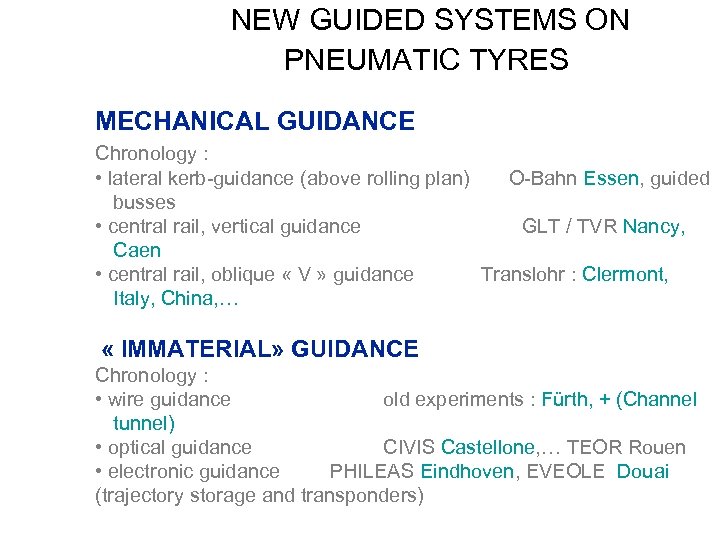
NEW GUIDED SYSTEMS ON PNEUMATIC TYRES MECHANICAL GUIDANCE Chronology : • lateral kerb-guidance (above rolling plan) O-Bahn Essen, guided busses • central rail, vertical guidance GLT / TVR Nancy, Caen • central rail, oblique « V » guidance Translohr : Clermont, Italy, China, … « IMMATERIAL» GUIDANCE Chronology : • wire guidance old experiments : Fürth, + (Channel tunnel) • optical guidance CIVIS Castellone, … TEOR Rouen • electronic guidance PHILEAS Eindhoven, EVEOLE Douai (trajectory storage and transponders)
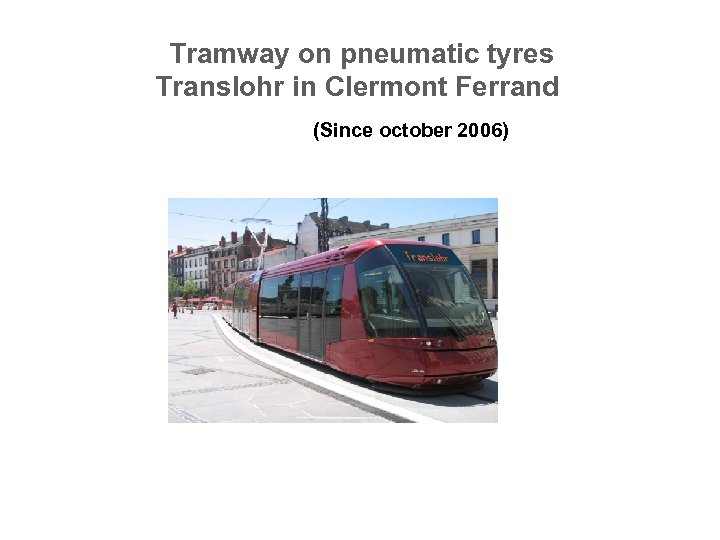
Tramway on pneumatic tyres Translohr in Clermont Ferrand (Since october 2006)
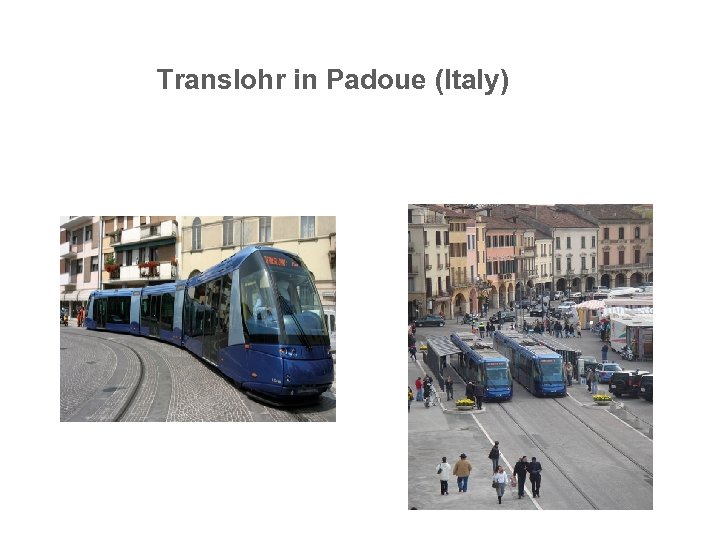
Translohr in Padoue (Italy)
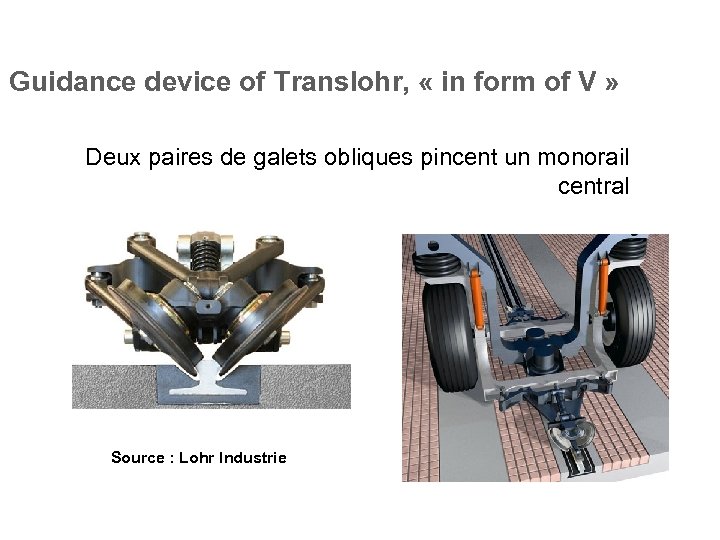
Guidance device of Translohr, « in form of V » Deux paires de galets obliques pincent un monorail central Source : Lohr Industrie
BHLS AND TRAM COMPARIZON • Cost comparizon is not the only one criteria and has to be replaced in its context. Eg 30 years ago a demonstration that fully automatic H-Bahn was cheaper than bus system for a network in the town of Erlangen. But hypothesis 1 mn frequency. • Compared to other investigations the FGSV cost comparizon (publication 2008) coordinated by V Deutsch (University Wuppertal) has two advantages : - it avoids to compare « apples with peers » , by choosing identical conditions - has limited the scope of the comparizon to a reasonable ridership for European context The choice of some parameters remains of course difficult
A PRUDENT INTERPRETATION OF BHLS AND TRAM COMPARIZON Results depend on the context : - in term of total cost during a 30 years period, in some conditions a 24 m biarticulated diesel BHLS could be significantly cheaper than tram, eg 30%, but not 2 times cheaper ; - for a 24 m biarticulated BHLS trolleybus total costs are comparable to that of tram, if we consider a 5 mn interval for trolleybus and 8 mn interval for tram. Comparizon relevant only for ridersip not higher than 2 500 pasengers/ h/ direction • Some elements are difficult to monetarize, eg smaller width of tram lanes, better regularity (longer vehicles at traffic lights) • Importance of some questions such as impact of electric supply
Скачать презентацию Various concepts of guided transport systems for periurban
ad206494823d899237a1514792c653c2.ppt