


 Скачать презентацию VANET Simulations with Ji ST SWANS SEVECOM Kick-off
95007e0e961793c2cb4aa0174902baba.ppt
- Количество слайдов: 16
 VANET Simulations with Ji. ST/ SWANS SEVECOM Kick-off Workshop Elmar Schoch • elmar. schoch@uni-ulm. de
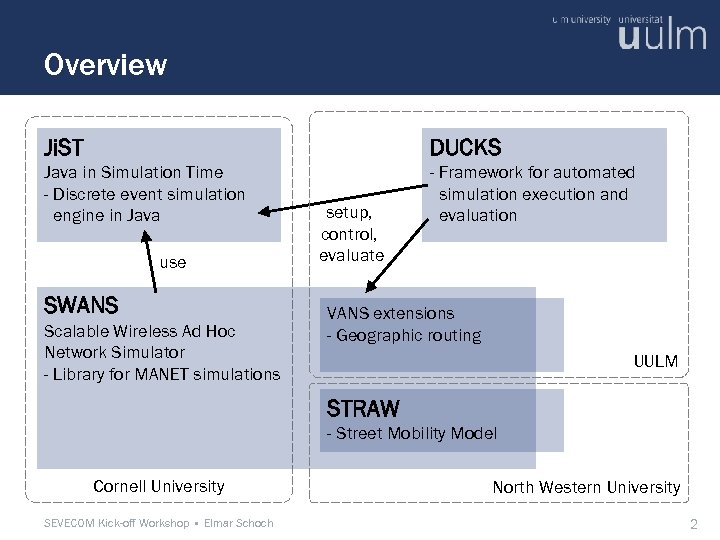 Overview Ji. ST DUCKS Java in Simulation Time - Discrete event simulation engine in Java - Framework for automated simulation execution and evaluation use SWANS Scalable Wireless Ad Hoc Network Simulator - Library for MANET simulations setup, control, evaluate VANS extensions - Geographic routing UULM STRAW - Street Mobility Model Cornell University SEVECOM Kick-off Workshop • Elmar Schoch North Western University 2
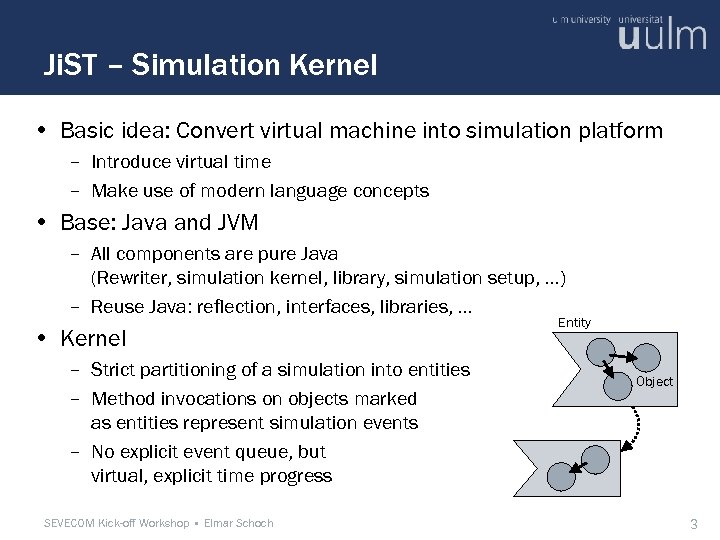 Ji. ST – Simulation Kernel • Basic idea: Convert virtual machine into simulation platform – Introduce virtual time – Make use of modern language concepts • Base: Java and JVM – All components are pure Java (Rewriter, simulation kernel, library, simulation setup, …) – Reuse Java: reflection, interfaces, libraries, … • Kernel – Strict partitioning of a simulation into entities – Method invocations on objects marked as entities represent simulation events – No explicit event queue, but virtual, explicit time progress SEVECOM Kick-off Workshop • Elmar Schoch Entity Object 3
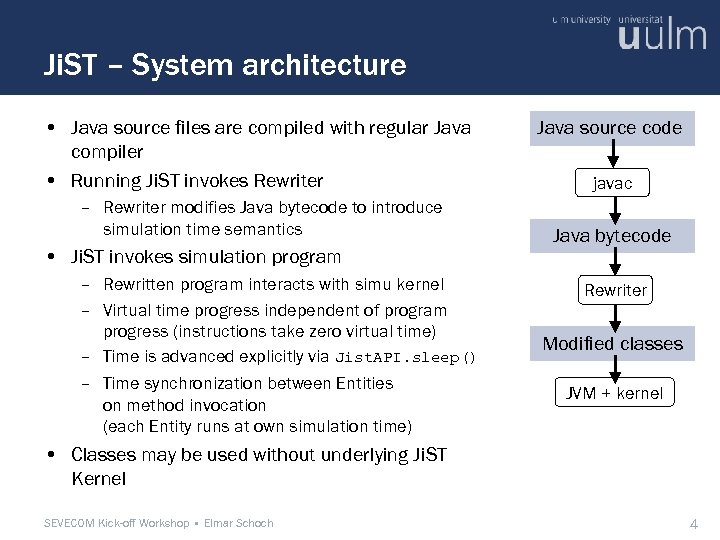 Ji. ST – System architecture • Java source files are compiled with regular Java compiler • Running Ji. ST invokes Rewriter – Rewriter modifies Java bytecode to introduce simulation time semantics • Ji. ST invokes simulation program – Rewritten program interacts with simu kernel – Virtual time progress independent of program progress (instructions take zero virtual time) – Time is advanced explicitly via Jist. API. sleep() – Time synchronization between Entities on method invocation (each Entity runs at own simulation time) Java source code javac Java bytecode Rewriter Modified classes JVM + kernel • Classes may be used without underlying Ji. ST Kernel SEVECOM Kick-off Workshop • Elmar Schoch 4
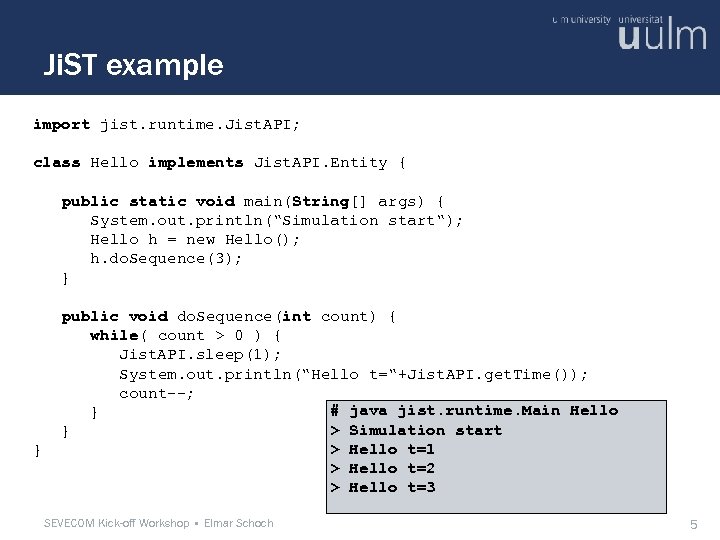 Ji. ST example import jist. runtime. Jist. API; class Hello implements Jist. API. Entity { public static void main(String[] args) { System. out. println(“Simulation start“); Hello h = new Hello(); h. do. Sequence(3); } } public void do. Sequence(int count) { while( count > 0 ) { Jist. API. sleep(1); System. out. println(“Hello t=“+Jist. API. get. Time()); count--; # java jist. runtime. Main Hello } > Simulation start } > Hello t=1 > Hello t=2 > Hello t=3 SEVECOM Kick-off Workshop • Elmar Schoch 5
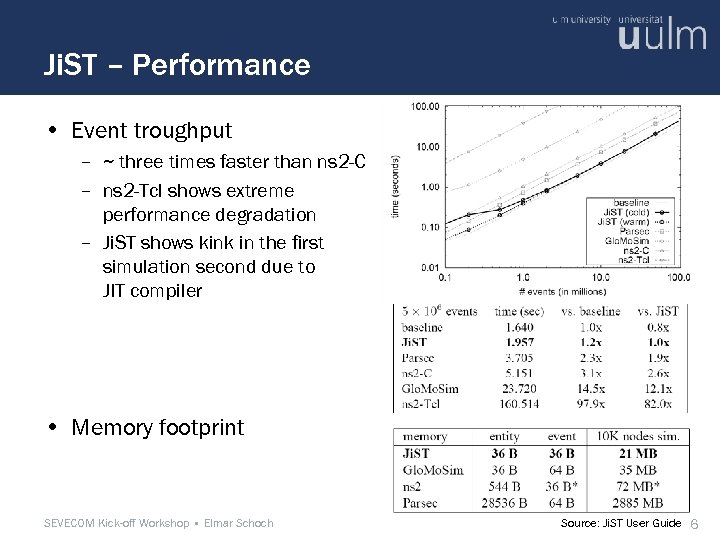 Ji. ST – Performance • Event troughput – ~ three times faster than ns 2 -C – ns 2 -Tcl shows extreme performance degradation – Ji. ST shows kink in the first simulation second due to JIT compiler • Memory footprint SEVECOM Kick-off Workshop • Elmar Schoch Source: Ji. ST User Guide 6
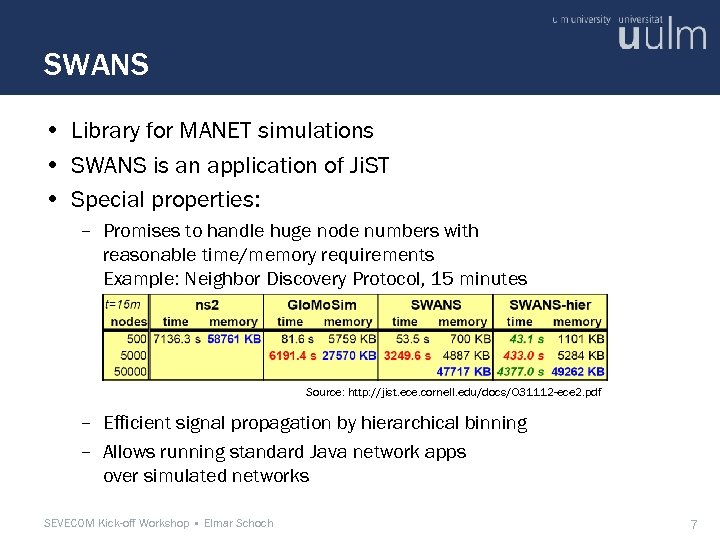 SWANS • Library for MANET simulations • SWANS is an application of Ji. ST • Special properties: – Promises to handle huge node numbers with reasonable time/memory requirements Example: Neighbor Discovery Protocol, 15 minutes Source: http: //jist. ece. cornell. edu/docs/031112 -ece 2. pdf – Efficient signal propagation by hierarchical binning – Allows running standard Java network apps over simulated networks SEVECOM Kick-off Workshop • Elmar Schoch 7
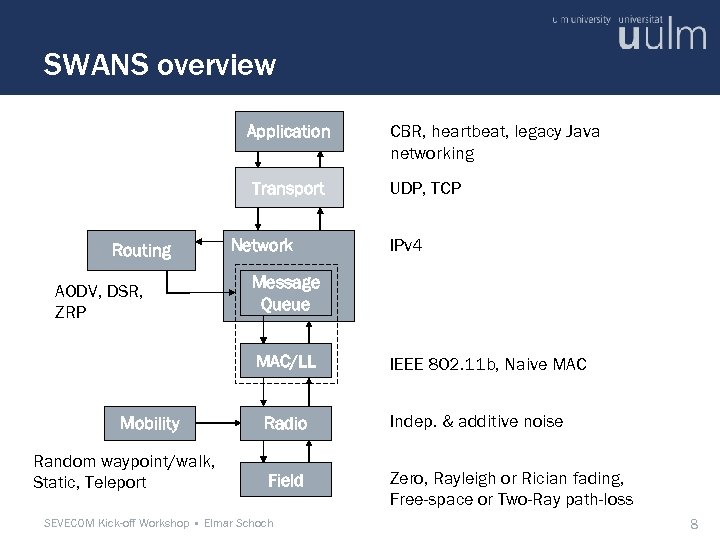 SWANS overview Application Transport Routing AODV, DSR, ZRP Network Random waypoint/walk, Static, Teleport UDP, TCP IPv 4 Message Queue MAC/LL Mobility CBR, heartbeat, legacy Java networking IEEE 802. 11 b, Naive MAC Radio Indep. & additive noise Field Zero, Rayleigh or Rician fading, Free-space or Two-Ray path-loss SEVECOM Kick-off Workshop • Elmar Schoch 8
 VANET simulations • Node mobility model STRAW – Vehicle movements • High velocities • Quasi one-dimensional movements on highways • Short encounters of oncoming traffic – Vehicle Behavior • Radio/Medium Access – Decentralized medium access, bandwidth allocation – Realistic radio propagation in urban environments • Routing – Position-based routing particularly suitable Currently implemented by UULM • Applications – Extreme variety of application ideas – Other C 2 C projects? SEVECOM Kick-off Workshop • Elmar Schoch 9
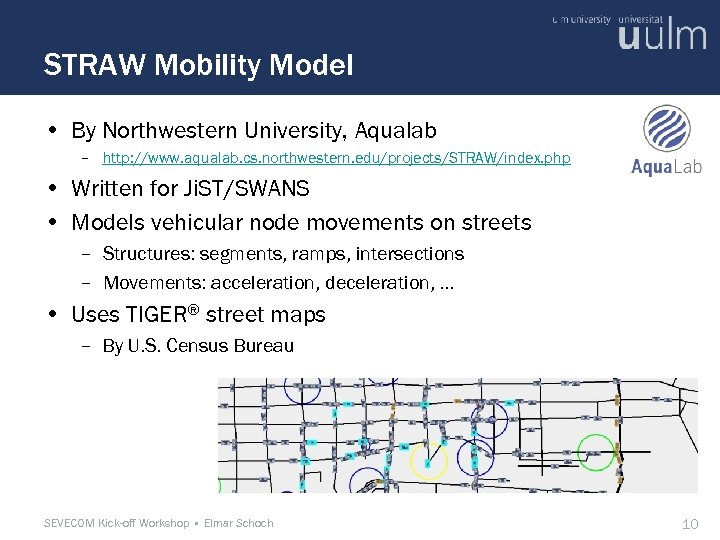 STRAW Mobility Model • By Northwestern University, Aqualab – http: //www. aqualab. cs. northwestern. edu/projects/STRAW/index. php • Written for Ji. ST/SWANS • Models vehicular node movements on streets – Structures: segments, ramps, intersections – Movements: acceleration, deceleration, … • Uses TIGER® street maps – By U. S. Census Bureau SEVECOM Kick-off Workshop • Elmar Schoch 10
 DUCKS simulation framework • Problem: – Ji. ST/SWANS lacks tools for handling simulation parameters and output • Solutions by DUCKS: – Easily define complete simulation scenarios by config files (e. g. various simulation setup parameters like field size, node number, . . . ) – Automated execution of simulations – Easy distribution of simulation on multiple servers – Structured statistics collection, storage and evaluation • Implementation nearly finished (still fixing some issues and extending usability) SEVECOM Kick-off Workshop • Elmar Schoch 11
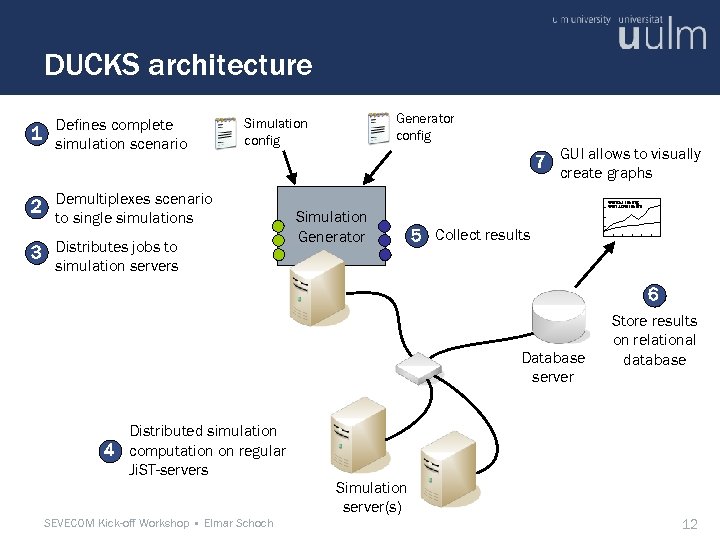 DUCKS architecture Defines complete 1 simulation scenario Generator config Simulation config 7 GUI allows to visually create graphs 2 Demultiplexes scenario to single simulations 3 Distributes jobs to Simulation Generator Without faking With 10% fakers 5 Collect results simulation servers 6 Database server Distributed simulation 4 computation on regular Ji. ST-servers SEVECOM Kick-off Workshop • Elmar Schoch Store results on relational database Simulation server(s) 12
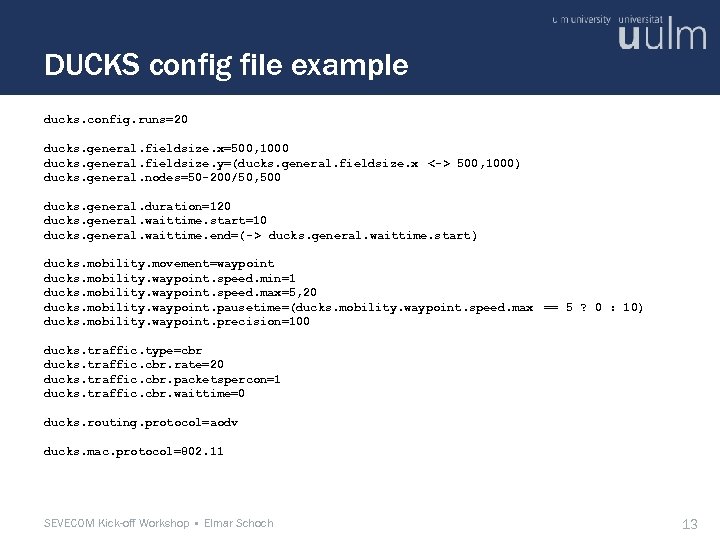 DUCKS config file example ducks. config. runs=20 ducks. general. fieldsize. x=500, 1000 ducks. general. fieldsize. y=(ducks. general. fieldsize. x <-> 500, 1000) ducks. general. nodes=50 -200/50, 500 ducks. general. duration=120 ducks. general. waittime. start=10 ducks. general. waittime. end=(- > ducks. general. waittime. start ) ducks. mobility. movement=waypoint ducks. mobility. waypoint. speed. min=1 ducks. mobility. waypoint. speed. max=5, 20 ducks. mobility. waypoint. pausetime=(ducks. mobility. waypoint. speed. max == 5 ? 0 : 10) ducks. mobility. waypoint. precision=100 ducks. traffic. type=cbr ducks. traffic. cbr. rate=20 ducks. traffic. cbr. packetspercon=1 ducks. traffic. cbr. waittime=0 ducks. routing. protocol=aodv ducks. mac. protocol=802. 11 SEVECOM Kick-off Workshop • Elmar Schoch 13
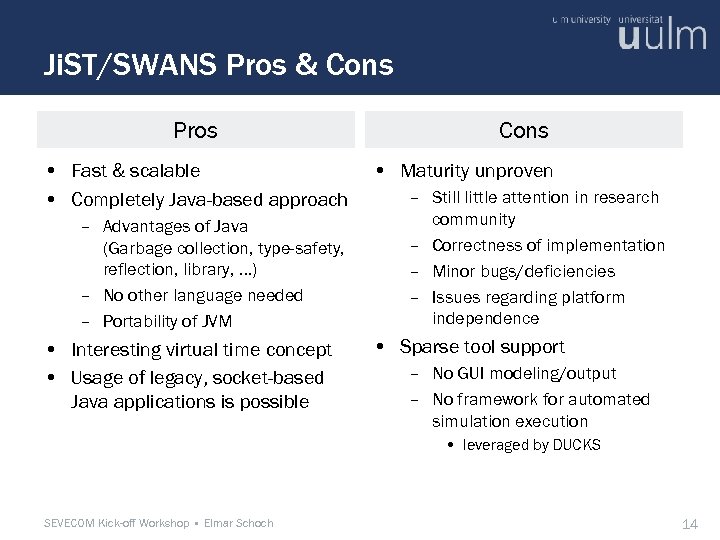 Ji. ST/SWANS Pros & Cons Pros • Fast & scalable • Completely Java-based approach – Advantages of Java (Garbage collection, type-safety, reflection, library, …) – No other language needed – Portability of JVM • Interesting virtual time concept • Usage of legacy, socket-based Java applications is possible Cons • Maturity unproven – Still little attention in research community – Correctness of implementation – Minor bugs/deficiencies – Issues regarding platform independence • Sparse tool support – No GUI modeling/output – No framework for automated simulation execution • leveraged by DUCKS SEVECOM Kick-off Workshop • Elmar Schoch 14
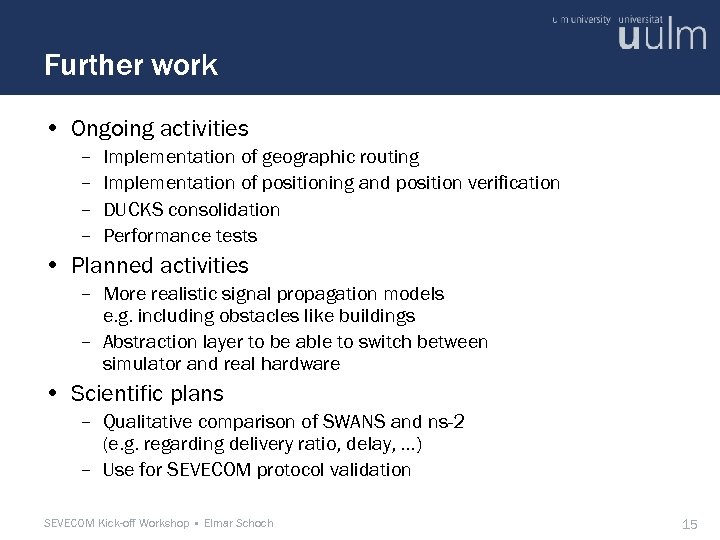 Further work • Ongoing activities – – Implementation of geographic routing Implementation of positioning and position verification DUCKS consolidation Performance tests • Planned activities – More realistic signal propagation models e. g. including obstacles like buildings – Abstraction layer to be able to switch between simulator and real hardware • Scientific plans – Qualitative comparison of SWANS and ns-2 (e. g. regarding delivery ratio, delay, …) – Use for SEVECOM protocol validation SEVECOM Kick-off Workshop • Elmar Schoch 15
 SEVECOM Kick-off Workshop • Elmar Schoch 16