 Скачать презентацию Vanderbilt Radiation Effects Research Institute for Space and
cd51981ca0e36a866eb578a70af1612f.ppt
- Количество слайдов: 16



Vanderbilt Radiation Effects Research Institute for Space and Defense Electronics Ron Schrimpf Department of Electrical Engineering and Computer Science

Vanderbilt University l Located in Nashville, TN l ~11, 000 students l Private l Engineering, Arts & Sciences, Medicine, Law, Business, Education, Music…
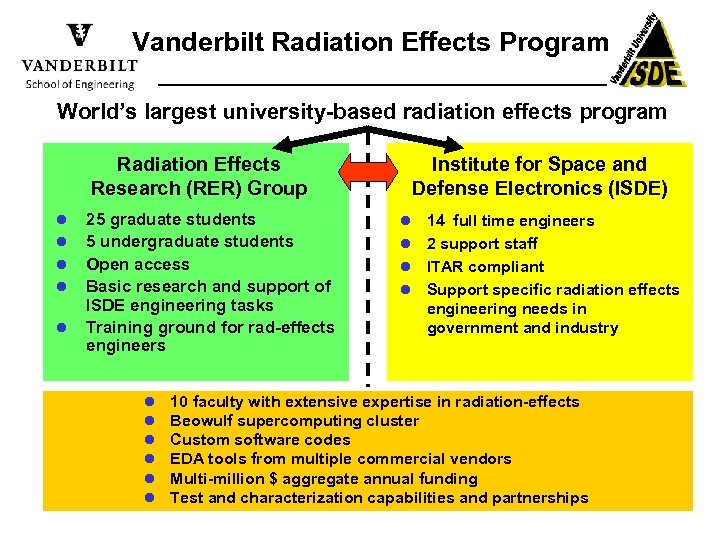
Vanderbilt Radiation Effects Program World’s largest university-based radiation effects program Radiation Effects Research (RER) Group l l l 25 graduate students 5 undergraduate students Open access Basic research and support of ISDE engineering tasks Training ground for rad-effects engineers l l l Institute for Space and Defense Electronics (ISDE) 14 full time engineers l 2 support staff l ITAR compliant l Support specific radiation effects engineering needs in government and industry l 10 faculty with extensive expertise in radiation-effects Beowulf supercomputing cluster Custom software codes EDA tools from multiple commercial vendors Multi-million $ aggregate annual funding Test and characterization capabilities and partnerships
What is ISDE ? Founded January 1, 2003 as a resource to support radiation effects analysis and rad-hard design needs Brings academic resources/expertise and real-world engineering to bear on system-driven needs ISDE provides: l Government and industry radiation-effects resource • Modeling and simulation • Design support: rad models, hardening by design • Technology support: assessment, characterization l Flexible staffing driven by project needs • 10 Faculty • 25 Graduate students • 14 Professional, non-tenured engineering staff
ISDE Capabilities l Characterize radiation and reliability responses of technologies l Develop and maintain device and circuit models and software tools l Apply simulation tools in support of design and characterization l Assist in IC and system design activities l Support development of test plans and standards l Interpret radiation and reliability test results l Assess capabilities and limitations of new technologies • Deep submicron (scaling, new materials, new structures) • Opto, nano, bio l Provide training, documentation and instructional materials l Serve as a radiation effects “SWAT” team
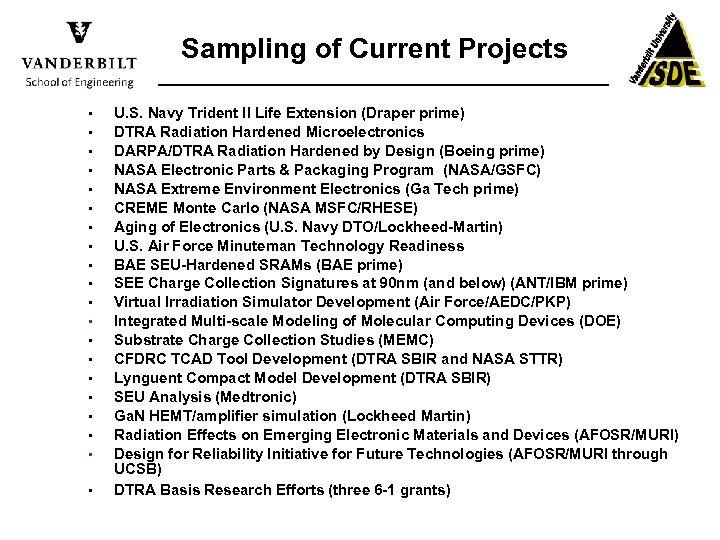
Sampling of Current Projects • • • • • U. S. Navy Trident II Life Extension (Draper prime) DTRA Radiation Hardened Microelectronics DARPA/DTRA Radiation Hardened by Design (Boeing prime) NASA Electronic Parts & Packaging Program (NASA/GSFC) NASA Extreme Environment Electronics (Ga Tech prime) CREME Monte Carlo (NASA MSFC/RHESE) Aging of Electronics (U. S. Navy DTO/Lockheed-Martin) U. S. Air Force Minuteman Technology Readiness BAE SEU-Hardened SRAMs (BAE prime) SEE Charge Collection Signatures at 90 nm (and below) (ANT/IBM prime) Virtual Irradiation Simulator Development (Air Force/AEDC/PKP) Integrated Multi-scale Modeling of Molecular Computing Devices (DOE) Substrate Charge Collection Studies (MEMC) CFDRC TCAD Tool Development (DTRA SBIR and NASA STTR) Lynguent Compact Model Development (DTRA SBIR) SEU Analysis (Medtronic) Ga. N HEMT/amplifier simulation (Lockheed Martin) Radiation Effects on Emerging Electronic Materials and Devices (AFOSR/MURI) Design for Reliability Initiative for Future Technologies (AFOSR/MURI through UCSB) DTRA Basis Research Efforts (three 6 -1 grants)
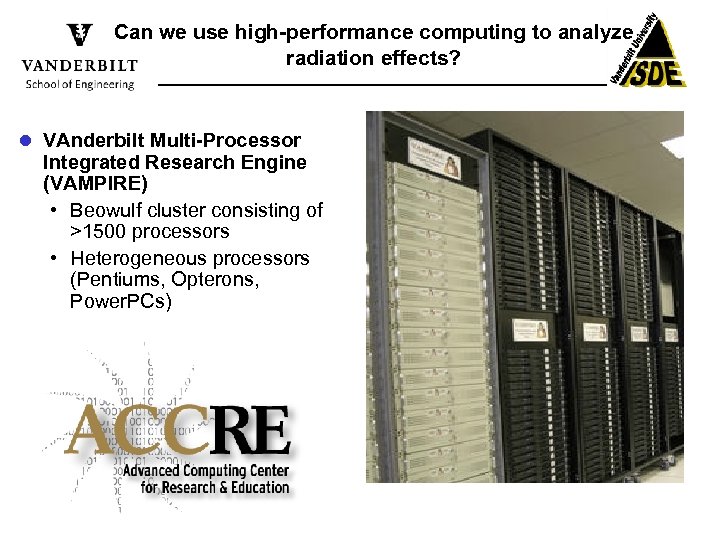
Can we use high-performance computing to analyze radiation effects? l VAnderbilt Multi-Processor Integrated Research Engine (VAMPIRE) • Beowulf cluster consisting of >1500 processors • Heterogeneous processors (Pentiums, Opterons, Power. PCs)
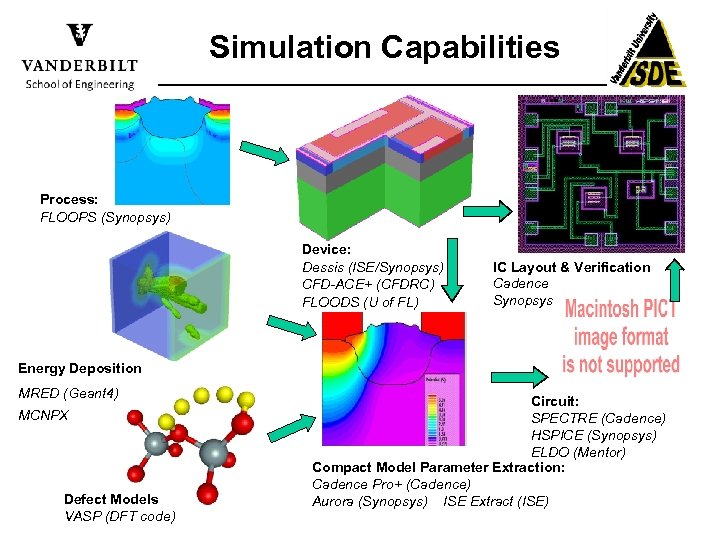
Simulation Capabilities Process: FLOOPS (Synopsys) Device: Dessis (ISE/Synopsys) CFD-ACE+ (CFDRC) FLOODS (U of FL) IC Layout & Verification Cadence Synopsys Energy Deposition MRED (Geant 4) MCNPX Defect Models VASP (DFT code) Circuit: SPECTRE (Cadence) HSPICE (Synopsys) ELDO (Mentor) Compact Model Parameter Extraction: Cadence Pro+ (Cadence) Aurora (Synopsys) ISE Extract (ISE)
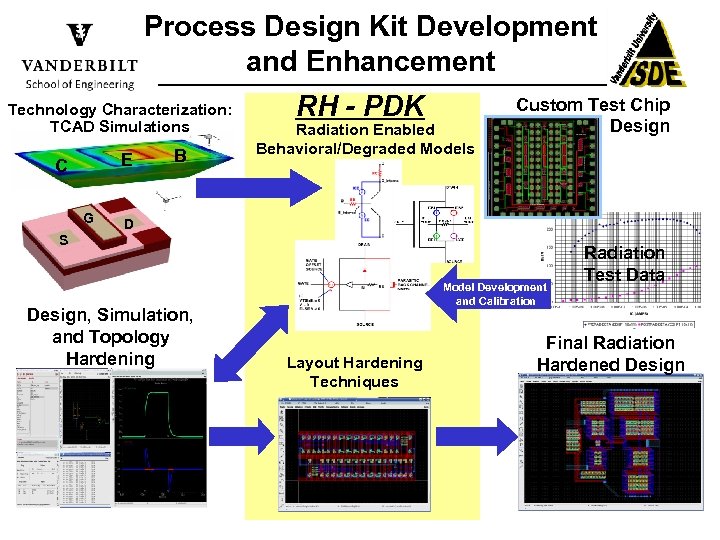
Process Design Kit Development and Enhancement Technology Characterization: TCAD Simulations E C G B RH - PDK Radiation Enabled Behavioral/Degraded Models Custom Test Chip Design D S Design, Simulation, and Topology Hardening Model Development and Calibration Layout Hardening Techniques Radiation Test Data Final Radiation Hardened Design
Physically Based Simulation of Radiation Events l 63 -Me. V proton incident on a Si. Ge HBT l Iso-charge surfaces following a nuclear reaction
Motion of an ion thru Si<110> -0. 08 0
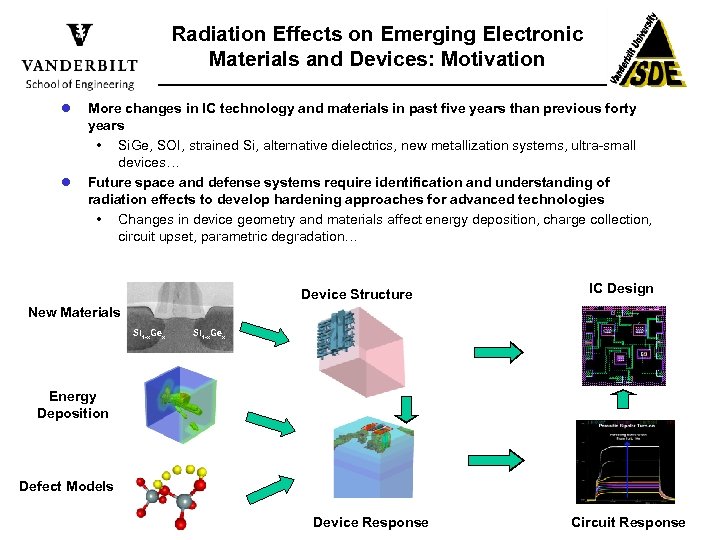
Radiation Effects on Emerging Electronic Materials and Devices: Motivation l l More changes in IC technology and materials in past five years than previous forty years • Si. Ge, SOI, strained Si, alternative dielectrics, new metallization systems, ultra-small devices… Future space and defense systems require identification and understanding of radiation effects to develop hardening approaches for advanced technologies • Changes in device geometry and materials affect energy deposition, charge collection, circuit upset, parametric degradation… Device Structure IC Design New Materials Si 1 -x. Gex Energy Deposition Defect Models Device Response Circuit Response
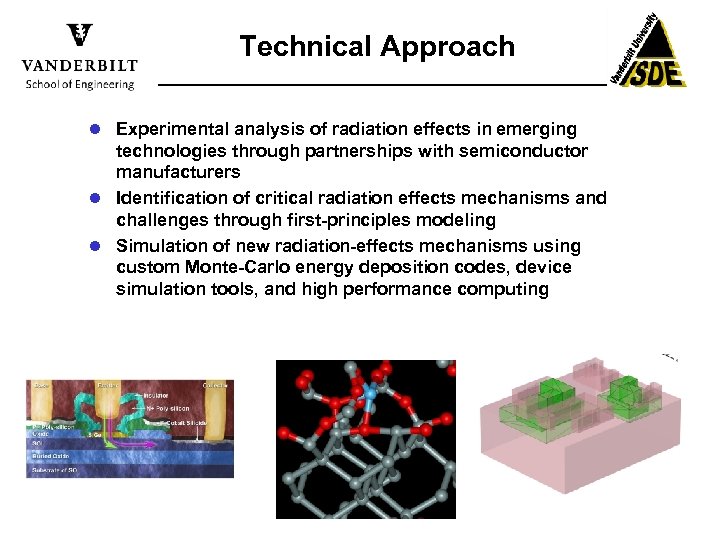
Technical Approach l Experimental analysis of radiation effects in emerging technologies through partnerships with semiconductor manufacturers l Identification of critical radiation effects mechanisms and challenges through first-principles modeling l Simulation of new radiation-effects mechanisms using custom Monte-Carlo energy deposition codes, device simulation tools, and high performance computing
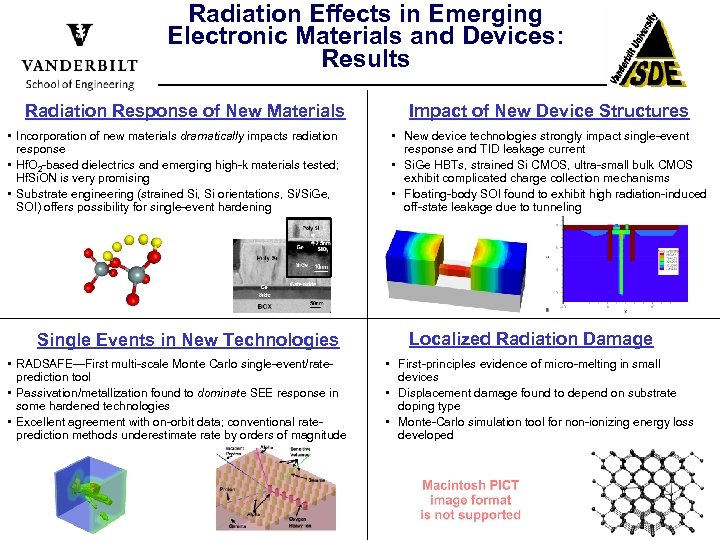
Radiation Effects in Emerging Electronic Materials and Devices: Results Radiation Response of New Materials • Incorporation of new materials dramatically impacts radiation response • Hf. O 2 -based dielectrics and emerging high-k materials tested; Hf. Si. ON is very promising • Substrate engineering (strained Si, Si orientations, Si/Si. Ge, SOI) offers possibility for single-event hardening Single Events in New Technologies • RADSAFE—First multi-scale Monte Carlo single-event/rateprediction tool • Passivation/metallization found to dominate SEE response in some hardened technologies • Excellent agreement with on-orbit data; conventional rateprediction methods underestimate rate by orders of magnitude Impact of New Device Structures • New device technologies strongly impact single-event response and TID leakage current • Si. Ge HBTs, strained Si CMOS, ultra-small bulk CMOS exhibit complicated charge collection mechanisms • Floating-body SOI found to exhibit high radiation-induced off-state leakage due to tunneling Localized Radiation Damage • First-principles evidence of micro-melting in small devices • Displacement damage found to depend on substrate doping type • Monte-Carlo simulation tool for non-ionizing energy loss developed
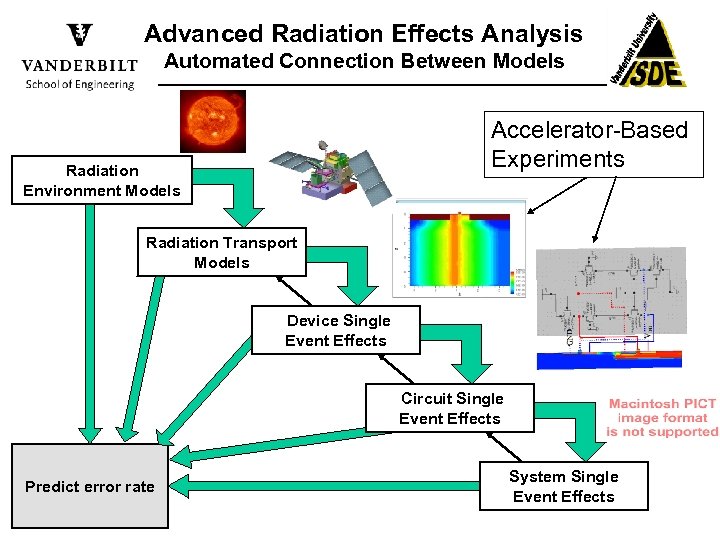
Advanced Radiation Effects Analysis Automated Connection Between Models Accelerator-Based Experiments Radiation Environment Models Radiation Transport Models • Device Single Event Effects • Circuit Single Event Effects Predict error rate System Single Event Effects
Summary l Vanderbilt has the largest university-based program focused on radiation effects in electronics. l Comprehensive approach from basic particle interactions to large-scale circuit and system performance. l Collaboration with multiple organizations.
Скачать презентацию Vanderbilt Radiation Effects Research Institute for Space and
cd51981ca0e36a866eb578a70af1612f.ppt