


 Скачать презентацию Values and Self-evaluation of Schools in the Czech
b6d3d9b85024b8e5f0f6c3db1aeeb67e.ppt
- Количество слайдов: 28
 Values and Self-evaluation of Schools in the Czech Republic Stanislav Michek stanislav. michek@nuov. cz 15 th April 2010, Helsinki
 Content of presentation § Context of Czech Republic § WAY TO QUALITY - National project for school self-evaluation
 Context information about Czech Republic educational system
 History milestones § § § Until 1989 – very centralised system From 1989 § Founding schools by private or religion founders § Demographic changes - decreesing of number pupils in education 2001 – White paper (National Programme for the Development of Education) 2001 - 2003 Decentralization and autonomy of schools 2004 – New Education Act and Educational Staff Act § Curricular reform: Framework Educational Programmes – School Educational Programmes § New role of Czech School Inspectorate § Self evaluation of schools
 Principles of Education shall be based on the principles of § equal access of all citizens § considering the educational needs of an individual; § mutual respect, deference, toleration of opinions, and dignity of all parties in education; § free basic and secondary education of citizens § free dissemination of findings arising from the results of current knowledge of the world and in compliance with general goals of education; § the opportunity given to everybody to learn for all their life whilst being aware of having co-responsibility for one’s education.
 Goals of Education General goals of education shall be, in particular, as follows: § the personal development of a human being who shall possess knowledge and social competencies, ethical and spiritual values for their personal and civil life, for the execution of a profession or working activities, and for acquiring information and learning in the course of life; § acquiring general education or general and vocational education; § understanding of and application of principles of democracy and a legal state, fundamental human rights and freedoms along with responsibility and a sense of social coherence; § understanding and application of the principle of equality of women and men in society; § the formation of national and state citizenship awareness and respect for the ethnic, national, cultural, language and religious identity of every person; § knowledge of global and European cultural values and traditions, understanding and acquiring principles and rules arising from European integration as a basis for coexistence at national and international levels; § acquisition and application of knowledge of the environment and its protection arising from the principles of sustainable growth and of safety and the protection of health.
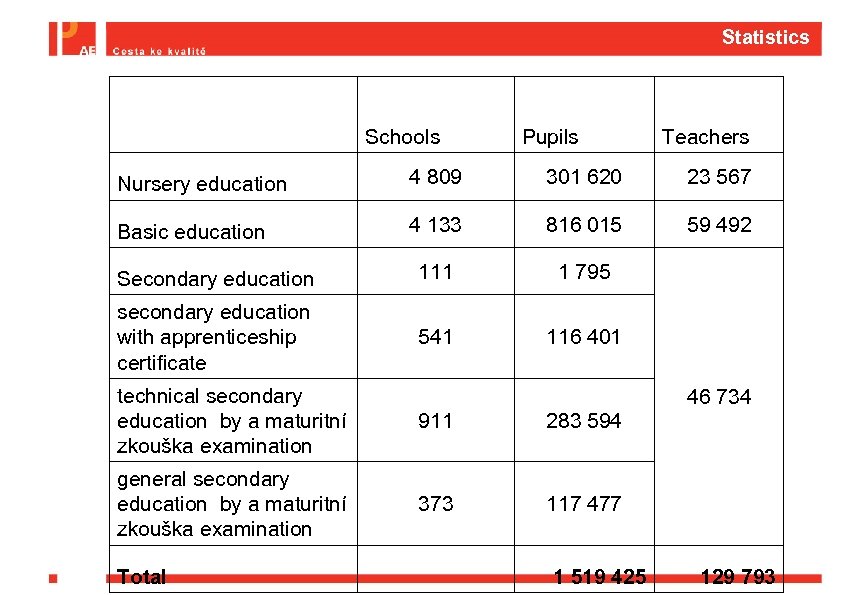 Statistics Schools Pupils Teachers Nursery education 4 809 301 620 23 567 Basic education 4 133 816 015 59 492 Secondary education 111 1 795 secondary education with apprenticeship certificate 541 116 401 technical secondary education by a maturitní zkouška examination 911 283 594 general secondary education by a maturitní zkouška examination 373 117 477 Total 46 734 1 519 425 129 793
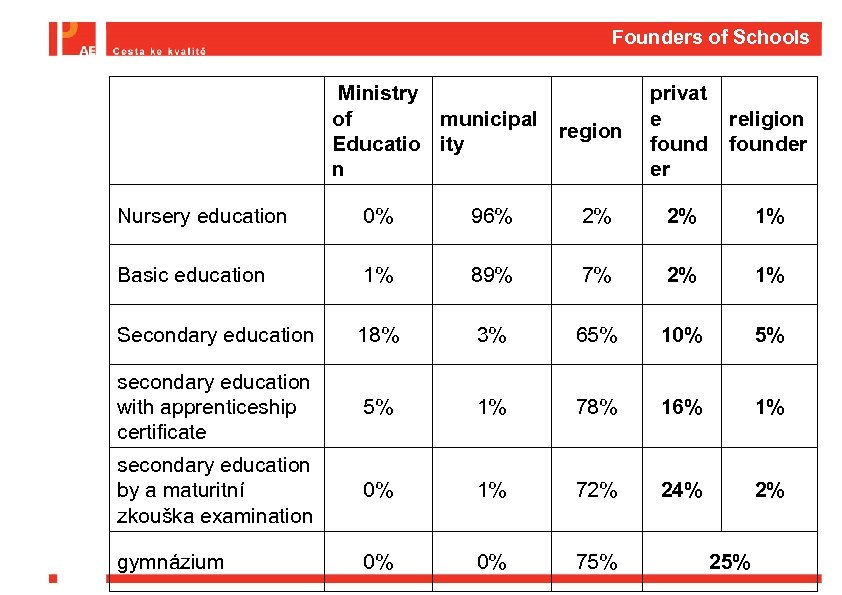 Founders of Schools Ministry municipal of Educatio ity n region privat e found er religion founder Nursery education 0% 96% 2% 2% 1% Basic education 1% 89% 7% 2% 1% Secondary education 18% 3% 65% 10% 5% secondary education with apprenticeship certificate 5% 1% 78% 16% 1% secondary education by a maturitní zkouška examination 0% 1% 72% 24% 2% gymnázium 0% 0% 75% 25%
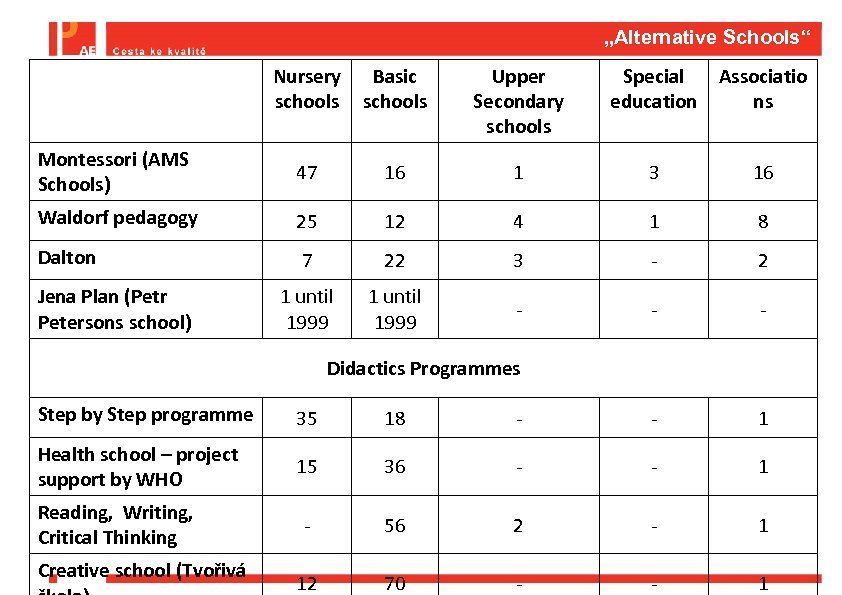 „Alternative Schools“ Nursery schools Basic schools Upper Secondary schools Special education Associatio ns Montessori (AMS Schools) 47 16 1 3 16 Waldorf pedagogy 25 12 4 1 8 Dalton 7 22 3 - 2 1 until 1999 - - - Jena Plan (Petr Petersons school) Didactics Programmes Step by Step programme 35 18 - - 1 Health school – project support by WHO 15 36 - - 1 - 56 2 - 1 12 70 - - 1 Reading, Writing, Critical Thinking Creative school (Tvořivá
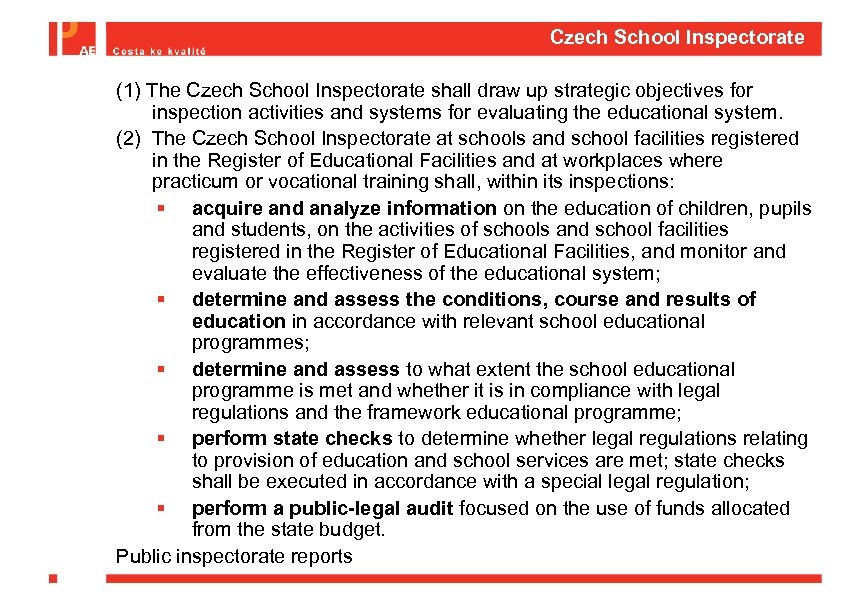 Czech School Inspectorate (1) The Czech School Inspectorate shall draw up strategic objectives for inspection activities and systems for evaluating the educational system. (2) The Czech School Inspectorate at schools and school facilities registered in the Register of Educational Facilities and at workplaces where practicum or vocational training shall, within its inspections: § acquire and analyze information on the education of children, pupils and students, on the activities of schools and school facilities registered in the Register of Educational Facilities, and monitor and evaluate the effectiveness of the educational system; § determine and assess the conditions, course and results of education in accordance with relevant school educational programmes; § determine and assess to what extent the school educational programme is met and whether it is in compliance with legal regulations and the framework educational programme; § perform state checks to determine whether legal regulations relating to provision of education and school services are met; state checks shall be executed in accordance with a special legal regulation; § perform a public-legal audit focused on the use of funds allocated from the state budget. Public inspectorate reports
 WAY TO QUALITY National project for school self-evaluation
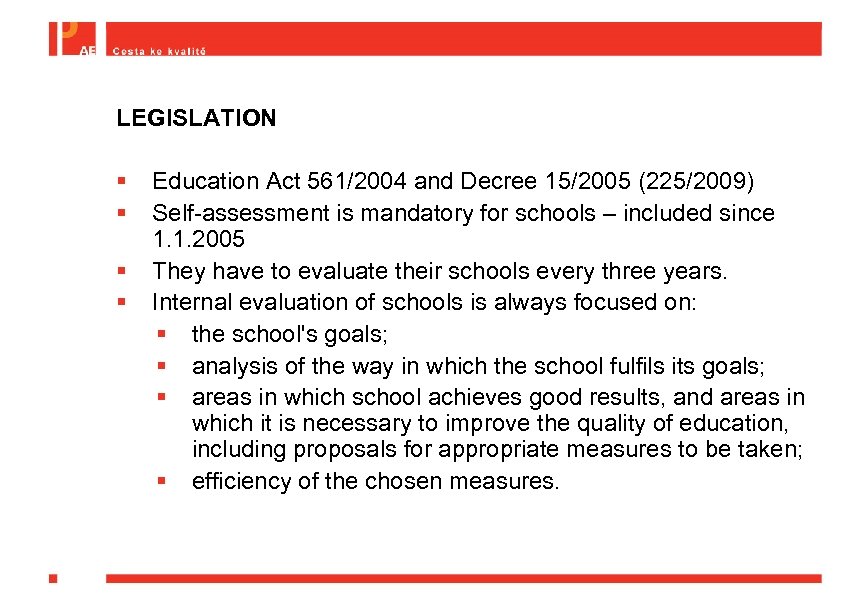 LEGISLATION § § Education Act 561/2004 and Decree 15/2005 (225/2009) Self-assessment is mandatory for schools – included since 1. 1. 2005 They have to evaluate their schools every three years. Internal evaluation of schools is always focused on: § the school's goals; § analysis of the way in which the school fulfils its goals; § areas in which school achieves good results, and areas in which it is necessary to improve the quality of education, including proposals for appropriate measures to be taken; § efficiency of the chosen measures.
 WHAT KIND OF SUPPORT SCHOOLS NEED? § § § § consultancy support further training methodology support financial support methodology guidelines of self-evaluation tools websites with good practice examples information about foreign approaches of self-evaluation
 PROJECT WAY TO QUALITY § Self-evaluation: setting up system and supporting school in self-evaluation – Way to Quality § § § Duration: May 2009 – April 2012 Budget: 77 million CZK (2 986 811 EUR) About 200 employees (different contracts) § Supported by European Social Fund (ESF) and state budget from Operational Programme Education for Competitiveness § Project of Ministry of Education, Youth and Sports § Partners: § NUOV - National Institute of Technical and Vocational Education § NIDV - National Institute for Further Education § Experts from: § Faculties of education and educational institutes of Charles University (Prague), Masaryk University (Brno), Palacky University (Olomouc), University of Ostrava, University of Pardubice § Founders and municipalities
 WAY TO QUALITY MAIN AIMS OF PROJECT § § Methodical support in school self-evaluation as one of the steps in curricular reform Supporting self-evaluation processes at schools as effective instrument of improvement in the quality of initial education Link self-evaluation and external evaluation in discussion among schools, inspection and statutory authorities Propose, verify and customize: § Methods and procedures of self-evaluation § Supporting systems for schools § System of teachers and leaders continuous training
 WAY TO QUALITY PRIMARY TARGET GROUPS SECONDARY TARGET GROUPS Management staff and teachers of these schools: § Special nursery schools § Primary schools § Elementary schools of music and arts § Conservatoires § Grammar schools § Secondary vocational schools § Secondary technical schools § Language schools with state language exam § § § 507 schools expressed their interest in project activities Pupils and students Experts in education Associations Organizations in education Decision makers Statutory authorities Inspectors Social partners (employers) Society (parents) Nongovernmental sector International partners
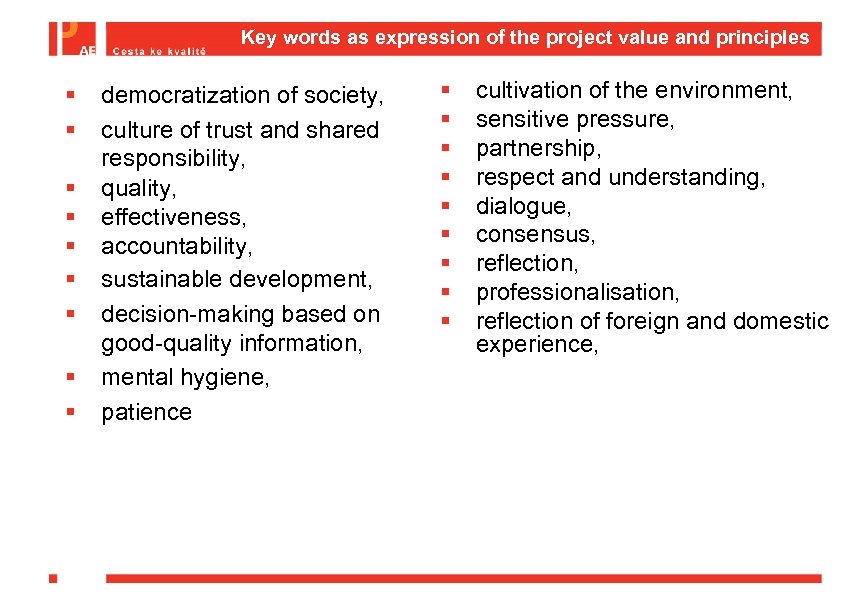 Key words as expression of the project value and principles § § § § § democratization of society, culture of trust and shared responsibility, quality, effectiveness, accountability, sustainable development, decision-making based on good-quality information, mental hygiene, patience § § § § § cultivation of the environment, sensitive pressure, partnership, respect and understanding, dialogue, consensus, reflection, professionalisation, reflection of foreign and domestic experience,
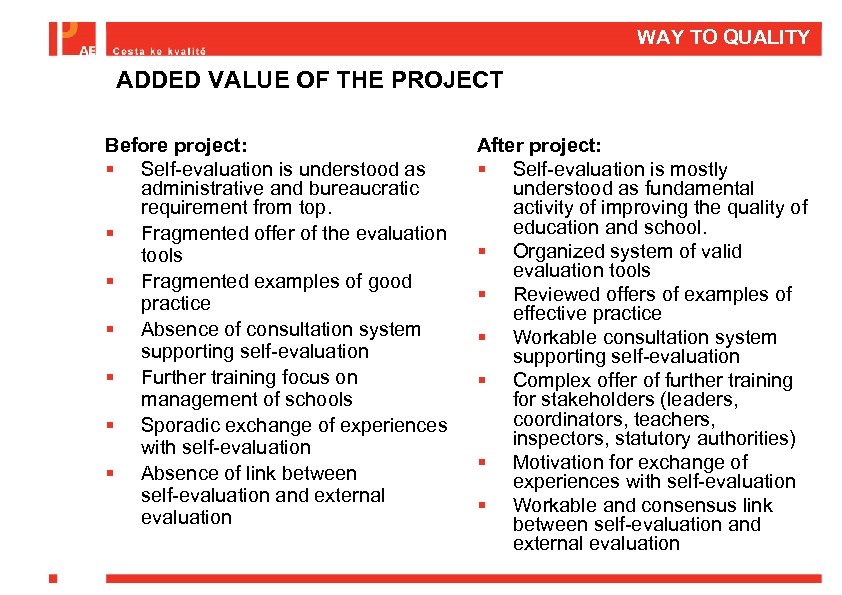 WAY TO QUALITY ADDED VALUE OF THE PROJECT Before project: § Self-evaluation is understood as administrative and bureaucratic requirement from top. § Fragmented offer of the evaluation tools § Fragmented examples of good practice § Absence of consultation system supporting self-evaluation § Further training focus on management of schools § Sporadic exchange of experiences with self-evaluation § Absence of link between self-evaluation and external evaluation After project: § Self-evaluation is mostly understood as fundamental activity of improving the quality of education and school. § Organized system of valid evaluation tools § Reviewed offers of examples of effective practice § Workable consultation system supporting self-evaluation § Complex offer of further training for stakeholders (leaders, coordinators, teachers, inspectors, statutory authorities) § Motivation for exchange of experiences with self-evaluation § Workable and consensus link between self-evaluation and external evaluation
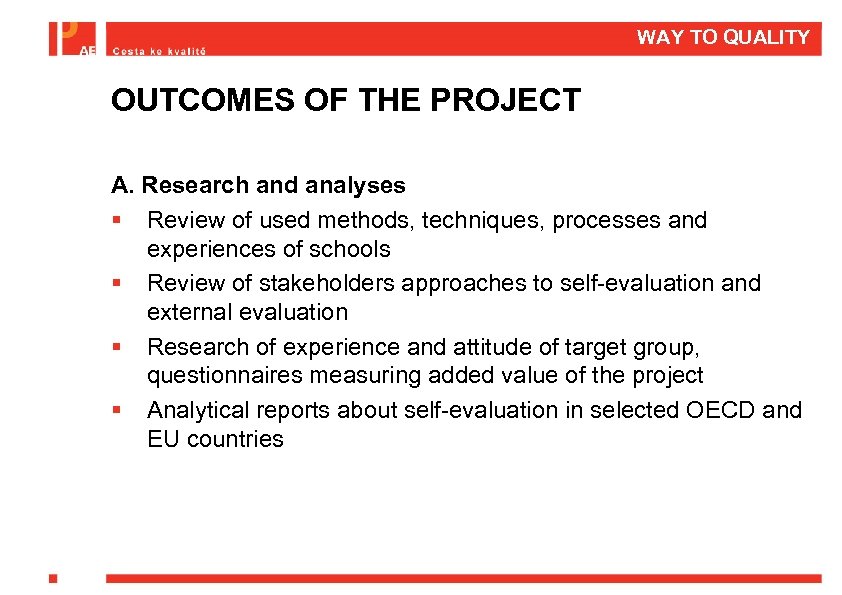 WAY TO QUALITY OUTCOMES OF THE PROJECT A. Research and analyses § Review of used methods, techniques, processes and experiences of schools § Review of stakeholders approaches to self-evaluation and external evaluation § Research of experience and attitude of target group, questionnaires measuring added value of the project § Analytical reports about self-evaluation in selected OECD and EU countries
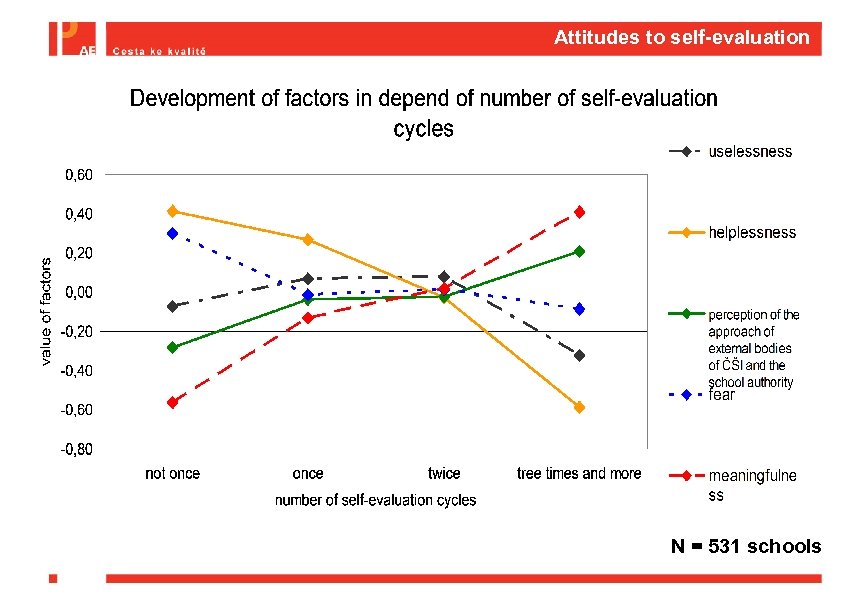 Attitudes to self-evaluation N = 531 schools
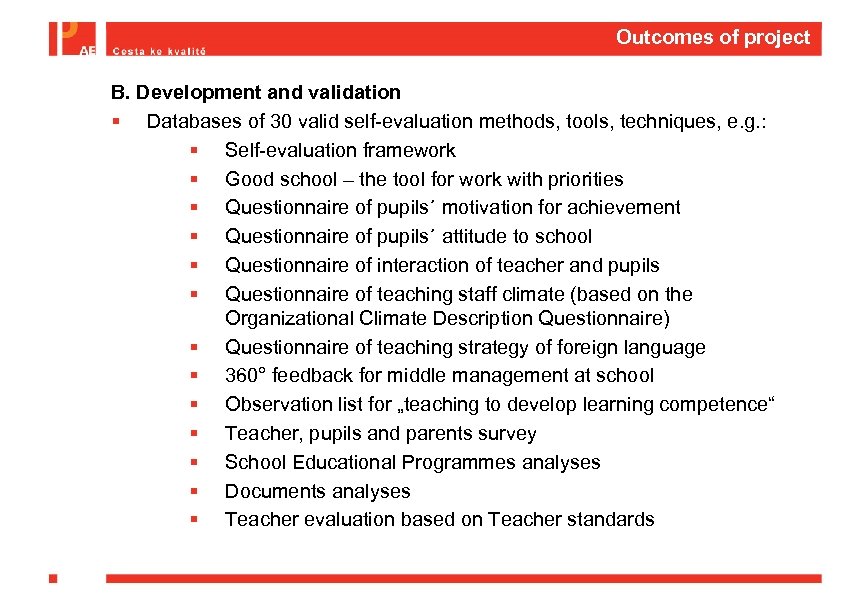 Outcomes of project B. Development and validation § Databases of 30 valid self-evaluation methods, tools, techniques, e. g. : § Self-evaluation framework § Good school – the tool for work with priorities § Questionnaire of pupils´ motivation for achievement § Questionnaire of pupils´ attitude to school § Questionnaire of interaction of teacher and pupils § Questionnaire of teaching staff climate (based on the Organizational Climate Description Questionnaire) § Questionnaire of teaching strategy of foreign language § 360° feedback for middle management at school § Observation list for „teaching to develop learning competence“ § Teacher, pupils and parents survey § School Educational Programmes analyses § Documents analyses § Teacher evaluation based on Teacher standards
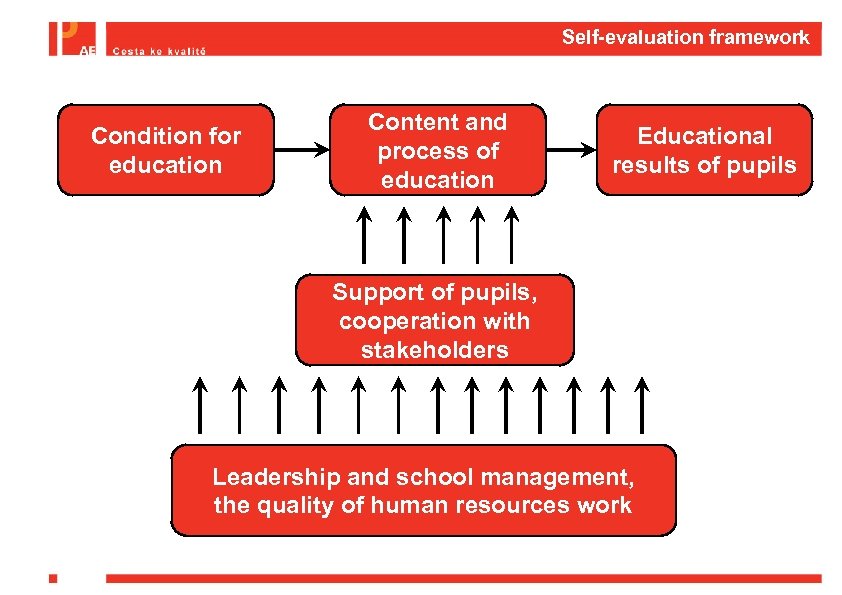 Self-evaluation framework Condition for education Content and process of education Educational results of pupils Support of pupils, cooperation with stakeholders Leadership and school management, the quality of human resources work
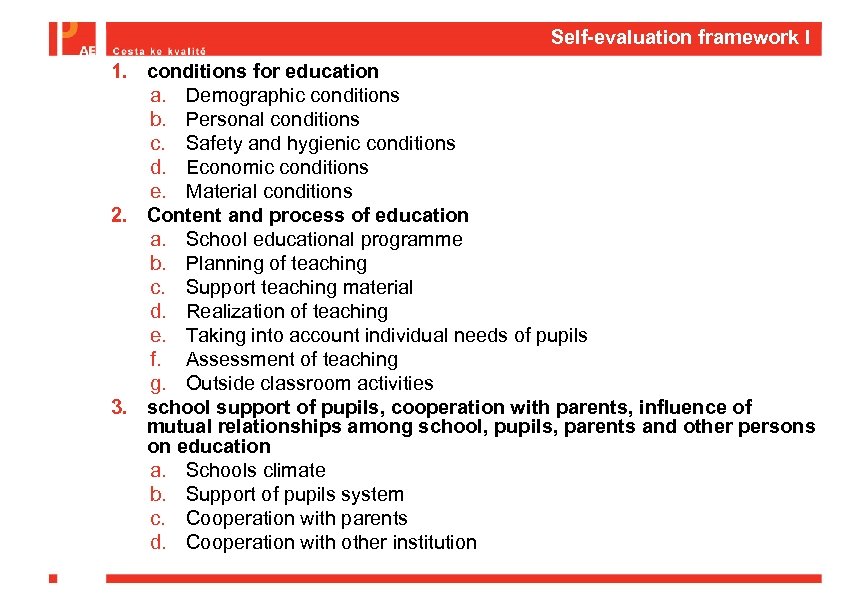 Self-evaluation framework I 1. conditions for education a. Demographic conditions b. Personal conditions c. Safety and hygienic conditions d. Economic conditions e. Material conditions 2. Content and process of education a. School educational programme b. Planning of teaching c. Support teaching material d. Realization of teaching e. Taking into account individual needs of pupils f. Assessment of teaching g. Outside classroom activities 3. school support of pupils, cooperation with parents, influence of mutual relationships among school, pupils, parents and other persons on education a. Schools climate b. Support of pupils system c. Cooperation with parents d. Cooperation with other institution
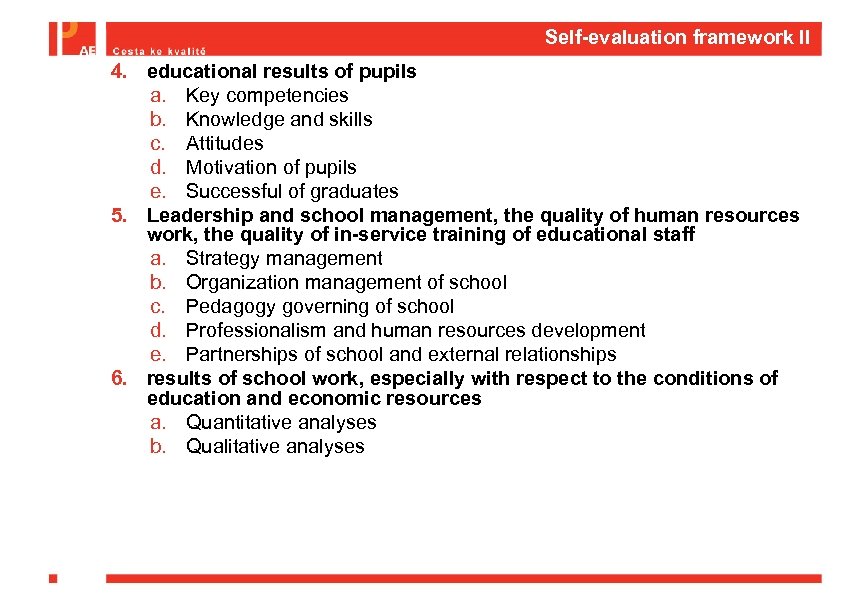 Self-evaluation framework II 4. educational results of pupils a. Key competencies b. Knowledge and skills c. Attitudes d. Motivation of pupils e. Successful of graduates 5. Leadership and school management, the quality of human resources work, the quality of in-service training of educational staff a. Strategy management b. Organization management of school c. Pedagogy governing of school d. Professionalism and human resources development e. Partnerships of school and external relationships 6. results of school work, especially with respect to the conditions of education and economic resources a. Quantitative analyses b. Qualitative analyses
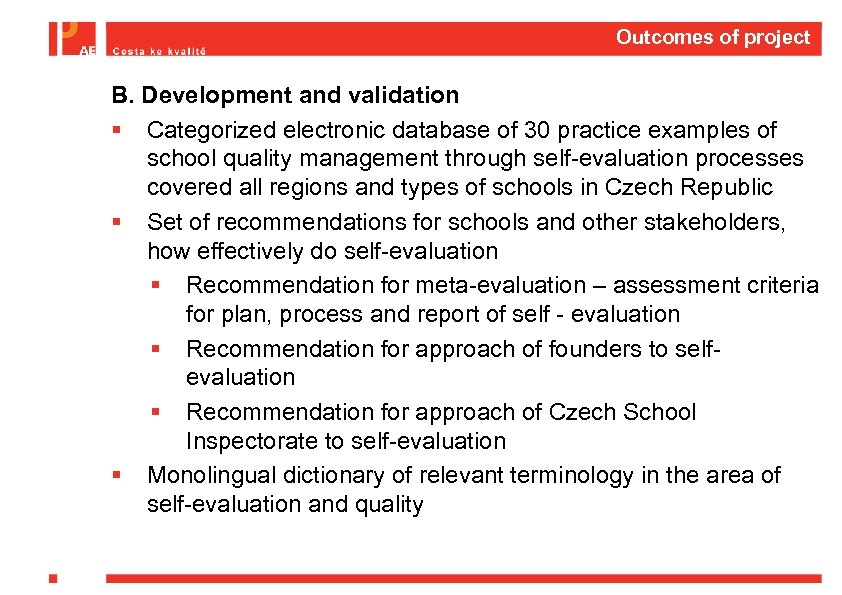 Outcomes of project B. Development and validation § Categorized electronic database of 30 practice examples of school quality management through self-evaluation processes covered all regions and types of schools in Czech Republic § Set of recommendations for schools and other stakeholders, how effectively do self-evaluation § Recommendation for meta-evaluation – assessment criteria for plan, process and report of self - evaluation § Recommendation for approach of founders to selfevaluation § Recommendation for approach of Czech School Inspectorate to self-evaluation § Monolingual dictionary of relevant terminology in the area of self-evaluation and quality
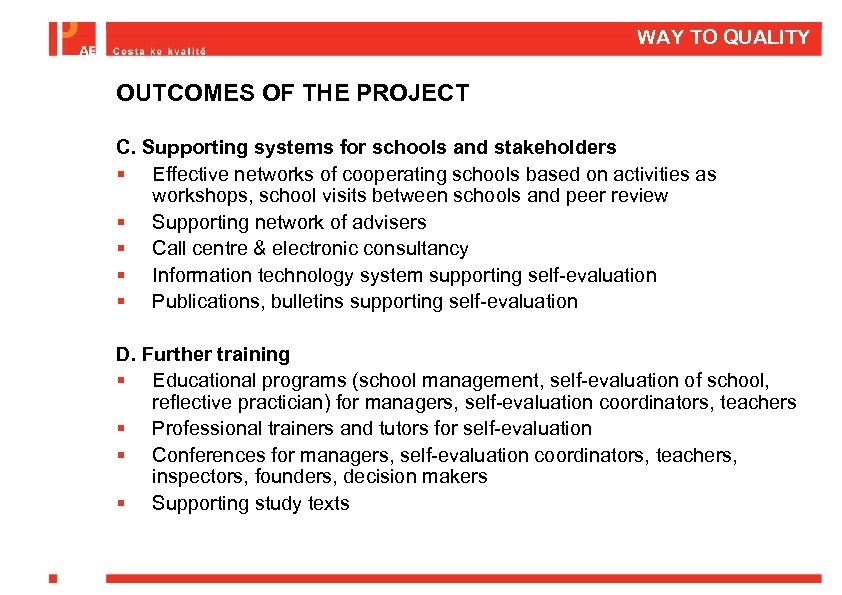 WAY TO QUALITY OUTCOMES OF THE PROJECT C. Supporting systems for schools and stakeholders § Effective networks of cooperating schools based on activities as workshops, school visits between schools and peer review § Supporting network of advisers § Call centre & electronic consultancy § Information technology system supporting self-evaluation § Publications, bulletins supporting self-evaluation D. Further training § Educational programs (school management, self-evaluation of school, reflective practician) for managers, self-evaluation coordinators, teachers § Professional trainers and tutors for self-evaluation § Conferences for managers, self-evaluation coordinators, teachers, inspectors, founders, decision makers § Supporting study texts
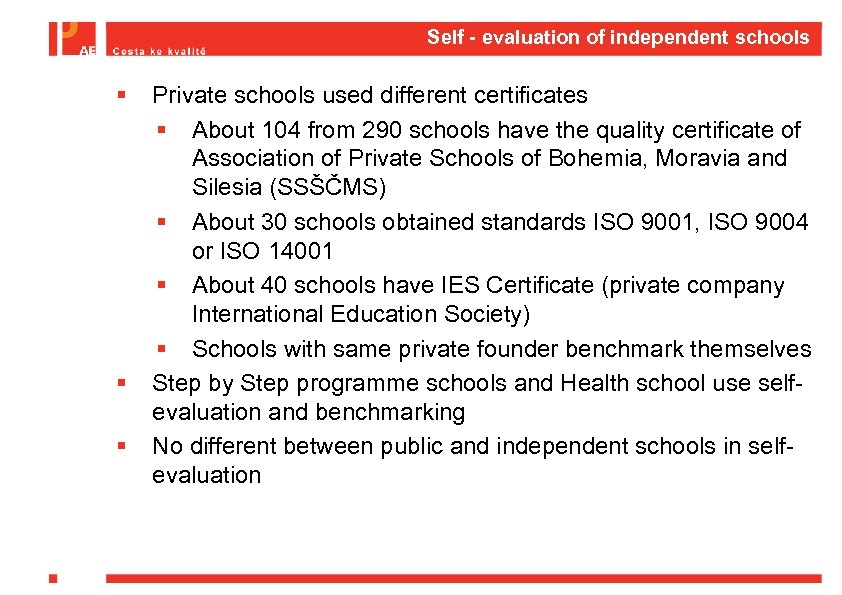 Self - evaluation of independent schools § § § Private schools used different certificates § About 104 from 290 schools have the quality certificate of Association of Private Schools of Bohemia, Moravia and Silesia (SSŠČMS) § About 30 schools obtained standards ISO 9001, ISO 9004 or ISO 14001 § About 40 schools have IES Certificate (private company International Education Society) § Schools with same private founder benchmark themselves Step by Step programme schools and Health school use selfevaluation and benchmarking No different between public and independent schools in self- evaluation
 THANK YOU For more information www. nuov. cz/ae stanislav. michek@nuov. cz