


 Скачать презентацию Value Stream Analysis Kaizen Training What you
1941715efcfaf4521dbefd9ff9be6e55.ppt
- Количество слайдов: 38
 Value Stream Analysis Kaizen Training
 What you can Expect l l “Value Stream Analysis Kaizen Training” contains what you need to know to get the job done, not everything you need to know to be an expert. Part 1 n l Part 2 n VSM Rev A 041505 Lean concepts and terminology The process by which we create future states 2
 VSM Rev A 041505 3
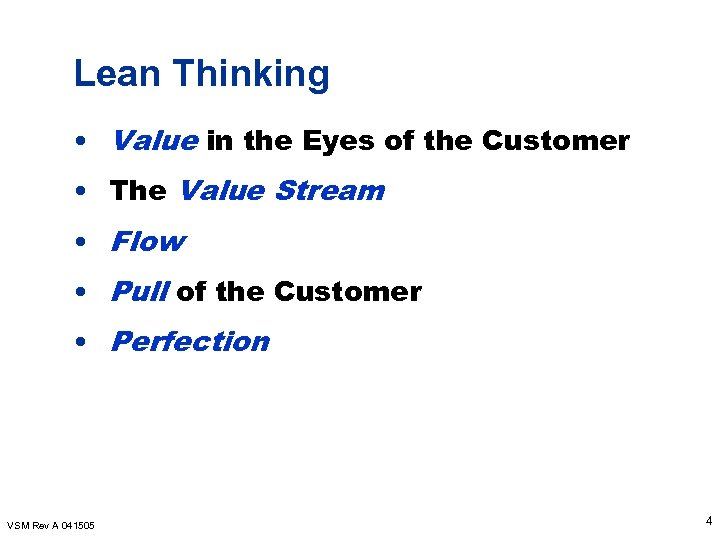 Lean Thinking • Value in the Eyes of the Customer • The Value Stream • Flow • Pull of the Customer • Perfection VSM Rev A 041505 4
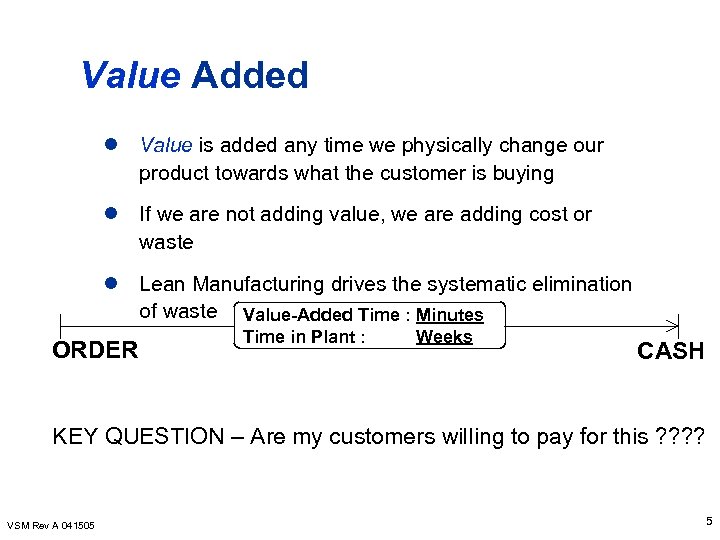 Value Added l Value is added any time we physically change our product towards what the customer is buying l If we are not adding value, we are adding cost or waste l Lean Manufacturing drives the systematic elimination of waste Value-Added Time : Minutes ORDER Time in Plant : Weeks CASH KEY QUESTION – Are my customers willing to pay for this ? ? VSM Rev A 041505 5
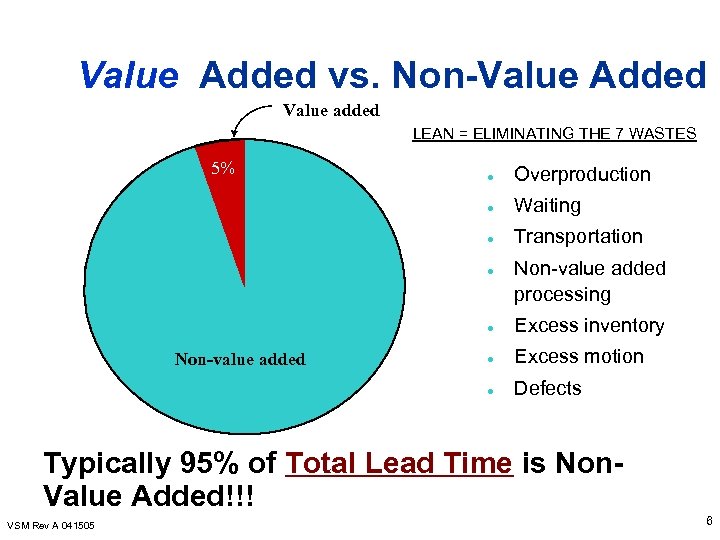 Value Added vs. Non-Value Added Value added LEAN = ELIMINATING THE 7 WASTES 5% l Overproduction l Waiting l Transportation l Non-value added processing l l Excess motion l Non-value added Excess inventory Defects Typically 95% of Total Lead Time is Non. Value Added!!! VSM Rev A 041505 6
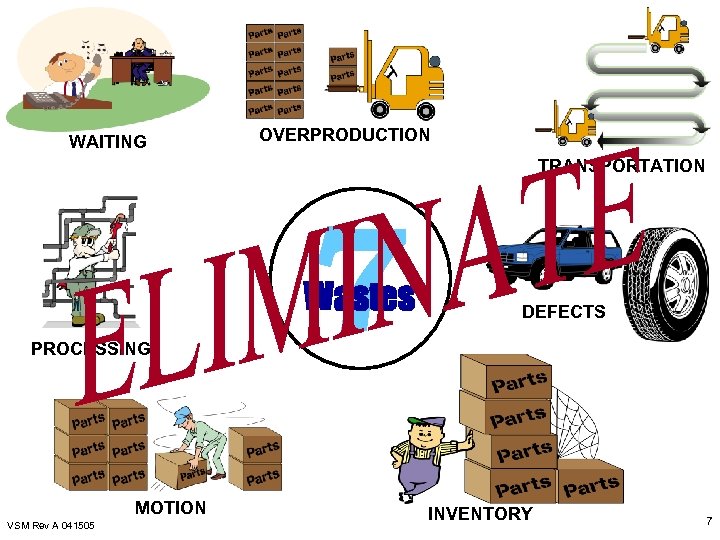 WAITING OVERPRODUCTION TRANSPORTATION 7 Wastes PROCESSING MOTION VSM Rev A 041505 DEFECTS INVENTORY 7
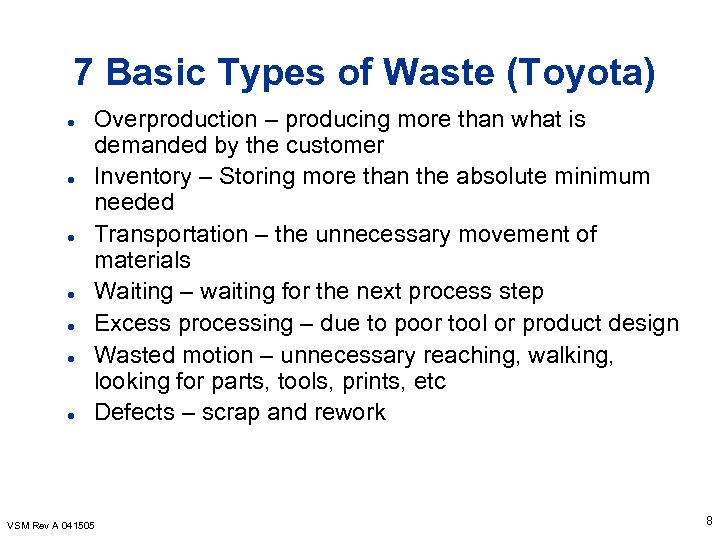 7 Basic Types of Waste (Toyota) l l l l Overproduction – producing more than what is demanded by the customer Inventory – Storing more than the absolute minimum needed Transportation – the unnecessary movement of materials Waiting – waiting for the next process step Excess processing – due to poor tool or product design Wasted motion – unnecessary reaching, walking, looking for parts, tools, prints, etc Defects – scrap and rework VSM Rev A 041505 8
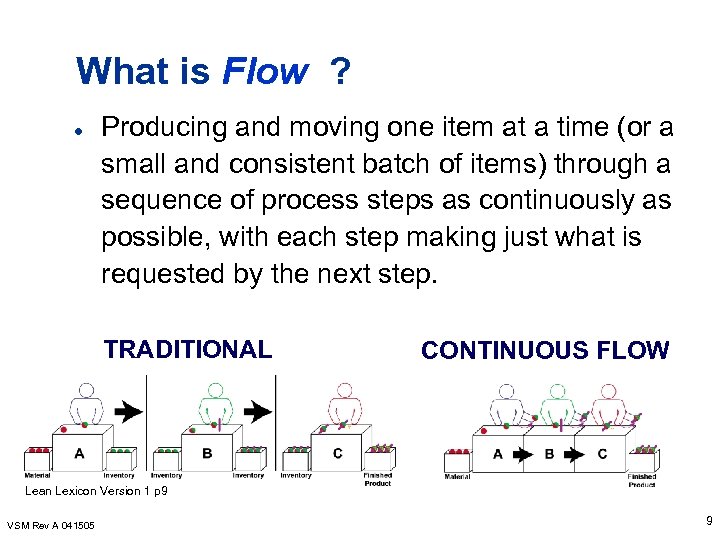 What is Flow ? l Producing and moving one item at a time (or a small and consistent batch of items) through a sequence of process steps as continuously as possible, with each step making just what is requested by the next step. TRADITIONAL CONTINUOUS FLOW Lean Lexicon Version 1 p 9 VSM Rev A 041505 9
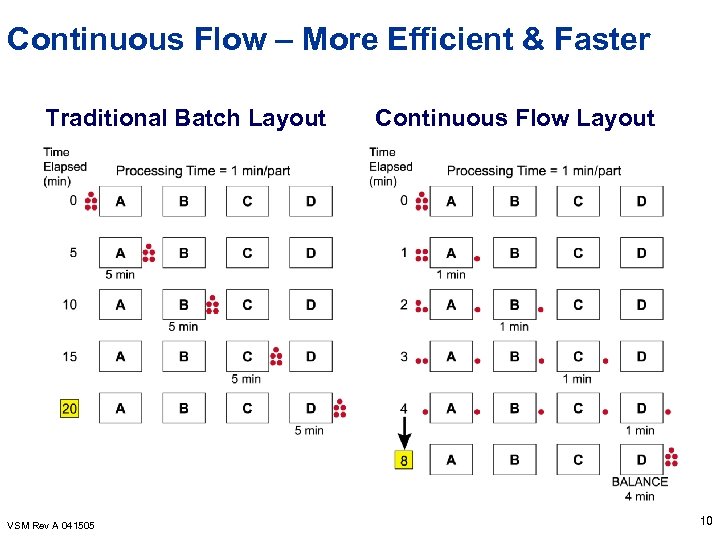 Continuous Flow – More Efficient & Faster Traditional Batch Layout VSM Rev A 041505 Continuous Flow Layout 10
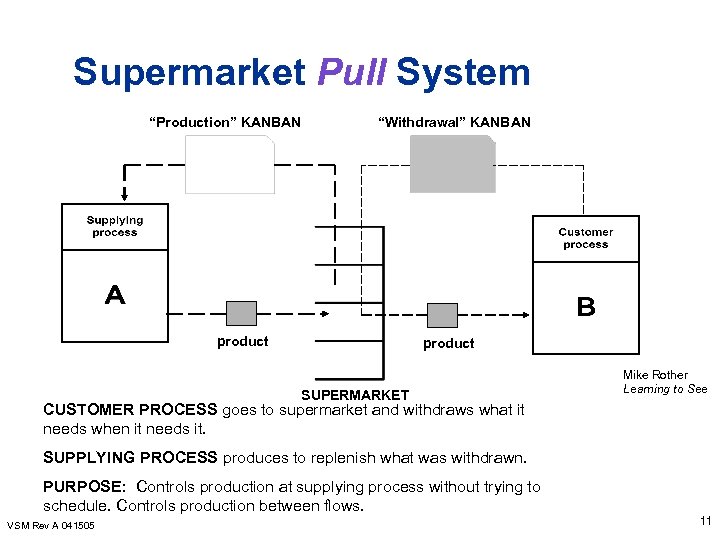 Supermarket Pull System “Production” KANBAN “Withdrawal” KANBAN product SUPERMARKET Mike Rother Learning to See CUSTOMER PROCESS goes to supermarket and withdraws what it needs when it needs it. SUPPLYING PROCESS produces to replenish what was withdrawn. PURPOSE: Controls production at supplying process without trying to schedule. Controls production between flows. VSM Rev A 041505 11
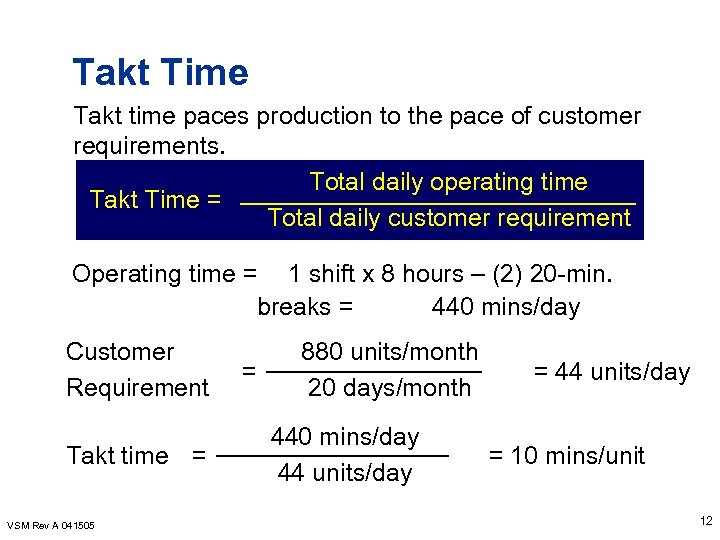 Takt Time Takt time paces production to the pace of customer requirements. Total daily operating time Takt Time = Total daily customer requirement Operating time = 1 shift x 8 hours – (2) 20 -min. breaks = 440 mins/day Customer Requirement Takt time = VSM Rev A 041505 = 880 units/month 20 days/month 440 mins/day 44 units/day = 10 mins/unit 12
 What is a Value Stream ? l A Value Stream is all the actions, value creating and non-value creating, required to bring a product from order to delivery n n Finalizes at the end-customer n VSM Rev A 041505 Starts with raw materials Involves several businesses 13
 Value Stream Mapping l Helps you to see the sources of waste in the value stream n n n Shows the flow of information and material Forms the blueprint for lean implementation (Imagine trying to build a house without a blueprint). Helps you to see more than just the single process level Provides a common language for talking about manufacturing processes Makes decisions about the flow apparent, so they can be discussed Ties together lean concepts and techniques, which helps to avoid “cherry picking” Improvement projects Mike Rother Learning to See VSM Rev A 041505 14
 What is Value Stream Analysis? l Value stream maps describe a value stream l Value stream analysis is a planning process n Uses value stream maps to communicate • • l Information Flow Material Flow Three value stream maps are created n n VSM Rev A 041505 Ideal state n l Current state Future state (3 months from now) Action plans are developed for the future state map 15
 The Value Stream Analysis Process l Phase 1 -Pre-event work l Phase 2 -The Main Event l Phase 3 -Accountability Process VSM Rev A 041505 16
 Value Stream Analysis Process Phase 1 Pre-event Planning
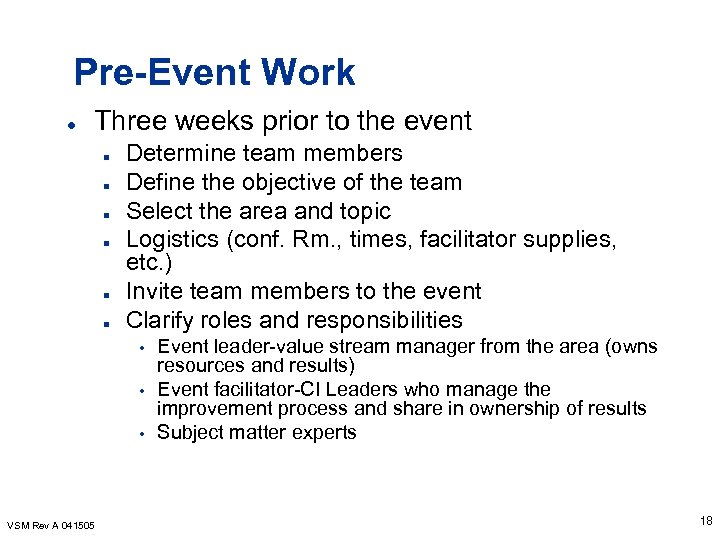 Pre-Event Work l Three weeks prior to the event n n n Determine team members Define the objective of the team Select the area and topic Logistics (conf. Rm. , times, facilitator supplies, etc. ) Invite team members to the event Clarify roles and responsibilities • • • VSM Rev A 041505 Event leader-value stream manager from the area (owns resources and results) Event facilitator-CI Leaders who manage the improvement process and share in ownership of results Subject matter experts 18
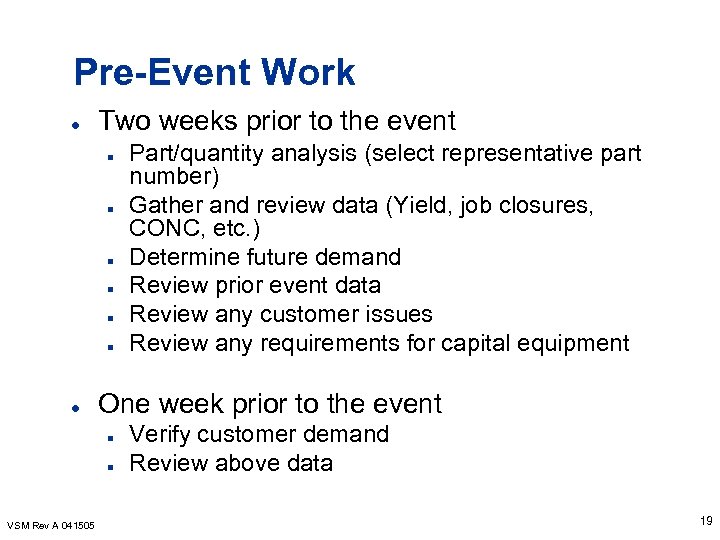 Pre-Event Work l Two weeks prior to the event n n n l One week prior to the event n n VSM Rev A 041505 Part/quantity analysis (select representative part number) Gather and review data (Yield, job closures, CONC, etc. ) Determine future demand Review prior event data Review any customer issues Review any requirements for capital equipment Verify customer demand Review above data 19
 Value Stream Analysis Process Phase 2 The Main Event
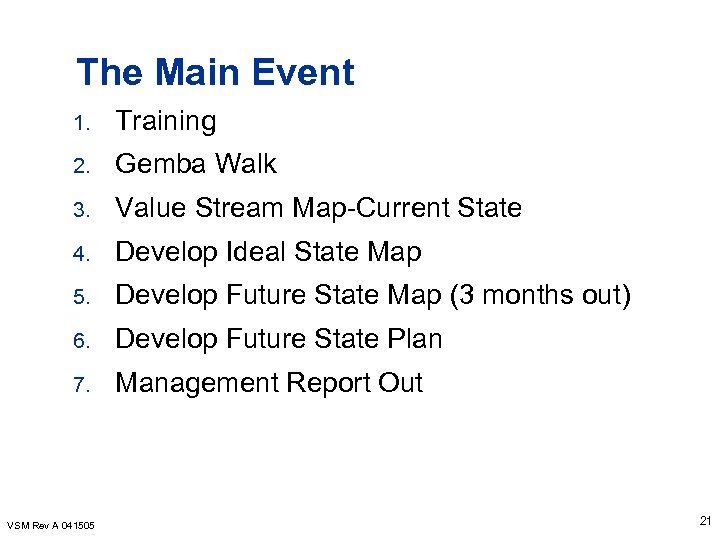 The Main Event 1. Training 2. Gemba Walk 3. Value Stream Map-Current State 4. Develop Ideal State Map 5. Develop Future State Map (3 months out) 6. Develop Future State Plan 7. Management Report Out VSM Rev A 041505 21
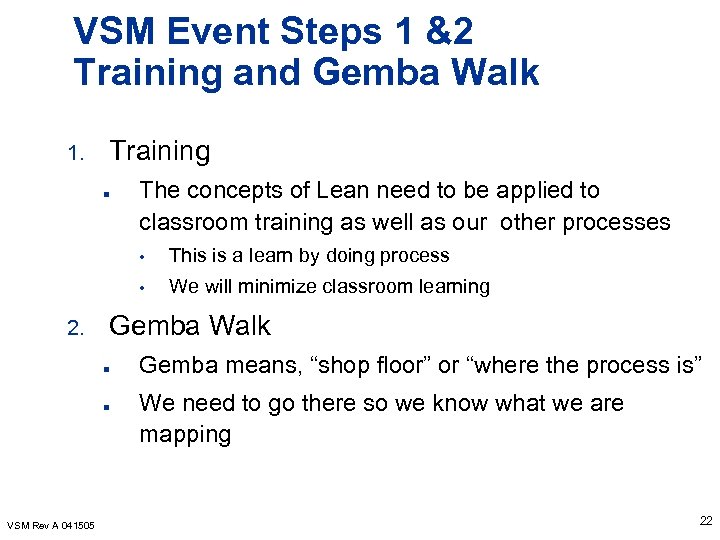 VSM Event Steps 1 &2 Training and Gemba Walk 1. Training n The concepts of Lean need to be applied to classroom training as well as our other processes • • 2. We will minimize classroom learning Gemba Walk n n VSM Rev A 041505 This is a learn by doing process Gemba means, “shop floor” or “where the process is” We need to go there so we know what we are mapping 22
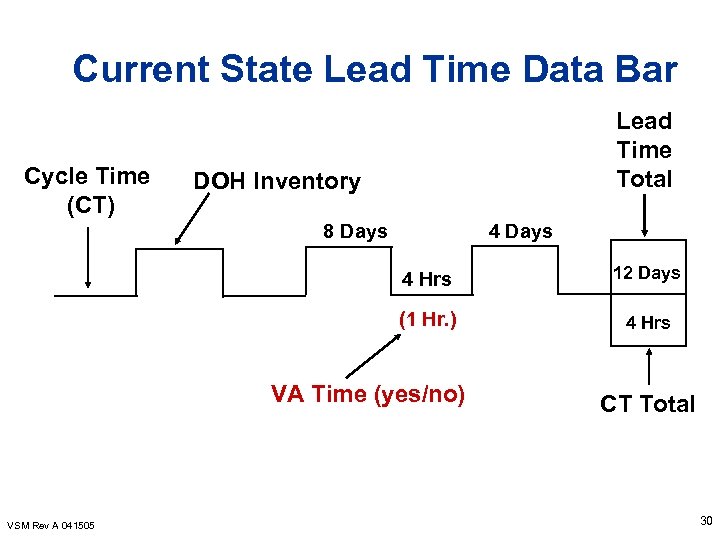
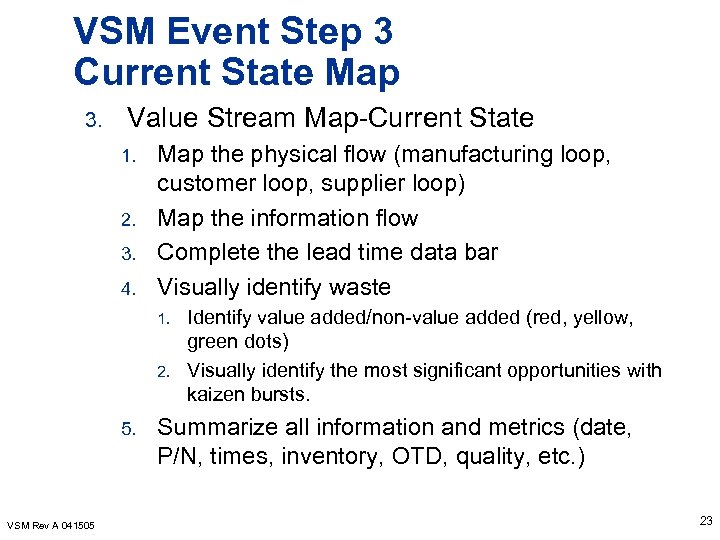 VSM Event Step 3 Current State Map 3. Value Stream Map-Current State 1. 2. 3. 4. Map the physical flow (manufacturing loop, customer loop, supplier loop) Map the information flow Complete the lead time data bar Visually identify waste 1. 2. 5. VSM Rev A 041505 Identify value added/non-value added (red, yellow, green dots) Visually identify the most significant opportunities with kaizen bursts. Summarize all information and metrics (date, P/N, times, inventory, OTD, quality, etc. ) 23
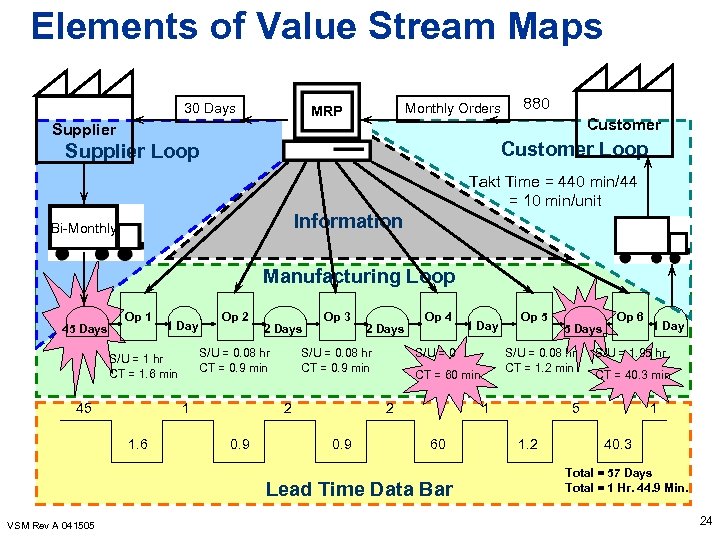 Elements of Value Stream Maps 30 Days Monthly Orders MRP Supplier 880 Customer Loop Supplier Loop Takt Time = 440 min/44 = 10 min/unit Information Bi-Monthly Manufacturing Loop 45 Days Op 1 1 Day 1 1. 6 2 Days S/U = 0. 08 hr CT = 0. 9 min S/U = 1 hr CT = 1. 6 min 45 Op 2 Op 3 S/U = 0. 08 hr CT = 0. 9 min 2 0. 9 2 Days Op 4 S/U = 0 1 60 Lead Time Data Bar VSM Rev A 041505 Op 5 5 Days S/U = 0. 08 hr CT = 1. 2 min CT = 60 min 2 0. 9 1 Day Op 6 S/U = 1. 95 hr CT = 40. 3 min 5 1. 2 1 Day 1 40. 3 Total = 57 Days Total = 1 Hr. 44. 9 Min. 24
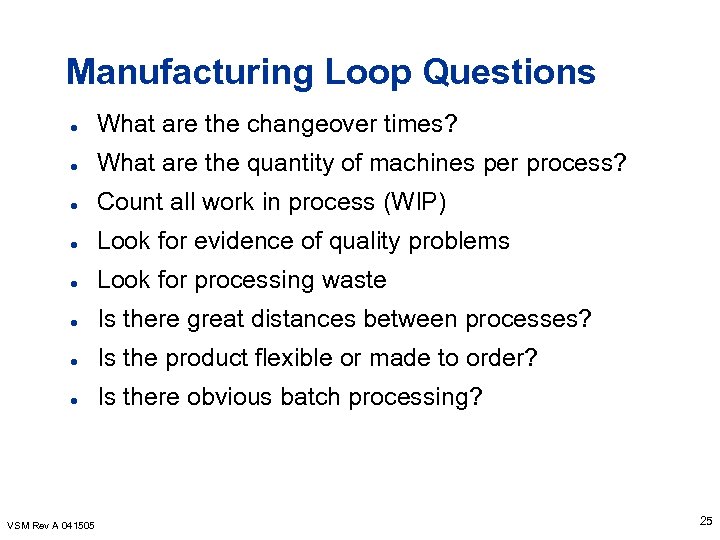 Manufacturing Loop Questions l What are the changeover times? l What are the quantity of machines per process? l Count all work in process (WIP) l Look for evidence of quality problems l Look for processing waste l Is there great distances between processes? l Is the product flexible or made to order? l Is there obvious batch processing? VSM Rev A 041505 25
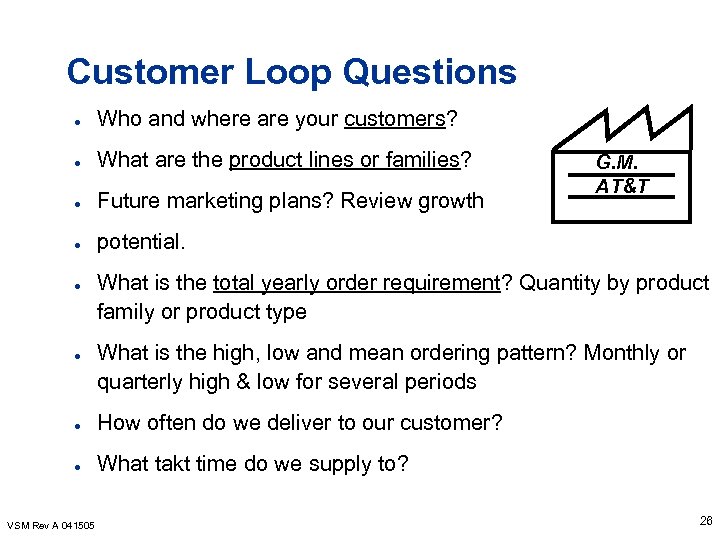 Customer Loop Questions l Who and where are your customers? l What are the product lines or families? l Future marketing plans? Review growth l potential. l l G. M. AT&T What is the total yearly order requirement? Quantity by product family or product type What is the high, low and mean ordering pattern? Monthly or quarterly high & low for several periods l How often do we deliver to our customer? l What takt time do we supply to? VSM Rev A 041505 26
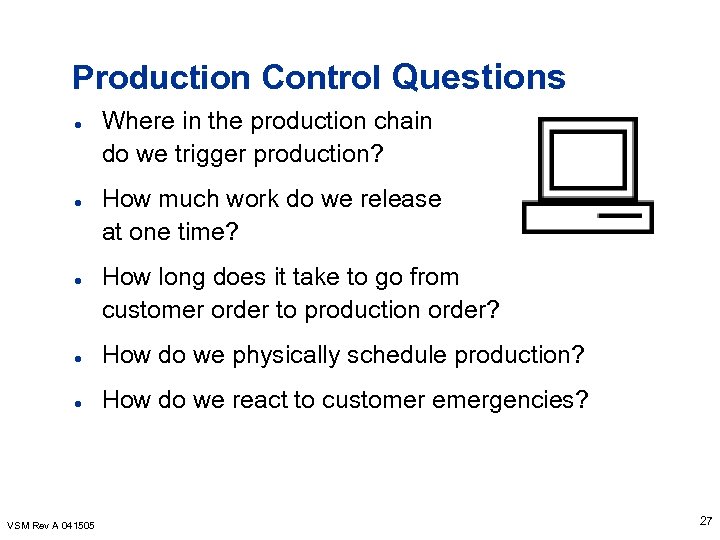 Production Control Questions l l l Where in the production chain do we trigger production? How much work do we release at one time? How long does it take to go from customer order to production order? l How do we physically schedule production? l How do we react to customer emergencies? VSM Rev A 041505 27
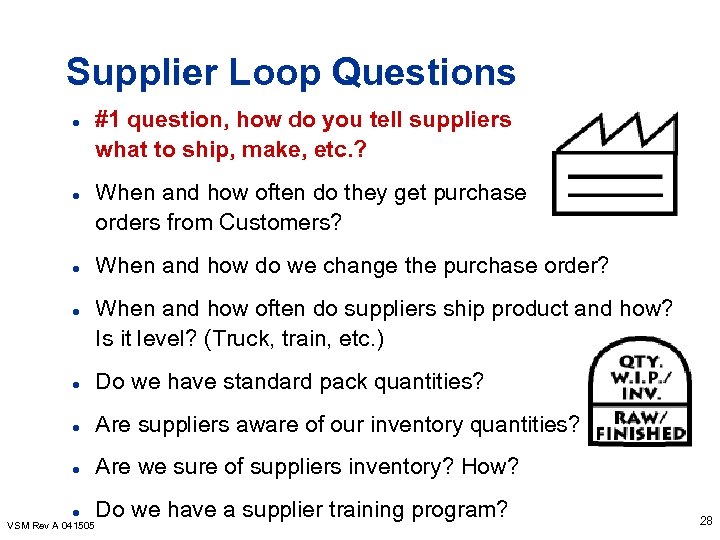 Supplier Loop Questions l l #1 question, how do you tell suppliers what to ship, make, etc. ? When and how often do they get purchase orders from Customers? When and how do we change the purchase order? When and how often do suppliers ship product and how? Is it level? (Truck, train, etc. ) l Do we have standard pack quantities? l Are suppliers aware of our inventory quantities? l Are we sure of suppliers inventory? How? l VSM Rev A 041505 Do we have a supplier training program? 28
 Information Flow Questions l How are the manufacturing and procurement orders distributed? n n VSM Rev A 041505 How frequently n l Who gets them What is the process of generating them How are the shop order schedules generated and revised? Are there “shortage meetings”? What parts of the manufacturing loop are scheduled by MRP? Make sure to document the informal (hot lists) as well as formal (MRP) information channels. 29
 Current State Lead Time Data Bar Cycle Time (CT) Lead Time Total DOH Inventory 8 Days 4 Hrs 12 Days (1 Hr. ) 4 Hrs VA Time (yes/no) VSM Rev A 041505 CT Total 30
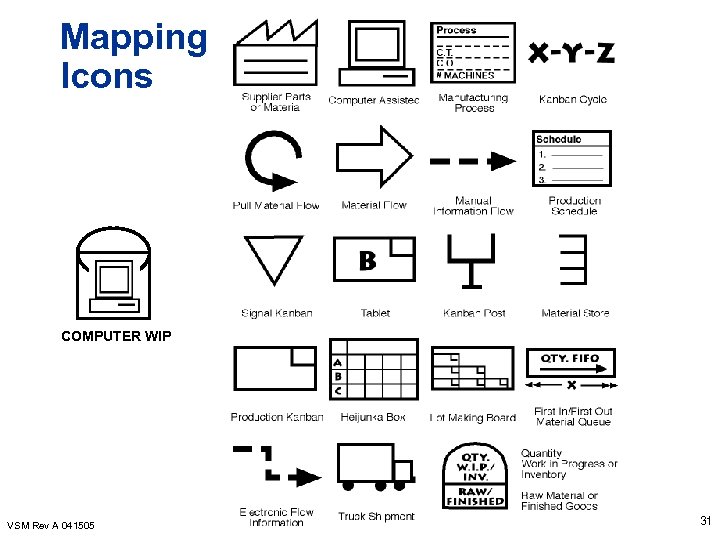 Mapping Icons COMPUTER WIP VSM Rev A 041505 31
 Visually Identify Waste l l As a team, review each process step for elements that are value added and non value added Each step can have any combination of value added, type 1 waste and/or type 2 waste n n n l l VSM Rev A 041505 Identify value added with a green dot Identify type 1 waste (waste but unavoidable in the current state) with a yellow dot Identify type 2 waste (pure waste, eliminate immediately) with a red dot As type 2 waste is identified, generate the actions to remove it (this will be the beginning of the future state implementation plan) Prioritize the waste opportunities and identify the biggest opportunities on the CS map with kaizen bursts 32
 VSM Event Step 4 Ideal State Map l Avoid shared resources l Assume that anything is possible n n Our profits are up n High job satisfaction n l Our customers are happy Capital is available if needed Create an ideal state map n n Map the information flow n VSM Rev A 041505 Map the physical flow Complete the lead time data bar 33
 VSM Event Step 5 Future State Map (3 months out) l l What of the ideal state map can be implemented in 3 months? Identify short term goals n n PRODUCTIVITY n QUALITY n VSM Rev A 041505 INVENTORY n l LEAD TIME CAPACITY Work from your current state map 34
 VSM Event Step 6 Future State Plan l This plan answers the question, “what actions need to be completed in the next 90 days to achieve the future state? n n VSM Rev A 041505 Think back to the “visually identify waste” step Plan addresses all “red dots” and Kaizen bursts 35
 VSM Event Step 7 Management Report Out l This report out is how the team publicly commits to management n n What was learned n What was accomplished during the event n What the outcome is. How much better will we be? n Description of the future state n VSM Rev A 041505 What the goal of the event was Commitment of the action plan 36
 Value Stream Analysis Process Phase 3 Accountability Process
 The Accountability Process The momentum for improvement is never higher then at the end of the event when everyone can really see the waste. As a result the accountability process must start immediately following the event (next day). l Display the current state map, future state map and future state plan in the affected area. l Commit to a stand up meeting in front of the maps and plan (daily at first, and then less frequent as applicable) l n VSM Rev A 041505 Focus on Due date control. Not meeting dates is letting the team down 38