


 Скачать презентацию Value Chains Livelihoods What s the difference and
6a19f1c8ca23335618ba5d85c9de4c96.ppt
- Количество слайдов: 7
 Value Chains & Livelihoods What’s the difference and why should we care? Jason Wolfe, Enterprise Development Advisor USAID Microenterprise Development office
 WHAT IS THE RATIONALE FOR THE VALUE CHAIN APPROACH? • Integrating poor households into growing markets • Empowering poor households to benefit from increasing globalization • Economic Growth • Poverty Reduction
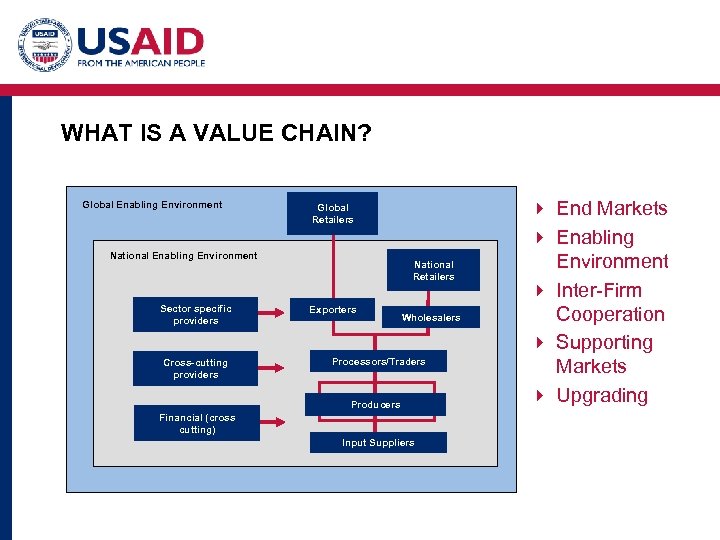 WHAT IS A VALUE CHAIN? Global Enabling Environment Global Retailers National Enabling Environment Sector specific providers Cross-cutting providers National Retailers Exporters Wholesalers Processors/Traders Producers Financial (cross cutting) Input Suppliers 4 End Markets 4 Enabling Environment 4 Inter-Firm Cooperation 4 Supporting Markets 4 Upgrading
 WHAT IS THE VALUE CHAIN APPROACH? • Taking a market systems perspective • Driving growth through end markets • Fostering competitiveness through improved interfirm relationships • Upgrading at the firm and industry level • Facilitating improved competitiveness
 WHAT ARE KEY DISTINCTIONS BETWEEN THE APPROACHES? • SLA centered on household; VCA centered on market system • SLA can be very descriptive; VCA can be very prescriptive • SLA emphasizes constraints; VCA emphasizes opportunities • SLA can be too broad; VCA can be too narrow • SLA naturally focuses on assets; VCA naturally focuses on revenue/income
 WHAT DOES IT ALL MEAN? • • SLA and VCA are two different views of the world CLA and VCA are not incompatible Neither is absolutely right nor absolutely wrong But they emphasize different aspects that can both help and hinder our efforts
 WHERE CAN I LEARN MORE? Knowledge General Info: Briefing Papers: Conflict-specific: Impact Assessment: micro. LINKS. org / valuechains micro. LINKS. org / AMAPkp 2 micro. LINKS. org / conflict micro. LINKS. org / PSDIAI Learning Training Curricula: micro. LINKS. org / VCtraining Breakfast Seminars & Screencasts: micro. LINKS. org / breakfast Technical Assistance Jason Wolfe 202 712 1882 jwolfe@usaid. gov