 Скачать презентацию Value Based Software Engineering Cmpe 550 Fall 2006
1684c8cf15a3e51f3ea21c6ccdf668fe.ppt
- Количество слайдов: 21



Value Based Software Engineering Cmpe 550 Fall 2006
Value-Based Software Engineering • Barry Boehm, USC • the primary critical success factors lie in the value domain.
Value-Based Software Engineering • current software engineering practice and research is done in a value-neutral setting – every requirement, use case, object, test case, and defect is equally important. – Methods are presented and practiced as largely logical activities involving mappings and transformations (e. g. , object-oriented development) – “Earned value” systems track project cost and schedule, not stakeholder or business value; – A “separation of concerns” is practiced, in which the responsibility of software engineers is confined to turning software requirements into verified code.
Value-Based Software Engineering • software has a major influence on most systems’ cost, schedule, and value; and software decisions are inextricably intertwined with system-level decisions. • value-neutral software engineering principles and practices are unable to deal with most of the sources of software project failure. • value-neutral methods are insufficient as a basis of an engineering discipline.
Value-Based Software Engineering • The definition of “engineering” in (Webster, 2002) “the application of science and mathematics by which the properties of matter and sources of energy in nature are made useful to people. ”
Value-Based Software Engineering • It is also hard to make financially responsible decisions using value-neutral methods.
Value-Based Software Engineering • Suppose you are the manager of a $2 million software project to develop a large customer billing system. A vendor of an automated test generation (ATG) tool comes to you with the following proposition: “Our tool has been shown to cut software test costs in half. Your test costs typically consume 50% of your total development costs, or $1 million for your current project. We’ll provide you the use of the tool for 30% of your test costs, or $300 K. After you’ve used the tool and saved 50% of your test costs, or $500 K, you’ll be $200 K ahead”. • How would you react to this proposition?
Value-Based Software Engineering • A typical answer would be: – to evaluate it from a technical and project management standpoint.
Value-Based Software Engineering • Persson and Yılmaztürk, 2004 compiled 34 good technical and project anagement reasons why an ATG tool might not save you 50% of your test costs: – – – unrepresentative test coverage; too much output data; Lack of test validity criteria; poor test design; instability due to rapid feature changes; Lack of management commitment; and lack of preparation and experience (“automated chaos yields faster chaos”).
Value-Based Software Engineering • a more serious concern lies outside traditional software engineering technology and management considerations: – They assume that every requirement, test case, and defect are equally important. • the more usual situation is a Pareto distribution – 80% of the mission value comes from 20% of the software components.
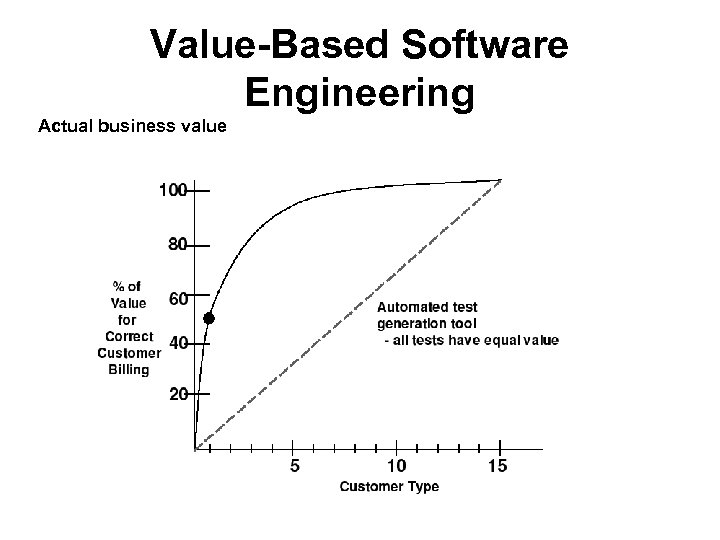
Value-Based Software Engineering Actual business value
Value-Based Software Engineering
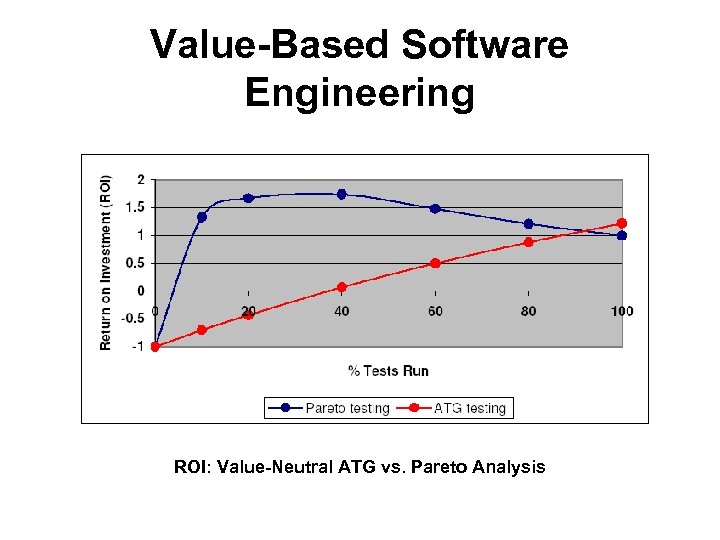
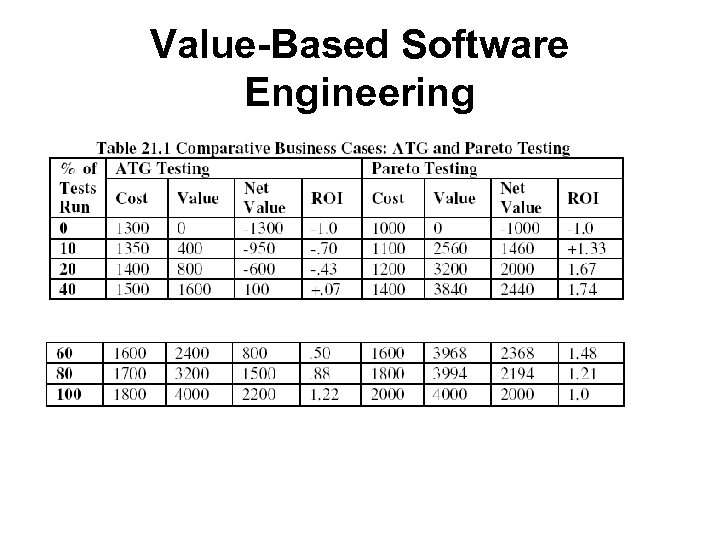
Value-Based Software Engineering ROI: Value-Neutral ATG vs. Pareto Analysis
Value-Based Software Engineering • The analysis is based on the following assumptions: – $1 M of the development costs have been invested in the customer billing system by the beginning of testing. – The ATG tool will cost $300 K and will reduce test costs by 50% as promised. – The business case for the system will produce $4 M in business value in return for the $2 M investment cost. – The business case will provide a similar 80: 20 distribution for the remaining 14 customer types.
Value-Based Software Engineering it appears that finding out which 60% of an organization’s testing budget actually produces a negative ROI would be highly worthwhile.
Value-Based Software Engineering • Estimates of global software costs are approaching $1 trillion per year. – half of this is spent on testing, and – 60% of the test effort can be profitably eliminated, • this creates a $300 billion per year cost savings potential for such value-based testing investments.
New Visions for Software Design and Productivity • Value Based Software Engineering – integration of a software system’s stakeholder value propositions into the system’s definition, design, development, deployment, and evolution is critical to the system’s success
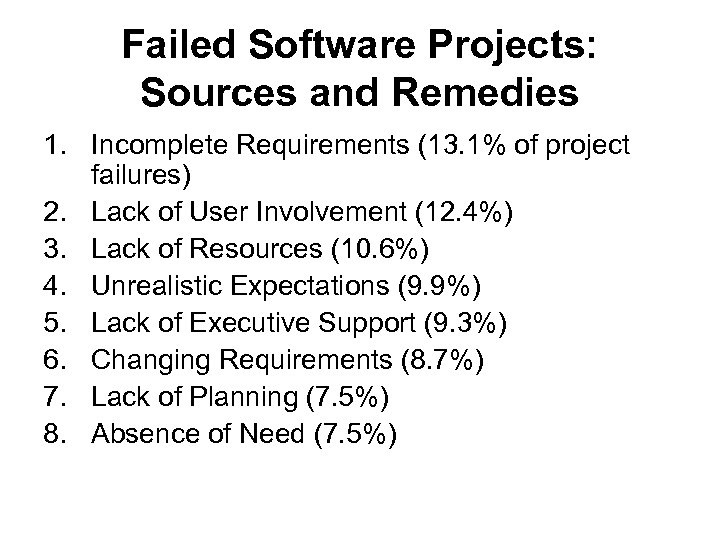
Failed Software Projects: Sources and Remedies 1. Incomplete Requirements (13. 1% of project failures) 2. Lack of User Involvement (12. 4%) 3. Lack of Resources (10. 6%) 4. Unrealistic Expectations (9. 9%) 5. Lack of Executive Support (9. 3%) 6. Changing Requirements (8. 7%) 7. Lack of Planning (7. 5%) 8. Absence of Need (7. 5%)
Software Economics Roadmap
Making Decisions that are Better for Value Creation • designers at all levels must make design decisions that are better for value added than those they make today – the design space within which designers operate needs to be sufficiently rich. – we need to understand better the links between technical design mechanism (e. g. architecture), context, and value creation, to enable both better education and decision-making in any given situation. – people involved in decision-making have to be educated in how to employ technical means more effectively to create value. – dynamic monitoring and control mechanisms are needed to better guide decision-makers through the design space in search of value added over time.
Making Decisions that are Better for Value Creation • These system specific models are based on better cost and payoff models and estimation and tracking capabilities, at the center of which is a business-case model for a given project, program or portfolio.
Скачать презентацию Value Based Software Engineering Cmpe 550 Fall 2006
1684c8cf15a3e51f3ea21c6ccdf668fe.ppt