


 Скачать презентацию Value Aided Satellite Altimetry Data for Weapon Presets
494f8bbcb7d18a594433db3fc358655f.ppt
- Количество слайдов: 54
 Value Aided Satellite Altimetry Data for Weapon Presets Michael Perry ENS, USNR Advisor: Prof. Peter Chu Second Reader: Eric Gottshall CDR, USN Collaborators: Gene Bessacini, Dave Cwalina (NUWC)
 Purpose • To define Navy altimeter requirements as a minimum number of satellite altimeters necessary to ensure maximum weapon effectiveness • To determine the point at which additional altimeter input no longer increases weapon effectiveness
 Objectives • Investigate the effects of satellite altimetry data vs. climatology data on weapon preset effectiveness • Define a metric for comparing MODAS data and GDEM data to initialize presets
 GDEM • Generalized Digital Environmental Model • Created using Temperature and Salinity profiles. – Master Oceanographic Observation Data Set (MOODS) • Climatology • 1/2 Degree Resolution
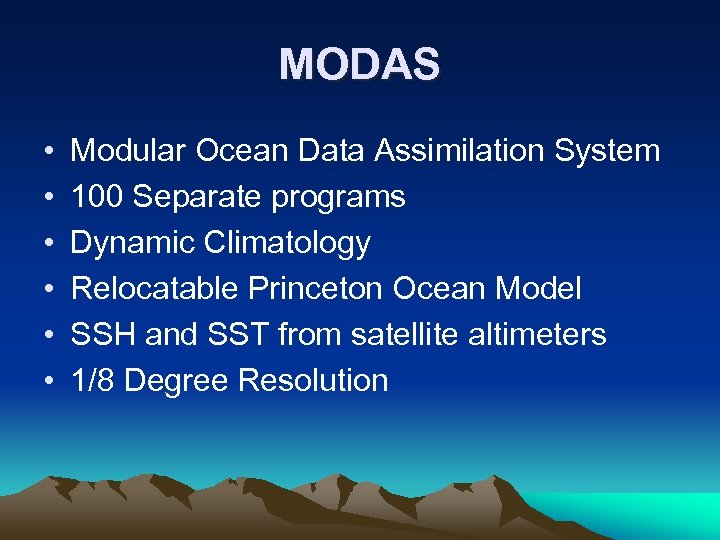 MODAS • • • Modular Ocean Data Assimilation System 100 Separate programs Dynamic Climatology Relocatable Princeton Ocean Model SSH and SST from satellite altimeters 1/8 Degree Resolution
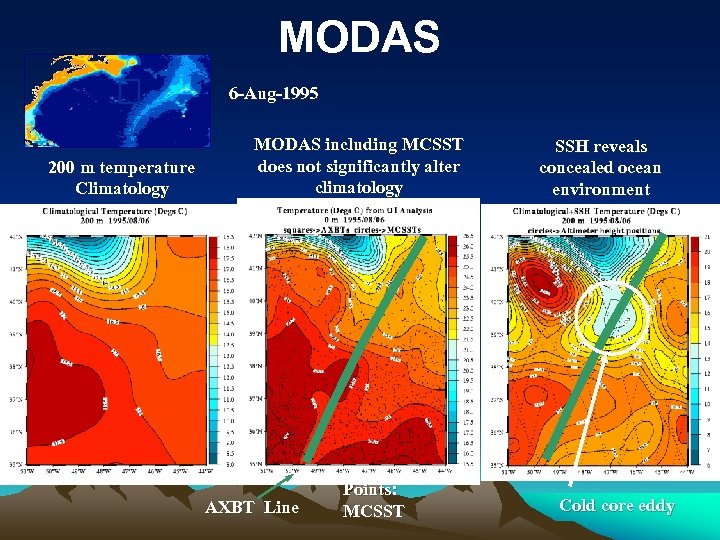 MODAS 6 -Aug-1995 200 m temperature Climatology MODAS including MCSST does not significantly alter climatology AXBT Line Points: MCSST SSH reveals concealed ocean environment Cold core eddy
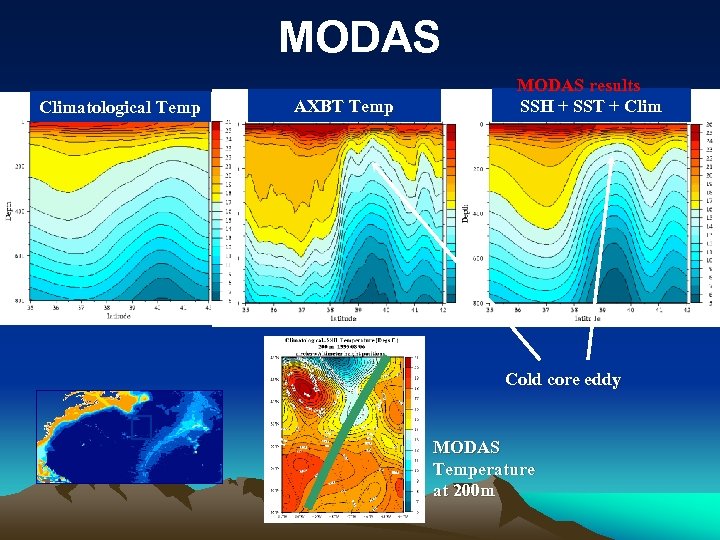 MODAS Climatological Temp AXBT Temp MODAS results SSH + SST + Clim Cold core eddy MODAS Temperature at 200 m
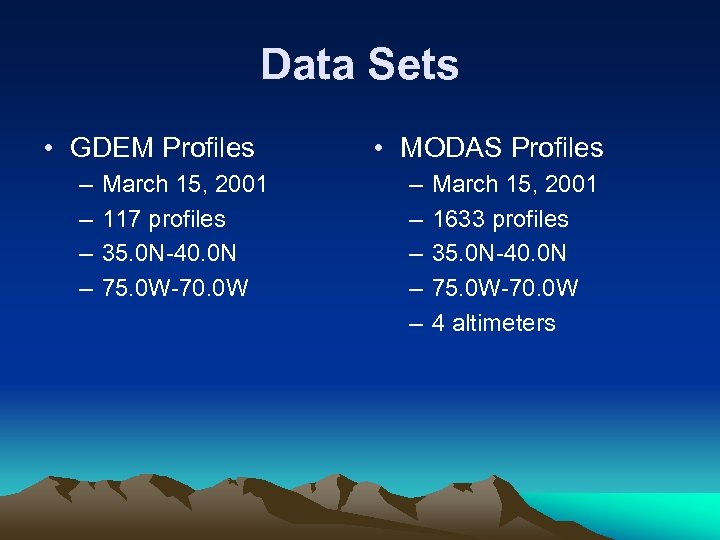 Data Sets • GDEM Profiles – – March 15, 2001 117 profiles 35. 0 N-40. 0 N 75. 0 W-70. 0 W • MODAS Profiles – – – March 15, 2001 1633 profiles 35. 0 N-40. 0 N 75. 0 W-70. 0 W 4 altimeters
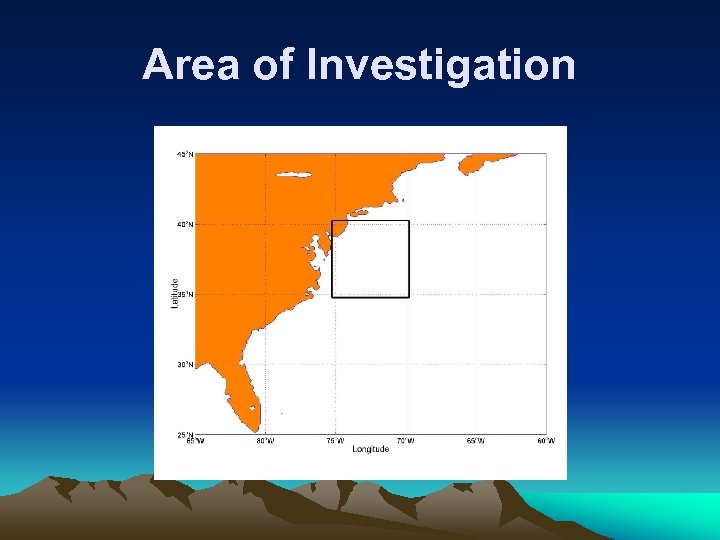 Area of Investigation
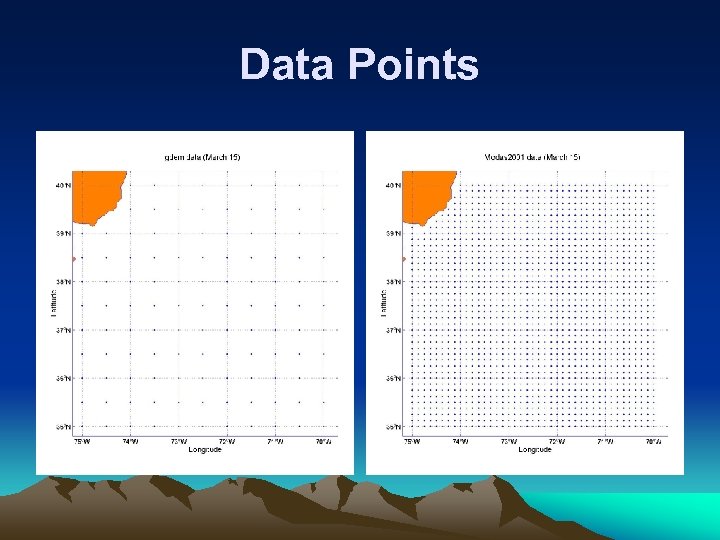 Data Points
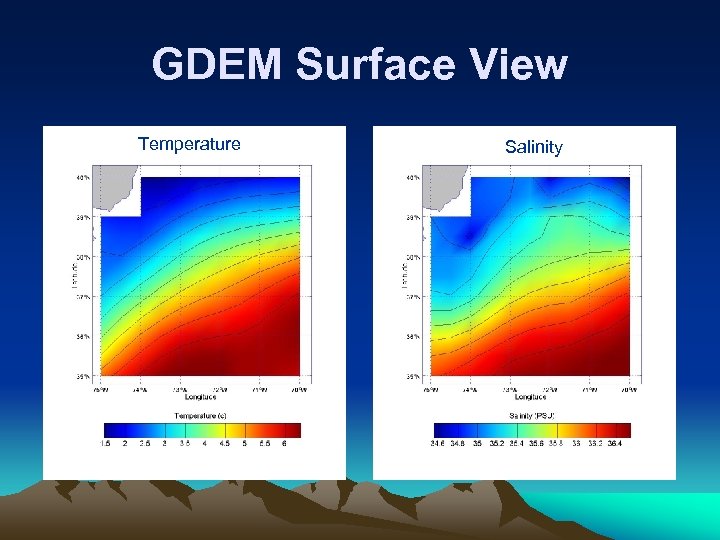 GDEM Surface View Temperature Salinity
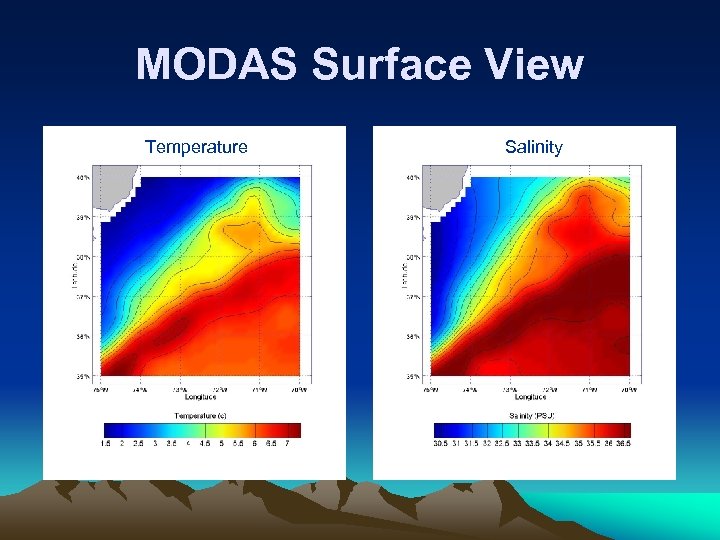 MODAS Surface View Temperature Salinity
 Surface
 Surface
 Surface
 100 m
100 m
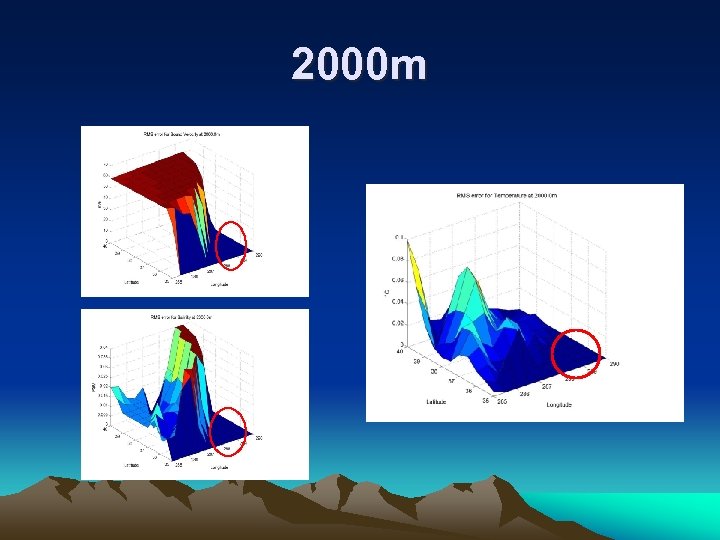 2000 m
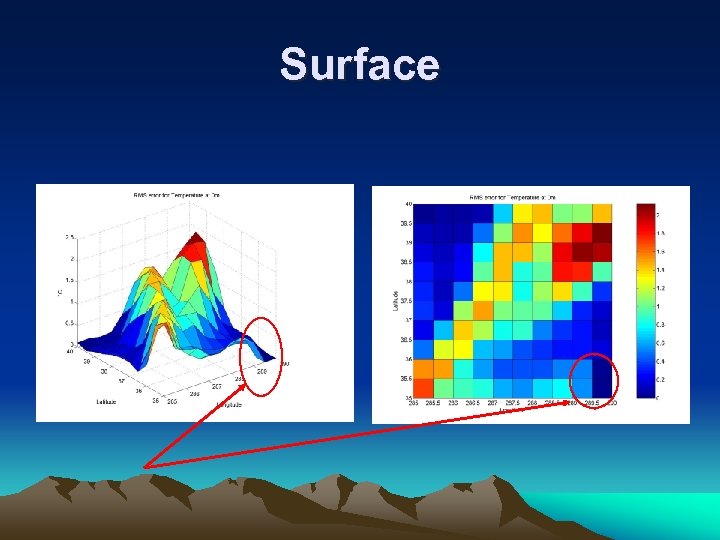
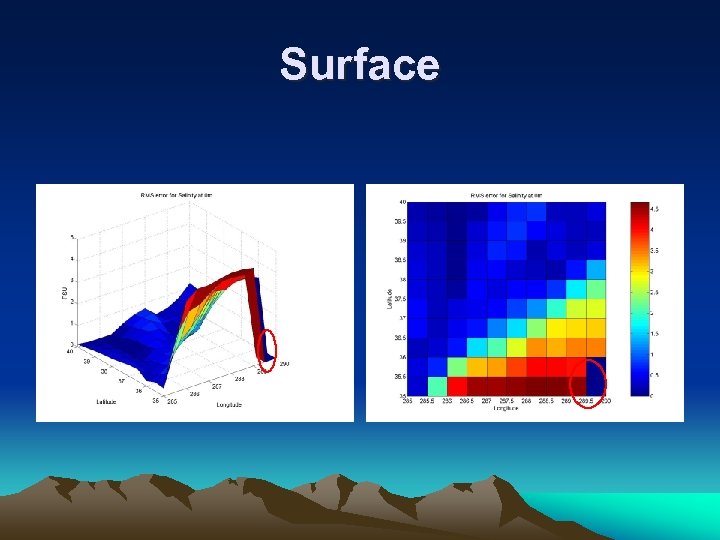
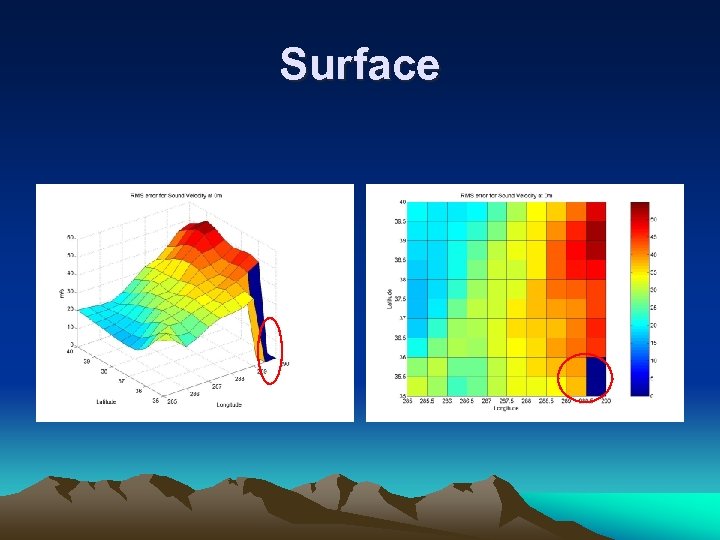
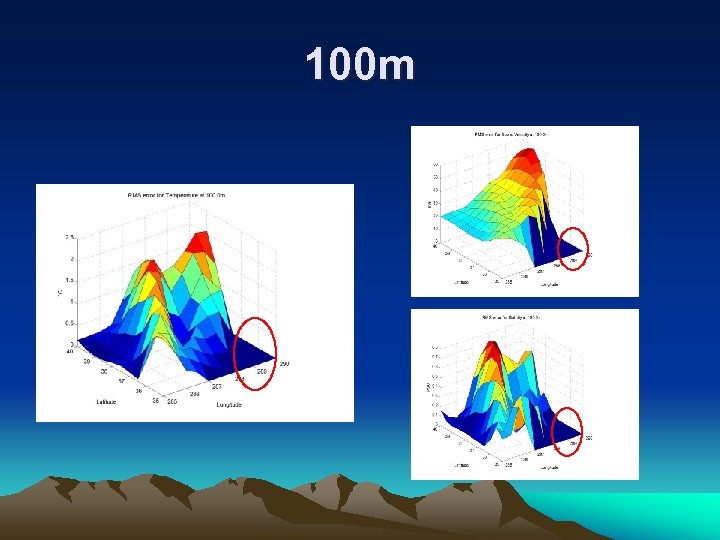
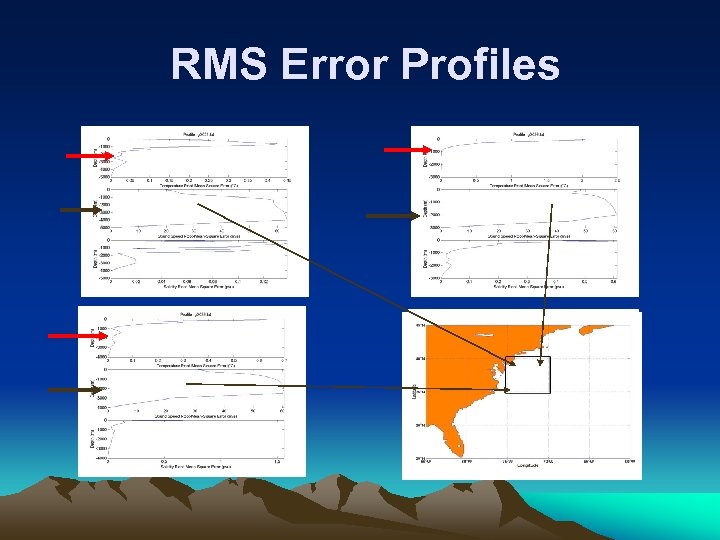 RMS Error Profiles
 Processing • Naval Undersea Warfare Center Division Newport • Weapon Acoustic Preset Program (WAPP) – Mk 48 Acoustic Preset Calculation – Output: Percentage Area Coverage
 Development Efforts Background • Torpedo Acoustic & Ballistic Preset Development Efforts Performed by NUWCDIVNPT, Combat Systems Department, Weapon Guidance and Control Branch (Code 2213) • Additional Tactical Decision Aid and Modeling Development Efforts for Harpoon, Tomahawk, SLMM, ISLMM • Points of Contact: – Gene Bessacini: bessaciniea@npt. nuwc. navy. mil – Dave Cwalina: cwalinads@npt. nuwc. navy. mil
 Weapon’s Acoustic Preset Program (WAPP) Objectives • To Provide the Fleet with an On-Board Automated Interactive Means for Generating Mk 48 & Mk 48 ADCAP Acoustic Presets and Visualizing Torpedo Performance • Base Computations on In Situ Environmental, Tactical, Target, and Weapon Parameters • Track the Evolution of Weapon, Tactical, Target, and Environmental Models • Provide Interfaces to • Support Fleet Exercises, Training, and Program Deliveries
 Acoustic Preset Program’s • • Mk 48 Acoustic Preset Program (M 48 APP)—Mk 48 Mod 3/4 Mk 48 ADCAP Acoustic Preset Program (MAAPP)—ADCAP Baseline, Shallow, TPU Weapon’s Acoustic Preset Program (WAPP)—Integrated Mk 48 and Mk 48 ADCAP Capability Programs Provide a Presetting Capability Based Upon: • A Common Graphics User Interface for the Entry of Environmental, Tactical, Target, and Weapon Data • A Common Computational Engine for the Generation of Accurate Acoustic Performance Predictions • Common Output in the Form of a Ranked Listset of Search Depth/Pitch Angle/LD/Effectiveness Values Along With an Acoustic Ray Trace and Signal Excess Map • Mk 48 Mod Specific Presets/Vehicle Dynamics/Acoustics & Signal Processing
 Program Evolution • Initial Development of Mk 48 ADCAP Acoustic Preset Program to Support ADCAP Block I • Incorporation of Shallow Water and Under Ice Capability • Development of Mk 48 Mod 3/4 Presetting Capability • Development of ADCAP Block II/Block IIA Capability • Merge of • High Frequency Environmental and Acoustic Sub. Model Update
 Support Status • • Royal Australian Navy—Mk 48 Acoustic Preset Program Part of Collins Class Augmentation System (CCAS) – HP TAC-3/4 Host under Unix – Configuration Managed Under Product Version Control (PVC) – Application Embedded in Overall Architecture – Documentation and Training Provided – Provides Environmental Data Entry for CCAS – Interfaces to Other Tactical Systems Specified Royal Canadian Navy—Mk 48 Acoustic Preset Program Rearchitected for Java – PC version under development
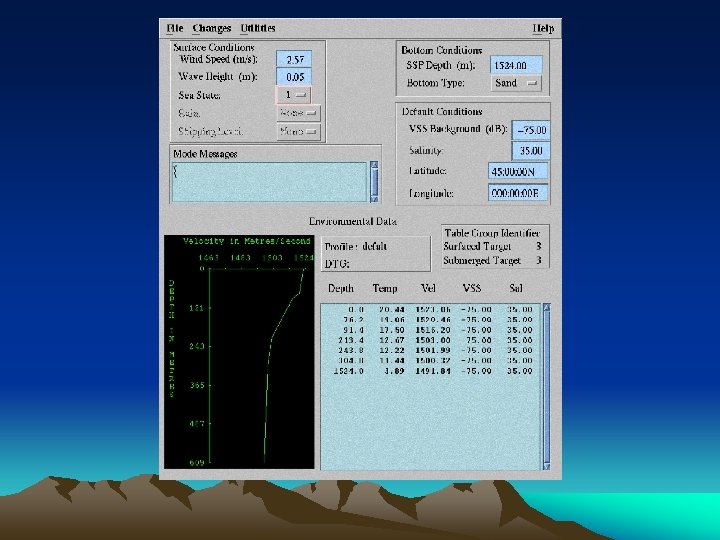
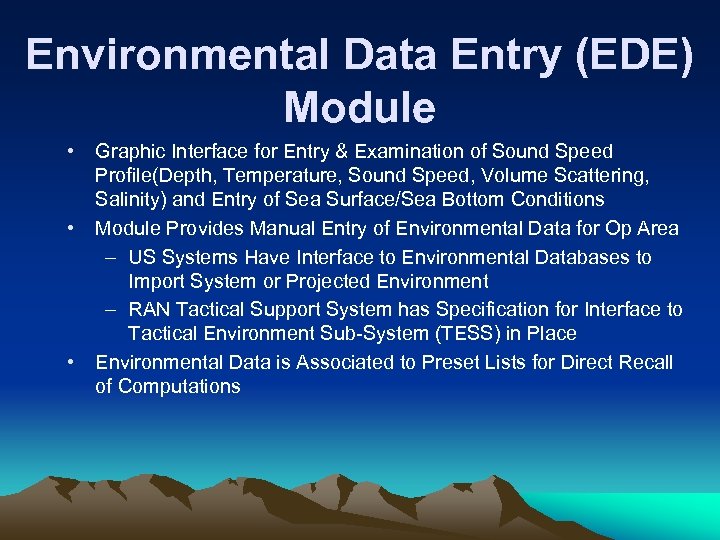 Environmental Data Entry (EDE) Module • • • Graphic Interface for Entry & Examination of Sound Speed Profile(Depth, Temperature, Sound Speed, Volume Scattering, Salinity) and Entry of Sea Surface/Sea Bottom Conditions Module Provides Manual Entry of Environmental Data for Op Area – US Systems Have Interface to Environmental Databases to Import System or Projected Environment – RAN Tactical Support System has Specification for Interface to Tactical Environment Sub-System (TESS) in Place Environmental Data is Associated to Preset Lists for Direct Recall of Computations
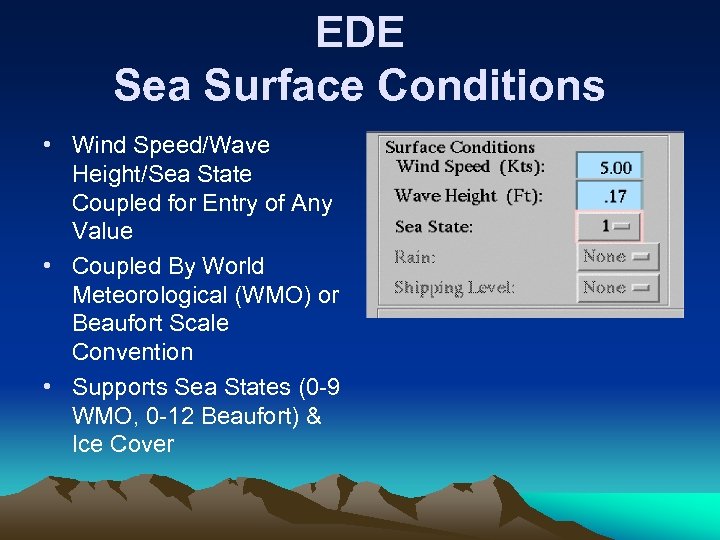 EDE Sea Surface Conditions • Wind Speed/Wave Height/Sea State Coupled for Entry of Any Value • Coupled By World Meteorological (WMO) or Beaufort Scale Convention • Supports Sea States (0 -9 WMO, 0 -12 Beaufort) & Ice Cover
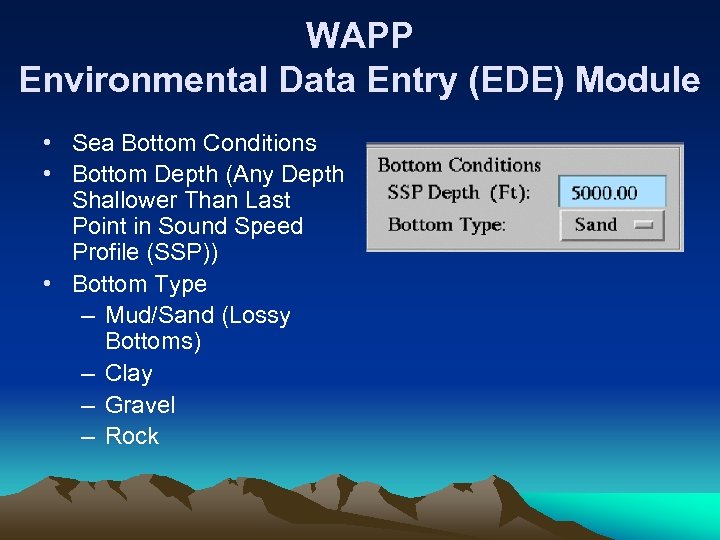 WAPP Environmental Data Entry (EDE) Module • Sea Bottom Conditions • Bottom Depth (Any Depth Shallower Than Last Point in Sound Speed Profile (SSP)) • Bottom Type – Mud/Sand (Lossy Bottoms) – Clay – Gravel – Rock
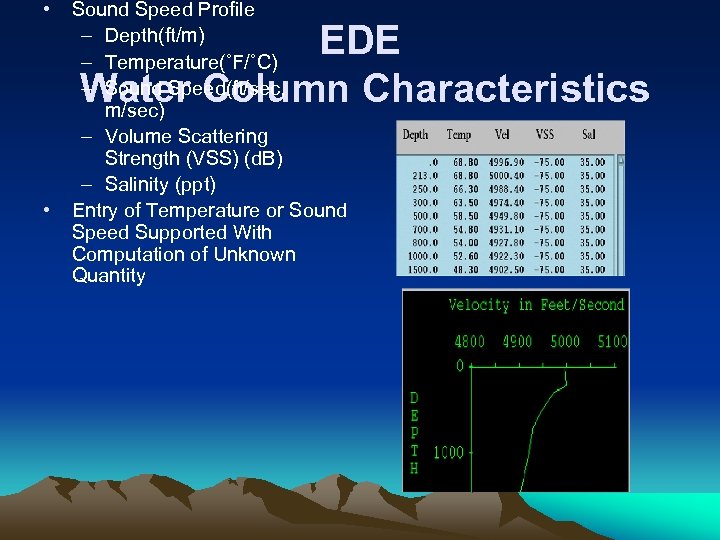 • • Sound Speed Profile – Depth(ft/m) – Temperature(˚F/˚C) – Sound Speed(ft/sec, m/sec) – Volume Scattering Strength (VSS) (d. B) – Salinity (ppt) Entry of Temperature or Sound Speed Supported With Computation of Unknown Quantity EDE Water Column Characteristics
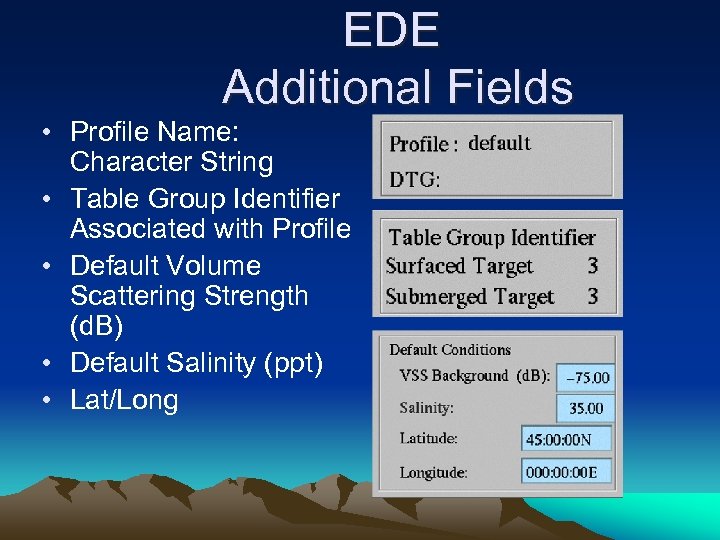 EDE Additional Fields • Profile Name: Character String • Table Group Identifier Associated with Profile • Default Volume Scattering Strength (d. B) • Default Salinity (ppt) • Lat/Long
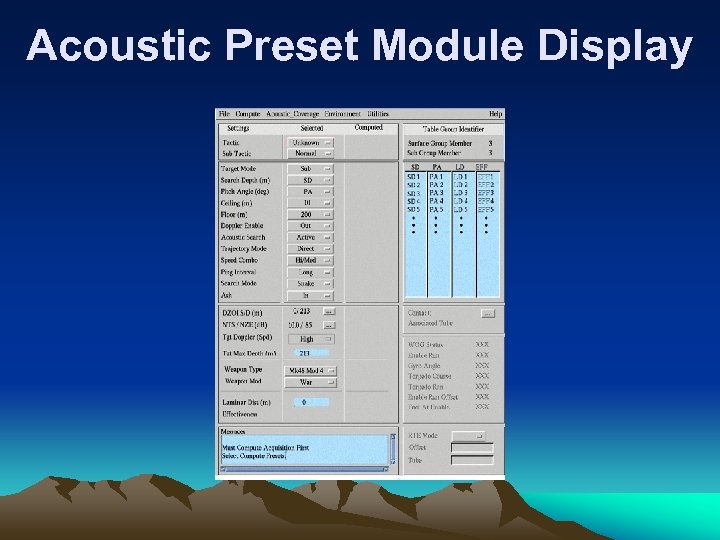 Acoustic Preset Module Display
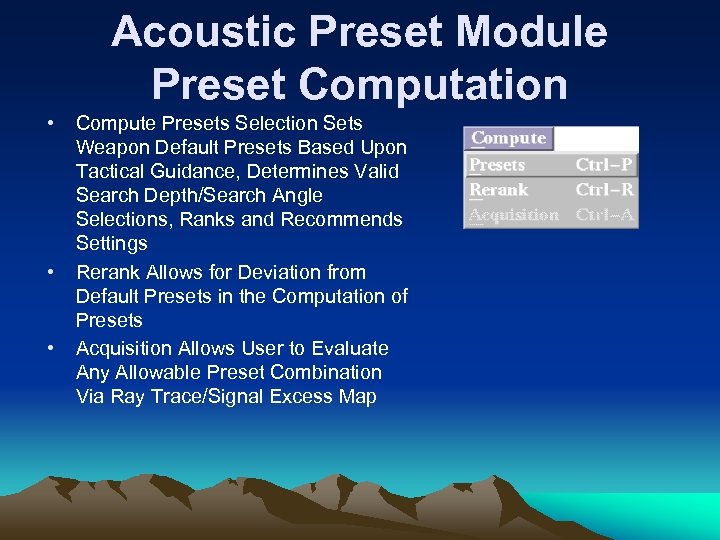 Acoustic Preset Module Preset Computation • • • Compute Presets Selection Sets Weapon Default Presets Based Upon Tactical Guidance, Determines Valid Search Depth/Search Angle Selections, Ranks and Recommends Settings Rerank Allows for Deviation from Default Presets in the Computation of Presets Acquisition Allows User to Evaluate Any Allowable Preset Combination Via Ray Trace/Signal Excess Map
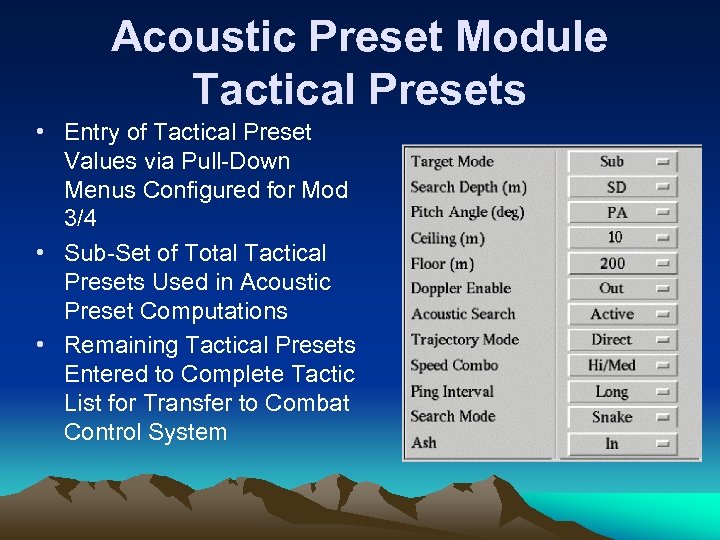 Acoustic Preset Module Tactical Presets • Entry of Tactical Preset Values via Pull-Down Menus Configured for Mod 3/4 • Sub-Set of Total Tactical Presets Used in Acoustic Preset Computations • Remaining Tactical Presets Entered to Complete Tactic List for Transfer to Combat Control System
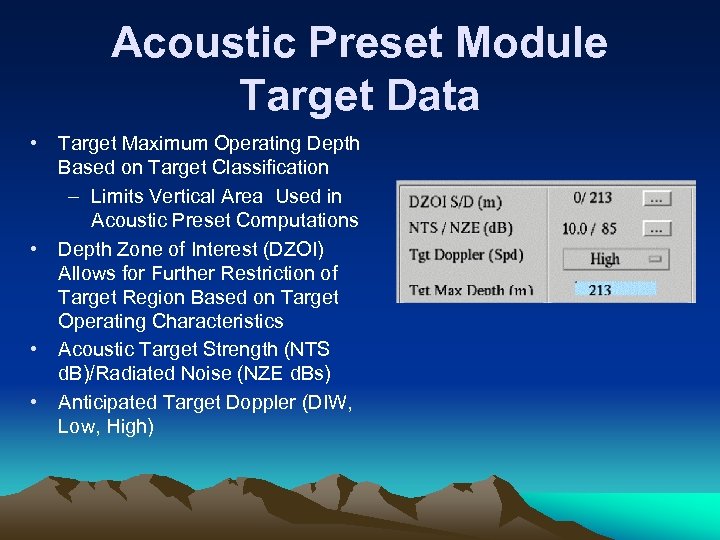 Acoustic Preset Module Target Data • • Target Maximum Operating Depth Based on Target Classification – Limits Vertical Area Used in Acoustic Preset Computations Depth Zone of Interest (DZOI) Allows for Further Restriction of Target Region Based on Target Operating Characteristics Acoustic Target Strength (NTS d. B)/Radiated Noise (NZE d. Bs) Anticipated Target Doppler (DIW, Low, High)
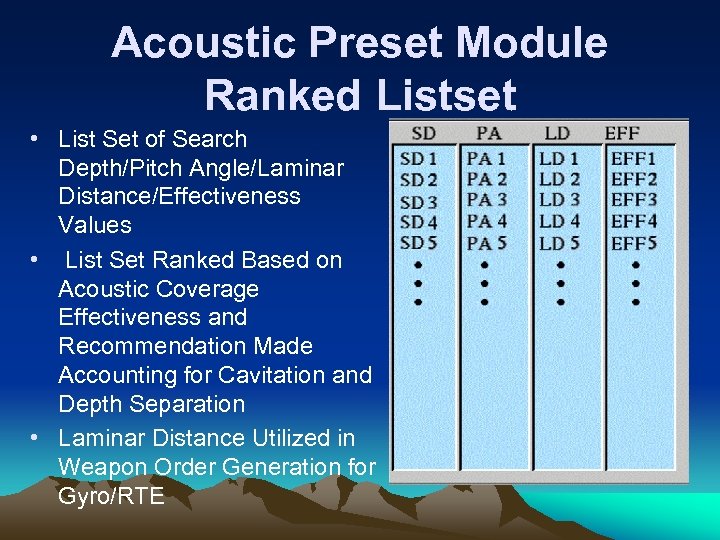 Acoustic Preset Module Ranked Listset • List Set of Search Depth/Pitch Angle/Laminar Distance/Effectiveness Values • List Set Ranked Based on Acoustic Coverage Effectiveness and Recommendation Made Accounting for Cavitation and Depth Separation • Laminar Distance Utilized in Weapon Order Generation for Gyro/RTE
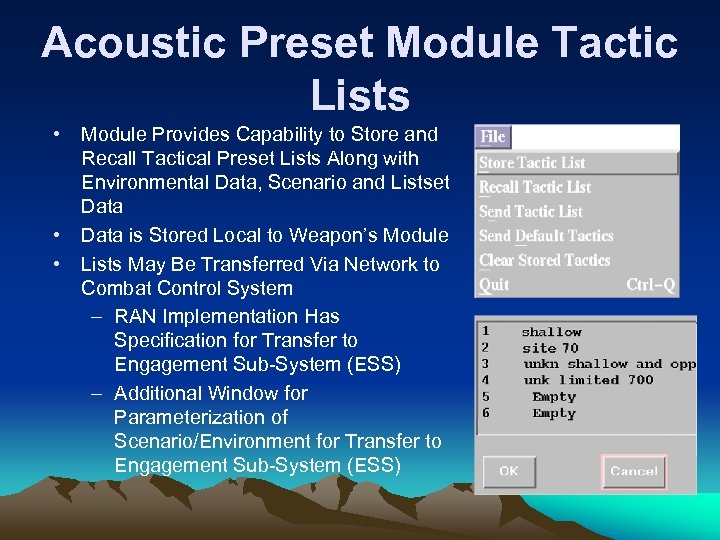 Acoustic Preset Module Tactic Lists • • • Module Provides Capability to Store and Recall Tactical Preset Lists Along with Environmental Data, Scenario and Listset Data is Stored Local to Weapon’s Module Lists May Be Transferred Via Network to Combat Control System – RAN Implementation Has Specification for Transfer to Engagement Sub-System (ESS) – Additional Window for Parameterization of Scenario/Environment for Transfer to Engagement Sub-System (ESS)
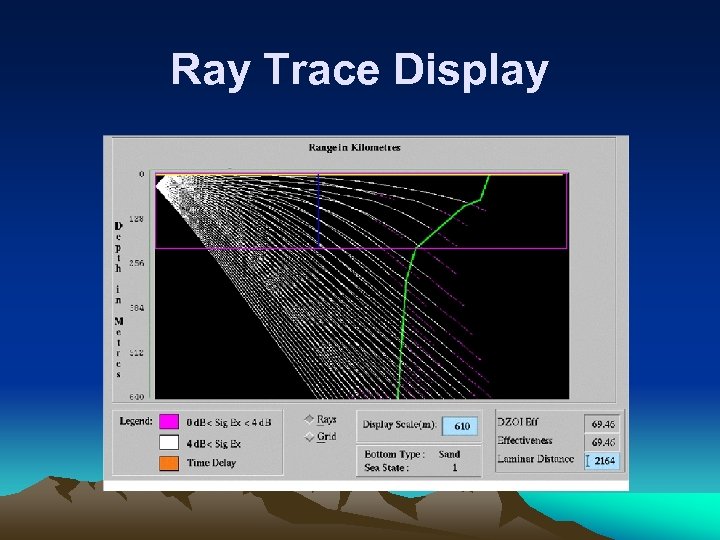 Ray Trace Display
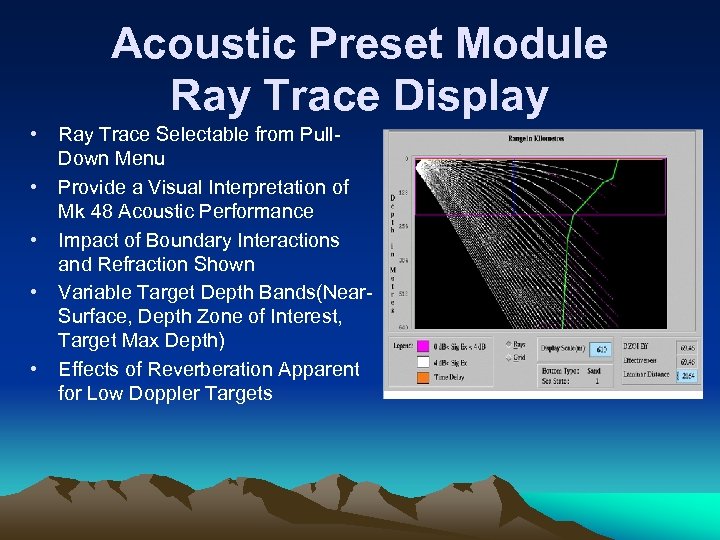 Acoustic Preset Module Ray Trace Display • • • Ray Trace Selectable from Pull. Down Menu Provide a Visual Interpretation of Mk 48 Acoustic Performance Impact of Boundary Interactions and Refraction Shown Variable Target Depth Bands(Near. Surface, Depth Zone of Interest, Target Max Depth) Effects of Reverberation Apparent for Low Doppler Targets
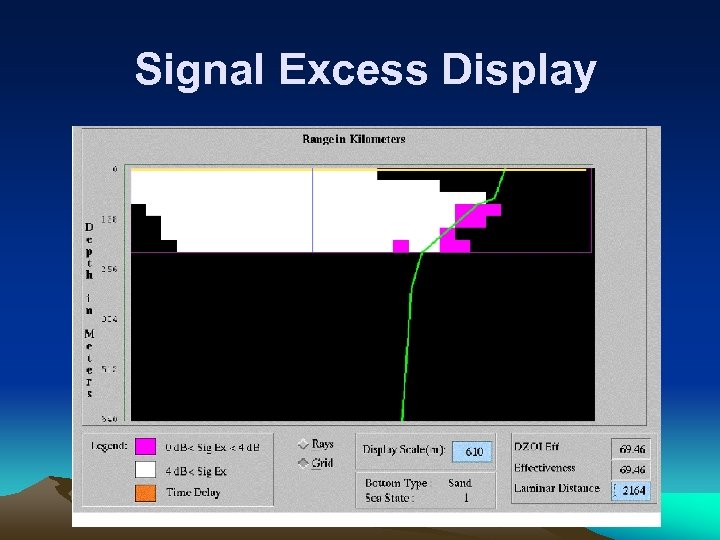 Signal Excess Display
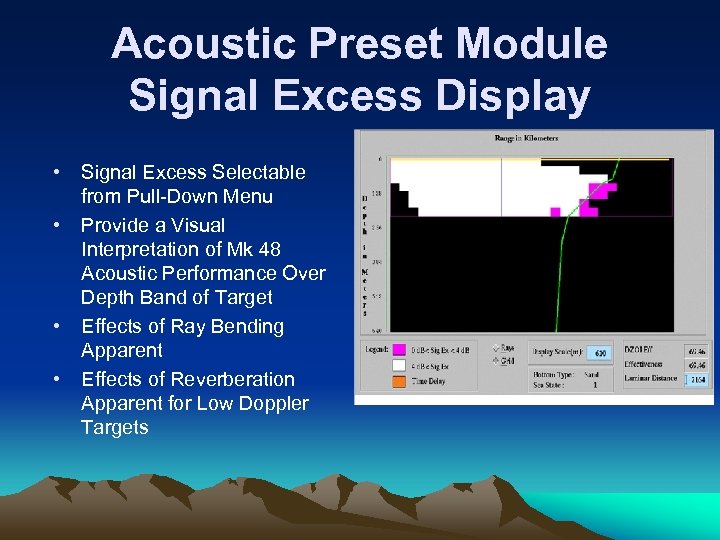 Acoustic Preset Module Signal Excess Display • • Signal Excess Selectable from Pull-Down Menu Provide a Visual Interpretation of Mk 48 Acoustic Performance Over Depth Band of Target Effects of Ray Bending Apparent Effects of Reverberation Apparent for Low Doppler Targets
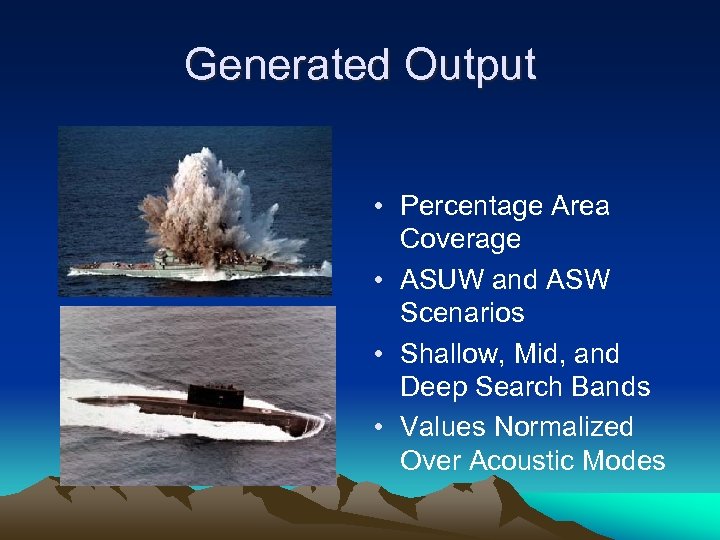 Generated Output • Percentage Area Coverage • ASUW and ASW Scenarios • Shallow, Mid, and Deep Search Bands • Values Normalized Over Acoustic Modes
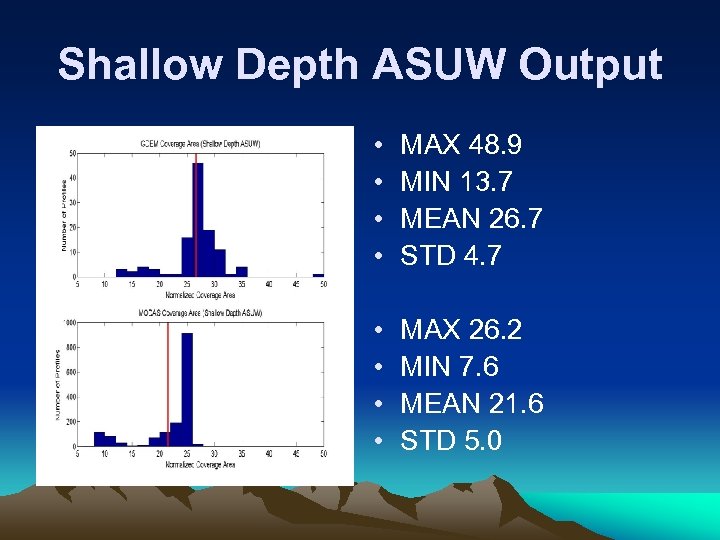 Shallow Depth ASUW Output • • MAX 48. 9 MIN 13. 7 MEAN 26. 7 STD 4. 7 • • MAX 26. 2 MIN 7. 6 MEAN 21. 6 STD 5. 0
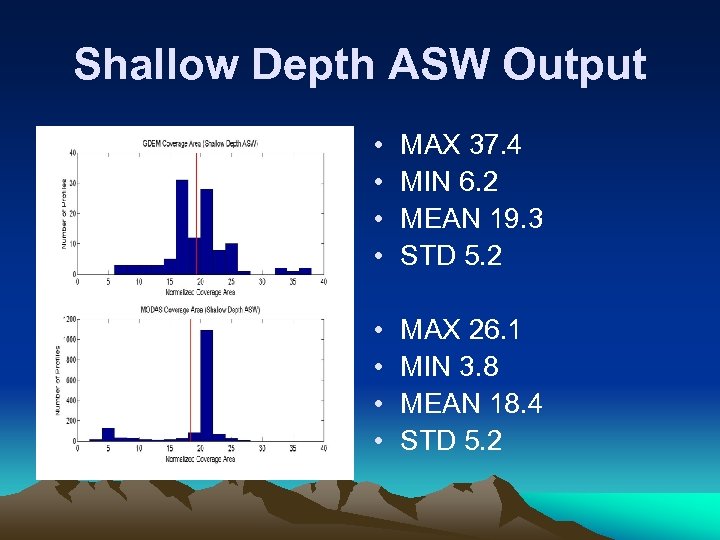 Shallow Depth ASW Output • • MAX 37. 4 MIN 6. 2 MEAN 19. 3 STD 5. 2 • • MAX 26. 1 MIN 3. 8 MEAN 18. 4 STD 5. 2
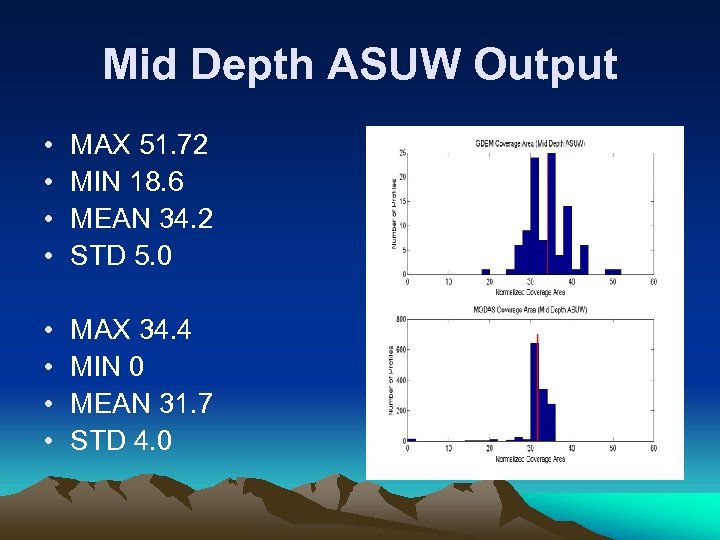 Mid Depth ASUW Output • • MAX 51. 72 MIN 18. 6 MEAN 34. 2 STD 5. 0 • • MAX 34. 4 MIN 0 MEAN 31. 7 STD 4. 0
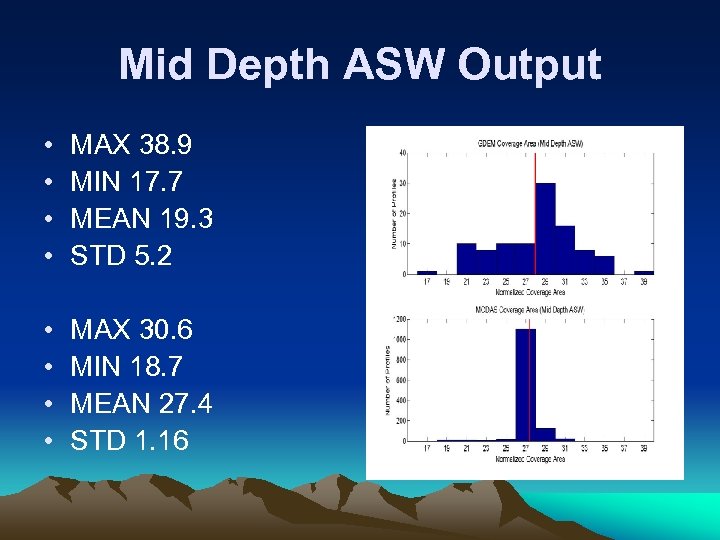 Mid Depth ASW Output • • MAX 38. 9 MIN 17. 7 MEAN 19. 3 STD 5. 2 • • MAX 30. 6 MIN 18. 7 MEAN 27. 4 STD 1. 16
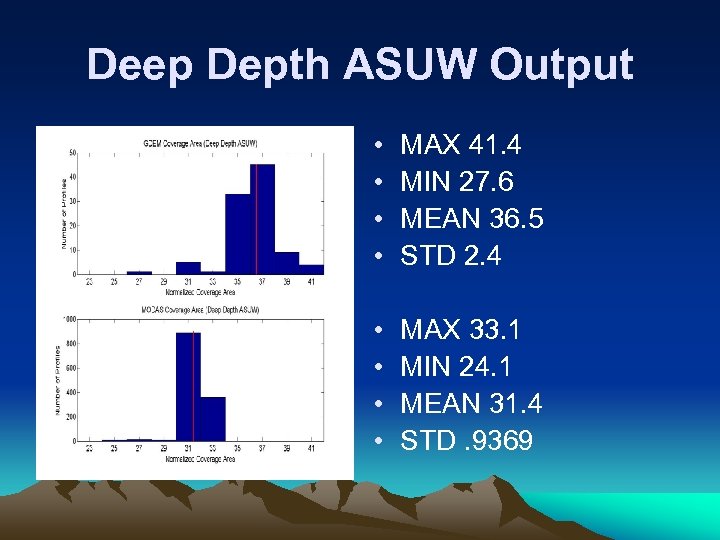 Deep Depth ASUW Output • • MAX 41. 4 MIN 27. 6 MEAN 36. 5 STD 2. 4 • • MAX 33. 1 MIN 24. 1 MEAN 31. 4 STD. 9369
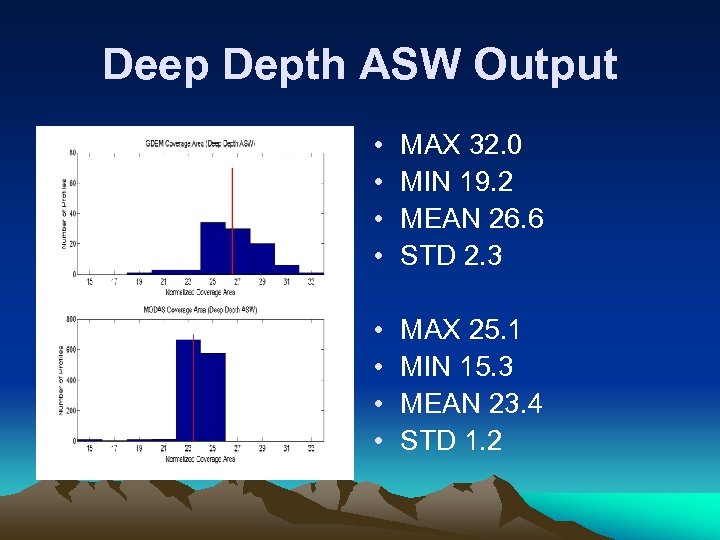 Deep Depth ASW Output • • MAX 32. 0 MIN 19. 2 MEAN 26. 6 STD 2. 3 • • MAX 25. 1 MIN 15. 3 MEAN 23. 4 STD 1. 2
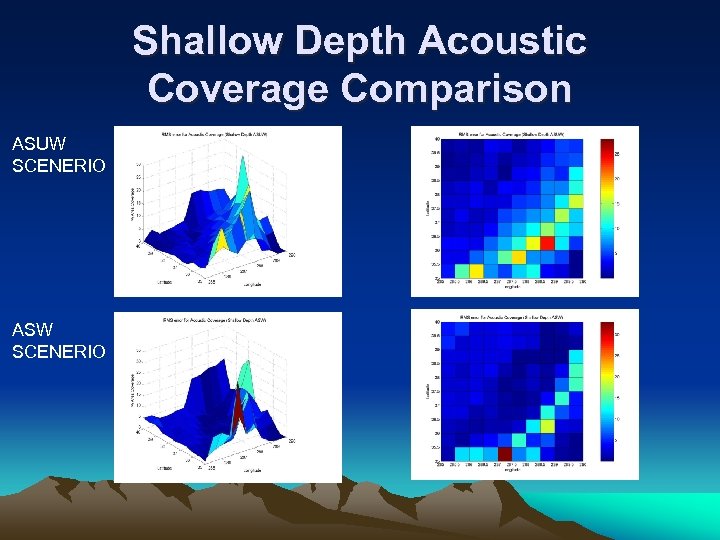 Shallow Depth Acoustic Coverage Comparison ASUW SCENERIO ASW SCENERIO
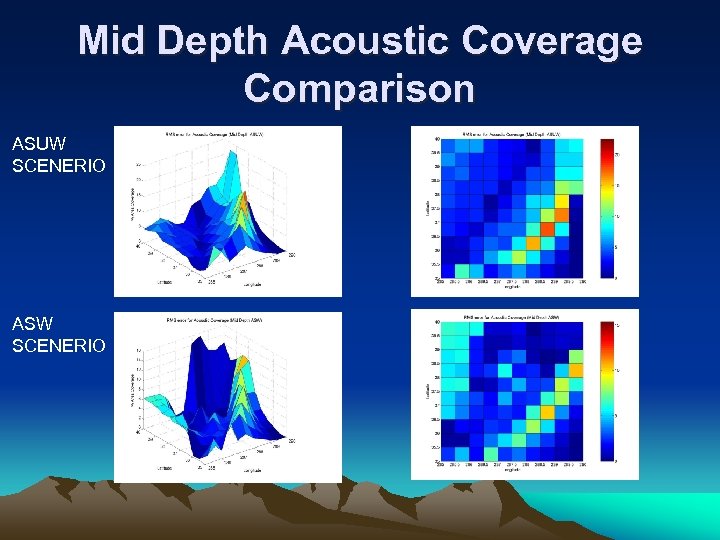 Mid Depth Acoustic Coverage Comparison ASUW SCENERIO ASW SCENERIO
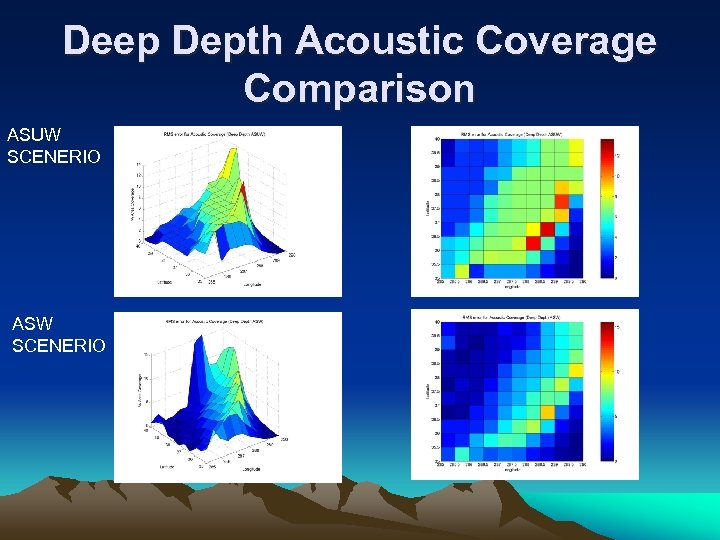 Deep Depth Acoustic Coverage Comparison ASUW SCENERIO ASW SCENERIO
 Conclusions • Percentage Area Coverage is an effective metric for comparing weapon presets • MODAS offers reliable results over the whole area while GDEM is “hit or miss” • MODAS initialized presets are optimized in Mid and Deep Depth Bands • For Shallow Depth Bands MODAS and GDEM produced similar results
 Future Projects • More Extensive Data Set – Observe changes over time and for different locations – Examine areas of strong thermal or salinity contrast • Altimeter Investigation – Vary the number of altimeters and observe the effect on area coverage – Determine optimal number of altimeters required
 Sources • http: //128. 160. 23. 42/gdemv. html – GDEM information • http: //www 7320. nrlssc. navy. mil/modas/ – MODAS information • Bennett, Theodore J. , “Estimating the Rotation Rate of Mesoscale Ocean Rings from Satellite Altimetry, ” Naval Research Laboratory, Stennis Space Center, MS, NRL/FR/7322— 939443, October 1993. • Crout, R. L. , “Radar Altimetry for Naval Applications, ” Presentation to the Standing Acquisition Coordination Team, 8 February 2000. • Jacobs, Gregg A. , Charlie N. Barron, Michael R. Carnes, Daniel N. Fox, Harley E. Hurlburt, Pavel Pistek, Roberts C. Rhodes, William J. Teague, “Navy Altimeter Data Requirements, ” Naval Research Laboratory, Stennis Space Center, MS, NRL/FR/7320— 99 -9696, November 1999.
 Questions?