


 Скачать презентацию Valuations and interim certificates Purpose Value the
572944f1c50f3c357d80fb7e100c1b41.ppt
- Количество слайдов: 19
 Valuations and interim certificates
 Purpose Value the works taking account of: –the physical work done on site; –any extra work ordered by the client; – the work of any specialist-nominated subcontractors; –the cost of running the site (the contractor’ s preliminaries); –the value of any materials delivered to site. © 2013 Andrew Ross and Peter Williams. Published 2013 by John Wiley & Sons, Ltd. 2
 Timing • In accordance with the JCT SBC/Q 2011, Interim Valuations shall be made by the Quantity Surveyor whenever the Architect/Contract Administrator considers them necessary for the purpose of ascertaining the amount to be stated as due in an Interim Certificate • Under the ICC – Measurement Version, the methodology is different because it is the Contractor who shall submit to the Engineer … a statement showing the estimated contract value … carried out up to the end of that month. It is the opinion of the Engineer that decides the amount to be certified for payment. © 2013 Andrew Ross and Peter Williams. Published 2013 by John Wiley & Sons, Ltd. 3
 Methods of payment • Stage payment – Link to contract sum analysis and programme – Link to agreed value profile • Measure and value – Remeasurement and application of contractor rates • Payment notices – The act requires notices to be provided. • Retention – Alternatives- bonds – Release of moieties – Retention limit under the ICC conditions – – – the physical work done on site; any extra work ordered by the client; the work of any specialist-nominated subcontractors; the cost of running the site (the contractor’ s preliminaries); the value of any materials delivered to site. © 2013 Andrew Ross and Peter Williams. Published 2013 by John Wiley & Sons, Ltd. 4
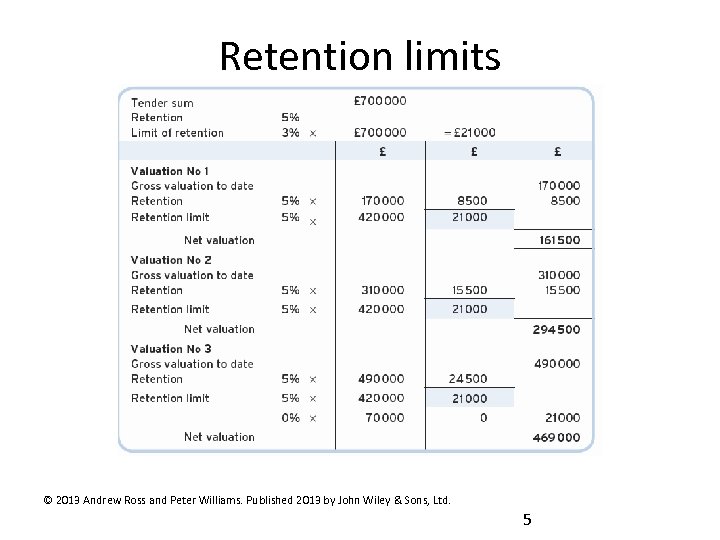 Retention limits © 2013 Andrew Ross and Peter Williams. Published 2013 by John Wiley & Sons, Ltd. 5
 Principles • Accumulation – Cumulative • Deduction of previous payments • Types of valuation – External valuation – Internal valuation – Subcontract valuation © 2013 Andrew Ross and Peter Williams. Published 2013 by John Wiley & Sons, Ltd. 6
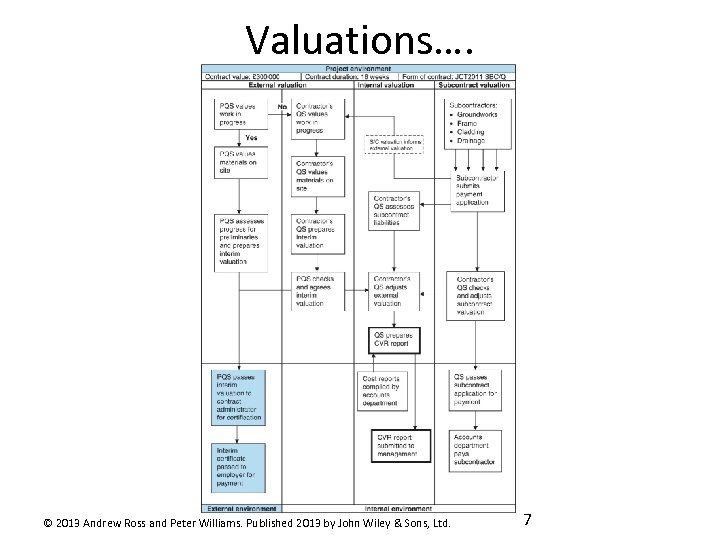 Valuations…. © 2013 Andrew Ross and Peter Williams. Published 2013 by John Wiley & Sons, Ltd. 7
 Techniques • Inspection – Easy and quick – But inaccurate • Measurement – On site or from revised drawings – Accurate and agreement assured – Timely and difficult to isolate variations • Ogive curve (reference to a model of planned expenditure) – Simple and adjustments to forecasts can be made – Inaccurate and slow progress may lead to over payment • Gantt chart – Easy to agree and relate to stage payment – Inaccurate and can be abused by loading © 2013 Andrew Ross and Peter Williams. Published 2013 by John Wiley & Sons, Ltd. 8
 Materials on site • Lists and inspection • Retention of title – Sale of good act 1979 – Dawber Williamson – Ensure entitlement © 2013 Andrew Ross and Peter Williams. Published 2013 by John Wiley & Sons, Ltd. 9
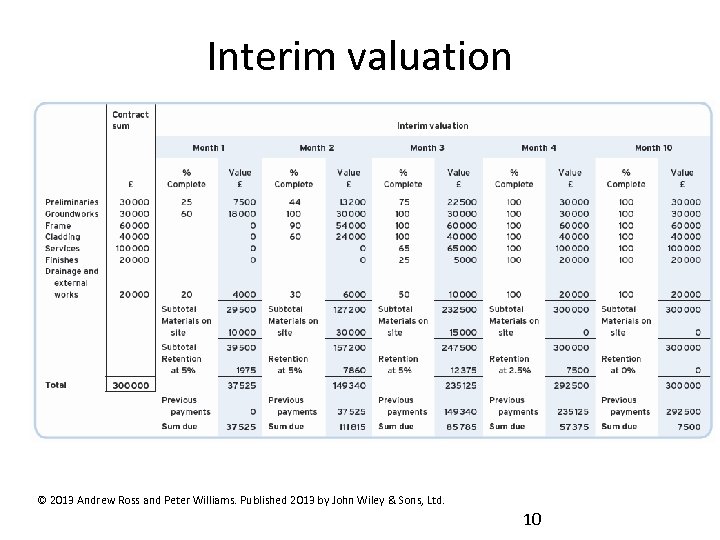 Interim valuation © 2013 Andrew Ross and Peter Williams. Published 2013 by John Wiley & Sons, Ltd. 10
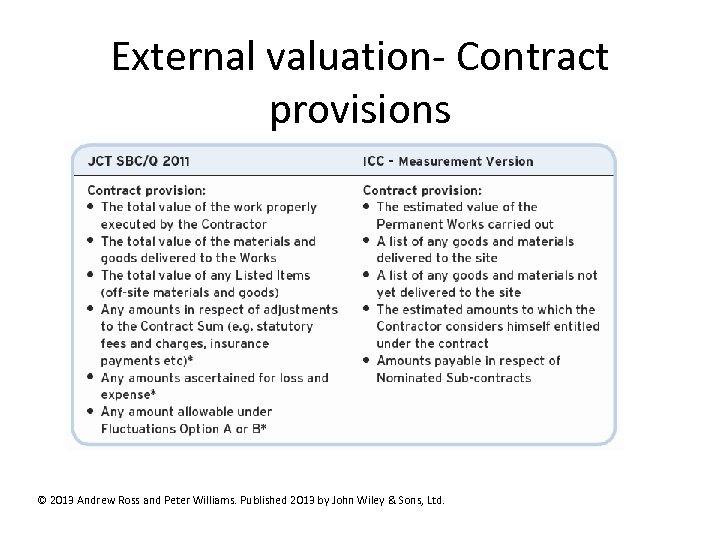 External valuation- Contract provisions © 2013 Andrew Ross and Peter Williams. Published 2013 by John Wiley & Sons, Ltd.
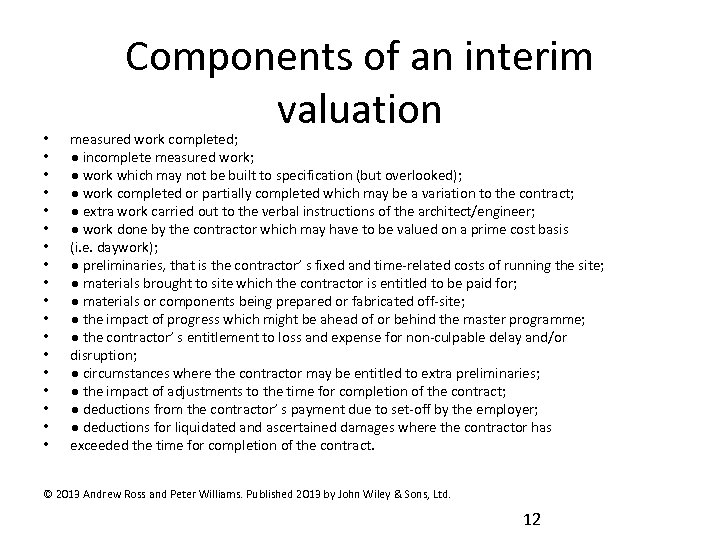 • • • • • Components of an interim valuation measured work completed; ● incomplete measured work; ● work which may not be built to specification (but overlooked); ● work completed or partially completed which may be a variation to the contract; ● extra work carried out to the verbal instructions of the architect/engineer; ● work done by the contractor which may have to be valued on a prime cost basis (i. e. daywork); ● preliminaries, that is the contractor’ s fixed and time-related costs of running the site; ● materials brought to site which the contractor is entitled to be paid for; ● materials or components being prepared or fabricated off-site; ● the impact of progress which might be ahead of or behind the master programme; ● the contractor’ s entitlement to loss and expense for non-culpable delay and/or disruption; ● circumstances where the contractor may be entitled to extra preliminaries; ● the impact of adjustments to the time for completion of the contract; ● deductions from the contractor’ s payment due to set-off by the employer; ● deductions for liquidated and ascertained damages where the contractor has exceeded the time for completion of the contract. © 2013 Andrew Ross and Peter Williams. Published 2013 by John Wiley & Sons, Ltd. 12
 Valuation of variations • For similar items of work carried out under similar conditions with no significant difference in quantity – use bills of quantities rates. • For similar items of work carried out under dissimilar conditions and/or with significant differences in quantity – use bills of quantities rates as a basis for the valuation. • For dissimilar items of work carried out under dissimilar conditions and/or with significant differences in quantity – value the work at fair rates. • Where an approximate quantity proves to be a reasonably accurate forecast of the quantity of work required – use the rate or price in the bills of quantities. • Where an approximate quantity is not a reasonably accurate forecast of the quantity of work required – use the rate or price in the bills of quantities as a basis for valuation. • Where the work involved in a variation cannot be properly valued by measurement – use daywork as the means of valuation. © 2013 Andrew Ross and Peter Williams. Published 2013 by John Wiley & Sons, Ltd. 13
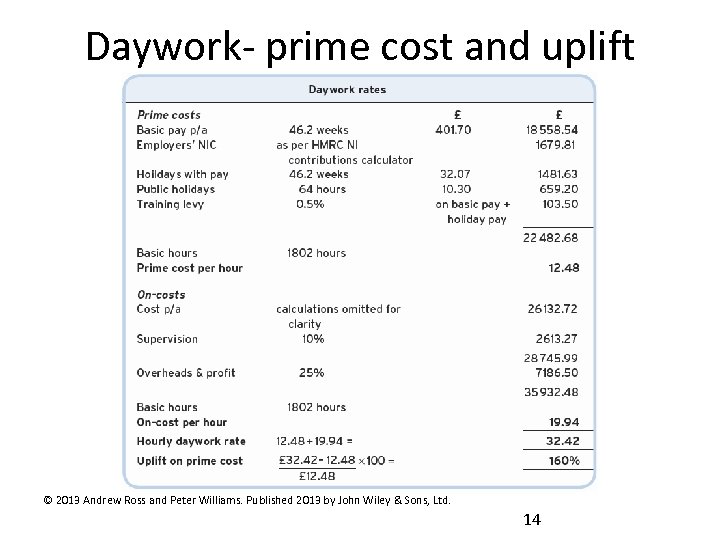 Daywork- prime cost and uplift © 2013 Andrew Ross and Peter Williams. Published 2013 by John Wiley & Sons, Ltd. 14
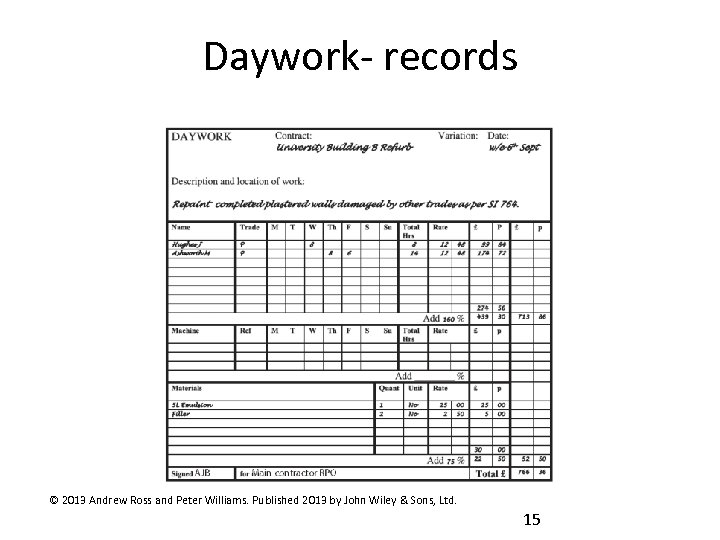 Daywork- records © 2013 Andrew Ross and Peter Williams. Published 2013 by John Wiley & Sons, Ltd. 15
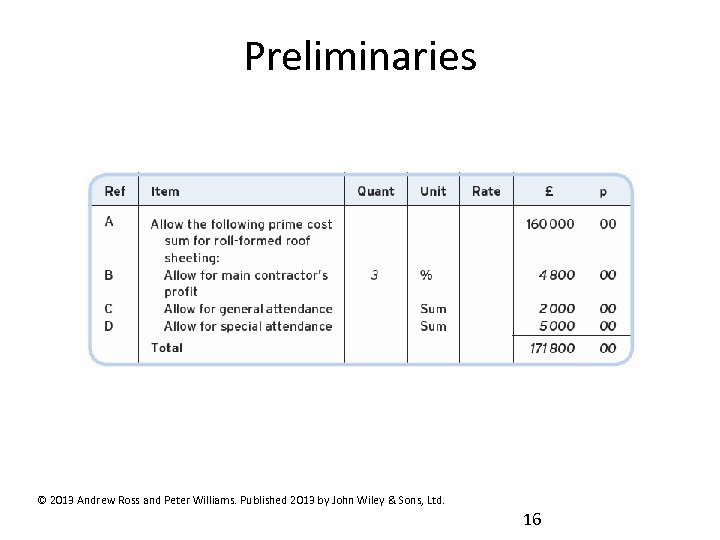 Preliminaries © 2013 Andrew Ross and Peter Williams. Published 2013 by John Wiley & Sons, Ltd. 16
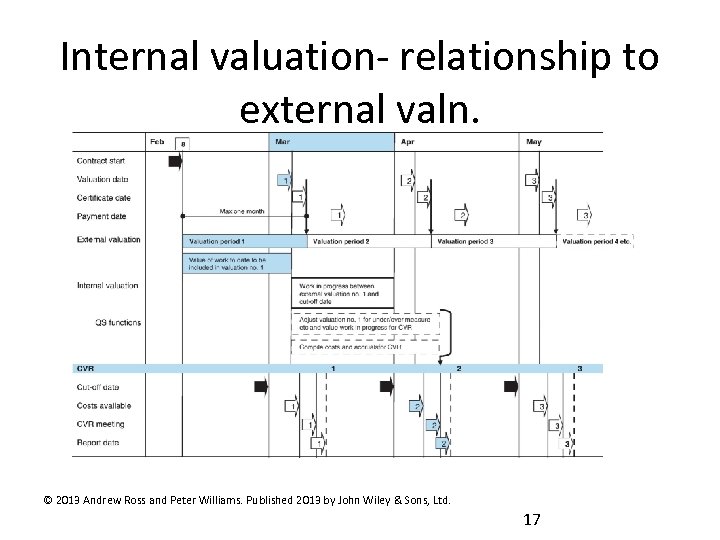 Internal valuation- relationship to external valn. © 2013 Andrew Ross and Peter Williams. Published 2013 by John Wiley & Sons, Ltd. 17
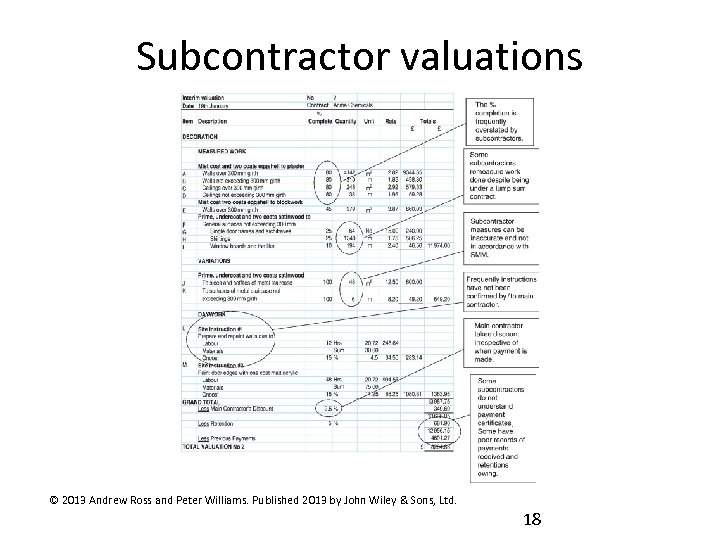 Subcontractor valuations © 2013 Andrew Ross and Peter Williams. Published 2013 by John Wiley & Sons, Ltd. 18
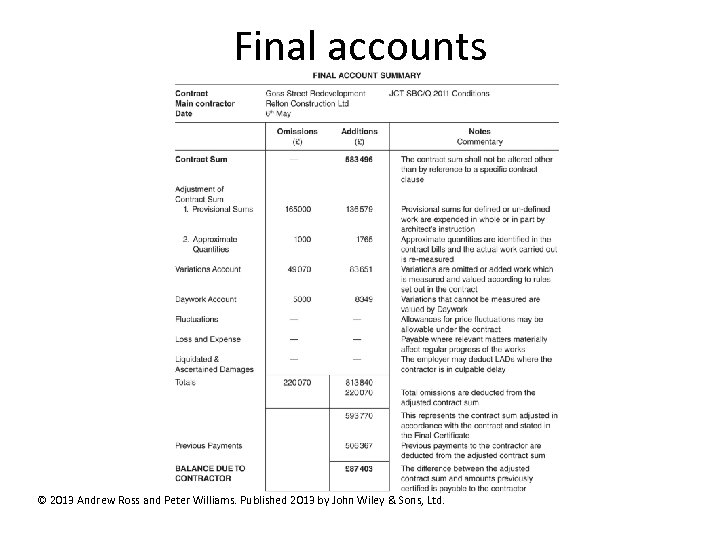 Final accounts © 2013 Andrew Ross and Peter Williams. Published 2013 by John Wiley & Sons, Ltd.