 Скачать презентацию VALUATION MODELS ACCURACY AND PREDICTIVE CAPABILITY A WORK-IN-PROGRESS
aeb0e40c69c212f0eca499cb4d9cbdc8.ppt
- Количество слайдов: 72



VALUATION MODELS: ACCURACY AND PREDICTIVE CAPABILITY (A WORK-IN-PROGRESS) Designed to be Challenging and Provocative Stamford Analyst Society May 25, 2005 By Rawley Thomas President Life. Cycle Returns, Inc. Rawley@LCRT. com Sources: Financial Statements and Price Data – Capital. IQ & Core. Data - Calculations – LCRT Platform - - © 2005 Life. Cycle Returns, Inc. All Rights Reserved
THE CONCEPT OF VALUE MANAGEMENT A strong correlation exists between enterprise value and the spread between CER (cash economic return) and cost of capital l Econometric DCF models can be built and validated against historical data to quantify this correlation and identify the key operating drivers which most significantly impact value l Managements can use these models to analyze their own corporate performance and to improve their decision making and value generation l Portfolio managers can use these models for buy / sell decisions l Sources: Financial Statements and Price Data – Capital. IQ & Core. Data - Calculations – LCRT Platform - 2 © 2005 Life. Cycle Returns, Inc. All Rights Reserved

DISCONNECT BETWEEN VALUE MANAGEMENT AND PORTFOLIO APPLICATION Sources: Financial Statements and Price Data – Capital. IQ & Core. Data - Calculations – LCRT Platform - - © 2005 Life. Cycle Returns, Inc. All Rights Reserved
UTILIZATION OF ECONOMIC RATE OF RETURN BASED DCF VALUATIONS Academic finance teaches that corporations create shareholder value when investing in projects which produce rates of return above the cost of capital l Yet, most professional money managers primarily employ P/E’s, EPS surprises and other metrics which fail to relate directly to the above fundamental finance principle l Why don’t most all portfolio managers utilize rate of return on capital based DCF techniques as their primary (or even exclusive) criteria for investment decisions? Hypothesis l Academics and practitioner oriented vendors have failed to demonstrate conceptually sound, overwhelming empirical evidence that either EVA® or DCF intrinsic valuation techniques based on corporate of return spreads over the cost of capital are superior to simple multiples in explaining stock price levels and total shareholder returns. l Sources: Financial Statements and Price Data – Capital. IQ & Core. Data - Calculations – LCRT Platform - 4 © 2005 Life. Cycle Returns, Inc. All Rights Reserved
OTHER HYPOTHESES FOR THE DISCONNECT BETWEEN CAPITAL BUDGETING PRINCIPLES AND PORTFOLIO DECISIONS l Failure to decompose the problem into separable component pieces – – l Solve the price level = PV of cash flows empirically first, before attacking the price change problem (academics usually employ multiple regression techniques of price changes related to other variables) Separate the validity of the cash flow forecast from the empirical validity of the terminal value structure Separate the migration of price toward intrinsic value and intrinsic value toward next year’s price Separate technical (behavioral finance sentiment) pressures from intrinsic valuations as anchors – wide-spread academic belief in the strong form instantaneous efficient markets precludes their openness to consider counter evidence Failure to develop measures of goodness which enable comparative empirical testing of different models and associated parameters – – Measure the empirical accuracy of intrinsic value models against actual stock price levels (without analyst intervention) Measure the differences between “Winner” and “Losers” – their means and their distributional “risk” characteristics Sources: Financial Statements and Price Data – Capital. IQ & Core. Data - Calculations – LCRT Platform - 5 © 2005 Life. Cycle Returns, Inc. All Rights Reserved
VALUATION MODEL AND SECURITY ANALYSIS PROCESSES Sources: Financial Statements and Price Data – Capital. IQ & Core. Data - Calculations – LCRT Platform - - © 2005 Life. Cycle Returns, Inc. All Rights Reserved
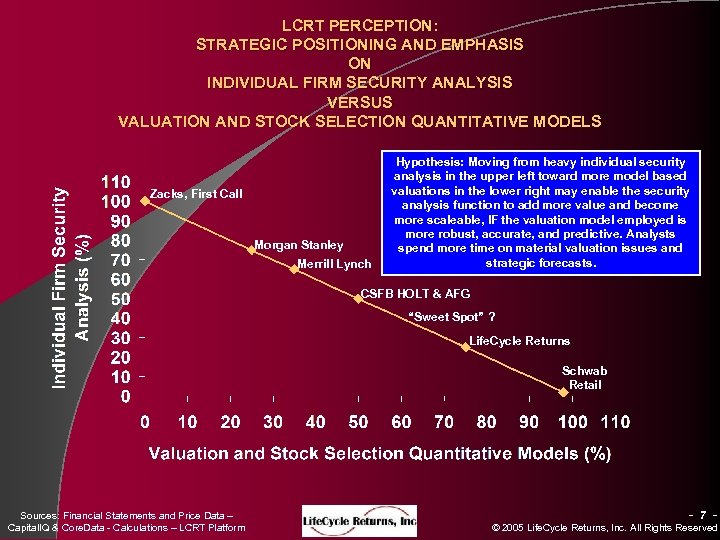
LCRT PERCEPTION: STRATEGIC POSITIONING AND EMPHASIS ON INDIVIDUAL FIRM SECURITY ANALYSIS VERSUS VALUATION AND STOCK SELECTION QUANTITATIVE MODELS Zacks, First Call Morgan Stanley Merrill Lynch Hypothesis: Moving from heavy individual security analysis in the upper left toward more model based valuations in the lower right may enable the security analysis function to add more value and become more scaleable, IF the valuation model employed is more robust, accurate, and predictive. Analysts spend more time on material valuation issues and strategic forecasts. CSFB HOLT & AFG “Sweet Spot” ? Life. Cycle Returns Schwab Retail Sources: Financial Statements and Price Data – Capital. IQ & Core. Data - Calculations – LCRT Platform - 7 © 2005 Life. Cycle Returns, Inc. All Rights Reserved
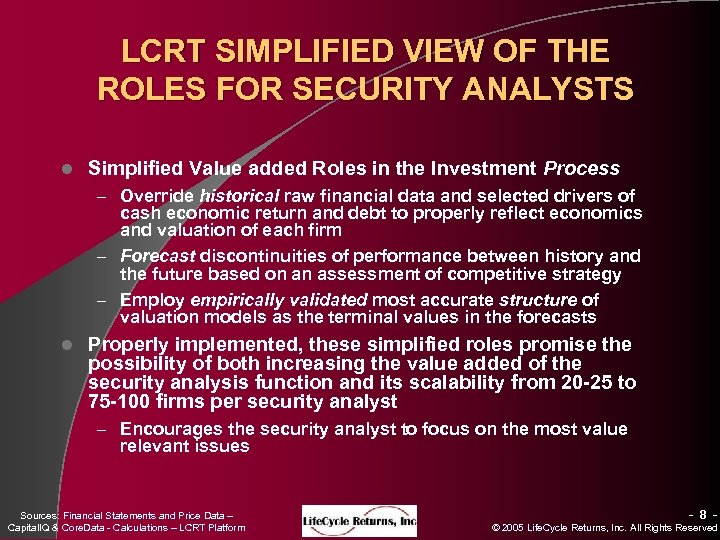
LCRT SIMPLIFIED VIEW OF THE ROLES FOR SECURITY ANALYSTS l Simplified Value added Roles in the Investment Process – Override historical raw financial data and selected drivers of cash economic return and debt to properly reflect economics and valuation of each firm – Forecast discontinuities of performance between history and the future based on an assessment of competitive strategy – Employ empirically validated most accurate structure of valuation models as the terminal values in the forecasts l Properly implemented, these simplified roles promise the possibility of both increasing the value added of the security analysis function and its scalability from 20 -25 to 75 -100 firms per security analyst – Encourages the security analyst to focus on the most value relevant issues Sources: Financial Statements and Price Data – Capital. IQ & Core. Data - Calculations – LCRT Platform - 8 © 2005 Life. Cycle Returns, Inc. All Rights Reserved
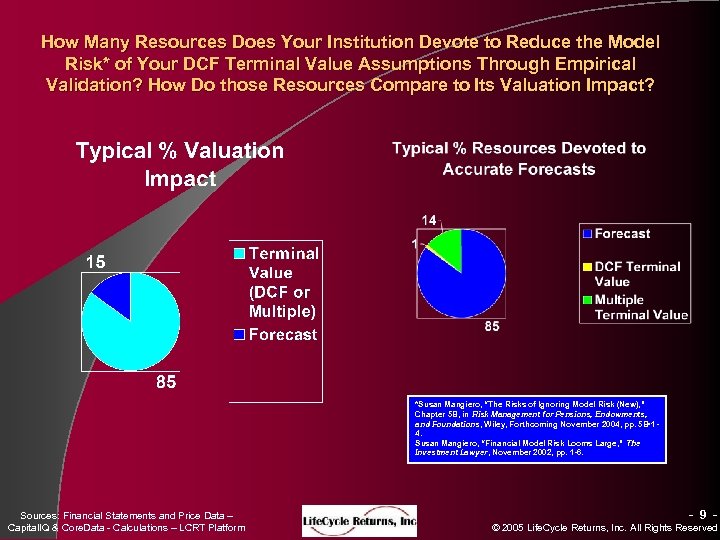
How Many Resources Does Your Institution Devote to Reduce the Model Risk* of Your DCF Terminal Value Assumptions Through Empirical Validation? How Do those Resources Compare to Its Valuation Impact? *Susan Mangiero, “The Risks of Ignoring Model Risk (New), ” Chapter 5 B, in Risk Management for Pensions, Endowments, and Foundations, Wiley, Forthcoming November 2004, pp. 5 B • 14. Susan Mangiero, “Financial Model Risk Looms Large, ” The Investment Lawyer, November 2002, pp. 1 -6. Sources: Financial Statements and Price Data – Capital. IQ & Core. Data - Calculations – LCRT Platform - 9 © 2005 Life. Cycle Returns, Inc. All Rights Reserved
COMPARISON OF VALUE BASED MANAGEMENT FRAMEWORKS Sources: Financial Statements and Price Data – Capital. IQ & Core. Data - Calculations – LCRT Platform - - © 2005 Life. Cycle Returns, Inc. All Rights Reserved
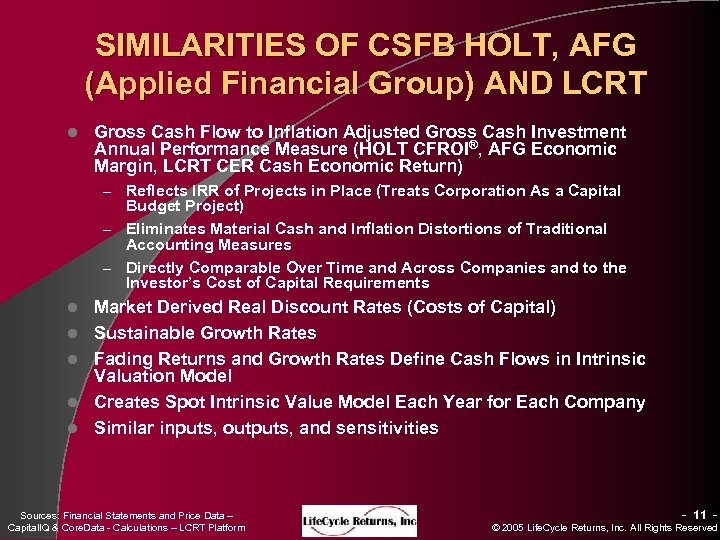
SIMILARITIES OF CSFB HOLT, AFG (Applied Financial Group) AND LCRT l Gross Cash Flow to Inflation Adjusted Gross Cash Investment Annual Performance Measure (HOLT CFROI®, AFG Economic Margin, LCRT CER Cash Economic Return) – Reflects IRR of Projects in Place (Treats Corporation As a Capital Budget Project) – Eliminates Material Cash and Inflation Distortions of Traditional Accounting Measures – Directly Comparable Over Time and Across Companies and to the Investor’s Cost of Capital Requirements l l l Market Derived Real Discount Rates (Costs of Capital) Sustainable Growth Rates Fading Returns and Growth Rates Define Cash Flows in Intrinsic Valuation Model Creates Spot Intrinsic Value Model Each Year for Each Company Similar inputs, outputs, and sensitivities Sources: Financial Statements and Price Data – Capital. IQ & Core. Data - Calculations – LCRT Platform - 11 © 2005 Life. Cycle Returns, Inc. All Rights Reserved
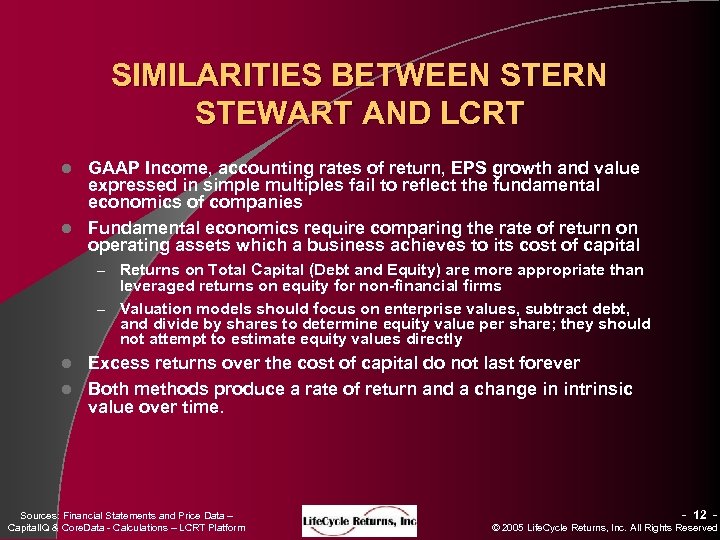
SIMILARITIES BETWEEN STERN STEWART AND LCRT GAAP Income, accounting rates of return, EPS growth and value expressed in simple multiples fail to reflect the fundamental economics of companies l Fundamental economics require comparing the rate of return on operating assets which a business achieves to its cost of capital l – Returns on Total Capital (Debt and Equity) are more appropriate than leveraged returns on equity for non-financial firms – Valuation models should focus on enterprise values, subtract debt, and divide by shares to determine equity value per share; they should not attempt to estimate equity values directly Excess returns over the cost of capital do not last forever l Both methods produce a rate of return and a change in intrinsic value over time. l Sources: Financial Statements and Price Data – Capital. IQ & Core. Data - Calculations – LCRT Platform - 12 © 2005 Life. Cycle Returns, Inc. All Rights Reserved
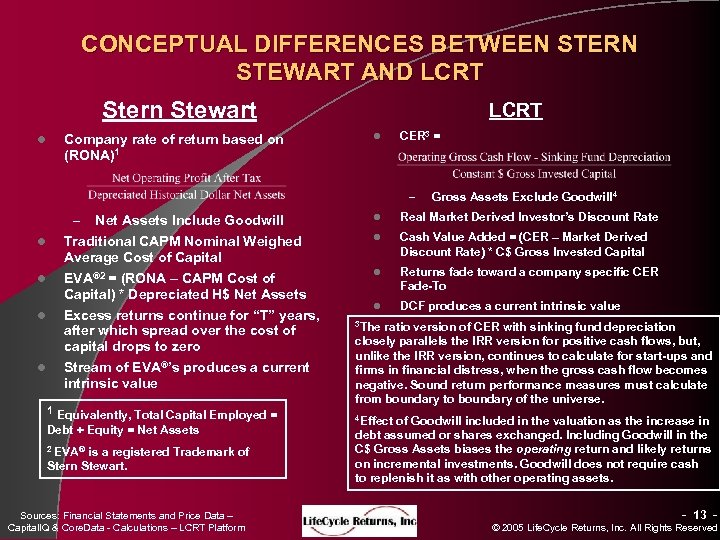
CONCEPTUAL DIFFERENCES BETWEEN STERN STEWART AND LCRT Stern Stewart Company rate of return based on (RONA)1 l LCRT l CER 3 = – – Net Assets Include Goodwill Gross Assets Exclude Goodwill 4 l Real Market Derived Investor’s Discount Rate l Traditional CAPM Nominal Weighed Average Cost of Capital l Cash Value Added = (CER – Market Derived Discount Rate) * C$ Gross Invested Capital l EVA® 2 = (RONA – CAPM Cost of Capital) * Depreciated H$ Net Assets l Returns fade toward a company specific CER Fade-To l Excess returns continue for “T” years, after which spread over the cost of capital drops to zero l DCF produces a current intrinsic value l Stream of EVA®’s produces a current intrinsic value 1 Equivalently, Total Capital Employed = Debt + Equity = Net Assets EVA® is a registered Trademark of Stern Stewart. 2 Sources: Financial Statements and Price Data – Capital. IQ & Core. Data - Calculations – LCRT Platform 3 The ratio version of CER with sinking fund depreciation closely parallels the IRR version for positive cash flows, but, unlike the IRR version, continues to calculate for start-ups and firms in financial distress, when the gross cash flow becomes negative. Sound return performance measures must calculate from boundary to boundary of the universe. 4 Effect of Goodwill included in the valuation as the increase in debt assumed or shares exchanged. Including Goodwill in the C$ Gross Assets biases the operating return and likely returns on incremental investments. Goodwill does not require cash to replenish it as with other operating assets. - 13 © 2005 Life. Cycle Returns, Inc. All Rights Reserved
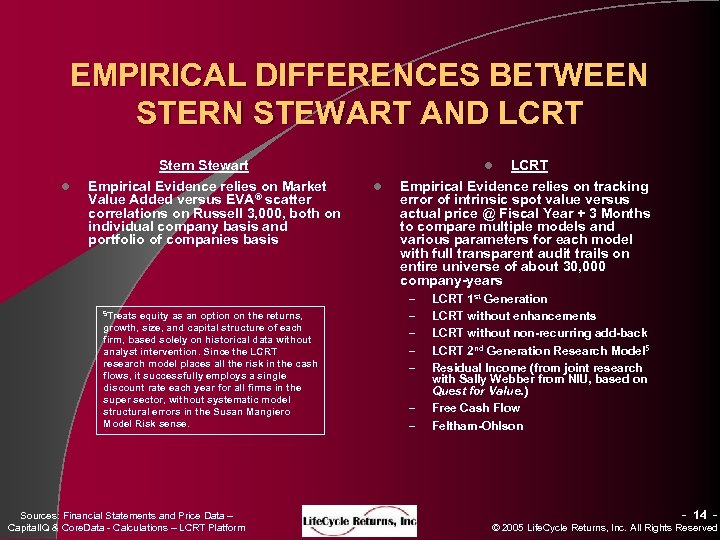
EMPIRICAL DIFFERENCES BETWEEN STERN STEWART AND LCRT l Stern Stewart Empirical Evidence relies on Market Value Added versus EVA® scatter correlations on Russell 3, 000, both on individual company basis and portfolio of companies basis LCRT Empirical Evidence relies on tracking error of intrinsic spot value versus actual price @ Fiscal Year + 3 Months to compare multiple models and various parameters for each model with full transparent audit trails on entire universe of about 30, 000 company-years l l – 5 Treats equity as an option on the returns, growth, size, and capital structure of each firm, based solely on historical data without analyst intervention. Since the LCRT research model places all the risk in the cash flows, it successfully employs a single discount rate each year for all firms in the super sector, without systematic model structural errors in the Susan Mangiero Model Risk sense. Sources: Financial Statements and Price Data – Capital. IQ & Core. Data - Calculations – LCRT Platform – – – LCRT 1 st Generation LCRT without enhancements LCRT without non-recurring add-back LCRT 2 nd Generation Research Model 5 Residual Income (from joint research with Sally Webber from NIU, based on Quest for Value. ) Free Cash Flow Feltham-Ohlson - 14 © 2005 Life. Cycle Returns, Inc. All Rights Reserved
MEASUREMENTS ILLUSTRATED Sources: Financial Statements and Price Data – Capital. IQ & Core. Data - Calculations – LCRT Platform - - © 2005 Life. Cycle Returns, Inc. All Rights Reserved
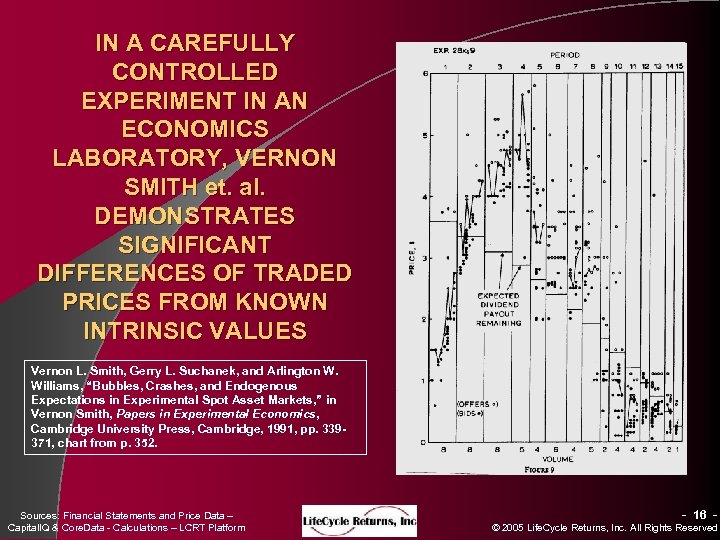
IN A CAREFULLY CONTROLLED EXPERIMENT IN AN ECONOMICS LABORATORY, VERNON SMITH et. al. DEMONSTRATES SIGNIFICANT DIFFERENCES OF TRADED PRICES FROM KNOWN INTRINSIC VALUES Vernon L. Smith, Gerry L. Suchanek, and Arlington W. Williams, “Bubbles, Crashes, and Endogenous Expectations in Experimental Spot Asset Markets, ” in Vernon Smith, Papers in Experimental Economics, Cambridge University Press, Cambridge, 1991, pp. 339371, chart from p. 352. Sources: Financial Statements and Price Data – Capital. IQ & Core. Data - Calculations – LCRT Platform - 16 © 2005 Life. Cycle Returns, Inc. All Rights Reserved
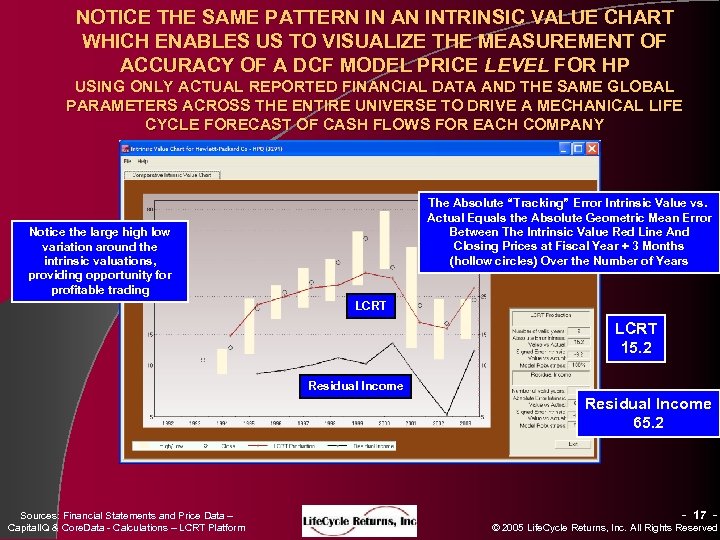
NOTICE THE SAME PATTERN IN AN INTRINSIC VALUE CHART WHICH ENABLES US TO VISUALIZE THE MEASUREMENT OF ACCURACY OF A DCF MODEL PRICE LEVEL FOR HP USING ONLY ACTUAL REPORTED FINANCIAL DATA AND THE SAME GLOBAL PARAMETERS ACROSS THE ENTIRE UNIVERSE TO DRIVE A MECHANICAL LIFE CYCLE FORECAST OF CASH FLOWS FOR EACH COMPANY The Absolute “Tracking” Error Intrinsic Value vs. Actual Equals the Absolute Geometric Mean Error Between The Intrinsic Value Red Line And Closing Prices at Fiscal Year + 3 Months (hollow circles) Over the Number of Years Notice the large high low variation around the intrinsic valuations, providing opportunity for profitable trading LCRT 15. 2 Residual Income 65. 2 Sources: Financial Statements and Price Data – Capital. IQ & Core. Data - Calculations – LCRT Platform - 17 © 2005 Life. Cycle Returns, Inc. All Rights Reserved
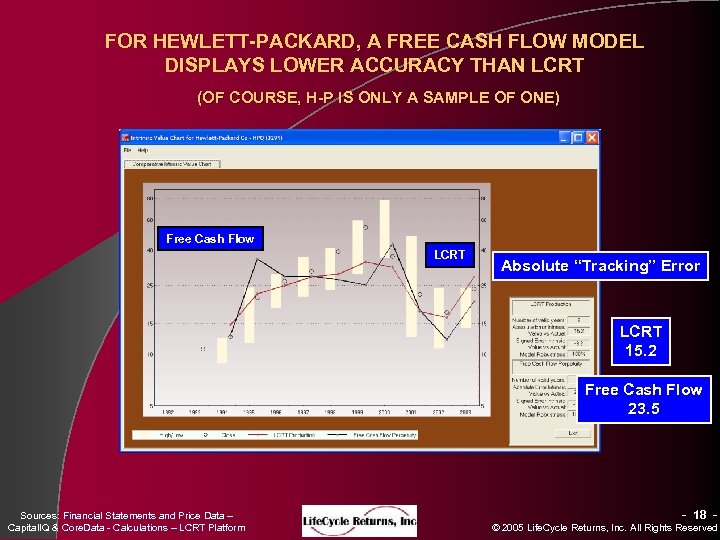
FOR HEWLETT-PACKARD, A FREE CASH FLOW MODEL DISPLAYS LOWER ACCURACY THAN LCRT (OF COURSE, H-P IS ONLY A SAMPLE OF ONE) Free Cash Flow LCRT Absolute “Tracking” Error LCRT 15. 2 Free Cash Flow 23. 5 Sources: Financial Statements and Price Data – Capital. IQ & Core. Data - Calculations – LCRT Platform - 18 © 2005 Life. Cycle Returns, Inc. All Rights Reserved

SEVERAL PROFESSORS ARE COLLABORATING WITH LCRT TO DETERMINE THE ROBUSTNESS AND ACCURACY OF TRADITIONAL MODELS AS NULL HYPOTHESES l Sally Webber of NIU and Doug Clinton of NIU – EVA® or Residual Income Models – Feltham-Ohlson Model l Adam Gehr of De. Paul – Dividend Discount Models Sources: Financial Statements and Price Data – Capital. IQ & Core. Data - Calculations – LCRT Platform - 19 © 2005 Life. Cycle Returns, Inc. All Rights Reserved
CONCEPTUAL DIFFERENCES BETWEEN MODELS Sources: Financial Statements and Price Data – Capital. IQ & Core. Data - Calculations – LCRT Platform - - © 2005 Life. Cycle Returns, Inc. All Rights Reserved
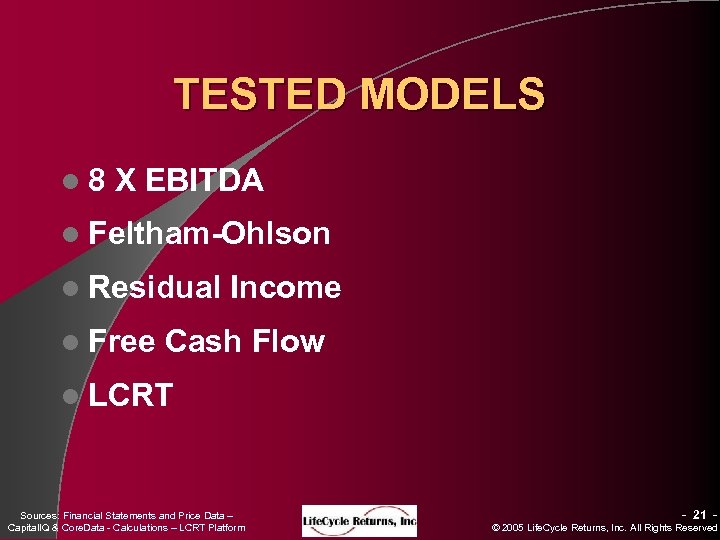
TESTED MODELS l 8 X EBITDA l Feltham-Ohlson l Residual l Free Income Cash Flow l LCRT Sources: Financial Statements and Price Data – Capital. IQ & Core. Data - Calculations – LCRT Platform - 21 © 2005 Life. Cycle Returns, Inc. All Rights Reserved
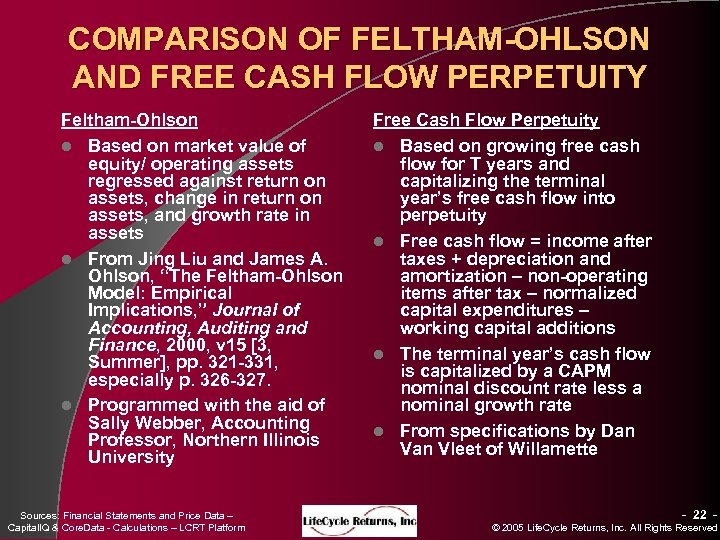
COMPARISON OF FELTHAM-OHLSON AND FREE CASH FLOW PERPETUITY Feltham-Ohlson l Based on market value of equity/ operating assets regressed against return on assets, change in return on assets, and growth rate in assets l From Jing Liu and James A. Ohlson, “The Feltham-Ohlson Model: Empirical Implications, ” Journal of Accounting, Auditing and Finance, 2000, v 15 [3, Summer], pp. 321 -331, especially p. 326 -327. l Programmed with the aid of Sally Webber, Accounting Professor, Northern Illinois University Sources: Financial Statements and Price Data – Capital. IQ & Core. Data - Calculations – LCRT Platform Free Cash Flow Perpetuity l Based on growing free cash flow for T years and capitalizing the terminal year’s free cash flow into perpetuity l Free cash flow = income after taxes + depreciation and amortization – non-operating items after tax – normalized capital expenditures – working capital additions l The terminal year’s cash flow is capitalized by a CAPM nominal discount rate less a nominal growth rate l From specifications by Dan Vleet of Willamette - 22 © 2005 Life. Cycle Returns, Inc. All Rights Reserved
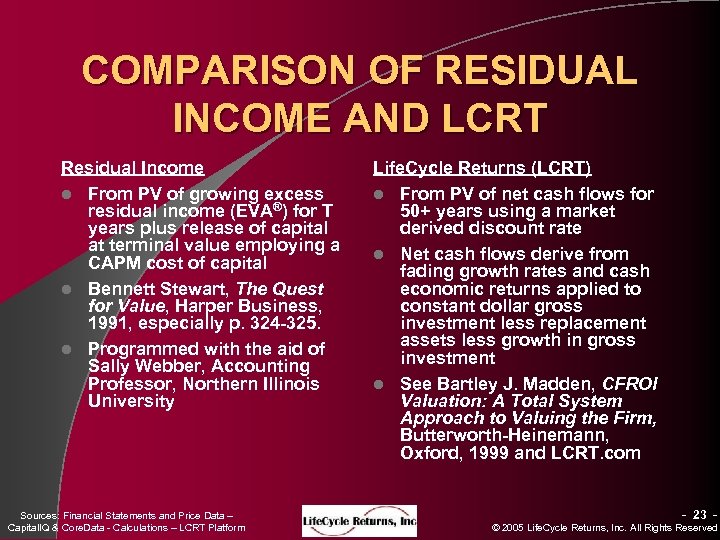
COMPARISON OF RESIDUAL INCOME AND LCRT Residual Income l From PV of growing excess residual income (EVA®) for T years plus release of capital at terminal value employing a CAPM cost of capital l Bennett Stewart, The Quest for Value, Harper Business, 1991, especially p. 324 -325. l Programmed with the aid of Sally Webber, Accounting Professor, Northern Illinois University Sources: Financial Statements and Price Data – Capital. IQ & Core. Data - Calculations – LCRT Platform Life. Cycle Returns (LCRT) l From PV of net cash flows for 50+ years using a market derived discount rate l Net cash flows derive from fading growth rates and cash economic returns applied to constant dollar gross investment less replacement assets less growth in gross investment l See Bartley J. Madden, CFROI Valuation: A Total System Approach to Valuing the Firm, Butterworth-Heinemann, Oxford, 1999 and LCRT. com - 23 © 2005 Life. Cycle Returns, Inc. All Rights Reserved
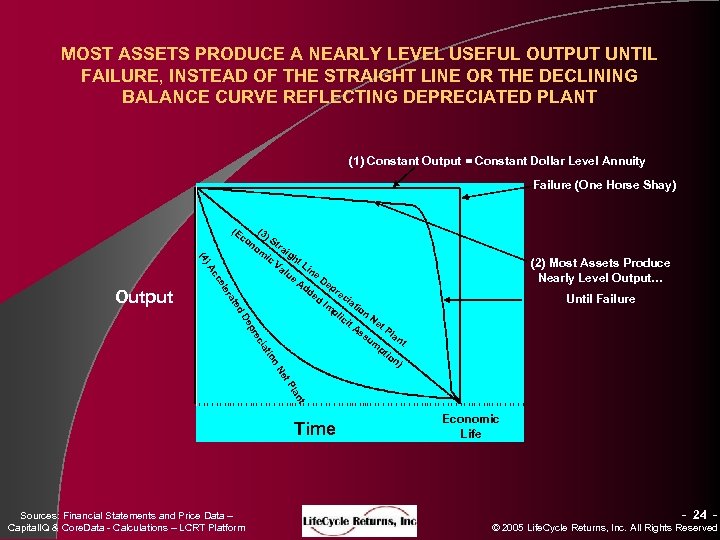
MOST ASSETS PRODUCE A NEARLY LEVEL USEFUL OUTPUT UNTIL FAILURE, INSTEAD OF THE STRAIGHT LINE OR THE DECLINING BALANCE CURVE REFLECTING DEPRECIATED PLANT (1) Constant Output = Constant Dollar Level Annuity Failure (One Horse Shay) (4) (2) Most Assets Produce Nearly Level Output… ler ce Ac Until Failure ion iat c re ep d. D ate Output (E ( co 3) S no tra m ig ic h Va t Li ne lu e Ad Dep re de c d Im iati on pl ic N it As et P la su nt m pt io n) t lan t. P Ne Time Sources: Financial Statements and Price Data – Capital. IQ & Core. Data - Calculations – LCRT Platform Economic Life - 24 © 2005 Life. Cycle Returns, Inc. All Rights Reserved
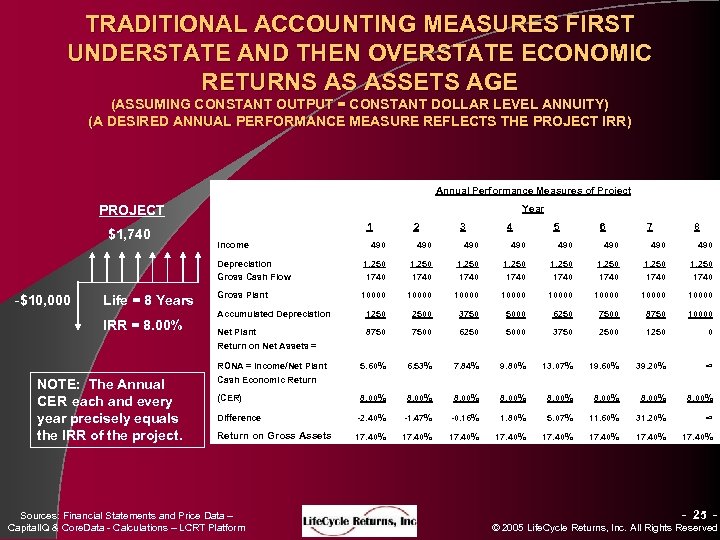
TRADITIONAL ACCOUNTING MEASURES FIRST UNDERSTATE AND THEN OVERSTATE ECONOMIC RETURNS AS ASSETS AGE (ASSUMING CONSTANT OUTPUT = CONSTANT DOLLAR LEVEL ANNUITY) (A DESIRED ANNUAL PERFORMANCE MEASURE REFLECTS THE PROJECT IRR) Annual Performance Measures of Project PROJECT $1, 740 Year 1 3 4 5 6 7 8 Life = 8 Years IRR = 8. 00% NOTE: The Annual CER each and every year precisely equals the IRR of the project. 490 490 Depreciation Gross Cash Flow -$10, 000 Income 2 1, 250 1740 1, 250 1740 Gross Plant 10000 10000 Accumulated Depreciation 1250 2500 3750 5000 6250 7500 8750 10000 Net Plant Return on Net Assets = 8750 7500 6250 5000 3750 2500 1250 0 RONA = Income/Net Plant Cash Economic Return 5. 60% 6. 53% 7. 84% 9. 80% 13. 07% 19. 60% 39. 20% ∞ (CER) 8. 00% 8. 00% Difference -2. 40% -1. 47% -0. 16% 1. 80% 5. 07% 11. 60% 31. 20% ∞ Return on Gross Assets 17. 40% 17. 40% Sources: Financial Statements and Price Data – Capital. IQ & Core. Data - Calculations – LCRT Platform - 25 © 2005 Life. Cycle Returns, Inc. All Rights Reserved
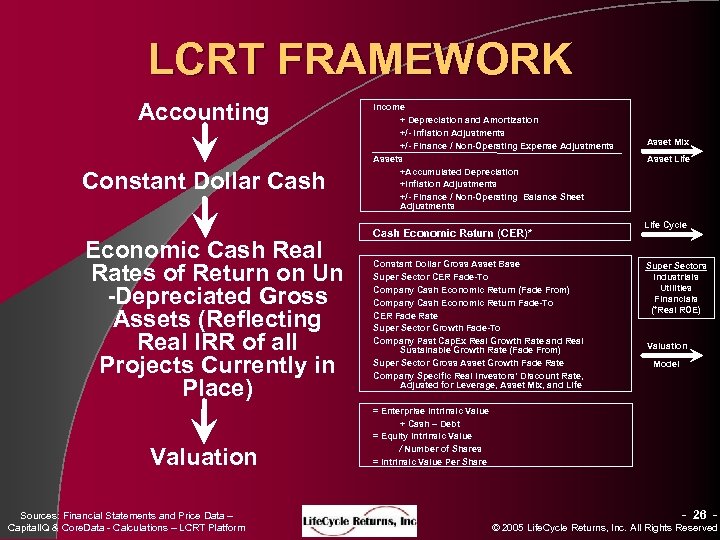
LCRT FRAMEWORK Accounting Constant Dollar Cash Economic Cash Real Rates of Return on Un -Depreciated Gross Assets (Reflecting Real IRR of all Projects Currently in Place) Valuation Sources: Financial Statements and Price Data – Capital. IQ & Core. Data - Calculations – LCRT Platform Income + Depreciation and Amortization +/- Inflation Adjustments +/- Finance / Non-Operating Expense Adjustments Assets +Accumulated Depreciation +Inflation Adjustments +/- Finance / Non-Operating Balance Sheet Adjustments Cash Economic Return (CER)* Constant Dollar Gross Asset Base Super Sector CER Fade-To Company Cash Economic Return (Fade From) Company Cash Economic Return Fade-To CER Fade Rate Super Sector Growth Fade-To Company Past Cap. Ex Real Growth Rate and Real Sustainable Growth Rate (Fade From) Super Sector Gross Asset Growth Fade Rate Company Specific Real Investors’ Discount Rate, Adjusted for Leverage, Asset Mix, and Life Asset Mix Asset Life Cycle Super Sectors Industrials Utilities Financials (*Real ROE) Valuation Model = Enterprise Intrinsic Value + Cash – Debt = Equity Intrinsic Value ⁄ Number of Shares = Intrinsic Value Per Share - 26 © 2005 Life. Cycle Returns, Inc. All Rights Reserved
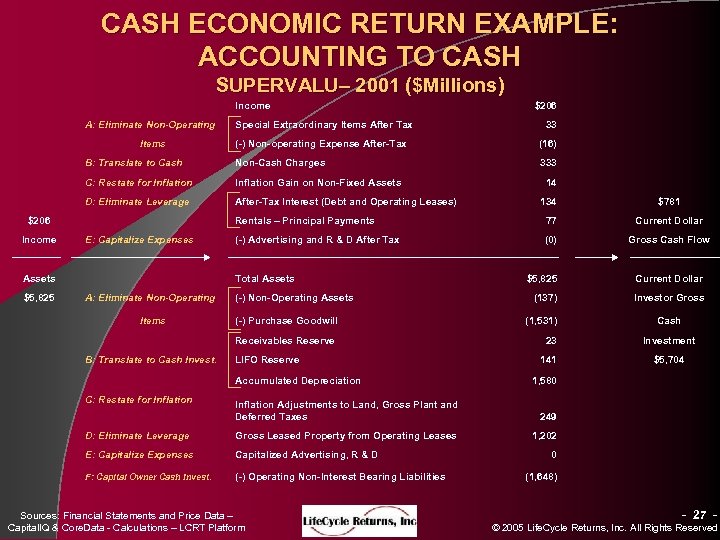
CASH ECONOMIC RETURN EXAMPLE: ACCOUNTING TO CASH SUPERVALU– 2001 ($Millions) Income A: Eliminate Non-Operating Items Special Extraordinary Items After Tax $206 33 (-) Non-operating Expense After-Tax (16) B: Translate to Cash Non-Cash Charges 333 C: Restate for Inflation Gain on Non-Fixed Assets D: Eliminate Leverage After-Tax Interest (Debt and Operating Leases) E: Capitalize Expenses Assets $5, 825 134 $781 Rentals – Principal Payments $206 Income 14 77 Current Dollar (-) Advertising and R & D After Tax (0) Gross Cash Flow Total Assets A: Eliminate Non-Operating Items (-) Non-Operating Assets (-) Purchase Goodwill Receivables Reserve B: Translate to Cash Invest. LIFO Reserve Accumulated Depreciation C: Restate for Inflation $5, 825 Current Dollar (137) Investor Gross (1, 531) Cash 23 Investment 141 $5, 704 1, 580 Inflation Adjustments to Land, Gross Plant and Deferred Taxes 249 D: Eliminate Leverage Gross Leased Property from Operating Leases 1, 202 E: Capitalize Expenses Capitalized Advertising, R & D F: Capital Owner Cash Invest. (-) Operating Non-Interest Bearing Liabilities Sources: Financial Statements and Price Data – Capital. IQ & Core. Data - Calculations – LCRT Platform 0 (1, 648) - 27 © 2005 Life. Cycle Returns, Inc. All Rights Reserved
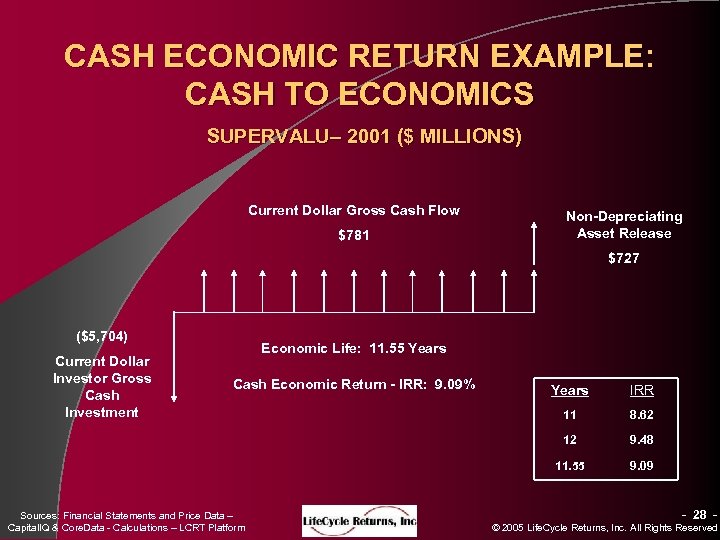
CASH ECONOMIC RETURN EXAMPLE: CASH TO ECONOMICS SUPERVALU– 2001 ($ MILLIONS) Current Dollar Gross Cash Flow $781 Non-Depreciating Asset Release $727 ($5, 704) Current Dollar Investor Gross Cash Investment Economic Life: 11. 55 Years Cash Economic Return - IRR: 9. 09% IRR 11 8. 62 12 9. 48 11. 55 Sources: Financial Statements and Price Data – Capital. IQ & Core. Data - Calculations – LCRT Platform Years 9. 09 - 28 © 2005 Life. Cycle Returns, Inc. All Rights Reserved
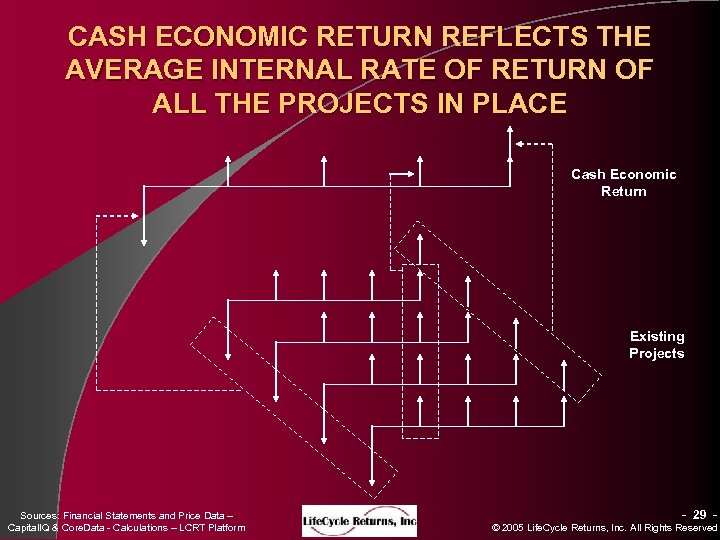
CASH ECONOMIC RETURN REFLECTS THE AVERAGE INTERNAL RATE OF RETURN OF ALL THE PROJECTS IN PLACE Cash Economic Return Existing Projects Sources: Financial Statements and Price Data – Capital. IQ & Core. Data - Calculations – LCRT Platform - 29 © 2005 Life. Cycle Returns, Inc. All Rights Reserved
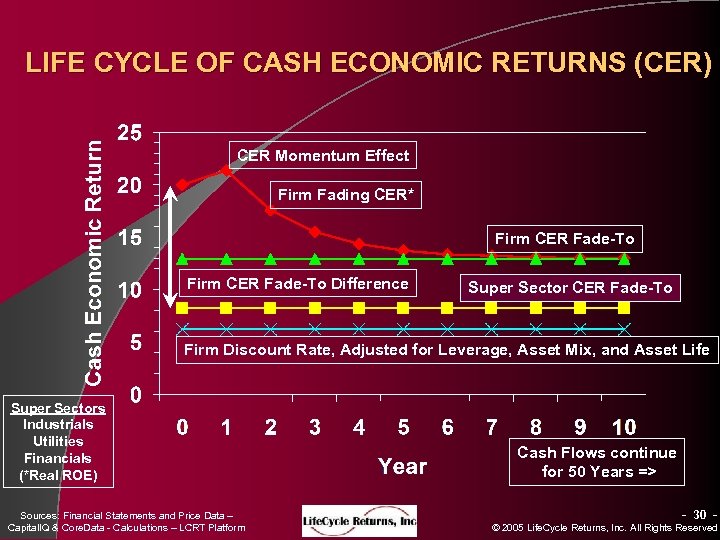
LIFE CYCLE OF CASH ECONOMIC RETURNS (CER) CER Momentum Effect Firm Fading CER* Firm CER Fade-To Difference Super Sector CER Fade-To Firm Discount Rate, Adjusted for Leverage, Asset Mix, and Asset Life Super Sectors Industrials Utilities Financials (*Real ROE) Sources: Financial Statements and Price Data – Capital. IQ & Core. Data - Calculations – LCRT Platform Cash Flows continue for 50 Years => - 30 © 2005 Life. Cycle Returns, Inc. All Rights Reserved
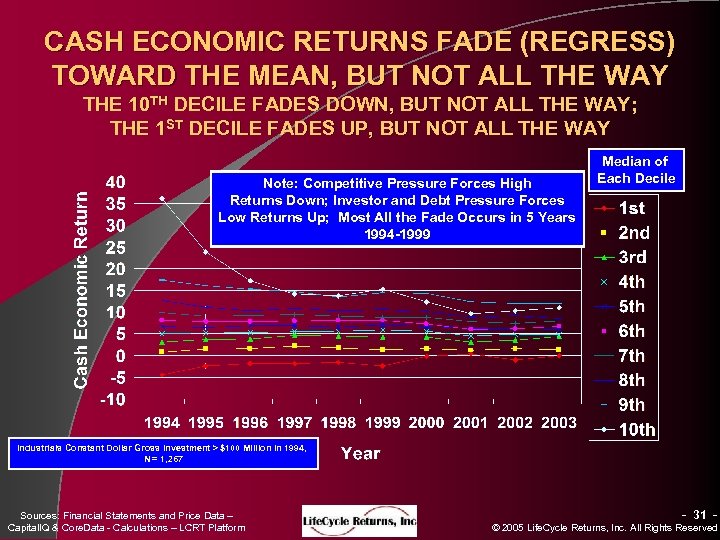
CASH ECONOMIC RETURNS FADE (REGRESS) TOWARD THE MEAN, BUT NOT ALL THE WAY THE 10 TH DECILE FADES DOWN, BUT NOT ALL THE WAY; THE 1 ST DECILE FADES UP, BUT NOT ALL THE WAY Note: Competitive Pressure Forces High Returns Down; Investor and Debt Pressure Forces Low Returns Up; Most All the Fade Occurs in 5 Years 1994 -1999 Median of Each Decile Industrials Constant Dollar Gross Investment > $100 Million in 1994, N = 1, 267 Sources: Financial Statements and Price Data – Capital. IQ & Core. Data - Calculations – LCRT Platform - 31 © 2005 Life. Cycle Returns, Inc. All Rights Reserved
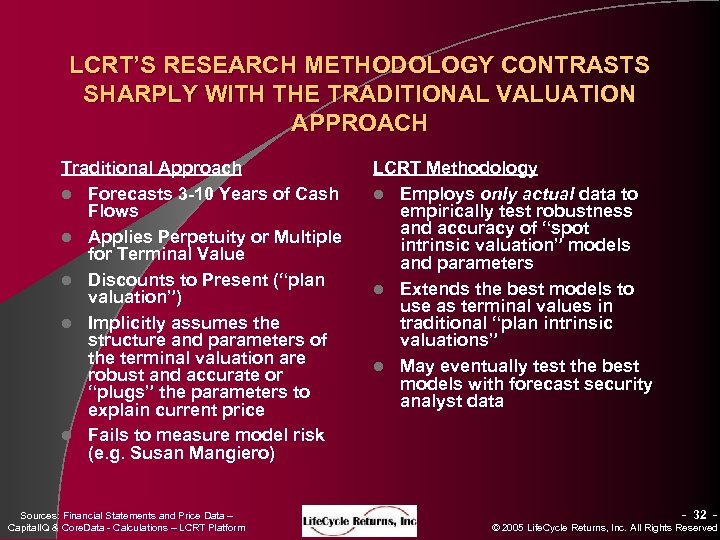
LCRT’S RESEARCH METHODOLOGY CONTRASTS SHARPLY WITH THE TRADITIONAL VALUATION APPROACH Traditional Approach l Forecasts 3 -10 Years of Cash Flows l Applies Perpetuity or Multiple for Terminal Value l Discounts to Present (“plan valuation”) l Implicitly assumes the structure and parameters of the terminal valuation are robust and accurate or “plugs” the parameters to explain current price l Fails to measure model risk (e. g. Susan Mangiero) Sources: Financial Statements and Price Data – Capital. IQ & Core. Data - Calculations – LCRT Platform LCRT Methodology l Employs only actual data to empirically test robustness and accuracy of “spot intrinsic valuation” models and parameters l Extends the best models to use as terminal values in traditional “plan intrinsic valuations” l May eventually test the best models with forecast security analyst data - 32 © 2005 Life. Cycle Returns, Inc. All Rights Reserved
EMPIRICAL DIFFERENCES BETWEEN MODELS Sources: Financial Statements and Price Data – Capital. IQ & Core. Data - Calculations – LCRT Platform - - © 2005 Life. Cycle Returns, Inc. All Rights Reserved
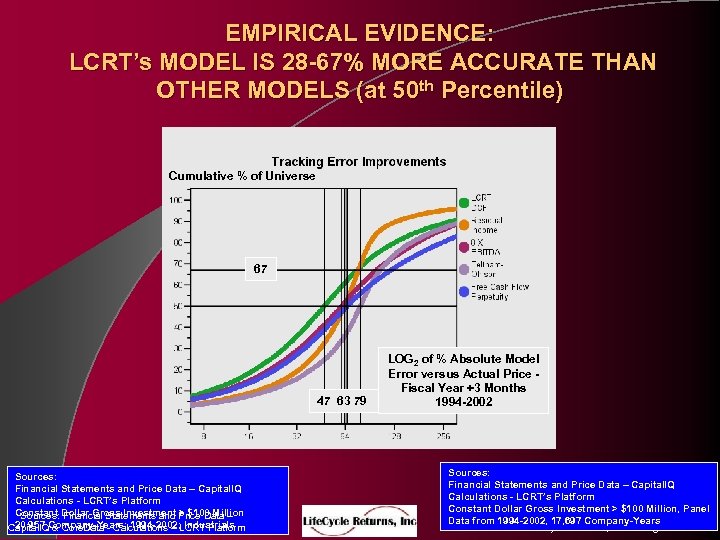
EMPIRICAL EVIDENCE: LCRT’s MODEL IS 28 -67% MORE ACCURATE THAN OTHER MODELS (at 50 th Percentile) Cumulative % of Universe 67 47 63 79 Sources: Financial Statements and Price Data – Capital. IQ Calculations - LCRT’s Platform Constant Dollar Gross Investment Price Data – Sources: Financial Statements and > $100 Million 20, 957 Company-Years; 1994 -2002; Industrials Capital. IQ & Core. Data - Calculations – LCRT Platform LOG 2 of % Absolute Model Error versus Actual Price Fiscal Year +3 Months 1994 -2002 Sources: Financial Statements and Price Data – Capital. IQ Calculations - LCRT’s Platform Constant Dollar Gross Investment > $100 Million, Panel - 34 Data from 1994 -2002, 17, 697 Company-Years © 2005 Life. Cycle Returns, Inc. All Rights Reserved
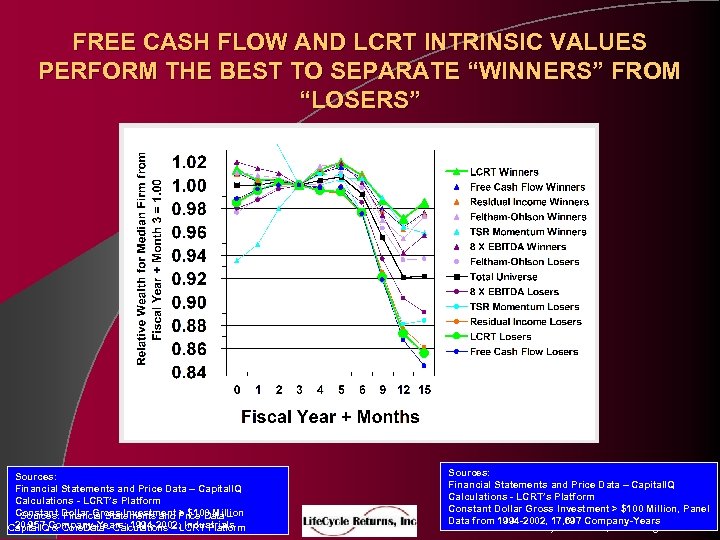
FREE CASH FLOW AND LCRT INTRINSIC VALUES PERFORM THE BEST TO SEPARATE “WINNERS” FROM “LOSERS” Sources: Financial Statements and Price Data – Capital. IQ Calculations - LCRT’s Platform Constant Dollar Gross Investment Price Data – Sources: Financial Statements and > $100 Million 20, 957 Company-Years; 1994 -2002; Industrials Capital. IQ & Core. Data - Calculations – LCRT Platform Sources: Financial Statements and Price Data – Capital. IQ Calculations - LCRT’s Platform Constant Dollar Gross Investment > $100 Million, Panel - 35 Data from 1994 -2002, 17, 697 Company-Years © 2005 Life. Cycle Returns, Inc. All Rights Reserved

ADVANCED LCRT RESEARCH Sources: Financial Statements and Price Data – Capital. IQ & Core. Data - Calculations – LCRT Platform - - © 2005 Life. Cycle Returns, Inc. All Rights Reserved
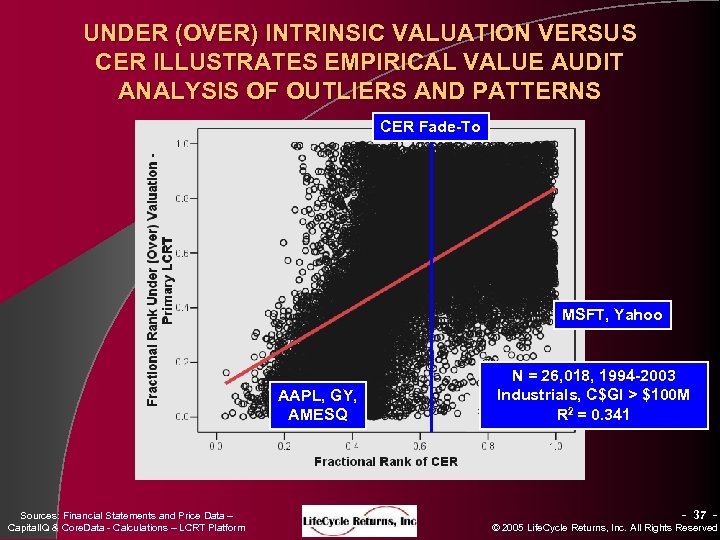
UNDER (OVER) INTRINSIC VALUATION VERSUS CER ILLUSTRATES EMPIRICAL VALUE AUDIT ANALYSIS OF OUTLIERS AND PATTERNS CER Fade-To MSFT, Yahoo AAPL, GY, AMESQ Sources: Financial Statements and Price Data – Capital. IQ & Core. Data - Calculations – LCRT Platform N = 26, 018, 1994 -2003 Industrials, C$GI > $100 M R 2 = 0. 341 - 37 © 2005 Life. Cycle Returns, Inc. All Rights Reserved
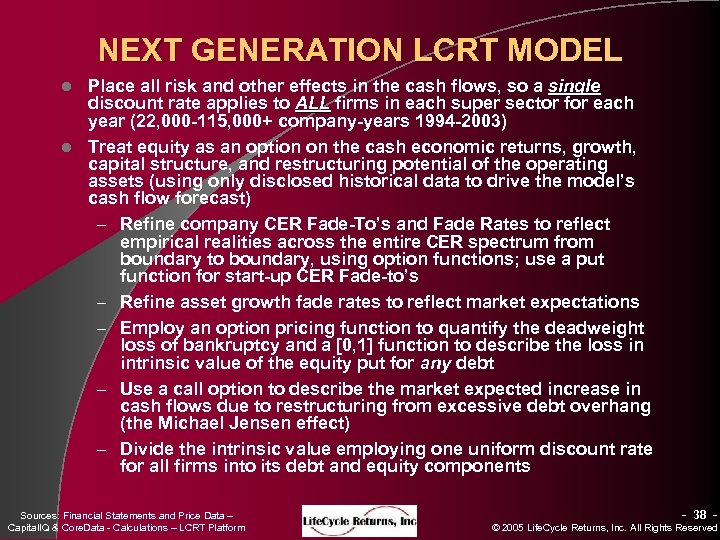
NEXT GENERATION LCRT MODEL Place all risk and other effects in the cash flows, so a single discount rate applies to ALL firms in each super sector for each year (22, 000 -115, 000+ company-years 1994 -2003) l Treat equity as an option on the cash economic returns, growth, capital structure, and restructuring potential of the operating assets (using only disclosed historical data to drive the model’s cash flow forecast) – Refine company CER Fade-To’s and Fade Rates to reflect empirical realities across the entire CER spectrum from boundary to boundary, using option functions; use a put function for start-up CER Fade-to’s – Refine asset growth fade rates to reflect market expectations – Employ an option pricing function to quantify the deadweight loss of bankruptcy and a [0, 1] function to describe the loss in intrinsic value of the equity put for any debt – Use a call option to describe the market expected increase in cash flows due to restructuring from excessive debt overhang (the Michael Jensen effect) – Divide the intrinsic value employing one uniform discount rate for all firms into its debt and equity components l Sources: Financial Statements and Price Data – Capital. IQ & Core. Data - Calculations – LCRT Platform - 38 © 2005 Life. Cycle Returns, Inc. All Rights Reserved
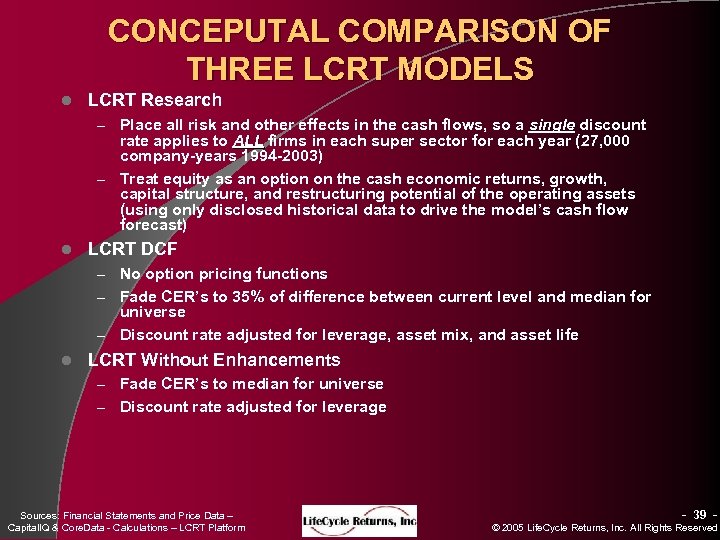
CONCEPUTAL COMPARISON OF THREE LCRT MODELS l LCRT Research – Place all risk and other effects in the cash flows, so a single discount rate applies to ALL firms in each super sector for each year (27, 000 company-years 1994 -2003) – Treat equity as an option on the cash economic returns, growth, capital structure, and restructuring potential of the operating assets (using only disclosed historical data to drive the model’s cash flow forecast) l LCRT DCF – No option pricing functions – Fade CER’s to 35% of difference between current level and median for universe – Discount rate adjusted for leverage, asset mix, and asset life l LCRT Without Enhancements – Fade CER’s to median for universe – Discount rate adjusted for leverage Sources: Financial Statements and Price Data – Capital. IQ & Core. Data - Calculations – LCRT Platform - 39 © 2005 Life. Cycle Returns, Inc. All Rights Reserved
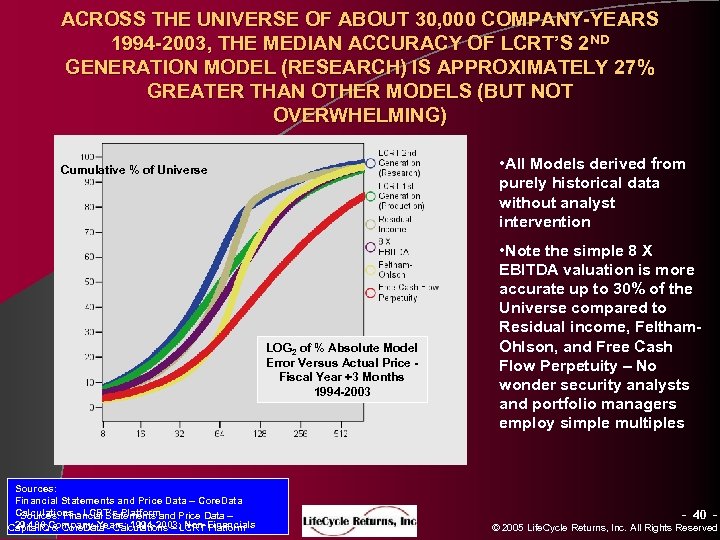
ACROSS THE UNIVERSE OF ABOUT 30, 000 COMPANY-YEARS 1994 -2003, THE MEDIAN ACCURACY OF LCRT’S 2 ND GENERATION MODEL (RESEARCH) IS APPROXIMATELY 27% GREATER THAN OTHER MODELS (BUT NOT OVERWHELMING) • All Models derived from purely historical data without analyst intervention Cumulative % of Universe LOG 2 of % Absolute Model Error Versus Actual Price Fiscal Year +3 Months 1994 -2003 Sources: Financial Statements and Price Data – Core. Data Calculations - LCRT’s Platform Sources: Financial Statements and Price Data – 29, 488 & Core. Data - Calculations – LCRT Platform Capital. IQCompany-Years; 1994 -2003; Non-Financials • Note the simple 8 X EBITDA valuation is more accurate up to 30% of the Universe compared to Residual income, Feltham. Ohlson, and Free Cash Flow Perpetuity – No wonder security analysts and portfolio managers employ simple multiples - 40 © 2005 Life. Cycle Returns, Inc. All Rights Reserved
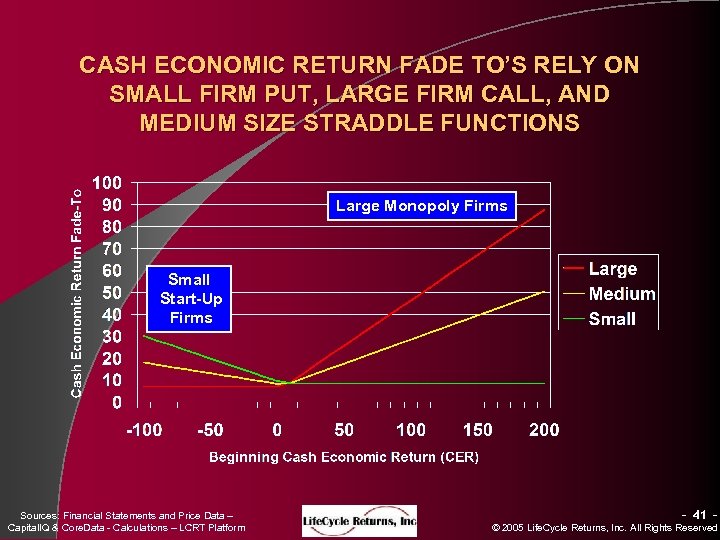
CASH ECONOMIC RETURN FADE TO’S RELY ON SMALL FIRM PUT, LARGE FIRM CALL, AND MEDIUM SIZE STRADDLE FUNCTIONS Large Monopoly Firms Small Start-Up Firms Sources: Financial Statements and Price Data – Capital. IQ & Core. Data - Calculations – LCRT Platform - 41 © 2005 Life. Cycle Returns, Inc. All Rights Reserved
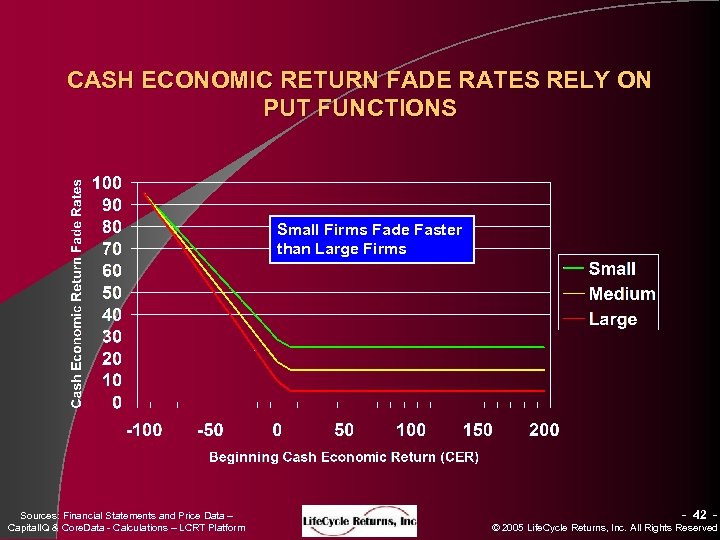
CASH ECONOMIC RETURN FADE RATES RELY ON PUT FUNCTIONS Small Firms Fade Faster than Large Firms Sources: Financial Statements and Price Data – Capital. IQ & Core. Data - Calculations – LCRT Platform - 42 © 2005 Life. Cycle Returns, Inc. All Rights Reserved
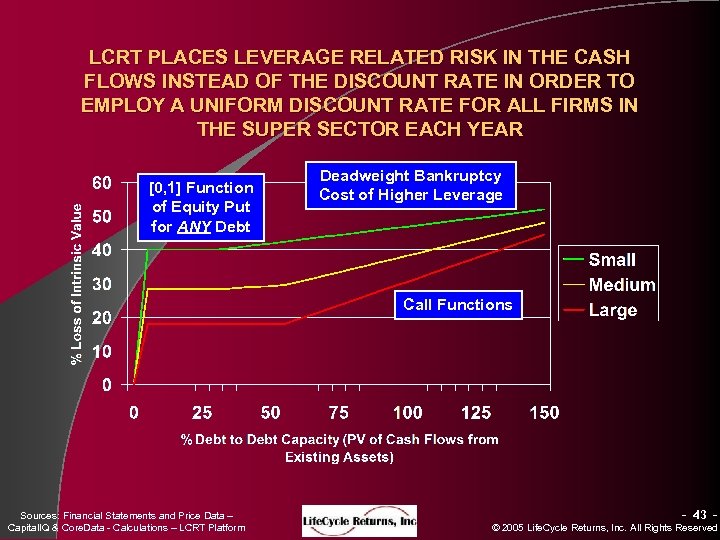
LCRT PLACES LEVERAGE RELATED RISK IN THE CASH FLOWS INSTEAD OF THE DISCOUNT RATE IN ORDER TO EMPLOY A UNIFORM DISCOUNT RATE FOR ALL FIRMS IN THE SUPER SECTOR EACH YEAR [0, 1] Function of Equity Put for ANY Debt Deadweight Bankruptcy Cost of Higher Leverage Call Functions Sources: Financial Statements and Price Data – Capital. IQ & Core. Data - Calculations – LCRT Platform - 43 © 2005 Life. Cycle Returns, Inc. All Rights Reserved
OUTPUTS AND USAGE OF LCRT PLATFORM FROM THE USER’S POINT OF VIEW Sources: Financial Statements and Price Data – Capital. IQ & Core. Data - Calculations – LCRT Platform - 44 © 2005 Life. Cycle Returns, Inc. All Rights Reserved
LIFECYCLE RETURNS PLATFORM “A Conceptually Sound, Empirically Validated, Disciplined Methodology for Valuation” l l l Overview of Concepts – Empirical Evidence (Refer to www. LCRT. com for more Information) – LCRT Framework: From Accounting to Cash; From Cash to Economics; from Economics to Valuation – Cash Economic Return Example: Accounting to Cash – Cash Economic Return Example: Cash to Economics – Life Cycle of Cash Economic Returns Retrieve Company by Ticker or Name – 11, 000+ Firms; 1994 -2003 Compare Valuation Models’ Results Valuation Control Center for most recent Year (The “Cockpit”) – Company Inputs and Platform Parameters – Overrides for Sensitivities – Audit Trails – Charts – Value Chart and Relative Wealth Chart Sources: Financial Statements and Price Data – Capital. IQ & Core. Data - Calculations – LCRT Platform l l l l Overrides for multiple years to reflect analysts’ insights and forecasts into valuations to achieve greater predictive capability Go. To Reports in Excel Annual Sheet for Complete Audit Trails of Calculations and Analytical Insights View Audit Trails for LCRT Valuation, Market Derived Discount Rates, and Plant Inflation Adjustments Personal Sheet for Customized Company Reports, Calculations, and Valuations Extract Variable List for Future Cross Sectional Analysis Extract for Cross Sectional Analysis of Multiple Companies and Research Articles – “Value Management – Past, Present, and Future” (Concepts – 44 pages) – Economic Performance Measurement – Valuation – Cost of Capital – Applications - 45 © 2005 Life. Cycle Returns, Inc. All Rights Reserved
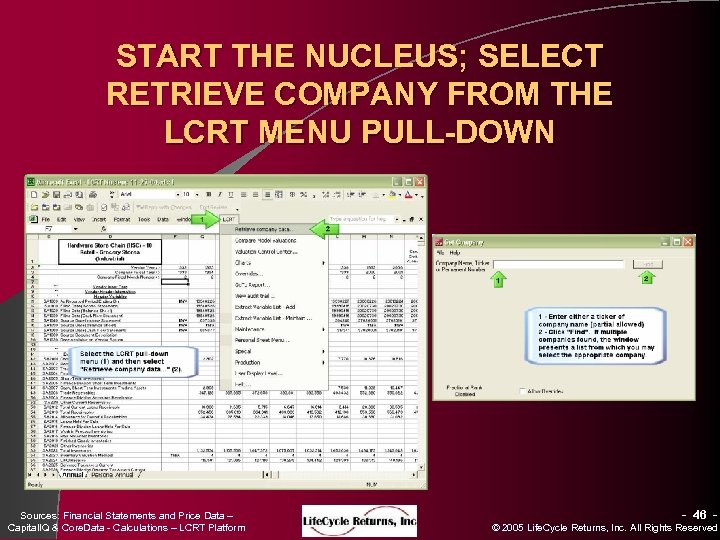
START THE NUCLEUS; SELECT RETRIEVE COMPANY FROM THE LCRT MENU PULL-DOWN Sources: Financial Statements and Price Data – Capital. IQ & Core. Data - Calculations – LCRT Platform - 46 © 2005 Life. Cycle Returns, Inc. All Rights Reserved
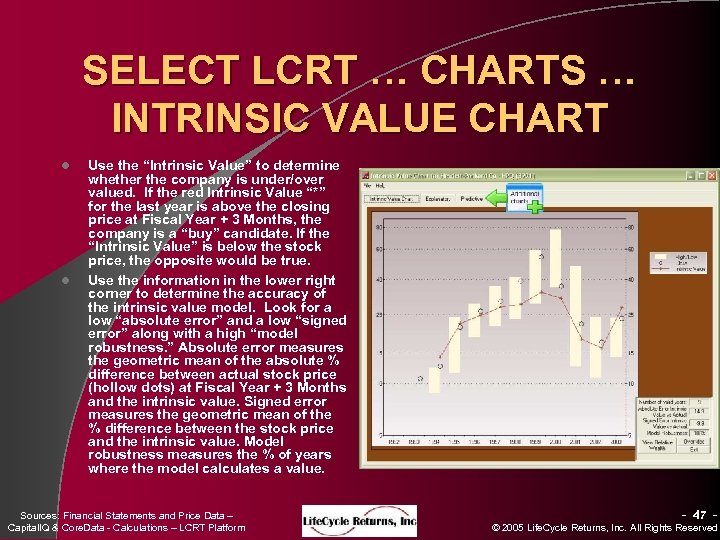
SELECT LCRT … CHARTS … INTRINSIC VALUE CHART l l Use the “Intrinsic Value” to determine whether the company is under/over valued. If the red Intrinsic Value “*” for the last year is above the closing price at Fiscal Year + 3 Months, the company is a “buy” candidate. If the “Intrinsic Value” is below the stock price, the opposite would be true. Use the information in the lower right corner to determine the accuracy of the intrinsic value model. Look for a low “absolute error” and a low “signed error” along with a high “model robustness. ” Absolute error measures the geometric mean of the absolute % difference between actual stock price (hollow dots) at Fiscal Year + 3 Months and the intrinsic value. Signed error measures the geometric mean of the % difference between the stock price and the intrinsic value. Model robustness measures the % of years where the model calculates a value. Sources: Financial Statements and Price Data – Capital. IQ & Core. Data - Calculations – LCRT Platform - 47 © 2005 Life. Cycle Returns, Inc. All Rights Reserved
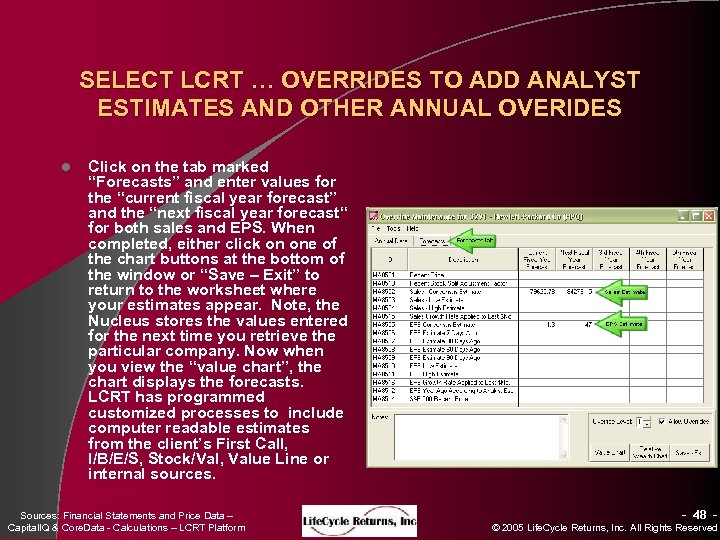
SELECT LCRT … OVERRIDES TO ADD ANALYST ESTIMATES AND OTHER ANNUAL OVERIDES l Click on the tab marked “Forecasts” and enter values for the “current fiscal year forecast” and the “next fiscal year forecast“ for both sales and EPS. When completed, either click on one of the chart buttons at the bottom of the window or “Save – Exit” to return to the worksheet where your estimates appear. Note, the Nucleus stores the values entered for the next time you retrieve the particular company. Now when you view the “value chart”, the chart displays the forecasts. LCRT has programmed customized processes to include computer readable estimates from the client’s First Call, I/B/E/S, Stock/Val, Value Line or internal sources. Sources: Financial Statements and Price Data – Capital. IQ & Core. Data - Calculations – LCRT Platform - 48 © 2005 Life. Cycle Returns, Inc. All Rights Reserved
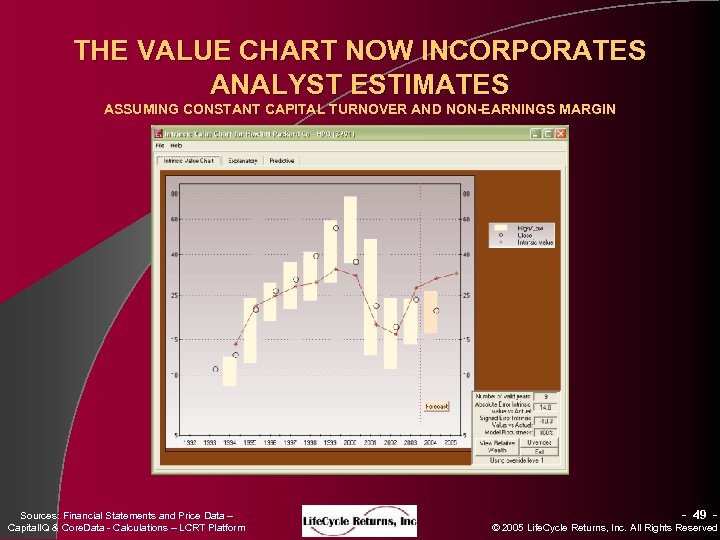
THE VALUE CHART NOW INCORPORATES ANALYST ESTIMATES ASSUMING CONSTANT CAPITAL TURNOVER AND NON-EARNINGS MARGIN Sources: Financial Statements and Price Data – Capital. IQ & Core. Data - Calculations – LCRT Platform - 49 © 2005 Life. Cycle Returns, Inc. All Rights Reserved
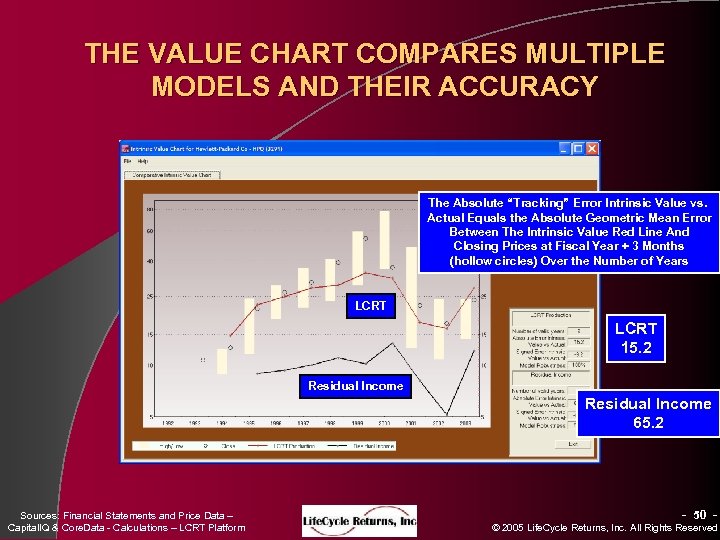
THE VALUE CHART COMPARES MULTIPLE MODELS AND THEIR ACCURACY The Absolute “Tracking” Error Intrinsic Value vs. Actual Equals the Absolute Geometric Mean Error Between The Intrinsic Value Red Line And Closing Prices at Fiscal Year + 3 Months (hollow circles) Over the Number of Years LCRT 15. 2 Residual Income 65. 2 Sources: Financial Statements and Price Data – Capital. IQ & Core. Data - Calculations – LCRT Platform - 50 © 2005 Life. Cycle Returns, Inc. All Rights Reserved
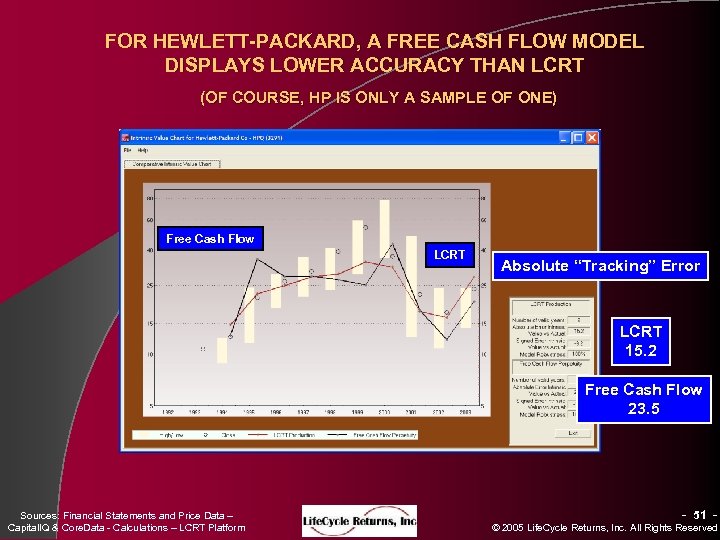
FOR HEWLETT-PACKARD, A FREE CASH FLOW MODEL DISPLAYS LOWER ACCURACY THAN LCRT (OF COURSE, HP IS ONLY A SAMPLE OF ONE) Free Cash Flow LCRT Absolute “Tracking” Error LCRT 15. 2 Free Cash Flow 23. 5 Sources: Financial Statements and Price Data – Capital. IQ & Core. Data - Calculations – LCRT Platform - 51 © 2005 Life. Cycle Returns, Inc. All Rights Reserved
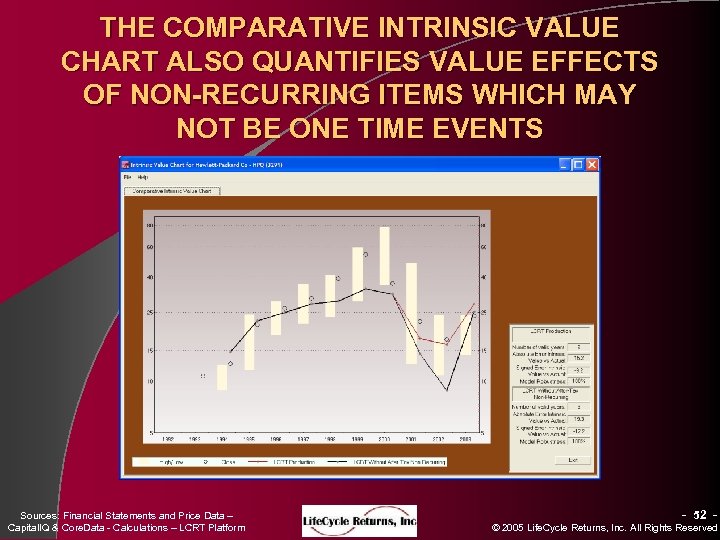
THE COMPARATIVE INTRINSIC VALUE CHART ALSO QUANTIFIES VALUE EFFECTS OF NON-RECURRING ITEMS WHICH MAY NOT BE ONE TIME EVENTS Sources: Financial Statements and Price Data – Capital. IQ & Core. Data - Calculations – LCRT Platform - 52 © 2005 Life. Cycle Returns, Inc. All Rights Reserved
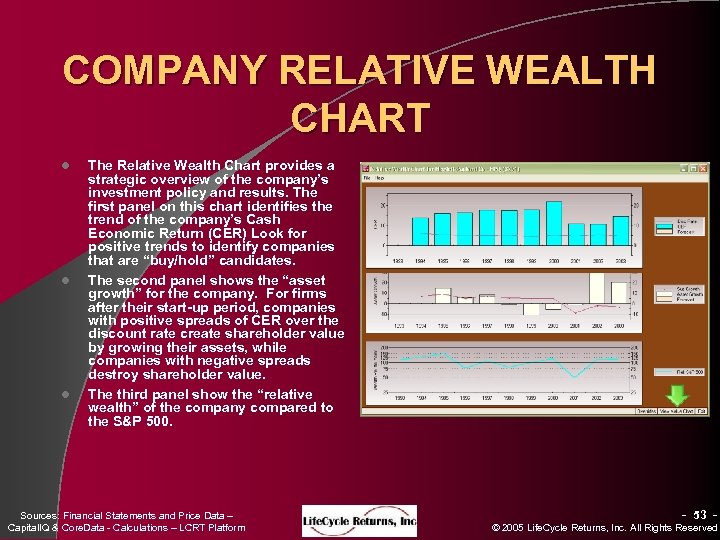
COMPANY RELATIVE WEALTH CHART l l l The Relative Wealth Chart provides a strategic overview of the company’s investment policy and results. The first panel on this chart identifies the trend of the company’s Cash Economic Return (CER) Look for positive trends to identify companies that are “buy/hold” candidates. The second panel shows the “asset growth” for the company. For firms after their start-up period, companies with positive spreads of CER over the discount rate create shareholder value by growing their assets, while companies with negative spreads destroy shareholder value. The third panel show the “relative wealth” of the company compared to the S&P 500. Sources: Financial Statements and Price Data – Capital. IQ & Core. Data - Calculations – LCRT Platform - 53 © 2005 Life. Cycle Returns, Inc. All Rights Reserved
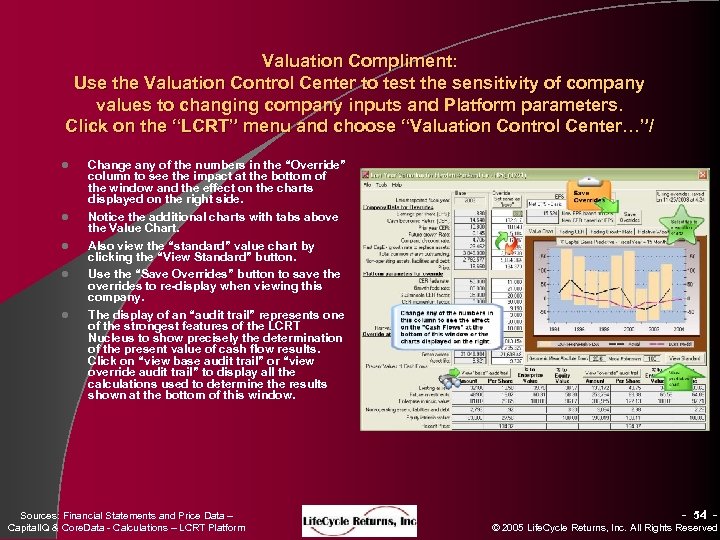
Valuation Compliment: Use the Valuation Control Center to test the sensitivity of company values to changing company inputs and Platform parameters. Click on the “LCRT” menu and choose “Valuation Control Center…”/ l l l Change any of the numbers in the “Override” column to see the impact at the bottom of the window and the effect on the charts displayed on the right side. Notice the additional charts with tabs above the Value Chart. Also view the “standard” value chart by clicking the “View Standard” button. Use the “Save Overrides” button to save the overrides to re-display when viewing this company. The display of an “audit trail” represents one of the strongest features of the LCRT Nucleus to show precisely the determination of the present value of cash flow results. Click on “view base audit trail” or “view override audit trail” to display all the calculations used to determine the results shown at the bottom of this window. Sources: Financial Statements and Price Data – Capital. IQ & Core. Data - Calculations – LCRT Platform - 54 © 2005 Life. Cycle Returns, Inc. All Rights Reserved
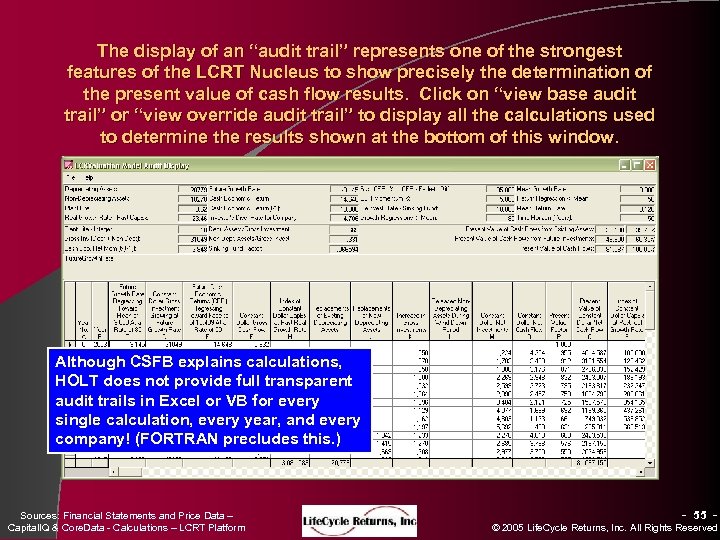
The display of an “audit trail” represents one of the strongest features of the LCRT Nucleus to show precisely the determination of the present value of cash flow results. Click on “view base audit trail” or “view override audit trail” to display all the calculations used to determine the results shown at the bottom of this window. Although CSFB explains calculations, HOLT does not provide full transparent audit trails in Excel or VB for every single calculation, every year, and every company! (FORTRAN precludes this. ) Sources: Financial Statements and Price Data – Capital. IQ & Core. Data - Calculations – LCRT Platform - 55 © 2005 Life. Cycle Returns, Inc. All Rights Reserved
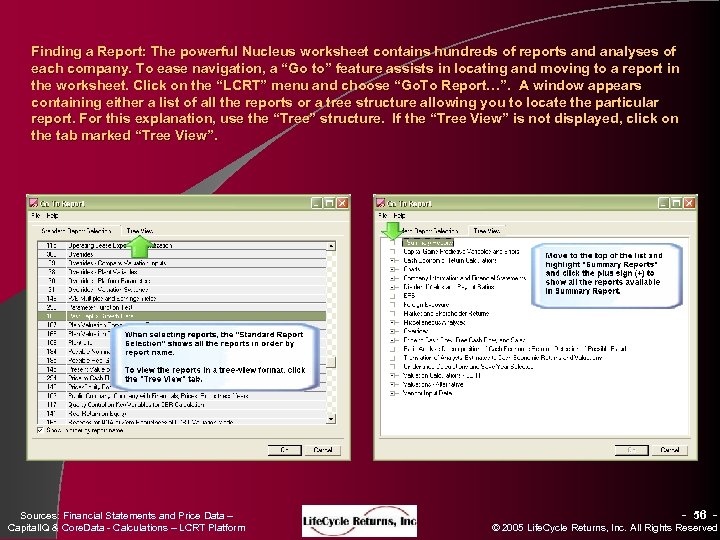
Finding a Report: The powerful Nucleus worksheet contains hundreds of reports and analyses of each company. To ease navigation, a “Go to” feature assists in locating and moving to a report in the worksheet. Click on the “LCRT” menu and choose “Go. To Report…”. A window appears containing either a list of all the reports or a tree structure allowing you to locate the particular report. For this explanation, use the “Tree” structure. If the “Tree View” is not displayed, click on the tab marked “Tree View”. Sources: Financial Statements and Price Data – Capital. IQ & Core. Data - Calculations – LCRT Platform - 56 © 2005 Life. Cycle Returns, Inc. All Rights Reserved
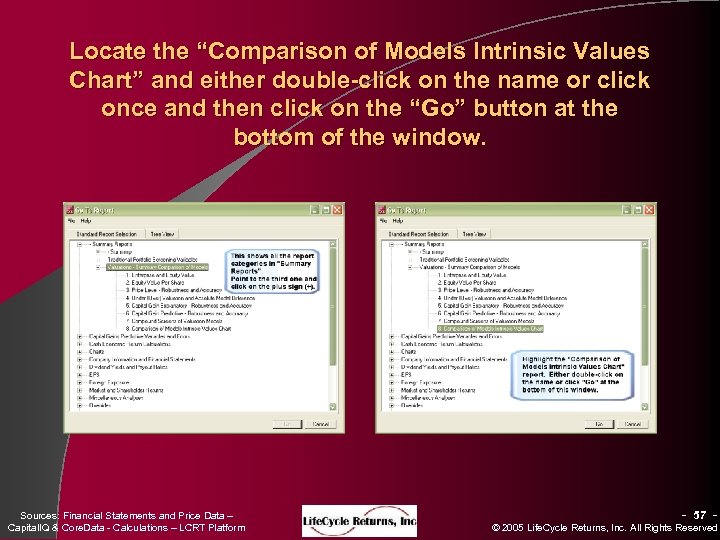
Locate the “Comparison of Models Intrinsic Values Chart” and either double-click on the name or click once and then click on the “Go” button at the bottom of the window. Sources: Financial Statements and Price Data – Capital. IQ & Core. Data - Calculations – LCRT Platform - 57 © 2005 Life. Cycle Returns, Inc. All Rights Reserved
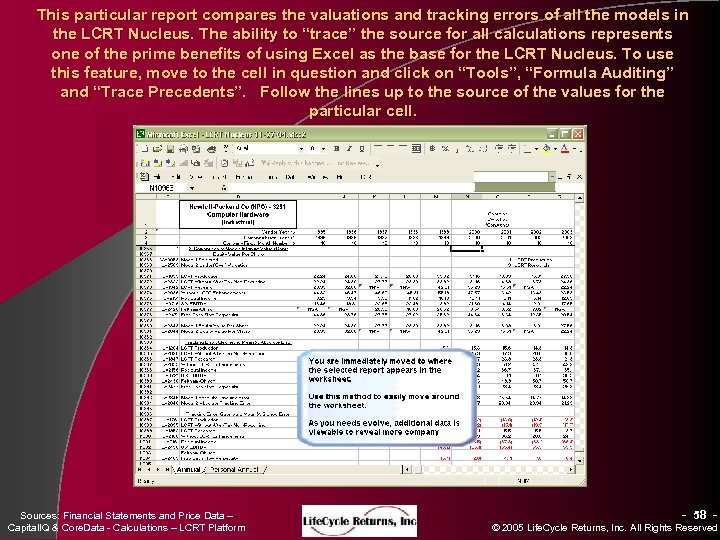
This particular report compares the valuations and tracking errors of all the models in the LCRT Nucleus. The ability to “trace” the source for all calculations represents one of the prime benefits of using Excel as the base for the LCRT Nucleus. To use this feature, move to the cell in question and click on “Tools”, “Formula Auditing” and “Trace Precedents”. Follow the lines up to the source of the values for the particular cell. Sources: Financial Statements and Price Data – Capital. IQ & Core. Data - Calculations – LCRT Platform - 58 © 2005 Life. Cycle Returns, Inc. All Rights Reserved
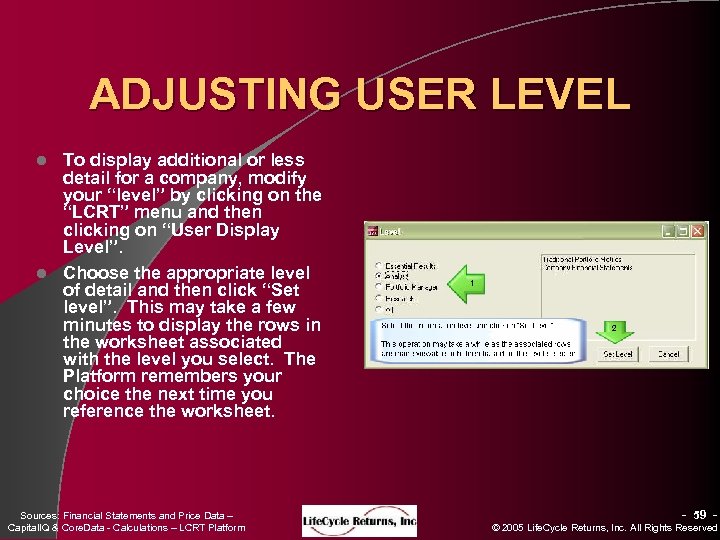
ADJUSTING USER LEVEL To display additional or less detail for a company, modify your “level” by clicking on the “LCRT” menu and then clicking on “User Display Level”. l Choose the appropriate level of detail and then click “Set level”. This may take a few minutes to display the rows in the worksheet associated with the level you select. The Platform remembers your choice the next time you reference the worksheet. l Sources: Financial Statements and Price Data – Capital. IQ & Core. Data - Calculations – LCRT Platform - 59 © 2005 Life. Cycle Returns, Inc. All Rights Reserved
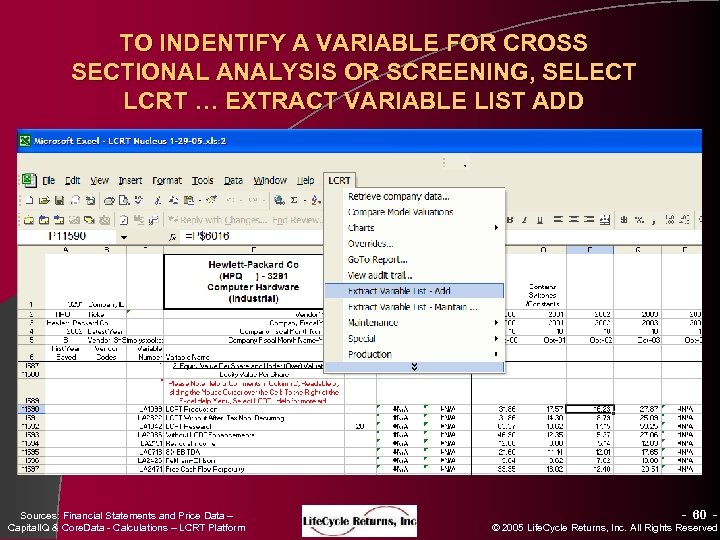
TO INDENTIFY A VARIABLE FOR CROSS SECTIONAL ANALYSIS OR SCREENING, SELECT LCRT … EXTRACT VARIABLE LIST ADD Sources: Financial Statements and Price Data – Capital. IQ & Core. Data - Calculations – LCRT Platform - 60 © 2005 Life. Cycle Returns, Inc. All Rights Reserved
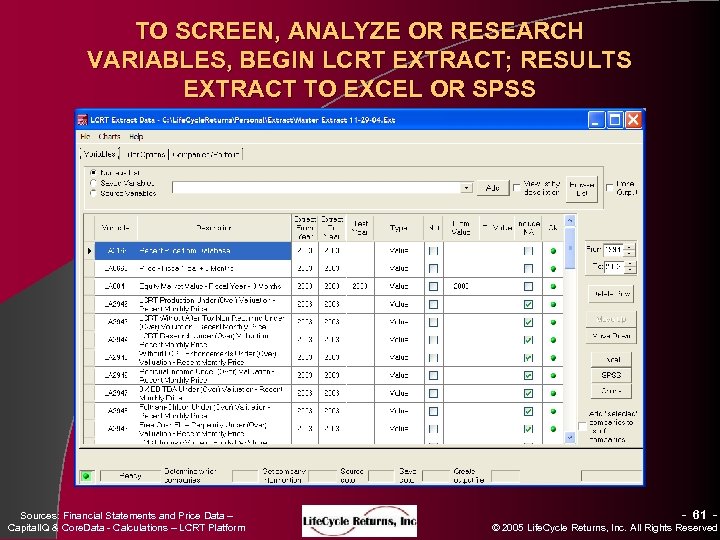
TO SCREEN, ANALYZE OR RESEARCH VARIABLES, BEGIN LCRT EXTRACT; RESULTS EXTRACT TO EXCEL OR SPSS Sources: Financial Statements and Price Data – Capital. IQ & Core. Data - Calculations – LCRT Platform - 61 © 2005 Life. Cycle Returns, Inc. All Rights Reserved
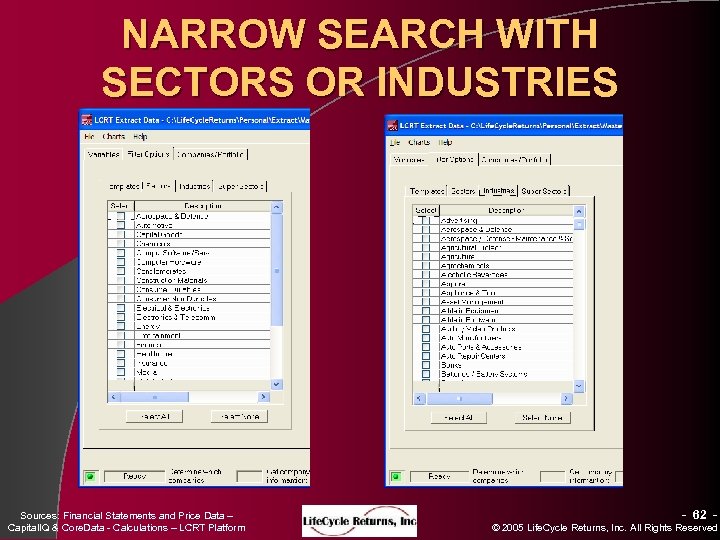
NARROW SEARCH WITH SECTORS OR INDUSTRIES Sources: Financial Statements and Price Data – Capital. IQ & Core. Data - Calculations – LCRT Platform - 62 © 2005 Life. Cycle Returns, Inc. All Rights Reserved
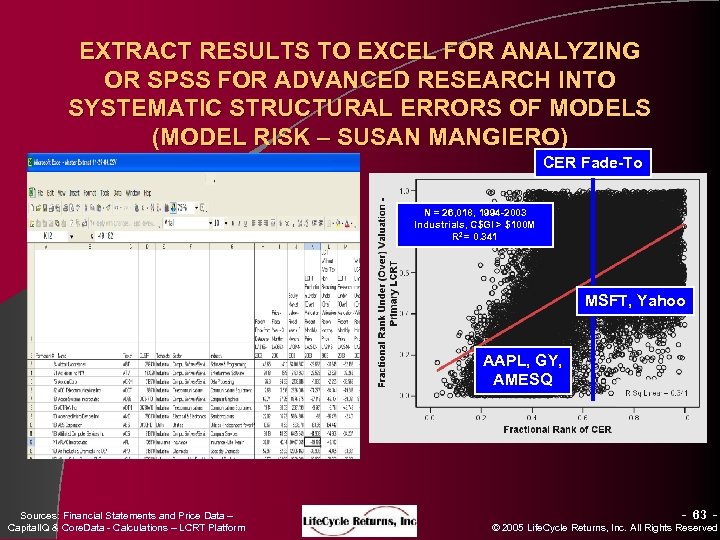
EXTRACT RESULTS TO EXCEL FOR ANALYZING OR SPSS FOR ADVANCED RESEARCH INTO SYSTEMATIC STRUCTURAL ERRORS OF MODELS (MODEL RISK – SUSAN MANGIERO) CER Fade-To N = 26, 018, 1994 -2003 Industrials, C$GI > $100 M R 2 = 0. 341 MSFT, Yahoo AAPL, GY, AMESQ Sources: Financial Statements and Price Data – Capital. IQ & Core. Data - Calculations – LCRT Platform - 63 © 2005 Life. Cycle Returns, Inc. All Rights Reserved
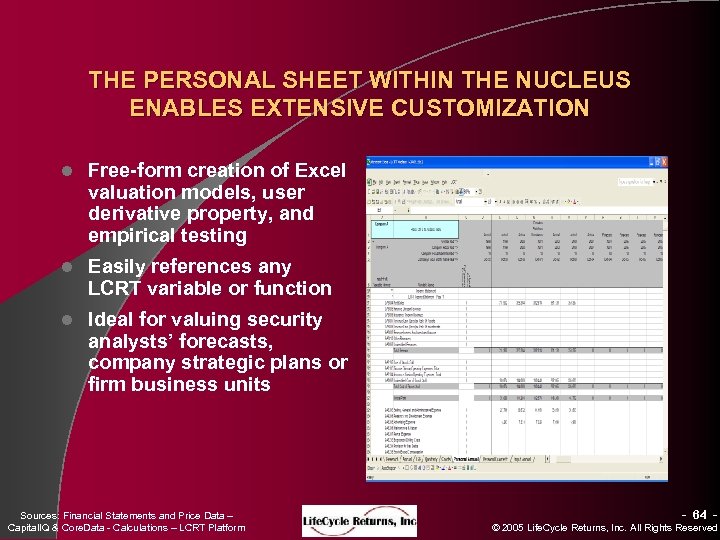
THE PERSONAL SHEET WITHIN THE NUCLEUS ENABLES EXTENSIVE CUSTOMIZATION l Free-form creation of Excel valuation models, user derivative property, and empirical testing l Easily references any LCRT variable or function l Ideal for valuing security analysts’ forecasts, company strategic plans or firm business units Sources: Financial Statements and Price Data – Capital. IQ & Core. Data - Calculations – LCRT Platform - 64 © 2005 Life. Cycle Returns, Inc. All Rights Reserved
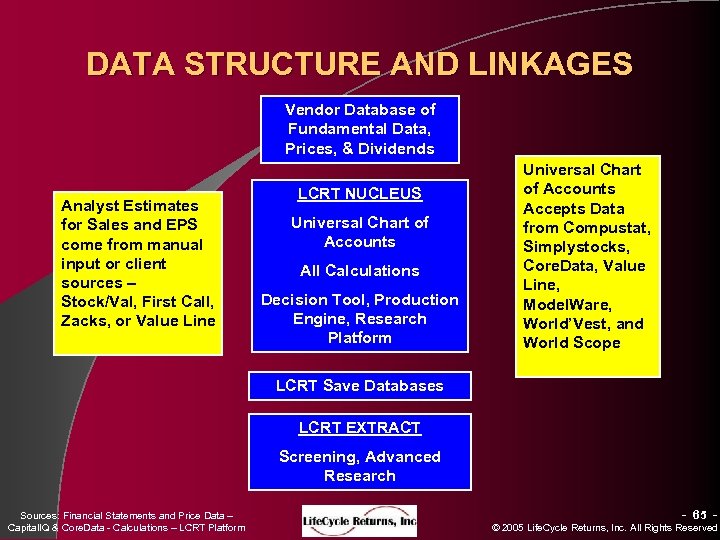
DATA STRUCTURE AND LINKAGES Vendor Database of Fundamental Data, Prices, & Dividends Analyst Estimates for Sales and EPS come from manual input or client sources – Stock/Val, First Call, Zacks, or Value Line LCRT NUCLEUS Universal Chart of Accounts All Calculations Decision Tool, Production Engine, Research Platform Universal Chart of Accounts Accepts Data from Compustat, Simplystocks, Core. Data, Value Line, Model. Ware, World’Vest, and World Scope LCRT Save Databases LCRT EXTRACT Screening, Advanced Research Sources: Financial Statements and Price Data – Capital. IQ & Core. Data - Calculations – LCRT Platform - 65 © 2005 Life. Cycle Returns, Inc. All Rights Reserved

BACKUP SLIDES Sources: Financial Statements and Price Data – Capital. IQ & Core. Data - Calculations – LCRT Platform - 66 © 2005 Life. Cycle Returns, Inc. All Rights Reserved
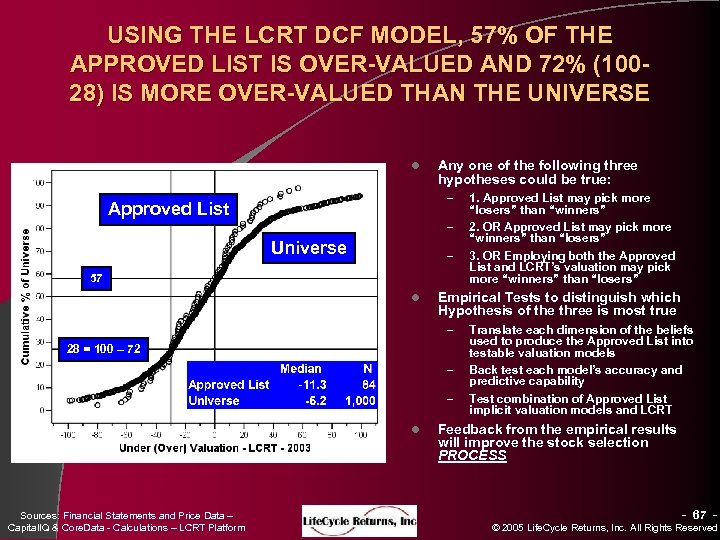
USING THE LCRT DCF MODEL, 57% OF THE APPROVED LIST IS OVER-VALUED AND 72% (10028) IS MORE OVER-VALUED THAN THE UNIVERSE l Any one of the following three hypotheses could be true: – Approved List – Universe – 57 l Empirical Tests to distinguish which Hypothesis of the three is most true – 28 = 100 – 72 – – l Sources: Financial Statements and Price Data – Capital. IQ & Core. Data - Calculations – LCRT Platform 1. Approved List may pick more “losers” than “winners” 2. OR Approved List may pick more “winners” than “losers” 3. OR Employing both the Approved List and LCRT’s valuation may pick more “winners” than “losers” Translate each dimension of the beliefs used to produce the Approved List into testable valuation models Back test each model’s accuracy and predictive capability Test combination of Approved List implicit valuation models and LCRT Feedback from the empirical results will improve the stock selection PROCESS - 67 © 2005 Life. Cycle Returns, Inc. All Rights Reserved
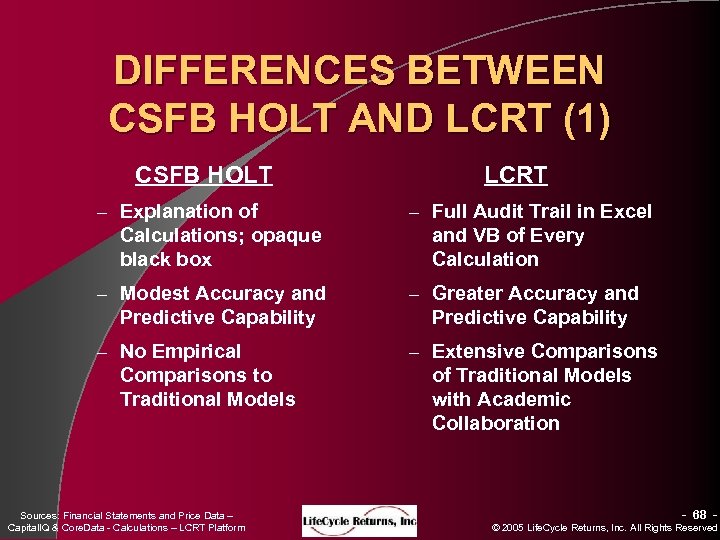
DIFFERENCES BETWEEN CSFB HOLT AND LCRT (1) CSFB HOLT – Explanation of Calculations; opaque black box – Modest Accuracy and Predictive Capability – No Empirical Comparisons to Traditional Models Sources: Financial Statements and Price Data – Capital. IQ & Core. Data - Calculations – LCRT Platform LCRT – Full Audit Trail in Excel and VB of Every Calculation – Greater Accuracy and Predictive Capability – Extensive Comparisons of Traditional Models with Academic Collaboration - 68 © 2005 Life. Cycle Returns, Inc. All Rights Reserved
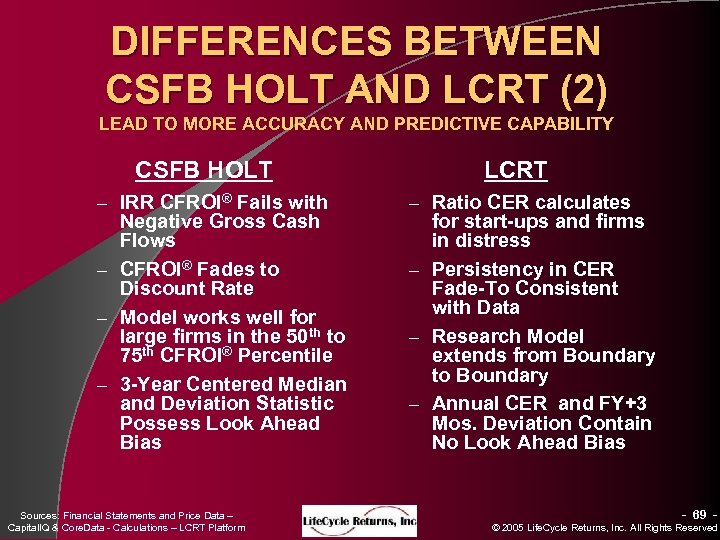
DIFFERENCES BETWEEN CSFB HOLT AND LCRT (2) LEAD TO MORE ACCURACY AND PREDICTIVE CAPABILITY CSFB HOLT – IRR CFROI® Fails with Negative Gross Cash Flows – CFROI® Fades to Discount Rate – Model works well for large firms in the 50 th to 75 th CFROI® Percentile – 3 -Year Centered Median and Deviation Statistic Possess Look Ahead Bias Sources: Financial Statements and Price Data – Capital. IQ & Core. Data - Calculations – LCRT Platform LCRT – Ratio CER calculates for start-ups and firms in distress – Persistency in CER Fade-To Consistent with Data – Research Model extends from Boundary to Boundary – Annual CER and FY+3 Mos. Deviation Contain No Look Ahead Bias - 69 © 2005 Life. Cycle Returns, Inc. All Rights Reserved
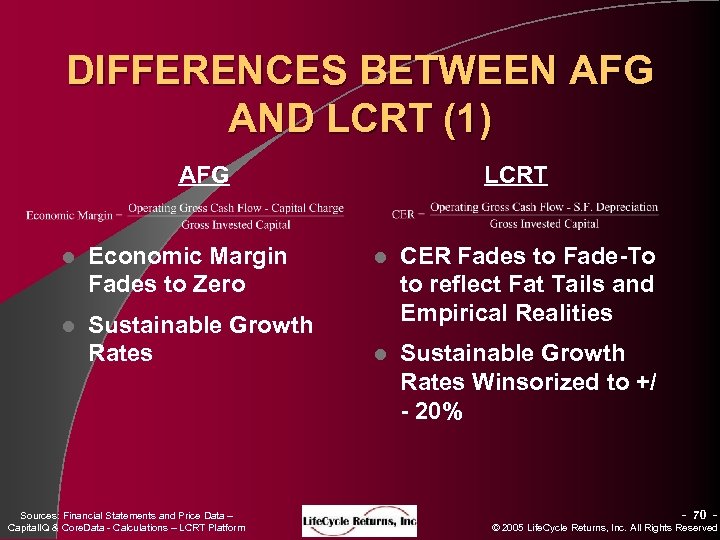
DIFFERENCES BETWEEN AFG AND LCRT (1) AFG l Economic Margin Fades to Zero l Sustainable Growth Rates Sources: Financial Statements and Price Data – Capital. IQ & Core. Data - Calculations – LCRT Platform LCRT l CER Fades to Fade-To to reflect Fat Tails and Empirical Realities l Sustainable Growth Rates Winsorized to +/ - 20% - 70 © 2005 Life. Cycle Returns, Inc. All Rights Reserved
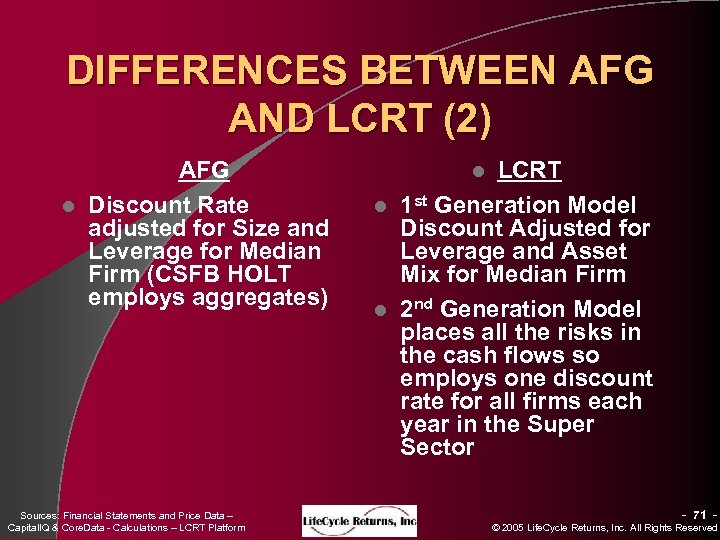
DIFFERENCES BETWEEN AFG AND LCRT (2) AFG l Discount Rate adjusted for Size and Leverage for Median Firm (CSFB HOLT employs aggregates) Sources: Financial Statements and Price Data – Capital. IQ & Core. Data - Calculations – LCRT Platform LCRT l 1 st Generation Model Discount Adjusted for Leverage and Asset Mix for Median Firm l 2 nd Generation Model places all the risks in the cash flows so employs one discount rate for all firms each year in the Super Sector l - 71 © 2005 Life. Cycle Returns, Inc. All Rights Reserved
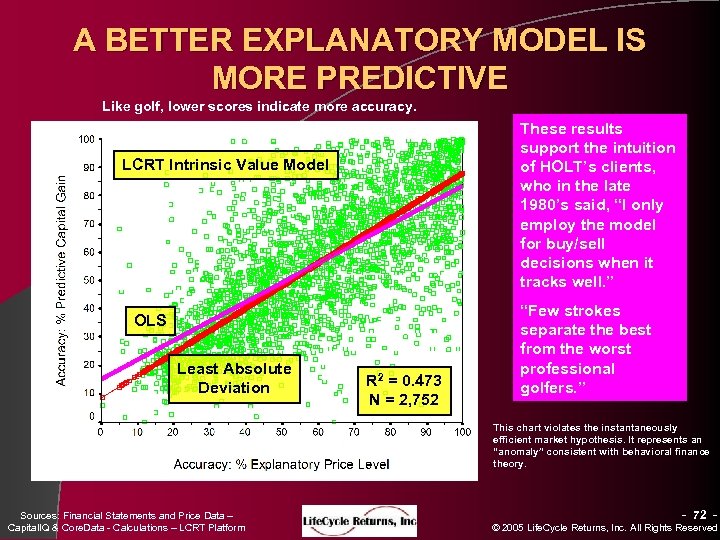
A BETTER EXPLANATORY MODEL IS MORE PREDICTIVE Like golf, lower scores indicate more accuracy. These results support the intuition of HOLT’s clients, who in the late 1980’s said, “I only employ the model for buy/sell decisions when it tracks well. ” LCRT Intrinsic Value Model OLS Least Absolute Deviation R 2 = 0. 473 N = 2, 752 “Few strokes separate the best from the worst professional golfers. ” This chart violates the instantaneously efficient market hypothesis. It represents an “anomaly” consistent with behavioral finance theory. Sources: Financial Statements and Price Data – Capital. IQ & Core. Data - Calculations – LCRT Platform - 72 © 2005 Life. Cycle Returns, Inc. All Rights Reserved
Скачать презентацию VALUATION MODELS ACCURACY AND PREDICTIVE CAPABILITY A WORK-IN-PROGRESS
aeb0e40c69c212f0eca499cb4d9cbdc8.ppt