


 Скачать презентацию Validity Management in SPKI 24 April 2002 Yki
f934128aa717ed1c2aa94129ff16b24b.ppt
- Количество слайдов: 19
 Validity Management in SPKI 24 April 2002 Yki. Kortesniemi@hut. fi (author) Tero. Hasu@hut. fi (presentation)
 Overview • Access control • Types of certificates (and how the type affects validation and revocation) • Validation and revocation methods in SPKI • SPKI validity management protocol 2
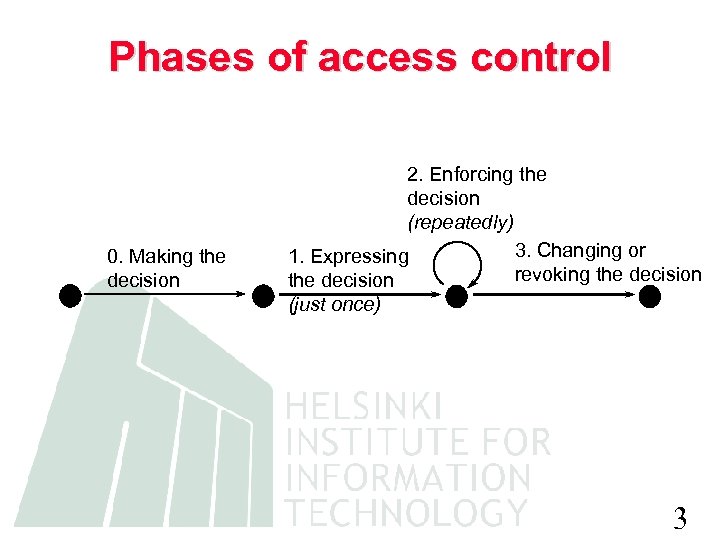 Phases of access control 0. Making the decision 2. Enforcing the decision (repeatedly) 3. Changing or 1. Expressing revoking the decision (just once) 3
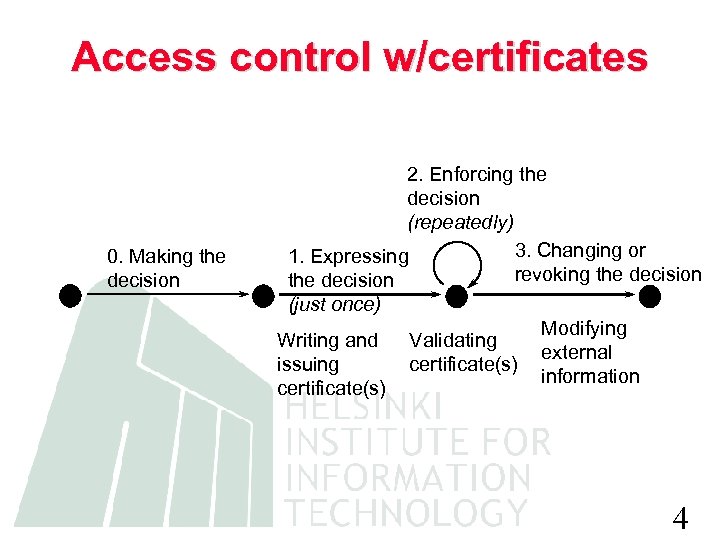 Access control w/certificates 0. Making the decision 2. Enforcing the decision (repeatedly) 3. Changing or 1. Expressing revoking the decision (just once) Modifying Writing and Validating external issuing certificate(s) information certificate(s) 4
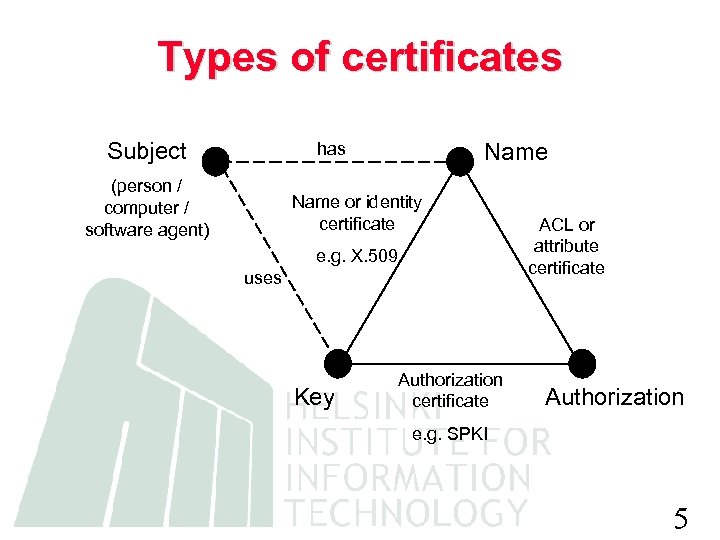 Types of certificates Subject Name has (person / computer / software agent) Name or identity certificate e. g. X. 509 uses Key Authorization certificate ACL or attribute certificate Authorization e. g. SPKI 5
 Identity certificates • Key - Name - Authorization binding proved during validation – no anonymity • Unique name required for each identity across the system – otherwise namesakes share rights – management burden • Grouping of rights – revoke just one certificate 6
 Authorization certificates • Key - Authorization binding proved during validation – more straightforward – performance • Anonymity is possible – benefits privacy of users – identity established if required (when acquiring the public key) 7
 Identity certificate issuers • Capable of establishing identity • Considered trustworthy • Typically have plenty of resources • Small number of issuers (in a system) • Small number of CRLs – may be practical to distribute to access control points 8
 Authorization certificate issuers • Anyone can be an issuer • Large number of issuers • Large number of CRLs – impractical to distribute in advance – obtain relevant CRLs online when required • Verifier can also be the issuer – issuer arranges revocation mechanisms – verifier normally owns protected resource – control revocation to balance risk 9
 Validity control in SPKI • Has to be considered when issuing a certificate • Validity period • Online checks – CRL – reval – one-time – limit – renew 10
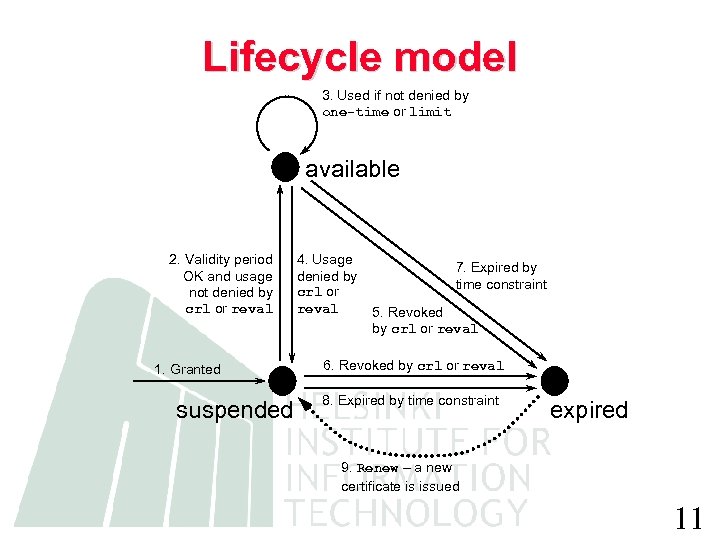 Lifecycle model 3. Used if not denied by one-time or limit available 2. Validity period OK and usage not denied by crl or reval 1. Granted suspended 4. Usage denied by crl or reval 7. Expired by time constraint 5. Revoked by crl or reval 6. Revoked by crl or reval 8. Expired by time constraint expired 9. Renew – a new certificate is issued 11
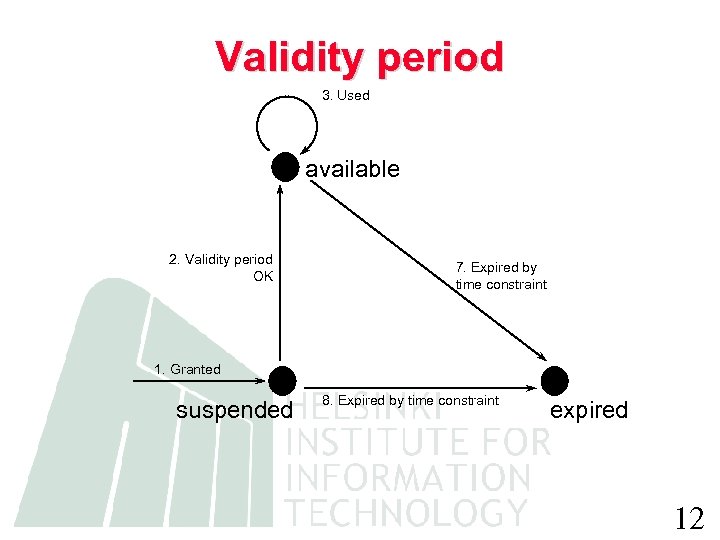 Validity period 3. Used available 2. Validity period OK 7. Expired by time constraint 1. Granted suspended 8. Expired by time constraint expired 12
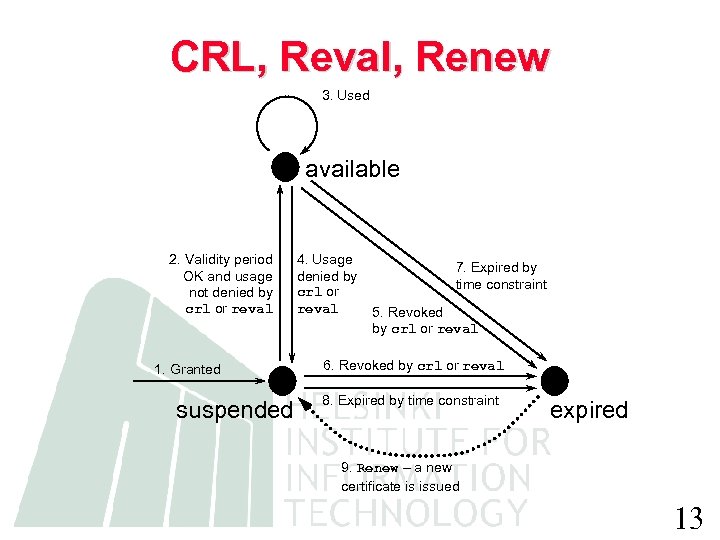 CRL, Reval, Renew 3. Used available 2. Validity period OK and usage not denied by crl or reval 1. Granted suspended 4. Usage denied by crl or reval 7. Expired by time constraint 5. Revoked by crl or reval 6. Revoked by crl or reval 8. Expired by time constraint expired 9. Renew – a new certificate is issued 13
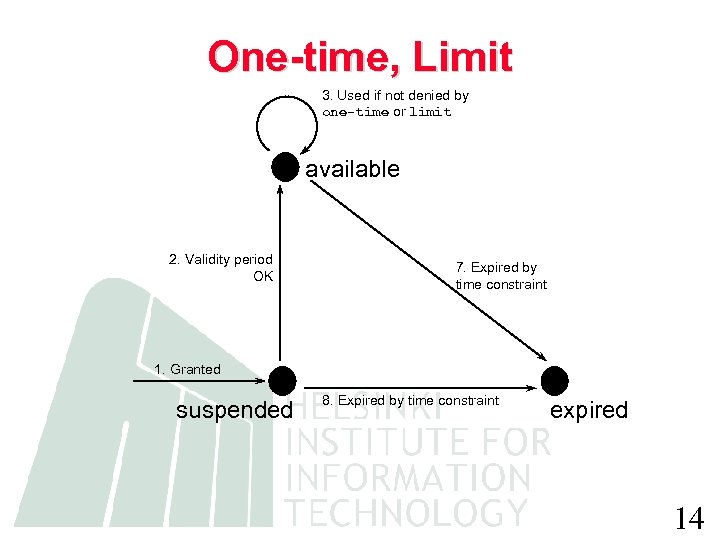 One-time, Limit 3. Used if not denied by one-time or limit available 2. Validity period OK 7. Expired by time constraint 1. Granted suspended 8. Expired by time constraint expired 14
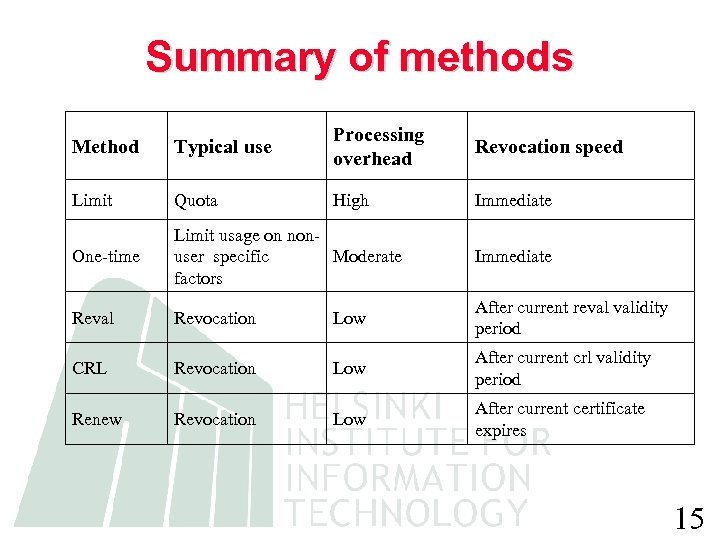 Summary of methods Method Typical use Processing overhead Revocation speed Limit Quota High Immediate One-time Limit usage on nonuser specific Moderate factors Immediate Reval Revocation Low After current reval validity period CRL Revocation Low After current crl validity period Renew Revocation Low After current certificate expires 15
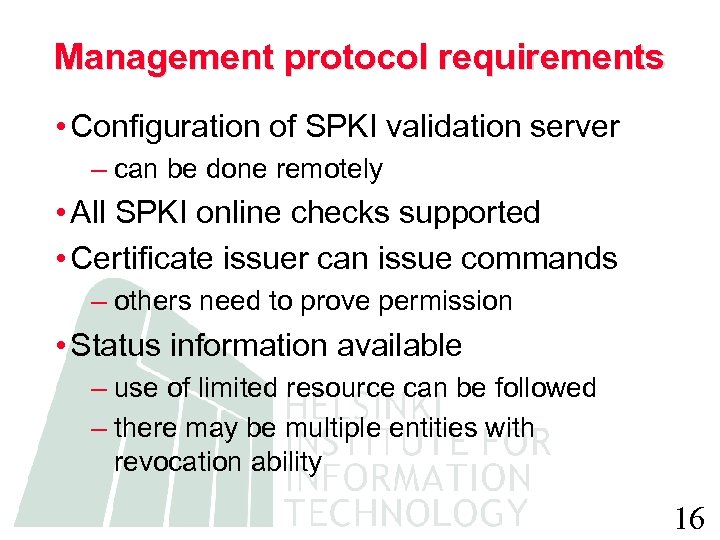 Management protocol requirements • Configuration of SPKI validation server – can be done remotely • All SPKI online checks supported • Certificate issuer can issue commands – others need to prove permission • Status information available – use of limited resource can be followed – there may be multiple entities with revocation ability 16
 Management protocol design • Two messages: – command – reply • Command message – e. g. revoke, re-enable, change quota – static and dynamic rules • Defined in XML – signed messages – requires secure transport protocol 17
 Command reply • server_update cert, chain? , online_test_hash, delete_request*, test_definition*, status_query*, signature • server_reply cert_hash, online_test_hash, delete_reply*, test_definition_reply*, status_reply*, service_status, signature 18
 The end • Questions? – (hope not) 19