


 Скачать презентацию Validation of non-formal and informal learning relevant
fc62dd0a0cfc3ce93fa0bf79da33c2da.ppt
- Количество слайдов: 11
 Validation of non-formal and informal learning – relevant for young people at risk? Jens Bjornavold Brussels 8 may 2015 Conference on the integration of young people excluded by early school leaving and unemployment: challenges and solutions
 Making learning visible - the glass is not half empty but half full…. . Ø Many young people will have negative experiences and perceptions of formal education and training Ø Less work experience puts young people at an disadvantage in the labour market Ø Many have, however, acquired knowledge and skills through personal activities, in the form of work, hobbies or volunteering…. Ø Validation of non-formal and informal learning can in many cases be a way to identify personal strengths and identify a potential way forward
 Validation of non-formal and informal learning and young people at risk…. Policies on validation of non-formal and informal learning form part of a wider range of education and social policy instruments addressing • • Early school leavers and Unemployed youths Validation, or recognition of prior learning, is important because it can help to make visible and value the learning taking place outside class-rooms, at work, in leisure time, in voluntary activities…
 Are existing validation initiatives addressing young people at risk Ø Few validation initiatives are directly addressing early school leavers; some good examples in Finland, Netherlands and Spain Ø More validation initiatives address young people in general. Many of these are linked to particular extra-curricular activities – for example scouting and sports – and do not necessarily reach those at risk Ø An increasing number of validation arrangements address those with low levels of qualifications, and may potentially address early school leavers Ø A high number of validation arrangements address unemployed, but not necessarily young people
 Two main forms of validation i) Summative validation - Certification Aiming at a formal certificate or qualification, but offering an alternative route to this. Can be crucial for re-entry into education and training ii) Formative validation – identification and documentation Not aiming at a formal qualification but focuses on identification and documentation of experiences. Can be crucial for selfunderstanding and self-awareness
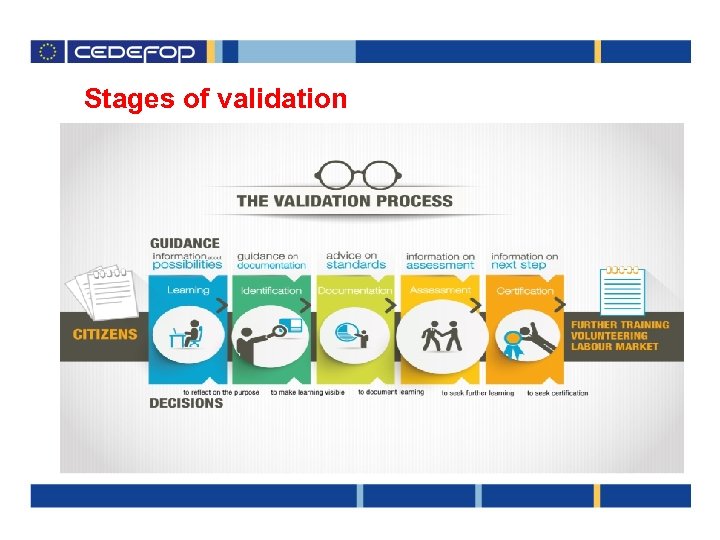 Stages of validation
 Summative validation - different forms Ø External examinations allowing young people to get a qualification without repeating the full education and training period Ø Validation as a way to be exempted from parts of the education and training Ø Validation of non-formal and informal learning as a way to achieve a full qualification
 Formative validation Helps to improve employability and prepare/motivate for further learning – Portfolios and Skills Audits/Bilan de competence My Skills, My Future (MSMF) - Scotland The ‘My Skills, My Future’ resources are primarily targeted at young people who are considered to be at risk of leaving school, or who have already left school, with few or no formal qualifications. They can also be used with young people who have been made redundant from their first job, adult returners to the workplace or the long-term unemployed. ■The resources help individuals clearly understand their range of skills ■They can help the users in a decision-making process regarding future career or further training ■By helping individuals to understand where their learning sits on the SCQF, their selfconfidence and aspirations can be raised which helps build self-confidence and raises aspirations ■Using the resources can be a way of generating evidence towards certain SQA awards The My Skills My Future resources were developed by the SCQF Partnership, Glasgow Caledonian University’s Department for Learning Enhancement and Academic Development (GCU LEAD) and Skills Development Scotland (SDS
 European initiatives and policies § Council Recommendation on validation of non-formal and informal learning (2012) ‘…. individuals who are unemployed or at risk of unemployment have the opportunity, in accordance with national legislation and specificities, to undergo a ‘skills audit’ aimed at identifying their knowledge, skills and competences within a reasonable period of time, ideally within six months of an identified need’. § Member States are recommended to put in place national validation arrangements, including skills audit, by 2018
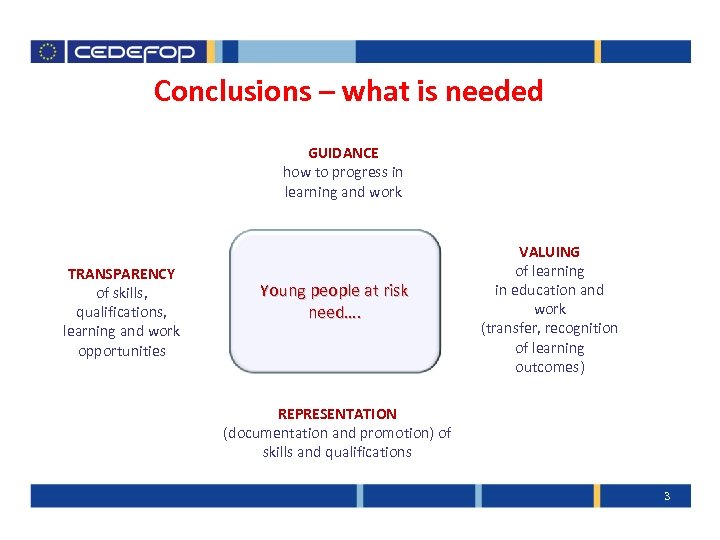 Conclusions – what is needed GUIDANCE how to progress in learning and work TRANSPARENCY of skills, qualifications, learning and work opportunities Young people at risk need…. VALUING of learning in education and work (transfer, recognition of learning outcomes) REPRESENTATION (documentation and promotion) of skills and qualifications 3
 European Inventory on validation of nonformal and informal learning http: //www. cedefop. europa. eu/en/events-andprojects/validation-non-formal-and-informallearning/european-inventory European Guidelines on validating nonformal and informal learning http: //www. cedefop. europa. eu/node/11010