


 Скачать презентацию Validation and checking of crystal structures Alexander J
66805cbde644b7d74e1e7e6039155884.ppt
- Количество слайдов: 70
 Validation and checking of crystal structures Alexander J. Blake, University of Nottingham, UK and Anthony Linden, University of Zurich, Switzerland This presentation contains material from the following lectures: American Crystallographic Association Annual Meeting, Los Angeles, July 2001; International Union of Crystallography Congress, Geneva, August 2002; University of th National Meeting, New York, Natal, Pietermaritzburg. South Africa, August 2003; ACS 226 , September 2003; British Crystallographic Association, Chemical Crystallography Group Meeting, Cambridge, November 2003; European Crystallographic Meeting, Budapest, August 2004
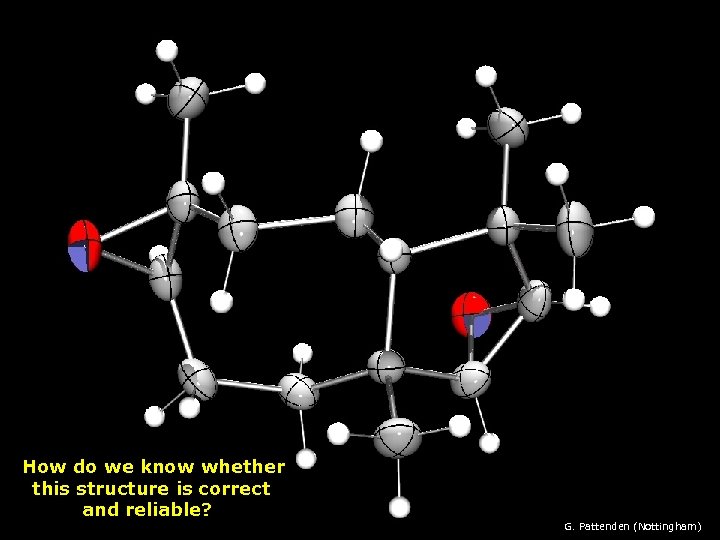 How do we know whether this structure is correct and reliable? G. Pattenden (Nottingham)
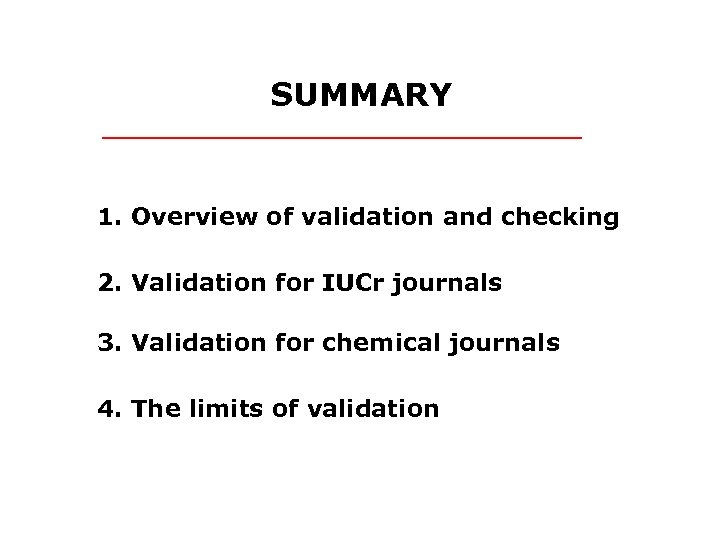
 OUTLINE
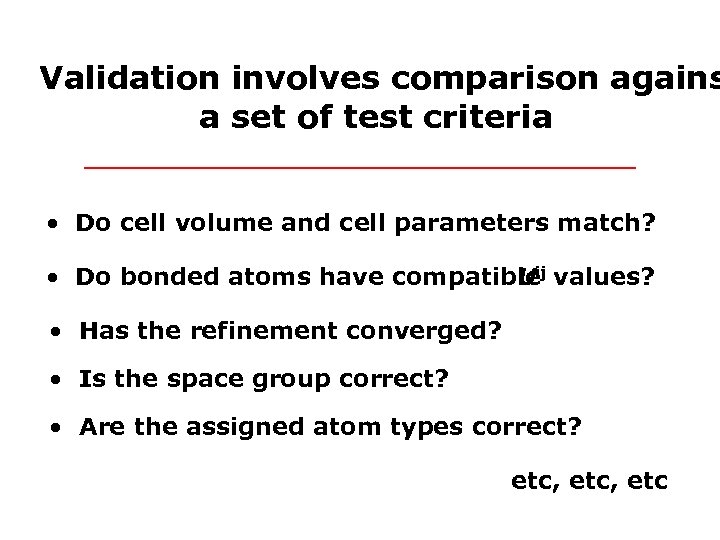 Validation involves comparison agains a set of test criteria • Do cell volume and cell parameters match? • Do bonded atoms have compatible values? Uij • Has the refinement converged? • Is the space group correct? • Are the assigned atom types correct? etc, etc
 Valid -ation Correct Appropriate Defensible
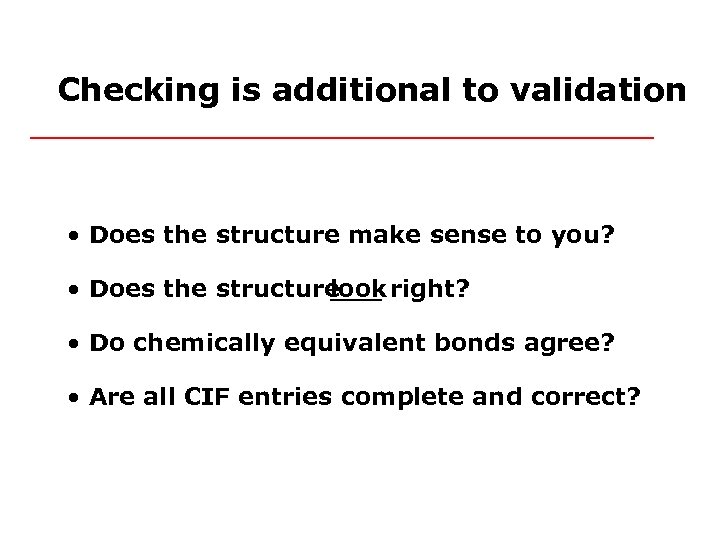 Checking is additional to validation • Does the structure make sense to you? • Does the structure look right? • Do chemically equivalent bonds agree? • Are all CIF entries complete and correct?
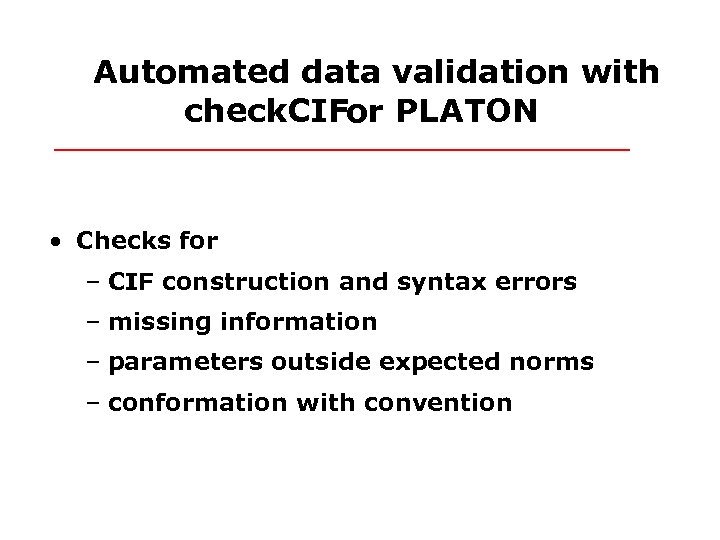 Automated data validation with check. CIFor PLATON • Checks for – CIF construction and syntax errors – missing information – parameters outside expected norms – conformation with convention
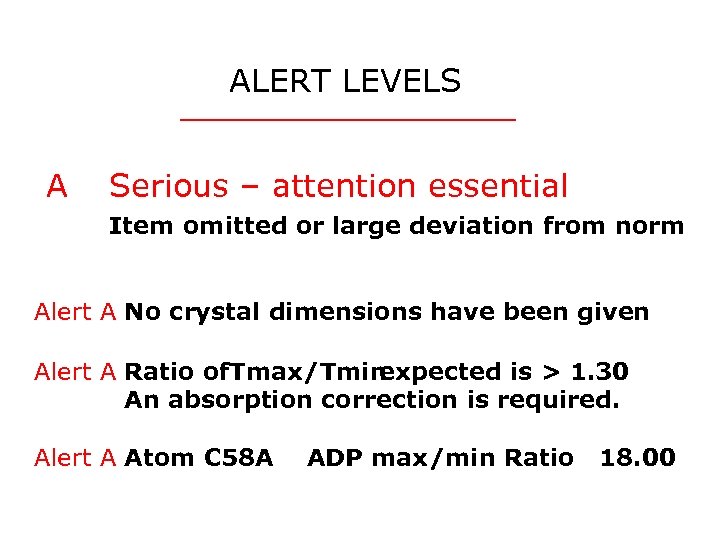 ALERT LEVELS A Serious – attention essential Item omitted or large deviation from norm Alert A No crystal dimensions have been given Alert A Ratio of. Tmax/Tmin expected is > 1. 30 An absorption correction is required. Alert A Atom C 58 A ADP max/min Ratio 18. 00
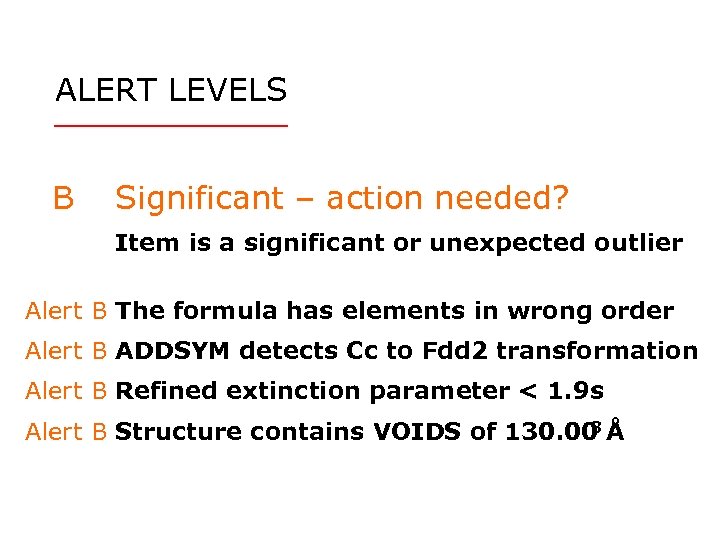 ALERT LEVELS B Significant – action needed? Item is a significant or unexpected outlier Alert B The formula has elements in wrong order Alert B ADDSYM detects Cc to Fdd 2 transformation Alert B Refined extinction parameter < 1. 9 s 3 Alert B Structure contains VOIDS of 130. 00 Å
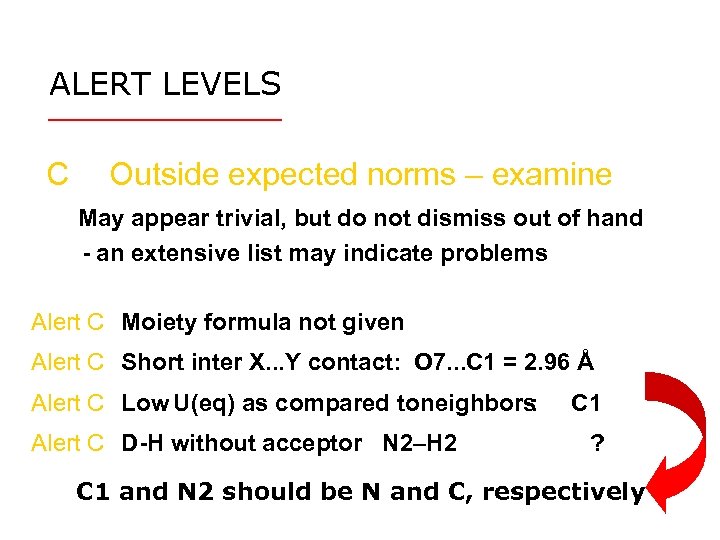 ALERT LEVELS C Outside expected norms – examine May appear trivial, but do not dismiss out of hand - an extensive list may indicate problems Alert C Moiety formula not given Alert C Short inter X. . . Y contact: O 7. . . C 1 = 2. 96 Å Alert C Low U(eq) as compared to neighbors : Alert C D-H without acceptor N 2–H 2 C 1 ? C 1 and N 2 should be N and C, respectively
 ALERT LEVELS G General issues – check
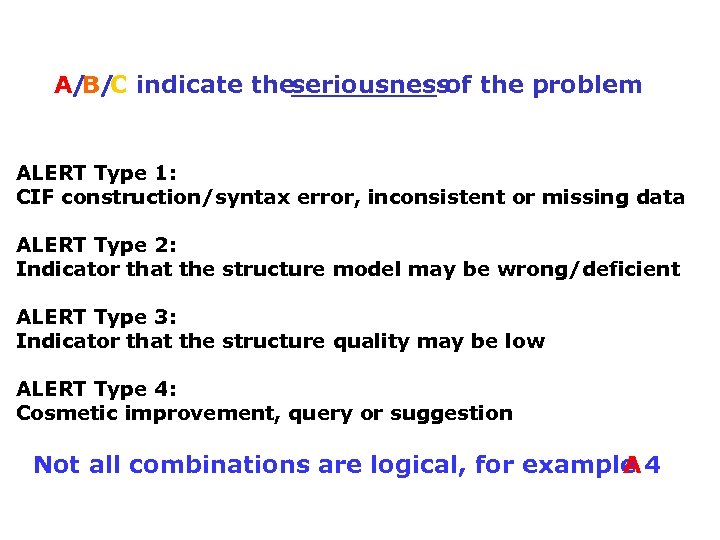 A/ C indicate theseriousness the problem B/ of ALERT Type 1: CIF construction/syntax error, inconsistent or missing data ALERT Type 2: Indicator that the structure model may be wrong/deficient ALERT Type 3: Indicator that the structure quality may be low ALERT Type 4: Cosmetic improvement, query or suggestion Not all combinations are logical, for example 4 A
 Sources of outlier parameters • Unresolved feature (e. g. , untreated disorder) • Artefact due to limited data quality • Inadequate procedures (e. g. , poor corrections) • Incorrect structure (e. g. , wrong space group) • A genuinely unusual observation!!
 What does validation software do? • Identifies possible problems ALERTs via • Provides explanations of ALERTs • Suggests interpretations and possible solutions Not just for authors • referees use it for assessment • authors need to be aware of this • how appropriate are IUCr criteria?
 When to validate? • software for data collection, refinement, etc - shoulddo its own validation • use PLATON in final stages of determination • validate raw CIF from the refinement program • must validate the final version as well • avoids problems at submission, refereeing, etc
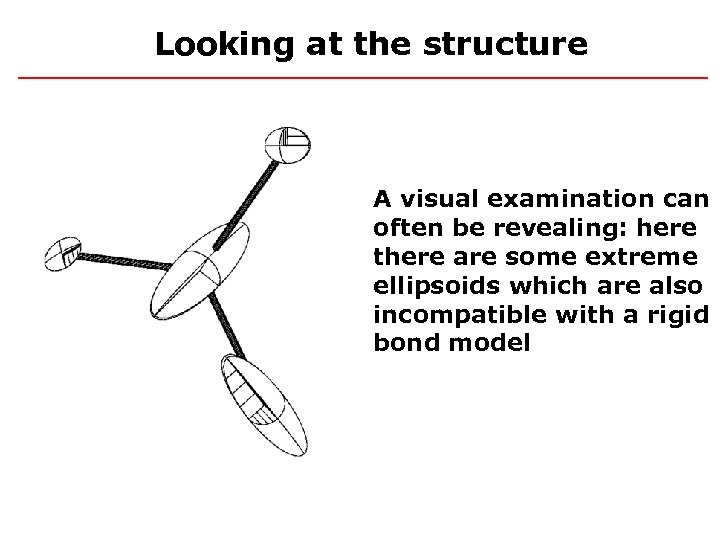 Looking at the structure A visual examination can often be revealing: here there are some extreme ellipsoids which are also incompatible with a rigid bond model
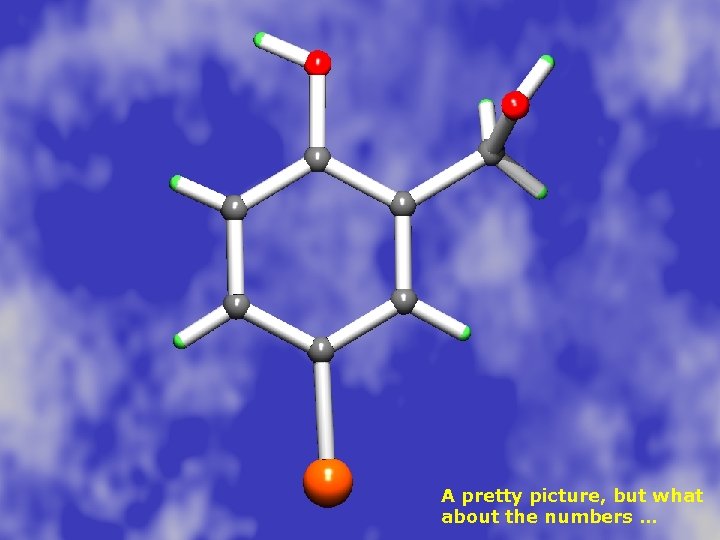 A pretty picture, but what about the numbers …
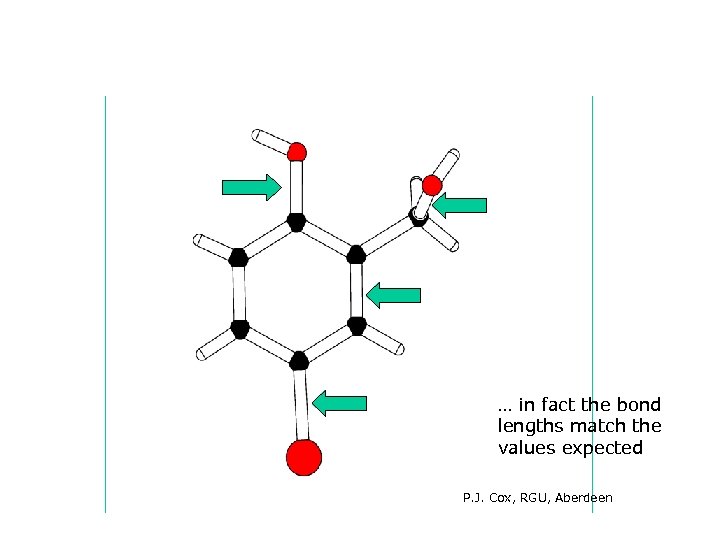 … in fact the bond lengths match the values expected P. J. Cox, RGU, Aberdeen
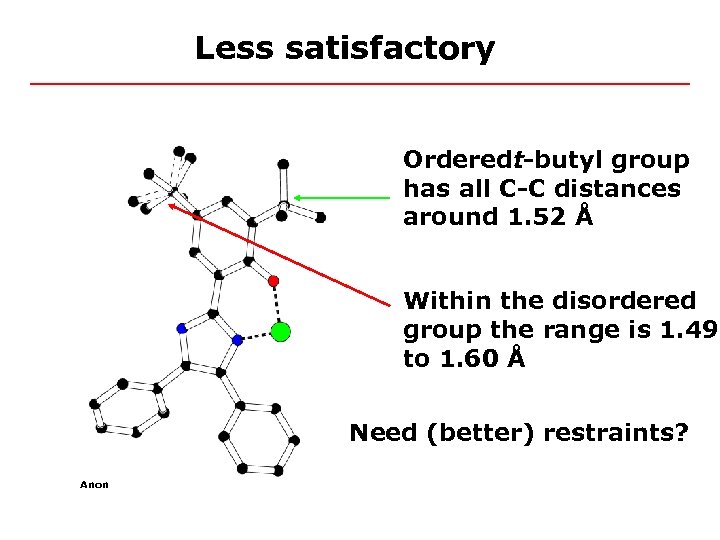 Less satisfactory Orderedt-butyl group has all C-C distances around 1. 52 Å Within the disordered group the range is 1. 49 to 1. 60 Å Need (better) restraints? Anon
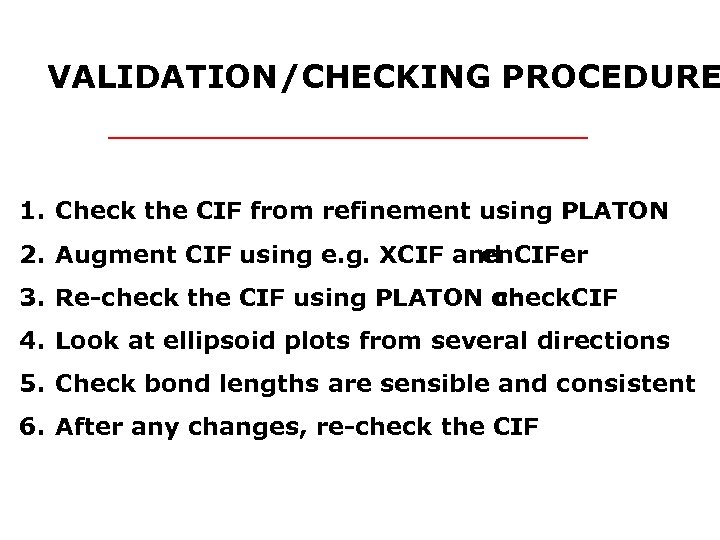 VALIDATION/CHECKING PROCEDURE 1. Check the CIF from refinement using PLATON 2. Augment CIF using e. g. XCIF and en. CIFer 3. Re-check the CIF using PLATON or check. CIF 4. Look at ellipsoid plots from several directions 5. Check bond lengths are sensible and consistent 6. After any changes, re-check the CIF
 Validation and IUCr Journals
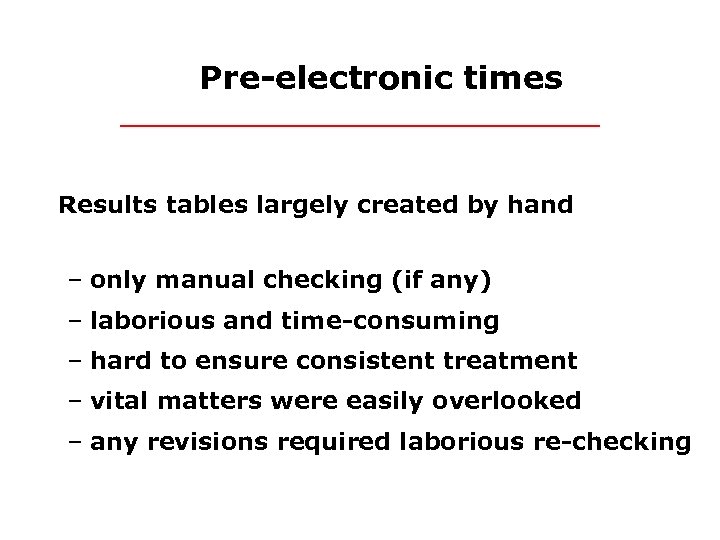 Pre-electronic times Results tables largely created by hand – only manual checking (if any) – laborious and time-consuming – hard to ensure consistent treatment – vital matters were easily overlooked – any revisions required laborious re-checking
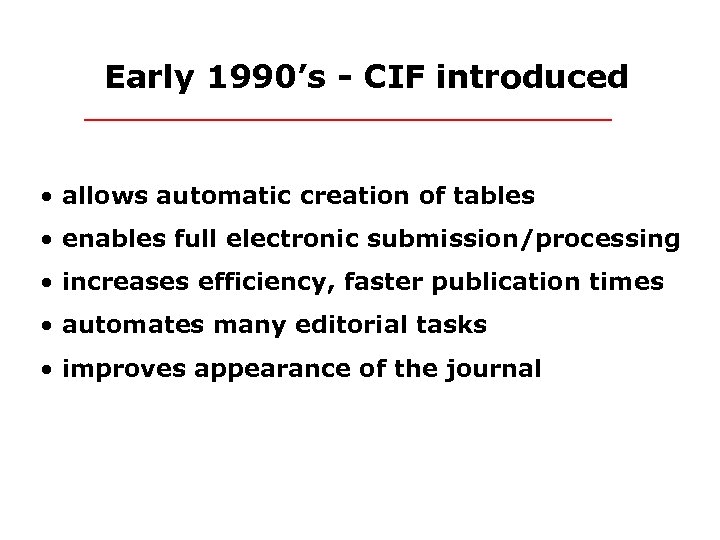 Early 1990’s - CIF introduced • allows automatic creation of tables • enables full electronic submission/processing • increases efficiency, faster publication times • automates many editorial tasks • improves appearance of the journal
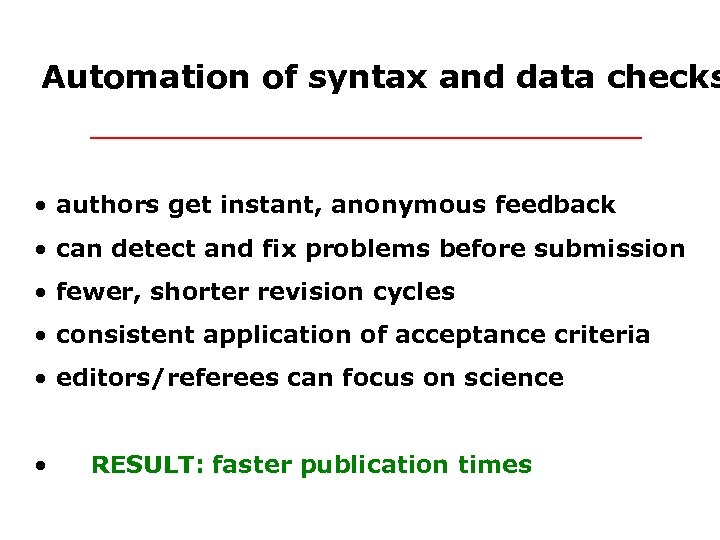 Automation of syntax and data checks • authors get instant, anonymous feedback • can detect and fix problems before submission • fewer, shorter revision cycles • consistent application of acceptance criteria • editors/referees can focus on science • RESULT: faster publication times
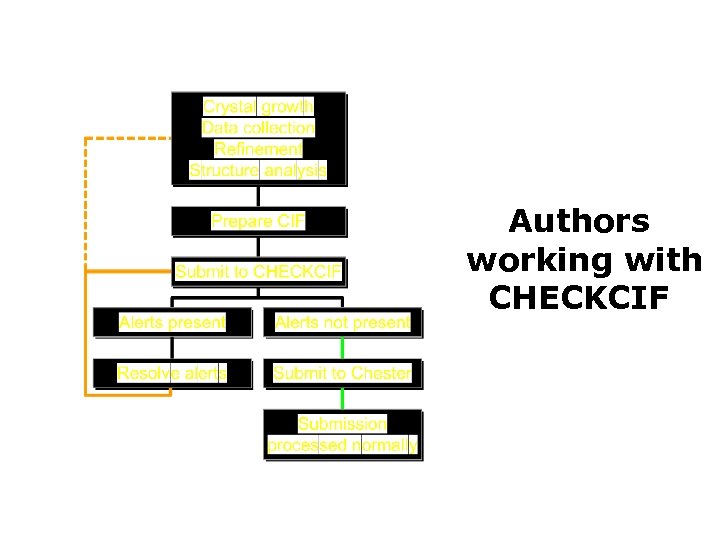 Authors working with CHECKCIF
 If you still get A alerts
 Assessment of VRF • VRF allows for “fine-tuning” • validation criteria need some flexibility • looking for sound scientific reasoning • sound explanation? Pass the CIF • otherwise suggest possible remedial action We try to be helpful and informative !
 A valid riposte Alert B ADDSYM detects additional (pseudo) symmetry element: I Author Response: This additional symmetry element does not hold true for one of the ether bridges, as discussed in the text.
 An inadequate answer Alert A < 85% complete theta max? ) ( Author Response: Hemisphere of data collected. [Space group P 21/n, Nonius. FAST] But what is the reason for missing data: • inherent geometrical limitation? • mistake in data collection or reduction?
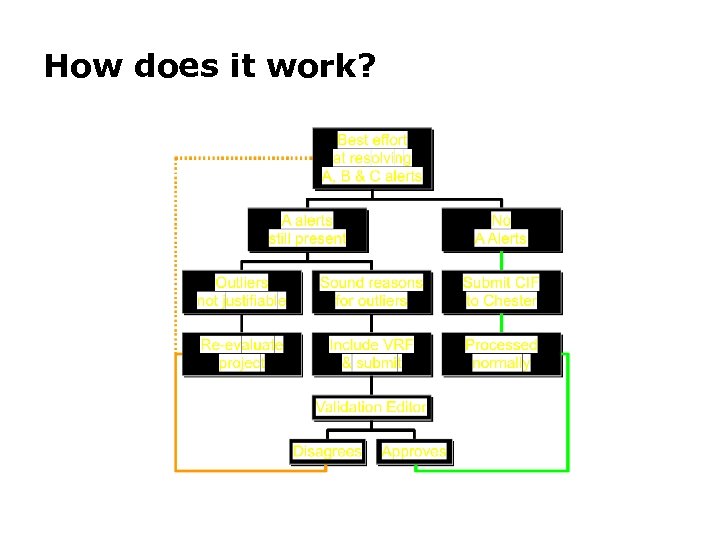 How does it work?
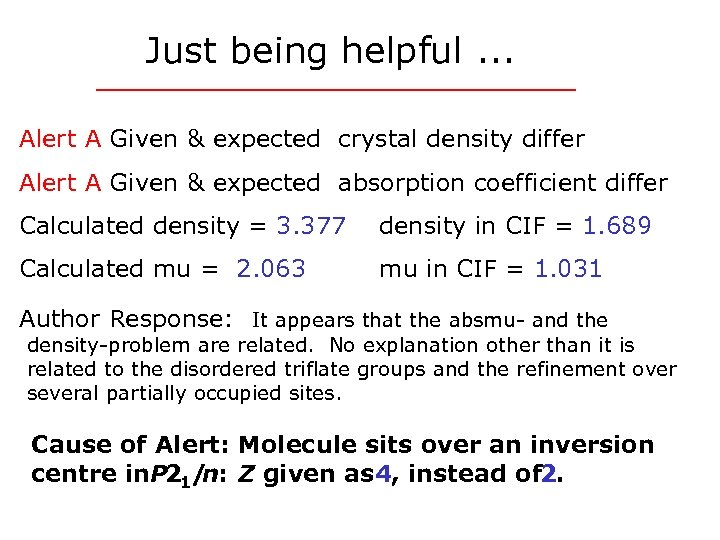 Just being helpful. . . Alert A Given & expected crystal density differ Alert A Given & expected absorption coefficient differ Calculated density = 3. 377 density in CIF = 1. 689 Calculated mu = 2. 063 mu in CIF = 1. 031 Author Response: It appears that the absmu- and the density-problem are related. No explanation other than it is related to the disordered triflate groups and the refinement over several partially occupied sites. Cause of Alert: Molecule sits over an inversion centre in. P 21/ Z given as 4, instead of 2. n:
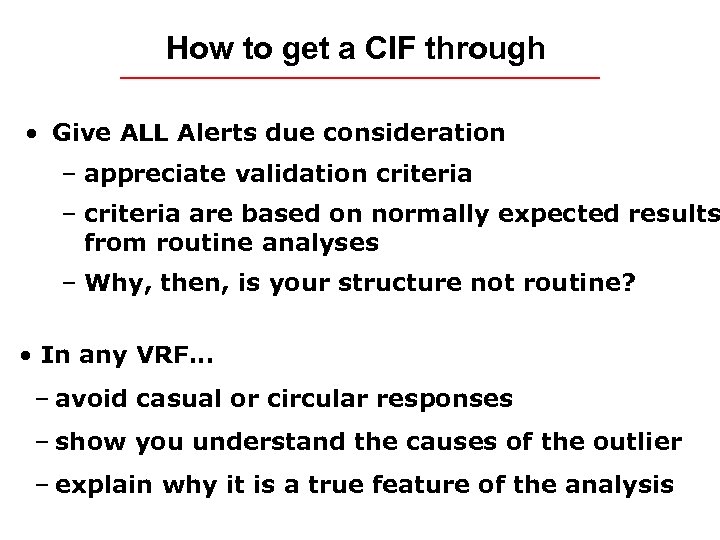 How to get a CIF through • Give ALL Alerts due consideration – appreciate validation criteria – criteria are based on normally expected results from routine analyses – Why, then, is your structure not routine? • In any VRF. . . – avoid casual or circular responses – show you understand the causes of the outlier – explain why it is a true feature of the analysis
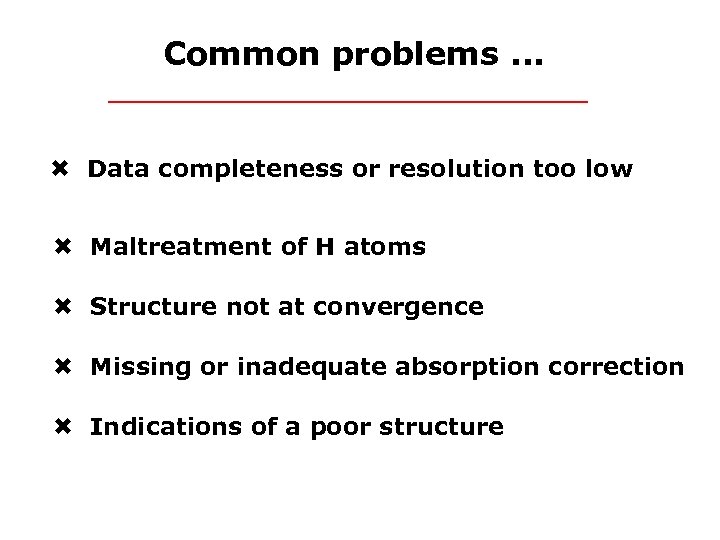
 What causes most problems?
 Common problems. . .
 Common problems. . . Ò Data completeness or resolution too low Ò Maltreatment of H atoms Ò Structure not at convergence Ò Missing or inadequate absorption correction Ò Indications of a poor structure
 Acta C CIF submissions in 2000 Tony Linden (Zurich)
 Fate of CIFs with VRFs in 2000 2002: 58% passed as is
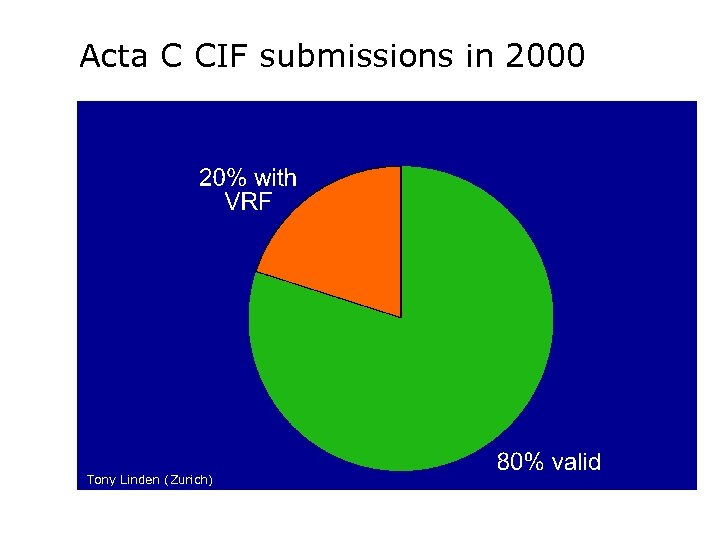
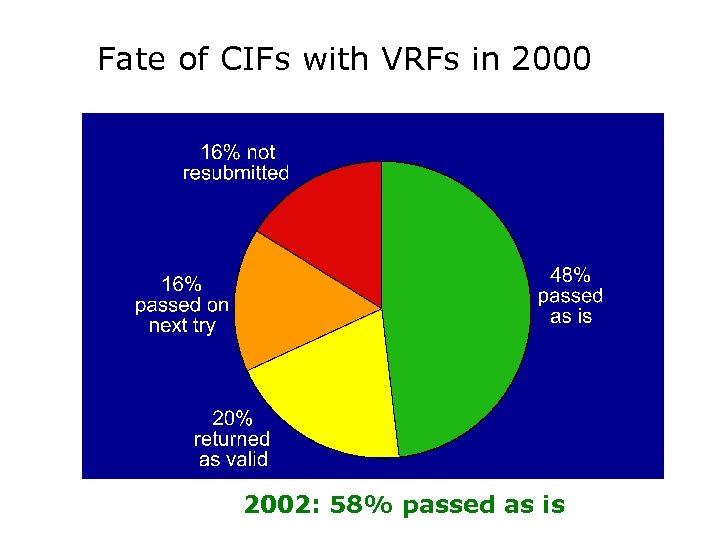
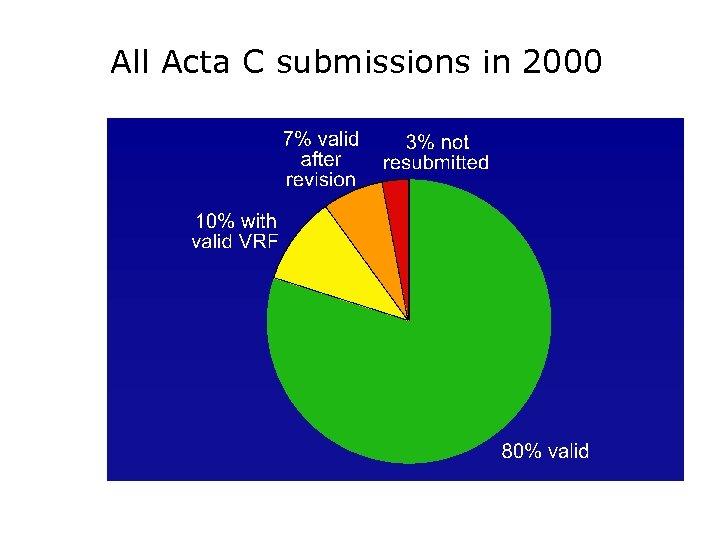 All Acta C submissions in 2000
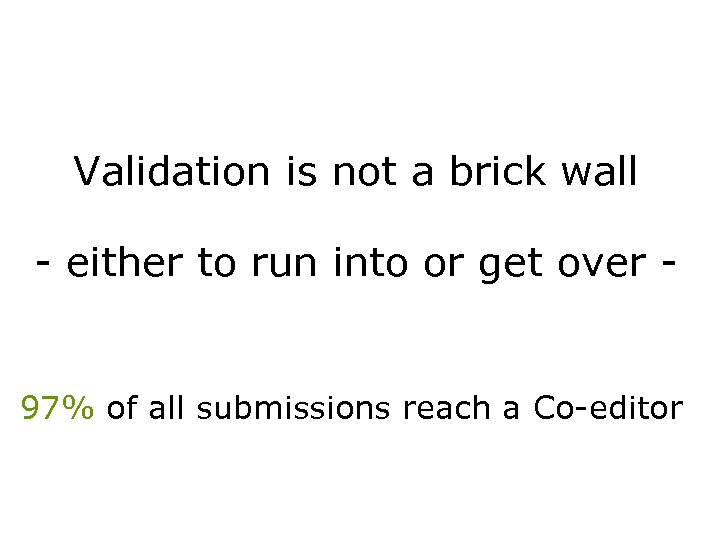 Validation is not a brick wall - either to run into or get over - 97% of all submissions reach a Co-editor
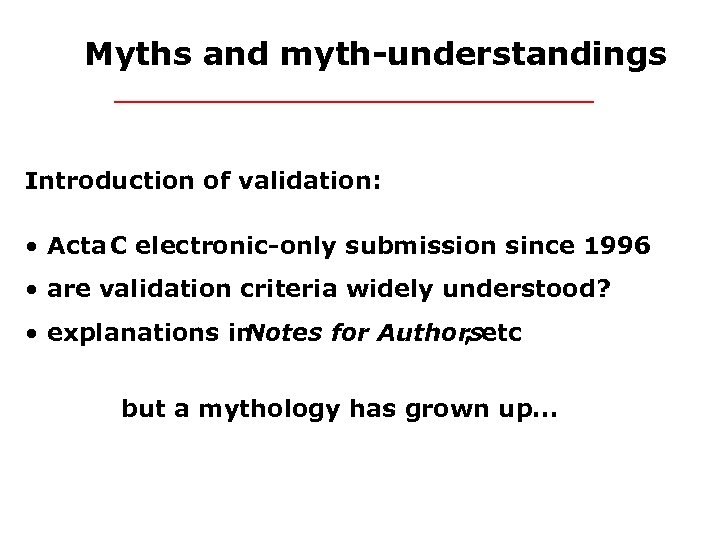 Myths and myth-understandings Introduction of validation: • Acta C electronic-only submission since 1996 • are validation criteria widely understood? • explanations in Notes for Authorsetc , but a mythology has grown up. . .
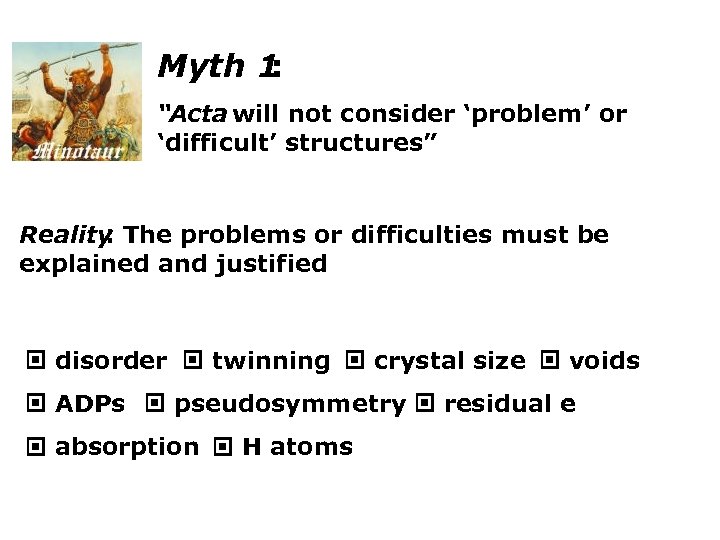 Myth 1 : “Acta will not consider ‘problem’ or ‘difficult’ structures” Reality The problems or difficulties must be : explained and justified disorder twinning crystal size voids ADPs pseudosymmetry residual e absorption H atoms
 Myth 2: “ Acta will not publish any Scylla structure with 1 > 0. 05/0. 07/0. 10. . . ” R Reality: There is no formal cut-off, but a structure with a high. R 1 will need to be justified.
 Myth 3 “Acta will not publish a : Gorgon structure with > 1 where one of the Z’ molecules is disordered” Reality We welcome such interesting structures, but : the disorder must be treated adequately.
 Myth 4: Dragon “Datasets must be (almost) perfectly complete”
 Myth or not? • Is the assertion based on direct experience? • Check with. Notes for Authors (www. iucr. org ) • If in any doubt, ask a Co-editor ( www. iucr. org ) • Your case may not be the same as a similar one
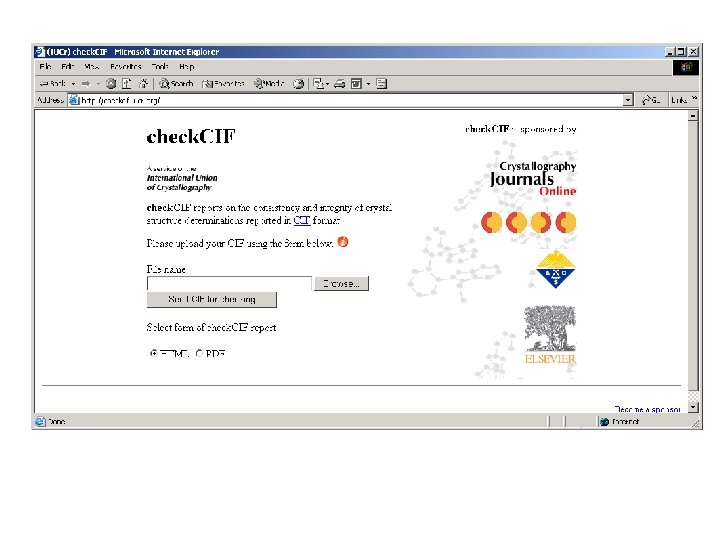
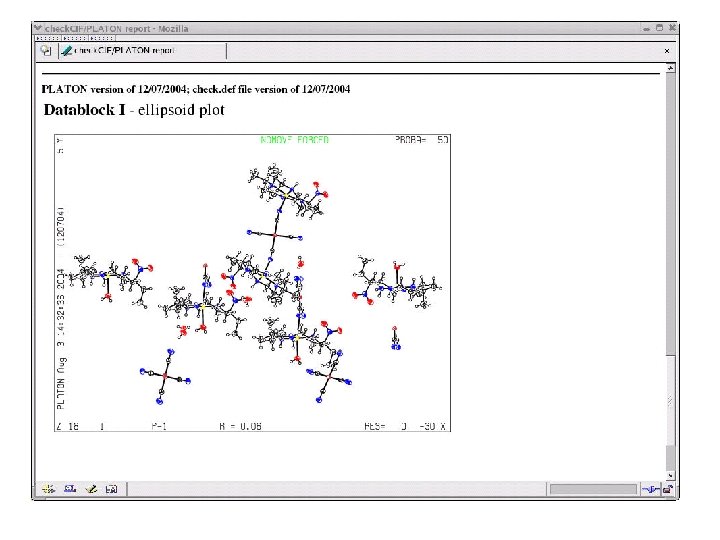
 check. CIF in 2004 • the new home of check. CIF : http: // checkcif. iucr. org • service sponsored by ACS, CCDC and Elsevier • an ORTEP plot is now included • part of new. Acta C/E submission procedures • will soon have online upload of all material Acta C and E for papers (CIF + figures/schemes/structure factors)
 Validation and other Journals

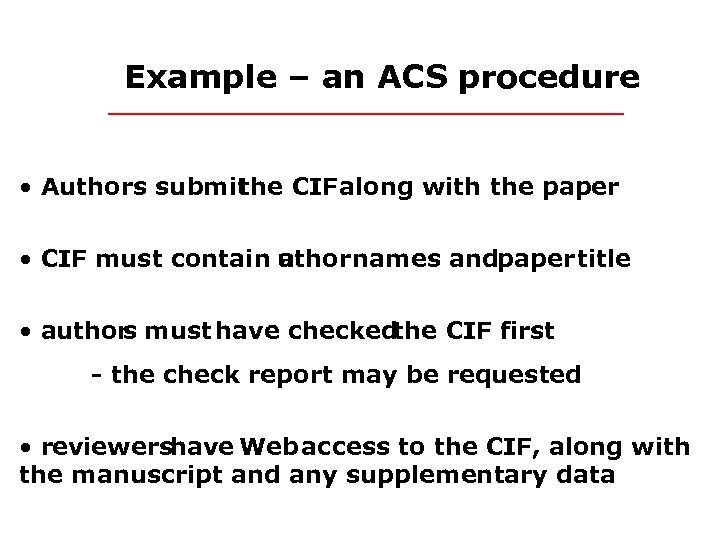 Example – an ACS procedure • Authors submit the CIF along with the paper • CIF must contain uthor names andpaper title a • author must have checkedthe CIF first s - the check report may be requested • reviewershave Web access to the CIF, along with the manuscript and any supplementary data
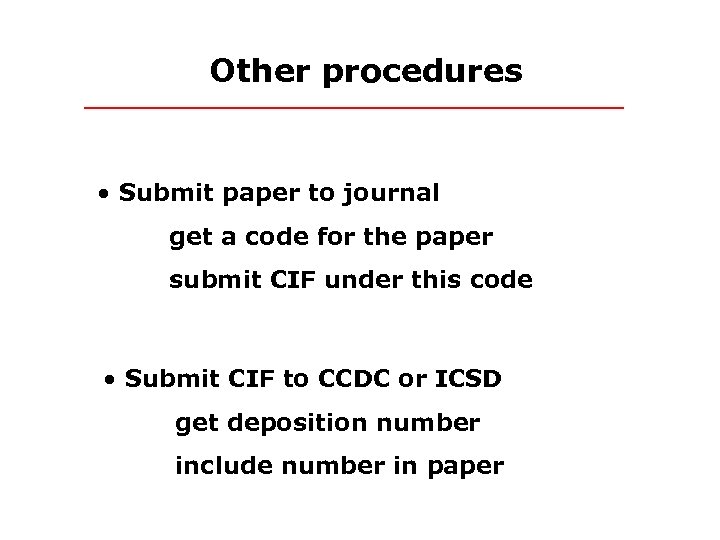 Other procedures • Submit paper to journal get a code for the paper submit CIF under this code • Submit CIF to CCDC or ICSD get deposition number include number in paper
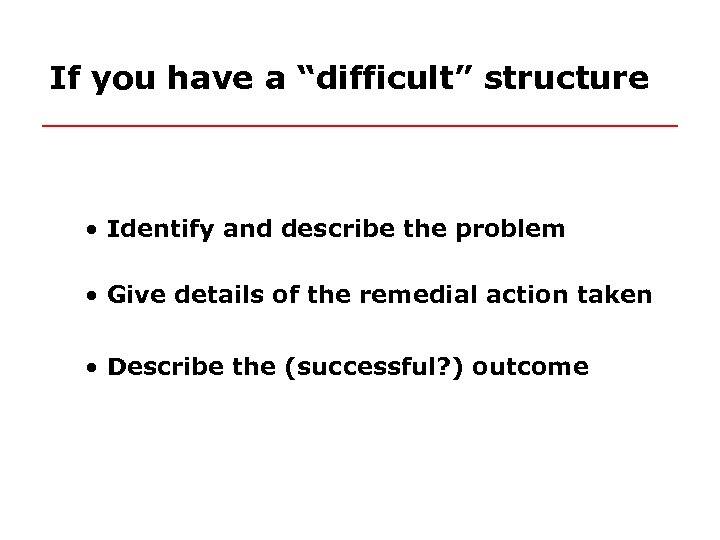 If you have a “difficult” structure • Identify and describe the problem • Give details of the remedial action taken • Describe the (successful? ) outcome
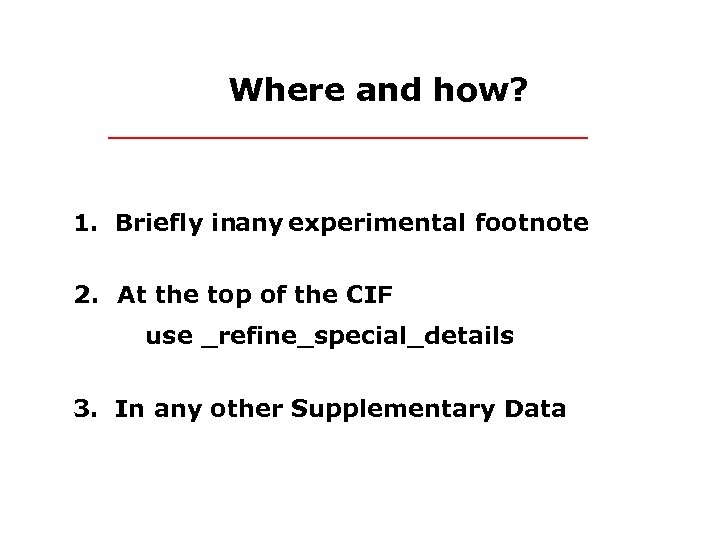 Where and how? 1. Briefly inany experimental footnote 2. At the top of the CIF use _refine_special_details 3. In any other Supplementary Data
 Example of text
 The limits of validation (automatic validation will not catch every problem)
 Possible limits to validation Ð test not (yet) implemented Ð test not practical Ð error not a validation issue Ð error cannot be detected from data in CIF Ð nonsense entries in the CIF
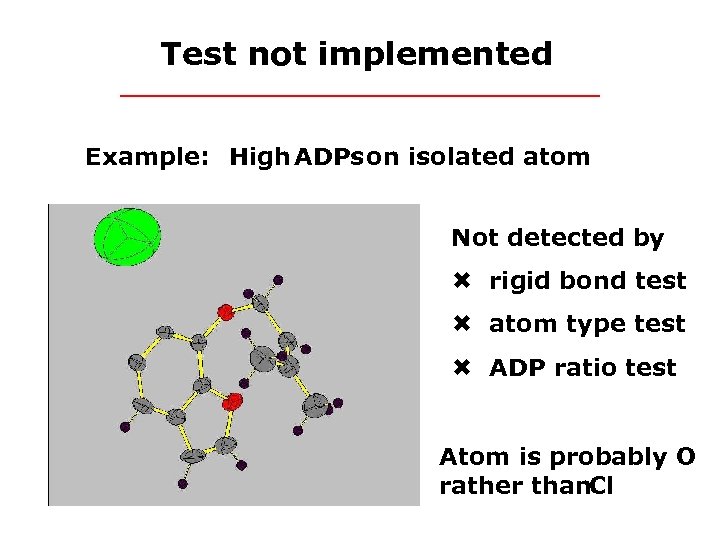 Test not implemented Example: High ADPs on isolated atom Not detected by Ò rigid bond test Ò atom type test Ò ADP ratio test Atom is probably O rather than. Cl
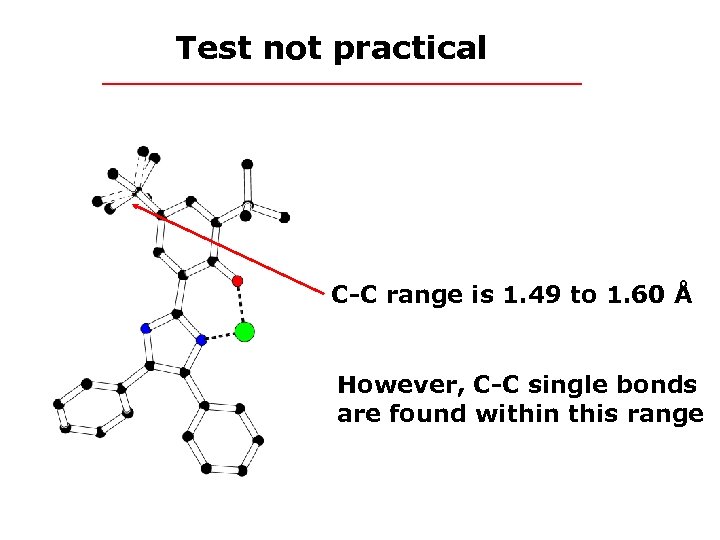 Test not practical C-C range is 1. 49 to 1. 60 Å However, C-C single bonds are found within this range
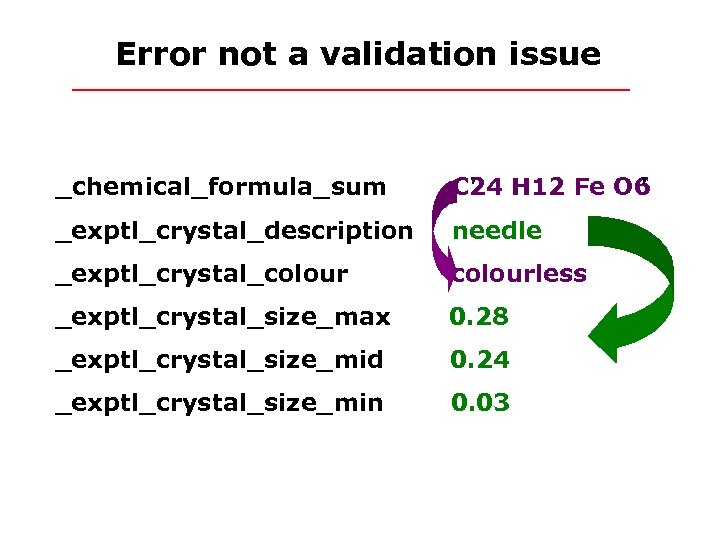 Error not a validation issue _chemical_formula_sum C 24 H 12 Fe O 6 ' ' _exptl_crystal_description needle _exptl_crystal_colourless _exptl_crystal_size_max 0. 28 _exptl_crystal_size_mid 0. 24 _exptl_crystal_size_min 0. 03
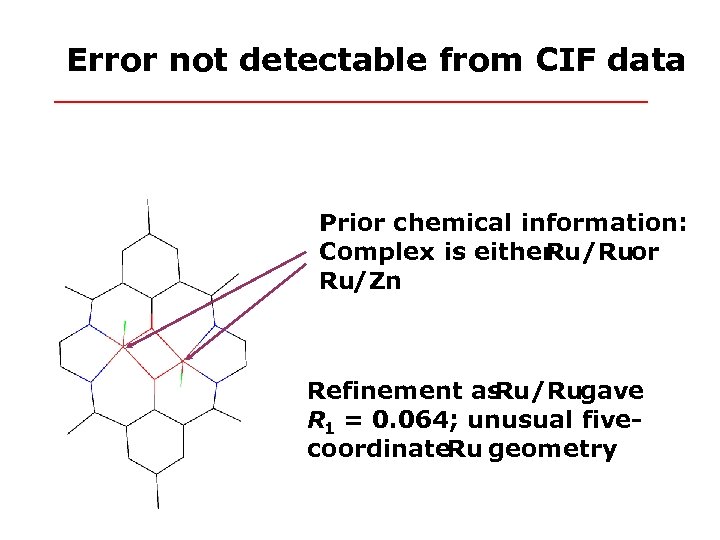 Error not detectable from CIF data Prior chemical information: Complex is either Ru/Ruor Ru/Zn Refinement as Ru/Rugave R 1 = 0. 064; unusual fivecoordinate. Ru geometry
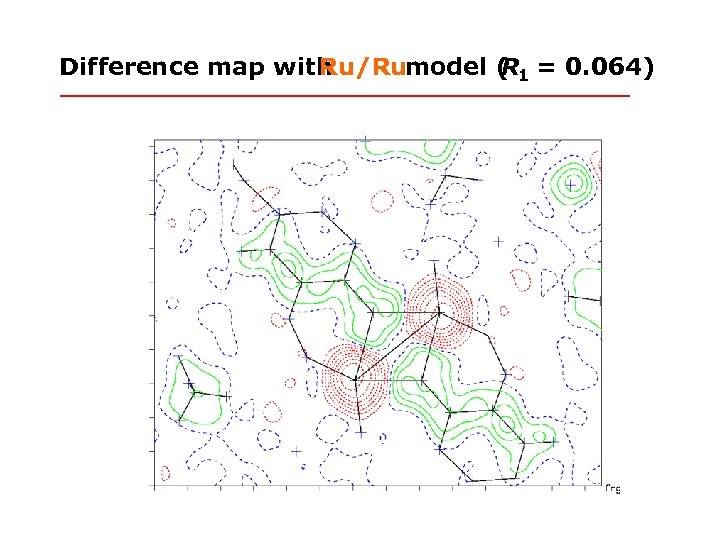 Difference map with Ru/Rumodel ( 1 = 0. 064) R
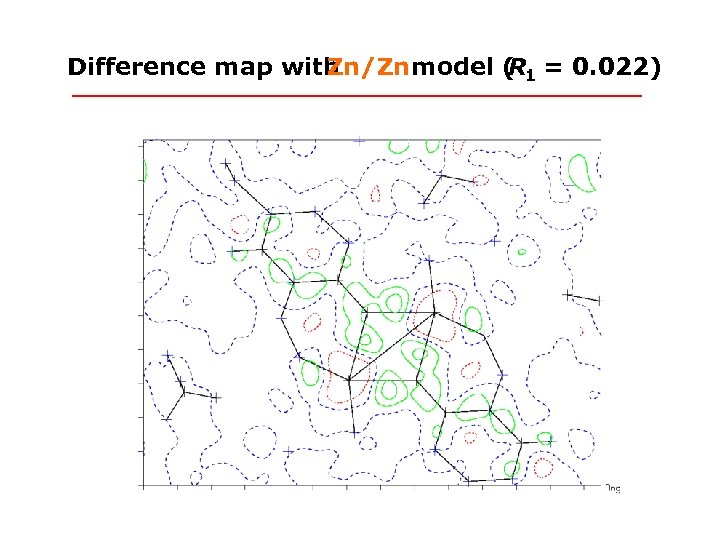 Difference map with Zn/Zn model ( 1 = 0. 022) R
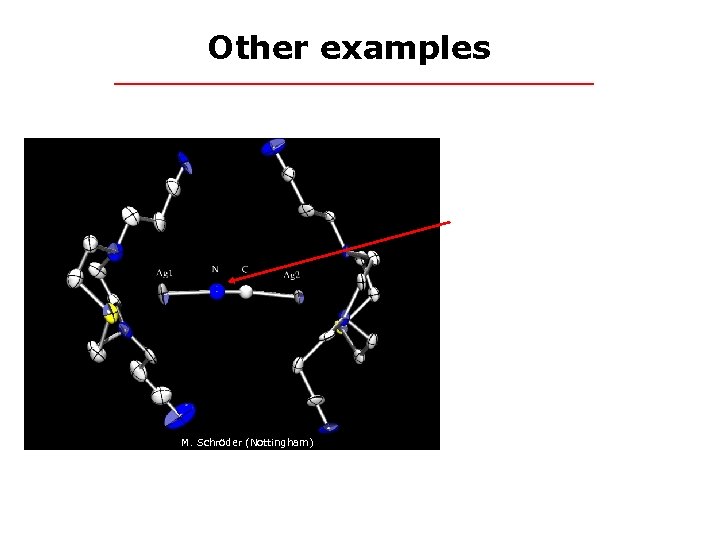 Other examples M. Schröder (Nottingham)
![Model complexes for [Ni. Fe] hydrogenase M. Schröder (Nottingham)](https://present5.com/presentation/66805cbde644b7d74e1e7e6039155884/image-65.jpg "Model complexes for [Ni. Fe] hydrogenase M. Schröder (Nottingham)") Model complexes for [Ni. Fe] hydrogenase M. Schröder (Nottingham)
Model complexes for [Ni. Fe] hydrogenase M. Schröder (Nottingham)
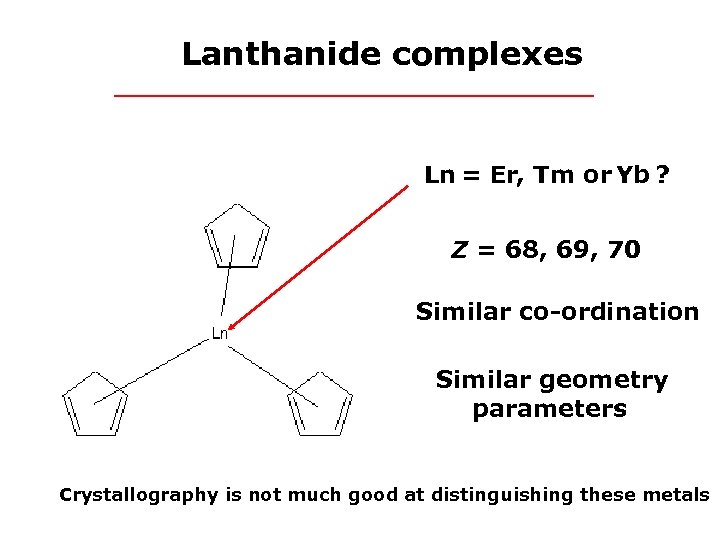 Lanthanide complexes Ln = Er, Tm or Yb ? Z = 68, 69, 70 Similar co-ordination Similar geometry parameters Crystallography is not much good at distinguishing these metals
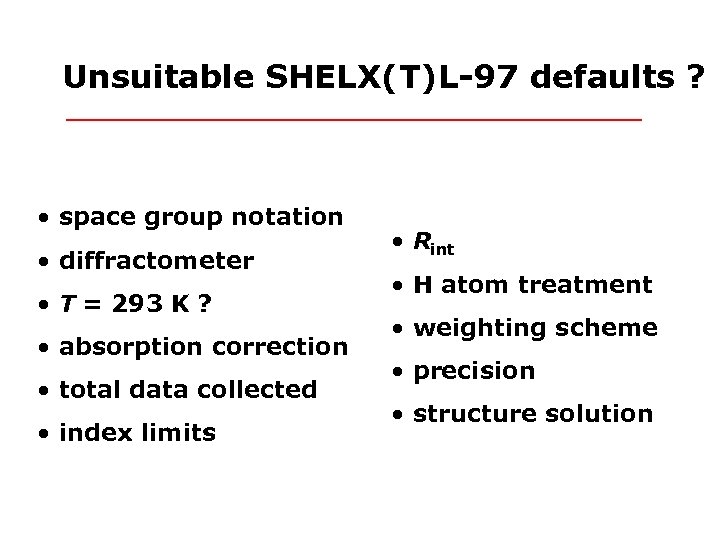
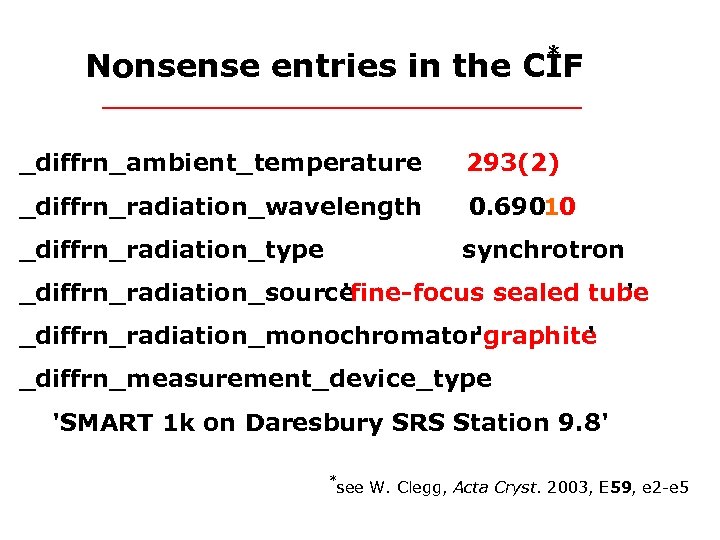 * Nonsense entries in the CIF _diffrn_ambient_temperature 293(2) _diffrn_radiation_wavelength 0. 69010 _diffrn_radiation_type synchrotron _diffrn_radiation_source 'fine-focus sealed tube ' _diffrn_radiation_monochromator 'graphite ' _diffrn_measurement_device_type 'SMART 1 k on Daresbury SRS Station 9. 8' * see W. Clegg, Acta Cryst. 2003, E 59, e 2 -e 5
 Unsuitable SHELX(T)L-97 defaults ? • space group notation • diffractometer • T = 293 K ? • absorption correction • total data collected • index limits • Rint • H atom treatment • weighting scheme • precision • structure solution
 SUMMARY 1. Overview of validation and checking 2. Validation for IUCr journals 3. Validation for chemical journals 4. The limits of validation
 Thanks to . . George Ferguson Ton Spek Peter Strickland. . . .