 Скачать презентацию Validating A Modern Microprocessor Bob Bentley Intel Corporation
c7b0bfdb1a9329c9a7fb581074f52bc3.ppt
- Количество слайдов: 26



Validating A Modern Microprocessor Bob Bentley Intel Corporation Enterprise Microprocessor Group Hillsboro, Oregon U. S. A. Page 1
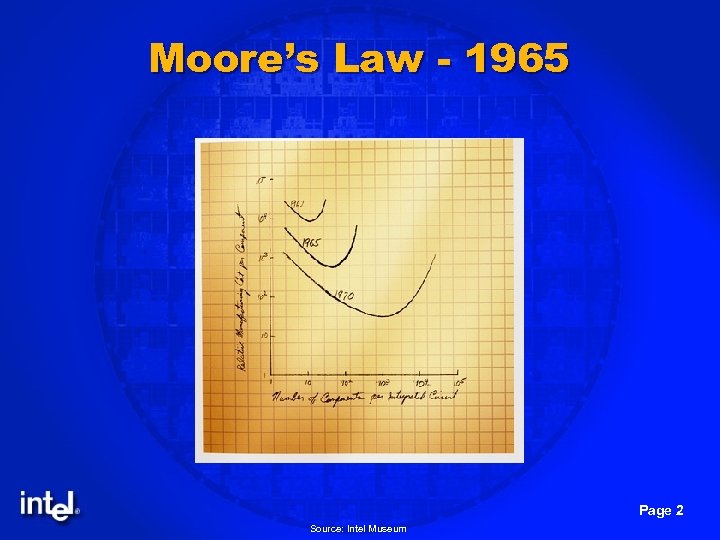
Moore’s Law - 1965 Page 2 Source: Intel Museum
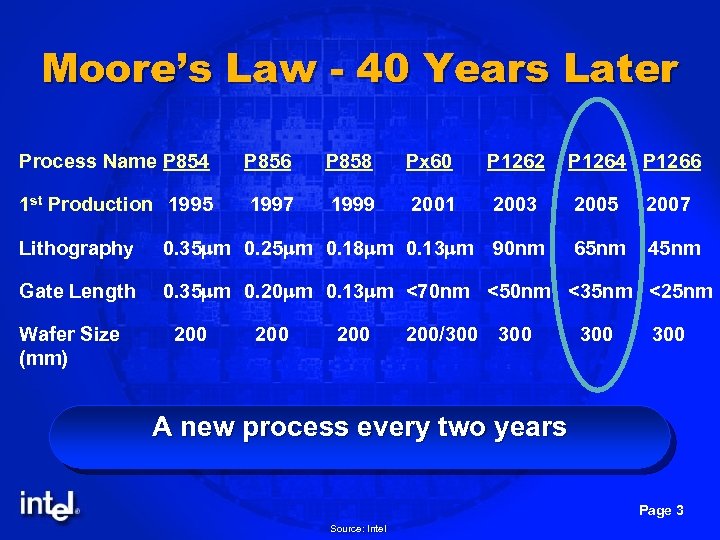
Moore’s Law - 40 Years Later Process Name P 854 P 856 P 858 Px 60 P 1262 P 1264 P 1266 1 st Production 1995 1997 1999 2001 2003 2005 2007 65 nm 45 nm Lithography 0. 35 mm 0. 25 mm 0. 18 mm 0. 13 mm 90 nm Gate Length 0. 35 mm 0. 20 mm 0. 13 mm <70 nm <50 nm <35 nm <25 nm Wafer Size (mm) 200 200/300 300 A new process every two years Page 3 Source: Intel
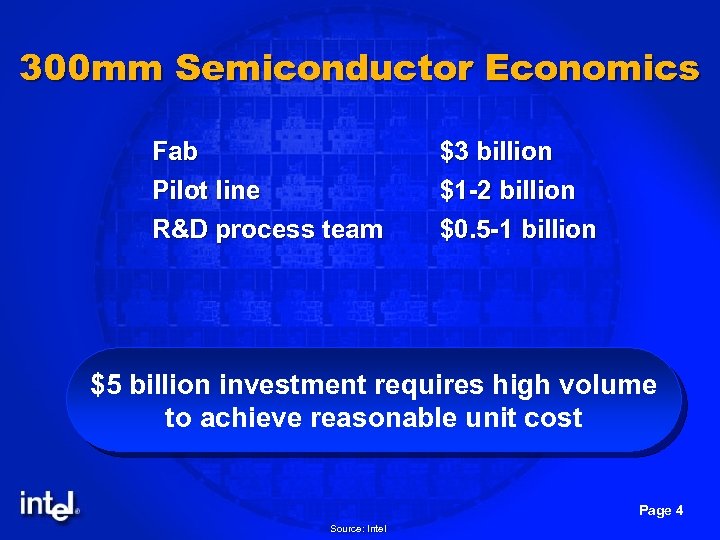
300 mm Semiconductor Economics Fab Pilot line $3 billion $1 -2 billion R&D process team $0. 5 -1 billion $5 billion investment requires high volume to achieve reasonable unit cost Page 4 Source: Intel
The Validation Challenge Microprocessor validation continues to be driven by the economics of Moore’s Law – Each new process generation doubles the number of transistors available to microprocessor architects and designers – Some of this increase is consumed by larger structures (caches, TLB, etc. ), which have no significant impact to validation – The rest goes to increased complexity: – Out-of-order, speculative execution machines – Deeper pipelines – New technologies (Hyper-Threading, 64 -bit extensions, virtualization, security, … – Multi-core designs – Increased complexity => increased validation effort and risk High volumes magnify the cost of a validation escape Page 5
Microprocessor Design Page 6
Microprocessor Design Scope Typical lead CPU design requires: – 500+ person design team: – logic and circuit design – physical design – validation and verification – design automation – 2 -2½ years from start of RTL development to A 0 tapeout – 9 -12 months from A 0 tapeout to production qual (may take longer for workstation/server products) One design cycle = 2 process generations Page 7
Pentium® 4 Processor RTL coding started: 2 H’ 96 – First cluster models released: late ’ 96 – First full-chip model released: Q 1’ 97 RTL coding complete: Q 2’ 98 – “All bugs coded for the first time!” RTL under full ECO control: Q 2’ 99 RTL frozen: Q 3’ 99 A-0 tapeout: December ’ 99 First packaged parts available: January 2000 First samples shipped to customers: Q 1’ 00 Production ship qualification granted: October 2000 Page 8
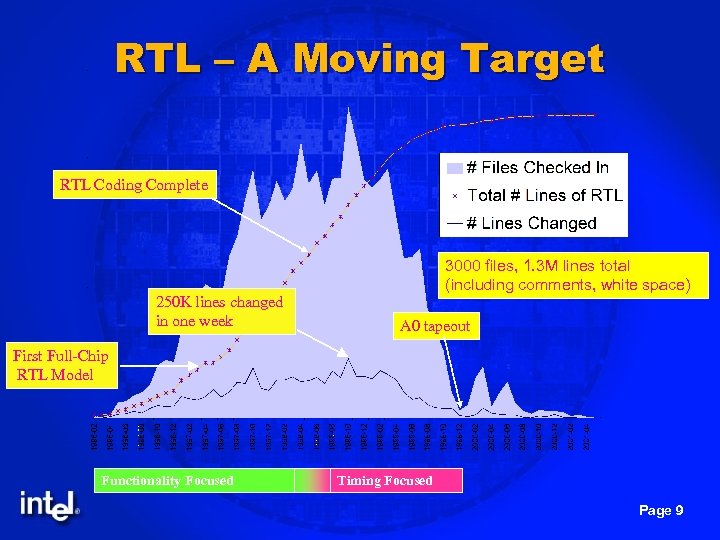
RTL – A Moving Target RTL Coding Complete 250 K lines changed in one week 3000 files, 1. 3 M lines total (including comments, white space) A 0 tapeout First Full-Chip RTL Model Functionality Focused Timing Focused Page 9
Microprocessor Validation Page 10
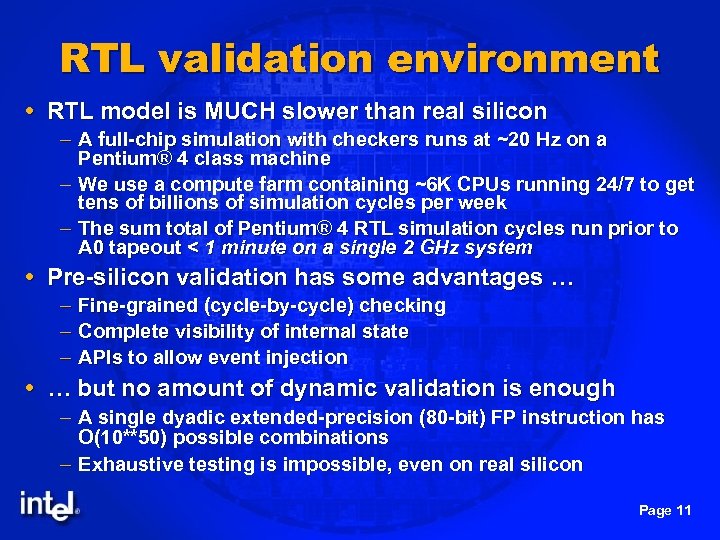
RTL validation environment RTL model is MUCH slower than real silicon – A full-chip simulation with checkers runs at ~20 Hz on a Pentium® 4 class machine – We use a compute farm containing ~6 K CPUs running 24/7 to get tens of billions of simulation cycles per week – The sum total of Pentium® 4 RTL simulation cycles run prior to A 0 tapeout < 1 minute on a single 2 GHz system Pre-silicon validation has some advantages … – Fine-grained (cycle-by-cycle) checking – Complete visibility of internal state – APIs to allow event injection … but no amount of dynamic validation is enough – A single dyadic extended-precision (80 -bit) FP instruction has O(10**50) possible combinations – Exhaustive testing is impossible, even on real silicon Page 11
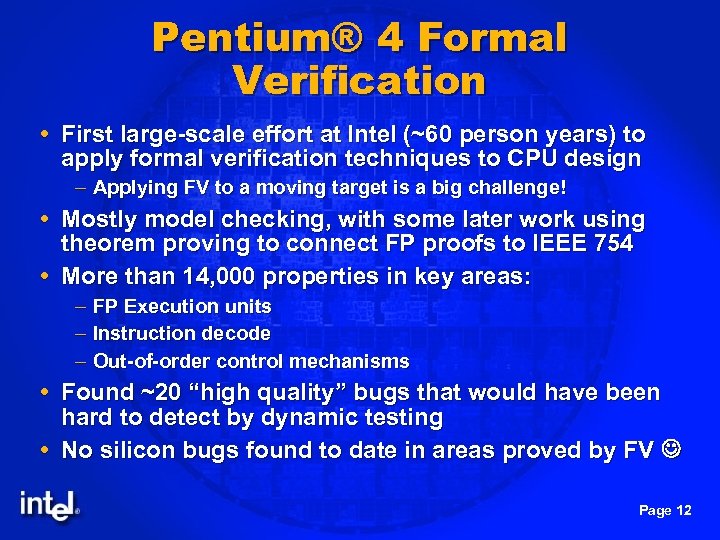
Pentium® 4 Formal Verification First large-scale effort at Intel (~60 person years) to apply formal verification techniques to CPU design – Applying FV to a moving target is a big challenge! Mostly model checking, with some later work using theorem proving to connect FP proofs to IEEE 754 More than 14, 000 properties in key areas: – FP Execution units – Instruction decode – Out-of-order control mechanisms Found ~20 “high quality” bugs that would have been hard to detect by dynamic testing No silicon bugs found to date in areas proved by FV Page 12
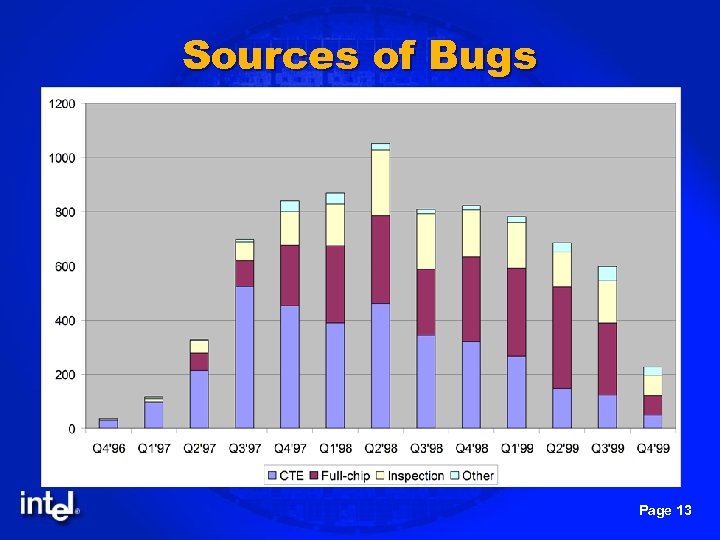
Sources of Bugs Page 13
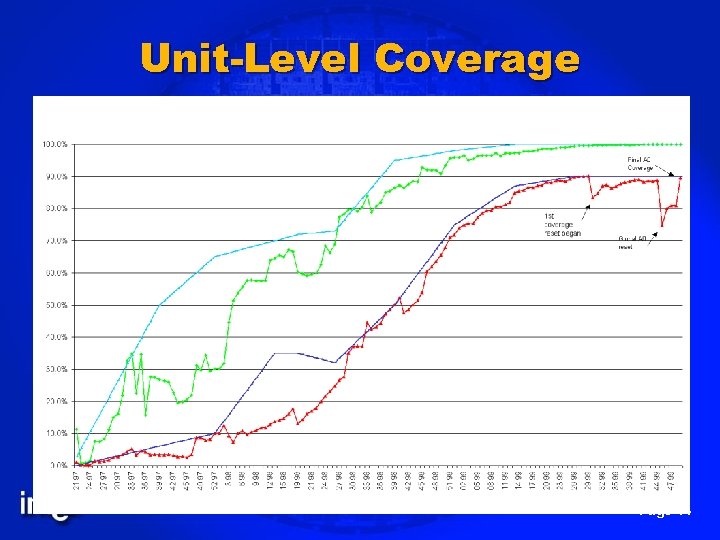
Unit-Level Coverage Page 14
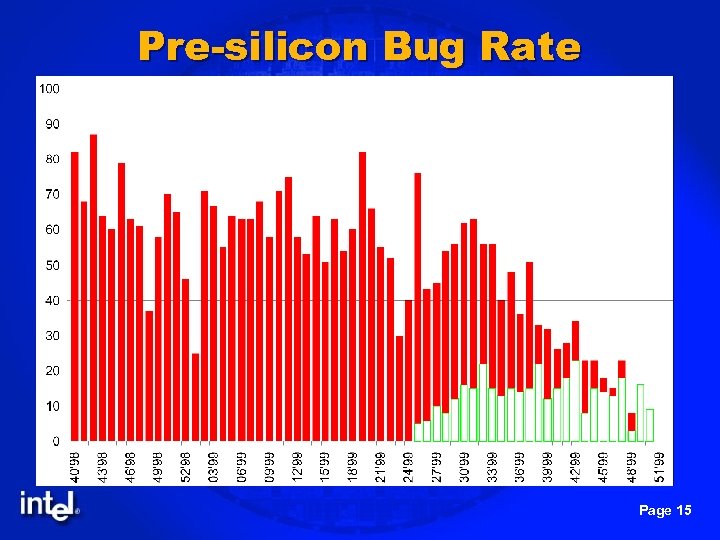
Pre-silicon Bug Rate Page 15
Formal Verification Page 16
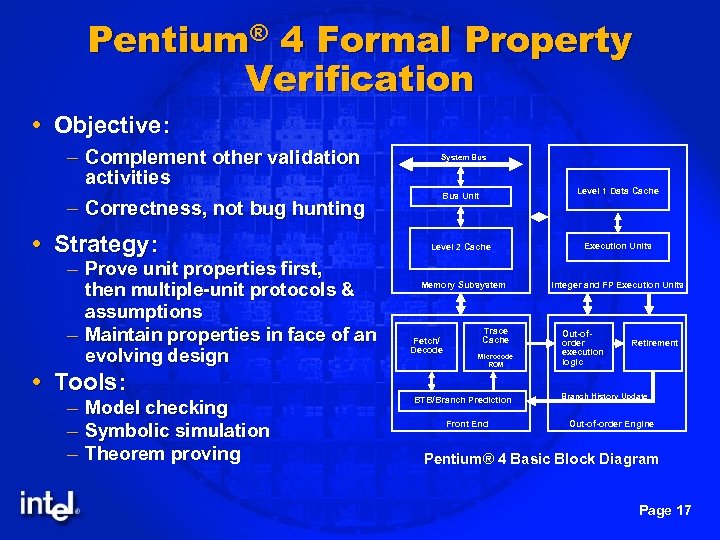
Pentium® 4 Formal Property Verification Objective: – Complement other validation activities – Correctness, not bug hunting Strategy: – Prove unit properties first, then multiple-unit protocols & assumptions – Maintain properties in face of an evolving design Tools: – – – Model checking Symbolic simulation Theorem proving System Bus Level 1 Data Cache Bus Unit Level 2 Cache Execution Units Memory Subsystem Integer and FP Execution Units Fetch/ Decode Trace Cache Microcode ROM BTB/Branch Prediction Front End Out-oforder execution logic Retirement Branch History Update Out-of-order Engine Pentium® 4 Basic Block Diagram Page 17
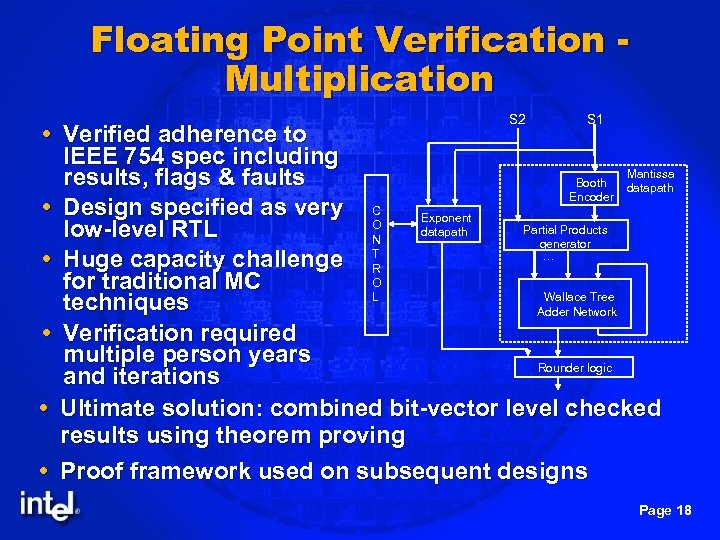
Floating Point Verification Multiplication S 2 S 1 Verified adherence to IEEE 754 spec including Mantissa results, flags & faults Booth datapath Encoder Design specified as very C Exponent O Partial Products datapath low-level RTL N generator T … Huge capacity challenge R O for traditional MC Wallace Tree L techniques Adder Network Verification required multiple person years Rounder logic and iterations Ultimate solution: combined bit-vector level checked results using theorem proving Proof framework used on subsequent designs Page 18
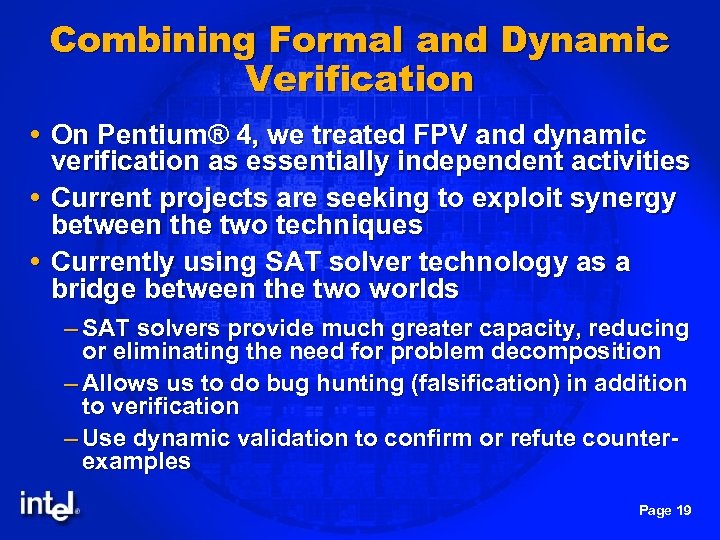
Combining Formal and Dynamic Verification On Pentium® 4, we treated FPV and dynamic verification as essentially independent activities Current projects are seeking to exploit synergy between the two techniques Currently using SAT solver technology as a bridge between the two worlds – SAT solvers provide much greater capacity, reducing or eliminating the need for problem decomposition – Allows us to do bug hunting (falsification) in addition to verification – Use dynamic validation to confirm or refute counterexamples Page 19
High-Level Formal Verification Formal Design Process: Work with architects & designers while design is being developed – Abstract model of architecture built and formally checked – Fast focus on algorithm problems – Intensive and quick feedback for every definition change – Find errors in early design approaches Goal: Completely verify architectural correctness – Avoid finding architectural bugs late in design cycle, when fixing them is much more difficult and costly – Drive rigor, completeness and correctness of the high level design – Speed up design phase based upon complete specification – Cleaner, simpler design – fewer warts Page 20
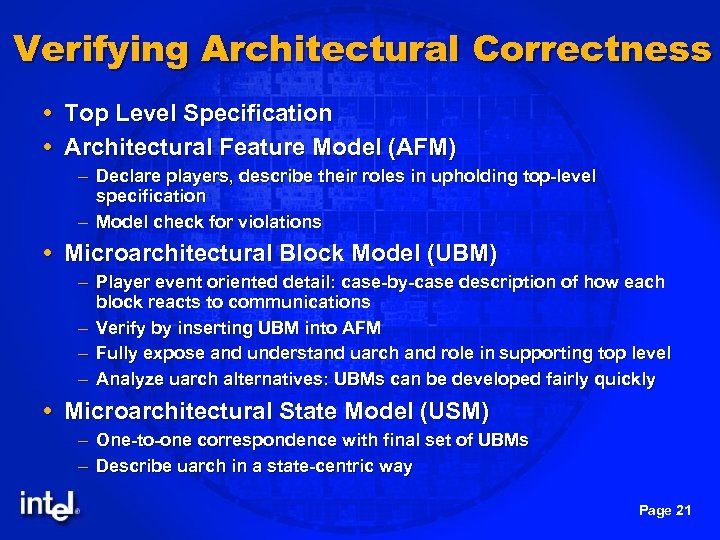
Verifying Architectural Correctness Top Level Specification Architectural Feature Model (AFM) – Declare players, describe their roles in upholding top-level specification – Model check for violations Microarchitectural Block Model (UBM) – Player event oriented detail: case-by-case description of how each block reacts to communications – Verify by inserting UBM into AFM – Fully expose and understand uarch and role in supporting top level – Analyze uarch alternatives: UBMs can be developed fairly quickly Microarchitectural State Model (USM) – One-to-one correspondence with final set of UBMs – Describe uarch in a state-centric way Page 21
Future Opportunities & Challenges Page 22
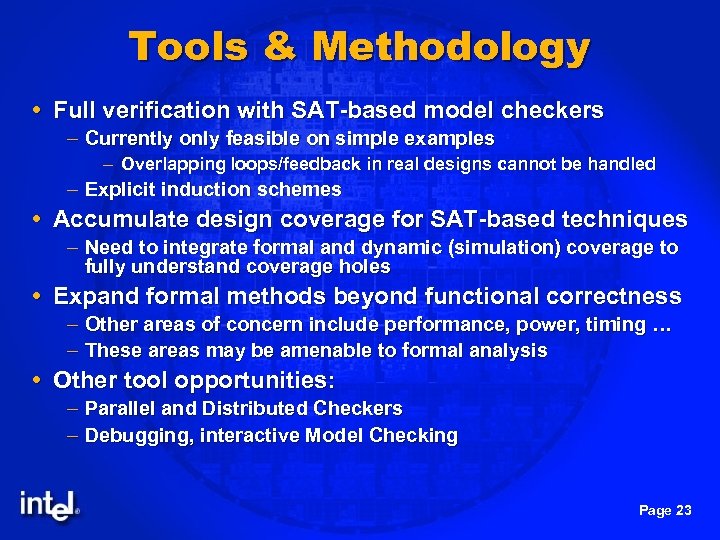
Tools & Methodology Full verification with SAT-based model checkers – Currently only feasible on simple examples – Overlapping loops/feedback in real designs cannot be handled – Explicit induction schemes Accumulate design coverage for SAT-based techniques – Need to integrate formal and dynamic (simulation) coverage to fully understand coverage holes Expand formal methods beyond functional correctness – Other areas of concern include performance, power, timing … – These areas may be amenable to formal analysis Other tool opportunities: – Parallel and Distributed Checkers – Debugging, interactive Model Checking Page 23
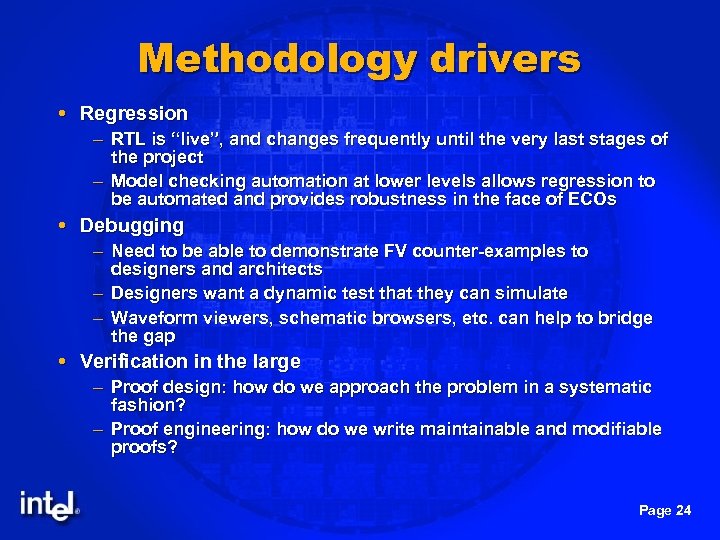
Methodology drivers Regression – RTL is “live”, and changes frequently until the very last stages of the project – Model checking automation at lower levels allows regression to be automated and provides robustness in the face of ECOs Debugging – Need to be able to demonstrate FV counter-examples to designers and architects – Designers want a dynamic test that they can simulate – Waveform viewers, schematic browsers, etc. can help to bridge the gap Verification in the large – Proof design: how do we approach the problem in a systematic fashion? – Proof engineering: how do we write maintainable and modifiable proofs? Page 24
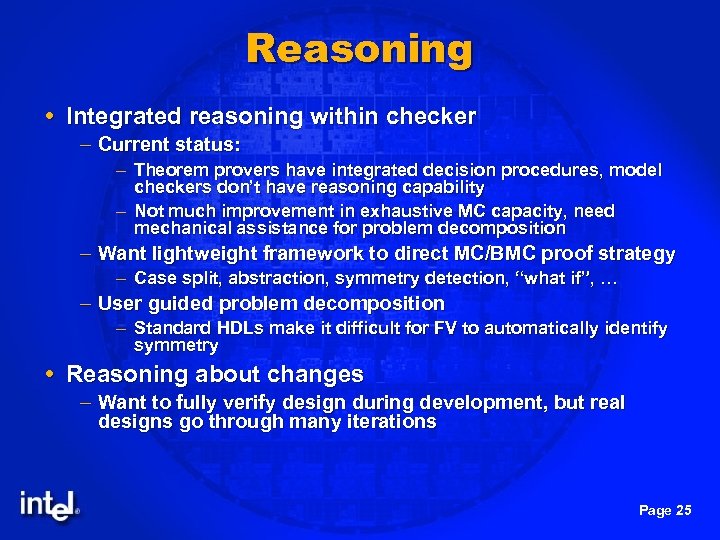
Reasoning Integrated reasoning within checker – Current status: – Theorem provers have integrated decision procedures, model checkers don’t have reasoning capability – Not much improvement in exhaustive MC capacity, need mechanical assistance for problem decomposition – Want lightweight framework to direct MC/BMC proof strategy – Case split, abstraction, symmetry detection, “what if”, … – User guided problem decomposition – Standard HDLs make it difficult for FV to automatically identify symmetry Reasoning about changes – Want to fully verify design during development, but real designs go through many iterations Page 25
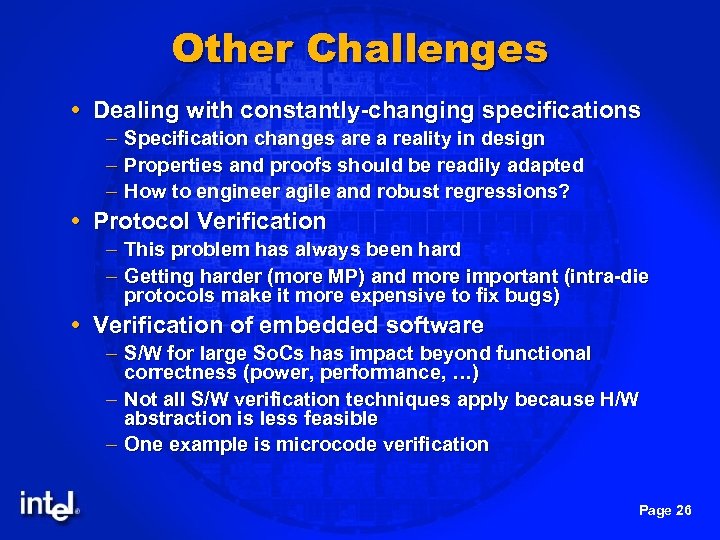
Other Challenges Dealing with constantly-changing specifications – Specification changes are a reality in design – Properties and proofs should be readily adapted – How to engineer agile and robust regressions? Protocol Verification – This problem has always been hard – Getting harder (more MP) and more important (intra-die protocols make it more expensive to fix bugs) Verification of embedded software – S/W for large So. Cs has impact beyond functional correctness (power, performance, …) – Not all S/W verification techniques apply because H/W abstraction is less feasible – One example is microcode verification Page 26
Скачать презентацию Validating A Modern Microprocessor Bob Bentley Intel Corporation
c7b0bfdb1a9329c9a7fb581074f52bc3.ppt