


 Скачать презентацию Valeriy Gordyna Introduction 1 Marketing as a
Marketing, the evolution of marketing.pptx
- Количество слайдов: 15
 Valeriy Gordyna
 Introduction 1. Marketing as a key tool for effective business development. 2. The evolution of marketing.
 Introduction The World Marketing Association has defined marketing as "the activity, set of institutions, and processes for creating, communicating, delivering, and exchanging offerings that have value for customers, clients, partners, and society at large. "
 Marketing as a key tool for effective business development In today’s world, the role of marketing in organizations is too important to be ignored ! Large and small organizations are today competing for the same market and the most innovative and proactive have emerged victors.
 Marketing as a key tool for effective business development Today’s global economy has realized the importance of small organizations and are increasingly giving them the much needed support to sustain their growth. As a result, a company’s survival is dependent upon their wise marketing efforts coupled by financial operational among other functions within their structure.
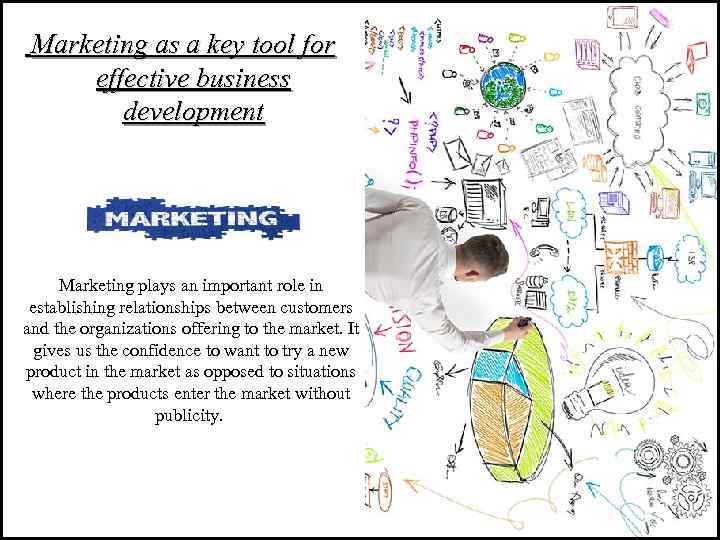 Marketing as a key tool for effective business development Marketing plays an important role in establishing relationships between customers and the organizations offering to the market. It gives us the confidence to want to try a new product in the market as opposed to situations where the products enter the market without publicity.
 Marketing as a key tool for effective business development Without marketing, our brands will not be illuminated and our organizations would be lifeless. Organization’s success is not only determined by the prudent application of funds to the various portfolios of investment but also by the relationship established with the customers, which is a function of marketing.
 The evolution of marketing There have been major stages in the history of marketing, which are: - The Trade Era - The Production Orientation Era - The Sales Orientation Era - The Marketing Orientation Era - The Relationship Marketing Era - The Social/Marketing Era
 The evolution of marketing Production consisted in handmade goods that were limited and generally traded through exploration. The Trade Era
 The Production Orientation Era Enter the industrial age. Since goods were scarce, businesses focused mainly in manufacturing. As long as someone was producing, someone else would want to buy it. This orientation rose to popularity due to shortages in the market, hence creating the foundation of Jean-Baptiste Say's famous remark: "Supply creates its own demand. "
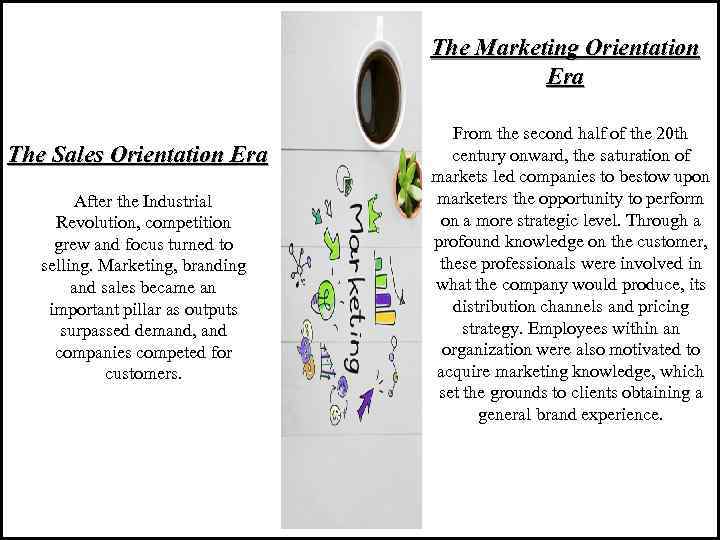 The Marketing Orientation Era The Sales Orientation Era After the Industrial Revolution, competition grew and focus turned to selling. Marketing, branding and sales became an important pillar as outputs surpassed demand, and companies competed for customers. From the second half of the 20 th century onward, the saturation of markets led companies to bestow upon marketers the opportunity to perform on a more strategic level. Through a profound knowledge on the customer, these professionals were involved in what the company would produce, its distribution channels and pricing strategy. Employees within an organization were also motivated to acquire marketing knowledge, which set the grounds to clients obtaining a general brand experience.
 But wait, there's more. . . According to recent publications, two new eras have been added to the list:
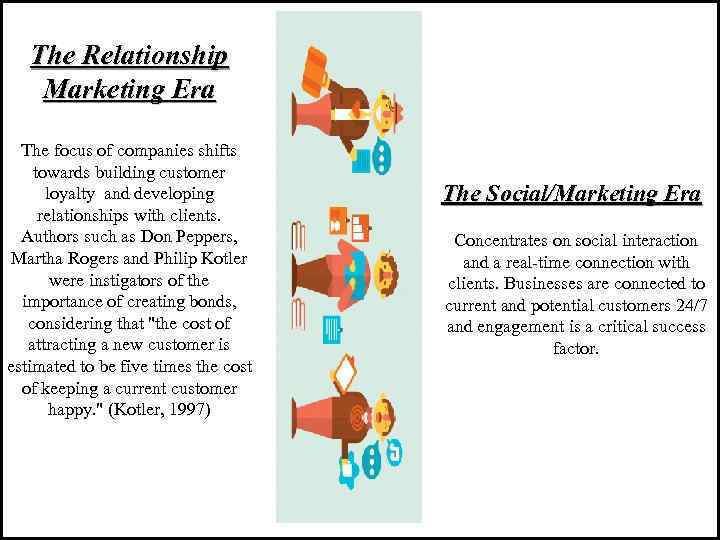 The Relationship Marketing Era The focus of companies shifts towards building customer loyalty and developing The Social/Marketing Era relationships with clients. Authors such as Don Peppers, Concentrates on social interaction But wait, there's more. . . According to recent publications, two new eras have been added to the Martha Rogers and Philip Kotler and a real-time connection with list: But wait, there's more. . . According to recent publications, two new eras have been added to were instigators of the clients. Businesses are connected to the list: importance of creating bonds, current and potential customers 24/7 considering that "the cost of and engagement is a critical success attracting a new customer is factor. estimated to be five times the cost of keeping a current customer happy. " (Kotler, 1997)
 Consider how much marketing has changed in the last century and will continue to shift as channels of communication, production levels and a society alter. As markets expand new marketing platforms emerge, the science and practice of this profession is being transformed by the minute. What we consider today to be the fastest way to reach our customers might be obsolete tomorrow. But wait, there's more. . . According to recent publications, two new eras have been added to the list:
 But wait, there's more. . . According to recent publications, two new eras have been added to the list: