


 Скачать презентацию Vacuum Electronics Research at The University of Michigan
4ede82d0f6498d4698bcf50e3fbb082f.ppt
- Количество слайдов: 14
 Vacuum Electronics Research at The University of Michigan Profs. Ron Gilgenbach, Y. Y. Lau and Mary Brake Nuclear Engineering & Radiological Sciences Dept. University of Michigan Ann Arbor, MI 48109 -2104 funded by the AFOSR University of Michigan
 OUTLINE motivation l research topics l recent results l future planned research l University of Michigan
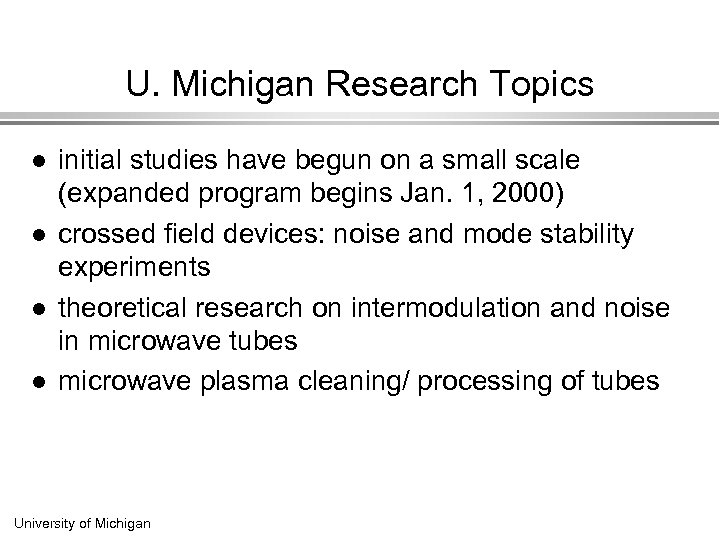 U. Michigan Research Topics l l initial studies have begun on a small scale (expanded program begins Jan. 1, 2000) crossed field devices: noise and mode stability experiments theoretical research on intermodulation and noise in microwave tubes microwave plasma cleaning/ processing of tubes University of Michigan
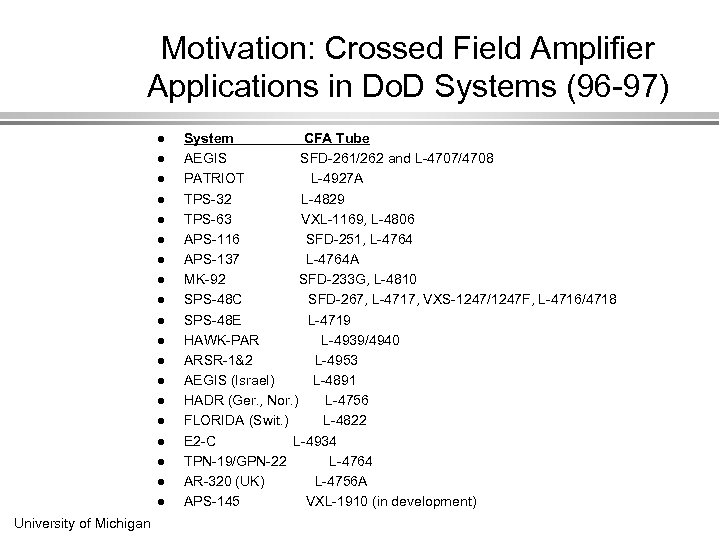 Motivation: Crossed Field Amplifier Applications in Do. D Systems (96 -97) l l l l l University of Michigan System CFA Tube AEGIS SFD-261/262 and L-4707/4708 PATRIOT L-4927 A TPS-32 L-4829 TPS-63 VXL-1169, L-4806 APS-116 SFD-251, L-4764 APS-137 L-4764 A MK-92 SFD-233 G, L-4810 SPS-48 C SFD-267, L-4717, VXS-1247/1247 F, L-4716/4718 SPS-48 E L-4719 HAWK-PAR L-4939/4940 ARSR-1&2 L-4953 AEGIS (Israel) L-4891 HADR (Ger. , Nor. ) L-4756 FLORIDA (Swit. ) L-4822 E 2 -C L-4934 TPN-19/GPN-22 L-4764 AR-320 (UK) L-4756 A APS-145 VXL-1910 (in development)
 magnetron experiments l l beginning with oven magnetrons (most efficient sources known); e. g. Toshiba 2 M 229, 700 -900 W @ 4 k. V, 0. 3 A investigate noise and out-of-band mode generation (source of EM pollution) investigate mode hopping in startup- regime explore the existence of “quiet-states” (W. C. Brown, 1988 Raytheon Tech. Rep. ) University of Michigan
 magnetron experiments (continued) l l l utilize time-frequency-analysis to examine the spectrum of magnetrons investigate the connection of noise to “excess” cathode emission current modeling of magnetron by Phillips Lab Scientists (Luginsland Spencer) University of Michigan
 Microwave-tube related theory efforts at U of Michigan l l l 1) Intermodulation in klystrons and in TWTs (Work in progress) 2) Low frequency emission noise from thermionic cathodes (scaling law synthesized for flicker noise power relative to shot noise power) 3) Low frequency ion noise in linear beam tubes (many observed features, such as sensitivity to Bfield, to cathode voltages, etc. , explained by simple theory. ) Methods to reduce this low frequency phase noise proposed. University of Michigan
 theoretical research (continued) l l l 4. Time-frequency analysis: Novel technique studied for reduction of interference in time-frequency analysis of tubes that display mode competition. 5. Crossed-field-device output characterization: Time frequency analysis being applied to various crossedfield device output, from microwave oven magnetron to CFA's. Noise in crossed-field geometry continues to be investigated. 6. Cathode processes: Processes that affect cathode life and cathode noise (e. g. , changes in emission due to evaporation and ion backbombardment) being analyzed. University of Michigan
 MICROWAVE PLASMA DISCHARGE CLEANING l l l l can clean from the inside of tube can match microwave frequency to tube type no electrode impurities added to system remote cleaning & cleans non-symmetric parts - high density processing plasma (> 10 E 12 - 10 e 14 /cc) Vs. RF plasmas (~10 E 9 - 10 E 10 or ICP =10 E 12) in principle, no limitation to plasma column length, depends upon the power capability inexpensive sources of 1 k. W power at 2. 45 GHz University of Michigan
 SURFACE WAVE EXCITED PLASMAS l l l Electromagnetic surface waves can sustain long plasma columns wave is excited at one end of a long tube containing a gas (~1 Torr to 750 Torr) EM wave travels along a plasma column it sustains (from the power that is carried by the wave) and these media constitute the wave's sole propagating structure University of Michigan
 INITIAL MICROWAVE PLASMA CLEANING STUDIES l l Microwave resonant cavity Fixed cavity inside diameter of 17. 8 cm Sliding short adjusts the length of the cavity to obtain specific electromagnetic modes (14. 5 cm to ~9. 5 cm Tuning stub , which applies the microwave power to the cavity, is placed very close to the glass tube containing the gas/ plasma University of Michigan
 LOW FREQUENCY ION NOISE IN TWT* Professor Y. Y. Lau Nuclear Engineering & Radiological Sciences Dept. University of Michigan Ann Arbor, MI 48109 -2104 *In collaboration with Dave Chernin and Wally Manheimer during sabbatical in 1999 University of Michigan
 A Comparison of Flicker Noise and Shot Noise on a Hot Cathode* Professor Y. Y. Lau Nuclear Engineering & Radiological Sciences Dept. University of Michigan Ann Arbor, MI 48109 -2104 *In collaboration with K. Jenson and B. Levush during sabbatical in 1999 University of Michigan
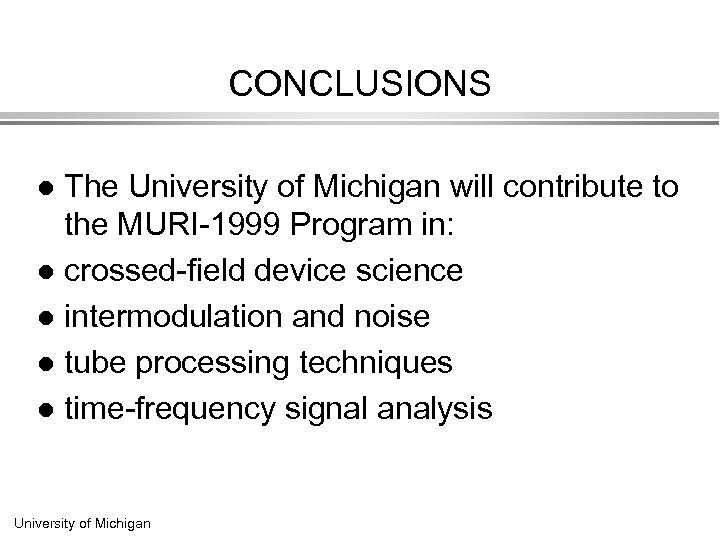 CONCLUSIONS The University of Michigan will contribute to the MURI-1999 Program in: l crossed-field device science l intermodulation and noise l tube processing techniques l time-frequency signal analysis l University of Michigan