 Скачать презентацию VA Research Development Program Robert Jaeger Ph
d18f139f14c01329211b92a2821ba56b.ppt
- Количество слайдов: 40



VA Research & Development Program Robert Jaeger, Ph. D RR&D Scientific Program Manager
VA Research Mission: “To discover knowledge and create innovations that advance the health and care of Veterans and the nation. ”
VA Research Standards • Is the research based on rigorous science? • Will the research produce data that drives clinical policy and translates to improved health care? • Will the research help Veterans? o o Is it Veteran-centric? The only research program focused entirely on Veteran’s needs
Rich 60 Year History • 3 Nobel Laureates, 6 Lasker Award Winners • Important Discoveries and Inventions o Devices Ø Ø o Cardiac Pacemaker First liver transplant Radioimmunoassay CT Scanner Treatments Ø Ø TB – First large scale clinical trial Cooperative Studies Program – Trials strongly influence medical practice
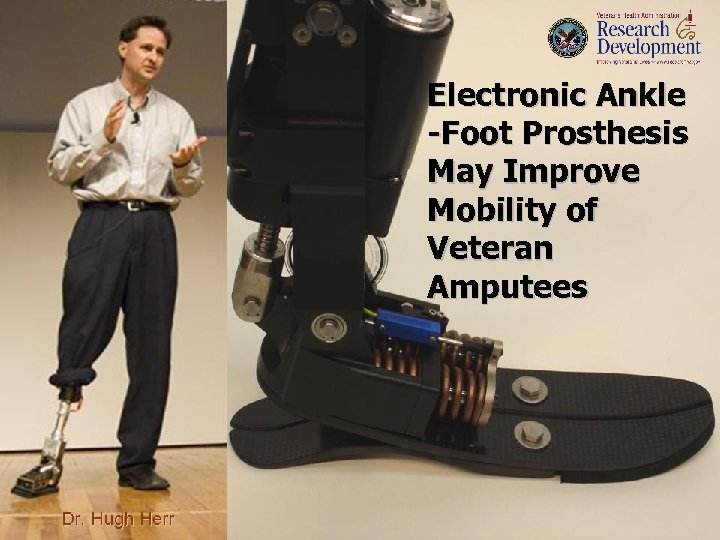
Rich 60 Year History (cont) • • First rehabilitation program for blind persons Linked smoking with cancer of the respiratory tract and lung Developed the nicotine patch for smoking cessation Found that the insulin pump controls diabetics blood sugar and weight better than multiple daily injections • Identified best treatments for colon cancer, psychoses, stable angina, high blood pressure and other conditions • Developed a computer-controlled ventilator system for critically ill patients • Developed the Seattle Foot
Intramural Research Program • VA Research is an intramural program o o Researchers must be employed by VA (usually 5/8 s or more) Having research and clinical care under the same roof is a unique strength
Intramural Research Program • VA Research connected directly to nation’s largest health system (being “Intramural”) o o o >70% of investigators are clinicians Links researchers directly to Veterans’ needs Facilitates implementation of research results • Unique research resources include o o o Electronic Health Record Cooperative Studies Program – Clinical Trials Telemedicine Drug safety center Rehabilitation research
Intramural Research Program • 117 VAMCs have capacity for research • ≈100 are funded by ORD at any time • ≈2000 ORD funded projects • Community of ≈3000 VA researchers with a long history of significant research o o Published 46, 149 articles in past 7 years Publish in the best journals • Broad, extensive research portfolio that balances the needs of all veterans • Best buy in government
Research Services • Basic Laboratory R & D • Clinical Science R & D o Cooperative Studies Program – Large clinical trials • Rehabilitation R & D • Health Services R & D o Quality Enhancement Research Initiative (QUERI) – Implementation research in which VA is the pioneer
Facilities • Facilities Infrastructure o o Outdated physical structure Research facilities ages average 49 yrs • Limited funding • Formal Congressionally mandated infrastructure assessment process is underway o Review of previous surveys, site visits, etc
ORD Initiatives in Research Compliance
Compliance Initiatives • New Directives in concurrence o Responses to FDA safety info (with PBM) Ø o o o Closer collaboration of ORD with PBM Response to SAE reports in studies Compliance auditing (with ORO) Research Participant Outreach Program (ORD) • Committee on Funding
Compliance Initiatives • Facilities must have a Research Compliance Officer o Performance Measure for VISN and MC Directors • Cooperative Studies Program o o Data integrity audit program - SMRT Unannounced audits Revision of CSP Handbook 1205 IT plan for CSP
VA Research Administrative Review
VA Research Administrative Review • Purpose – Address issues regarding administration of research in Medical Centers and VISNs o o o Governance Compliance Researchers and research implementation • Structure o o Membership - VISN Directors, MCDs, CMOs, COS, ACOS/Rs, AOs, RCOs and researchers Steering Committee Ø Ø o Governance Subcommittee - Chair, Randy Petzel Human Capital Subcommittee – Chair, Jack Hetrick Reports to Health Services Committee and National Leadership Board
VA Research Administrative Review • Governance and Human Resources Subcommittee activities o o o o Recruitment, retention and support of investigators Roles of VISN and Medical Center leadership positions in research Research performance expectations of VHA leaders Reporting lines Responsibility of R & D Committee Time allocation for research efforts Responsibilities concerning compliance
Research Accountability Meeting • Research Accountability Meeting 2009 o o o Was held January 13, 14 th 2009 Includes MCDs, COS, ACOS/R, AO, RCO Over 600 attendees Novel design Interactive meeting Follow-up in VAMCs
Other Recent Administrative Advances
Administrative Advances • Improved collaborations within ORD & VHA and with Do. D, other federal agencies and the private sector o • • • CDMRP Organizational Improvements Communications Central IRB – Important to multisite studies On-line grant submission IT
VA Central IRB • VA Central IRB has been launched • Unique VA entity for multi-site trials • Purposes o o Improve human research protection Highest quality human subject protection Efficiency Centralized accountability • First meeting December 21 -22, 2007 o 9 meetings so far • First protocol reviewed August 12, 2008
Online Grants Application Process • NIH Electronic Research Administration (e. RA) System launched o o Electronic processing system for grant submission Streamline ORD proposal review and management processes • One common submission process for all ORD proposals o Implemented in HHS (CDC, AHRQ, FDA) • Alternate Activity Code approved by NIH o Activity Code IO 1
IT Security • Working Groups formed to examine research and education IT issues o VHA, OIT and universities convened by AAMC Ø o First meeting September 17 Initiatives to improve data storage and retrieval and make other IT improvements for research use • Clinical monitor directive • Patient choice re personal data
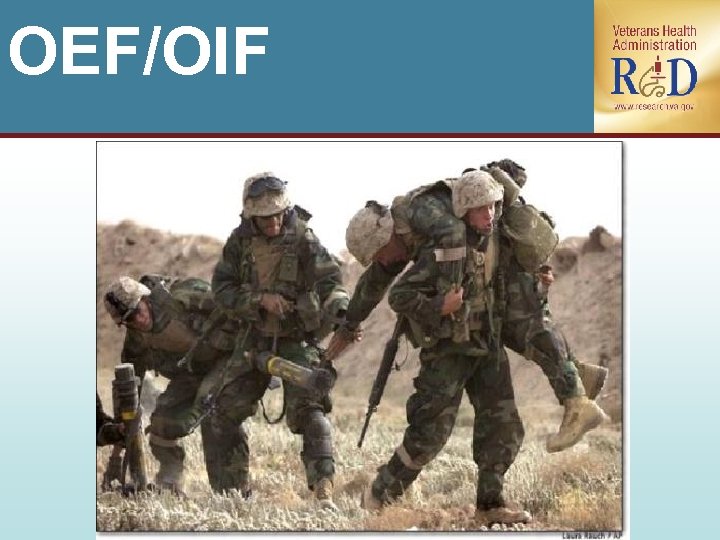
OEF/OIF
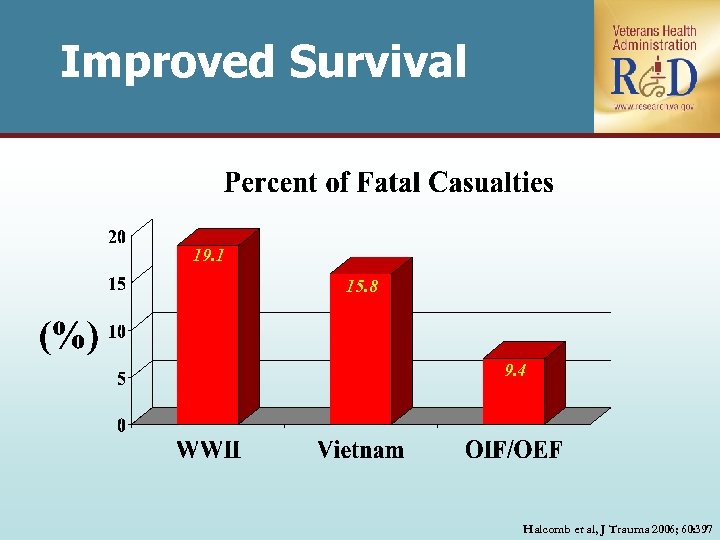
Improved Survival 19. 1 15. 8 9. 4 Halcomb et al, J Trauma 2006; 60: 397
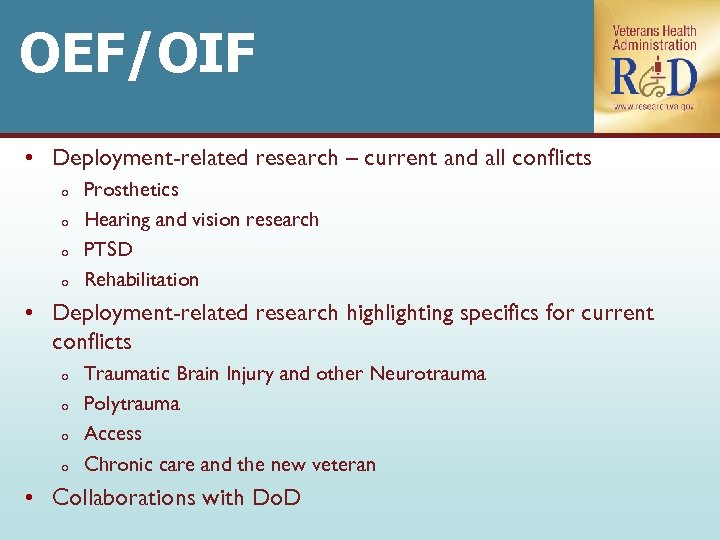
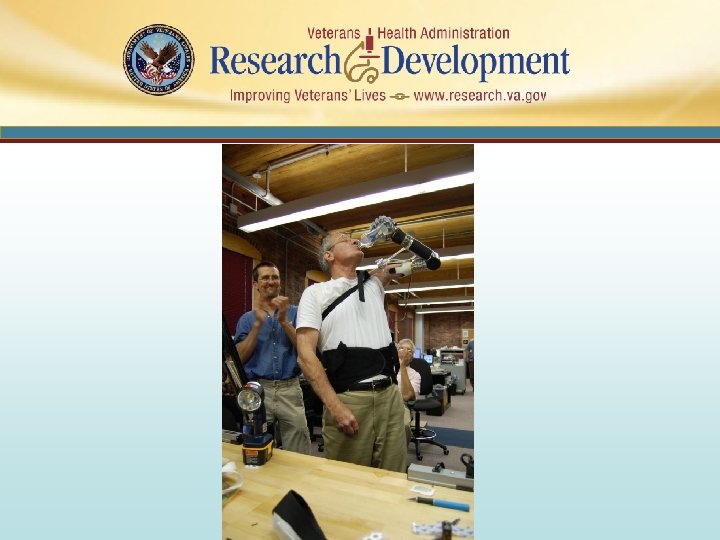
OEF/OIF • Deployment-related research – current and all conflicts o o Prosthetics Hearing and vision research PTSD Rehabilitation • Deployment-related research highlighting specifics for current conflicts o o Traumatic Brain Injury and other Neurotrauma Polytrauma Access Chronic care and the new veteran • Collaborations with Do. D
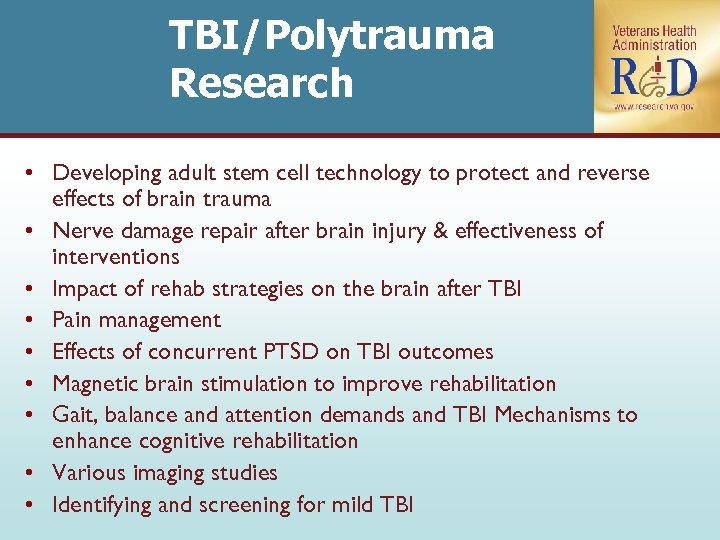
TBI/Polytrauma Research • Developing adult stem cell technology to protect and reverse effects of brain trauma • Nerve damage repair after brain injury & effectiveness of interventions • Impact of rehab strategies on the brain after TBI • Pain management • Effects of concurrent PTSD on TBI outcomes • Magnetic brain stimulation to improve rehabilitation • Gait, balance and attention demands and TBI Mechanisms to enhance cognitive rehabilitation • Various imaging studies • Identifying and screening for mild TBI
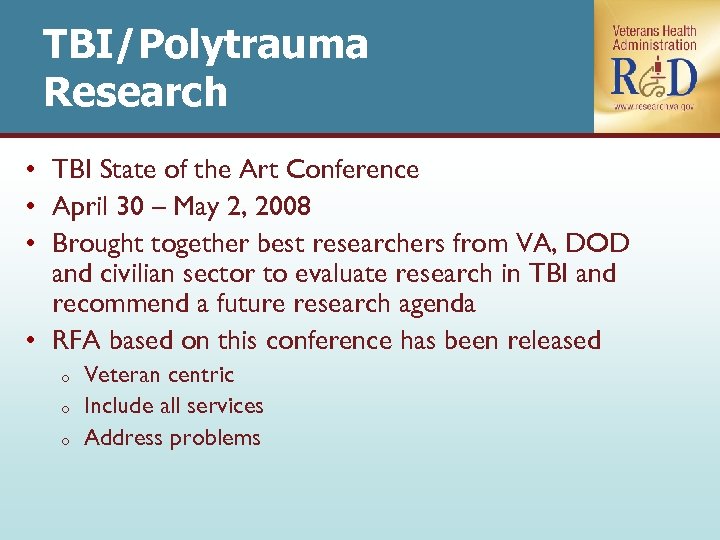
TBI/Polytrauma Research • TBI State of the Art Conference • April 30 – May 2, 2008 • Brought together best researchers from VA, DOD and civilian sector to evaluate research in TBI and recommend a future research agenda • RFA based on this conference has been released o o o Veteran centric Include all services Address problems
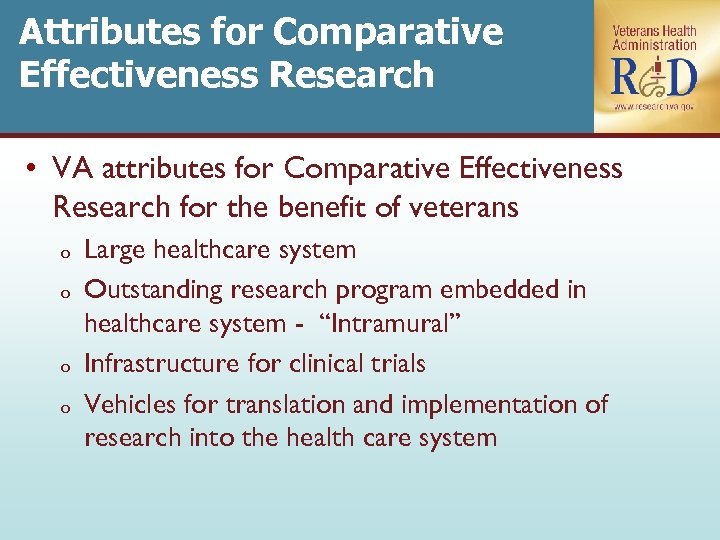
Attributes for Comparative Effectiveness Research • VA attributes for Comparative Effectiveness Research for the benefit of veterans o o Large healthcare system Outstanding research program embedded in healthcare system - “Intramural” Infrastructure for clinical trials Vehicles for translation and implementation of research into the health care system
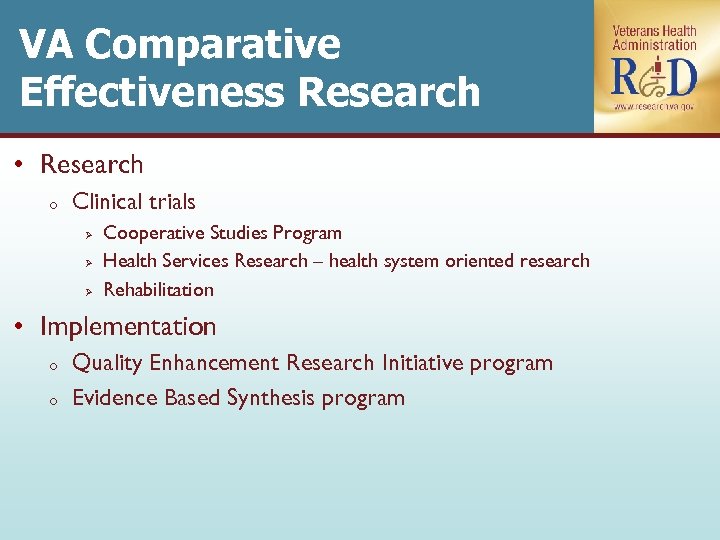
VA Comparative Effectiveness Research • Research o Clinical trials Ø Ø Ø Cooperative Studies Program Health Services Research – health system oriented research Rehabilitation • Implementation o o Quality Enhancement Research Initiative program Evidence Based Synthesis program
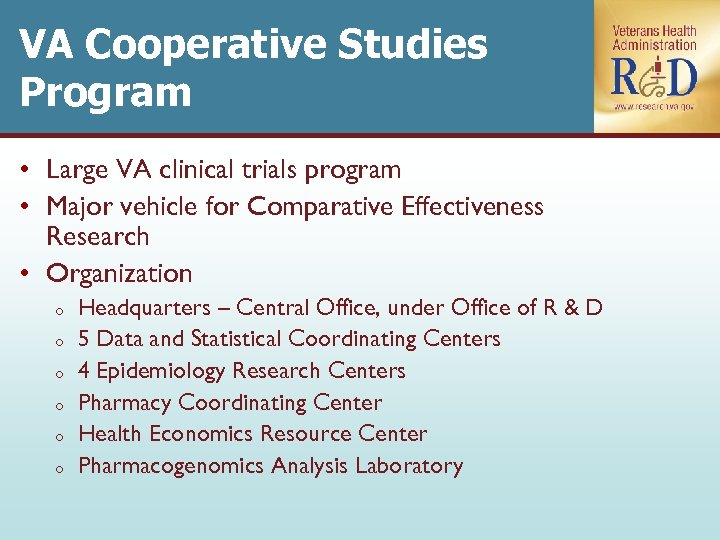
VA Cooperative Studies Program • Large VA clinical trials program • Major vehicle for Comparative Effectiveness Research • Organization o o o Headquarters – Central Office, under Office of R & D 5 Data and Statistical Coordinating Centers 4 Epidemiology Research Centers Pharmacy Coordinating Center Health Economics Resource Center Pharmacogenomics Analysis Laboratory
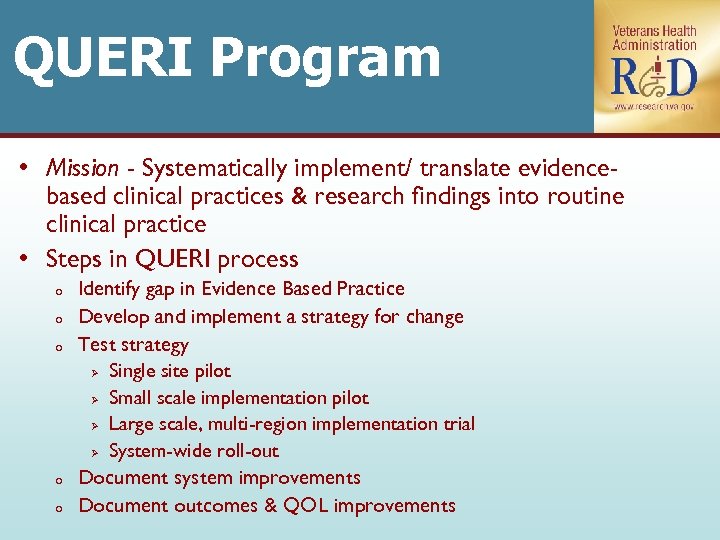
QUERI Program • Mission - Systematically implement/ translate evidencebased clinical practices & research findings into routine clinical practice • Steps in QUERI process o o o Identify gap in Evidence Based Practice Develop and implement a strategy for change Test strategy Ø Single site pilot Ø Small scale implementation pilot Ø Large scale, multi-region implementation trial Ø System-wide roll-out Document system improvements Document outcomes & QOL improvements
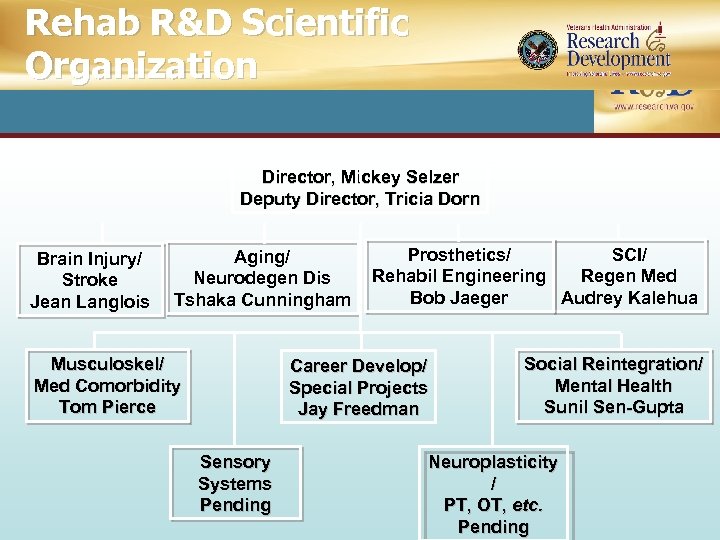
Rehab R&D Scientific Organization Director, Mickey Selzer Deputy Director, Tricia Dorn Brain Injury/ Stroke Jean Langlois Aging/ Neurodegen Dis Tshaka Cunningham Musculoskel/ Med Comorbidity Tom Pierce Prosthetics/ SCI/ Rehabil Engineering Regen Med Bob Jaeger Audrey Kalehua Career Develop/ Special Projects Jay Freedman Sensory Systems Pending Social Reintegration/ Mental Health Sunil Sen-Gupta Neuroplasticity / PT, OT, etc. Pending
Prostheses
Electronic Ankle -Foot Prosthesis May Improve Mobility of Veteran Amputees
Pause for Video Clip
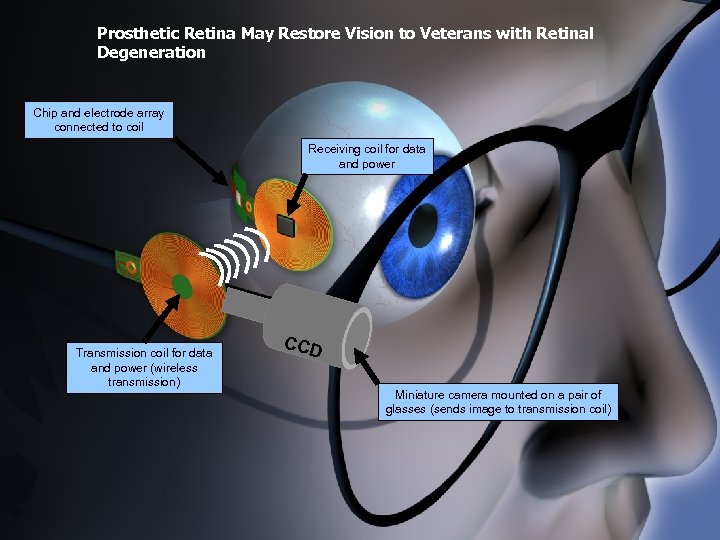
Prosthetic Retina May Restore Vision to Veterans with Retinal Degeneration Chip and electrode array connected to coil Receiving coil for data and power Transmission coil for data and power (wireless transmission) CCD Miniature camera mounted on a pair of glasses (sends image to transmission coil)
Personalized Research • Personalized medicine as a research agenda o How do we “personalize” the research agenda? Ø E. g. Rehabilitation, Polytrauma, Geriatrics • Some issues o RCT only deals with averages Ø o o o E. g. ICD in subgroups Research using small numbers Research on such topics as models of care, care giving, long-term care, etc. Research that takes into account individual differences Ø Complex, multisystem diseases, etc
Personalized Research • Some steps in Personalized Research o Improve research capabilities of EHR Ø Ø o Reengineering of research approaches Ø o Informatics Consortium – collaboration with IT Natural language processing and indexing Exploration of new research methodology, etc Explore biological mechanisms, models of care, etc. • Use of VA’s brainpower
Contact robert. jaeger@va. gov
Скачать презентацию VA Research Development Program Robert Jaeger Ph
d18f139f14c01329211b92a2821ba56b.ppt