


 Скачать презентацию V S Akhmetov Institute of Astronomy V N
37774cc5c7d63a2ea20f7e7fb4cf6b64.ppt
- Количество слайдов: 29
 V. S. Akhmetov Institute of Astronomy, V. N. Karazin Kharkiv National University, Kharkiv, Ukraine akhmetovvs@gmail. com The comparison and analysis of data modern astrometric catalogues in GAIA era. The science of Gaia and future challenges Lund Observatory, 30 th August - 1 st September 2017 1
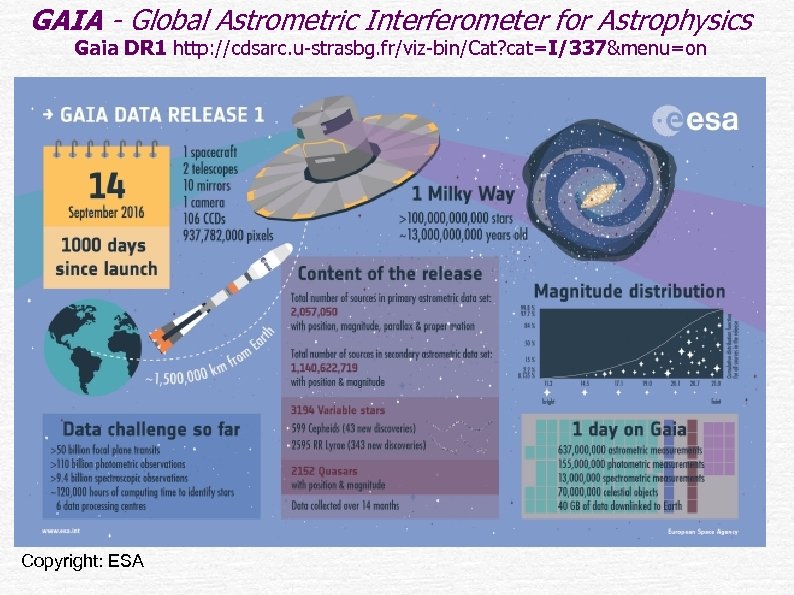 GAIA - Global Astrometric Interferometer for Astrophysics Gaia DR 1 http: //cdsarc. u-strasbg. fr/viz-bin/Cat? cat=I/337&menu=on Copyright: ESA
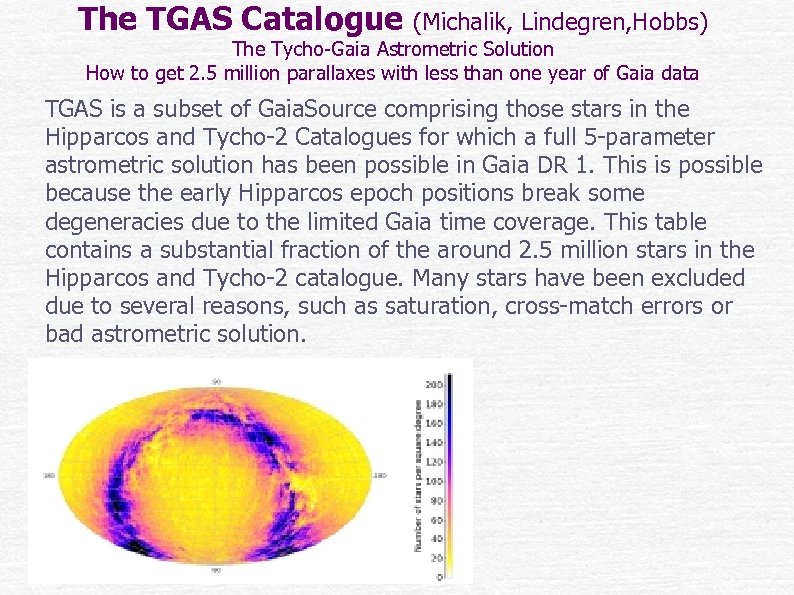 The TGAS Catalogue (Michalik, Lindegren, Hobbs) The Tycho-Gaia Astrometric Solution How to get 2. 5 million parallaxes with less than one year of Gaia data TGAS is a subset of Gaia. Source comprising those stars in the Hipparcos and Tycho-2 Catalogues for which a full 5 -parameter astrometric solution has been possible in Gaia DR 1. This is possible because the early Hipparcos epoch positions break some degeneracies due to the limited Gaia time coverage. This table contains a substantial fraction of the around 2. 5 million stars in the Hipparcos and Tycho-2 catalogue. Many stars have been excluded due to several reasons, such as saturation, cross-match errors or bad astrometric solution.
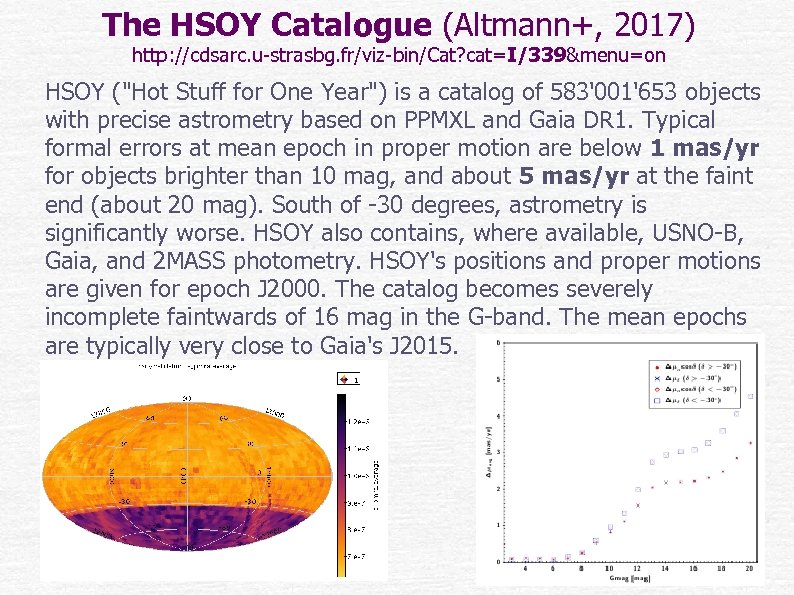 The HSOY Catalogue (Altmann+, 2017) http: //cdsarc. u-strasbg. fr/viz-bin/Cat? cat=I/339&menu=on HSOY ("Hot Stuff for One Year") is a catalog of 583'001'653 objects with precise astrometry based on PPMXL and Gaia DR 1. Typical formal errors at mean epoch in proper motion are below 1 mas/yr for objects brighter than 10 mag, and about 5 mas/yr at the faint end (about 20 mag). South of -30 degrees, astrometry is significantly worse. HSOY also contains, where available, USNO-B, Gaia, and 2 MASS photometry. HSOY's positions and proper motions are given for epoch J 2000. The catalog becomes severely incomplete faintwards of 16 mag in the G-band. The mean epochs are typically very close to Gaia's J 2015.
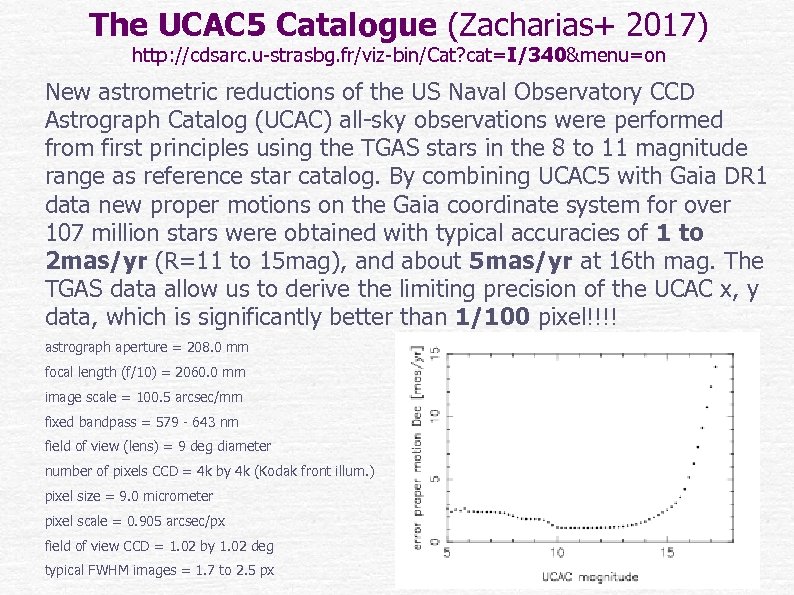 The UCAC 5 Catalogue (Zacharias+ 2017) http: //cdsarc. u-strasbg. fr/viz-bin/Cat? cat=I/340&menu=on New astrometric reductions of the US Naval Observatory CCD Astrograph Catalog (UCAC) all-sky observations were performed from first principles using the TGAS stars in the 8 to 11 magnitude range as reference star catalog. By combining UCAC 5 with Gaia DR 1 data new proper motions on the Gaia coordinate system for over 107 million stars were obtained with typical accuracies of 1 to 2 mas/yr (R=11 to 15 mag), and about 5 mas/yr at 16 th mag. The TGAS data allow us to derive the limiting precision of the UCAC x, y data, which is significantly better than 1/100 pixel!!!! astrograph aperture = 208. 0 mm focal length (f/10) = 2060. 0 mm image scale = 100. 5 arcsec/mm fixed bandpass = 579 - 643 nm field of view (lens) = 9 deg diameter number of pixels CCD = 4 k by 4 k (Kodak front illum. ) pixel size = 9. 0 micrometer pixel scale = 0. 905 arcsec/px field of view CCD = 1. 02 by 1. 02 deg typical FWHM images = 1. 7 to 2. 5 px
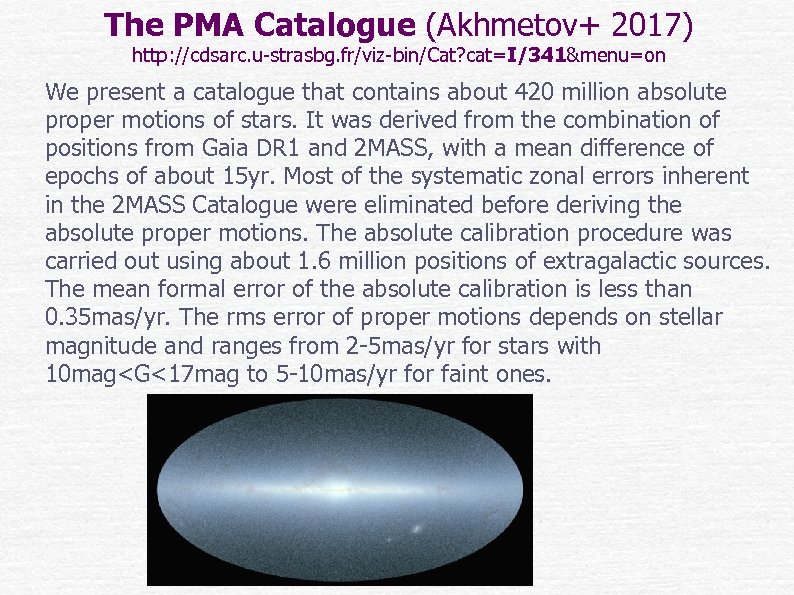 The PMA Catalogue (Akhmetov+ 2017) http: //cdsarc. u-strasbg. fr/viz-bin/Cat? cat=I/341&menu=on We present a catalogue that contains about 420 million absolute proper motions of stars. It was derived from the combination of positions from Gaia DR 1 and 2 MASS, with a mean difference of epochs of about 15 yr. Most of the systematic zonal errors inherent in the 2 MASS Catalogue were eliminated before deriving the absolute proper motions. The absolute calibration procedure was carried out using about 1. 6 million positions of extragalactic sources. The mean formal error of the absolute calibration is less than 0. 35 mas/yr. The rms error of proper motions depends on stellar magnitude and ranges from 2 -5 mas/yr for stars with 10 mag
 2 MASS(PSC) Two Micron All Sky Survey (Point Source Catalog) 2 MASS used two highly-automated 1. 3 -m telescopes, one at Mt. Hopkins, AZ, and one at CTIO, Chile. Each telescope is equipped with a three-channel camera, each channel consisting of a 256 W 256 array of Hg. Cd. Te detectors, capable of observing the sky simultaneously at J (1. 25 µm), H (1. 65 µm), and Ks (2. 17 µm). The northern 2 MASS facility began routine operations in 1997 June, and the southern facility in 1998 March. Survey operations were complete for both hemispheres on 2001 February 15. The final release contains position and 3 band near-infrared photometry of 470, 992, 970 objects.
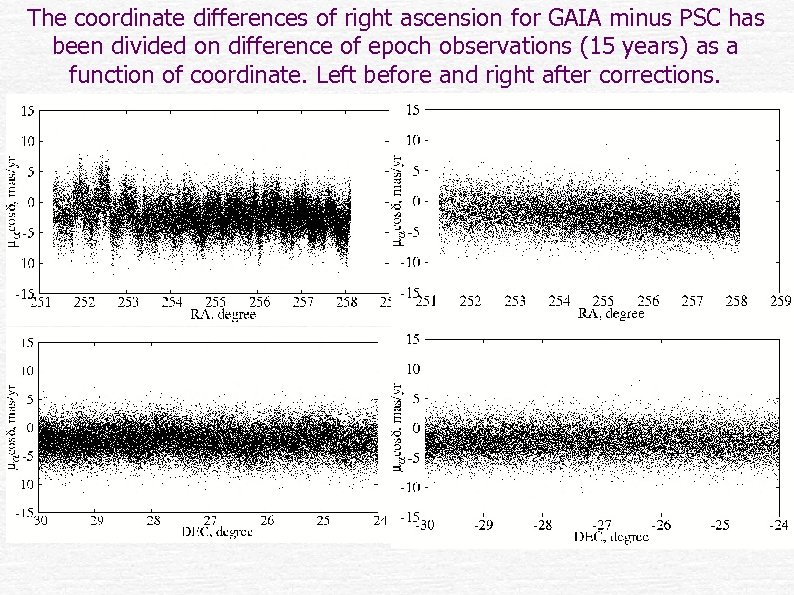 The coordinate differences of right ascension for GAIA minus PSC has been divided on difference of epoch observations (15 years) as a function of coordinate. Left before and right after corrections.
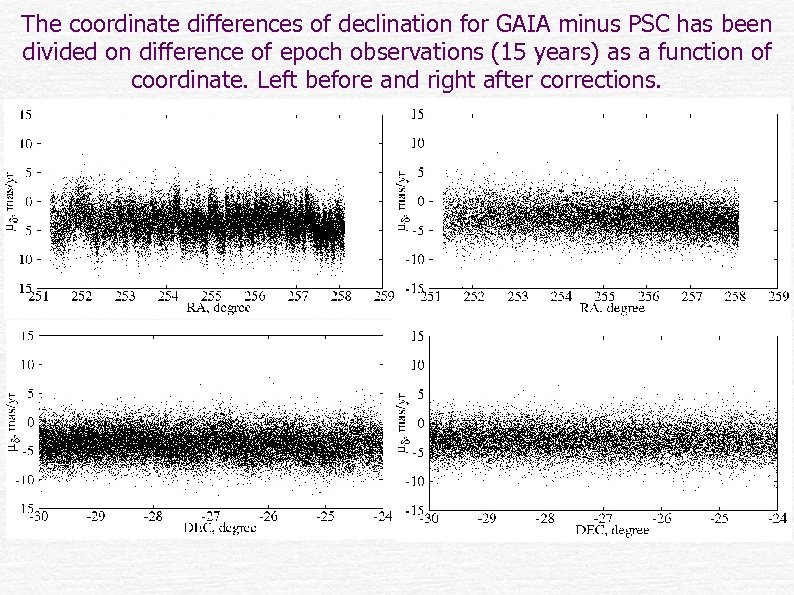 The coordinate differences of declination for GAIA minus PSC has been divided on difference of epoch observations (15 years) as a function of coordinate. Left before and right after corrections.
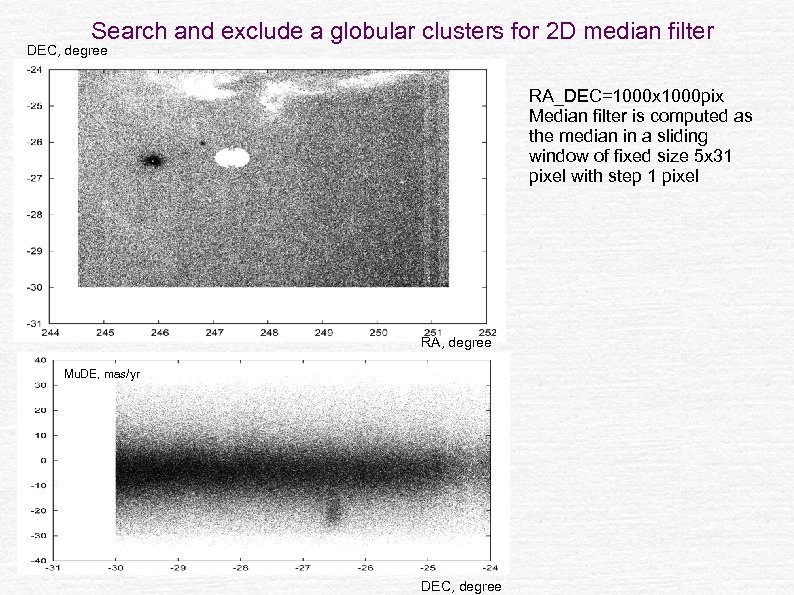 Search and exclude a globular clusters for 2 D median filter DEC, degree RA_DEC=1000 x 1000 pix Median filter is computed as the median in a sliding window of fixed size 5 x 31 pixel with step 1 pixel RA, degree Mu. DE, mas/yr DEC, degree
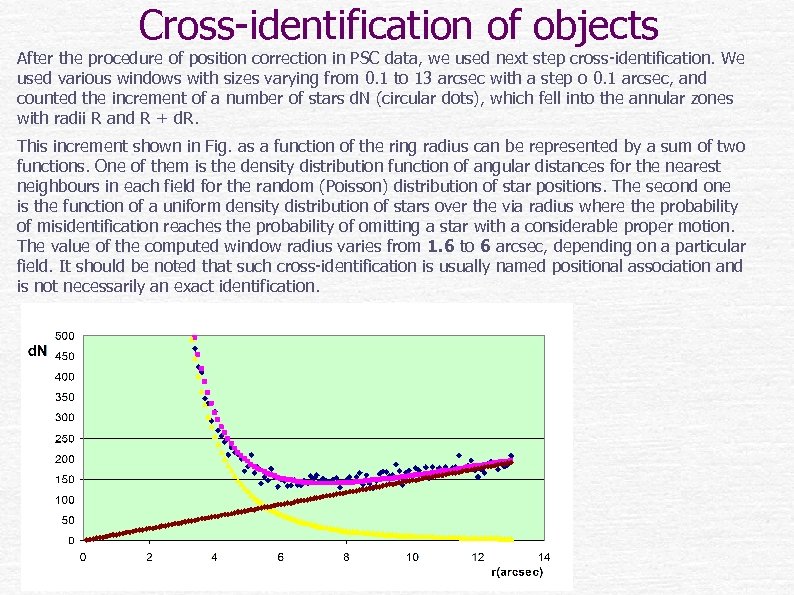 Cross-identification of objects After the procedure of position correction in PSC data, we used next step cross-identification. We used various windows with sizes varying from 0. 1 to 13 arcsec with a step o 0. 1 arcsec, and counted the increment of a number of stars d. N (circular dots), which fell into the annular zones with radii R and R + d. R. This increment shown in Fig. as a function of the ring radius can be represented by a sum of two functions. One of them is the density distribution function of angular distances for the nearest neighbours in each field for the random (Poisson) distribution of star positions. The second one is the function of a uniform density distribution of stars over the via radius where the probability of misidentification reaches the probability of omitting a star with a considerable proper motion. The value of the computed window radius varies from 1. 6 to 6 arcsec, depending on a particular field. It should be noted that such cross-identification is usually named positional association and is not necessarily an exact identification.
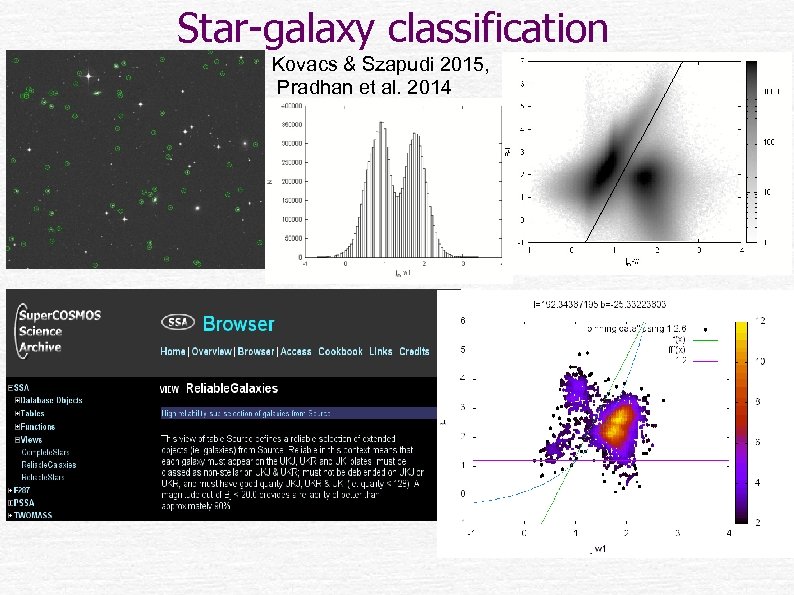 Star-galaxy classification Kovacs & Szapudi 2015, Pradhan et al. 2014
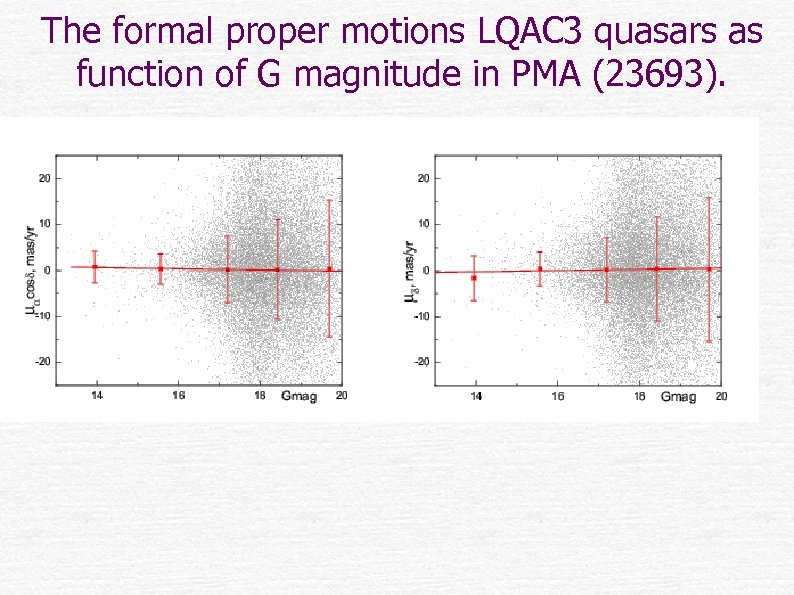 The formal proper motions LQAC 3 quasars as function of G magnitude in PMA (23693).
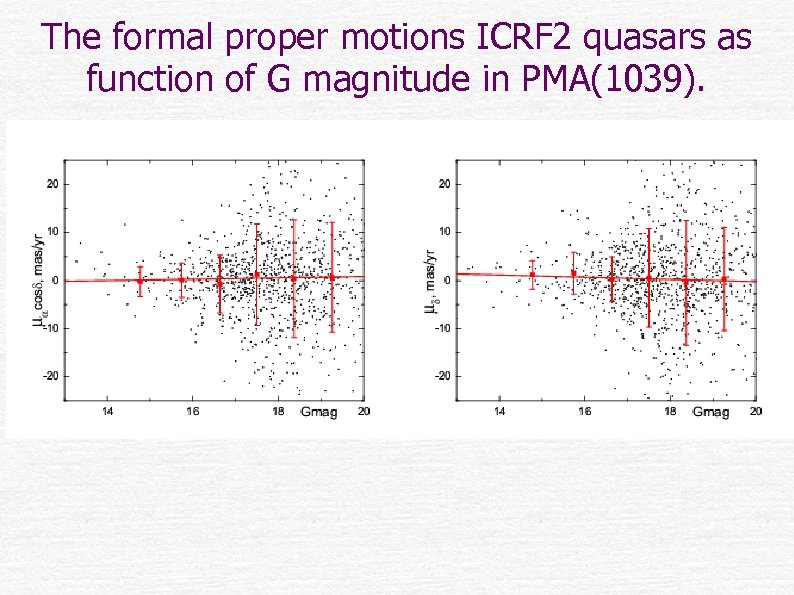 The formal proper motions ICRF 2 quasars as function of G magnitude in PMA(1039).
 The comparison and analysis of data modern astrometric catalogues 1. For provide quick access to modern astronomical catalogs that contains data for celestial objects including stars, galaxies, quasars and others objects has been developed database MSSQL (Windows) and Postgre. SQL (Linux). 2. The software for astrometric catalogs analysis by means of the Roland Wielens method has been created. 3. The kinematics studies of the Galaxy using classical Ogorodnikov-Milne model presented in OGMUI software.
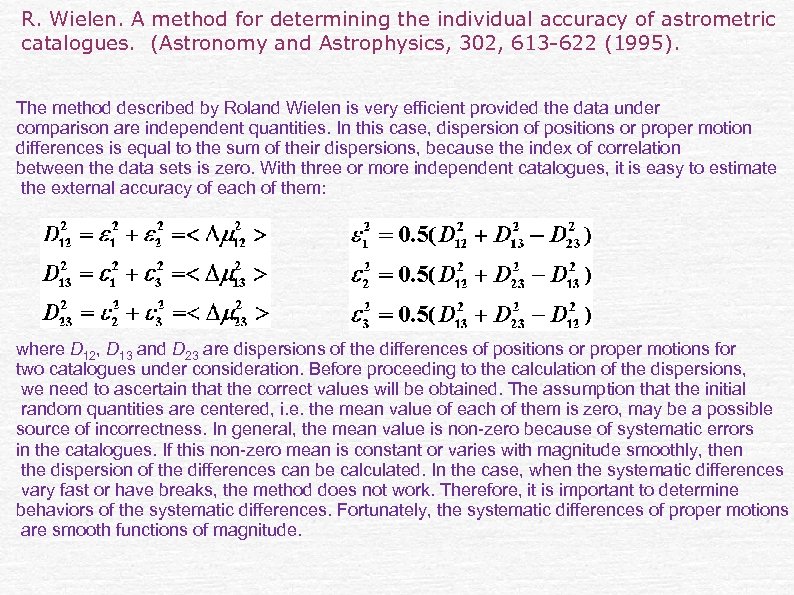 R. Wielen. A method for determining the individual accuracy of astrometric catalogues. (Astronomy and Astrophysics, 302, 613 -622 (1995). The method described by Roland Wielen is very efficient provided the data under comparison are independent quantities. In this case, dispersion of positions or proper motion differences is equal to the sum of their dispersions, because the index of correlation between the data sets is zero. With three or more independent catalogues, it is easy to estimate the external accuracy of each of them: where D 12, D 13 and D 23 are dispersions of the differences of positions or proper motions for two catalogues under consideration. Before proceeding to the calculation of the dispersions, we need to ascertain that the correct values will be obtained. The assumption that the initial random quantities are centered, i. e. the mean value of each of them is zero, may be a possible source of incorrectness. In general, the mean value is non-zero because of systematic errors in the catalogues. If this non-zero mean is constant or varies with magnitude smoothly, then the dispersion of the differences can be calculated. In the case, when the systematic differences vary fast or have breaks, the method does not work. Therefore, it is important to determine behaviors of the systematic differences. Fortunately, the systematic differences of proper motions are smooth functions of magnitude.
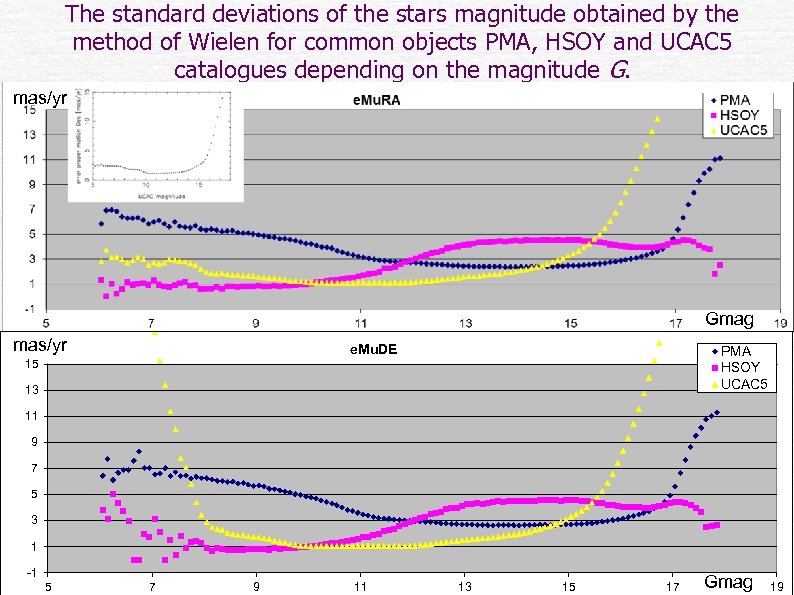 The standard deviations of the stars magnitude obtained by the method of Wielen for common objects PMA, HSOY and UCAC 5 catalogues depending on the magnitude G. mas/yr Gmag mas/yr e. Mu. DE PMA HSOY UCAC 5 15 13 11 9 7 5 3 1 -1 5 7 9 11 13 15 17 Gmag 19
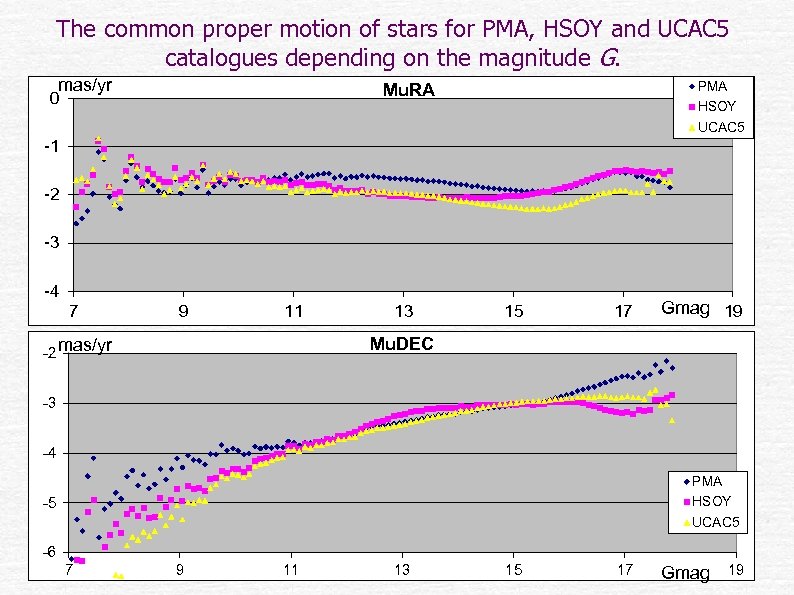 The common proper motion of stars for PMA, HSOY and UCAC 5 catalogues depending on the magnitude G. mas/yr 0 PMA HSOY UCAC 5 Mu. RA -1 -2 -3 -4 7 9 11 13 15 17 Gmag 19 Mu. DEC -2 mas/yr -3 -4 PMA HSOY UCAC 5 -5 -6 7 9 11 13 15 17 Gmag 19
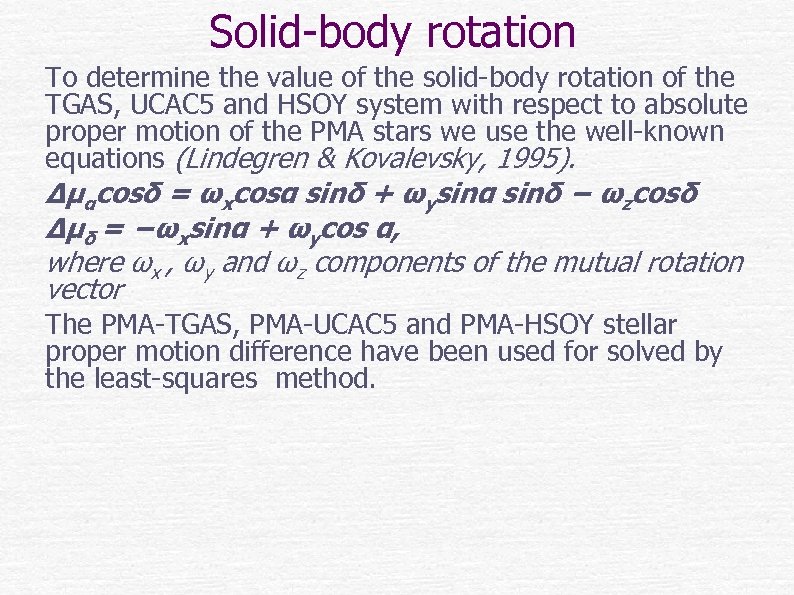 Solid-body rotation To determine the value of the solid-body rotation of the TGAS, UCAC 5 and HSOY system with respect to absolute proper motion of the PMA stars we use the well-known equations (Lindegren & Kovalevsky, 1995). ∆µαcosδ = ωxcosα sinδ + ωysinα sinδ − ωzcosδ ∆µδ = −ωxsinα + ωycos α, where ωx , ωy and ωz components of the mutual rotation vector The PMA-TGAS, PMA-UCAC 5 and PMA-HSOY stellar proper motion difference have been used for solved by the least-squares method.
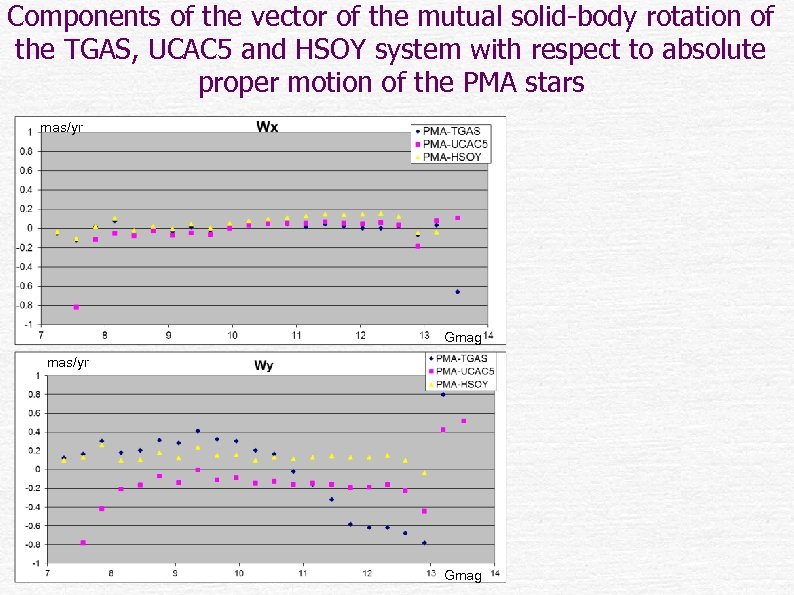 Components of the vector of the mutual solid-body rotation of the TGAS, UCAC 5 and HSOY system with respect to absolute proper motion of the PMA stars mas/yr Gmag
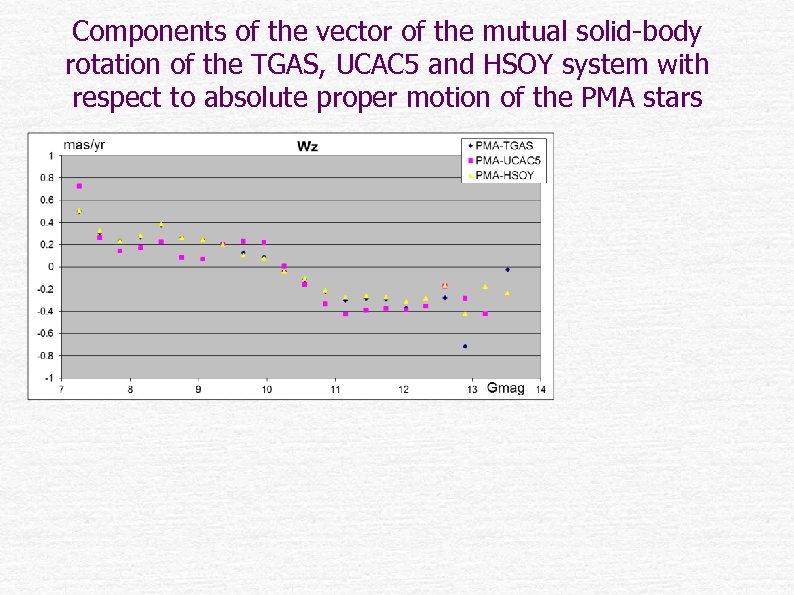 Components of the vector of the mutual solid-body rotation of the TGAS, UCAC 5 and HSOY system with respect to absolute proper motion of the PMA stars
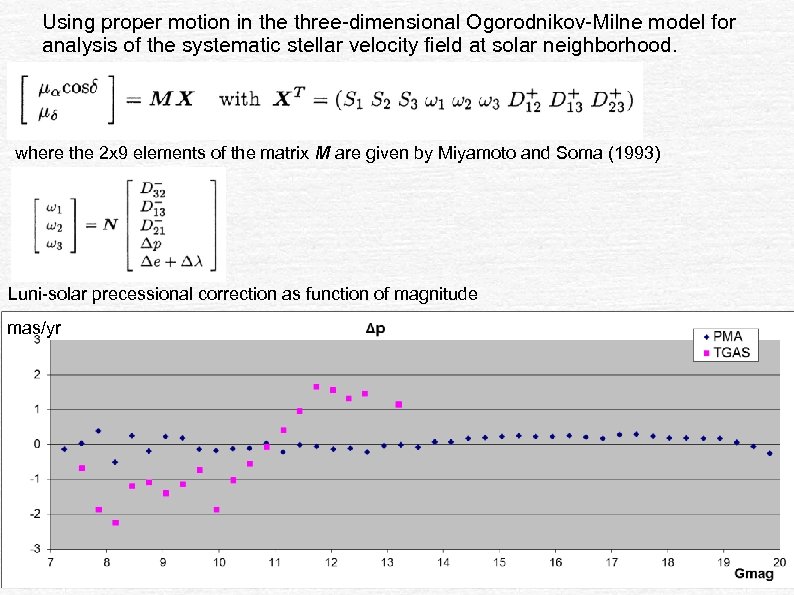 Using proper motion in the three-dimensional Ogorodnikov-Milne model for analysis of the systematic stellar velocity field at solar neighborhood. where the 2 x 9 elements of the matrix M are given by Miyamoto and Soma (1993) Luni-solar precessional correction as function of magnitude mas/yr
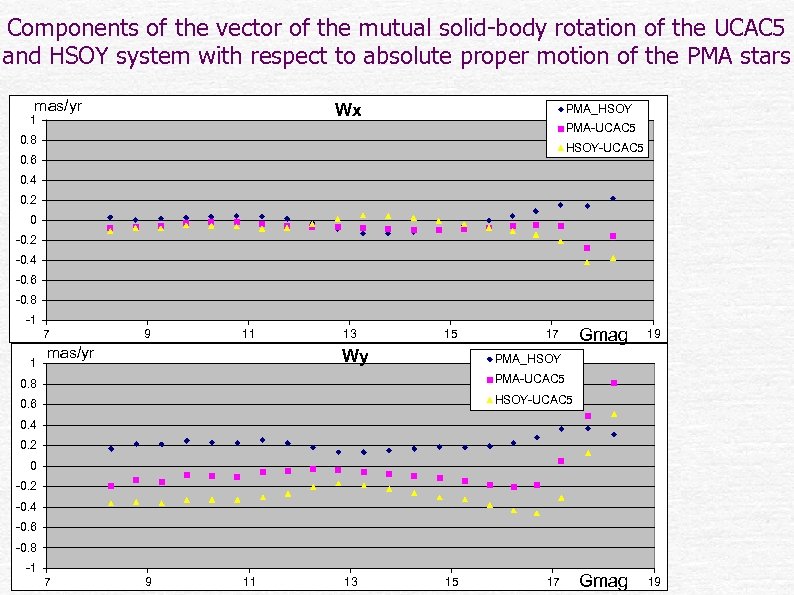 Components of the vector of the mutual solid-body rotation of the UCAC 5 and HSOY system with respect to absolute proper motion of the PMA stars mas/yr Wx 1 PMA_HSOY PMA-UCAC 5 0. 8 HSOY-UCAC 5 0. 6 0. 4 0. 2 0 -0. 2 -0. 4 -0. 6 -0. 8 -1 7 1 9 11 mas/yr 13 15 Wy 17 Gmag 19 PMA_HSOY 0. 8 PMA-UCAC 5 0. 6 HSOY-UCAC 5 0. 4 0. 2 0 -0. 2 -0. 4 -0. 6 -0. 8 -1 7 9 11 13 15 17
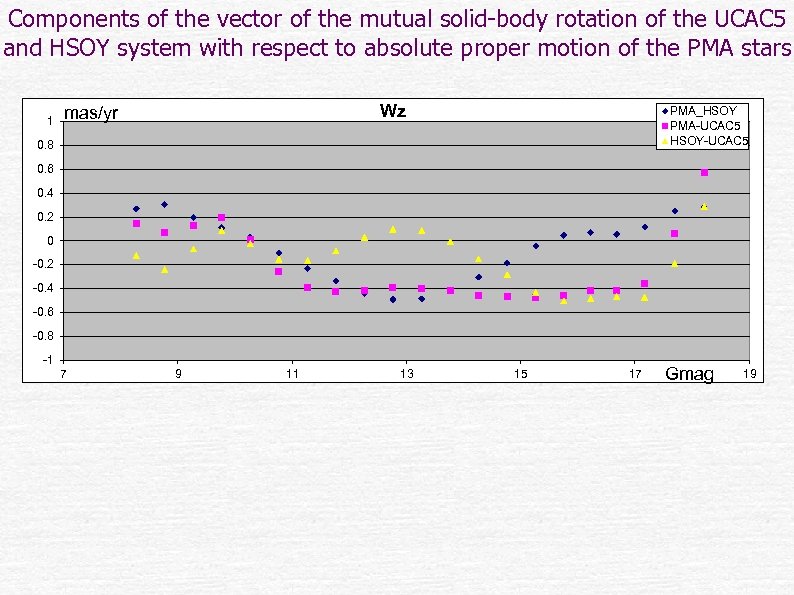 Components of the vector of the mutual solid-body rotation of the UCAC 5 and HSOY system with respect to absolute proper motion of the PMA stars 1 Wz mas/yr PMA_HSOY PMA-UCAC 5 HSOY-UCAC 5 0. 8 0. 6 0. 4 0. 2 0 -0. 2 -0. 4 -0. 6 -0. 8 -1 7 9 11 13 15 17 Gmag 19
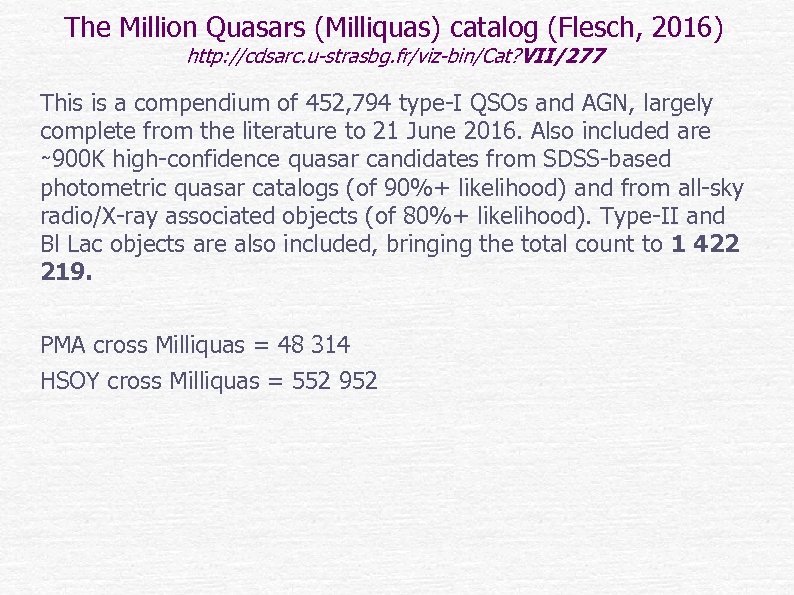 The Million Quasars (Milliquas) catalog (Flesch, 2016) http: //cdsarc. u-strasbg. fr/viz-bin/Cat? VII/277 This is a compendium of 452, 794 type-I QSOs and AGN, largely complete from the literature to 21 June 2016. Also included are ∼ 900 K high-confidence quasar candidates from SDSS-based photometric quasar catalogs (of 90%+ likelihood) and from all-sky radio/X-ray associated objects (of 80%+ likelihood). Type-II and Bl Lac objects are also included, bringing the total count to 1 422 219. PMA cross Milliquas = 48 314 HSOY cross Milliquas = 552 952
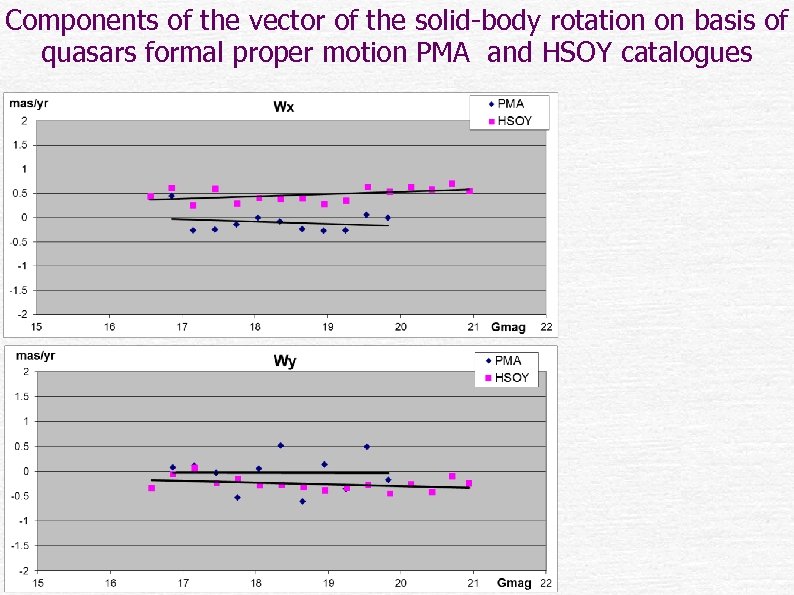 Components of the vector of the solid-body rotation on basis of quasars formal proper motion PMA and HSOY catalogues
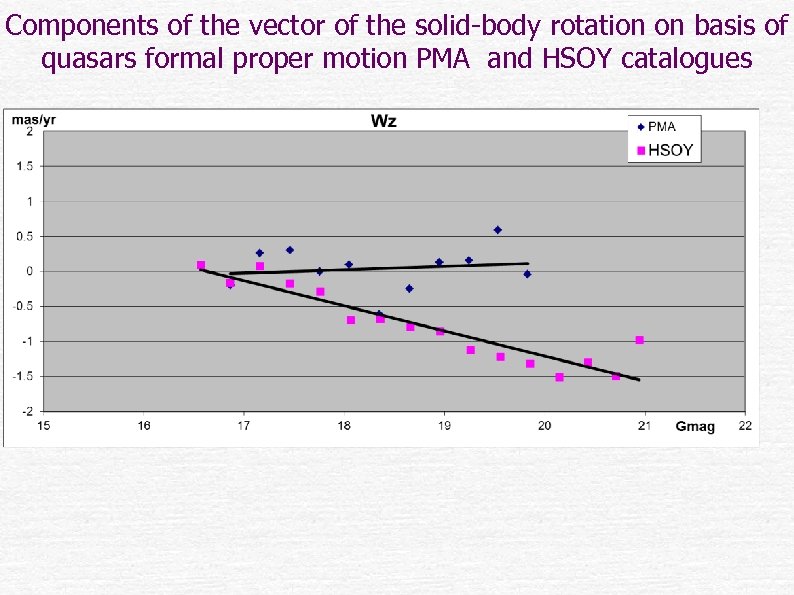 Components of the vector of the solid-body rotation on basis of quasars formal proper motion PMA and HSOY catalogues
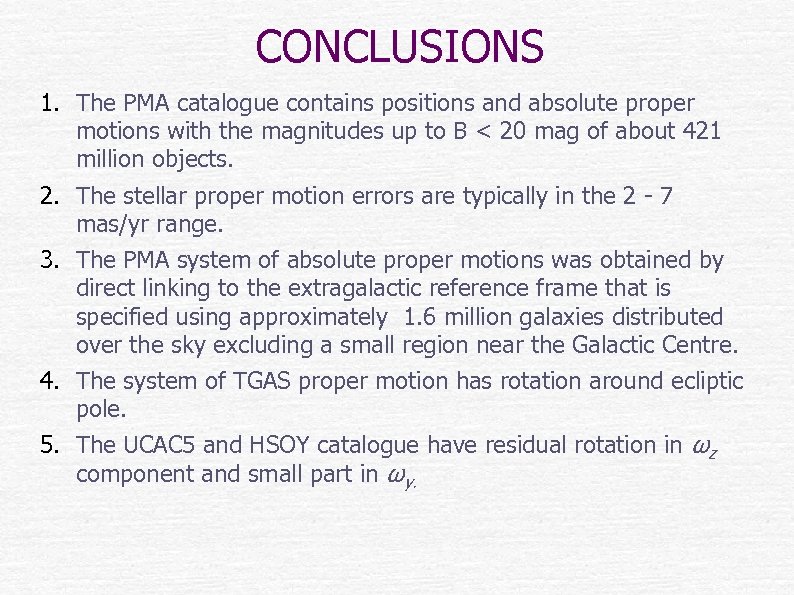 CONCLUSIONS 1. The PMA catalogue contains positions and absolute proper motions with the magnitudes up to B < 20 mag of about 421 million objects. 2. The stellar proper motion errors are typically in the 2 - 7 mas/yr range. 3. The PMA system of absolute proper motions was obtained by direct linking to the extragalactic reference frame that is specified using approximately 1. 6 million galaxies distributed over the sky excluding a small region near the Galactic Centre. 4. The system of TGAS proper motion has rotation around ecliptic pole. 5. The UCAC 5 and HSOY catalogue have residual rotation in ωz component and small part in ωy.
 Thank you for your attention! akhmetovvs@gmail. com