


 Скачать презентацию V A OF CLIMATE CHANGE IN THE WATER RESOURCES
82d63df18f28c9d382ede9eb10887412.ppt
- Количество слайдов: 21
 V&A OF CLIMATE CHANGE IN THE WATER RESOURCES SECTOR IN KENYA Francis Mutua Department of Meteorology University of Nairobi – Kenya
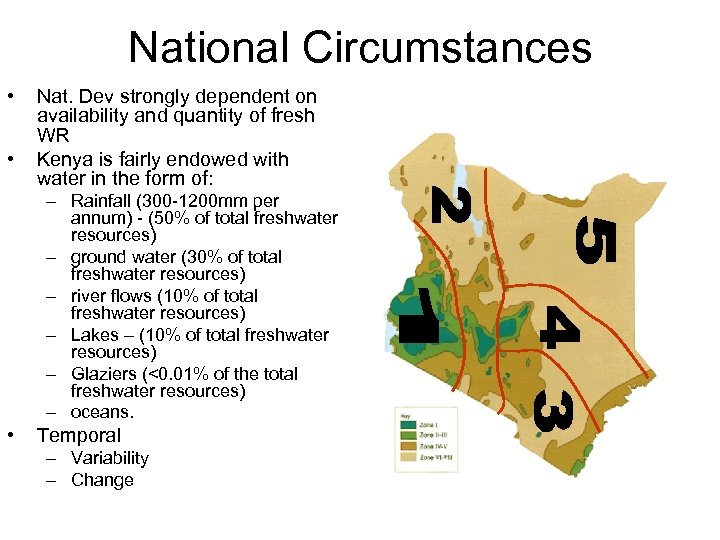 National Circumstances • • Nat. Dev strongly dependent on availability and quantity of fresh WR Kenya is fairly endowed with water in the form of: – Rainfall (300 -1200 mm per annum) - (50% of total freshwater resources) – ground water (30% of total freshwater resources) – river flows (10% of total freshwater resources) – Lakes – (10% of total freshwater resources) – Glaziers (<0. 01% of the total freshwater resources) – oceans. • Temporal – Variability – Change
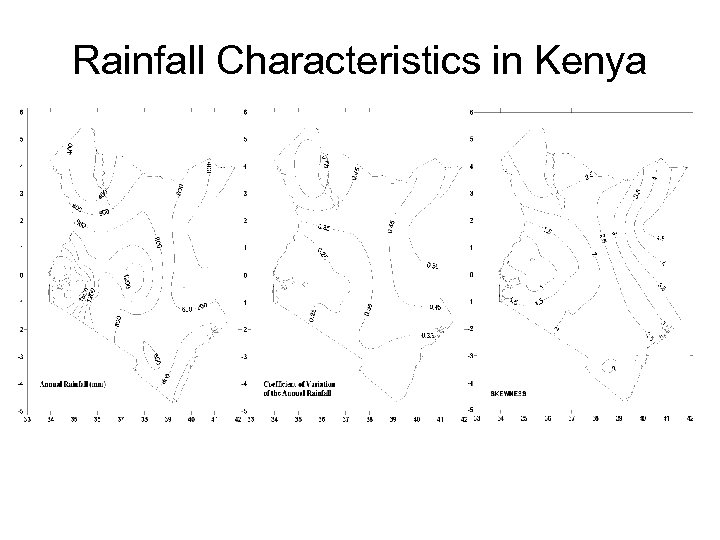 Rainfall Characteristics in Kenya
 Climate Variability and Water Resources • • • Climate variations have significant consequences on the quality and quantity of water in all hydrological regimes. Climate variability is the major cause of the extremes which are observed in hydrological systems in Kenya: floods and droughts NB: floods (quick onset) and droughts (slow onset) hazards are part of the climate systems and therefore unavoidable However, they need not become disasters because it is possible to to be prepared for them (especially drought hazards) Often, they turn into disasters – Famine and crop failure – Deaths (humans and livestock) – Adverse economic impacts and impoverishment – Conflicts
 Disasters in Kenya 1. 2. 3. 4. Droughts • Most of these are Floods climate-driven vis. Lightning, wind-storms, hailstorms, etc à-vis the available freshwater Epidemics resources such as – Malaria lakes, rivers and groundwater. – HIV/AIDS • Thresholds not – Cholera readily available because of the 5. Environmental degradation time-variance of (desertification, pollution, soil erosion, the water etc) resources systems mainly due to 6. Earthquakes increasing land 7. Pest infestation, Conflicts, fires, use activities. livestock diseases, etc.
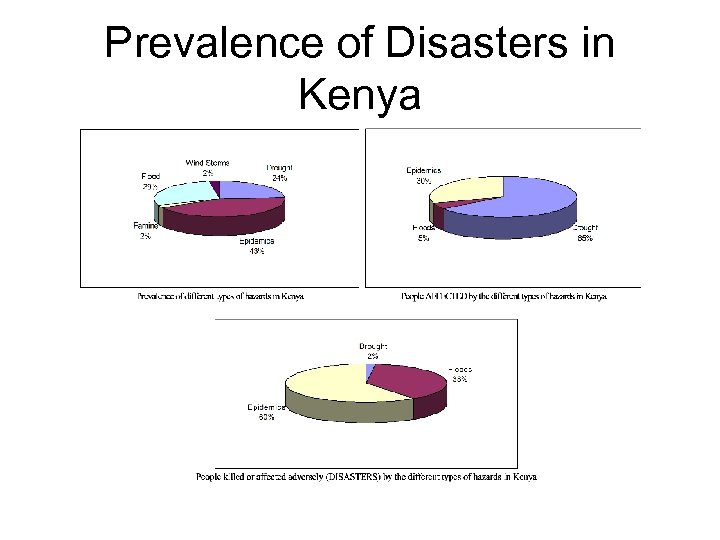 Prevalence of Disasters in Kenya
 Institutions involved in Flood/Drought Issues • • • • Ministry of Water Resources Management and Development Ministry of Agriculture Ministry of Roads and Public Works National Disaster Centre in the Office of the President Provincial Administration in the Office of the President Kenya Meteorological Department in the Ministry of Transport and Communications Ministry of Environment, Natural Resources and Wildlife National Environmental Management Authority in the Ministry of Local Government Ministry of Health Ministry of Lands and Settlement Basin Development Authorities District Disaster Communities Community flood/drought Committees NGOS
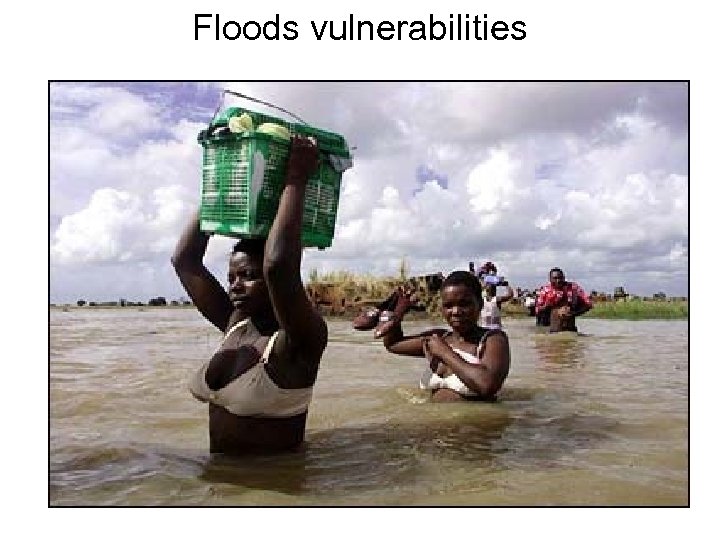 Floods vulnerabilities
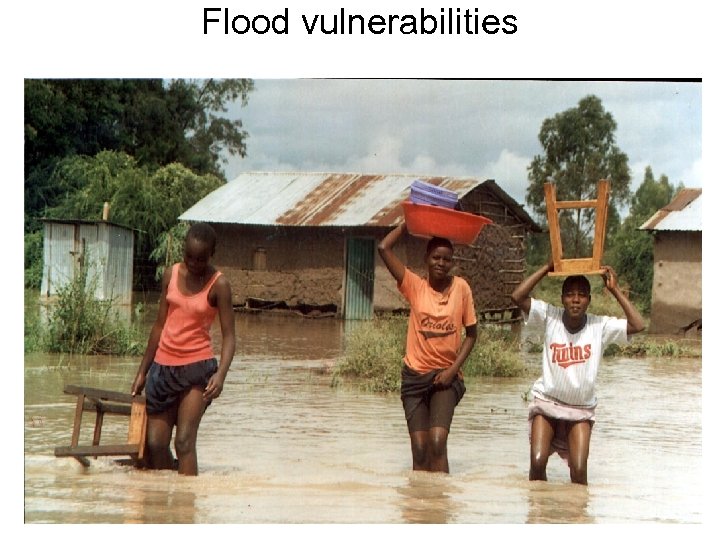 Flood vulnerabilities
 Vulnerable People and Places – People who live on arid or semi-arid lands, in low-lying coastal areas, in water-limited or flood-prone areas – It is… clear that climate change will, in many parts of the world, adversely affect socio-economic sectors, including water resources, agriculture, forestry, fisheries and human settlements, ecological systems …, and human health …, with developing countries being the most vulnerable. (IPCC 2000 a) – Developing countries… have lesser capacity to adapt and are more vulnerable to climate change damages, just as they are to other stresses. This condition is most extreme among the poorest people. (IPCC 2001: 8)
 Flood and drought Impacts • Sectors: – Community safety (loss of lives, starvation, conflicts, migrations, etc) – Agriculture – Environmental degradation – Hydropower generation and transmission – Communications infrastructure – Tourism and wildlife – Community Health (malaria, depression, typhoid, diarrhoea, HIV/AIDS) – Politics – Leisure – etc
 VULNERABILITY IN WATER RESOURCES DUE TO CLIMATE CHANGE The physical factors – Existence of a highly variable hydrological and climatic regime that is marginal for agricultural and livestock developments; – Episodic precipitation patterns which promote high rates of sedimentation and siltation; – Topography and soil patterns that promote soil erosion; – Lack of variety in climatic conditions across the region which weaken the options for relocation in strategies which are intended to reduce the drought risk. – Lack of adequate mainstreaming of climate information in water resources planning The societal factors – – – – – Poverty and low income levels; Conflicts and wars; Pandemics; High dependence on rain-fed systems; Lack of controls for strengthening security in water supplies and consequently in crucial water uses such as irrigation and hydro-power generation; Poor planning and management of agricultural water supply and irrigation systems; High population densities and other factors that inhibit population mobility and implementation of traditional coping mechanisms; Inexperience of communities to cope with droughts; Unwillingness of communities to live with some drought risks as a trade-off against beneficial services or goods. Low level of trust in climate prediction products Vulnerability = Function of: Exposure, Sensitivity and Adaptive Capacity (Resilience)
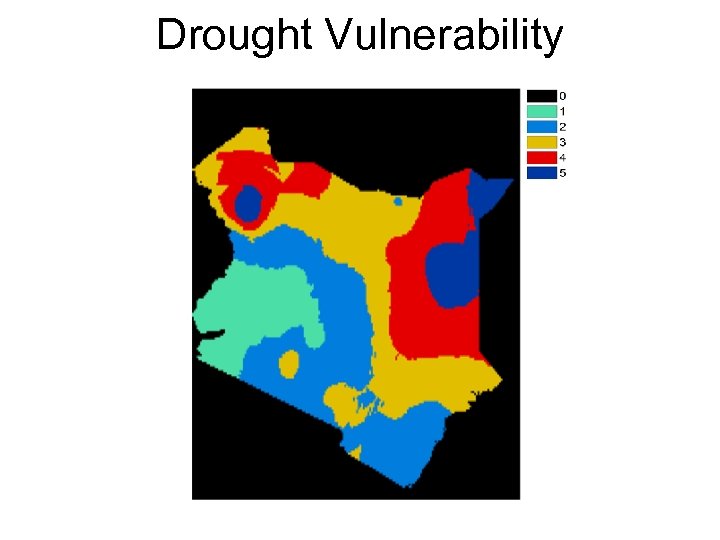 Drought Vulnerability
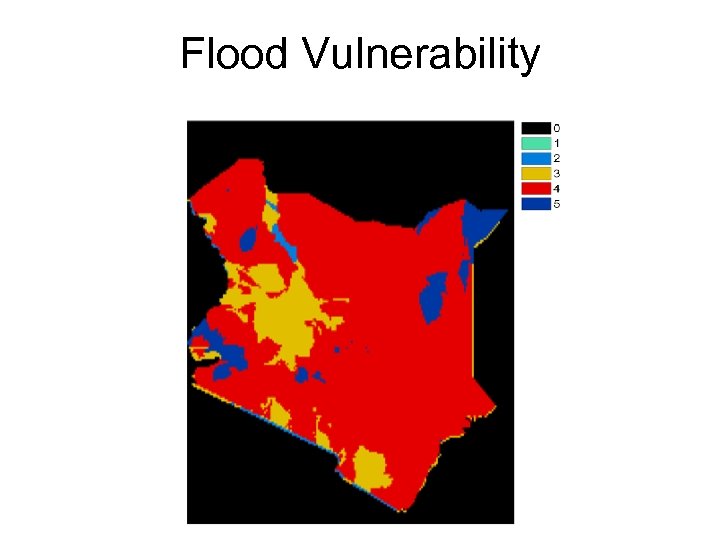 Flood Vulnerability
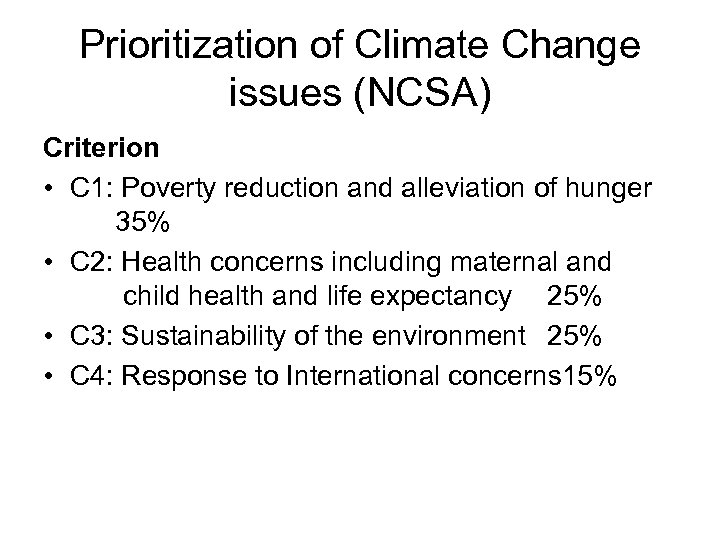 Prioritization of Climate Change issues (NCSA) Criterion • C 1: Poverty reduction and alleviation of hunger 35% • C 2: Health concerns including maternal and child health and life expectancy 25% • C 3: Sustainability of the environment 25% • C 4: Response to International concerns 15%
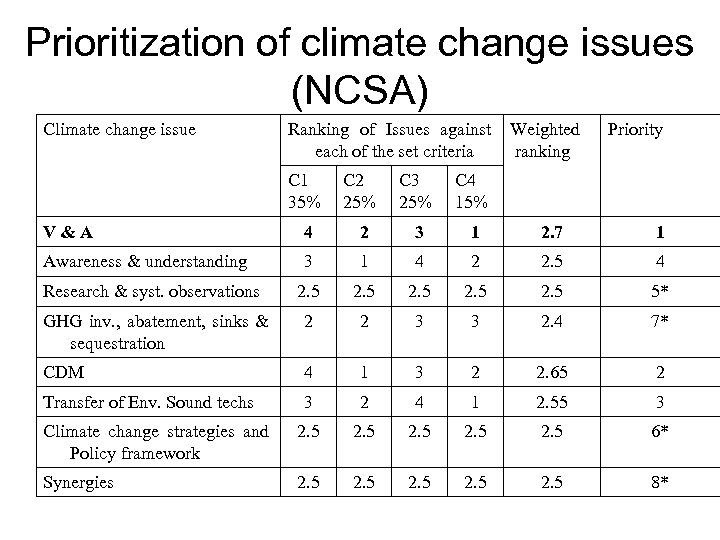 Prioritization of climate change issues (NCSA) Climate change issue Ranking of Issues against each of the set criteria Weighted ranking Priority C 1 35% C 2 25% C 3 25% C 4 15% V&A 4 2 3 1 2. 7 1 Awareness & understanding 3 1 4 2 2. 5 4 Research & syst. observations 2. 5 2. 5 5* GHG inv. , abatement, sinks & sequestration 2 2 3 3 2. 4 7* CDM 4 1 3 2 2. 65 2 Transfer of Env. Sound techs 3 2 4 1 2. 55 3 Climate change strategies and Policy framework 2. 5 2. 5 6* Synergies 2. 5 2. 5 8*
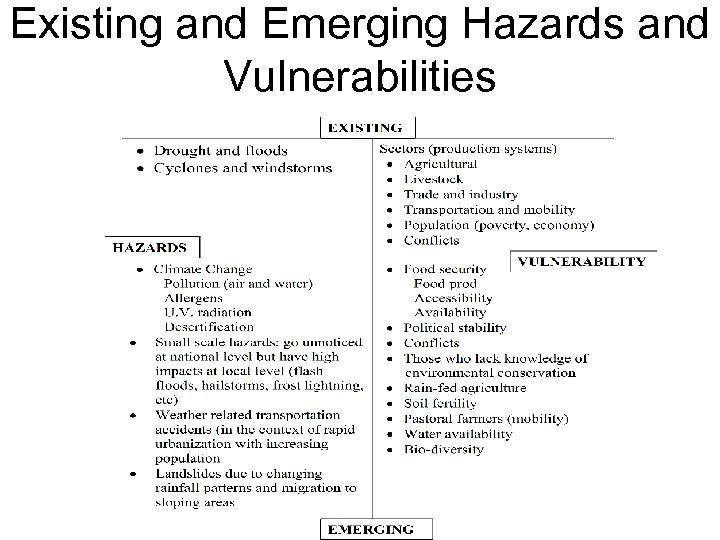 Existing and Emerging Hazards and Vulnerabilities
 PREVIOUS STUDIES ON V&A IN WATER RESOURCES • The United States Country Studies Programme (USCSP) in 1994. – WATBAL for water Resources • The UNDP/GEF Capacity Building in Sub Sahara Africa to Respond to UNFCCC in 1996. • The INC • UNEP study on the implications of climate change, sea level rise and vulnerability assessment of selected coastlines.
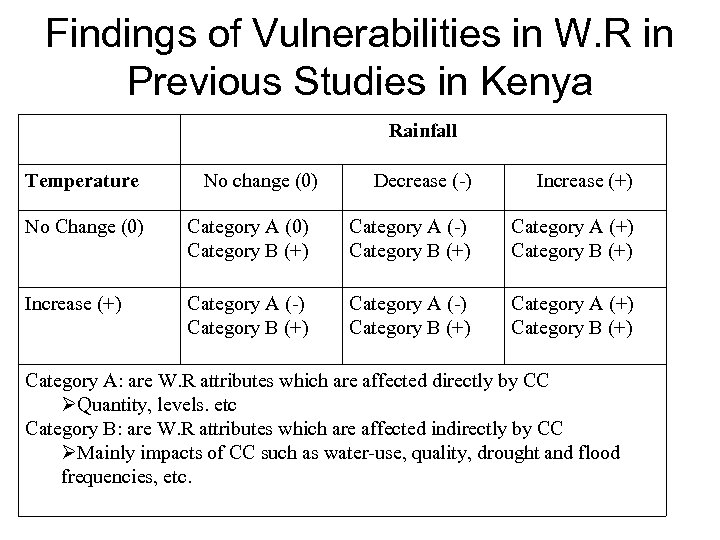 Findings of Vulnerabilities in W. R in Previous Studies in Kenya Rainfall Temperature No change (0) Decrease (-) Increase (+) No Change (0) Category A (0) Category B (+) Category A (-) Category B (+) Category A (+) Category B (+) Increase (+) Category A (-) Category B (+) Category A (+) Category B (+) Category A: are W. R attributes which are affected directly by CC Quantity, levels. etc Category B: are W. R attributes which are affected indirectly by CC Mainly impacts of CC such as water-use, quality, drought and flood frequencies, etc.
 Adaptation 1. 2. 3. 4. 5. Unavailability of readily usable climate information in some cases Limitations of institutional setup and monitoring priorities Inadequate awareness of the value of climate and weather information Mistrust in the quality of meteorological data and products Unfavorable packaging and delivery of climate and weather information and products 6. Reducing over-reliance on rainfall in developmental activities (diversification from rain-fed agriculture to more use of groundwater) 7. Reducing pollution in water resources (proper land-use management policies) 8. Large isolated vs. small and well distributed water supply projects 9. Education and awareness 10. Promotion of water-use efficient technologies to minimize wastages 11. Monitoring, assessments and research (development of sustainable EWS) • Kenya govt has been sensitized on many of these issues and has in the past few years been spearheading development and implementation of policies that can strengthen the resilience of the society (reduce their vulnerabilities) in the water sector due to climate change
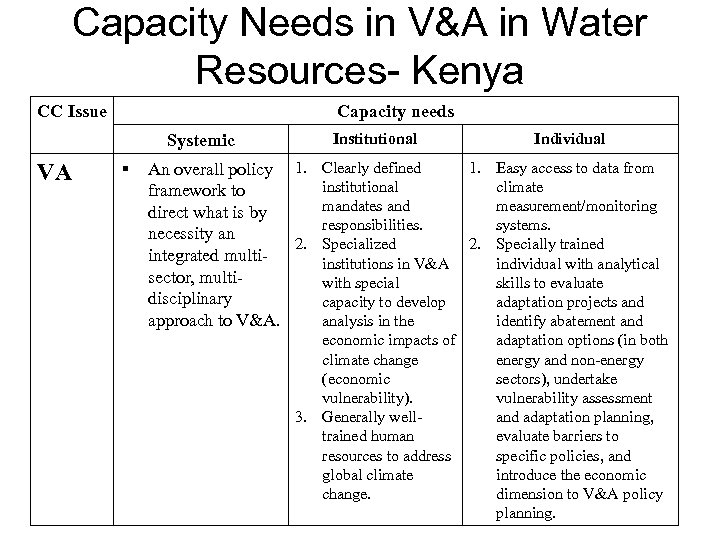 Capacity Needs in V&A in Water Resources- Kenya CC Issue Capacity needs Systemic VA Institutional An overall policy 1. Clearly defined institutional framework to mandates and direct what is by responsibilities. necessity an 2. Specialized integrated multiinstitutions in V&A sector, multiwith special disciplinary capacity to develop approach to V&A. analysis in the Individual 1. Easy access to data from climate measurement/monitoring systems. 2. Specially trained individual with analytical skills to evaluate adaptation projects and identify abatement and economic impacts of adaptation options (in both climate change energy and non-energy (economic sectors), undertake vulnerability). vulnerability assessment 3. Generally welland adaptation planning, trained human evaluate barriers to resources to address specific policies, and global climate introduce the economic change. dimension to V&A policy planning.