


 Скачать презентацию V 2 G Vehicle to Grid Power Seth
6d3e1bf2de9c1f76f15e41b91bfe8dee.ppt
- Количество слайдов: 23
 V 2 G: Vehicle to Grid Power Seth Insley CH 407 H
 Concept Cars use large amounts of power – Far more than other power uses 750 GW electric vs 12 TW from cars – Must generate or store it themselves – Unused most of the time Average use only 1 hour per day Fuel cell, hybrid and battery cars generate power as electricity – Why not hook them up to the power grid?
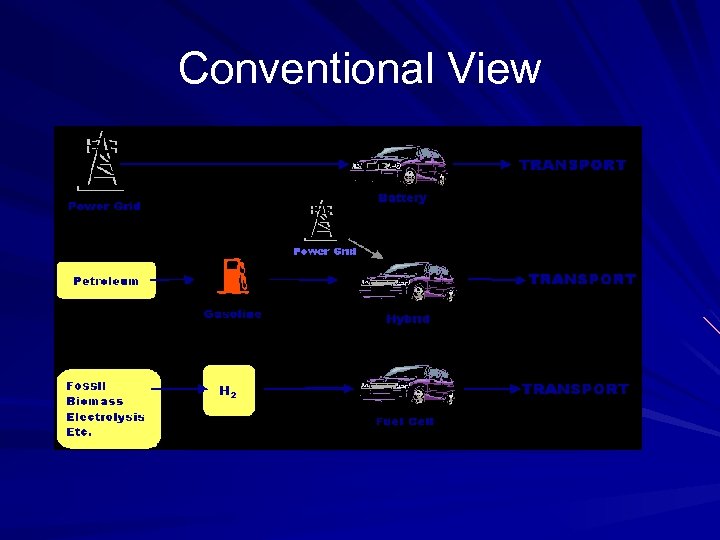 Conventional View
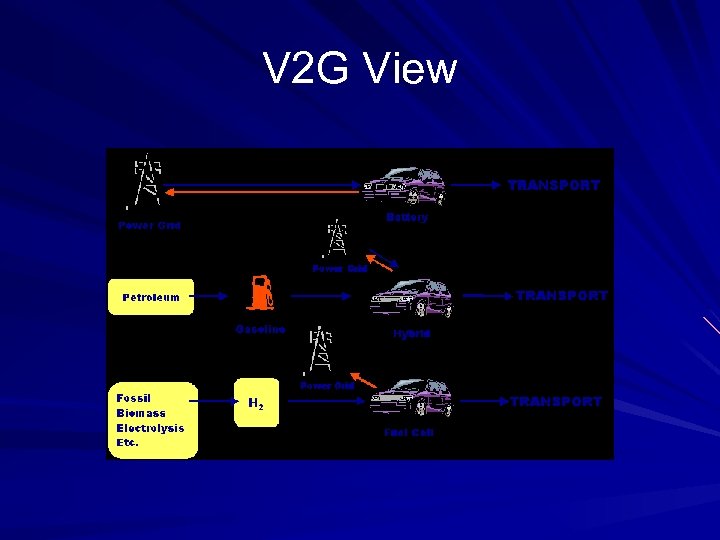 V 2 G View
 Examples Use the battery in plug-in hybrid/battery cars to buy cheap power at night and sell during the day Use hybrid/fuel cell car to generate peak power Use either to provide ‘spinning’ reserve or regulation services
 Benefits Better utilize existing generation capacity – Will need to build fewer new electric plants – Allow better load balancing by diversifying the electric grid – Reduce transport load on grid by distributing generation – Increase grid reliability Provide income to car owners – Offset or reduce the cost of the car
 Considerations How will vehicles be connected to the grid? How will this effect drivers? Is this a cost effective way to generate power?
 Infrastructure Requires physical connection between car and grid – Only useful when parked – Could hook up at home – Could be incorporated into public charging stations or parking lots – Should be simple to set up, automatically handling payment, etc Just plug it in May also desire fuel connection: – Natural gas or hydrogen
 Driver Experience Primary Consideration: Will this affect range? – Allow owner to easily limit extent of discharge/fuel use Will it be easy to set up? Will it be sufficiently profitable to make it worth the effort? – The car owner should not have to worry about this – Only sell power when profitable
 Economics Not worthwhile unless it returns sufficient amounts of money after expenses incurred – Cost of fuel/ electricity – Maintenance costs for Battery Fuel cell Engine – Effort required by owner
 Economic Advantages Very low capital costs – Car already bought Adding grid capabilities relatively cheap – Even so, costs roughly $60/kw Compared to $1000/kw for traditional generators Due to lower efficiencies, reliability Has freedom to buy/sell only when profitable – Much more responsive than traditional generators
 Economic Disadvantages Poor Efficiency – Smaller/cheaper generators are less efficient – Need more fuel to generate same power Requires relatively expensive fuels – Gasoline or hydrogen or natural gas vs coal – Cannot buy fuel in bulk
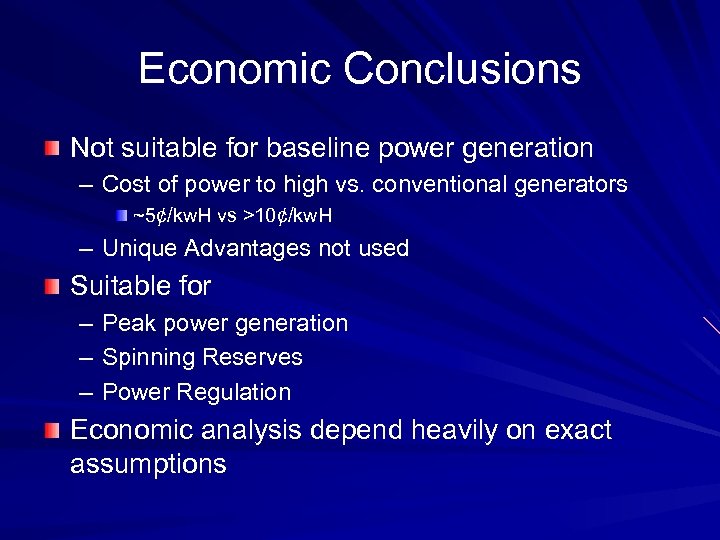 Economic Conclusions Not suitable for baseline power generation – Cost of power to high vs. conventional generators ~5¢/kw. H vs >10¢/kw. H – Unique Advantages not used Suitable for – – – Peak power generation Spinning Reserves Power Regulation Economic analysis depend heavily on exact assumptions
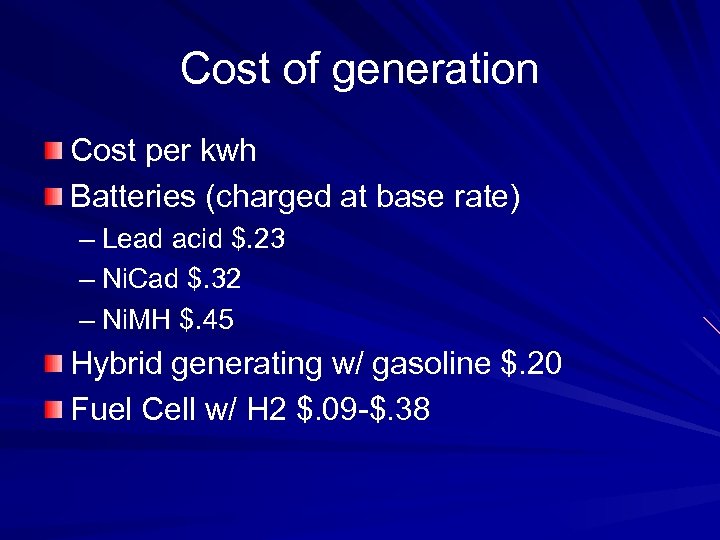 Cost of generation Cost per kwh Batteries (charged at base rate) – Lead acid $. 23 – Ni. Cad $. 32 – Ni. MH $. 45 Hybrid generating w/ gasoline $. 20 Fuel Cell w/ H 2 $. 09 -$. 38
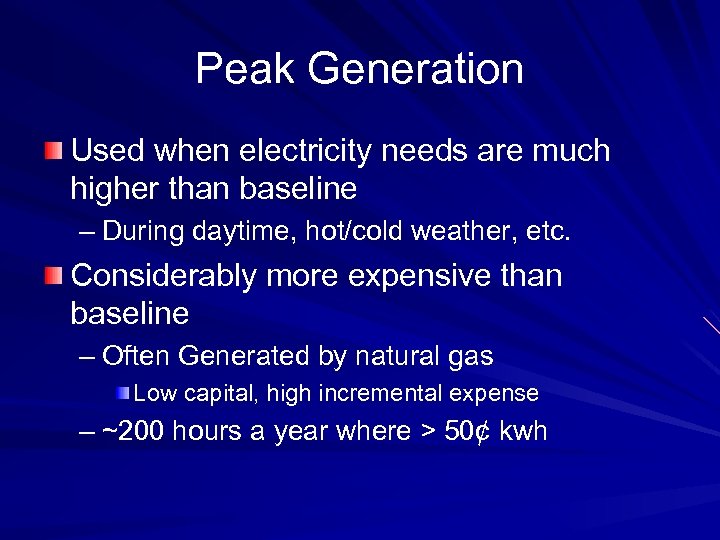 Peak Generation Used when electricity needs are much higher than baseline – During daytime, hot/cold weather, etc. Considerably more expensive than baseline – Often Generated by natural gas Low capital, high incremental expense – ~200 hours a year where > 50¢ kwh
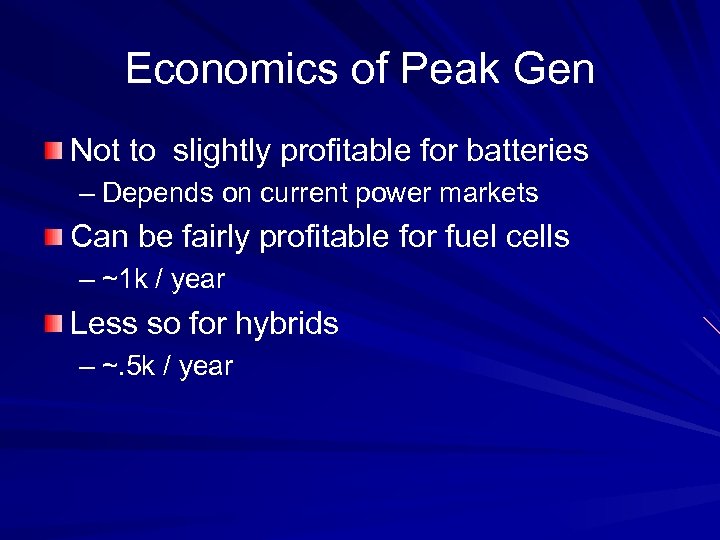 Economics of Peak Gen Not to slightly profitable for batteries – Depends on current power markets Can be fairly profitable for fuel cells – ~1 k / year Less so for hybrids – ~. 5 k / year
 Spinning Reserve Generators ready to provide power in ~10 min Used to preserve grid stability if generators go down, load is too high Sold on contract basis – Ex. 1 Kw for a day – Payment even if not used – Extra payment if used
 Spinning Economics Profitable for all vehicle types – Batteries $10 -$700 – Fuel cell, hybrid generating: ~$2000
 Power Regulation Used to keep frequency stable at 60 Hz Must be able to respond instantly 2 kinds – Regulation up – generating power – Regulation down – absorbing power
 Regulation Economics Batteries are ideal for this purpose – Up/down corresponds to discharge/charge – Has minimal effect on total charge – ~3 k for lead acid – ~2 k for Ni. MH – Actual degradation hard to determine Not profitable for other types
 Market Size All numbers for CA electric market ~300 k battery vehicles for regulation 76 k – 273 k vehicles for spinning reserve ~ 734 k vehicles at max for peak. 5% – 5% of total light vehicle count Additional uses are likely in a saturated market – More reliability, renewable
 Conclusion V 2 G is a promising concept – Provides a cheaper way to provide many grid services Needs more detailed study Not hard to implement simply May play an important role in the future power grid
 Sources V 2 G research group at U of DE. “V 2 G: Vehicle To Grid Power” http: //www. udel. edu/V 2 G/ Kempton, et. al. “Vehicle-to-Grid Power” http: //www. udel. edu/V 2 G-Cal-2001. pdf Kempton, Letendre. “Electric Vehicles as a new Source of Power for Electric Utilities” http: //www. udel. edu/V 2 G/Kempton-Letendre 97. pdf