


 Скачать презентацию UW-CIMSS MURI Management Progress Report 07 -09
4fec29cbdaf78901f747bc9e5721a46f.ppt
- Количество слайдов: 37
 UW-CIMSS MURI Management & Progress Report 07 -09 June 2005 University of Wisconsin-Madison, Wisconsin http: //cimss. ssec. wisc. edu/muri Wayne Feltz MURI Program Manager
 UW-MURI TASKS 1 Mathematical Quantification of Useful Hyperspectral Information 2 Radiative Transfer Modeling • Clear and Cloudy Sky Emission/Absorption • Atmospheric Particulate Emission/Absorption • Surface Emission/Absorption • Adjoint & Linear Tangent 3 Mathematical Retrieval Algorithm Development • Atmospheric Parameters • Suspended Particulate Detection and Quantification • Sea Surface Temperature • Surface Material Identification 4 Product Research • Ocean and Land Surface Characterization • Lower Tropospheric Temperature, Moisture and Winds • Surface Material Products • Aerosols/Visibility/Volcanic Ash • Derived (Second Order) Products
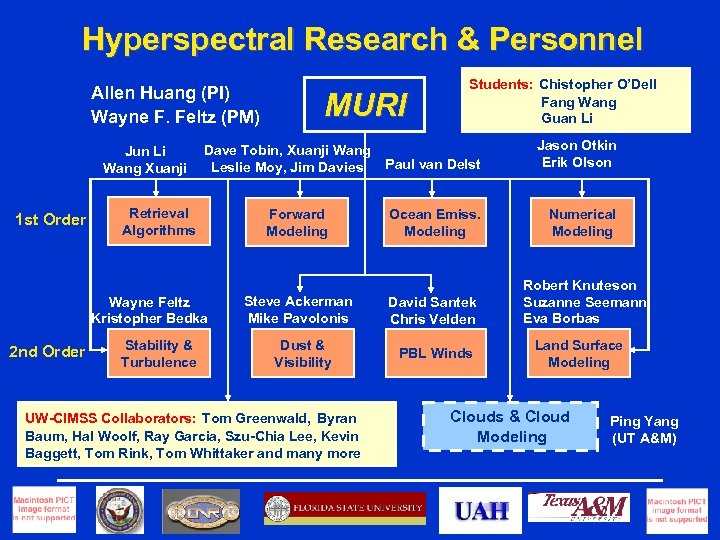 Hyperspectral Research & Personnel Allen Huang (PI) Wayne F. Feltz (PM) Jun Li Wang Xuanji 1 st Order Dave Tobin, Xuanji Wang Leslie Moy, Jim Davies Retrieval Algorithms Wayne Feltz Kristopher Bedka 2 nd Order Stability & Turbulence MURI Forward Modeling Steve Ackerman Mike Pavolonis Dust & Visibility UW-CIMSS Collaborators: Tom Greenwald, Byran Baum, Hal Woolf, Ray Garcia, Szu-Chia Lee, Kevin Baggett, Tom Rink, Tom Whittaker and many more Students: Chistopher O’Dell Fang Wang Guan Li Paul van Delst Jason Otkin Erik Olson Ocean Emiss. Modeling Numerical Modeling David Santek Chris Velden Robert Knuteson Suzanne Seemann Eva Borbas PBL Winds Land Surface Modeling Clouds & Cloud Modeling Ping Yang (UT A&M)
 I. Radiative Transfer Modeling Clear and Cloudy David Tobin, Leslie Moy, James Davies, Ping Yang, Xiang Wang, Tom Greenwald, Bryan Baum
 Clear Sky Fast Model Accomplishments David Tobin and Leslie Moy Reproduce and Upgrade existing GIFTS Fast Model • Coefficients promulgated 2003 • Greatly improved the dependent set statistics (esp. water vapor) • Water continuum regression made at nadir applied to all angles • SVD regression and optical depth weighting incorporated • Written in flexible code with visualization capabilities. Under CVS control Corresponding Tangent Linear Adjoint Code Written • Tested to machine precision accuracy • User friendly “wrap-around” code complete • Transferred code to Dr. Xiaolei Zou at FSU Investigated Surface Reflected Radiance • Great improvement with two point Gaussian Quadrature (over single point)
 Hyperspectral IR Cloudy Fast Forward Model X. Wang, J. E. Davies, E. R. Olson, J. A. Otkin, H-L. Huang, Ping Yang#, Heli Wei#, Jianguo Niu# and David D. Turner* Cooperative Institute for Meteorological Satellite Studies (CIMSS), Madison, WI #Department of Atmospheric Sciences, Texas A&M University, College Station, TX *Climate Physics Group, Pacific Northwest National Laboratory, Richland, WA 99352 Xuanji. Wang@ssec. wisc. edu
 Cloud Model Current Status Ø We have implemented the two-layer cloud model in the framework of the GIFTS fast model (ly 2 g) and included access to an ecosystem surface emissivity model (MODIS band resolution) - less than 1 s per GIFTS spectrum (3000+ chans). Ø We have created a system for generating ly 2 g and LBLRTM/DISORT (Dave Turner’s LBLDIS) simulated brightness temperatures for GIFTS channels and equivalent cloudy profiles. [Those computed by LBLDIS operate on a vertical profile of cloud properties, ly 2 g must select approximately equivalent thin layer height/OD/radii for up to two layers]. Ø We have automated the selection of cloud layer heights, ODs, effective radii from mesoscale model inputs. Ø We have added a net. CDF interface option to make easier the visualization of inputs/outputs with Unidata’s IDV.
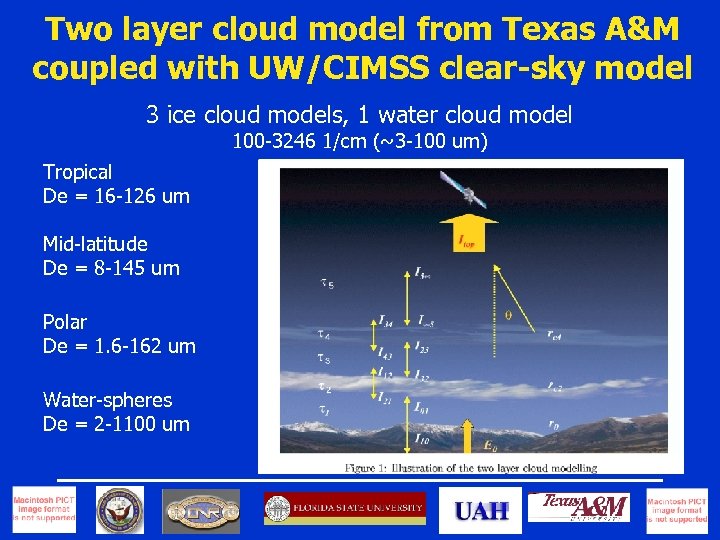 Two layer cloud model from Texas A&M coupled with UW/CIMSS clear-sky model 3 ice cloud models, 1 water cloud model 100 -3246 1/cm (~3 -100 um) Tropical De = 16 -126 um Mid-latitude De = 8 -145 um Polar De = 1. 6 -162 um Water-spheres De = 2 -1100 um
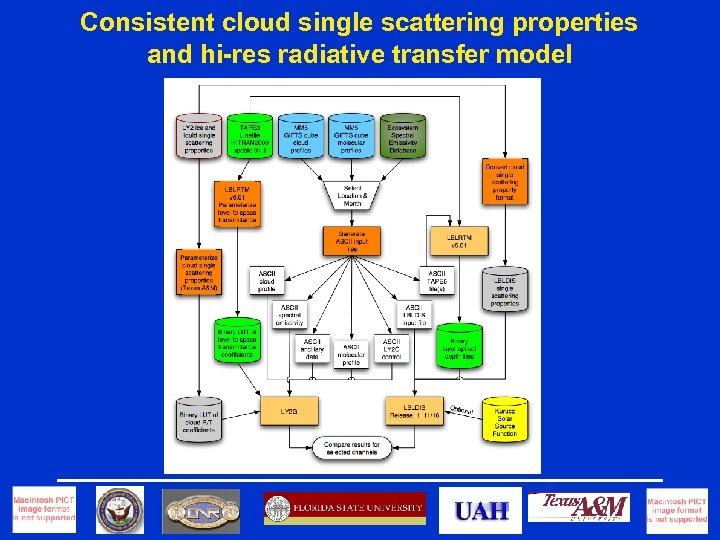 Consistent cloud single scattering properties and hi-res radiative transfer model
 Development of Ice Cloud Microphysical and Optical Models For Multispectral/Hyperspectral Instruments Bryan A. Baum 1 Ping Yang 2, Andrew Heymsfield 3 NASA Langley Research Center, Hampton, VA Texas A&M University, College Station, TX 3 National Center for Atmospheric Research, Boulder, CO 1 2 Goal: Provide ice cloud bulk scattering models that are developed consistently for suite of multispectral and hyperspectral instruments 5 th Workshop on Hyperspectral Science June 9 -11, 2005
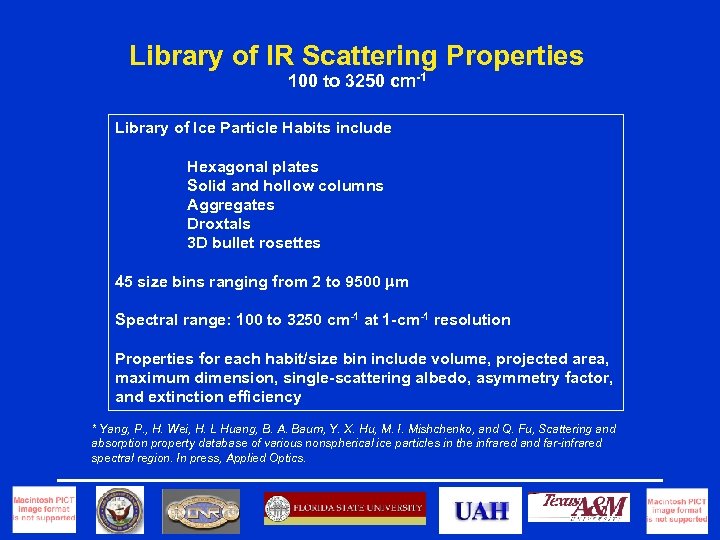 Library of IR Scattering Properties 100 to 3250 cm-1 Library of Ice Particle Habits include Hexagonal plates Solid and hollow columns Aggregates Droxtals 3 D bullet rosettes 45 size bins ranging from 2 to 9500 m Spectral range: 100 to 3250 cm-1 at 1 -cm-1 resolution Properties for each habit/size bin include volume, projected area, maximum dimension, single-scattering albedo, asymmetry factor, and extinction efficiency * Yang, P. , H. Wei, H. L Huang, B. A. Baum, Y. X. Hu, M. I. Mishchenko, and Q. Fu, Scattering and absorption property database of various nonspherical ice particles in the infrared and far-infrared spectral region. In press, Applied Optics.
 Summary for IR Spectral Models Bulk scattering models based on in situ PSD data Models based on simulations of variety of ice particle habits Include IWC and Dm Provide some information on variability of properties Models are available at http: //www. ssec. wisc. edu/~baum
 Unified Radiative Transfer Model: Microwave to Infrared Tom Greenwald • Purpose of developing one fast RT model across thermal spectrum: – Consistency in radiance calculations – Multi-sensor retrievals of atmospheric profiles and cloud properties – Direct radiance assimilation applications • Presentation will discuss forward modeling and adjoint sensitivities in cloudy atmospheres
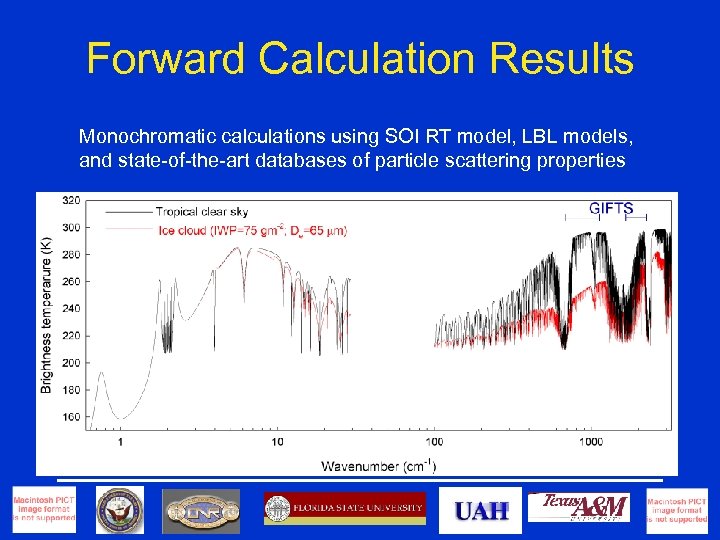 Forward Calculation Results Monochromatic calculations using SOI RT model, LBL models, and state-of-the-art databases of particle scattering properties
 II. Mathematical Retrieval Algorithm Development Jun Li, Jason Otkin, Erik Olson, Fang Wang
 NWP Modeling Highlights Jason Otkin and Erik Olson • Performed an extensive comparison study between the MM 5 and WRF in order to determine the ability of each model to realistically simulate mesoscale atmospheric structures • Developed a suite of utilities used to convert WRF modelsimulated data into atmospheric profiles used as ingest in forward radiative transfer models • Ported the MM 5 and WRF models to our new SGI Altix • Generated our first simulated atmospheric profile dataset (the ATREC simulation) using the WRF model
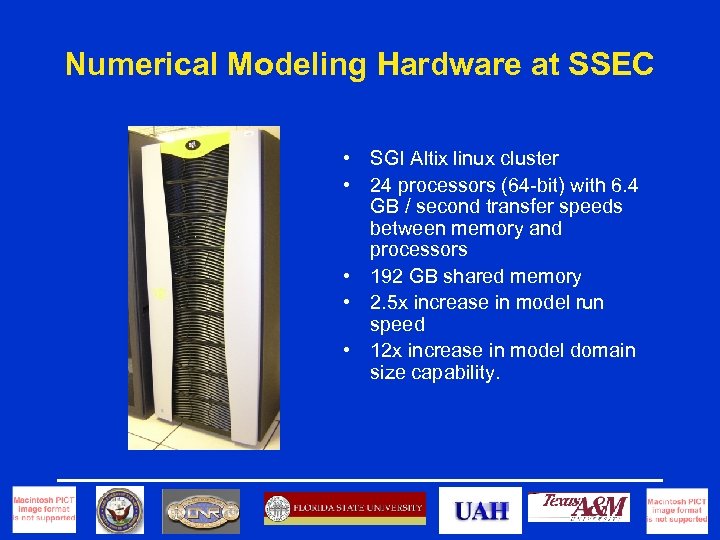 Numerical Modeling Hardware at SSEC • SGI Altix linux cluster • 24 processors (64 -bit) with 6. 4 GB / second transfer speeds between memory and processors • 192 GB shared memory • 2. 5 x increase in model run speed • 12 x increase in model domain size capability.
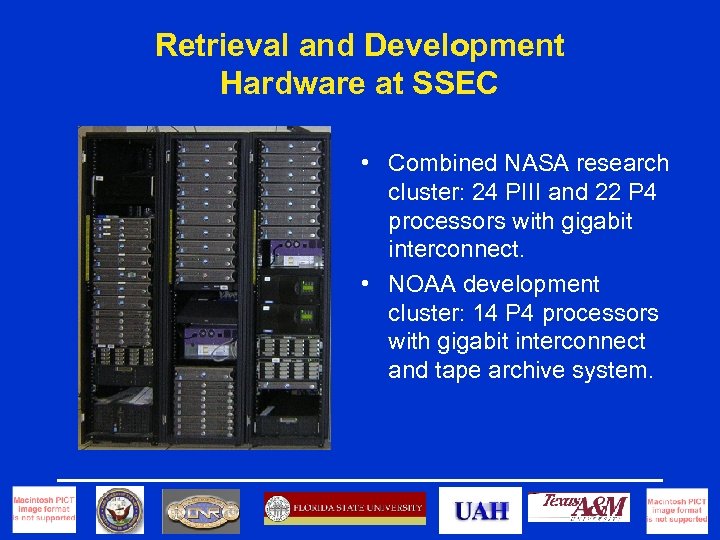 Retrieval and Development Hardware at SSEC • Combined NASA research cluster: 24 PIII and 22 P 4 processors with gigabit interconnect. • NOAA development cluster: 14 P 4 processors with gigabit interconnect and tape archive system.
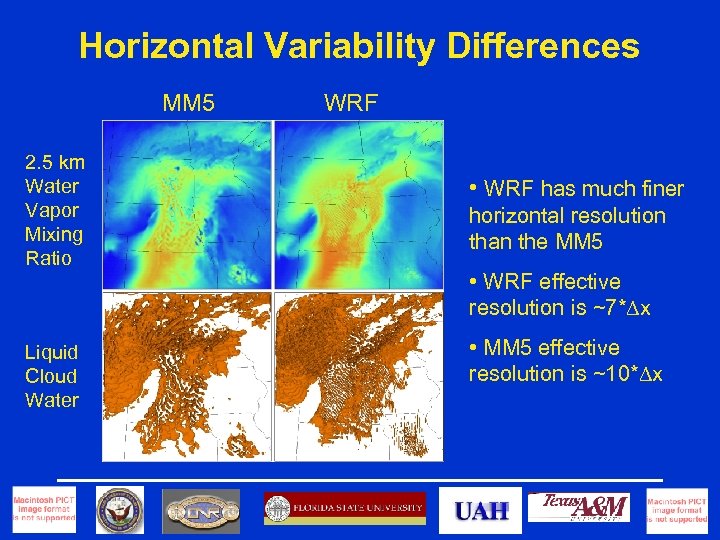 Horizontal Variability Differences MM 5 2. 5 km Water Vapor Mixing Ratio Liquid Cloud Water WRF • WRF has much finer horizontal resolution than the MM 5 • WRF effective resolution is ~7*Dx • MM 5 effective resolution is ~10*Dx
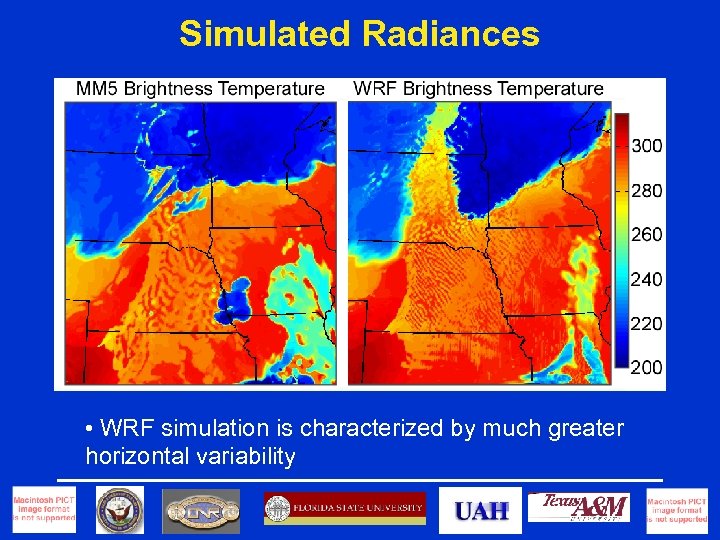 Simulated Radiances • WRF simulation is characterized by much greater horizontal variability
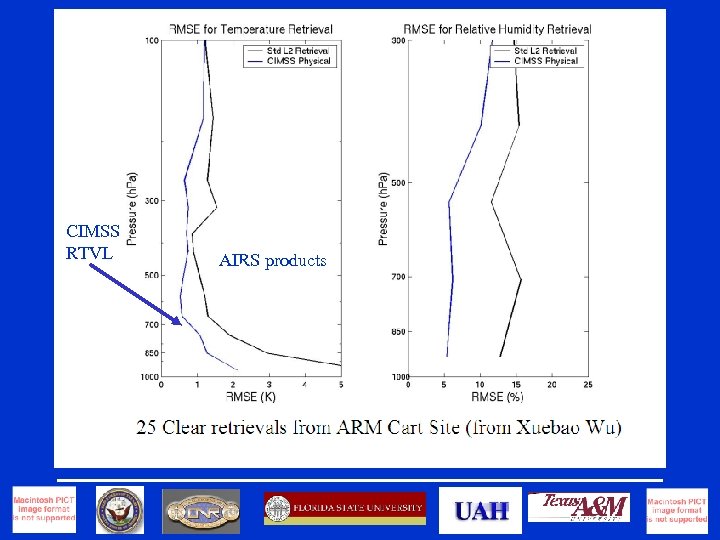
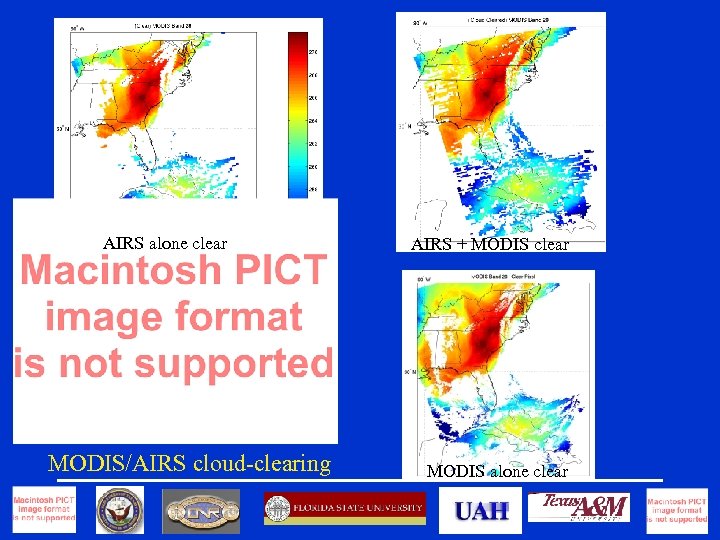
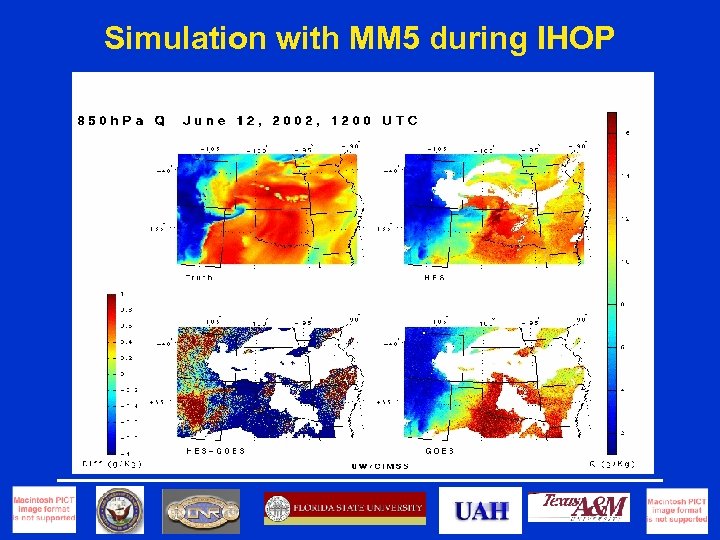
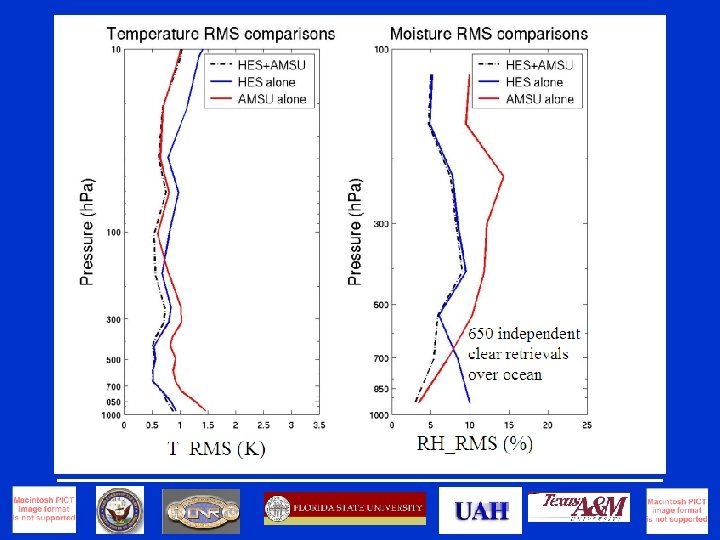
 Hyperspectal Temperature and Moisture Retrieval Highlights • Clear sky sounding retrieval algorithm has been tested using AIRS data. Both regression and physical retrieval work reliably. • Cube data study from IHOP case has demonstrated that HES provides retrievals with better accuracy and coverage (in partial cloud cover) than the current GOES sounder. • Optimal Imager/Sounder cloud-clearing algorithm (Li et al 2005, June issue of IEEE TGRS) has been developed for single-layer cloudy sounding retrieval. • Imager/Sounder/MW combination is also in progress.
 CIMSS RTVL AIRS products
 AIRS alone clear MODIS/AIRS cloud-clearing AIRS + MODIS clear MODIS alone clear
 Simulation with MM 5 during IHOP
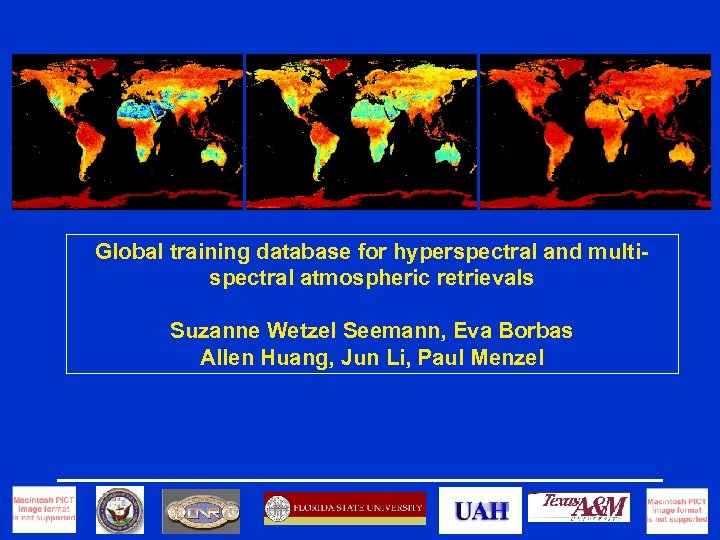 Global training database for hyperspectral and multispectral atmospheric retrievals Suzanne Wetzel Seemann, Eva Borbas Allen Huang, Jun Li, Paul Menzel
 Synthetic regression retrievals of atmospheric properties require a global dataset of temperature, moisture, and ozone profiles. Estimates of surface skin temperature and emissivity are also required to calculate radiances from each profile. Radiosonde temperature-moisture-ozone profile together with calculated MODIS radiances are used to create the synthetic regression relationship for atmospheric retrievals. • We introduce a new data set consisting of global profiles drawn from NOAA-88, ECMWF, TIGR-3, CMDL ozonesondes, and FSL radiosondes. Application of the database to MODIS atmospheric retrievals will be presented for various combinations of profiles and different forward models. • Skin temperature and emissivity values have been assigned to each profile. In earlier satellite regression retrieval algorithms, skin temperature and emissivity were assigned relatively randomly or held constant for each profile. A more physical basis for characterizing the surface is presented here, with emphasis on a new global ecosystembased surface emissivity database.
 III. Meteorological Hyperspectral Product Research Winds, Stability, Turbulence, Volcanic Ash Steve Ackerman, Kristopher Bedka, Wayne Feltz, Robert Knuteson, Suzanne Seemann, Michael Pavolonis, Tony Wimmers
 Feature-tracked winds from AIRS moisture retrievals Christopher Velden and Dave Santek • Goal: To demonstrate tracking features in AIRS retrieved moisture fields to derive wind profiles. • Single Field of View [SFOV] retrievals were obtained from the CIMSS retrieval group to achieve the needed spatial resolution for tracking features. The operational 3 x 3 retrieval would result in 50 km pixels; much too low resolution. • To-date, vectors derived in cloud-free regimes only to avoid cloud contamination. • Initial results are encouraging.
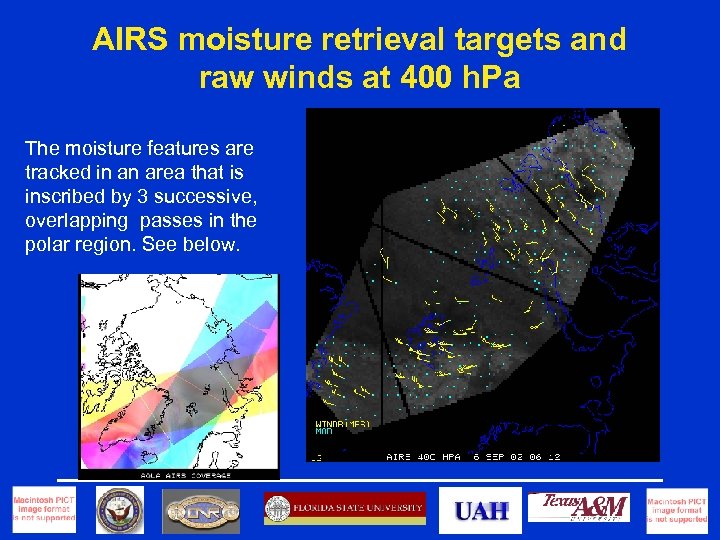 AIRS moisture retrieval targets and raw winds at 400 h. Pa The moisture features are tracked in an area that is inscribed by 3 successive, overlapping passes in the polar region. See below.
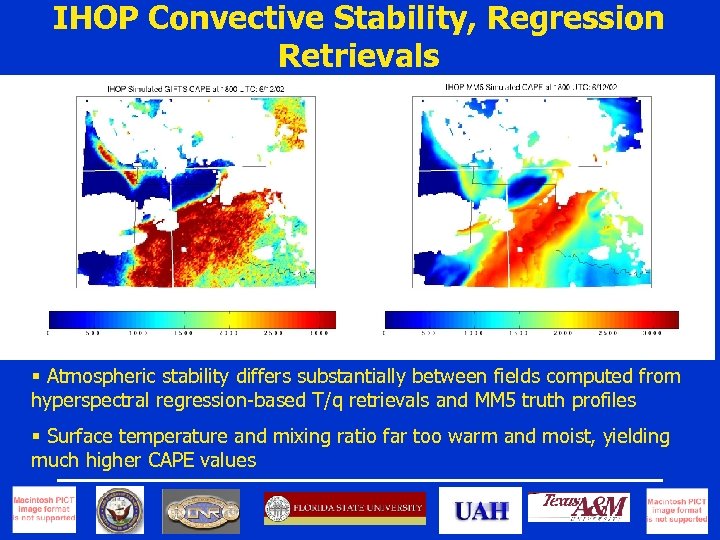 IHOP Convective Stability, Regression Retrievals § Atmospheric stability differs substantially between fields computed from hyperspectral regression-based T/q retrievals and MM 5 truth profiles § Surface temperature and mixing ratio far too warm and moist, yielding much higher CAPE values
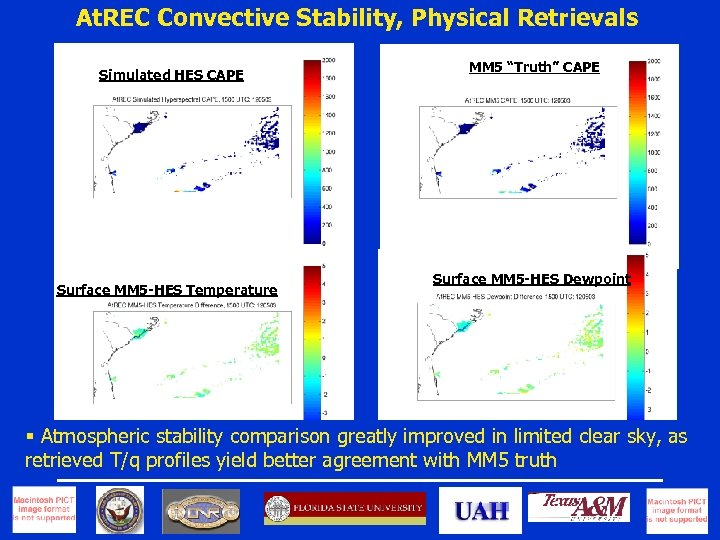 At. REC Convective Stability, Physical Retrievals Simulated HES CAPE Surface MM 5 -HES Temperature MM 5 “Truth” CAPE Surface MM 5 -HES Dewpoint § Atmospheric stability comparison greatly improved in limited clear sky, as retrieved T/q profiles yield better agreement with MM 5 truth
 Volcanic Ash work at CIMSS Mike Pavolonis/Steve Ackerman Key activities: 1). development of an automated ash detection algorithms that are applicable to a large variety of satellite imagers 2). Pursuing methods to determine ash plume heights based on available spectral information
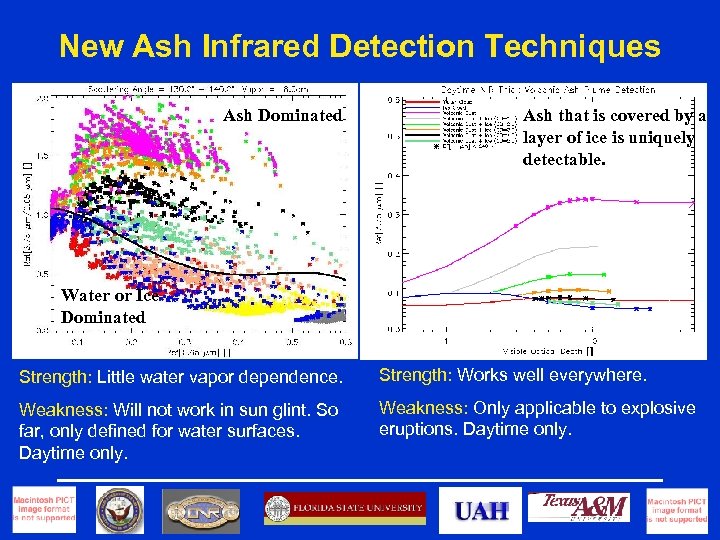 New Ash Infrared Detection Techniques Ash Dominated Ash that is covered by a layer of ice is uniquely detectable. Water or Ice Dominated Strength: Little water vapor dependence. Strength: Works well everywhere. Weakness: Will not work in sun glint. So far, only defined for water surfaces. Daytime only. Weakness: Only applicable to explosive eruptions. Daytime only.
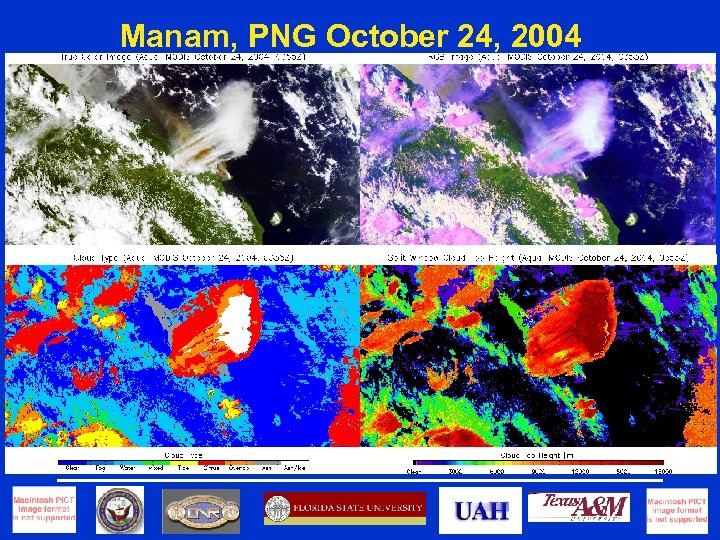 Manam, PNG October 24, 2004
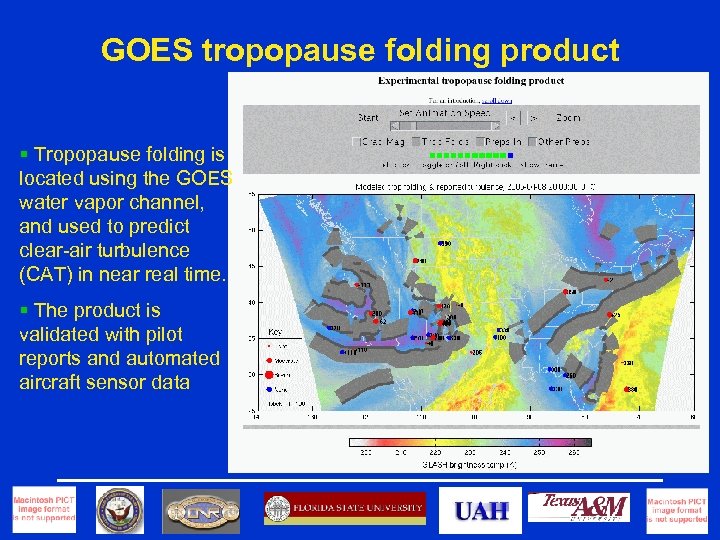 GOES tropopause folding product § Tropopause folding is located using the GOES water vapor channel, and used to predict clear-air turbulence (CAT) in near real time. § The product is validated with pilot reports and automated aircraft sensor data
 MURI Highlights • New computer greatly improved capacity to produce higher resolution NWP simulations needed to investigate future hyperspectral resolution capabilities • Basic research has been honed to focus on current and future meteorological forecasting needs specifically with toward aviation hazards and severe weather conditions • Leveraging with other hyperspectral funding (GOES-R Risk Reduction) to support general Navy, NOAA, and NASA hyperspectral science • More than 30 conference papers and 15 journal papers published with MURI related efforts: http: //cimss. ssec. wisc. edu/muri/ This basic research provides a solid foundation for prototyping Naval hyperspectral meteorological application system