


 Скачать презентацию UTS CENTRE FORENSIC SCIENCE The Current State of
fa2e3e01fde8795fb50444c4f2b5a5ac.ppt
- Количество слайдов: 20
 UTS: CENTRE FORENSIC SCIENCE The Current State of Affairs and Trends in the Crime Laboratory - Developments in the Last Ten Years - New Issues Facing the Trace Examiner Australian & New Zealand Perspective Prof. Claude Roux University of Technology, Sydney, Australia claude. roux@uts. edu. au Presented at the Trace Evidence Symposium, Clearwater Beach FL, 13 -16 August 2007
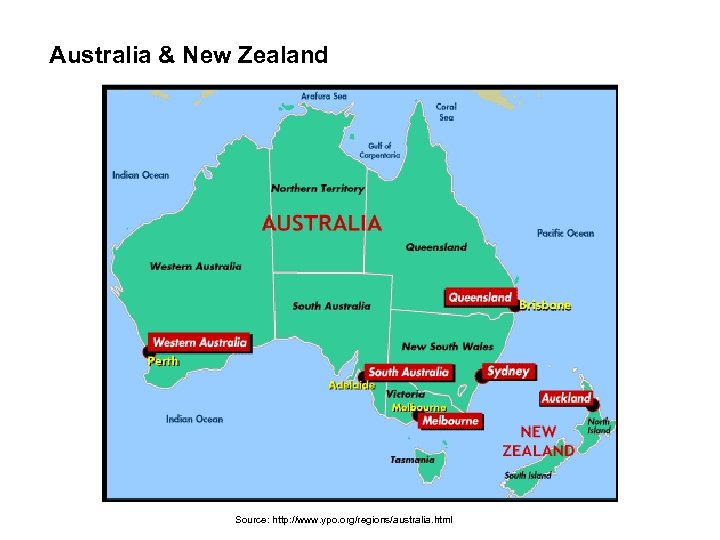 Australia & New Zealand Source: http: //www. ypo. org/regions/australia. html
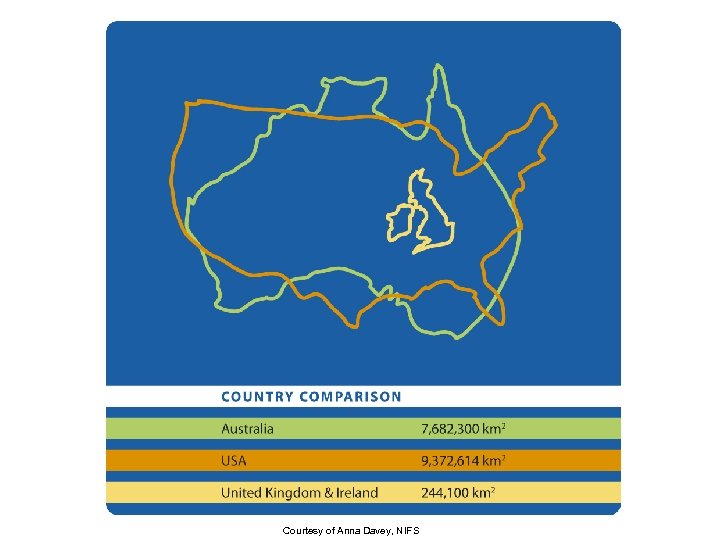 Courtesy of Anna Davey, NIFS

 UTS: CENTRE FORENSIC SCIENCE Background to Australia and New Zealand — Multi-jurisdictions — Provision of forensic science can vary: • Central or ‘full service’ labs, embedded with field services • Two main services: field and labs • Three of more services: field, Police lab and ‘other’ government lab(s) — Main groups: • NIFS: National Institute of Forensic Science • SMANZFL: Senior Managers of Australian & NZ Forensic Laboratories – Specialist Advisory Groups (SAG), eg. for trace: C-SAG and B-SAG — Increasing interest in R&D, including funding opportunities and partnerships
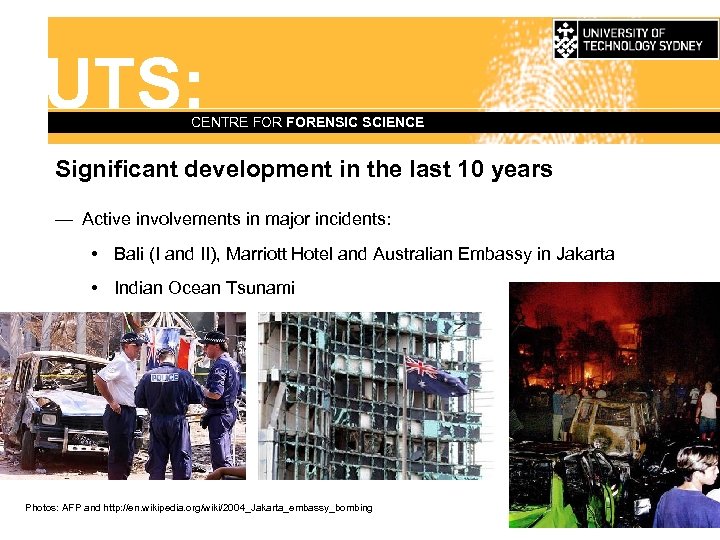 UTS: CENTRE FORENSIC SCIENCE Significant development in the last 10 years — Active involvements in major incidents: • Bali (I and II), Marriott Hotel and Australian Embassy in Jakarta • Indian Ocean Tsunami Photos: AFP and http: //en. wikipedia. org/wiki/2004_Jakarta_embassy_bombing
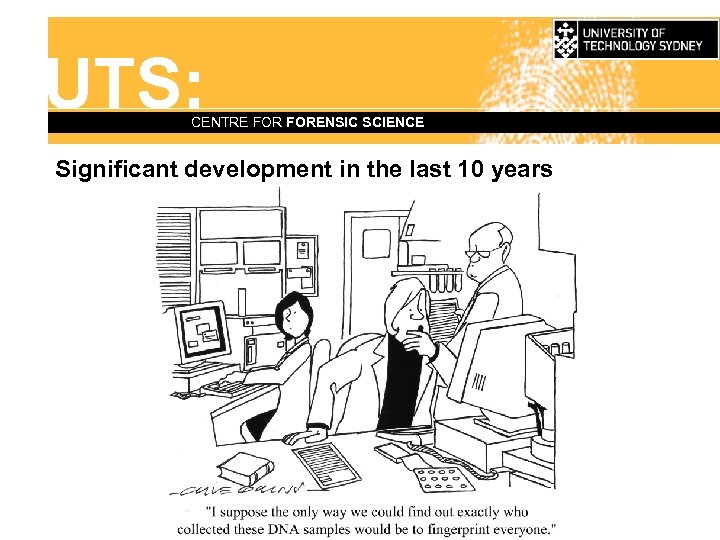 UTS: CENTRE FORENSIC SCIENCE Significant development in the last 10 years
 UTS: CENTRE FORENSIC SCIENCE Significant development in the last 10 years — DNA = new benchmark • Affected the status and resourcing of trace evidence: impacted on lab infrastructure and processes and altered the evidence mix. • DNA ‘raised the bar’ of forensic evidence interpretation. • DNA continues to evolve and there is a new emphasis on how and when the DNA was transferred - advent of biological criminalistics real trace evidence topic. • This puts new emphasis on reconstruction of events and sets new challenges for trace evidence.
 UTS: CENTRE FORENSIC SCIENCE Significant development in the last 10 years — Some progress made towards a better understanding of the value of trace evidence (through studies into the application of Bayesian statistics) – however not enough. — Improvements in analytical instrumentation (improved sensitivity and specificity). — Progress with respect to instrument miniaturisation, permitting some analyses to be conducted at or near the crime scene. — But emerging technologies need to find their right place in the new environment!
 UTS: CENTRE FORENSIC SCIENCE Significant development in the last 10 years — In most jurisdictions, ultra-specialisation is not viable anymore - we need a generalist approach: • In trace evidence this can be seen as materials focused scientists with the ability to apply microscopy techniques at the front end, followed by more specialised analytical techniques. — However, growing need for specialist services that are not necessarily offered as core in this 'generalist' approach : • eg. soils - not sufficient cases to warrant in house expertise. • Centres of specialisation is an important direction (eg. the CSIRO Forensic Soils Unit)
 UTS: CENTRE FORENSIC SCIENCE Issues and Challenges — The need forensic science to be more proactive (rather than reactive) in order to provide better intelligence earlier in the investigation. — Laboratory backlogs, laboratory backlogs, and…. laboratory backlogs (increasing pressure to reduce turnaround times!). • The backlog in forensic laboratories is NOT about analytical technologies (otherwise there would be no backlog in DNA labs!) but is about the time needed to search items submitted in the laboratory.
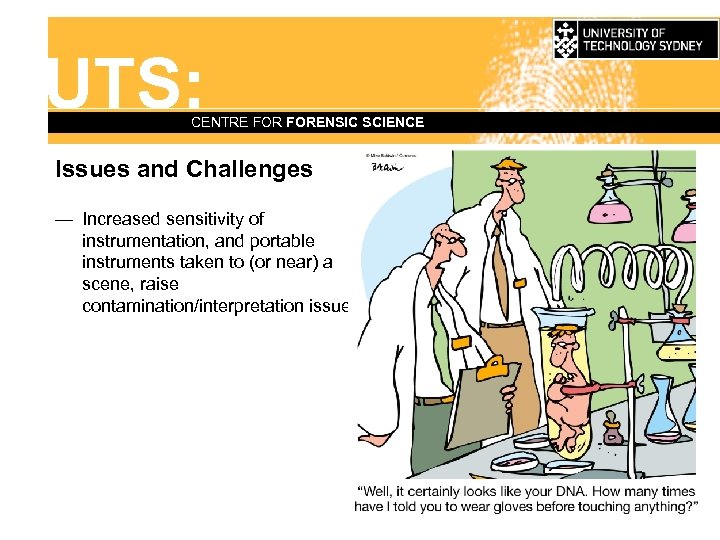 UTS: CENTRE FORENSIC SCIENCE Issues and Challenges — Increased sensitivity of instrumentation, and portable instruments taken to (or near) a scene, raise contamination/interpretation issues.
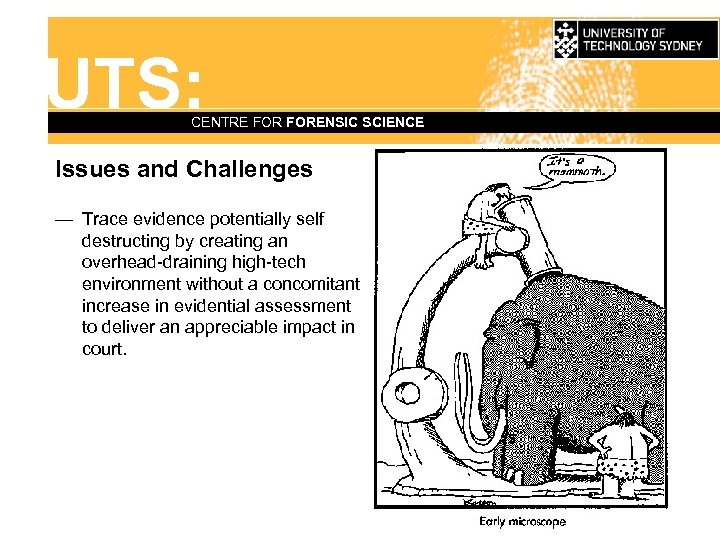 UTS: CENTRE FORENSIC SCIENCE Issues and Challenges — Trace evidence potentially self destructing by creating an overhead-draining high-tech environment without a concomitant increase in evidential assessment to deliver an appreciable impact in court.
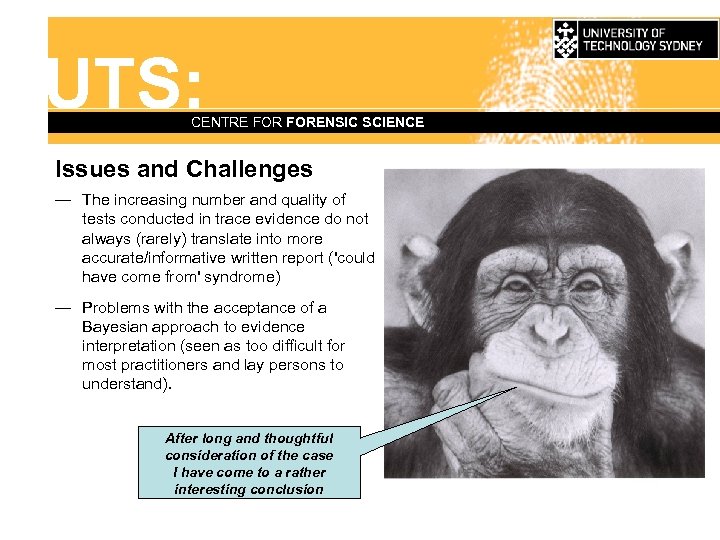 UTS: CENTRE FORENSIC SCIENCE Issues and Challenges — The increasing number and quality of tests conducted in trace evidence do not always (rarely) translate into more accurate/informative written report ('could have come from' syndrome) — Problems with the acceptance of a Bayesian approach to evidence interpretation (seen as too difficult for most practitioners and lay persons to understand). After long and thoughtful consideration of the case I have come to a rather interesting conclusion
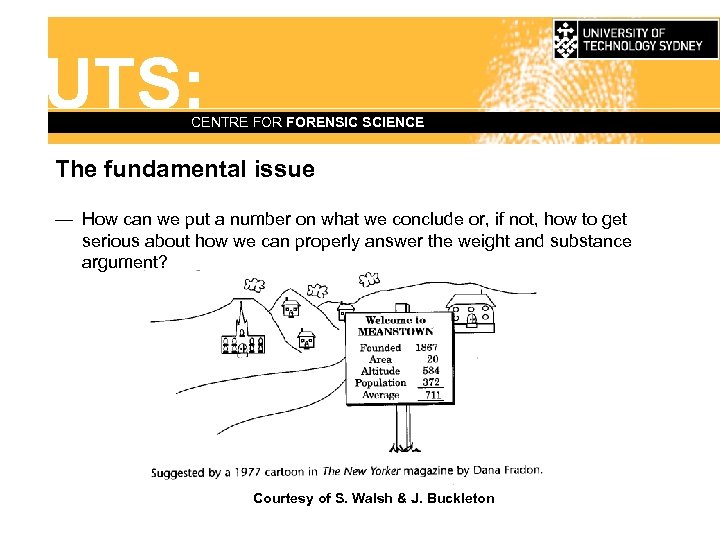 UTS: CENTRE FORENSIC SCIENCE The fundamental issue — How can we put a number on what we conclude or, if not, how to get serious about how we can properly answer the weight and substance argument? Courtesy of S. Walsh & J. Buckleton
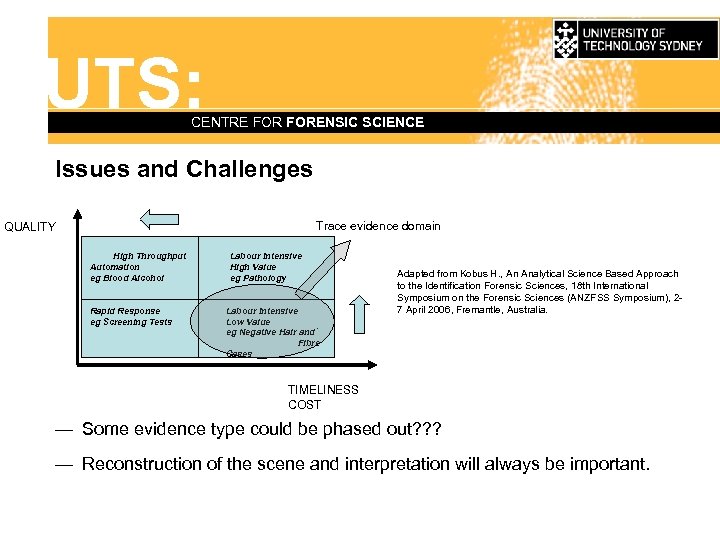 UTS: CENTRE FORENSIC SCIENCE Issues and Challenges Trace evidence domain QUALITY High Throughput Automation eg Blood Alcohol Rapid Response eg Screening Tests Labour Intensive High Value eg Pathology Labour Intensive Low Value eg Negative Hair and` Fibre Cases Adapted from Kobus H. , An Analytical Science Based Approach to the Identification Forensic Sciences, 18 th International Symposium on the Forensic Sciences (ANZFSS Symposium), 27 April 2006, Fremantle, Australia. TIMELINESS COST — Some evidence type could be phased out? ? ? — Reconstruction of the scene and interpretation will always be important.
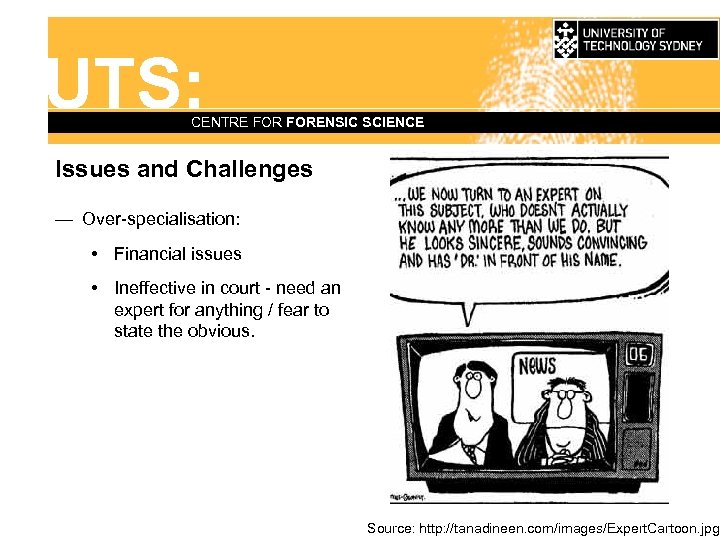 UTS: CENTRE FORENSIC SCIENCE Issues and Challenges — Over-specialisation: • Financial issues • Ineffective in court - need an expert for anything / fear to state the obvious. Source: http: //tanadineen. com/images/Expert. Cartoon. jpg
 UTS: CENTRE FORENSIC SCIENCE Strategic Directions — Move towards more 'forensic intelligence' to direct investigations. — More generalist approach: • Focus on criminalistics more than on specialised sub-disciplines. • Forensic triage using multi-disciplinary approach to harvest potential evidence. — More onsite analyses (building on the advantages of portable instruments): • Will maximise the benefit of the central laboratory. • At least part of the future answer to case management has to be cleverer examination and triage at the scene to better inform item collection. — The future of criminalistics is more in hand of crime scene investigators because of new portable technologies as well as strategic/policy focus on DNA and fingerprints.
 UTS: CENTRE FORENSIC SCIENCE Strategic Directions — Quick retrieving of categorisation-level information (linking of cases) as opposed to identification and/or discrimination driven approaches: • Provides a coherent approach across the board and fits with the intelligence drive. • Will decrease the backlog. — Worry less about the apparent low discrimination abilities of trace evidence and focus on the fact that it is a value-added source of information for the reconstruction of a case, or, more broadly, for investigative purposes. • This kind of information is rarely obtained with other types of forensic evidence, especially those focusing on identification only.
 UTS: CENTRE FORENSIC SCIENCE Acknowledgements — NIJ for the invitation — Members of the Australian & NZ Forensic Science community who provided feedback and thoughts, in particular: • Dr John Buckleton, ESR, Auckland • Dr Hilton Kobus, SA Forensic Science Centre, Adelaide. • Prof Chris Lennard, University of Canberra • Dr James Robertson, AFP, Canberra • David Royds, AFP, Canberra • Kevan Walsh, ESR, Auckland • Simon Walsh, AFP, Canberra