Скачать презентацию Utilizing e CRM Supply Chain Novell e Directory
f00e5636b54d8d608cc80727721dca4d.ppt
- Количество слайдов: 61
 Utilizing e. CRM, Supply Chain, Novell e. Directory™, and Security Solutions in the Transportation Sector www. novell. com Lawrence Rosenshein Senior Digital Business Strategist Strategic Services Group Novell, Inc. Lawrence. Rosenshein@novell. com Charles Radi Strategic Services Group Novell, Inc. Charles. Radi@novell. com
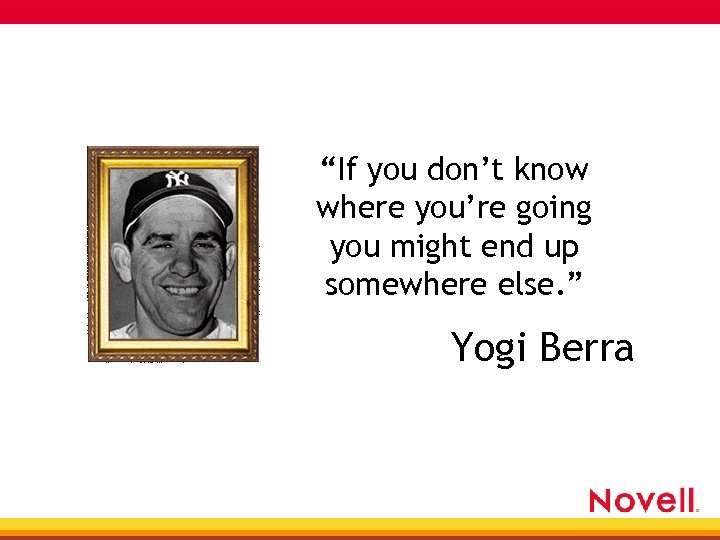 “If you don’t know where you’re going you might end up somewhere else. ” Yogi Berra
 Objectives • one Net Overview • Forces Driving the Transportation Industry • Current developments in Transportation 4 Ocean Shipping Industry as metaphor • A Multi-Modal Transportation Provider 4 A Novell Case Study
 Agenda one Net Overview
 Vision…one Net A world where networks of all types—corporate and public, intranets, extranets, and the Internet—work together as one Net and securely connect employees, customers, suppliers, and partners across organizational boundaries Mission To solve complex business and technical challenges with Net business solutions that enable people, processes, and systems to work together and our customers to profit from the opportunities of a networked world
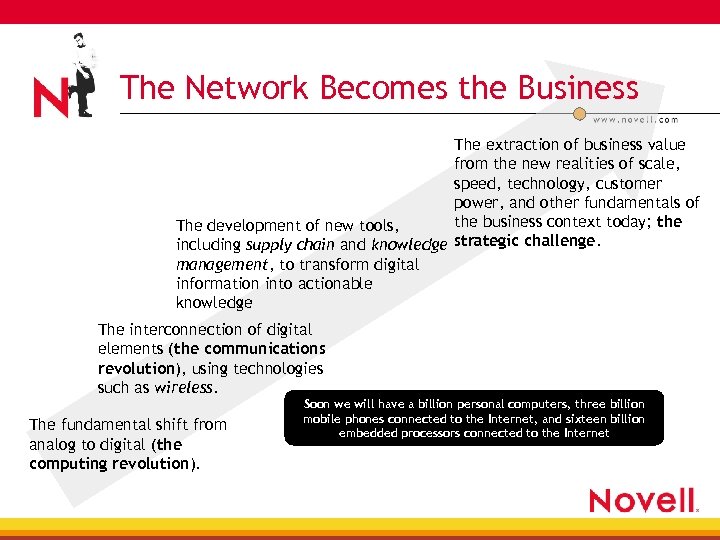 The Network Becomes the Business The extraction of business value from the new realities of scale, speed, technology, customer power, and other fundamentals of the business context today; the The development of new tools, including supply chain and knowledge strategic challenge. management, to transform digital information into actionable knowledge The interconnection of digital elements (the communications revolution), using technologies such as wireless. The fundamental shift from analog to digital (the computing revolution). Soon we will have a billion personal computers, three billion mobile phones connected to the Internet, and sixteen billion embedded processors connected to the Internet
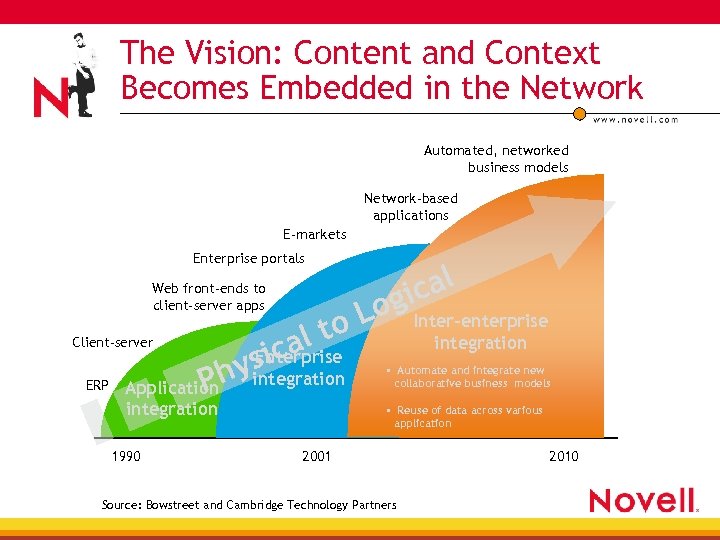 The Vision: Content and Context Becomes Embedded in the Network Automated, networked business models Network-based applications E-markets Enterprise portals Web front-ends to client-server apps cal ysi Client-server ERP Ph Application Lo to Enterprise integration 1990 cal gi Inter-enterprise integration • Automate and integrate new collaborative business models • Reuse of data across various application 2001 Source: Bowstreet and Cambridge Technology Partners 2010
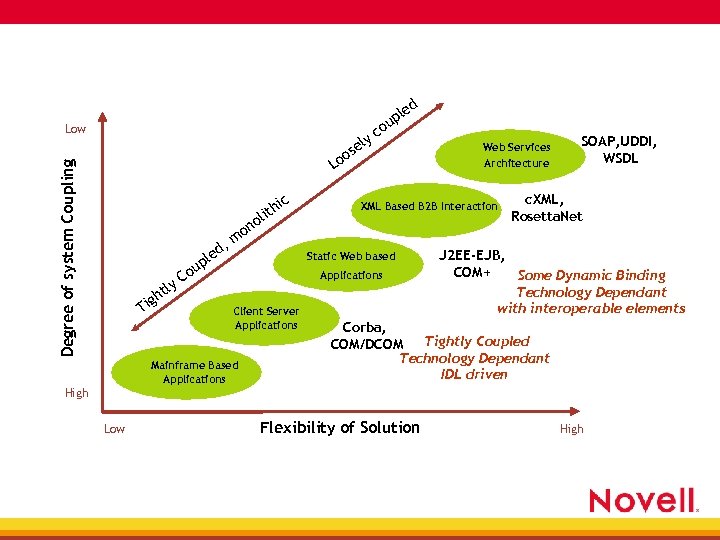 ed l up o Low Degree of system Coupling Lo c hi lit , gh C ly t Ti ed pl ou c ly e os XML Based B 2 B Interaction o on m Static Web based Applications Client Server Applications Mainframe Based Applications Web Services Architecture SOAP, UDDI, WSDL c. XML, Rosetta. Net J 2 EE-EJB, COM+ Some Dynamic Binding Technology Dependant with interoperable elements Corba, Tightly Coupled COM/DCOM Technology Dependant IDL driven High Low Flexibility of Solution High
 The Internet Is Infrastructure • The Internet is infrastructure, like roads or lighthouses, which benefits everyone but no one company in particular • Standards are extending now from the physical and technical to the logical and business layers • We’re building the logical infrastructure on top of the physical infrastructure
 Transportation Is in the Forefront • The next wave is machines talking to machines • Networked business models will become reality • Best of breed outsourcing and coupling • Business processes will be re-built 4 Bottom-up approach 4 Loosely coupled (and de-coupled) web services 4 Dynamically done based on real-time needs 4 Cost structures can be greatly reduced
 Agenda Forces Driving the Transportation Sector
 Forces Driving the New Economy Nearly Every Industry Is Affected • Globalization of markets • Deregulation and privatization of markets • Disinflationary economies, coupled with capital abundance • Consumer power 4 Disintermediation of non-value added channels 4 Products become content-rich vs. engineering rich 4 Consumers break traditional brick and mortar rules • Communications ubiquity • Heightened emphasis on innovation
 New Economy Businesses Are Driven by Six Characteristics • • • Scale—coalition of independent entities Speed—velocity is changing market behavior Technology—rapid assimilation of new capabilities Customer-Centricity—they measure your loyalty Intellectual Capital—putting a price on brains Trust—yours to lose The best of today’s players in the new economy excel at all six. *see Cambridge’s New Economy Primer, Redefining Customer Acquisition, Business Models for the New Economy, and Creating Value Through Innovation for more information on Cambridge thought leadership
 These Characteristics Have Organizational Implications • Smart scaling requires an open organization and a • • • relentless quest for competencies and partnerships Velocity of markets requires focus and flexibility Technology innovation requires an adaptive culture and cooperation between the business and ‘IT’ Customer centric reverse markets require highly informed, motivated, and empowered employees Intellectual capital requires fostering innovation Trust must be embedded in the organization These features must be built into New Economy Business models
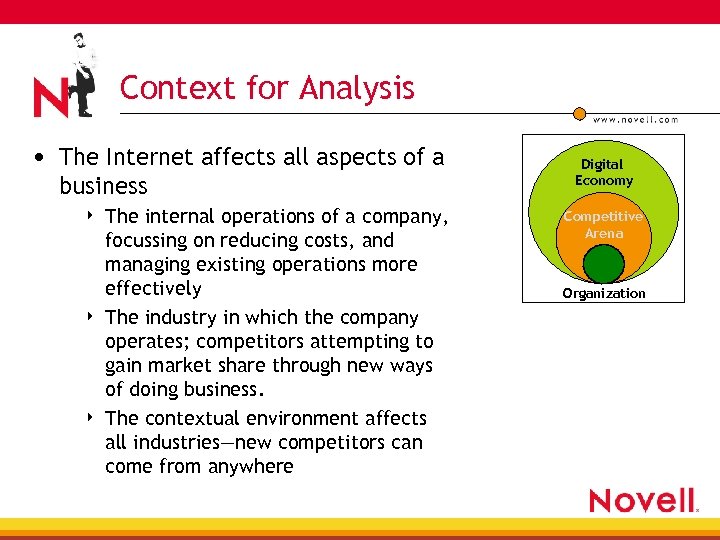 Context for Analysis • The Internet affects all aspects of a business 4 4 4 The internal operations of a company, focussing on reducing costs, and managing existing operations more effectively The industry in which the company operates; competitors attempting to gain market share through new ways of doing business. The contextual environment affects all industries—new competitors can come from anywhere Digital Economy Competitive Arena Organization
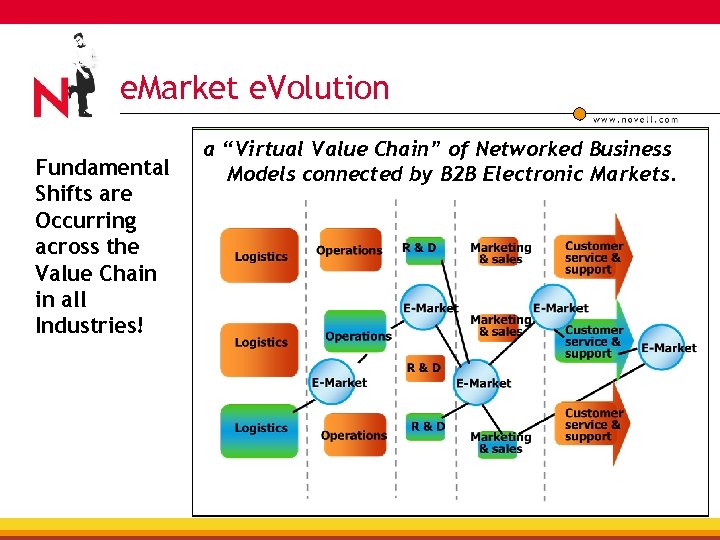 e. Market e. Volution Fundamental Shifts are Occurring across the Value Chain in all Industries! …to an “Integrated Value Networked Business a. From an “Inside. Chain” of Customers, “Virtual Value the 4 Walls” focus on Partners and Suppliers. . . Models connected by B 2 B Electronic Markets. efficiency….
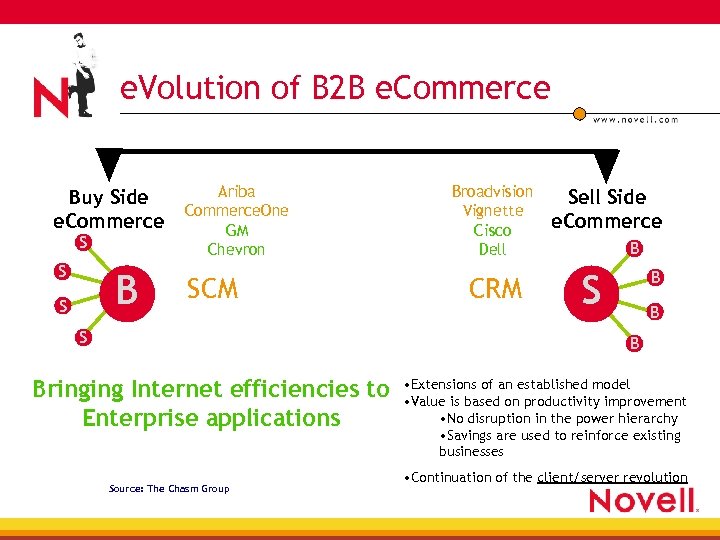 e. Volution of B 2 B e. Commerce Buy Side e. Commerce S S B S Ariba Commerce. One GM Chevron SCM S Broadvision Vignette Cisco Dell CRM Sell Side e. Commerce B S B Bringing Internet efficiencies to Enterprise applications Source: The Chasm Group • Extensions of an established model • Value is based on productivity improvement • No disruption in the power hierarchy • Savings are used to reinforce existing businesses • Continuation of the client/server revolution
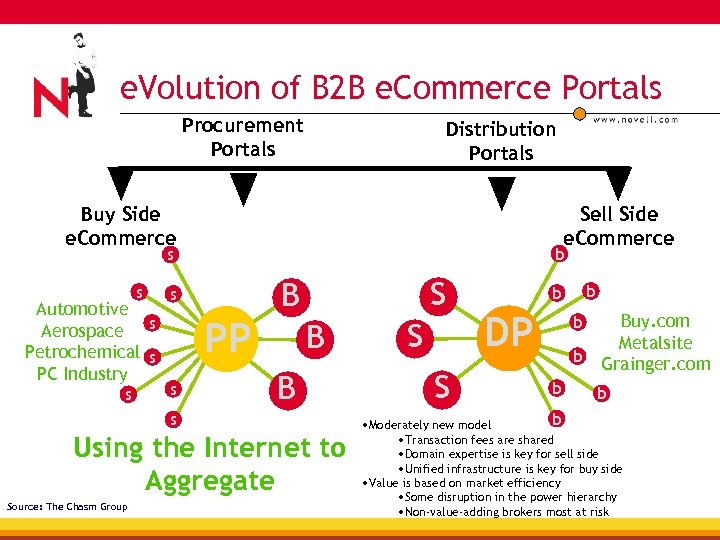 e. Volution of B 2 B e. Commerce Portals Procurement Portals Distribution Portals Buy Side e. Commerce Sell Side e. Commerce b s s Automotive Aerospace s Petrochemical s PC Industry s PP s S B s B B s Using the Internet to Aggregate Source: The Chasm Group S S b b DP b b b Buy. com Metalsite Grainger. com b b • Moderately new model • Transaction fees are shared • Domain expertise is key for sell side • Unified infrastructure is key for buy side • Value is based on market efficiency • Some disruption in the power hierarchy • Non-value-adding brokers most at risk
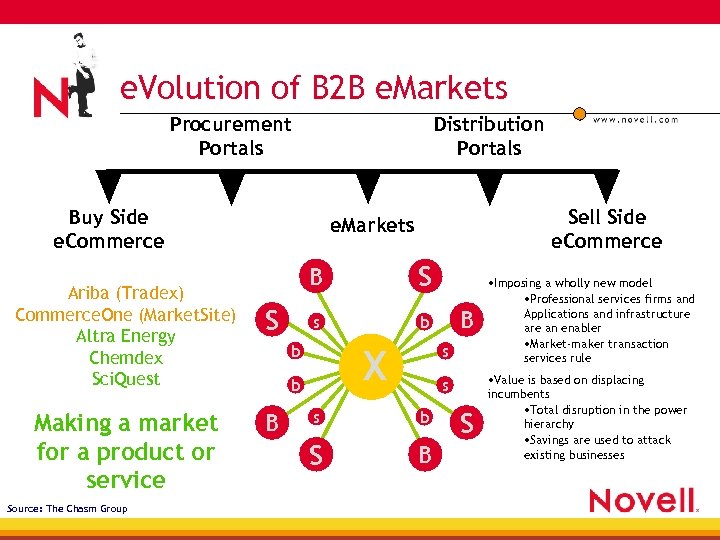 e. Volution of B 2 B e. Markets Procurement Portals Distribution Portals Buy Side e. Commerce Ariba (Tradex) Commerce. One (Market. Site) Altra Energy Chemdex Sci. Quest Making a market for a product or service Source: The Chasm Group Sell Side e. Commerce e. Markets B s S S b b B S • Value is based on displacing incumbents • Total disruption in the power hierarchy • Savings are used to attack existing businesses s X b B • Imposing a wholly new model • Professional services firms and Applications and infrastructure an enabler • Market-maker transaction services rule s s b S B
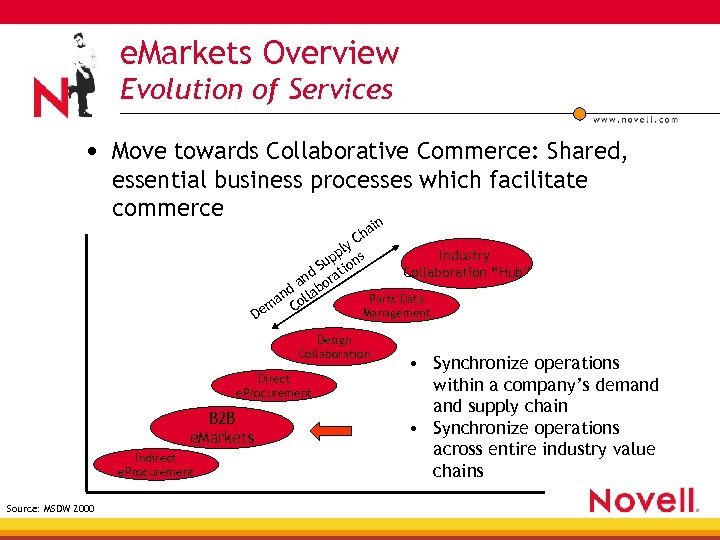 e. Markets Overview Evolution of Services • Move towards Collaborative Commerce: Shared, essential business processes which facilitate commerce n ai Ch ly Industry pp ns Su tio Collaboration “Hub” d an bora d Parts Data an olla em C Management D Design Collaboration Direct e. Procurement B 2 B e. Markets Indirect e. Procurement Source: MSDW 2000 • Synchronize operations within a company’s demand supply chain • Synchronize operations across entire industry value chains
 Strategy Today • Strategy in today’s business environment is complex and subject to rapid change • How can businesses create (and attempt to sustain) competitive advantage to become successful, high performance organizations exploiting distinctive competencies?
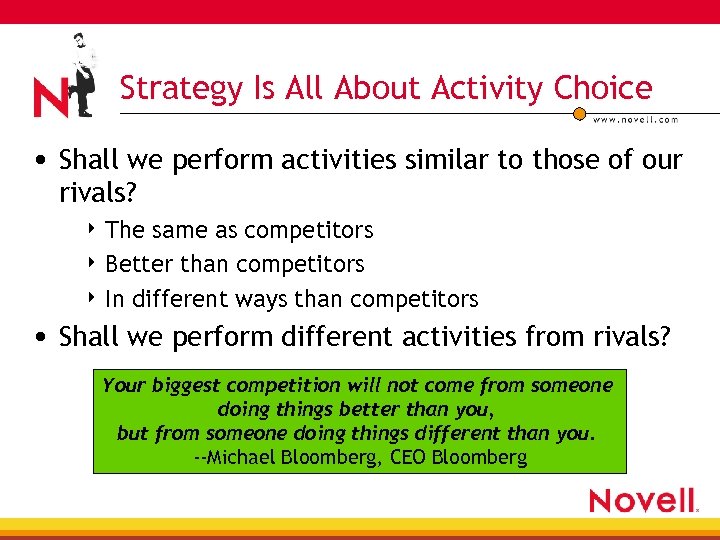 Strategy Is All About Activity Choice • Shall we perform activities similar to those of our rivals? 4 The same as competitors 4 Better than competitors 4 In different ways than competitors • Shall we perform different activities from rivals? Your biggest competition will not come from someone doing things better than you, but from someone doing things different than you. --Michael Bloomberg, CEO Bloomberg
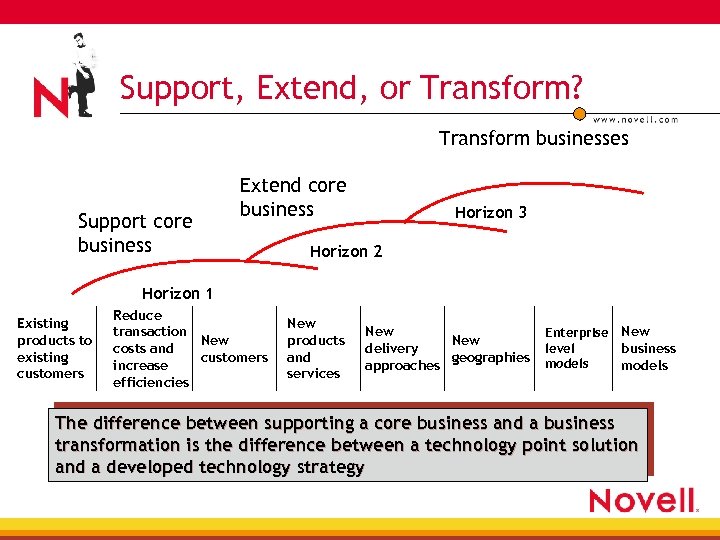 Support, Extend, or Transform? Transform businesses Support core business Extend core business Horizon 3 Horizon 2 Horizon 1 Existing products to existing customers Reduce transaction New costs and customers increase efficiencies New products and services New delivery geographies approaches Enterprise New level business models The difference between supporting a core business and a business transformation is the difference between a technology point solution and a developed technology strategy
 Agenda Current Developments in the Ocean Shipping Industry
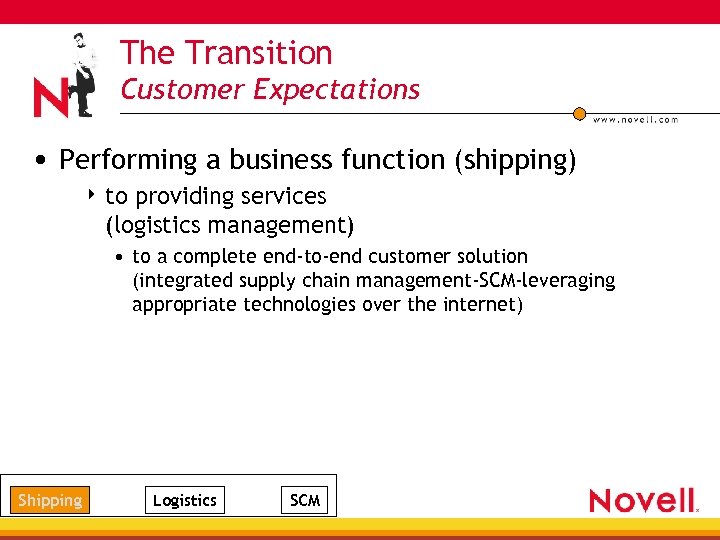 The Transition Customer Expectations • Performing a business function (shipping) 4 to providing services (logistics management) • to a complete end-to-end customer solution (integrated supply chain management-SCM-leveraging appropriate technologies over the internet) Shipping Logistics SCM
 The Transition Why It’s Happening • The New Economy values intellectual capital over material capital - the Internet enables the transition 4 4 4 The Internet is ubiquitous…it evens the playing field The Internet shifts power in the industry from those that best manage hard assets, to those that best manage the information associated with hard assets Information allows better management decisions, both internally (business operations) and externally (business model analysis); information that enables better management decisions commands a premium in the market and, in turn, commoditizes hard assets • Doing things right does not matter if you’re not doing the right things Shipping Logistics SCM
 The Transition Shipping—The Material Assets • Shipping allows companies to move product from one point to another 4 Flexibility in scheduling, quality of service, and the general level of perceived value are all components of how customers evaluate their shipping partners • Shipping is a business function, associated with logistics management, as part of the customers’ management of their supply chains Shipping Logistics SCM
 The Transition Logistics—Managing the Assets’ Information • Logistics is a process which interfaces and interacts with the entire company and with external companies, vendors, customers, carriers and more • Logistics is responsible for the movement of products from your vendors right through to the delivery at your customer's door, including moves through manufacturing facilities, warehouses, third-parties, such as repackagers or distributors • It is not shipping and receiving, nor is it traffic or warehousing. . . it is much more Shipping Logistics SCM
 The Transition Logistics—The Five Components • Movement of product—Shipping Company core • • Shipping business Movement of information—Information-timely and accurate—is vital for sound decision-making Time/service—The ability to respond to the dynamics of the global marketplace Cost—often the key metric by which logistics effectiveness is measured. Integration—within your company, between you and your customers, between you and your vendors, across your supply chain, across the industry’s value chain b Logistics SCM new d The oun egr ttl a
 The Transition: Customer Solutions—End -to-End Supply Chain Management • Customer solutions offer competitive advantage • The industry is shifting to a focus on complete customer solutions 4 4 Few companies will be able to provide world-class end-to-end supply chain solutions A complete solution will be made up of a tightly integrated group of partnerships and alliances • A companies’ value will be measured by how well they perform their particular activities but also, how well they coordinate with their partners in providing the customer with a complete supply chain solution Shipping Logistics SCM
 The Transition Supply Chain Management Trends • Companies are demanding supply chain transparency 4 4 Especially in the retail industries, fulfillment of orders, both customer facing and sourcing needs can be a competitive advantage SC transparency allows for more accurate planning and forecasting • Collaborative Planning, Forecasting and Replenishment (CPFR) capability for companies relies on information in the supply chain; the better the information, the better the management tool 4 Shipping “You can funnel virtually your entire supply chain through the Internet, and everybody ends up winning”—Ernie Heether, SVP Merchandise Operations, K-Mart Corporation Logistics SCM
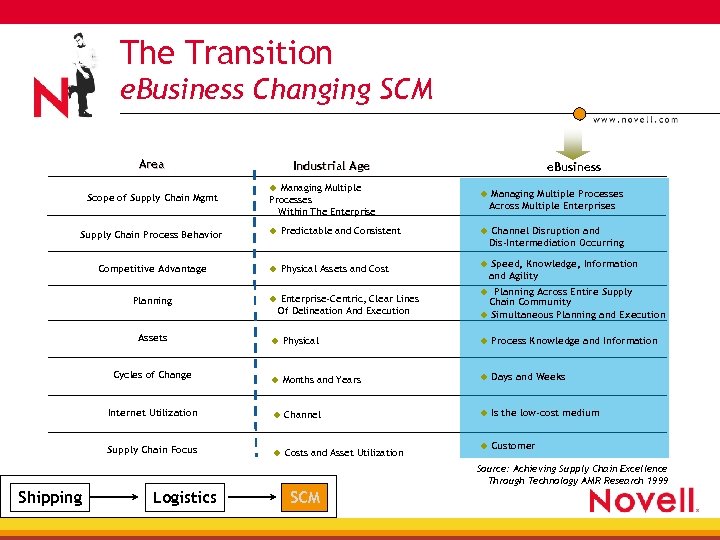 The Transition e. Business Changing SCM Area Scope of Supply Chain Mgmt Supply Chain Process Behavior Competitive Advantage Planning Assets Industrial Age u Managing Multiple Processes Within The Enterprise u Predictable and Consistent u Physical Assets and Cost u Enterprise-Centric, Clear Lines Of Delineation And Execution e. Business u Managing Multiple Processes Across Multiple Enterprises u Channel Disruption and Dis-Intermediation Occurring u Speed, Knowledge, Information and Agility u Planning Across Entire Supply Chain Community u Simultaneous Planning and Execution u Physical u Process Knowledge and Information u Months and Years u Days and Weeks Internet Utilization u Channel u Is the low-cost medium Supply Chain Focus u Costs and Asset Utilization Cycles of Change u Customer Source: Achieving Supply Chain Excellence Through Technology AMR Research 1999 Shipping Logistics SCM
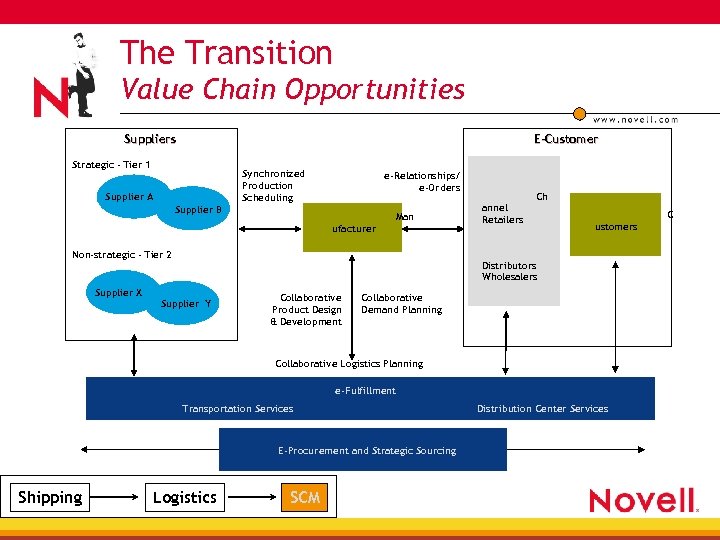 The Transition Value Chain Opportunities Suppliers E-Customer Strategic - Tier 1 Supplier A Supplier B Synchronized Production Scheduling e-Relationships/ e-Orders ufacturer Man Non-strategic - Tier 2 annel Retailers Ch ustomers Distributors Wholesalers Supplier X Supplier Y Collaborative Product Design & Development Collaborative Demand Planning Collaborative Logistics Planning e-Fulfillment Transportation Services E-Procurement and Strategic Sourcing Shipping Logistics SCM Distribution Center Services C
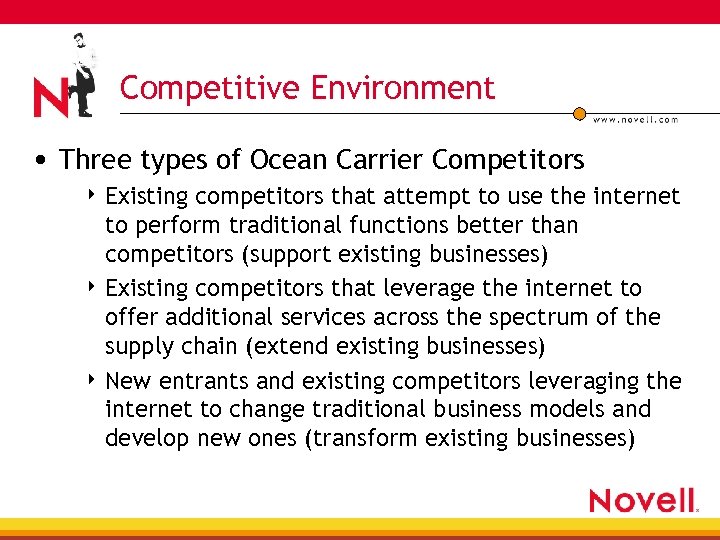 Competitive Environment • Three types of Ocean Carrier Competitors 4 Existing competitors that attempt to use the internet to perform traditional functions better than competitors (support existing businesses) 4 Existing competitors that leverage the internet to offer additional services across the spectrum of the supply chain (extend existing businesses) 4 New entrants and existing competitors leveraging the internet to change traditional business models and develop new ones (transform existing businesses)
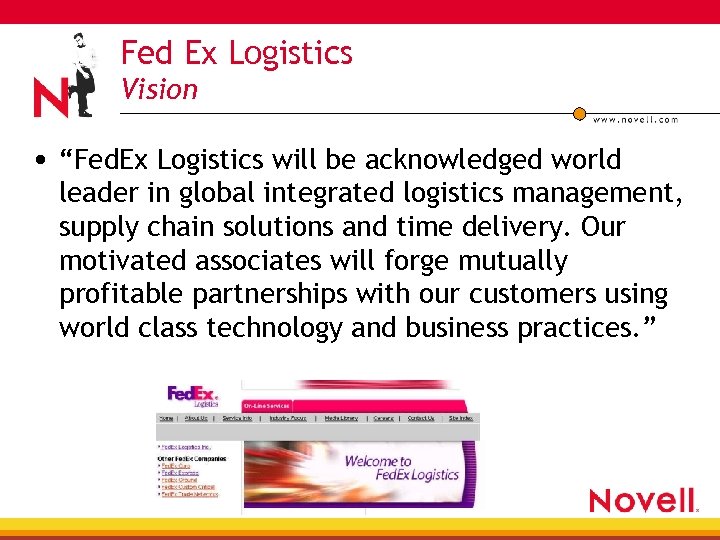 Fed Ex Logistics Vision • “Fed. Ex Logistics will be acknowledged world leader in global integrated logistics management, supply chain solutions and time delivery. Our motivated associates will forge mutually profitable partnerships with our customers using world class technology and business practices. ”
 Agenda A Multi-Modal Transportation Provider 4 A Novell Case Study of Client X
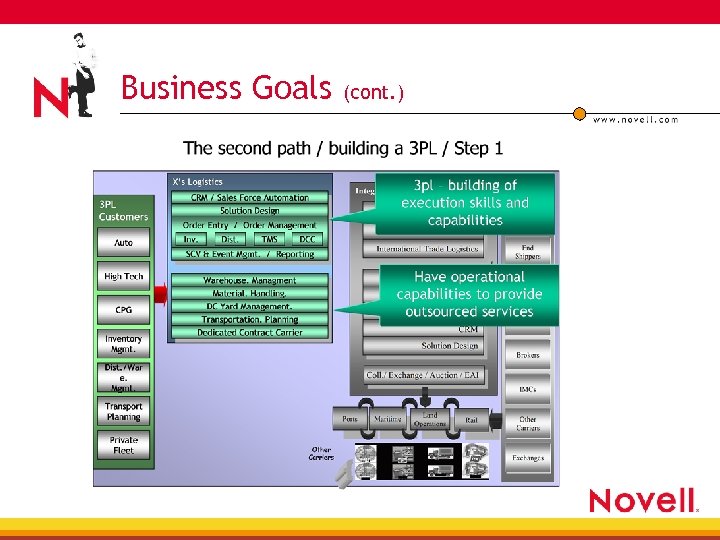
 One of the Largest Latin American Transportation Providers • Founded in mid-’ 50 s • Integral part of NAFTA success • Now a Novell Client
 Strategic Vision Statement “Integrated door-to-door-all-in logistics multimodal transportation services providing one-stop-shop master-contractor convenience to its clients. ”
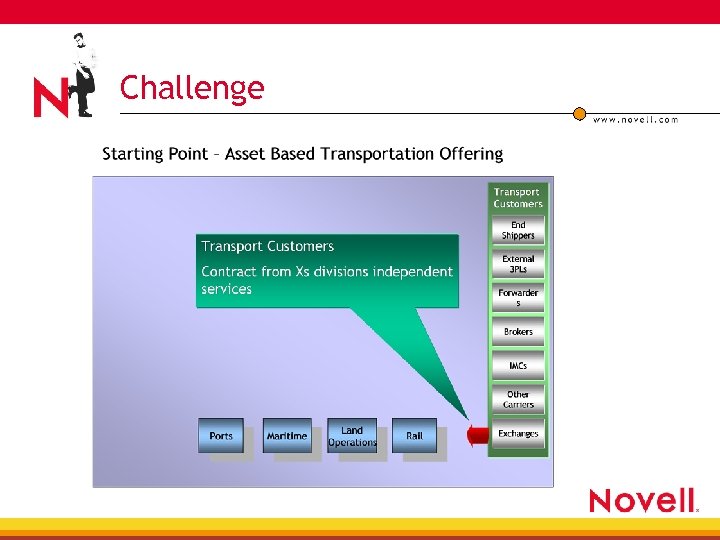 Challenge
 Business Goals
 Business Goals (cont. )
 Strategic Target
 Project Overview—PDW/PEW • Objective 4 Define the digital product that will support the requirements given by the first set of customers in terms of functionality, technical architecture and look and feel (User Experience). As part of the project the multidisplinary team will also evaluate the technical tools, packages and plataforms that will support X’s Logistics Group • To achieve the objective the following tasks were performed: 4 4 4 Definition of the high level business processes Definition of the functional requirements and prioritization of them Definition of the future state architecture Definition of the User Experience or Visual Architecture Technology evaluation to select the players for the final platform
 Project Overview • Deliverables 4 High Level business processes 4 Functional Requirements (through the functionality matrix) 4 Future State e. Business Architecture 4 Visual Architecture (including storyboard) 4 Packages’ evaluation and possible scenarios 4 High level gap analysis 4 Final Presentation
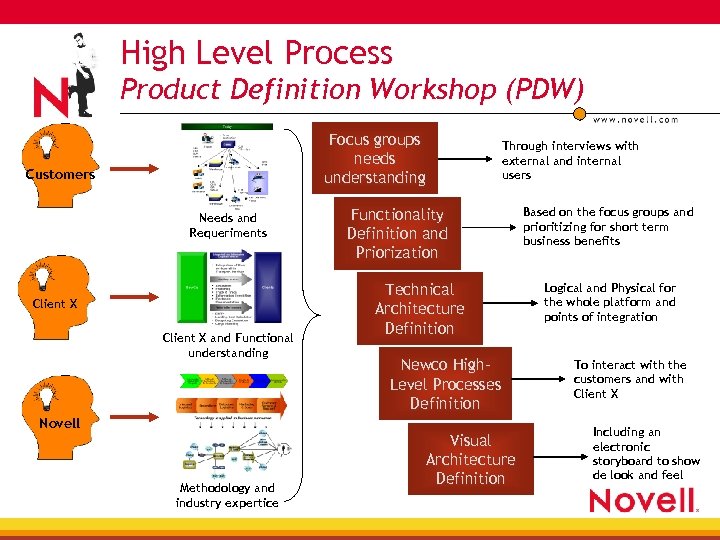 High Level Process Product Definition Workshop (PDW) Focus groups needs understanding Customers Needs and Requeriments Client X and Functional understanding Novell Methodology and industry expertice Through interviews with external and internal users Functionality Definition and Priorization Technical Architecture Definition Newco High. Level Processes Definition Visual Architecture Definition Based on the focus groups and prioritizing for short term business benefits Logical and Physical for the whole platform and points of integration To interact with the customers and with Client X Including an electronic storyboard to show de look and feel
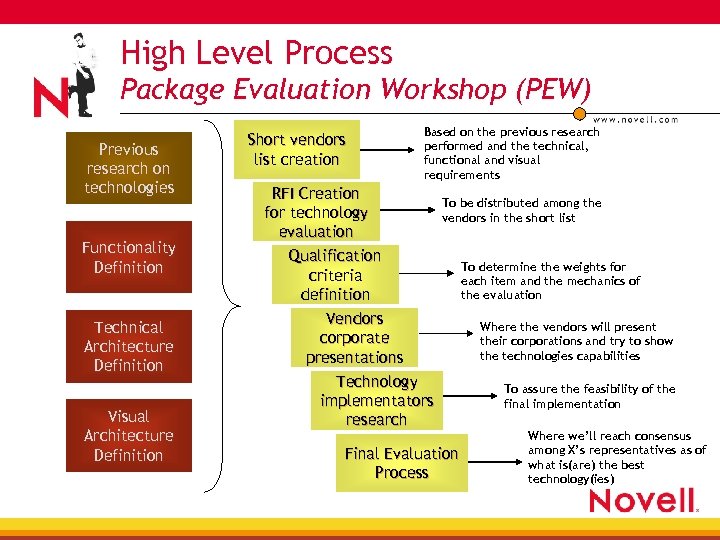 High Level Process Package Evaluation Workshop (PEW) Previous research on technologies Functionality Definition Technical Architecture Definition Visual Architecture Definition Short vendors list creation Based on the previous research performed and the technical, functional and visual requirements RFI Creation for technology evaluation Qualification criteria definition Vendors corporate presentations Technology implementators research To be distributed among the vendors in the short list Final Evaluation Process To determine the weights for each item and the mechanics of the evaluation Where the vendors will present their corporations and try to show the technologies capabilities To assure the feasibility of the final implementation Where we’ll reach consensus among X’s representatives as of what is(are) the best technology(ies)
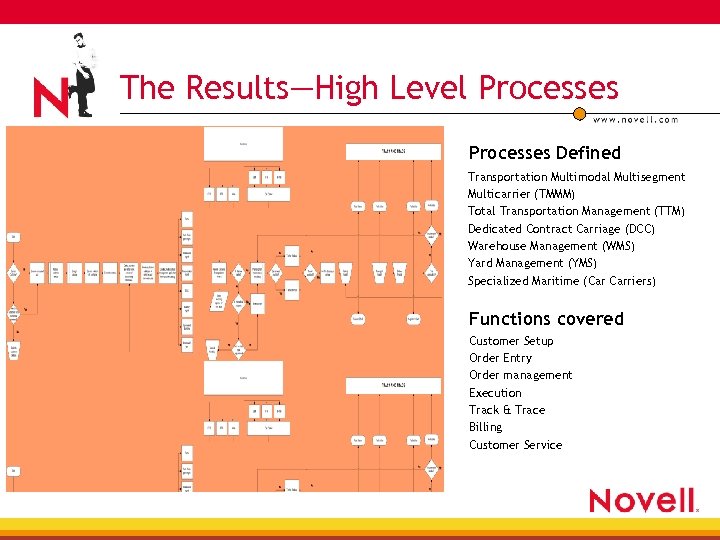 The Results—High Level Processes Defined Transportation Multimodal Multisegment Multicarrier (TMMM) Total Transportation Management (TTM) Dedicated Contract Carriage (DCC) Warehouse Management (WMS) Yard Management (YMS) Specialized Maritime (Car Carriers) Functions covered Customer Setup Order Entry Order management Execution Track & Trace Billing Customer Service
 Technical Architecture Track Process and Activities • Facilitated sessions, between Client X Logistics And Novell, led to: 4 4 4 4 Definition of the logical technical architecture Definition of the physical technical architecture Inventory of system interfaces Definition of design, development, test and production environment infrastructure requirements Definition of the technology package requirements of the systems involved(specifically EAI Tools) Technology package recommendations (short list of up to three (3) packages) Short list of ISP and managed hosting services vendors (up to three (3))
 High Level Architecture View What Is an e. Business Enterprise Architecture? • The “Blueprint” for building value-added business applications that enable the delivery of e. Business services to customers, partners, suppliers, and employees • Provides the foundation of Core Services and processes to extend the enterprise as determined by true business value • These processes are both inter-company and intra-company, and can leverage the information collected from any application or system • The goal of an e. Business Enterprise Architecture is to create the optimal environment for the support of a company’s competitive advantage
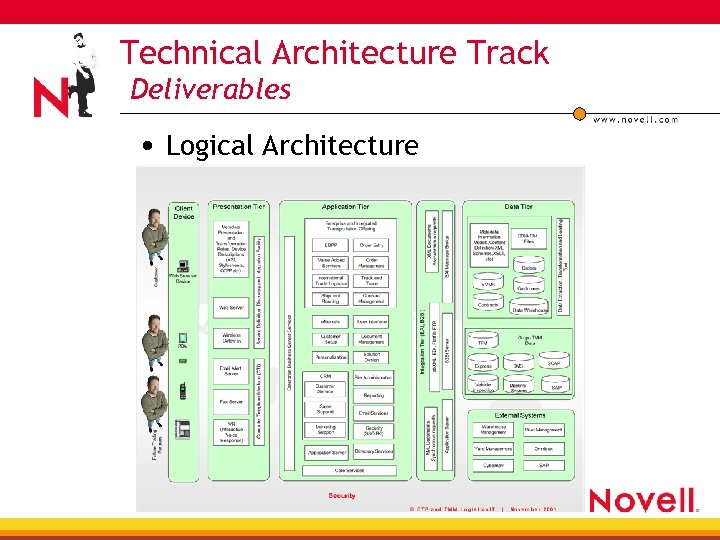 Technical Architecture Track Deliverables • Logical Architecture
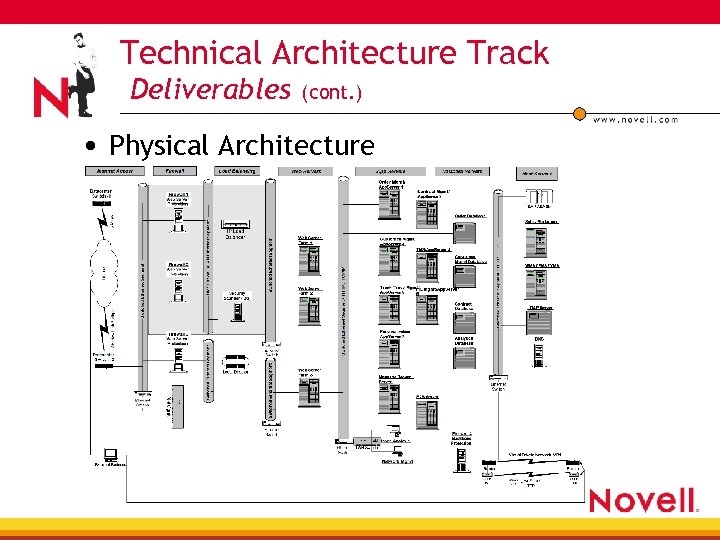 Technical Architecture Track Deliverables (cont. ) • Physical Architecture
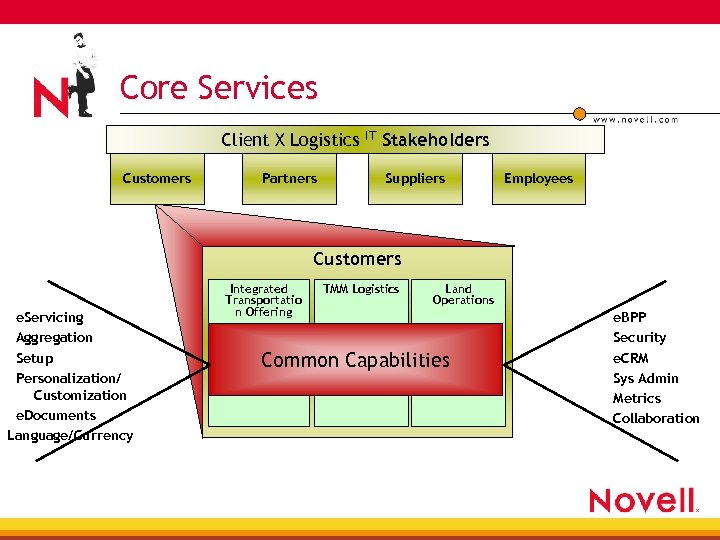 Core Services Client X Logistics Customers Partners IT Stakeholders Suppliers Employees Customers e. Servicing Aggregation Setup Personalization/ Customization e. Documents Language/Currency Integrated Transportatio n Offering TMM Logistics Land Operations Common Capabilities e. BPP Security e. CRM Sys Admin Metrics Collaboration
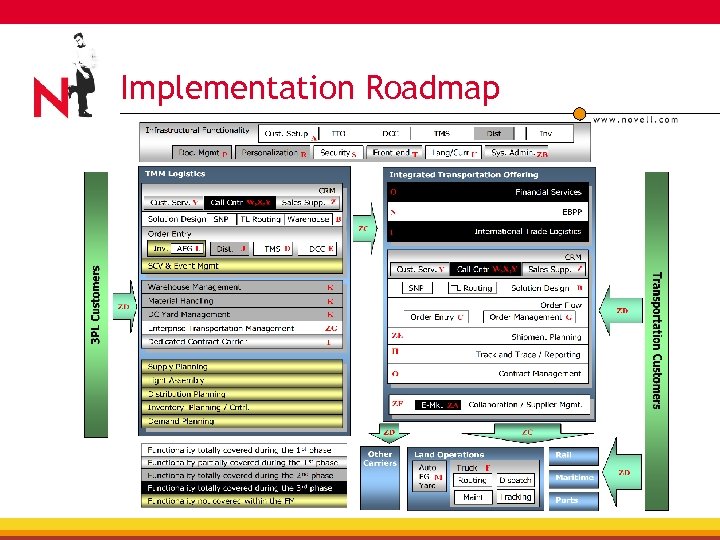 Implementation Roadmap
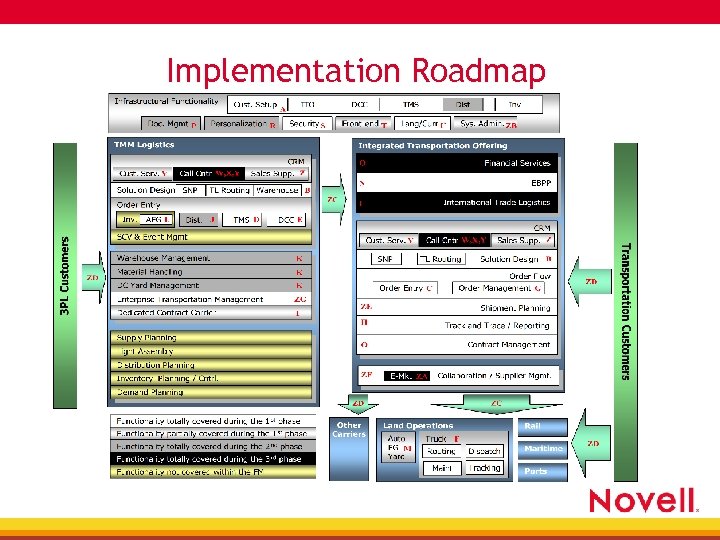 Implementation Roadmap
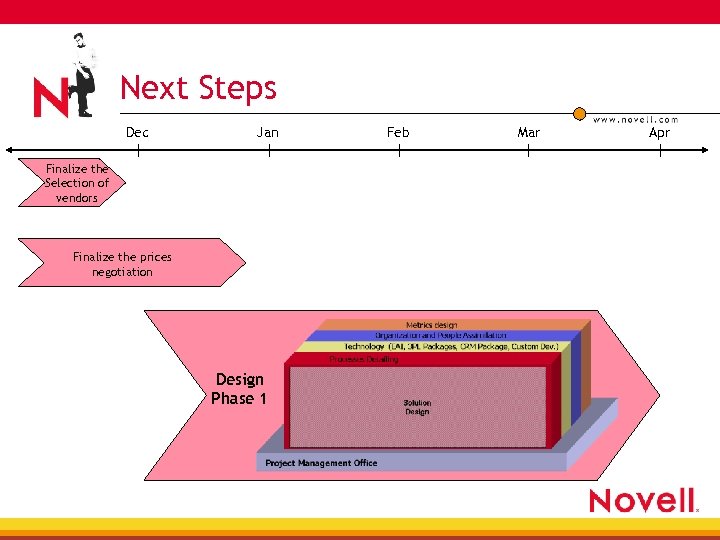 Next Steps Dec Jan Finalize the Selection of vendors Finalize the prices negotiation Design Phase 1 Feb Mar Apr
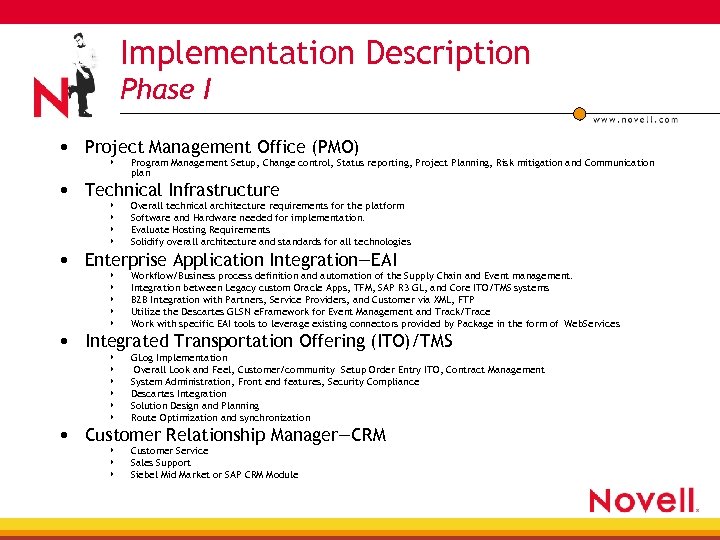 Implementation Description Phase I • Project Management Office (PMO) 4 Program Management Setup, Change control, Status reporting, Project Planning, Risk mitigation and Communication plan • Technical Infrastructure 4 4 Overall technical architecture requirements for the platform Software and Hardware needed for implementation. Evaluate Hosting Requirements Solidify overall architecture and standards for all technologies 4 4 4 Workflow/Business process definition and automation of the Supply Chain and Event management. Integration between Legacy custom Oracle Apps, TFM, SAP R 3 GL, and Core ITO/TMS systems B 2 B Integration with Partners, Service Providers, and Customer via XML, FTP Utilize the Descartes GLSN e. Framework for Event Management and Track/Trace Work with specific EAI tools to leverage existing connectors provided by Package in the form of Web. Services 4 4 4 GLog Implementation Overall Look and Feel, Customer/community Setup Order Entry ITO, Contract Management System Administration, Front end features, Security Compliance Descartes Integration Solution Design and Planning Route Optimization and synchronization 4 4 4 Customer Service Sales Support Siebel Mid Market or SAP CRM Module • Enterprise Application Integration—EAI • Integrated Transportation Offering (ITO)/TMS • Customer Relationship Manager—CRM
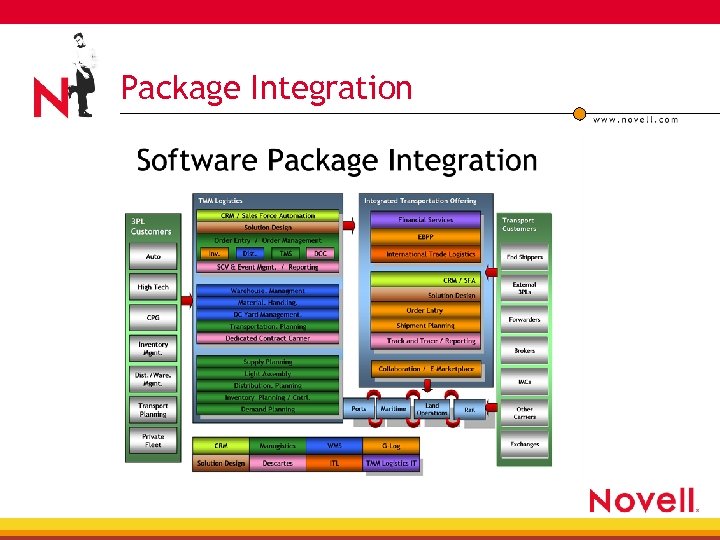 Package Integration
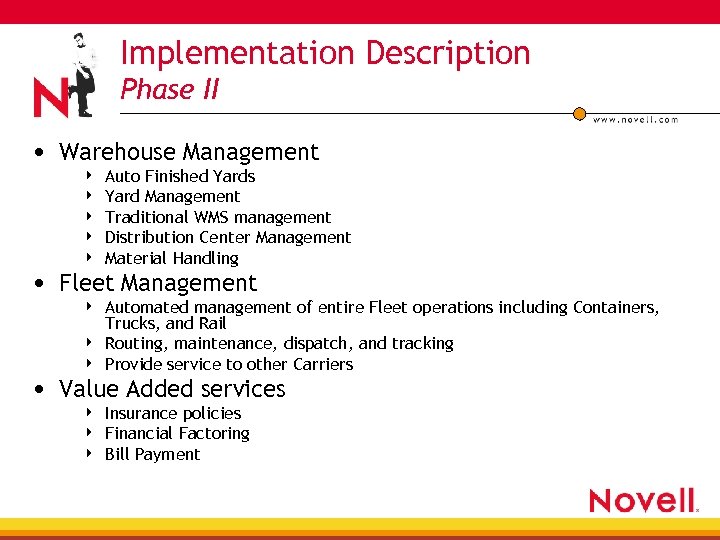 Implementation Description Phase II • Warehouse Management 4 4 4 Auto Finished Yards Yard Management Traditional WMS management Distribution Center Management Material Handling • Fleet Management 4 4 4 Automated management of entire Fleet operations including Containers, Trucks, and Rail Routing, maintenance, dispatch, and tracking Provide service to other Carriers • Value Added services 4 4 4 Insurance policies Financial Factoring Bill Payment
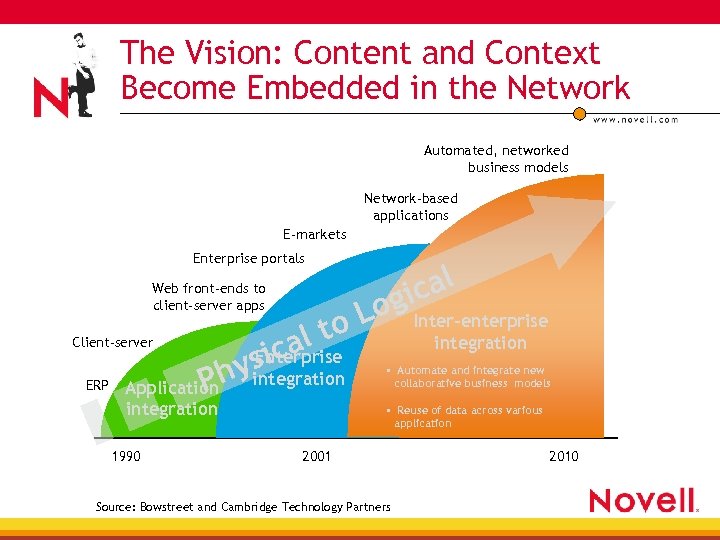 The Vision: Content and Context Become Embedded in the Network Automated, networked business models Network-based applications E-markets Enterprise portals Web front-ends to client-server apps cal ysi Client-server ERP Ph Application Lo to Enterprise integration 1990 cal gi Inter-enterprise integration • Automate and integrate new collaborative business models • Reuse of data across various application 2001 Source: Bowstreet and Cambridge Technology Partners 2010