


 Скачать презентацию Utility Payment Conference Duke Energy s Click to edit
126a4781d9f2f0460c24cddff1d1116b.ppt
- Количество слайдов: 9
 Utility Payment Conference Duke Energy’s Click to edit Master Payment title style Strategy Jeff Hill Senior Business Operations Analyst October, 2009 1
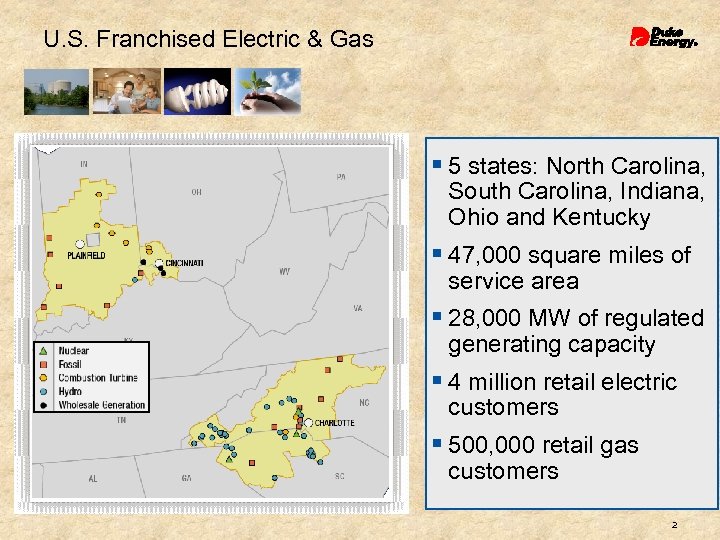 U. S. Franchised Electric & Gas § 5 states: North Carolina, South Carolina, Indiana, Ohio and Kentucky § 47, 000 square miles of service area § 28, 000 MW of regulated generating capacity § 4 million retail electric customers § 500, 000 retail gas customers 2
 History of Duke’s Walk In Payment Processing § Since 1988, Duke has used an on-line cash system for real time (or pending) payment posting. Real time payment information is vital for debt management activities and customer satisfaction. § Several upgrades via in-house developed systems (i. e. automatic reconnect orders). § Late 2007, RFP sent out to vendors and Global Express selected as vendor for Duke’s SE pay agent network. 3
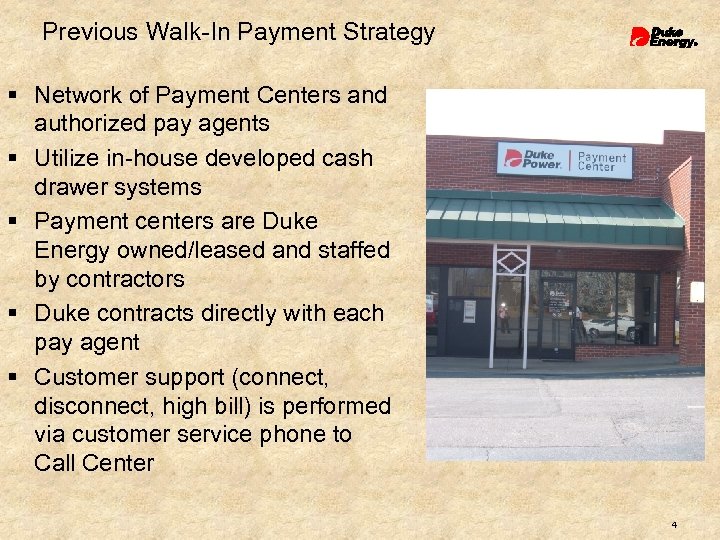 Previous Walk-In Payment Strategy § Network of Payment Centers and authorized pay agents § Utilize in-house developed cash drawer systems § Payment centers are Duke Energy owned/leased and staffed by contractors § Duke contracts directly with each pay agent § Customer support (connect, disconnect, high bill) is performed via customer service phone to Call Center 4
 Current Walk-In Payment Strategy § Move away from Duke supported infrastructure (i. e. workstations, broadband, banking, and support) § Utilize network of vendor managed pay agents § Evaluate existing Payment Centers and add vendor managed pay agents to provide customers additional options or potentially move to all vendor pay agents when timing is right 5
 CPI – Common Payment Interface § A web service enabling 2 -way communication between Duke and our various pay channels. § Search capabilities for various pay channels. For example, pay agents can search by customer name, address or phone number to locate a customer’s account without a bill stub. § More information provided to the pay channel for customer’s benefit, i. e. balance owed (current and past due), disconnect date and amount to avoid disconnect. Helps optimize self-service channels for customers and provides consistency across all channels. § Communication back to pay channel so customer is aware of what action will take place. For pay agents, messaging is printed on the receipt such as “Disconnect Stopped”. § Provides common channel to route all information flowing between Duke and its payment vendors (pay agent, IVR/Phone, e-Bill). § Enables future adoption of new payment methods (kiosks, cell phone, etc. ) and is scalable for new acquisitions or mergers. 6
 Customer Benefits of CPI § Immediate recognition of payment such that correct account balances will be recognized and quoted by the IVR and WEB § Immediately stops disconnection or issues a reconnect where feasible, reducing disconnects in error § No manual intervention -- eliminates the need for a customer to call back and supports Duke’s efforts for first call resolution § Builds customer confidence that credit actions are taken care of properly based on confirmation messages § Customers will have access to multiple self-service channels to obtain current account information and make payments (i. e. IVR, WEB, e-Bill) 7
 Future Strategy § More choices/options for customer convenience § Push to lower cost channels and self service models § Evaluate remaining Payment Centers § Expansion of pay agent network § Evaluate kiosk approach that would integrate real time payments via CPI 8
 Questions? Speaker Information: Jeff Hill Senior Business Operations Analyst 704 -382 -5993 jeffrey. hill@duke-energy. com 9